
Fertilizer Spreader Market Size and Share
Market Overview
| Study Period | 2021 - 2031 |
|---|---|
| Market Size (2026) | USD 4.33 Billion |
| Market Size (2031) | USD 5.72 Billion |
| Growth Rate (2026 - 2031) | 5.72 % |
| Fastest Growing Market | Asia Pacific |
| Largest Market | Europe |
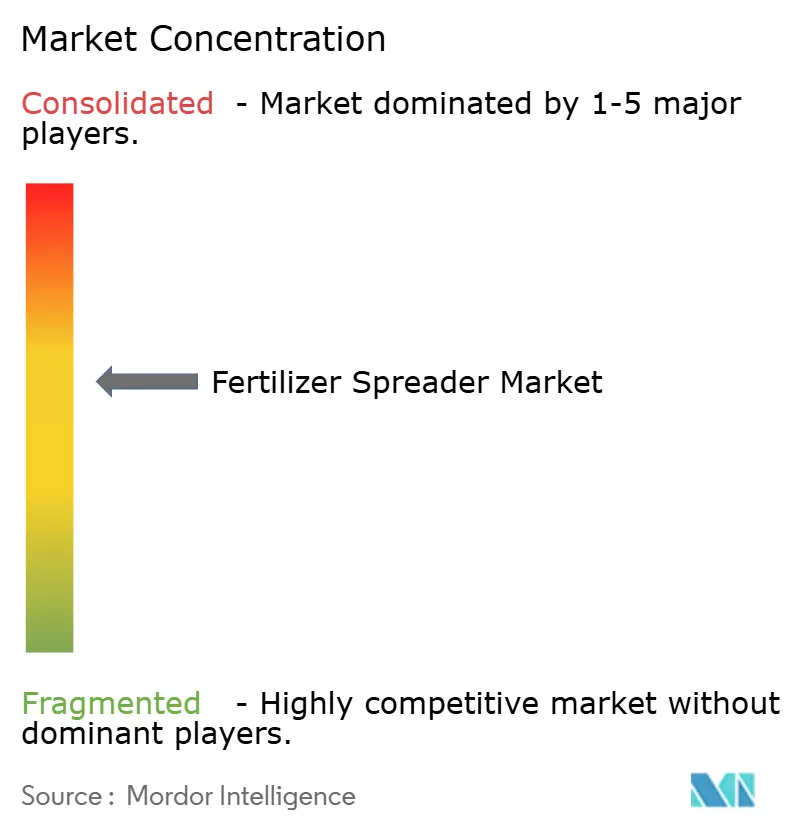
| Market Concentration | Medium |
Major Players
*Disclaimer: Major Players sorted in no particular order Image © Mordor Intelligence. Reuse requires attribution under CC BY 4.0. |
|
Fertilizer Spreader Market Analysis by Mordor Intelligence
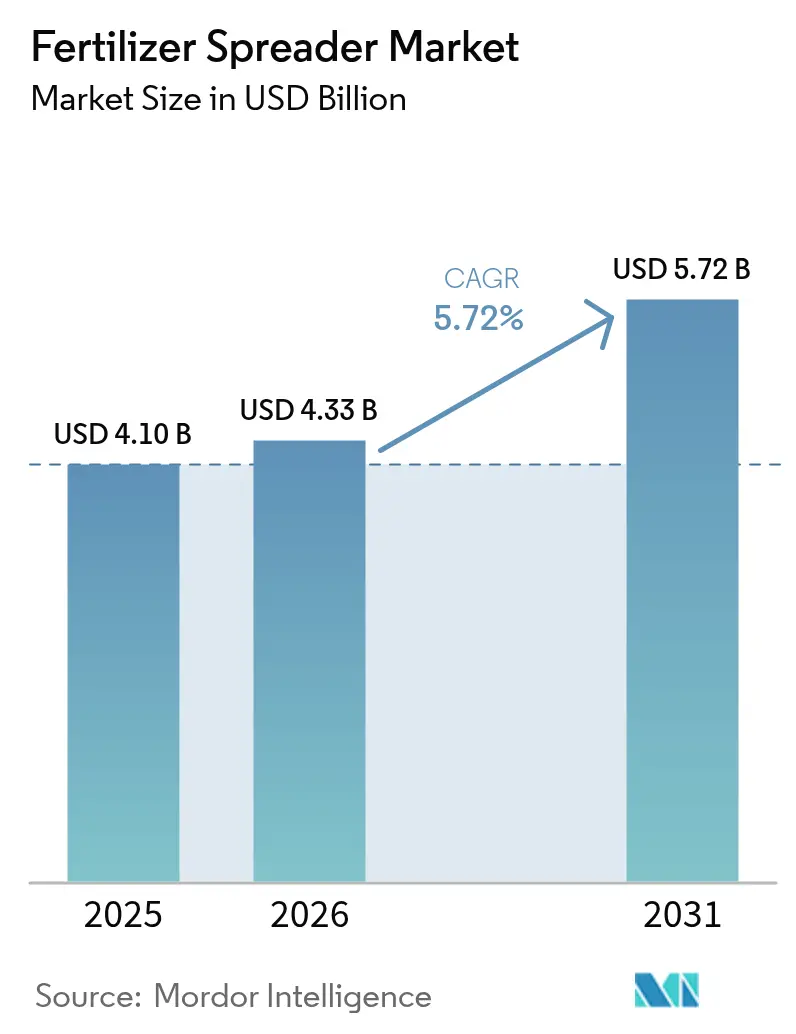
The fertilizer spreader market size was valued at USD 4.1 billion in 2025 and estimated to grow from USD 4.33 billion in 2026 to reach USD 5.72 billion by 2031, at a CAGR of 5.72% during the forecast period (2026-2031). Evolving precision-farming practices, acute labor shortages, and tightening environmental regulations are compelling growers to replace or upgrade conventional equipment with GPS-enabled variable-rate machines. Rotary spinner designs still dominate large-acreage grain production because of their wide swath coverage, yet pneumatic airflow systems are gaining traction where uniformity and multi-nutrient accuracy drive yield. Subsidy programs in North America and Europe are shortening payback cycles for high-specification spreaders, and digital sales channels are unlocking new routes to market for smaller brands. Meanwhile, rising demand for granular micronutrient blends and in-season liquid fertilization is widening the product mix that manufacturers must support.
Key Report Takeaways
- By machinery type, rotary/spinner equipment led with 45.40% revenue share in 2025, while pneumatic airflow systems are projected to expand at a 9.18% CAGR through 2031.
- By 2025, conventional non-GPS configurations held a 71.20% market share of the fertilizer spreader market, whereas precision/GPS-guided variants were growing at a 10.52% CAGR to 2031.
- By drive mechanism, PTO-driven mounted spreaders accounted for 37.50% of the fertilizer spreader market size in 2025, while self-propelled units registered the fastest pace at 9.92% CAGR.
- By fertilizer form, granular products captured 77.40% of demand in 2025, with liquid formulations advancing at an 7.88% CAGR.
- By end-use application, row-crop farms accounted for a 66.20% share of the fertilizer spreader market size in 2025, while the specialty/horticulture segment is projected to rise at a 7.55% CAGR.
- By sales channel, dealer/distributor storefronts retained a 70.30% share in 2025, yet the online segment is accelerating at a 10.78% CAGR.
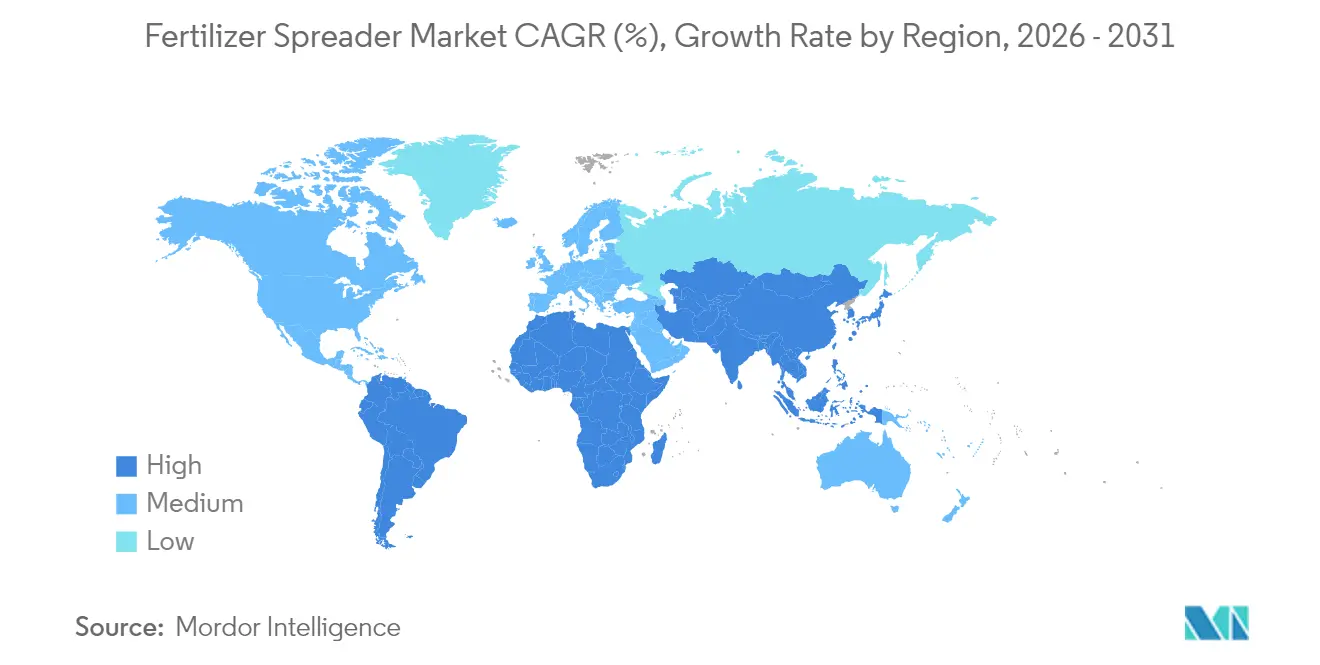
- By region, Europe commanded 28.70% revenue share during 2025, whereas Asia-Pacific shows the steepest climb at 7.45% CAGR.
Note: Market size and forecast figures in this report are generated using Mordor Intelligence’s proprietary estimation framework, updated with the latest available data and insights as of 2026.
Market Trends and Insights
Drivers Impact Analysis of Fertilizer Spreader Market*
| Driver | (~) % Impact on CAGR Forecast | Geographic Relevance | Impact Timeline |
|---|---|---|---|
| Rising global calorie demand and arable-land scarcity | +1.2% | Global, Asia-Pacific, Sub-Saharan Africa | Long term (≥ 4 years) |
| Shortage and the rising cost of agricultural labor stimulate mechanization | +1.8% | North America and Europe core, South America | Medium term (2-4 years) |
| Subsidy programmes for precision-fertilizer equipment | +0.9% | Europe, North America, select Asia-Pacific markets | Short term (≤ 2 years) |
| Adoption of variable-rate technology (VRT) for fertilizer | +1.4% | Global, led by developed markets | Medium term (2-4 years) |
| Shift to granular micronutrient blends requiring high-accuracy spread | +0.7% | Global, high-value crop regions | Long term (≥ 4 years) |
| The surge of carbon credit schemes rewarding optimized nutrient use | +0.5% | North America, Europe, emerging Asia-Pacific | Long term (≥ 4 years) |
| Source: Mordor Intelligence | |||
Rising Global Calorie Demand and Arable-Land Scarcity
Steady population growth and changing diets are driving the rising expectations for increased yield per acre. Due to the limited land expansion potential, uniform nutrient placement through advanced airflow machines is becoming increasingly critical for high-value crops. Variable-rate spreaders that sync with soil-mapping platforms enable growers to fine-tune applications, maximizing output from existing hectares. These capabilities support export-oriented producers in the Asia-Pacific and Africa, trying to lift productivity without aggravating soil degradation. Manufacturers that can prove a aiming to boost productivity without exacerbating field-level return on investment are well-positioned to ride this secular demand wave.
Shortage and the Rising Cost of Agricultural Labour Stimulate Mechanization
Farm operations in North America and Western Europe are facing double-digit wage inflation and persistent labor shortages. Self-propelled spreaders reduce crew requirements and can finish multi-field routes before weather windows close, turning labor scarcity into a catalyst for adoption. GPS autosteer and blockage sensors enable less-experienced drivers to achieve overlap accuracy comparable to that of skilled operators, thereby mitigating the talent bottleneck. South American growers confronting seasonal labor migration trends are also adopting higher-capacity PTO units to maintain throughput. Equipment suppliers that bundle remote diagnostics and operator training stand to capture additional service revenue.
Subsidy Programmes for Precision-Fertilizer Equipment
Canadian, British, and European Union grant schemes cover 30-50% of the purchase costs for variable-rate spreaders, rapidly tipping the cost-benefit analysis in favor of higher-spec models. Canada’s Agricultural Clean Technology program offers non-repayable contributions of up to CAD 2 million (USD 1.4 million) for greenhouse-gas-reducing machinery, explicitly listing precision fertilizer applicators as eligible[1]Source: "Agricultural Clean Technology Program," Agriculture and Agri-Food Canada, agriculture.canada.ca. In the United Kingdom, DEFRA’s Technology Fund earmarked £31 million (approximately USD 40 million) in 2024 for equipment that reduces nutrient and pesticide losses. Early farm-gate data indicate that grantees shorten spreader payback periods by 18-24 months compared to non-supported purchases[2]Source: "Farming Equipment and Technology Fund," Department for Environment, Food & Rural Affairs, gov.uk .
Adoption of Variable-Rate Technology (VRT) for Fertilizer
As sensor prices fall and agronomic data proliferate, growers are shifting from simple sectional control to zone-specific nutrient scripts generated from yield maps and soil conductivity scans. Purdue University field trials show VRT cuts fertilizer use by 7-12% while sustaining yields, improving gross margins on both arable and specialty crops. Cloud connectivity lets operators upload as-applied maps that satisfy regulatory audits and carbon credit verification. Dealers report retrofit VRT controllers as a high-growth aftermarket niche because they upgrade legacy spreaders at a modest cost[3]Source: "Precision Agriculture and Fertilizer Efficiency," Purdue University, docs.lib.purdue.edu.
Restraints Impact Analysis of Fertilizer Spreader Market*
| Restraint | (~) % Impact on CAGR Forecast | Geographic Relevance | Impact Timeline |
|---|---|---|---|
| High upfront cost vs. conventional broadcast methods | -1.6% | Global, acute in developing markets | Short term (≤ 2 years) |
| Low farmer awareness in smallholder economies | -0.8% | Sub-Saharan Africa, South Asia, and parts of South America | Medium term (2-4 years) |
| Fragmented after-sales and calibration service networks | -0.6% | Rural areas globally, pronounced in emerging markets | Medium term (2-4 years) |
| Sensitivity to fertilizer price volatility and farm income swings | -0.9% | Global, particularly commodity-dependent regions | Short term (≤ 2 years) |
| Source: Mordor Intelligence | |||
High Upfront Cost vs. Conventional Broadcast Methods
Price tags on advanced spreaders range from USD 25,000 to USD 200,000, a hurdle for small and medium farms operating on thin margins. Credit access is uneven across emerging economies, so growers prioritize near-term liquidity over multi-year efficiency gains. Equipment-as-a-service models that charge per-hectare usage and retrofit VRT kits targeting legacy spinners are gaining popularity as bridge solutions. OEMs are experimenting with subscription packages bundling hardware, software updates, and agronomic advice to flatten capital spikes and widen market reach.
Low Farmer Awareness in Smallholder Economies
Information gaps on calibration, data interpretation, and economic payback slow precision spreader uptake across smallholder regions. Limited extension capacity and scant local demonstrations leave growers unconvinced that digital prescriptions will work on variable tropical soils. Studies show that peer-to-peer trial plots and mobile-based advisory services sharply improve adoption intent among smallholders once yield benefits are visualized. Dealer networks partnering with NGOs and agritech start-ups are piloting group-purchase schemes and shared-ownership models to mitigate financial and knowledge barriers.
*Our forecasts treat driver/restraint impacts as directional, not additive. The impact forecasts reflect baseline growth, mix effects, and variable interactions.
Fertilizer Spreader Market Segment Analysis
By Machinery Type:
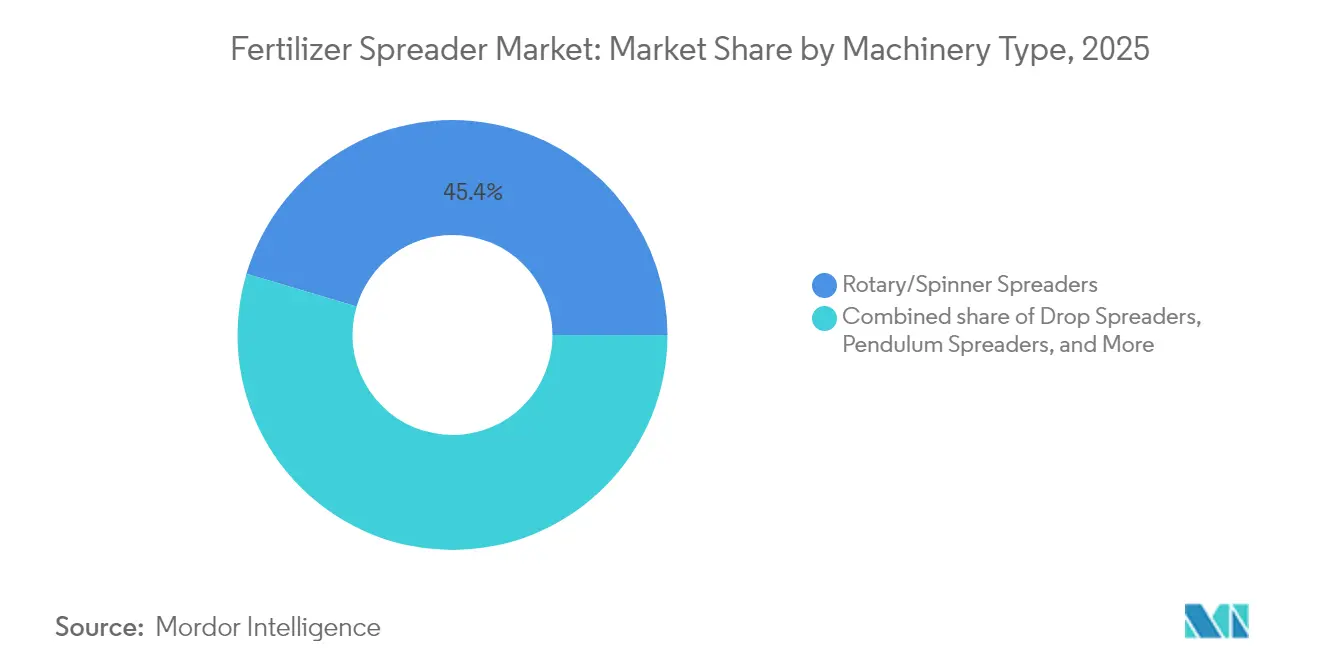
Pneumatic Systems Gain TractionThe fertilizer spreader market size for rotary/spinner units reached a substantial scale in 2025, accounting for 45.40% of global sales, as large-acreage grain farms value wide coverage and low operating costs. Pneumatic airflow designs, although currently smaller in volume, are expanding at a 9.18% CAGR because airflow paths deliver an even distribution of multi-density blends, which are critical for vegetables, orchards, and seed crops.
Airflow spreaders also support controlled-release pellets and coated nutrients, preventing particle segregation and positioning them as the technology of choice for premium-priced input programs. In regions with frequent wind events, their enclosed boom design minimizes drift, aligning with tightening buffer-zone regulations. Manufacturers investing in boom length optimization and hydraulic fan drive efficiency anticipate a continued share gain as input suppliers broaden granular micronutrient offerings. Activated-carbon-lined drop hoppers and corrosion-resistant alloys are being introduced to extend machine life, a key purchasing consideration given the rising capital costs in the fertilizer spreader market.


By Technology:
Precision Systems Drive InnovationConventional non-GPS spreaders still occupy 71.20% of the fertilizer spreader market share, reflecting the sheer installed base and the appeal of lower ticket prices in cost-sensitive geographies. Precision/GPS-guided platforms, however, are registering 10.52% CAGR backed by quantifiable input savings and environmental-compliance mandates that require digital record keeping.
VRT prescriptions transmitted over cellular networks let operators alter rates on the go, ensuring nutrient applications match high-resolution soil layers. Leading OEMs are integrating ISOBUS-compatible controllers so that mixed-brand fleets can share maps and machine health data, a capability prized by custom-applicator service providers managing multi-client routes. Augmented-reality calibration tools accessed via smartphones reduce set-up errors, lowering the learning curve that historically deterred upgrades within the fertilizer spreader market.
By Drive Mechanism:
Self-Propelled Units AcceleratePTO-driven mounted designs accounted for 37.50% of the fertilizer spreader market size in 2025 as they allow growers to leverage existing tractors and minimize incremental investment. Yet self-propelled rigs, once perceived as a niche, now post the fastest 9.92% CAGR because they free tractors for other fieldwork and carry larger hoppers that cut refill downtime.
Cab suspension, multi-camera visibility, and 50+ km/h road speeds make these machines attractive for contractors covering dispersed plots. Auto-boom height control maintains uniform throw distance on undulating terrain, a common challenge in South American soy regions. As Tier-4-final engine regulations spread globally, self-propelled OEMs are offering methane-capable or hybrid drivelines to future-proof fleets against evolving emission norms in the fertilizer spreader market.
By Sales Channel:
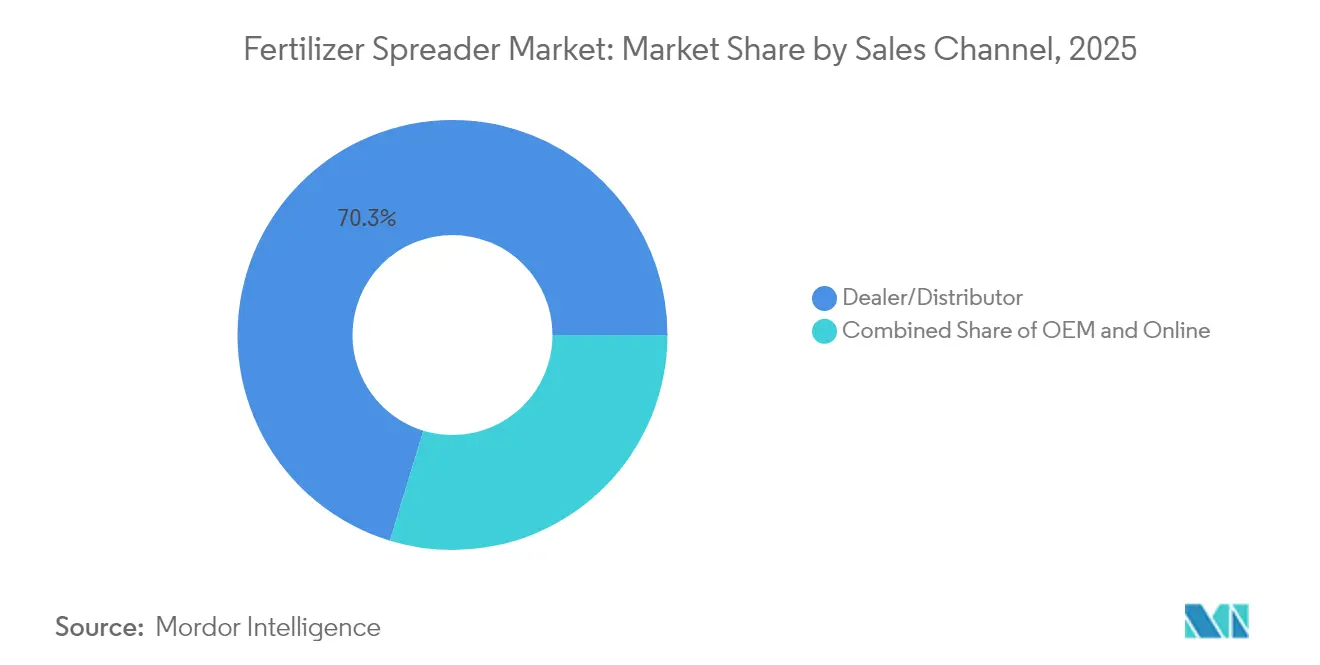
Digital Transformation AcceleratesLegacy dealer storefronts retained a 70.30% channel share in 2025, largely due to their established parts distribution and financing desks, which facilitate the smooth purchase of capital equipment. Yet, online portals are growing at a robust 10.78% CAGR as farmers increasingly compare specs, watch calibration tutorials, and secure quotes online before attending in-person demos.
OEMs are piloting virtual-reality walkarounds and 3D configurators that enable customers to remotely visualize boom options and hopper capacities, thereby shrinking the decision timeline. Manufacturers that integrate their e-commerce platforms with dealer service scheduling are seeing higher customer satisfaction scores than those relying solely on traditional sales processes in the fertilizer spreader market.
By End-Use Application:
Specialty Crops Drive GrowthRow-crop growers accounted for 66.20% of 2025 unit demand, anchoring the market with high-volume purchases timed to tight planting calendars. In contrast, specialty/horticulture operations covering vegetables, berries, and protected-culture crops are climbing a 7.55% CAGR curve by adopting high-accuracy pneumatic or drop technologies that validate premium produce claims.
Specialty producers want sub-5% CV to avoid cosmetic damage and nutrient hotspots that trigger tip burn or blossom-end rot. Many integrate spreader data with greenhouse climate software or irrigation controllers, evidencing how digital ecosystems extend machinery value. This diversification beyond broad access has prompted OEMs to customize smaller hopper sizes and lower-clearance chassis inside the fertilizer spreader market.
By Fertilizer Form:
Liquid Applications ExpandGranular products long dominated due to storage stability and compatibility with legacy machines, owning a 77.40% share in 2025. Liquid formulations are surging at 7.88% CAGR on the back of split-application strategies that sync nutrient delivery with crop demand stages, especially in maize and oilseed rape.
Liquid systems equipped with high-capacity pumps and variable-orifice nozzles apply nitrogen-sulfur blends precisely at tasseling or flowering, boosting uptake while curbing leaching. Tank agitation, corrosion-resistant plumbing, and in-line flow meters are key engineering differentiators as manufacturers chase this opportunity. Extension research in the United States shows that properly calibrated liquid rigs can cut nitrogen loss by 15%, an economic and environmental win that resonates in the fertilizer spreader market.
Geography Analysis
Europe Fertilizer Spreader Market
Europe leads the fertilizer spreader market with a 28.70% share in 2025, reflecting mature precision-agriculture infrastructure and Common Agricultural Policy incentives that subsidize technology adoption. Stringent nitrate directives and watershed protection regulations make variable-rate application a near-requirement for large arable operations. The region's strong dealer networks and established financing channels smooth the path to high-specification machines. Manufacturers targeting this market emphasize software integration with farm management platforms and compatibility with European satellite correction signals that enable sub-meter accuracy.
APAC Fertilizer Spreader Market
The Asia-Pacific region is advancing at a 7.45% CAGR through 2031, the fastest regional growth rate globally. China's policy shift toward reduced fertilizer intensity while maintaining yields creates demand for spreaders that optimize placement efficiency. The government's agricultural modernization program subsidizes mechanization, particularly for cooperatives serving multiple smallholders. India's expanding agrochemical sector, valued at USD 32.4 billion in 2024, signals growing investment capacity for application equipment. Manufacturers are adapting designs for Asian conditions by offering narrower working widths for paddy fields and simplified controls for operators with limited technical training.
The Americas Fertilizer Spreader Market
North America maintains a significant fertilizer spreader market size despite recent headwinds from commodity price volatility and rising equipment costs. Large-scale grain operations value precision technology integration and data management capabilities that align with established digital farming practices. However, AGCO's 15.1% sales decline in Q2 2024 reflects cautious capital spending as farmers prioritize equipment longevity over replacement. Manufacturers are responding with retrofit packages that add variable-rate capability to existing spreaders at lower entry points. South American growth is uneven due to currency fluctuations, though Brazil's expanding soybean acreage drives demand for high-capacity machines that can cover vast plantations during narrow application windows.

Regulatory Landscape
Safety and compliance requirements for fertilizer spreaders are tightening around machinery safety, environmental protection, and digitally enabled controls. In Europe, Regulation (EU) 2023/1230 on machinery (adopted in 2023) replaces the Machinery Directive framework for equipment placed on the market from January 20, 2027, adding emphasis on cybersecurity and rules for substantial modifications. This is likely to affect spreaders with integrated software, connectivity, and automated controls.
Standards activity is also shaping design requirements across solid and liquid application equipment. In June 2026, DIN published DIN EN ISO 4254-6:2026-06 covering safety requirements for sprayers and liquid fertilizer distributors, reinforcing guard, control, and operator-safety expectations relevant to liquid fertilization platforms. In China, JB/T 14870-2024 and DB11/T 2355-2024 introduced technical and operational requirements for organic fertilizer spreaders, including durability and anti-corrosion considerations. In the United States, environmental compliance linked to land application practices (for example, US EPA requirements under 40 CFR 412.4 for manure land application setbacks and buffers) and the US EPA 2026 NPDES Pesticide General Permit (finalized in 2024 and effective October 31, 2026) increase the value of documentation-ready, precision shutoff and geofencing capabilities for applicators operating under stricter discharge and runoff scrutiny.
Competitive Landscape
The fertilizer spreader market exhibits moderate concentration, with the top five manufacturers controlling 61% share in 2025, leaving a sizeable 39% tail served by regional specialists and niche innovators. Deere & Company leads, followed by CNH Industrial and AGCO. Kubota and Rauch round out the top bracket. Scale affords these leaders global dealer coverage and research and development resources. Still, no single brand dominates outright, enabling agile entrants to win market share by solving localized pain points.
Strategic differentiation now hinges on software integration and data connectivity rather than purely mechanical specifications. CNH Industrial’s automated control suite showcased at FIRA USA 2024 reduces fertilizer overlap by up to 10% by adjusting shutter positions in real-time, exemplifying how algorithms deliver tangible input savings. Deere’s Operations Center synchronizes as-applied maps from spreaders with planter prescription files, creating a closed agronomic loop. AGCO’s retrofit kits extend VRT capability to older Rogator platforms, monetizing installed-base relationships while lowering farmer CapEx thresholds.
White-space opportunities cluster in three areas. First, retrofit precision modules for legacy spinner frames answer cost-sensitive grower segments. Second, autonomous spreaders address acute labor shortages in vineyards and specialty crop fields. Third, pared-down precision features priced for emerging economies promise volume gains where full-spec machines remain unaffordable. Because service responsiveness ranks high in buyer surveys, regional manufacturers that bundle fast-moving parts hubs with app-based maintenance scheduling can punch above their weight despite smaller R&D budgets. As the fertilizer spreader market evolves, innovation velocity and post-sale support are poised to shift share faster than the manufacturing scale alone.
Fertilizer Spreader Industry Leaders
-
Deere & Company
-
AGCO Corporation
-
Kubota Corporation
-
Kuhn Group (Bucher Industries)
-
CNH Industrial N.V. (Exor N.V.)
- *Disclaimer: Major Players sorted in no particular order
Fertilizer Spreader Market Companies Covered in this Report
- AGCO Corporation
- CNH Industrial N.V. (Exor N.V.)
- Deere & Company
- Kubota Corporation
- Kuhn Group (Bucher Industries)
- Mahindra & Mahindra Ltd.
- Amazone Werke
- BOGBALLE A/S (Erhvervsinvest)
- Rauch Landmaschinenfabrik
- Salford Group (Linamar Corporation)
- Jacto
- IRIS Spreaders Co., Ltd.
- Adams Fertilizer Equipment (Reppert Capital Partners)
- Teagle Machinery Limited

Market Opportunities and Future Outlook
Product differentiation is moving toward real-time sensing and automation that reduce application variability under changing field and product conditions. In April 2026, Amazone highlighted radar-based automation integrated into fertilizer spreaders, reflecting a push toward closed-loop adjustments that complement weigh cells, wind compensation, and density-change handling. This creates whitespace for OEMs and retrofit providers to package sensors, controllers, and ISOBUS-compatible integration in ways that can be serviced through dealer networks, especially for large installed bases of conventional spinners.
There is also an opportunity in helping growers and dealers operationalize precision spreading where service capacity and adoption remain uneven. The 2026 CropLife and Purdue University Precision Ag Adoption Survey showed a decline in the share of dealers offering variable-rate fertilizer application services, to 78% from a 2020 peak of 89%, pointing to a gap that can be addressed through simpler calibration workflows, remote diagnostics, and turnkey agronomic enablement bundled with equipment. Section control innovations support demand in labor-constrained and specialty segments that need higher uniformity and tighter environmental compliance; for example, Unverferth received an ASABE AE50 Award in February 2026 for its Air Command section control system, underscoring continued OEM investment in precision distribution architectures that reduce overlap and improve placement efficiency across multi-product programs.
Recent Industry Developments in Fertilizer Spreader Market
- April 2026: John Deere detailed new planter technology for model year 2027 that expands integrated fertilizer placement capabilities, including dual-product configurations aligned with ExactShot and ExactRate nutrient delivery. Although centered on planters, the upgrade reinforces OEM momentum toward factory-integrated, data-driven nutrient application systems that compete with or complement standalone spreader workflows. It also raises the bar for interoperability with digital platforms that manage prescriptions and as-applied documentation.
- December 2025: Kubota highlighted Tractor Implement Management (TIM) support for its DSX-W GEOSPREAD spreaders to automate tractor-implement functions and maintain spreading precision. TIM-enabled automation strengthens the case for ISOBUS-based integration and reduces operator workload, which is critical for contractors and farms facing labor constraints. The feature also supports a premium option ladder that encourages upgrades from conventional, manually calibrated spreaders.
- September 2025: AGCO launched next-generation Air Max Precision F1 and F2 spreaders for TerraGator models, adding larger boom options (including 90-foot) and expanded section control features. The update targets higher-capacity, fewer-pass application for large-acreage operations while tightening overlap management to reduce input waste. It also signals continued investment in self-propelled and high-throughput platforms where precision control is becoming a primary buying criterion.


Fertilizer Spreader Market Report Scope and Research Methodology
Market Definition and Coverage
For this study, the fertilizer spreader market covers the sale of equipment used to apply granular or liquid fertilizer at controlled rates across farms and managed land, measured in manufacturer and channel revenues.
Scope exclusions: Excludes aerial or drone application services, stand-alone rate-control electronics sold separately, and spare parts sold on their own.
Segments Covered in This Report
-
By Machinery Type
- Drop Spreaders
- Rotary/Spinner Spreaders
- Pendulum Spreaders
- Air-Flo/Pneumatic Spreaders
- Liquid Fertilizer Sprayers
-
By Technology
- Conventional
- Precision/GPS-guided
- Autonomous/Robotics-enabled
-
By Drive Mechanism
- PTO-driven Mounted
- Trailed
- Self-propelled
- Walk-behind/Manual
-
By Fertilizer Form
- Granular
- Powdered
- Liquid
-
By End-use Application
- Row-crop Farms
- Specialty/Horticulture
- Turf and Landscaping
- Orchard and Vineyard
-
By Sales Channel
- OEM
- Dealer/Distributor
- Online
-
Geography
-
North America
- United States
- Canada
- Mexico
- Rest of North America
-
South America
- Brazil
- Argentina
- Rest of South America
-
Europe
- Germany
- United Kingdom
- France
- Spain
- Russia
- Rest of Europe
-
Asia-Pacific
- China
- India
- Japan
- South Korea
- Rest of Asia-Pacific
-
Middle East
- Saudi Arabia
- Turkey
- UAE
- Rest of Middle East
-
Africa
- South Africa
- Egypt
- Rest of Africa
-
North America
Data Sources, Market Sizing, and Validation
Desk Research
Desk work started by mapping how fertilizer spreaders are bought and used, and then linking that usage to public signals that can be checked year over year. The research used official agriculture and machinery statistics such as USDA and Eurostat releases, FAOSTAT indicators on crop area and fertilizer use, and UN Comtrade trade flows for relevant equipment categories.
To ground pricing and adoption context, we also reviewed sources like farm mechanization notes from national agriculture ministries, extension publications, and association websites that describe application practices and how buyers select equipment. Company filings, investor presentations, and reputable press were used to cross-check product mix changes and distribution shifts. Paid subscriptions for company financials and news supported consistency checks when public disclosures were limited. These examples are not exhaustive, and additional sources were also consulted to collect data, validate it, and clarify assumptions.
Primary Interviews and Surveys
Primary work focused on speaking with people who see demand and pricing up close, including equipment distributors, dealers, farm operators, and product managers across key agricultural regions. These conversations helped confirm what is counted as a fertilizer spreader sale, how average selling prices move by capacity and automation level, and how replacement cycles change with crop economics and nutrient-runoff regulation requirements.
Distribution of primary research fieldwork respondents
| Company type | Respondent position | Region |
|---|---|---|
| Top tier: 39% | CXOs: 18% | APAC: 43% |
| Mid tier: 40% | Functional/Unit leaders: 23% | EMEA: 37% |
| Smaller Players: 21% | Managers: 59% | Americas: 20% |
Market-Sizing & Forecasting
Sizing begins with a top-down build that reconstructs equipment demand from the active farm base and application needs, and then translates that demand into value using observed price bands. Key inputs include arable land and crop mix shifts, fertilizer application intensity, mechanization and tractor penetration, typical replacement cycles for spreaders, and average selling prices by spreader configuration and capacity.
Once that view is built, results are stress-tested using selective bottom-up approximations, such as dealer and distributor channel checks and sampled volume-by-price calculations for common product classes. Where coverage gaps exist, for example fragmented local brands and private manufacturers, we apply expansion factors that are justified through interview feedback and cross-checks against import trends and farm equipment shipment signals.
For forecasting, scenario analysis is used because the market tracks farm income, fertilizer affordability, and policy on nutrient-runoff impacts. We then translate those drivers into yearly adoption and pricing paths, and we validate that the direction matches what primary respondents expect in their order books and dealer pipelines.
Data Validation & Update Cycle
Validation is done in steps so the final totals stay realistic and traceable. We compare model outputs against independent signals such as trade movements, changes in planted area, and shifts in fertilizer use, and then review outliers before finalizing a number.
If a large variance shows up by region or by year, we re-check assumptions like ASP progression, replacement timing, and the share of liquid versus dry systems. When needed, targeted follow-up conversations are triggered to resolve the mismatch. Reports are refreshed annually, with interim updates when material events occur, and a final pre-delivery review pass is completed so the latest available data is reflected.
Mordor Intelligence's Fertilizer Spreader Market Size Compared With Other Published Estimates
Published market sizes for fertilizer spreaders often do not match because the counting rules are different, even when the titles look the same. The biggest differences usually come from what products are included, which revenue point is used (factory gate versus retail), and how prices are converted across countries and time periods.
Some external figures appear closer to a narrow equipment-only view that leans heavily on trade and a limited set of product types, and they can also mix in years where pricing was unusually soft or strong. In contrast, the spread here is explained by how Mordor Intelligence counts complete spreader equipment sales across major channels. It keeps out stand-alone control electronics, separately sold spares, and application services so the value stays tied to comparable machine revenue.
Benchmark comparison
| Source | Market Size | Gaps in Research Methodology |
|---|---|---|
| Mordor Intelligence | USD 4.10 B (2025) | |
| Global Consultancy A | USD 0.83 B (2025) | Uses a narrower product mapping and tends to anchor on reported trade and a limited set of spreader formats, which can undercount local production and dealer-led sales in large farming markets. |
| Industry Publisher B | USD 2.13 B (2025) | Applies a broader but less consistent pricing build across regions, and may blend adjacent application equipment or mixed-channel pricing, which shifts the value upward without the same exclusion rules for services and add-on electronics. |
The table indicates that scope and pricing mechanics drive most of the spread rather than simple arithmetic differences. By keeping the unit of account consistent (complete spreader equipment) and then checking it against farm activity and channel signals, the final number is easier to explain and to replicate in future updates.


Key Questions Answered in the Report
What CAGR is forecast for the fertilizer spreader market to 2031?
The fertilizer spreader market is projected to grow at a 5.72% CAGR, rising from USD 4.1 billion in 2025 to USD 5.72 billion by 2031.
Which technology segment is expanding the fastest?
Precision/GPS-guided spreaders lead in growth at an 10.52% CAGR because they deliver 12–18% per-hectare cost savings while meeting compliance documentation needs.
Why are pneumatic airflow spreaders gaining popularity?
Airflow machines provide superior distribution uniformity for micronutrient blends and controlled-release pellets, helping high-value crops meet tight coefficient-of-variation targets even under windy conditions.
How concentrated is the competitive landscape?
The top five manufacturers capture 61% share, with Deere & Company, CNH Industrial, and AGCO leading and leaving remaining market for regional and specialized suppliers.
What role do subsidy programs play in adoption?
Grants from Canada, the United Kingdom, and EU member states cover 30–50% of purchase costs, cutting payback periods to about three seasons and accelerating precision-equipment uptake.
Which region holds the highest growth potential?
Asia-Pacific posts the steepest 7.45% CAGR as China and India subsidize mechanization and precision fertilizer practices to boost yields while capping nutrient overuse.
Page last updated on:


 Your data is secure and never sold or shared.


