
Fatty Methyl Ester Sulfonate Market Size and Share
Market Overview
| Study Period | 2020 - 2031 |
|---|---|
| Market Size (2026) | USD 0.89 Billion |
| Market Size (2031) | USD 1.43 Billion |
| Growth Rate (2026 - 2031) | 9.95 % |
| Fastest Growing Market | Asia Pacific |
| Largest Market | Asia Pacific |
| Market Concentration | Medium |
Major Players *Disclaimer: Major Players sorted in no particular order Image © Mordor Intelligence. Reuse requires attribution under CC BY 4.0. | |
Fatty Methyl Ester Sulfonate Market Analysis by Mordor Intelligence
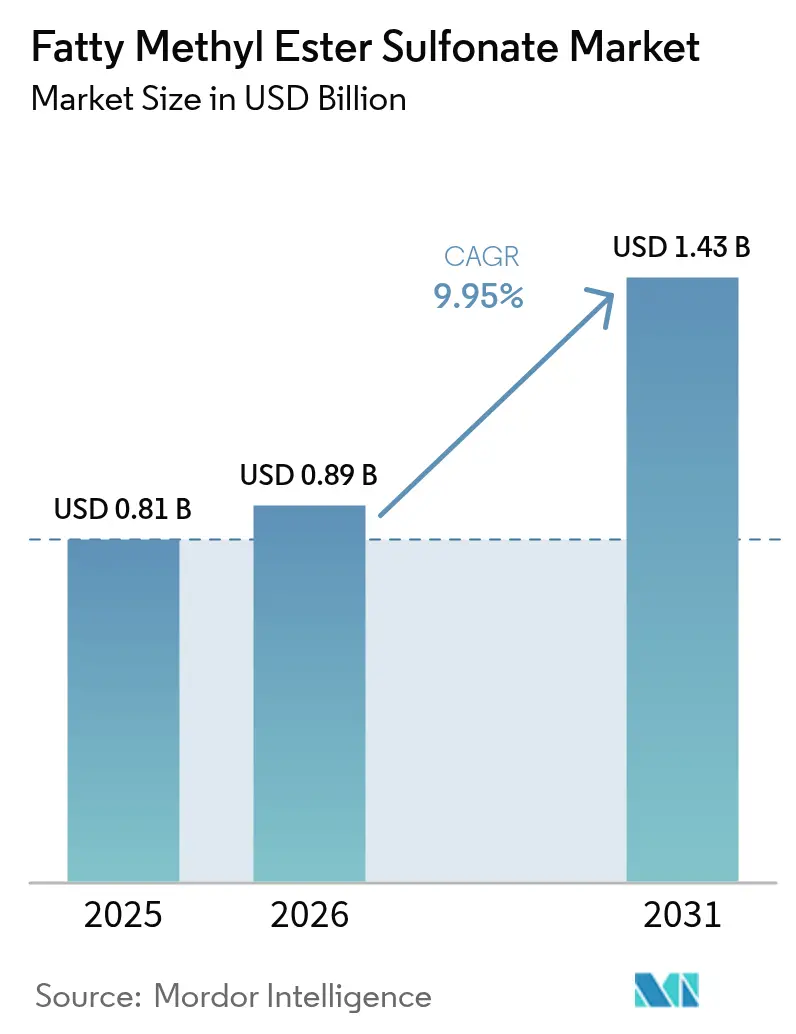
The fatty methyl ester sulfonate market size is expected to grow from USD 0.81 billion in 2025 to USD 0.89 billion in 2026 and is forecast to reach USD 1.43 billion by 2031 at 9.95% CAGR over 2026-2031. This solid growth trajectory mirrors the global pivot toward bio-based surfactants, tighter environmental regulations, and the cost gains delivered by modern oleochemical processes. Ample palm kernel and coconut oil supplies in Southeast Asia, sustained capital expenditure in sulfonation capacity, and the preference for compact detergent formats continue to widen commercial acceptance. The fatty methyl ester sulfonate market now benefits from corporate decarbonization commitments that favor renewable feedstocks, rising premiums for mild and non-irritating ingredients, and certification programs that reward traceable supply chains. Despite feedstock price swings and high entry costs for specialized equipment, sustained demand from both detergents and premium personal-care lines keeps overall sentiment positive
Key Report Takeaways
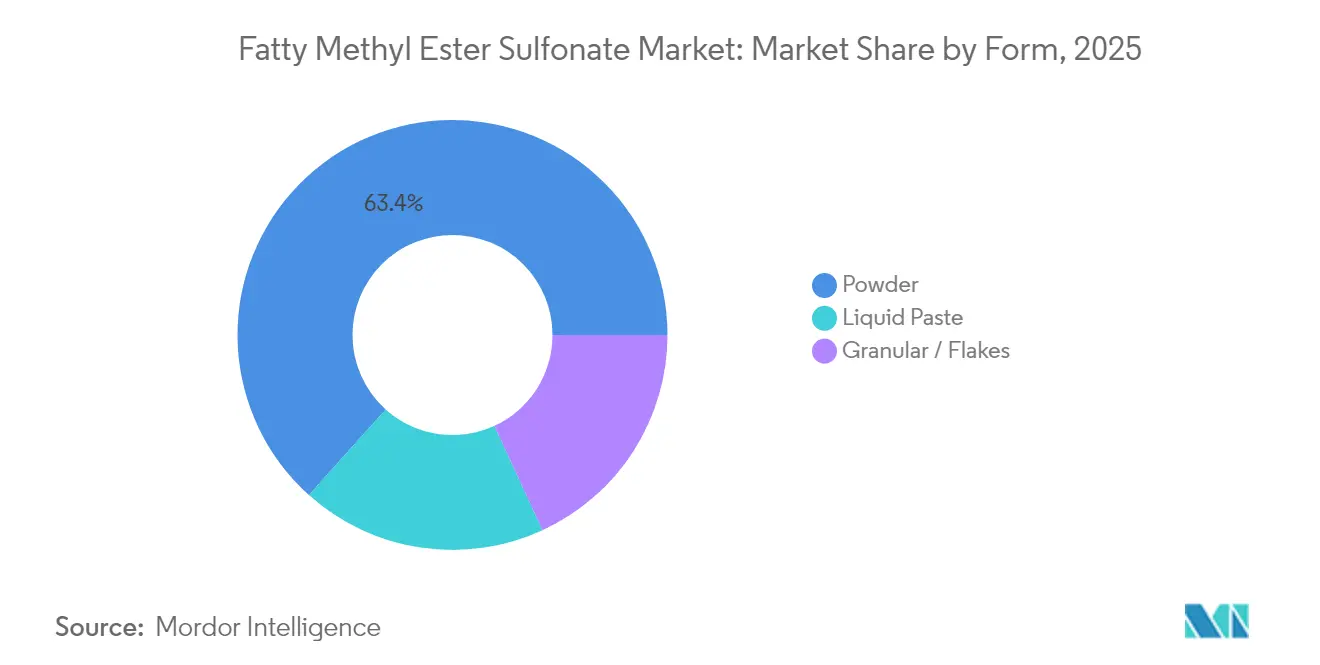
- By form, powder products held 63.36% of the fatty methyl ester sulfonate market share in 2025; liquid paste variants are forecast to register an 10.86% CAGR through 2031.
- By feedstock source, palm-kernel oil commanded 81.68% share of the fatty methyl ester sulfonate market size in 2025; coconut oil is the fastest-growing feedstock at an 11.31% CAGR.
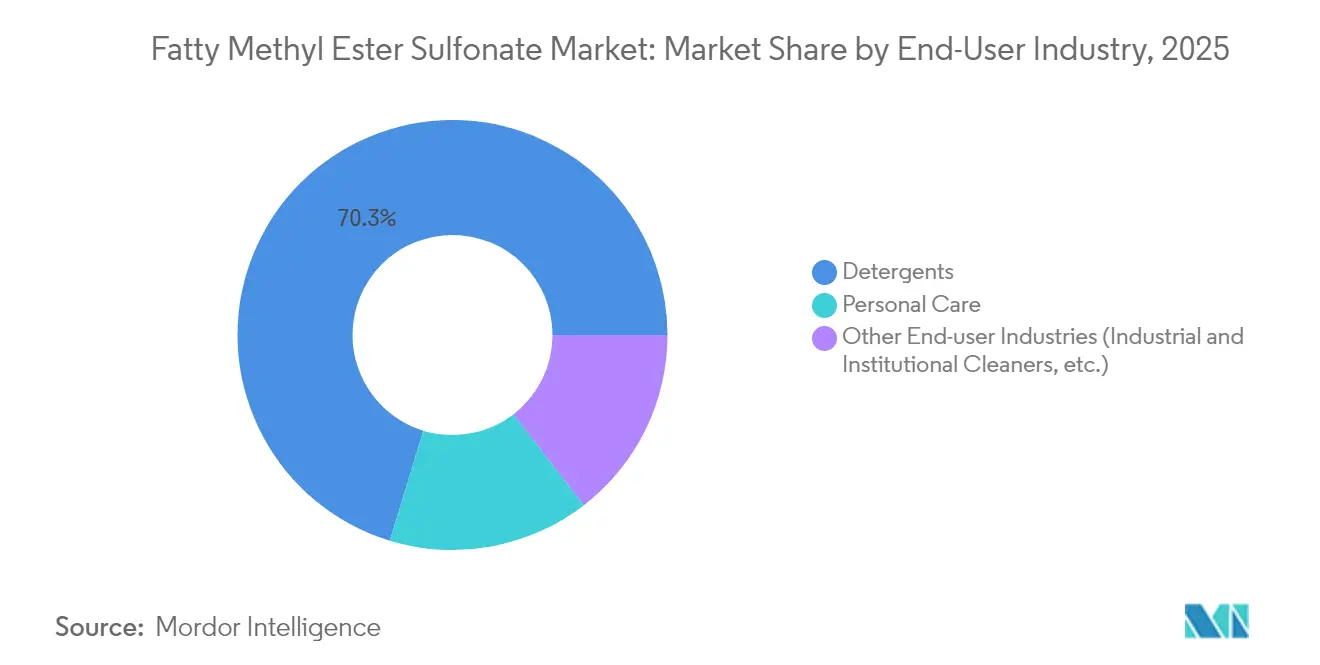
- By end-user industry, detergents led with 70.29% revenue share in 2025, while personal care is projected to expand at an 11.02% CAGR to 2031.
- By geography, Asia-Pacific accounted for 57.26% of 2025 revenues, and the region is set to grow at a 10.82% CAGR toward 2031.
Note: Market size and forecast figures in this report are generated using Mordor Intelligence’s proprietary estimation framework, updated with the latest available data and insights as of 2026.
Market Trends and Insights
Drivers Impact Analysis of Fatty Methyl Ester Sulfonate Market*
| Driver | (~) % Impact on CAGR Forecast | Geographic Relevance | Impact Timeline |
|---|---|---|---|
| Surging demand for bio-based surfactants | +2.8% | Global, with APAC and Europe leading adoption | Medium term (2-4 years) |
| Rapid penetration of premium compact powders | +1.9% | North America & Europe core, expanding to APAC | Short term (≤ 2 years) |
| Growing demand from personal care industry | +2.1% | APAC core, spill-over to North America | Long term (≥ 4 years) |
| Increasing demand for mild and non-irritating surfactants | +1.6% | Global, with premium markets in developed regions | Medium term (2-4 years) |
| Expansion of the cleaning products market | +1.4% | APAC manufacturing hubs, global distribution | Short term (≤ 2 years) |
| Source: Mordor Intelligence | |||
Surging Demand for Bio-Based Surfactants
Switching to bio-based surfactants has moved from niche to mainstream as regulators mandate lower carbon footprints and consumers favor products with renewable content. The renewable chemicals sector, encompassing surfactants, will grow 19.11% annually to 2030, reinforcing downstream appetite for fatty methyl ester sulfonates. Multinationals are expanding biomass-balance approaches; BASF added coco-derived betaine grades to its EcoBalanced line to capture the sustainability premium[1]BASF SE, “EcoBalanced Portfolio Expansion,” basf.com. Institutional efforts such as the EU-funded SurfToGreen program, aiming for surfactants with more than 95% bio-content, further institutionalize demand[2]Circular Bio-based Europe, “SurfToGreen Project Overview,” europa.eu. These mutually reinforcing forces underpin enduring upside for the fatty methyl ester sulfonate market.
Rapid Penetration of Premium Compact Powders
Concentrated laundry formats demand surfactants that maintain high foam in low-volume formulations, where fatty methyl ester sulfonates excel. Manufacturers are pairing FMES with novel eco-enzymes to lift stain removal while lowering wash temperature requirements, thereby shrinking energy use. Consumers increasingly accept higher unit prices in exchange for smaller, lighter packs, which cut transport emissions and align with zero-waste goals. The trend, originating in Europe and North America, is spreading across emerging Asia as retailers push compact lines to optimize shelf space. This widespread adoption reinforces volume growth in the fatty methyl ester sulfonate market
Growing Demand from Personal Care Industry
Personal-care formulators view FMES as a naturally sourced, sulfate-free alternative that delivers gentle cleansing and rapid biodegradation. BASF’s launch of Dehyton PK45, derived from Rainforest Alliance-certified coconut oil, illustrates supplier innovation targeting premium skincare. Asia’s expanding middle class fuels premium hair- and skin-care uptake, with China and India leading consumption gains. Premium price points in these categories offset production cost pressures and support margin expansion across the fatty methyl ester sulfonate market.
Increasing Demand for Mild and Non-Irritating Surfactants
Ingredient-sensitive consumers scrutinize product safety and skin-sensory attributes, elevating mild surfactants such as FMES. The EPA’s Safer Choice Program endorses low-toxicity alternatives, accelerating brand reformulation roadmaps in North America[3]United States Environmental Protection Agency, “Safer Choice Program Criteria,” epa.gov. Parallel R&D in glycolipid hydrotropes, including heptyl glucoside, signals a broader industry push toward skin-friendly cleansing bases[4]American Oil Chemists’ Society, “Heptyl Glucoside as Sustainable Hydrotrope,” aocs.org. Collectively, these developments extend FMES's relevance beyond detergents into household and pet-care lines, deepening penetration of the fatty methyl ester sulfonate market.
Restraints Impact Analysis of Fatty Methyl Ester Sulfonate Market*
| Restraint | (~) % Impact on CAGR Forecast | Geographic Relevance | Impact Timeline |
|---|---|---|---|
| Feedstock price volatility | -1.8% | APAC production hubs, global supply chains | Short term (≤ 2 years) |
| Hydrolysis & viscosity issues in high-water liquid detergents | -0.9% | Global liquid detergent markets, particularly North America & Europe | Medium term (2-4 years) |
| High production costs | -1.4% | Global manufacturing, particularly new entrants | Medium term (2-4 years) |
| Source: Mordor Intelligence | |||
Feedstock Price Volatility
Palm and coconut oil account for nearly two-thirds of total FMES manufacturing cost, so rising prices pressure margins. Indonesia’s B40 biodiesel mandate lifted crude palm oil futures toward MYR 5,000 per tonne in 2025, adding procurement stress for surfactant makers. Coconut oil faces upward pressure as the Philippines warns of tightening global supply while considering export curbs. Climate factors, including El Niño-linked droughts, heighten volatility and complicate long-term feedstock hedging, weighing on the fatty methyl ester sulfonate market.
High Production Costs
FMES plants require specialized sulfonation reactors, corrosion-resistant alloys, and continuous neutralization systems that elevate capital intensity. After multimillion-dollar optimization, Stepan Company reported a 39% EBITDA lift and USD 48 million in annual savings, demonstrating the scale needed to lower unit costs. Smaller entrants often struggle to reach such efficiencies, especially if they must fund compliance upgrades for wastewater, emissions, and worker safety. As a result, new capacity additions remain measured, tempering near-term supply growth in the fatty methyl ester sulfonate market.
*Our forecasts treat driver/restraint impacts as directional, not additive. The impact forecasts reflect baseline growth, mix effects, and variable interactions.
Fatty Methyl Ester Sulfonate Market Segment Analysis
By Form:
Innovation Expands Liquid Paste ProspectsPowder products accounted for 63.36% of the fatty methyl ester sulfonate market size in 2025, a position secured by stability, shelf life, and ease of bulk transport. Spray-drying lines tailored to FMES allow detergent makers to incorporate enzymes without denaturation, protecting performance at high storage temperatures. Yet R&D breakthroughs in rheology control have propelled liquid paste grades to an 10.86% CAGR, challenging powder dominance. New neutralization methods improve hydrolysis resistance, yielding transparent concentrates that let brands market “cold-wash” liquid detergents.
Granular and flake variants serve commercial laundries that require controlled dissolution in tunnel washers, while gel formats appear in car-wash additives demanding high foam retention. Fermentation-derived rhamnolipids introduced by Evonik illustrate how alternative biosurfactant technologies blur traditional form delineations. As process knowledge spreads, manufacturers will likely fine-tune particle size, moisture, and active-content levels to meet niche application needs, cementing form-based competition within the fatty methyl ester sulfonate market.


By Feedstock Source:
Sustainability Reshapes Sourcing StrategiesPalm kernel oil still underpins 81.68% of global FMES output, thanks to robust plantations, reliable fatty-acid profiles, and integrated oleochemical hubs across Malaysia and Indonesia. Mill upgrades under the Malaysian Sustainable Palm Oil 2.0 standard push traceability and greenhouse-gas audits, enabling certified suppliers to capture higher margins. However, coconut oil supply, centered on the Philippines and Indonesia, is expanding at 11.31% annually because brands prize its non-deforestation image and pleasant odor in rinse-off products. Certification programs such as Rainforest Alliance accelerate this shift by rewarding transparent farming practices.
Producers are also trialing soy and tallow methyl esters in regional blends to hedge cost risk and support local agriculture. Unilever’s USD 120 million partnership with Genomatica to develop palm-free surfactant feedstocks exemplifies the strategic push for diversification. In this evolving context, supply-chain resilience and credible certification increasingly determine competitive advantage, anchoring feedstock policy debates in boardrooms linked to the fatty methyl ester sulfonate market.
By End-User Industry:
Volume Stability and Margin UpsideDetergents continue to generate the largest revenue block, holding 70.29% of overall demand in 2025. Compact powder detergents remain central within this anchor segment because FMES delivers high foam and easy rinsing even in low-dosage formats. Enzymatic boosters introduced by top brands further enhance wash performance, reinforcing the position of the fatty methyl ester sulfonate market in mass-market laundry products. Institutional cleaning, covering food-service and health-care sites, values FMES for quick biodegradation and safe-handling credentials that help operators comply with sanitary regulations. In contrast, though smaller by volume, personal-care demand posts the fastest 11.02% CAGR as consumers gravitate to sulfate-free shampoos and mild cleansers that command double-digit price premiums versus traditional surfactants.
Personal-care formulators exploit FMES’s balanced hydrophilic-lipophilic profile to design clear shampoos and creamy facial washes with minimal irritation. Premium brands highlight coconut-derived feedstocks on front-of-pack labeling, adding storytelling value that resonates with eco-conscious buyers. The industrial and institutional cleaning sector leverages FMES in concentrated sanitizers, capitalizing on its compatibility with chlorine-based actives. Collectively, these growth pockets diversify revenue streams and help mitigate cyclical swings in detergent volumes, underscoring the resilience of the fatty methyl ester sulfonate market.
Geography Analysis
APAC Fatty Methyl Ester Sulfonate Market
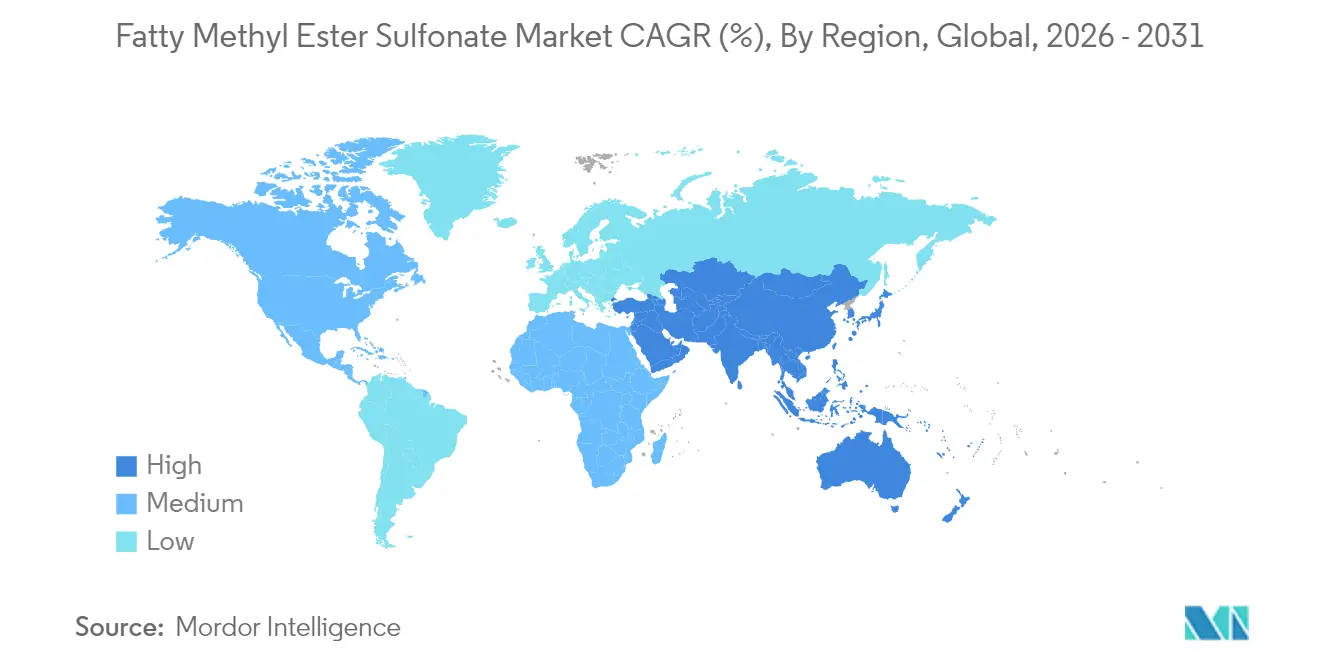
Asia-Pacific held 57.26% of global revenues in 2025 and is advancing at a 10.82% CAGR through 2031. Abundant palm kernel supplies, an installed base of sulfonation towers, and local demand from China’s detergent majors keep utilization rates high. Malaysia and Indonesia continue to refine oleochemical clusters that bundle feedstock, energy, and logistics advantages. KLK’s decision to expand processing capacity in China underscores the region’s dual role as producer and consumer. That proximity reduces freight costs and shortens order-to-delivery cycles, deepening Asia’s competitive moat within the fatty methyl ester sulfonate market.
North America Fatty Methyl Ester Sulfonate Market
North America exhibits slower headline growth yet benefits from regulatory frameworks such as the EPA Safer Choice Program that direct purchasing toward renewable, low-toxicity inputs. Stepan’s new Pasadena, Texas, alkoxylation unit demonstrates a commitment to local capacity as brands seek a secure domestic supply. High consumer willingness to pay for clean-label personal-care products supports added FMES volume despite comparatively higher feedstock costs versus Asia.
Europe Fatty Methyl Ester Sulfonate Market
Europe’s trajectory is shaped by stringent chemical policy reforms, including updated REACH dossiers and the Detergent Regulation revision that tighten biodegradability and labeling rules. Governments invest in circular-bioeconomy initiatives like SurfToGreen to source surfactants from agricultural side-streams, further embedding FMES in regional supply chains. Eastern Europe offers emerging manufacturing bases for export back into the single market, offsetting Western Europe’s higher labor and energy expenses. Together these patterns add depth to the fatty methyl ester sulfonate market while reinforcing the premium commanded by certified, traceable products.

Value Chain Analysis
The fatty methyl ester sulfonate (FMES) value chain starts with upstream oilseed and plantation economics, anchored by palm-kernel oil and coconut oil sourcing that is heavily concentrated in Southeast Asia. These feedstocks move through crushing and refining into lauric oils, then transesterification into fatty-acid methyl esters (FAME). The process continues with sulfonation, neutralization, and finishing into powder, flakes/granules, or paste grades sold to detergent, personal-care, and industrial and institutional (I&I) formulators. Vertically integrated oleochemical groups can cover plants from plantations to oleochemicals and downstream surfactants, while non-integrated FMES producers typically depend on third-party lauric oils or methyl esters and stay more exposed to feedstock and logistics swings.
Midstream processing is capital and know-how intensive, with sulfonation reactors, corrosion-resistant materials, utilities, and effluent treatment shaping cost structure and acting as practical entry barriers. The clearest bottlenecks are (i) access to consistent, traceable palm-kernel and coconut supply and (ii) operational efficiency in continuous processing steps, where energy and utility costs affect unit economics. Downstream distribution is usually split between bulk shipments to detergent manufacturers and specialty packs for personal-care ingredient channels. In these higher-spec applications, color, odor, and mildness requirements tighten quality control and can raise rejection risk without strong process discipline.
Competitive Landscape
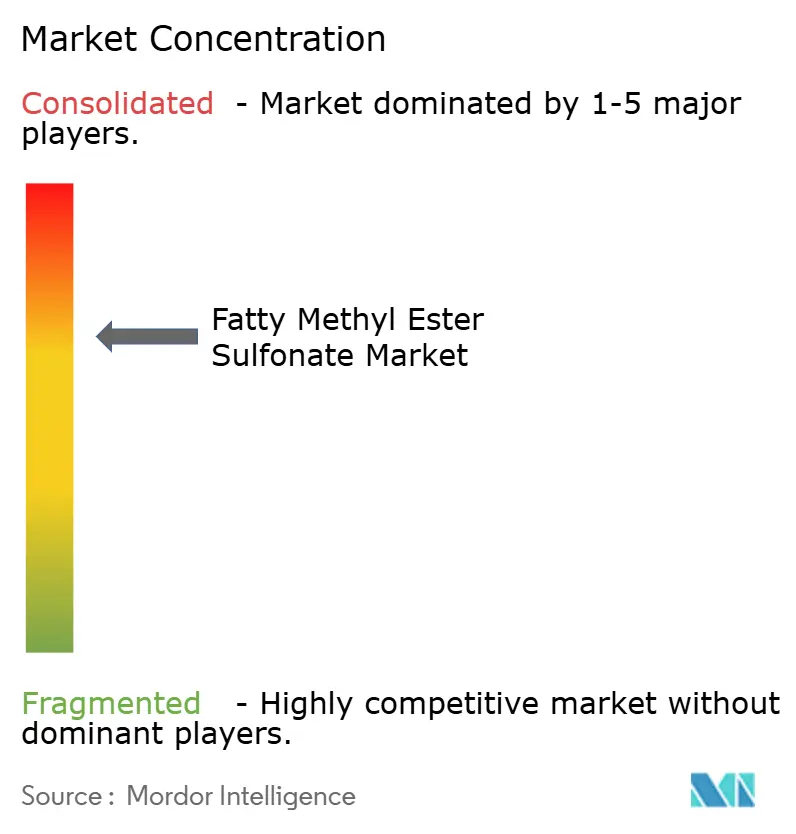
The fatty methyl ester sulfonate market is moderately concentrated. BASF, Stepan Company, KLK Oleo, Wilmar International, and Lion Corporation collectively hold a significant share by combining integrated feedstock assets with proprietary sulfonation know-how. Strategically, leading players double down on sustainability verification, greenhouse-gas accounting, and traceable sourcing to defend price premiums. Digital monitoring of batch quality and predictive maintenance on sulfonation lines lowers downtime and ensures consistent color and active content, key specifications in premium personal-care grades. R&D races center on greener sulfonation chemistry, improved catalyst recovery, and fully palm-free feedstocks, signaling ongoing innovation cycles within the fatty methyl ester sulfonate market.
Fatty Methyl Ester Sulfonate Industry Leaders
Emery Oleochemicals
KLK Oleo
Lion Corporation
Stepan Company
Wilmar International Ltd
- *Disclaimer: Major Players sorted in no particular order
Fatty Methyl Ester Sulfonate Market Companies Covered in this Report
- BASF
- Chemithon Corporation
- Emery Oleochemicals
- FENCHEM
- KLK Oleo
- KPL International Ltd
- Lion Corporation
- PT Ecogreen Oleochemicals
- Sinopec Jinling Petrochemical
- Stepan Company
- Surface Chemical Industry Co Ltd
- Wilmar International Ltd

Market Opportunities and Future Outlook
FMES suppliers have an opening where traceable renewable feedstocks intersect with premium formulations, particularly in compact powders and sulfate-free personal-care products that require both sustainability claims and performance. With palm-kernel oil accounting for 81.68% of 2025 FMES output, offerings built on certified or alternative lauric sources (including coconut-linked certification programs cited by leading suppliers) can support portfolio segmentation by grade, documentation package, and chain-of-custody requirements. In parallel, procurement criteria in North America via the EPA Safer Choice Program and European initiatives supporting high bio-content surfactants, such as the EU-funded SurfToGreen program, reinforce the commercial value of biodegradability and renewable-content documentation.
Manufacturing opportunities focus on de-bottlenecking and reliability upgrades that reduce conversion costs in sulfonation and finishing, given that high production costs and feedstock volatility remain major constraints. At the same time, substitute bio-based surfactants are scaling across detergents and personal care, with Evonik inaugurating a rhamnolipid biosurfactants facility in Slovakia in May 2024. This raises expectations for FMES suppliers around mildness, performance-in-use, and sustainability narratives, and it increases the value of application development such as blends, cold-wash compatibility, and rheology control for liquid paste grades to protect formulation share. There is also whitespace in dual-sourcing and regionalization strategies, since global formulators want to reduce dependence on single-origin lauric supply chains. That supports demand for multi-site production, flexible feedstock recipes where feasible (including other vegetable oils), and technical service that can shorten reformulation cycles.
Recent Industry Developments in Fatty Methyl Ester Sulfonate Market
- June 2026: Stepan Company highlighted its continued investment focus on specialty surfactants and process capability on its corporate updates, reinforcing its positioning in higher-value, performance-driven formulations. This supports downstream customers that require consistent quality and documentation for renewable and mild surfactant systems used in detergents and personal care.
- June 2025: Wilmar International Limited moved to acquire the remaining 50% stake in its Nigerian joint venture, PZ Wilmar, from PZ Cussons plc, taking full control of the business. Greater integration around palm oil-based operations strengthens access to feedstocks that are relevant for oleochemical chains supplying bio-based surfactant intermediates.
- February 2025: KLK Oleo expanded into India with a new representative office in Mumbai, KLK Oleo India (KLKOI), to strengthen local presence for its oleochemical portfolio. The move improves customer access and technical-commercial coverage in a growing detergent and personal-care manufacturing base that consumes bio-based surfactants and their intermediates.


Fatty Methyl Ester Sulfonate Market Report Scope and Research Methodology
Market Definition and Coverage
This market covers fatty methyl ester sulfonate (FMES) sold as an anionic surfactant for cleaning-related uses, counted as manufacturer-level revenue from all key producing regions and traded volumes that reach end users.
Scope exclusions: Petroleum-based alkylbenzene sulfonates and non-sulfonated fatty acid methyl esters are excluded even if they are used in similar detergent formulations.
Segments Covered in This Report
- By Form
- Powder
- Granular / Flakes
- Liquid Paste
- By Feedstock Source
- Palm-kernel Oil
- Coconut Oil
- Other Vegetable Oils (e.g., Tallow, Soy)
- By End-User Industry
- Detergents
- Personal Care
- Other End-User Industries (Industrial and Institutional Cleaners, etc.)
- By Geography
- Asia-Pacific
- China
- India
- Japan
- South Korea
- Rest of Asia-Pacific
- North America
- United States
- Canada
- Mexico
- Europe
- Germany
- United Kingdom
- Italy
- France
- Rest of Europe
- South America
- Brazil
- Argentina
- Rest of South America
- Middle East and Africa
- Saudi Arabia
- South Africa
- Rest of Middle East and Africa
- Asia-Pacific
Data Sources, Market Sizing, and Validation
Desk Research
For the starting structure, we reviewed public datasets that explain how surfactants move through the chemicals and cleaning value chain. Useful anchors came from sources such as UN Comtrade trade statistics, the US International Trade Commission data tools, Eurostat chemical and manufacturing statistics, and FAOSTAT indicators that help contextualize lauric oil availability.
To keep the model realistic, additional desk inputs were taken from company annual reports and investor presentations, customs and port releases cited in reputed press, and technical papers in peer-reviewed journals that describe sulfonation yields and typical form factors (powder, flakes, paste). Where needed, paid subscriptions were used for company financials, patents, and shipment-level import export checks so that capacities and commercial timelines could be cross-verified. The desk sources listed here are illustrative, and many other public materials were also used for collection, validation, and clarification.
Primary Interviews and Surveys
Primary work was used to test what we saw in public data, and then fill gaps that typically sit in pricing, grade mix, and regional adoption. We spoke with producers, distributors, detergent formulators, and procurement and technical roles across APAC, EMEA, and the Americas so that assumptions around demand drivers and supply constraints could be checked in plain terms.
Distribution of primary research fieldwork respondents
| Company type | Respondent position | Region |
|---|---|---|
| Top tier: 32% | CXOs: 12% | APAC: 44% |
| Mid tier: 52% | Functional/Unit leaders: 29% | EMEA: 32% |
| Smaller Players: 16% | Managers: 59% | Americas: 24% |
Market-Sizing & Forecasting
The core model starts from a top-down build that reconstructs the FMES demand pool from detergent and cleaner production indicators, trade flows for relevant chemical categories, and the observed penetration of bio-based anionic surfactants in key formulations. Those totals are then corroborated with selective bottom-up checks, such as sampled producer capacity and utilization discussions, channel checks on average selling prices, and a sanity test using regional volume needs multiplied by realistic price bands.
Inputs that were treated as important knobs include lauric-oil feedstock availability (palm-kernel and coconut), sulfonation capacity additions and shutdowns, form mix shifts between powder, flakes, and paste, detergent formulation trends tied to phosphate-free products, and regional pricing spreads that move with freight and currency timing. When small producers or informal supply is hard to quantify, it is handled through conservative gap factors that are validated through distributor interviews and import export signals.
For forecasting, scenario analysis was preferred because feedstock swings and capacity projects can shift the market faster than a smooth trendline. The forward view is built by updating each driver and then checking it against expert expectations on adoption and pricing so the final curve stays plausible year by year.
Data Validation & Update Cycle
Each model run is checked against independent signals, including trade direction, announced capacity changes, and whether implied prices fall inside the range heard from market participants. Outliers are reviewed in a second pass, and when a variance cannot be explained by a known event, the relevant assumptions are revisited and the right respondents are re-contacted.
Before sign-off, the work is reviewed in steps so that calculation logic, units, and currency handling are aligned across regions. Reports are refreshed annually, and interim updates are made when material events occur, such as large capacity expansions, feedstock disruptions, or policy changes that shift detergent demand. Right before delivery, a fresh final sweep is performed so clients receive the most current view.
Mordor Intelligence's Fatty Methyl Ester Sulfonate Market Size Measured Against Other Published Estimates
It is common to see different market values for FMES because publishers do not always count the same product set, they may use different base years, and they often apply different price logic when converting volumes into USD. We also see gaps when one estimate leans heavily on a single growth rate without stress-testing it against supply limits.
Petroleum-based alkylbenzene sulfonates are kept outside Mordor Intelligence's scope, and that single exclusion can lift or lower totals a lot when a publisher blends broader anionic surfactants into one number. Other differences usually come from whether flake and paste forms are fully counted, how fast average selling prices are assumed to change with lauric-oil costs, and whether exchange rates are taken from the base year or averaged through the year.
Benchmark comparison
| Source | Market Size | Gaps in Research Methodology |
|---|---|---|
| Mordor Intelligence | USD 0.89 B (2026) | |
| Industry Observatory A | USD 1.03 B (2024) | Uses an earlier base year and appears to blend FMES with adjacent bio-based surfactant revenues, which can inflate totals when detergent reformulation is assumed to be faster than observed. |
| Global Consultancy B | USD 1.49 B (2024) | Applies a broader definition that likely includes multiple methyl ester sulfonate derivatives and uses aggressive price progression, with limited visible checks against feedstock and sulfonation capacity constraints. |
Taken together, the spread is mainly explained by what is included with FMES and how pricing and currency timing are treated. By tying the total back to detergent demand signals, capacity realities, and interview-validated price bands, the estimate stays traceable to variables that can be re-checked and updated as conditions change.


Key Questions Answered in the Report
What is the current Fatty Methyl Ester Sulfonate Market size?
The fatty methyl ester sulfonate market stands at USD 0.89 billion in 2026 and is projected to reach USD 1.43 billion by 2031.
Which segment generates the largest demand for fatty methyl ester sulfonates?
Detergents dominate, accounting for 70.29% of 2025 revenue due to FMES compatibility with compact powder formulations.
Which region leads growth in the fatty methyl ester sulfonate market?
Asia-Pacific holds 57.26% of global revenue and is expanding at a 10.82% CAGR through 2031 on the back of feedstock availability and booming detergent manufacturing.
What are the main restraints on FMES market growth?
Feedstock price swings and high capital costs for specialized sulfonation equipment weigh on margins and limit rapid capacity expansion.
Page last updated on:


 Your data is secure and never sold or shared.


