
Fast Fashion Market Size and Share
Market Overview
| Study Period | 2021 - 2031 |
|---|---|
| Market Size (2026) | USD 179.77 Billion |
| Market Size (2031) | USD 279.79 Billion |
| Growth Rate (2026 - 2031) | 9.25 % |
| Fastest Growing Market | Asia-Pacific |
| Largest Market | Asia-Pacific |
| Market Concentration | High |
Major Players *Disclaimer: Major Players sorted in no particular order Image © Mordor Intelligence. Reuse requires attribution under CC BY 4.0. | |
Fast Fashion Market Analysis by Mordor Intelligence
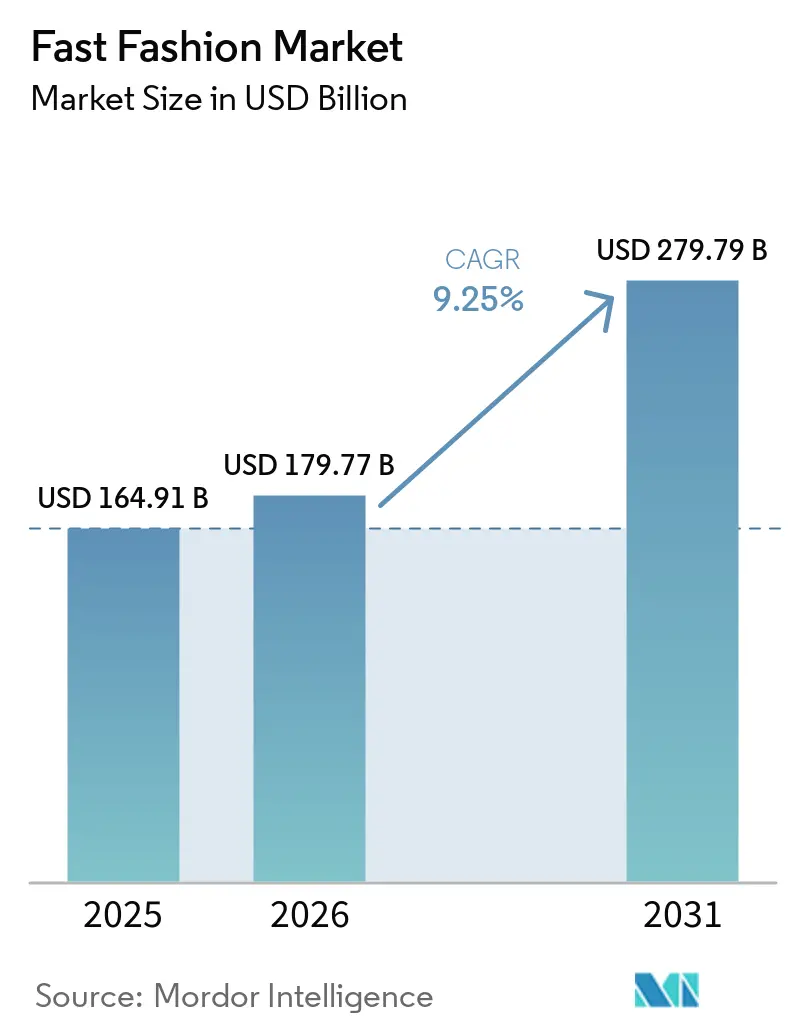
The fast fashion market size was valued at USD 164.91 billion in 2025 and is projected to reach USD 179.77 billion by 2026 and USD 279.79 billion by 2031, growing at a CAGR of 9.25% from 2026 to 2031. Affordable and trend-led apparel continues to serve consumers across income levels and regions. Short product cycles make speed, price access, and inventory response central to competitive performance. Mobile commerce is shortening the path from product discovery to purchase, particularly in high-growth consumer markets. Regulatory requirements and import costs are also changing sourcing decisions, return processes, and inventory management. Companies that combine responsive supply networks with clear value propositions have more room to manage these pressures.
Key Report Takeaways
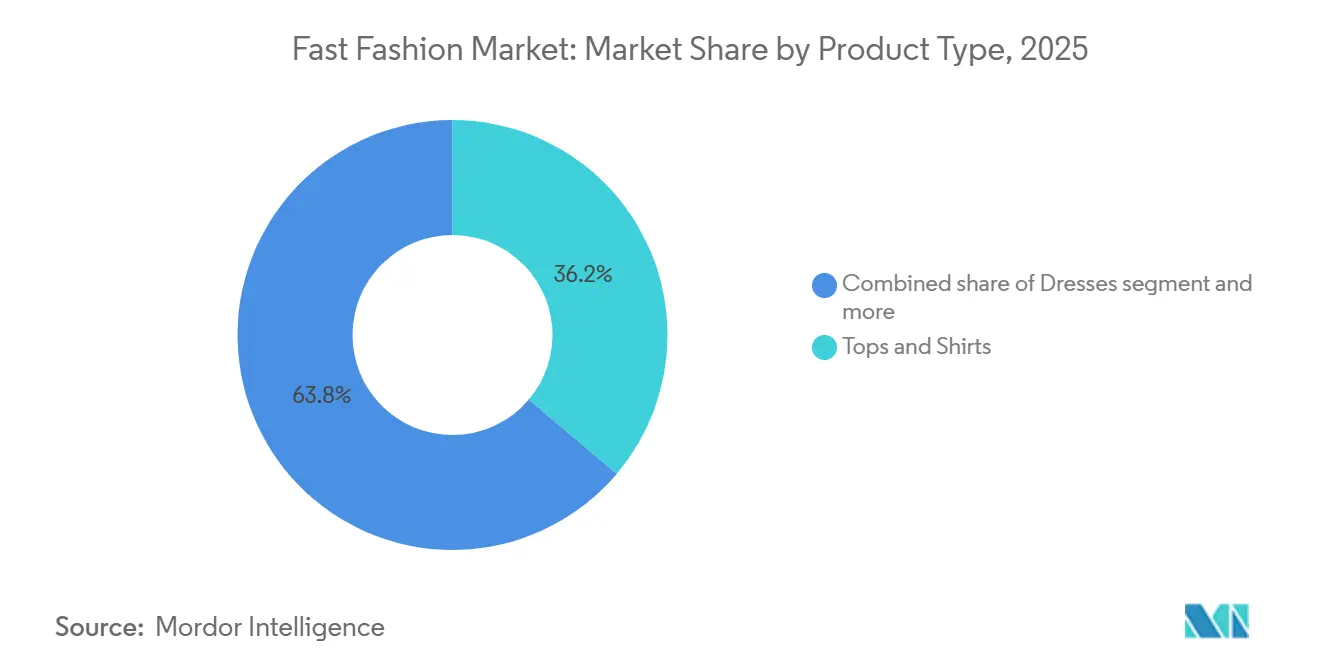
- By product type, Tops and Shirts held 36.17% of the fast fashion market share in 2025, while Dresses and One-Piece Apparel are projected to grow at a CAGR of 10.08% through 2031.
- By end-user, Women held 60.94% of the fast fashion market share in 2025, while Men are projected to grow at a CAGR of 10.09% through 2031.
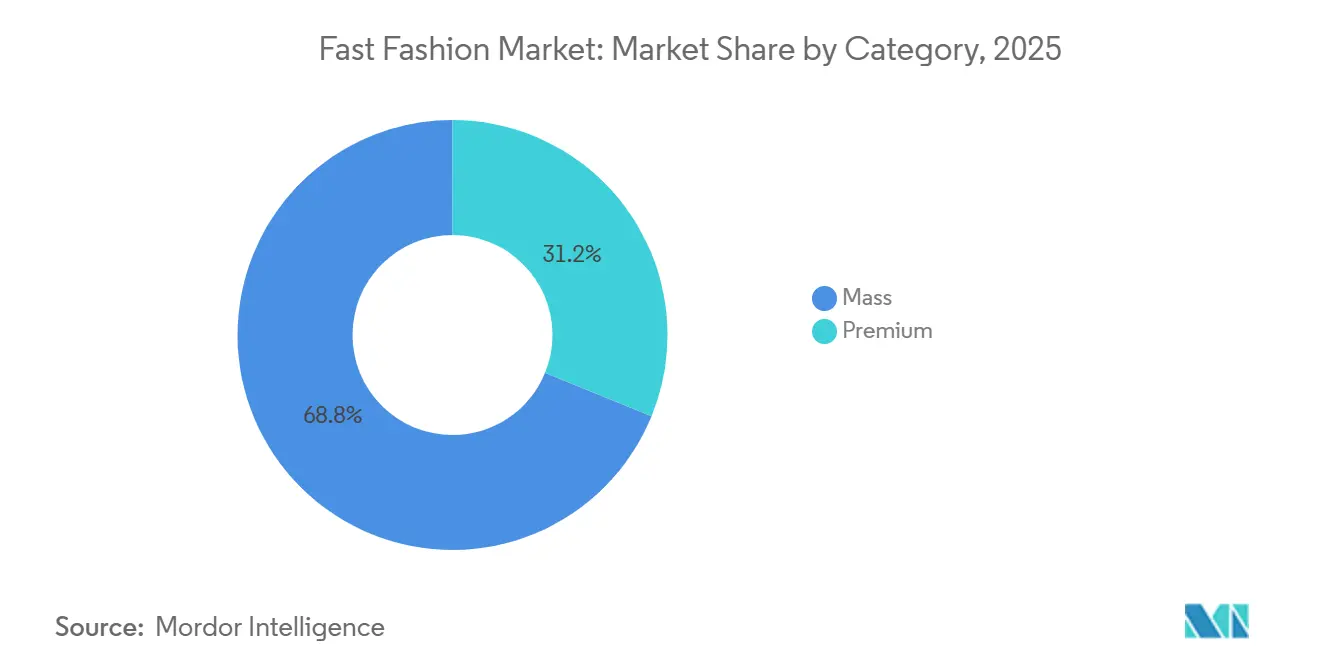
- By category, Mass accounted for 68.83% of the fast fashion market size in 2025, while Premium Fast Fashion is projected to grow at a CAGR of 11.66% through 2031.
- By distribution channel, Offline Retail held 62.47% of the fast fashion market share in 2025, while Online Retail is projected to grow at a CAGR of 12.34% through 2031.
- By geography, Asia-Pacific held 35.77% of the fast fashion market size in 2025 and is projected to grow at a CAGR of 10.61% through 2031.
Note: Market size and forecast figures in this report are generated using Mordor Intelligence’s proprietary estimation framework, updated with the latest available data and insights as of January 2026.
Global Fast Fashion Market Trends and Insights
Drivers Impact Analysis*
| Driver | (~) % Impact on CAGR Forecast | Geographic Relevance | Impact Timeline |
|---|---|---|---|
| Increasing Influencer Collaborations and Celebrity Endorsements | +2.1% | Global, with peak intensity in North America, UK, and APAC core | Short term (≤ 2 years) |
| Rising Demand for Affordable Fashionable Clothing | +2.3% | Global; highest incremental contribution from South and Southeast Asia | Long term (≥ 4 years) |
| Frequent Discounts and Promotional Pricing Strategies | +1.5% | Global; strongest in North America and Western Europe | Short term (≤ 2 years) |
| Easy Product Comparison Across Multiple Brands | +0.9% | Global; concentrated in markets with high e-commerce penetration | Medium term (2-4 years) |
| Convenient Return and Exchange Policies Boosting Purchases | +0.8% | North America, EU, Australia | Short term (≤ 2 years) |
| Faster Product Launches and Collection Updates | +1.4% | Global; most impactful in trend-sensitive APAC and European markets | Medium term (2-4 years) |
| Source: Mordor Intelligence | |||
Increasing Influencer Collaborations and Celebrity Endorsements
Social media-native marketing has shifted from an experimental budget allocation to the primary demand-generation engine in fast fashion, with creator-led commerce compressing the gap between content and conversion. WeArisma's 2026 Fashion Influence Index reports that TikTok's fashion EMV grew 45% in 2025 and now represents 25% of all fashion EMV globally, at approximately 2.5 times the per-post value of Instagram, indicating that brands optimising for reach without prioritising platform-specific engagement depth are systematically underperforming their investment. The second-order implication, frequently underestimated by planning teams, is that TikTok's viral content cycles are reshaping inventory planning: high-velocity organic content compresses the window between trend identification and sell-through to days, rewarding brands with agile replenishment capabilities.
Rising Demand for Affordable Fashionable Clothing
Consumer financial pressure is amplifying fast fashion demand, as shoppers increasingly prioritise style-to-cost efficiency over durability in both developed and emerging markets. Rapid urbanisation across Southeast Asia, South Asia, and Sub-Saharan Africa continuously expands the addressable population: first-generation urban consumers typically anchor wardrobe spending on accessible, trend-forward options before moving up the quality ladder, creating a predictable multi-year demand pipeline. The strategic implication, distinct from the obvious price appeal, is that brands extending size ranges, inclusive fits, and regionally relevant designs are capturing disproportionate loyalty in expanding demographic cohorts where repurchase frequency is the actual profitability driver. Brands stranded at mid-premium price points without clear quality differentiation face simultaneous pressure from below and above, as the Asia Business Council's Spring 2026 Briefing confirms that Uniqlo's international revenue reached approximately USD 12 billion in FY2025, demonstrating that quality-at-value positioning can coexist profitably with fast fashion at global scale [1].
Frequent Discounts and Promotional Pricing Strategies
Discount velocity has evolved into a structural feature of fast fashion commerce rather than a tactical lever, with algorithmic markdown calendars designed to sustain purchase urgency across shopper sessions at near-continuous promotional depth. The competitive distortion embedded in this driver is becoming apparent through regulatory enforcement: France's DGCCRF (Directorate General for Competition, Consumer Affairs and Fraud Prevention) issued a EUR 2.3 million fine against Boohoo in August 2026 for deceptive pricing practices, including misleading discount labelling, demonstrating that promotional pricing risks now carry enforcement-level financial exposure in major markets [2]. Zalando's 2025 results offer a structural counterpoint: its Plus loyalty programme, which reached 16.8 million members accounting for nearly half of Q4 2025 GMV, shows that discount-independent repeat purchasing is achievable at scale when personalisation infrastructure and membership benefits are sufficiently developed.
Faster Product Launches and Collection Updates
Product launch acceleration has transitioned from a differentiating capability to an industry minimum standard in fast fashion, and the competitive advantage now lies in the ability to sustain speed without sacrificing margin or quality consistency. Inditex's 1H2026 results illustrate the commercial case: the company achieved 9.2% constant-currency revenue growth and a 58.7% gross margin while operating across 215 markets, attributing its performance explicitly to its within-season sourcing model and the ability to react to fashion trends within weeks. The OECD notes that the ultra-fast fashion model uses real-time data analytics and algorithmic forecasting to automate production allocation, enabling inventory alignment with micro-trend cycles and compressing the design-to-shelf timeline from months to days [3].
Restraints Impact Analysis*
| Restraint | (~) % Impact on CAGR Forecast | Geographic Relevance | Impact Timeline |
|---|---|---|---|
| Counterfeit Products Weaken Brand Differentiation | -1.0% | Global; highest exposure in APAC, North America, and Western Europe online channels | Medium term (2–4 years) |
| Shopper Concerns Over data Privacy and Cybersecurity | -0.8% | EU (GDPR), North America, APAC; amplified by high-profile retail breaches in 2025 | Short term (≤ 2 years) |
| Uncertainty Surrounding Online Apparel Sizing and Fit | -0.7% | Global; strongest in markets with limited physical retail access | Medium term (2–4 years) |
| Import Tariffs Increase Cross-Border Sourcing Costs | -1.5% | North America (primary); South America and APAC increasingly affected | Short term (≤ 2 years) |
| Source: Mordor Intelligence | |||
Import Tariffs Increase Cross-Border Sourcing Costs
U.S. tariff policy has delivered the most structurally significant cost shock to the fast fashion supply chain since the initial Section 301 tariffs on Chinese goods in 2018. The AAFA reports that U.S. apparel imports faced a near-record average effective tariff rate of 24.6% in 2025, while the removal of the de minimis exemption for Chinese-origin shipments, effective May 2025, previously allowing duty-free entry for sub-USD 800 parcels, structurally raised the cost base for cross-border direct-to-consumer platforms. A Texas Tech University/ICAC analysis of U.S. apparel import data through June 2026 found that import values ran approximately 8% below the corresponding 2025 period, with sourcing shifting sharply from China toward Vietnam, Bangladesh, and Cambodia, though expanding alternative suppliers replaced only 19.8% of the physical volume lost in cotton-dominant apparel, indicating that supply chain diversification is slower and more operationally complex than public strategy announcements suggest.
Counterfeit Products Weaken Brand Differentiation
Counterfeiting has moved well beyond a brand protection issue into a direct competitive and consumer safety threat that compounds the challenge of sustaining differentiation at the affordable end of the fast fashion market. A 2026 study by the AAFA and Intertek found that 41% of counterfeit apparel, footwear, and accessory products tested failed product safety standards, including chemical hazard thresholds, demonstrating that the proliferation of unregulated counterfeits creates public health exposure that erodes consumer trust in the legitimate fast fashion ecosystem. A French court issued an interim ban in July 2026 prohibiting Shein from selling products that infringe Lacoste's trademarks, awarding Lacoste EUR 110,000 in provisional damages, a ruling that highlights the legal exposure platforms face when third-party sellers on open marketplaces circumvent intellectual property compliance.
*Our forecasts treat driver/restraint impacts as directional, not additive. The impact forecasts reflect baseline growth, mix effects, and variable interactions.
Segment Analysis
By Product Type: Occasional Wear Shifts the Fast Fashion Product Mix
Tops and shirts held 36.17% of the fast fashion market share in 2025, making the category the largest product type. The category benefits from frequent replacement and broad use across casual, work, and social settings. It also has a low barrier to trend adoption because consumers can add a new top without changing an entire wardrobe. Bottoms, including trousers, jeans, and skirts, remain an important part of the product mix because they support repeat wardrobe purchases. Denim continues to provide a stable base, while athleisure-inspired joggers and structured trousers broaden the category. Jackets and outerwear have a smaller volume position, but changing weather patterns and layered streetwear looks extend their relevance beyond traditional seasonal periods. Other apparel, including basics, loungewear, and accessories, supports larger baskets when retailers present related items together. These products are particularly suited to cross-selling in digital stores where customers can add complementary items during checkout.
Dresses and one-piece apparel are forecast to expand at a CAGR of 10.08% through 2031. Demand is supported by consumers seeking garments that work for daytime use and social occasions without requiring additional styling layers. The category fits spending linked to events, travel, gatherings, and social content, where shoppers may seek a distinct outfit for a specific moment. This purchase pattern differs from replenishment-led demand for basics because visual newness can play a larger role. Retailers that offer different fits, lengths, and price levels can address a wider range of occasions. Product design also matters because the same item must meet expectations for comfort, appearance, and repeated use. The category gives fast fashion retailers another way to balance high-volume essentials with more occasion-specific choices. It also increases the value of responsive launch calendars when interest changes quickly around seasonal events.

By End-User: Women Retain the Largest Base While Men's Demand Grows
Women held 60.94% of the fast fashion market share in 2025 and remained the largest end-user group. Their position reflects frequent purchases across tops and shirts, dresses and one-piece apparel, bottoms, and accessories. Women also engage with a broad range of trend cycles, which supports regular product refreshes across retailers. The children segment is smaller, but adult purchasing decisions can create repeat demand when households trust a retailer's quality, fit, and pricing. Brand familiarity at early ages can also support longer-term customer relationships as buying needs change. Product choice within this segment must consider durability, size progression, and parental confidence. Online content focused on new arrivals and accessible styling can draw attention to women-focused assortments. This makes social and digital discovery important alongside stores and traditional promotional activity.
Men are forecast to grow at a CAGR of 10.09% through 2031, exceeding the overall market growth rate. More relaxed workplace dress codes have widened demand for casual and streetwear-influenced clothing. Men are also purchasing a broader set of products that combine everyday use with performance-inspired details. Joggers, technical hoodies, and structured activewear have moved into mainstream fast fashion menswear collections. This blend reduces the need for retailers to separate casual clothing and athletic-influenced styles into distinct assortments. It also supports a larger set of price points and styling options within menswear. Brands can respond by improving fit consistency and expanding choices in color, fabric, and practical features. The growing role of this end-user group increases the importance of balanced investment across womenswear and menswear.
By Category: Mass Volume Remains Central as Premium Fast Fashion Advances
Mass accounted for 68.83% of the fast fashion market size in 2025 and remained the core volume category. It serves shoppers who prioritize accessible prices, regular newness, and a wide selection of everyday apparel. Physical stores remain important for this group in markets where e-commerce access and confidence are still developing. Consumer expectations are nevertheless rising within the mass category, particularly for consistent fit, acceptable quality, and clearer material information. Younger buyers can change platforms quickly when these requirements are not met. This creates a minimum quality threshold even for retailers that compete on low prices. Store-led models can still generate strong volume when cost control, product availability, and current styles are aligned. The category therefore remains central to the fast fashion industry even as consumer expectations become more demanding.
Premium fast fashion is projected to grow at a CAGR of 11.66% through 2031. Established brands are using higher-quality lines and more differentiated designs to create distance from ultra-low-cost competition. The approach is intended to improve unit economics while preserving a price point that remains reachable for a broad audience. Premium positioning depends on the customer seeing a real improvement in materials, design, fit, or reduced discounting. A label alone does not provide that distinction if the product does not show a visible change. Retailers also need to manage product selection carefully so higher-value items do not create excessive inventory risk. A more focused assortment can support quality investment and lower markdown pressure. This approach gives brands a route to serve shoppers who want stronger value without moving into traditional premium apparel.
By Distribution Channel: Offline Retail Holds Scale While Online Retail Accelerates
Offline retail held 62.47% of the fast fashion market share in 2025 and remained the largest distribution channel. Physical stores allow shoppers to assess fit, fabric, color, and styling before they buy. They also support discovery, immediate collection, and social shopping experiences that digital channels do not fully replace. Store networks remain important in markets where consumers have limited confidence in online sizing. Inditex plans approximately EUR 2.3 billion in ordinary capital expenditure during 2026 for store enlargement, refurbishment, and technology integration, including assisted checkout and soft-tag systems. This investment shows that leading retailers continue to treat stores as part of an integrated retail system. Physical locations can also translate social media attention into visits through product edits and local merchandising. The channel remains relevant where store experience and digital convenience work together.
Online retail is projected to grow at a CAGR of 12.34% through 2031, the fastest rate among distribution channels. Mobile commerce is expanding access across Southeast Asia, South Asia, and Latin America. Digital personalisation can help shoppers find relevant products and can reduce friction in browsing and purchasing. Zalando reported that its Size & Fit AI uses body measurement data from more than 1 million customers and reduced size-related returns by more than 8%. This shows why fit information and returns processes have become central to online apparel performance. Retailers that improve fulfillment speed, product information, and returns management can strengthen repeat purchasing. Those capabilities also help reduce the disadvantage created by uncertainty over sizing and fit. The channel's growth depends on whether retailers can make online apparel buying easier and more reliable for consumers.
Geography Analysis
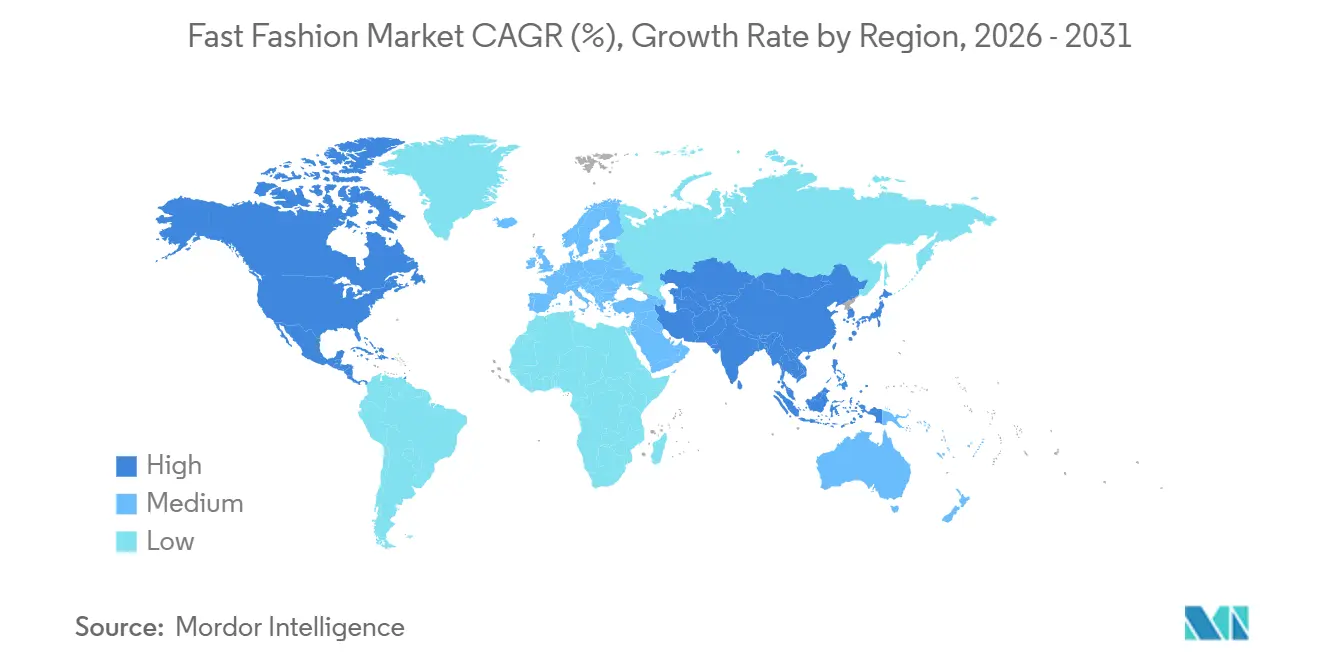
Asia-Pacific held 35.77% of the fast fashion market share in 2025 and is forecast to grow at a CAGR of 10.61% through 2031. The region combines major manufacturing networks with a large and expanding consumer base. China remains important for production and domestic demand, while India, Indonesia, and Vietnam contribute additional consumer growth. Rising income levels and mobile commerce are bringing more shoppers into accessible fashion categories. Social commerce formats can connect product discovery and purchasing within a single digital experience. This favors retailers that can respond quickly to local preferences and manage mobile-first customer journeys.
North America remains a significant regional market, although import costs and consumer conditions create pressure for retailers that depend heavily on offshore sourcing. The American Apparel & Footwear Association reported that the average effective tariff rate on U.S. apparel imports reached 24.6% in 2025. The removal of the de minimis exemption for Chinese-origin shipments from May 2025 raised the cost base for affected direct-to-consumer cross-border shipments. These changes make supply-chain diversification and pricing decisions more important. Inditex continued to invest in the United States during 2026, including the opening of Bershka's first U.S. store at Aventura Mall. Canada and Mexico add volume to the region, with Mexico also benefiting from nearshore production interest.
Europe remains an important consumer and operating base for the fast fashion market. The EU Digital Product Passport registry became operational during July 2026 under the Ecodesign for Sustainable Products Regulation. Large companies also became subject to restrictions on destroying unsold apparel, clothing accessories, and footwear during July 2026. These requirements place more focus on inventory planning, product traceability, and overproduction risk. Germany, the UK, France, and the Nordic countries remain key spending centers, while Poland, Spain, and Italy offer room for further digital retail development. The Middle East and Africa also provide emerging demand through younger, digitally connected consumers and growing mobile commerce.
Competitive Landscape
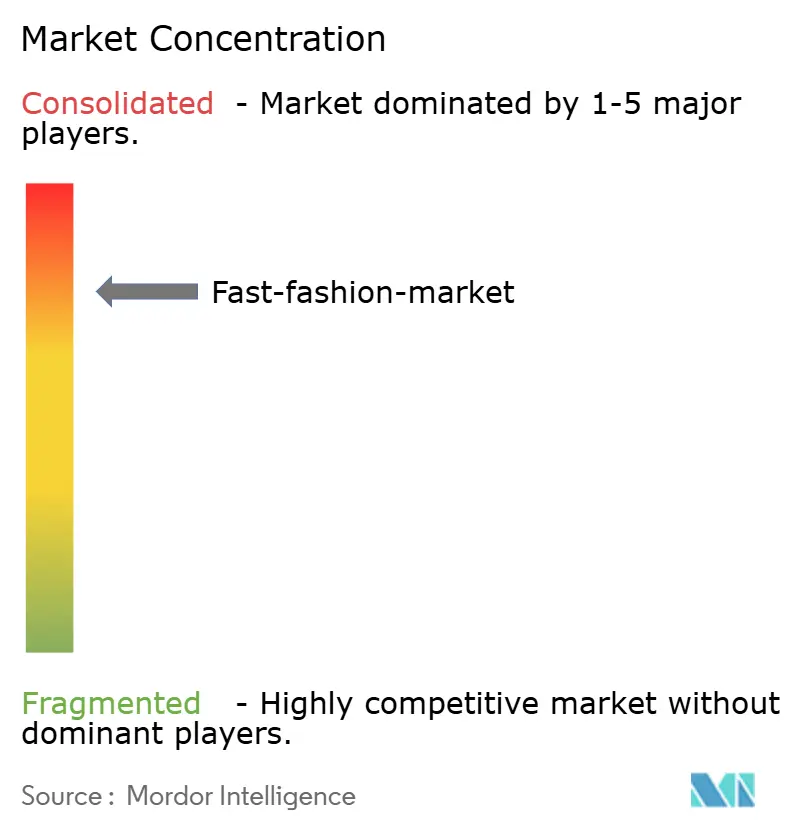
The fast fashion market is highly concentrated, with Inditex, H&M Group, Shein, and Fast Retailing among the leading companies. Their operating models differ, but each competes through price access, recognizable brands, product availability, and increasingly through digital capability. Inditex combines within-season sourcing with integrated physical and digital operations. The company reported first-half 2026 net sales of EUR 19.8 billion, 9.2% growth at constant currency, and a 58.7% gross margin. Its sourcing model supports reaction to changing fashion demand within weeks. This operating approach helps the group manage collection freshness while retaining close control over merchandising and store execution.
H&M Group has focused on procurement efficiency, cost discipline, and AI-supported allocation as part of its operational response. The company reported a 54% gross margin and a 10.6% operating margin in the third quarter of 2026. It has also stated that it is increasing in-season purchasing and using AI-supported allocation to improve response to demand. Fast Retailing continues to pursue international growth through Uniqlo, while maintaining a value-led positioning. Digital platforms are also changing the competitive setting by helping brands reach consumers without owning the same scale of store network. Zalando reported 2025 GMV of EUR 17.56 billion and 62 million active customers, underlining the scale of multi-brand online demand. The company is integrating more personalized content and fit tools into its consumer experience.
Smaller companies compete through local design relevance, social media activity, and regional supply-chain flexibility. Urban Revivo, Fashion Nova, and Trendyol illustrate the challenge that regionally focused operators can present to larger global retailers. These companies can respond to local product preferences without applying the same merchandise plan across every geography. The strongest openings are found in culturally relevant assortments and accessible products with visible quality or design differentiation. These positions can support better margins and fewer returns than a model based only on low pricing. Zalando has also expanded its role as a capability provider through SCAYLE-powered partnerships that support brand commerce and fulfillment operations. Competitive success increasingly depends on whether a company can combine brand relevance with dependable sourcing, data use, and customer service.
Fast Fashion Industry Leaders
-
Gap Inc.
-
Shein Group Ltd.
-
Next plc
-
Primark Limited
-
adidas AG
- *Disclaimer: Major Players sorted in no particular order
Recent Industry Developments
- August 2026: Inditex opened Bershka's first U.S. store at Aventura Mall in Miami. The opening forms part of 20 planned U.S. expansion projects by the end of 2027 across Zara, Bershka, and Massimo Dutti.
- September 2026: H&M expanded its Gurugram retail footprint in India with a new store at Ireo Boulevard. The opening formed part of the group's India strategy, as it planned 90 net openings and 170 closures globally during 2026.
- October 2025: SHEIN and rapper GloRilla launched a co-branded collection across SHEIN's MUSERA and SHEIN ICON brand lines. Prices ranged from USD 2 to USD 46, extending SHEIN's celebrity collaboration activity in the United States.
Global Fast Fashion Market Report Scope
Fast fashion refers to affordable yet trendy clothing that swiftly transitions from design to retail, aiming to capitalize on current trends. The Fast Fashion Market Report is segmented by Product type (Tops and Shirts, Bottoms, Dresses and One-Piece Apparel, Jackets and Outerwear, Other Apparel), by End-User (Men, Women, and Children), by Category (Mass and Premium), by Distribution (Offline Retail and Online Retail), and by Geography (North America, Europe, Asia-Pacific, South America, and the Middle East and Africa). The Market Forecasts are Provided in Terms of Value (USD).
| Tops and Shirts |
| Bottoms (Trousers, Jeans and Skirts) |
| Dresses and One-Piece Apparel |
| Jackets and Outerwear |
| Other Product Types |
| Men |
| Women |
| Children |
| Mass |
| Premium |
| Offline Retail |
| Online Retail |
| North America | United States |
| Canada | |
| Mexico | |
| Rest of North America | |
| Europe | Germany |
| United Kingdom | |
| Italy | |
| France | |
| Spain | |
| Netherlands | |
| Poland | |
| Belgium | |
| Sweden | |
| Rest of Europe | |
| Asia-Pacific | China |
| India | |
| Japan | |
| Australia | |
| Indonesia | |
| South Korea | |
| Thailand | |
| Singapore | |
| Rest of Asia-Pacific | |
| South America | Brazil |
| Argentina | |
| Colombia | |
| Chile | |
| Peru | |
| Rest of South America | |
| Middle East and Africa | South Africa |
| Saudi Arabia | |
| United Arab Emirates | |
| Nigeria | |
| Egypt | |
| Morocco | |
| Turkey | |
| Rest of Middle East and Africa |
| Product Type | Tops and Shirts | |
| Bottoms (Trousers, Jeans and Skirts) | ||
| Dresses and One-Piece Apparel | ||
| Jackets and Outerwear | ||
| Other Product Types | ||
| End-User | Men | |
| Women | ||
| Children | ||
| Category | Mass | |
| Premium | ||
| Distribution Channel | Offline Retail | |
| Online Retail | ||
| Geography | North America | United States |
| Canada | ||
| Mexico | ||
| Rest of North America | ||
| Europe | Germany | |
| United Kingdom | ||
| Italy | ||
| France | ||
| Spain | ||
| Netherlands | ||
| Poland | ||
| Belgium | ||
| Sweden | ||
| Rest of Europe | ||
| Asia-Pacific | China | |
| India | ||
| Japan | ||
| Australia | ||
| Indonesia | ||
| South Korea | ||
| Thailand | ||
| Singapore | ||
| Rest of Asia-Pacific | ||
| South America | Brazil | |
| Argentina | ||
| Colombia | ||
| Chile | ||
| Peru | ||
| Rest of South America | ||
| Middle East and Africa | South Africa | |
| Saudi Arabia | ||
| United Arab Emirates | ||
| Nigeria | ||
| Egypt | ||
| Morocco | ||
| Turkey | ||
| Rest of Middle East and Africa | ||
Key Questions Answered in the Report
What is the projected value of the Fast Fashion Market by 2031?
The fast fashion market is projected to reach USD 279.79 billion by 2031, from USD 164.91 billion in 2025, at a 9.25% CAGR from 2026 to 2031.
Which product type has the largest share in fast fashion?
Tops and shirts led product demand with a 36.17% share in 2025. Dresses and one-piece apparel are the fastest-growing product type at a 10.08% CAGR through 2031.
Which consumer group is growing fastest in fast fashion?
Men is the fastest-growing end-user group, with a projected CAGR of 10.09% through 2031. Women remained the largest group with a 60.94% share in 2025.
Why is online retail growing in fast fashion?
Online retail is forecast to grow at a 12.34% CAGR through 2031 as mobile shopping, personalization, fulfillment, and fit tools improve the digital purchase experience.