
Farm Animal Healthcare Market Size and Share
Market Overview
| Study Period | 2022 - 2031 |
|---|---|
| Market Size (2026) | USD 24.77 Billion |
| Market Size (2031) | USD 31.69 Billion |
| Growth Rate (2026 - 2031) | 5.06 % |
| Fastest Growing Market | Asia Pacific |
| Largest Market | North America |
| Market Concentration | Medium |
Major Players *Disclaimer: Major Players sorted in no particular order Image © Mordor Intelligence. Reuse requires attribution under CC BY 4.0. | |
Farm Animal Healthcare Market Analysis by Mordor Intelligence
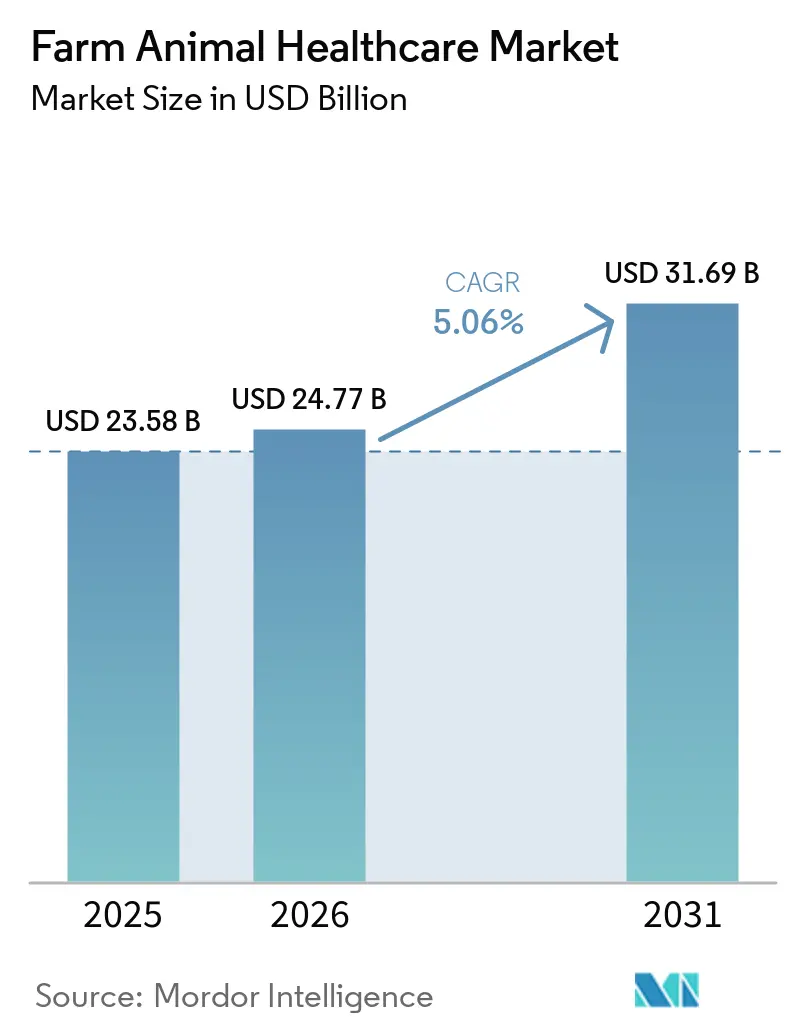
The Farm Animal Healthcare market size was valued at USD 23.58 billion in 2025 and estimated to grow from USD 24.77 billion in 2026 to reach USD 31.69 billion by 2031, at a CAGR of 5.06% during the forecast period (2026-2031). Expansion reflects the decisive move toward preventive biologics, wider use of AI-enabled disease-surveillance platforms, and tighter welfare rules that restrict routine antibiotic therapy in favor of vaccination programs. Rapid uptake of precision livestock tools, rising protein demand in emerging economies, and concerted regulatory efforts against zoonotic outbreaks further reinforce growth prospects. Competitive dynamics now hinge on the ability of manufacturers to integrate diagnostics with therapeutics and to supply region-specific vaccines that satisfy heightened compliance standard. At the same time, counterfeit-medicine risks, veterinary workforce gaps, and uneven regulatory alignment across low- and middle-income countries temper overall momentum.
Key Report Takeaways
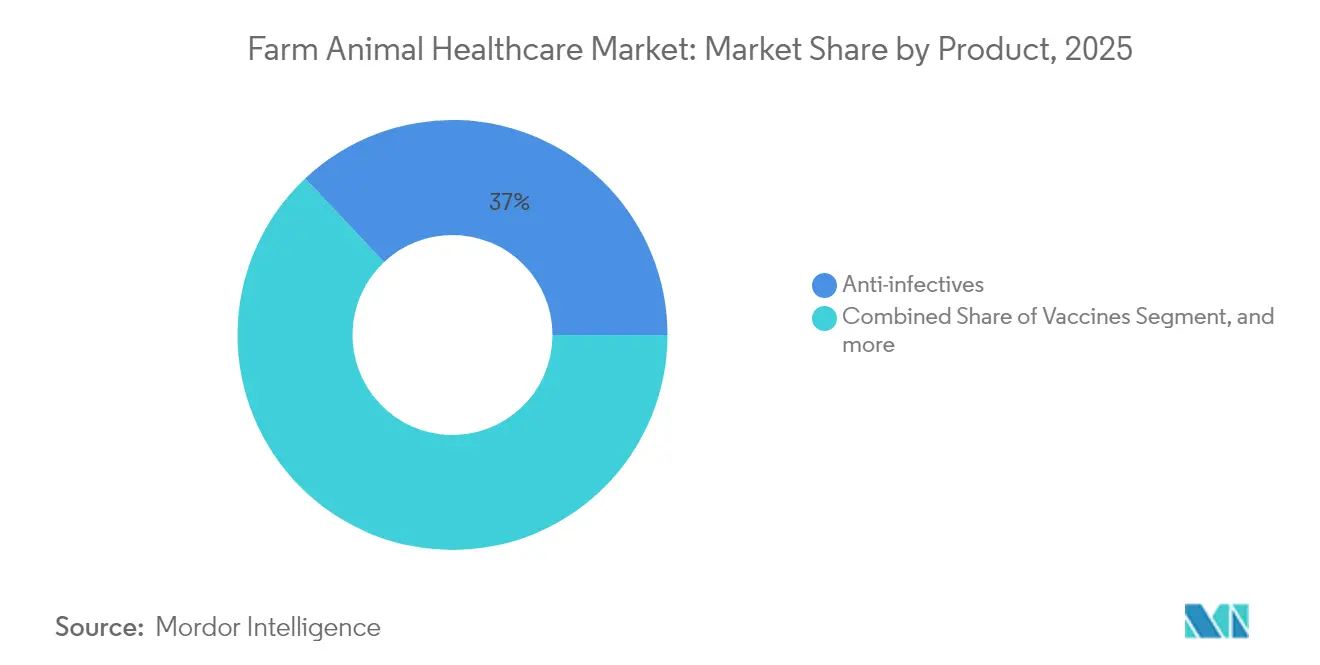
- By product category, anti-infectives led with 37.02% of Farm Animal Healthcare market share in 2025 while vaccines are expanding at a 7.31% CAGR through 2031.
- By animal type, poultry captured 38.10% revenue in 2025 whereas the cattle segment shows the fastest 6.61% CAGR through 2031.
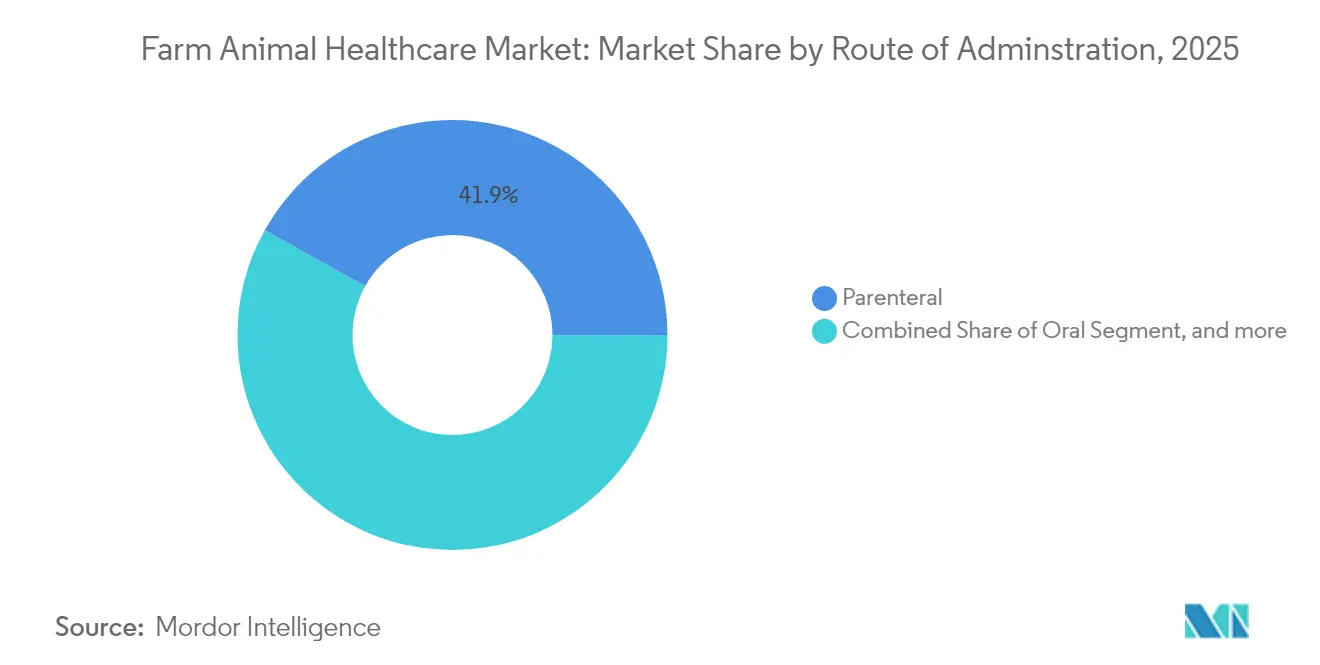
- By route of administration, parenteral products held 41.90% revenue in 2025, and topical formats are rising at a 7.19% CAGR through 2031.
- By geography, North America accounted for 42.70% revenue in 2025, yet Asia-Pacific is advancing at a 6.39% CAGR through 2031.
Note: Market size and forecast figures in this report are generated using Mordor Intelligence’s proprietary estimation framework, updated with the latest available data and insights as of 2026.
Market Trends and Insights
Drivers Impact Analysis of Farm Animal Healthcare Market*
| Driver | % (~) Impact on CAGR Forecast | Geographic Relevance | Impact Timeline |
|---|---|---|---|
| Advanced Technology Accelerating On-Farm Diagnostics | +1.2% | Global, with early adoption in North America & EU | Medium term (2-4 years) |
| Government & Animal-Welfare Vaccination Mandates | +0.9% | Global, strongest in EU & North America | Short term (≤ 2 years) |
| Growing Threat Of Emerging Zoonoses | +0.8% | Global, with hotspots in APAC & Africa | Long term (≥ 4 years) |
| Shift Toward Preventive Biologics & Integrated Health Plans | +1.1% | Global, led by developed markets | Medium term (2-4 years) |
| AI-Enabled Real-Time Disease-Surveillance Platforms | +0.7% | North America, EU, select APAC markets | Long term (≥ 4 years) |
| Autogenous-Vaccine CDMO Investments In Emerging Markets | +0.5% | APAC, Latin America, MEA | Long term (≥ 4 years) |
| Source: Mordor Intelligence | |||
Advanced Technology Accelerating On-Farm Diagnostics
Portable PCR units and smartphone biosensors now allow barn-side pathogen detection within minutes, reducing outbreak response time from 72 hours to under 12 hours in systems such as Korea’s KAHIS platform[1]. Faster diagnosis drives timely treatment, curbs losses, and lifts demand for connected devices that integrate seamlessly with herd-management software. Adoption is most pronounced in North America and Western Europe where capital budgets and broadband coverage are strong. Device makers enjoy recurring revenue through reagent cartridges and data-subscription services. Wider rollout to remote regions hinges on affordable hardware and robust cold-chain logistics for test kits.
Government and Animal Welfare Vaccination Mandates
The European Union’s African Swine Fever program and the USDA National Poultry Improvement Plan obligate commercial farms to follow strict immunization schedules. Government animal-health agencies, though a smaller slice of the swine healthcare industry, shape market direction through eradication programs and emergency vaccine stockpiles, evidenced by AU-PANVAC’s 2025 ASF initiative. These rules create steady vaccine demand, favor firms with regulatory compliance expertise, and raise entry barriers for generic suppliers. Mandatory programs also spur investment in cold-chain infrastructure and automated mass-vaccination equipment. Emerging economies mirror these policies to secure export certifications, further enlarging the Farm Animal Healthcare market. However, smallholders face higher operating costs and need subsidies or cooperative models to comply.
Growing Threat of Emerging Zoonoses
Climate change and habitat encroachment heighten spillover risk, with 75% of new infectious diseases originating in animals and costing over USD 20 billion yearly[3]. Recent HPAI waves across North America and Europe underline the vulnerability of intensive production systems. As a result, governments underwrite rapid-response vaccine stockpiles and push for broad-spectrum biologics. Manufacturers with flexible mRNA or vector platforms can re-formulate quickly, gaining a margin edge. Insurance providers increasingly link policy premiums to farm vaccination status, reinforcing the pivot from treatment to prevention.
Shift Toward Preventive Biologics and Integrated Health Plans
USDA Veterinary Feed Directive rules curbing antibiotic use have accelerated investment in vaccines, probiotics, and biosecurity bundles. Producers now purchase multi-year service contracts that blend immunizations, nutrition plans, and environmental audits. The bundled model promotes long-term relationships between manufacturers, veterinarians, and farmers, raising switching costs. Firms with wide portfolios and field-support teams dominate while single-product specialists hunt for partnerships or niche indications. Integrated programs also generate valuable real-world data that feed AI engines for predictive analytics.
Restraints Impact Analysis of Farm Animal Healthcare Market*
| Restraint | % Impact on CAGR Forecast | Geographic Relevance | Impact Timeline |
|---|---|---|---|
| Counterfeit & Sub-Standard Medicines | -0.6% | Global, concentrated in APAC & Africa | Short term (≤ 2 years) |
| Rising Costs Of Veterinary Services & Testing | -0.4% | Global, most acute in developed markets | Medium term (2-4 years) |
| Acute Rural-Veterinarian Shortage After U.S. FDA GFI-263 | -0.3% | North America, spreading to other regions | Long term (≥ 4 years) |
| Fragmented Regulatory Harmonisation In LMICs | -0.2% | APAC, Africa, Latin America | Long term (≥ 4 years) |
| Source: Mordor Intelligence | |||
Counterfeit and Sub-Standard Medicines
Substandard products account for 10-15% of global veterinary supply, eroding farmer confidence and fostering antimicrobial resistance. Enforcement raids, such as a USD 2.4 million vaccine seizure in Texas, spotlight the scale of illicit trade. Legitimate firms must invest in serialization, blockchain tracking, and education campaigns, raising operating costs. Emerging markets bear the brunt due to limited oversight and porous borders, which slows legitimate market entry and keeps the Farm Animal Healthcare market from achieving its full potential.
Rising Costs of Veterinary Services and Testing
Average veterinary fees climbed 8.3% per year from 2020-2024, outpacing farm-gate prices and squeezing margins for smaller operations. Molecular diagnostics cost up to five times more than culture methods, yet are increasingly required for trade certification. High costs spur demand for at-home test kits and tele-consulting, but they also force some producers to forgo recommended interventions, limiting revenue upside for suppliers.
*Our forecasts treat driver/restraint impacts as directional, not additive. The impact forecasts reflect baseline growth, mix effects, and variable interactions.
Farm Animal Healthcare Market Segment Analysis
By Product:
Vaccines Drive Biologics RevolutionThe vaccine segment’s 7.31% CAGR through 2031 underscores a decisive transition to prevention as anti-infectives, despite a 37.02% 2025 revenue lead, face stewardship pressure. Farm Animal Healthcare market size gains stem from mRNA platforms, novel adjuvants, and automated delivery systems that cut labor costs. Manufacturers leverage premium pricing on differentiated biologics, offsetting margins lost to generic antibiotics. Parasiticides keep stable growth as expanding vector ranges threaten grazing herds, while medicinal feed additives face stricter residue rules that trim demand.
Autogenous vaccines expand quickly within the wider vaccine portfolio. Facilities in Brazil and Australia shorten supply chains and customize antigens to farm-specific pathogens, enhancing efficacy and commanding higher prices. Anti-infectives pivot to combination formulations and slow-release injectables to sustain differentiation. Diagnostic manufacturers partner with biologics suppliers to bundle herd-health packages, further boosting Farm Animal Healthcare market penetration.

By Animal Type:
Cattle Segment Accelerates Despite Poultry DominancePoultry maintained a 38.10% revenue share in 2025 as intensive broiler and layer systems standardize vaccination and biosecurity protocols. The cattle segment, however, leads future growth at a 6.61% CAGR, driven by dairy consolidation and precision farming tools that pinpoint mastitis or respiratory flare-ups early. The cattle healthcare market is set to expand as wearable sensors and AI analytics enable targeted dosing and optimize reproductive performance.
Swine producers grapple with persistent African Swine Fever risks, steering investment toward robust biosecurity and multivalent vaccines. Sheep and goat health remains niche, though targeted parasite control products find traction in arid regions. Aquaculture cross-over technologies gain attention as land-based farmers diversify, enlarging the Farm Animal Healthcare market beyond terrestrial species.
By Route of Administration:
Topical Innovation Challenges Parenteral DominanceParenteral products commanded 41.90% revenue in 2025 because injectables remain the gold standard for vaccines and critical therapeutics. Topical formats, however, are rising at a 7.19% CAGR as pour-on and microneedle patches deliver long-acting parasiticides without causing injection-site lesions. Farm Animal Healthcare market share for topical solutions will climb as labor shortages intensify and welfare certifications prioritize low-stress treatments.
Oral therapies face tighter controls, yet probiotics and prebiotics retain appeal as antibiotic alternatives. Implantable and inhalation devices are early-stage technologies promising precise dosing and minimal residue, positioning innovators for future Farm Animal Healthcare market disruption.
By Distribution Channel:
Digital Transformation Reshapes Traditional NetworksVeterinary hospitals still dominate but direct-to-farm e-commerce climbs rapidly, cutting procurement costs and offering subscription replenishment. Large integrators negotiate bulk rates and favor suppliers that provide data dashboards and remote support. Pharmacies thrive in peri-urban areas, yet on-farm direct sales outpace all channels because manufacturers package products with service contracts that include on-site training. This evolution raises Farm Animal Healthcare market barriers for firms lacking digital infrastructure or field teams.
Supply-chain integrity initiatives such as blockchain tracing strengthen trusted distributors while squeezing gray-market operators. Regulatory audits now scrutinize temperature-logging records, making cold-chain compliance a competitive differentiator across the Farm Animal Healthcare industry.
Geography Analysis
North America Farm Animal Healthcare Market
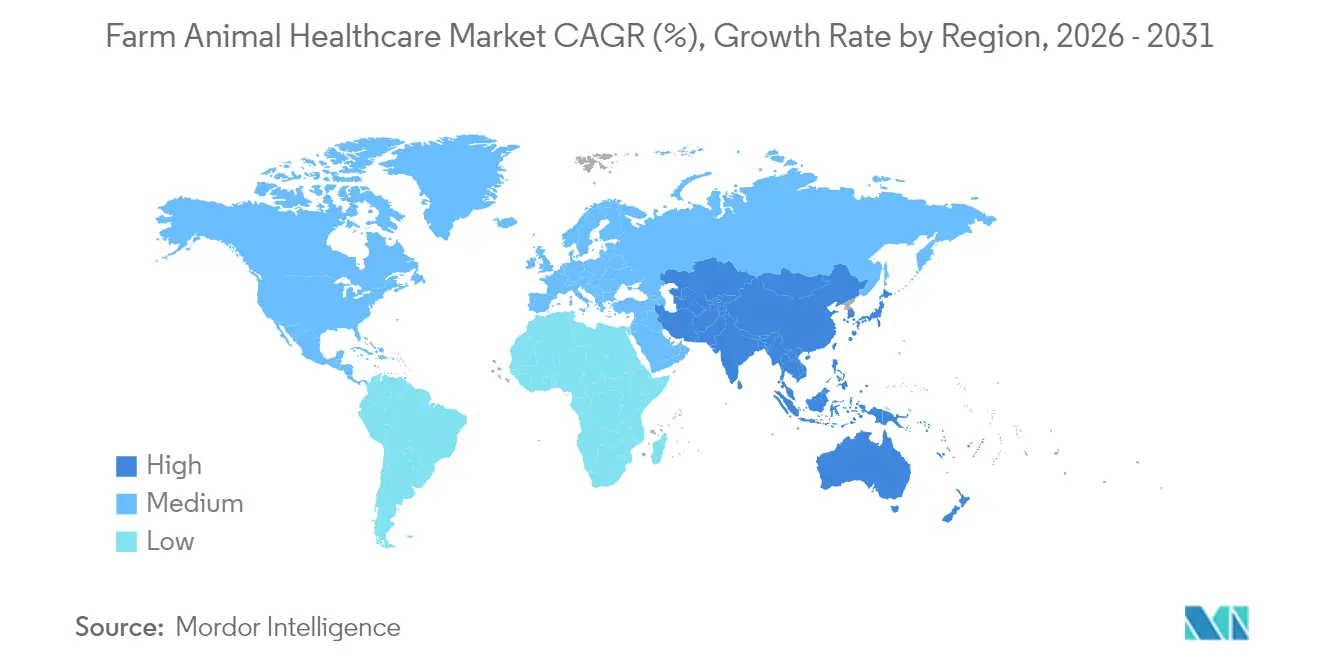
North America, holding 42.70% revenue in 2025, benefits from strong R&D ecosystems, established reimbursement for veterinary services, and early adoption of AI-based surveillance. Ongoing rural veterinarian shortages, though, threaten service coverage and may temper Farm Animal Healthcare market growth in frontier counties. Federal loan-forgiveness programs and mobile clinic initiatives aim to mitigate the gap.
APAC Farm Animal Healthcare Market
Asia-Pacific leads growth with a 6.39% CAGR through 2031 as China modernizes mega-farms and India scales dairy cooperatives. Regulatory reforms that streamline dossier reviews and recognize international Good Manufacturing Practice certificates improve market entry timelines. Yet diverse languages and non-uniform biosecurity rules continue to complicate commercialization strategies.
Europe Farm Animal Healthcare Market
Europe sustains moderate gains under strict welfare legislation and comprehensive vaccination mandates. Producers invest in premium biologics and diagnostics to satisfy export-market residue tolerances. Eastern member states allocate EU recovery funds to upgrade cold-chain logistics, broadening Farm Animal Healthcare market access.
South America and MEA Farm Animal Healthcare Market
South America and the Middle East and Africa represent high-potential, early-stage markets. Brazil and Argentina deploy autogenous vaccine capacity aimed at endemic strains, while Gulf states invest in food-security programs that include large-scale dairy and poultry ventures. Regulatory capacity constraints and counterfeit-product infiltration remain hurdles yet gradual harmonization under trade blocs such as Mercosur offers a clearer path for Farm Animal Healthcare market expansion.
Regulatory Landscape
Regulation is tightening around antimicrobial stewardship, welfare compliance, and traceability, which is reshaping how farm animal medicines are authorized, labeled, and used. In the European Union, the Veterinary Medicinal Products Regulation (EU) 2019/6 continues to anchor marketing authorization and supply controls, and Commission Implementing Regulation (EU) 2025/2091 sets out veterinary GMP requirements. The European Medicines Agency has also asked marketing authorization holders to align product information with QRD template v9.1 by 29 January 2027, raising the compliance bar for labeling and lifecycle updates across Member States.
In key national markets, disease control and movement rules are increasingly linked to surveillance status and farm-level health plans. In the United States, USDA APHIS updated guidance in April 2026 for interstate movement of lactating dairy cattle under the National Milk Testing Strategy, removing certain testing requirements for animals originating from states with Unaffected State Status, while animal disease traceability requirements for cattle and bison remain governed by 9 CFR Part 86. In the United Kingdom, Defra opened a February 2026 consultation on mandatory proposals under the Animal Health and Welfare Pathway, including annual health reviews for cattle, sheep, and pigs and eradication programs for BVD and PRRS, alongside expanded Improve Animal Health and Welfare funding in January 2026 that supports reviews and follow-ups across multiple herds or flocks.
Value Chain Analysis
The farm animal healthcare value chain covers upstream inputs (active ingredients, biological antigens, adjuvants, packaging, cold-chain materials, and diagnostic reagents), manufacturing (pharmaceuticals, vaccines including autogenous batches, and point-of-care diagnostics), and downstream distribution through veterinary hospitals and clinics, pharmacies and drug stores, e-commerce, and on-farm direct models supported by field service teams. End users include integrated poultry and swine operations, dairy and beef producers, and smallholders, with veterinarians, veterinary para-professionals, and community animal health workers influencing product selection, administration protocols, and compliance documentation.
Bottlenecks increasingly concentrate in cold-chain integrity, counterfeit-risk control, and input or logistics volatility that affects both therapeutics and nutrition-linked health outcomes. Supply disruptions have included intermittent vaccine stock-outs (for example, Nobilis ND Clone 30) and shortages in key feed-additive inputs such as methionine and formic acid linked to methanol availability and transit risk through the Strait of Hormuz. Governance and standard-setting bodies such as WOAH, VICH, Codex Alimentarius, and the WTO SPS framework shape residue limits, dossier harmonization, and trade certification workflows, while digital surveillance systems and traceability tools are becoming more central as farms and suppliers align health programs with movement rules and export requirements.
Competitive Landscape
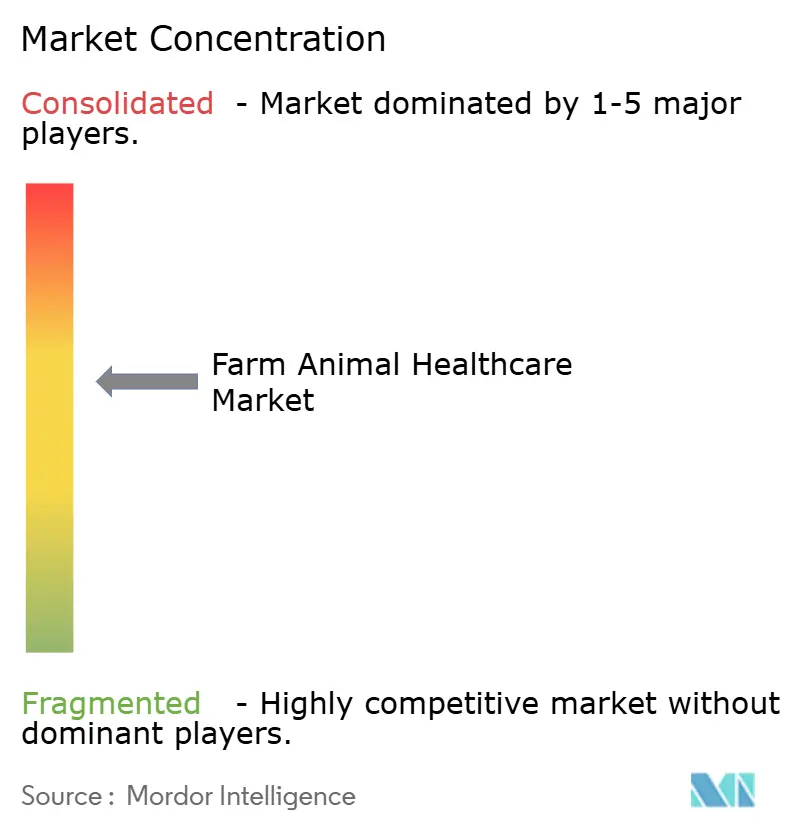
The farm animal healthcare market exhibits moderate concentration as global majors leverage scale, vertical integration, and broad portfolios to retain competitive edges. Zoetis, Merck Animal Health, and Boehringer Ingelheim supplement in-house pipelines with acquisitions of niche technology firms to accelerate time-to-market for novel delivery platforms. Regional leaders such as Ceva Santé Animale and Huvepharma strengthen their positions through autogenous vaccine sites that tailor products to local pathogens, reinforcing customer loyalty.
Digital transformation is the new battleground. Companies integrate IoT sensors, machine-learning analytics, and blockchain tracing into end-to-end health solutions that promise measurable return on investment. Strategic collaborations between vaccine developers and diagnostic innovators create bundled offerings that lock in customers over multi-year contracts and lift switching costs for farms. Smaller players differentiate through deep specialization or geographic focus, often partnering with contract manufacturers to offset scale disadvantages.
Competitive rivalry intensifies around precision livestock farming where hardware, software, and biologics converge. Early-mover advantages accrue to firms that secure patent coverage on data-driven treatment algorithms and seamless device interoperability. Regulatory compliance expertise remains a decisive barrier; established firms maintain dedicated teams versed in filing standards across over 100 jurisdictions, shielding them from fast-moving challengers. Still, disruptive entrants offering low-cost AI platforms or synthetic biology vaccines present credible long-term threats to incumbent Farm Animal Healthcare market leaders.
Farm Animal Healthcare Industry Leaders
-
Zoetis Inc
-
Ceva Animal Health
-
Boehringer Ingelheim GmbH
-
Elanco
-
Vetoquinol
- *Disclaimer: Major Players sorted in no particular order
Farm Animal Healthcare Market Companies Covered in this Report
- Bayer Animal Health
- Bimeda
- Boehringer Ingelheim
- Ceva Santé Animale
- Dechra Pharmaceuticals
- Elanco
- Hester Biosciences
- Huvepharma
- Indian Immunologicals
- Intas Pharmaceuticals
- Merck
- Norbrook
- Ouro Fino Saúde Animal
- Phibro Animal Health
- Vetoquinol
- Virbac
- Virbac South Africa
Market Opportunities and Future Outlook
White-space is opening where preventive biologics, precision livestock tooling, and non-antibiotic alternatives can be packaged into auditable, farm-level programs. Acquisition activity shows where leading suppliers are placing emphasis beyond traditional pharmaceuticals: Zoetis announced in 2026 agreements to acquire Neogen's animal genomics business (USD 160 million) and the VitalRADS veterinary teleradiology platform, targeting tighter integration of genetic risk tools and AI-assisted diagnostics into farm decision-making. Merck Animal Health also announced in June 2026 an agreement to acquire TARGAN, adding biodevice capabilities (WingScan) for poultry processing and production efficiency, reinforcing hardware-software-biologics bundle strategies.
Opportunities are also widening in region-specific vaccine and biologics portfolios, particularly for production systems facing persistent endemic disease pressure and antibiotic-use constraints. Ceva Animal Health acquired Aquilon CyL S.L. in June 2026 to strengthen swine intestinal health solutions, including a vaccine targeting Brachyspira hyodysenteriae, and formed the Ceva Bussan Animal Health joint venture with Mitsui and Co. in May 2026 to deepen market access in Japan. Policy trends toward more prescriptive antimicrobial stewardship and disease-control rules are pushing manufacturers to combine compliant product labeling, reliable cold-chain supply, and digital proof of use, which can support higher-value contracts with integrators and export-oriented producers.
Recent Industry Developments in Farm Animal Healthcare Market
- July 2026: Zoetis received European Commission marketing authorization for Poulvac Procerta HVT-ND, expanding its poultry vaccine portfolio under EU approval pathways. In the same month, Zoetis also announced a definitive agreement to acquire VitalRADS, a veterinary teleradiology services platform, strengthening its diagnostic and AI-enabled interpretation capabilities that can be integrated into precision herd and flock health programs.
- June 2026: Ceva Animal Health acquired Aquilón CyL S.L., a Spanish biotechnology company focused on swine intestinal health, adding a vaccine targeting Brachyspira hyodysenteriae for swine dysentery. The transaction broadens Ceva's biological solutions footprint in Europe and supports portfolio depth in high-impact production diseases where antibiotic restrictions elevate demand for preventive approaches.
- May 2024: MSD Animal Health (Merck Animal Health) announced that the European Commission granted marketing authorization for the INNOVAX-ND-H5 vaccine for chickens. The approval supports commercial rollout of vaccination-based control strategies in poultry operations facing avian influenza risk and tighter antimicrobial stewardship requirements.
Farm Animal Healthcare Market Report Scope and Research Methodology
Market Definition and Coverage
For this methodology, the farm animal healthcare market covers revenue from products used to prevent, diagnose, and treat health conditions in food producing animals, as purchased through veterinary and farm channels. This includes commonly used medicines, vaccines, and diagnostics that support herd and flock health outcomes.
Scope exclusions: We exclude companion animal only products, pet insurance and grooming services, and non-health farm equipment that does not have a disease prevention or treatment role.
Segments Covered in This Report
- By Product
- Vaccines
- Parasiticides
- Anti-infectives
- Medicinal Feed Additives
- Other Products
- By Animal Type
- Cattle
- Swine
- Poultry
- Sheep & Goats
- Other Animal Types
- By Route of Administration
- Oral
- Parenteral
- Topical
- Other Route of Administrations
- By Distribution Channel
- Veterinary Hospitals
- Veterinary Clinics
- Pharmacies & Drug Stores
- E-commerce
- On-farm Direct
- Geography
- North America
- United States
- Canada
- Mexico
- Europe
- Germany
- United Kingdom
- France
- Italy
- Spain
- Rest of Europe
- Asia-Pacific
- China
- Japan
- India
- Australia
- South Korea
- Rest of Asia-Pacific
- Middle East & Africa
- GCC
- South Africa
- Rest of Middle East & Africa
- South America
- Brazil
- Argentina
- Rest of South America
- GCC
- North America
Data Sources, Market Sizing, and Validation
Desk Research
Desk research started with building the demand pool using livestock and poultry populations, production intensity proxies, and disease burden indicators, then mapping how care is delivered across regions. We relied on public and official sources, including FAOSTAT for livestock and poultry numbers, WOAH updates for disease notifications, USDA and Eurostat for production and trade series, and national agriculture and veterinary regulator sites for policy changes that affect usage patterns.
To convert activity into market value, we cross-checked product mix and use-rate assumptions using peer-reviewed veterinary journals, vaccination and antimicrobial stewardship guidance from authorities, and company annual reports, filings, and investor presentations for directional revenue splits. In a few cases, paid company financials and a patent database were used to confirm product portfolios and innovation cadence. The desk research sources listed here are illustrative, and additional public materials were also used for data collection, validation, and clarification.
Primary Interviews and Surveys
Primary interviews and structured surveys were used to pressure-test desk assumptions and to fill gaps on real-world usage levels across cattle, swine, poultry, and small ruminants. We spoke with manufacturers, distributors, veterinarians, integrators, and farm managers across APAC, EMEA, and the Americas, so the model reflects differences in access, regulation, and purchasing behavior.
Distribution of primary research fieldwork respondents
| Company type | Respondent position | Region |
|---|---|---|
| Top tier: 38% | CXOs: 13% | APAC: 42% |
| Mid tier: 44% | Functional/Unit leaders: 30% | EMEA: 34% |
| Smaller Players: 18% | Managers: 57% | Americas: 24% |
Market-Sizing & Forecasting
The core model uses a top-down approach where animal populations and production volumes are reconstructed into a treated demand pool by species, then translated into value using typical treatment rates and price bands by product group. We focused on practical input variables such as livestock headcount trends, vaccination penetration, parasite seasonality, antibiotic stewardship pressure, disease outbreak frequency signals, and channel mix shifts between on-farm direct buying and retail or clinic purchasing.
Those totals were corroborated using selective bottom-up approximations, such as sampling a set of supplier revenues by animal health exposure, checking distributor throughput signals, and validating implied price per treated animal against interview feedback. Where data was thin, gaps were handled with conservative adoption ranges, then tightened through follow-up calls until implied usage matched known production systems.
For forecasting, scenario analysis was used, supported by short series smoothing on stable variables and expert-agreed outlooks for key drivers such as herd expansion, biosecurity spending, and policy limits on certain antimicrobials. The final forecast is linked to visible livestock and disease indicators, then adjusted for expected mix and pricing changes confirmed through field inputs.
Data Validation & Update Cycle
Outputs were checked against independent signals, including livestock production growth, animal health spending direction in major countries, and product mix expectations from practitioners, and then variances were reviewed line by line. If an input created a sudden jump that did not match known events, such as a disease wave or a regulatory shift, the assumption was revisited and primary respondents were re-contacted to confirm what is happening in practice.
Before sign-off, the model and narrative passed through multiple analyst reviews to align calculation logic, unit consistency, and currency handling. Reports are refreshed annually, with interim updates triggered by material events like major outbreaks, policy actions, or notable pricing disruptions, and a final pre-delivery check is completed to keep the numbers current.
Mordor Intelligence's Farm Animal Healthcare Market Sizing Compared With Other Published Estimates
Published estimates for farm animal healthcare can look different even when the topic name is the same, because each publisher chooses its own product inclusions, animal coverage, and the timing for price and currency assumptions. Differences also show up when some studies mix services and technologies into the same total, while others stick to product revenues reported through veterinary and farm purchasing routes.
Some external figures are broader by design because they fold in equipment or wider farm management solutions, and they may apply faster price growth without confirming what is actually paid in each channel. In Mordor Intelligence, the number is limited to animal health products used for farm species, and totals are checked against species-level demand signals, including treated population logic and route-of-administration mix, before the final value is locked.
Benchmark comparison
| Source | Market Size | Gaps in Research Methodology |
|---|---|---|
| Mordor Intelligence | USD 24.77 B (2026) | |
| Industry Publisher A | USD 23.51 B (2024) | Uses an earlier base year and a different timing for pricing, and it also groups equipment with pharmaceuticals in some product cuts, which shifts the total away from product-only spend. |
| Research House B | USD 21.08 B (2024) | Applies a narrower product set in the base year and leans more on stated CAGR ranges, with less visible linkage to treated population and channel mix by species. |
The spread mainly comes from what gets counted as healthcare, plus how pricing and channel mix are handled in the base year. By anchoring the total to animal populations, treatment and vaccination usage, and realistic price bands that are rechecked in interviews, the estimate stays traceable to steps that can be repeated and audited.
Key Questions Answered in the Report
What is the expected value of the Farm Animal Healthcare market in 2031?
The Farm Animal Healthcare market is projected to reach USD 31.69 billion by 2031.
Which product category is growing fastest in livestock health?
Vaccines are advancing at a 7.31% CAGR as producers pivot to preventive care.
Which region shows the fastest growth in animal healthcare demand?
Asia-Pacific is growing at a 6.39% CAGR thanks to livestock sector modernization and rising protein consumption.
What challenge most limits rural livestock health services in North America?
An acute shortage of large-animal veterinarians following FDA prescription changes limits service coverage.
How are counterfeit medicines affecting farm animal health?
Sub-standard products account for up to 15% of supply, undermining treatment efficacy and driving antimicrobial resistance.