
Extruded Polypropylene (XPP) Foam Market Size and Share
Market Overview
| Study Period | 2020 - 2031 |
|---|---|
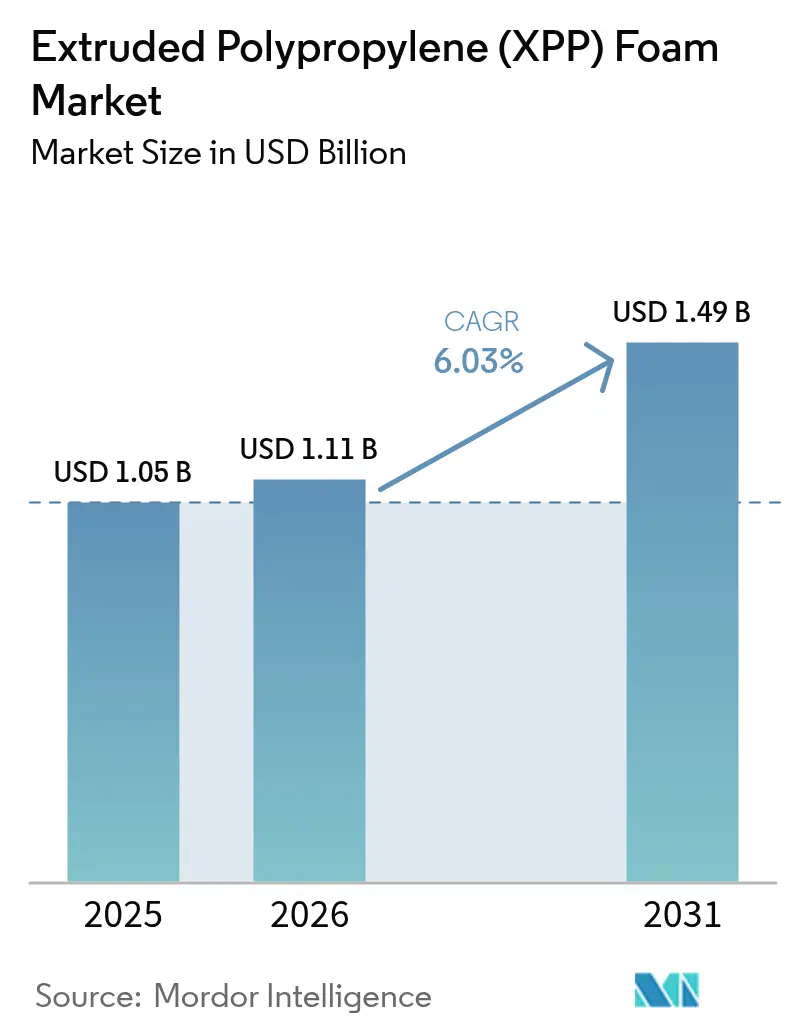
| Market Size (2026) | USD 1.11 Billion |
| Market Size (2031) | USD 1.49 Billion |
| Growth Rate (2026 - 2031) | 6.03 % |
| Fastest Growing Market | Asia Pacific |
| Largest Market | Asia Pacific |
| Market Concentration | Medium |
Major Players *Disclaimer: Major Players sorted in no particular order Image © Mordor Intelligence. Reuse requires attribution under CC BY 4.0. | |
Extruded Polypropylene (XPP) Foam Market Analysis by Mordor Intelligence
The Extruded Polypropylene (XPP) Foam Market size was valued at USD 1.05 billion in 2025 and estimated to grow from USD 1.11 billion in 2026 to reach USD 1.49 billion by 2031, at a CAGR of 6.03% during the forecast period (2026-2031). The steady climb mirrors rising material substitution in automotive, packaging, and construction, where low density, high impact strength, and heat resistance deliver measurable performance and sustainability benefits. Lightweighting mandates in vehicles, recyclable-content targets in packaging, and stricter building‐energy codes continue to expand the customer base. Supply-side momentum is reinforced by bio-circular polypropylene investments that lower carbon footprints and align with recycling rules, while recent breakthroughs in supercritical foaming add design flexibility. At the same time, volatile propylene costs and tight extrusion capacity constrain immediate scaling, giving established producers pricing power. Overall, the extruded polypropylene foam market is positioned for durable growth through the end of the decade.
Key Report Takeaways
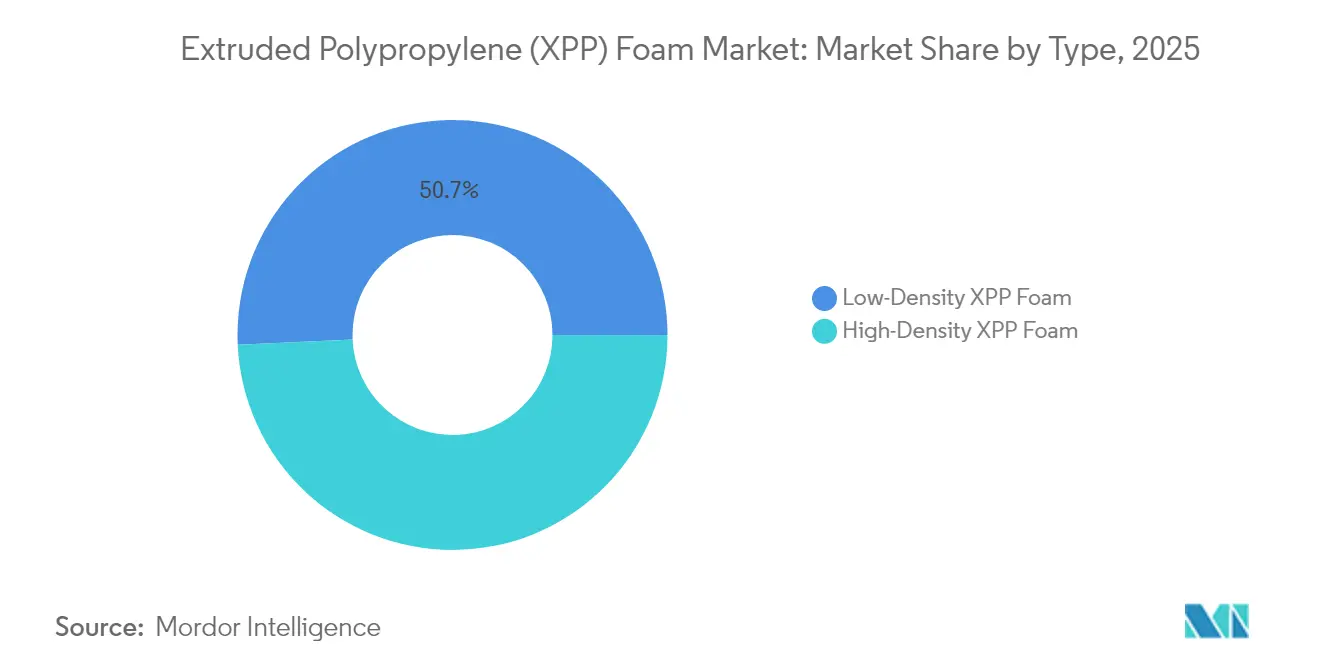
- By type, low-density grades led with 50.72% of the extruded polypropylene foam market share in 2025, whereas high-density variants are set to grow at 7.65% CAGR to 2031.
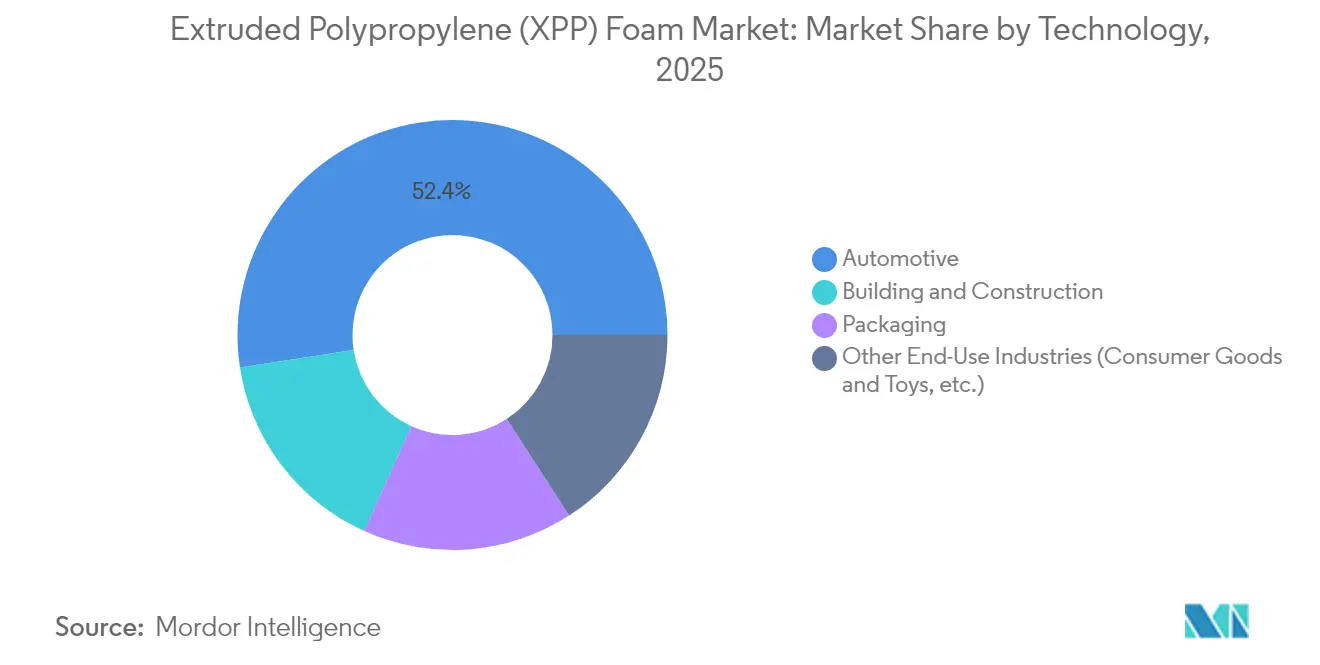
- By end-user industry, automotive captured 52.41% revenue share of the extruded polypropylene foam market size in 2025 and is expanding at 7.04% CAGR to 2031.
- By geography, Asia-Pacific held 54.12% of 2025 revenues in the extruded polypropylene foam market, and is set to grow at the fastest CAGR of 7.18% through 2031.
Note: Market size and forecast figures in this report are generated using Mordor Intelligence’s proprietary estimation framework, updated with the latest available data and insights as of 2026.
Global Extruded Polypropylene (XPP) Foam Market Trends and Insights
Drivers Impact Analysis*
| Driver | (~) % Impact on CAGR Forecast | Geographic Relevance | Impact Timeline |
|---|---|---|---|
| Superior properties & high recyclability | +1.8% | Global | Long term (≥ 4 years) |
| Automotive lightweighting mandates | +2.1% | North America & EU, APAC core | Medium term (2-4 years) |
| Growing demand from packaging industry | +1.5% | Global, with early gains in Asia-Pacific | Short term (≤ 2 years) |
| Increasing demand for recyclable and sustainable foams | +1.3% | EU & North America, spill-over to APAC | Long term (≥ 4 years) |
| Drone & UAV protective packaging boom | +0.7% | North America & EU | Medium term (2-4 years) |
| Source: Mordor Intelligence | |||
Superior Properties & High Recyclability
XPP foam delivers a closed-cell matrix that absorbs energy, dampens noise, and insulates heat better than many incumbent polymers. It maintains dimensional integrity up to 130 °C, vital for vehicle under-hood and cabin components that experience temperature spikes. Because it is thermoplastic, the material can be shredded, re-pelletized, and extruded again without cross-linking degradation, satisfying circular-economy procurement policies. Its resistance to moisture, solvents, and ultraviolet radiation lengthens product life and lowers total cost. Global recycled-polypropylene usage continues to rise, giving converters a growing pool of feedstock that reinforces the extruded polypropylene foam market value proposition.
Automotive Lightweighting Mandates
Corporate Average Fuel Economy rules in the United States, the European Union’s CO₂ fleet targets, and China’s dual-credit system collectively pressure automakers to shed vehicle mass. Replacing heavy plastics or metal inserts with XPP foam in bumper cores, door panels, and battery enclosures cuts part weight by about 25% while keeping crash energy absorption intact. Chemical foaming enables thin-wall sections with fine cell morphology that meet strict dimensional tolerances. Automakers are now specifying recycled-content XPP grades, as demonstrated by interior-trim supplier Grupo Antolin’s 20% weight-reduction program using foamed recyclate[1]SAE International Staff, “Lightweighting Strategies for Electric Vehicles,” SAE International, sae.org.
Growing Demand from Packaging Industry
E-commerce growth and cold-chain logistics require protective packaging that resists compression set and insulates perishable goods. XPP foam meets these needs while complying with emerging bans on expanded polystyrene in food service. Bio-circular grades such as Braskem’s WENEW, derived from used cooking oil, match virgin performance and satisfy brand commitments to carbon neutrality. Adoption is spreading fastest in Asia-Pacific, where consumer-goods volumes are high and national plastic-waste regulations are tightening.
Increasing Demand for Recyclable and Sustainable Foams
The European Packaging and Packaging Waste Regulation mandates that all packaging be recyclable by 2030 and introduces graduated recycled-content quotas, accelerating interest in mono-material solutions. Brand owners in North America and Europe have raised post-consumer resin usage targets, lifting demand for mechanically recyclable foams. Producers with in-house reprocessing loops capture off-cuts and post-industrial scrap, increasing material yield and lowering carbon intensity.
Restraints Impact Analysis*
| Restraint | (~) % Impact on CAGR Forecast | Geographic Relevance | Impact Timeline |
|---|---|---|---|
| High price of extruded polypropylene | -0.70% | Global | Short term (≤ 2 years) |
| Volatile propylene feedstock costs | -0.50% | Global, with acute impact in Asia-Pacific | Short term (≤ 2 years) |
| Limited large-scale extrusion capacity in several regions | -0.80% | MEA, South America, parts of APAC | Medium term (2-4 years) |
| Source: Mordor Intelligence | |||
High Price of Extruded Polypropylene & Volatile Propylene Feedstock Costs
Spot propylene climbed to USD 825-835/mt FOB Korea in early 2025 after refinery outages tightened supply[2]Polymerupdate Editorial Team, “Asia Daily Petrochemical Report,” Polymerupdate, polymerupdate.com. North American polypropylene contracts followed, jumping 9% in Q1 2025 as producers declared force majeure. These price swings compress converter margins and delay capacity investments, especially for smaller firms that cannot hedge raw-material risk through long-term contracts. High resin costs ripple through the extruded polypropylene foam market, raising finished-product prices and prompting short-term customer substitution toward lower-priced foams when performance demands allow.
Limited Large-Scale Extrusion Capacity in Several Regions
Few plants operate the tandem-extrusion lines needed for stable high-throughput XPP production outside East Asia, Europe, and the United States. Importing foam billets raises freight costs and carbon footprints, countering corporate sustainability goals. Capital expenditure for a modern 15 ktpa line exceeds USD 35 million, a deterrent in demand-emerging regions like Southeast Asia and the Middle East. Equipment, process know-how, and maintenance support remain concentrated among a handful of suppliers, extending lead times for new entrants[3]American Foam Products Staff, “Dramatic Rise of Material Costs for Foam Fabricators,” American Foam Products, americanfoamproducts.com.
*Our forecasts treat driver/restraint impacts as directional, not additive. The impact forecasts reflect baseline growth, mix effects, and variable interactions.
Segment Analysis
By Type: High-Density Variants Drive Innovation
High-density grades represent the fastest-advancing slice of the extruded polypropylene foam market, posting a 7.65% CAGR through 2031 as designers pursue higher compressive strength and dimensional rigidity. In 2025, Low-density foam remained the leader, holding 50.72% of the extruded polypropylene foam market share, thanks to packaging and interior auto uses where weight savings trump structural loads.
Process engineers now tailor density within a single sheet by modulating nucleating agents across the melt profile, achieving multi-zone parts that blend cushioning and stiffness. Supercritical CO₂ foaming narrows cell-size distribution and lifts mechanical integrity, a breakthrough for panels subject to concentrated loads. Nanofiller research, including graphene platelet additions, demonstrates up to 30% modulus uplift at filler loadings below 1 wt% %, broadening the suitability of XPP in construction thermal-break assemblies. Architects specify high-density XPP over mineral wool as building-envelope codes tighten due to comparable R-values at half the mass. Low-density foam still powers in-line returnable packaging, foldable dunnage, and HVAC ducts. New clarifier masterbatches raise heat-distortion temperatures by 8 °C, extending service life in under-hood airflow components where continuous temperatures reach 110 °C. Market leaders are combining post-industrial scrap with virgin resin for low-density sheets, keeping physical properties unchanged while lowering resin costs and greenhouse-gas intensity. Materials technologists expect the extruded polypropylene foam market to shift toward hybrid density solutions that exploit the best attributes of each grade. High-density cores paired with low-density skins inside one co-extruded laminate enable lightweight yet robust transport container walls. The new configurations are likely to capture share from solid polypropylene boards and aluminum honeycomb, especially in last-mile logistics enclosures seeking weight and cost reductions.


By End-User Industry: Automotive Sector Maintains Dual Leadership
Automotive designers anchor more than half of all sales, with the extruded polypropylene foam market size for automotive applications projected to grow at a 7.04% CAGR. Battery-electric vehicle programs drive the fastest gains, as every kilogram trimmed can extend range by 0.6 km on the WLTP cycle, a metric regulators and consumers value. XPP foam shields battery housings from road debris while acting as a thermal barrier that slows thermal runaway propagation. Interior trends toward minimalist cabins emphasize lightweight, soft-touch panels, where foamed polypropylene handily displaces talc-filled homopolymer sheets.
Construction absorbs the second-largest share, benefiting from XPP’s moisture resistance and ability to meet stringent fire-tester E84 Class A flame-spread scores with halogen-free additives. Improved compressive strength supports sandwich roof-panel designs in modular homes, slashing assembly time and on-site waste. Packaging’s contribution is scaling with online grocery volumes, and brand owners leverage foam’s closed-cell insulation to maintain chilled temperatures during 24-hour delivery windows. Automotive contracts increasingly stipulate a minimum of 25% recycled content, encouraging foam producers to install degassing extruders that refine post-consumer polypropylene. This aligns with United States Inflation Reduction Act incentives that reward lower life-cycle emissions in vehicle supply chains. At the same time, in-vehicle acoustic performance is rising in priority as electric drivetrains remove engine noise, and XPP’s tunable cell geometry enables tailored sound-transmission loss curves. These cross-currents confirm that the extruded polypropylene foam industry will remain integral to next-generation mobility solutions while deepening its foothold in construction and logistics.
Geography Analysis
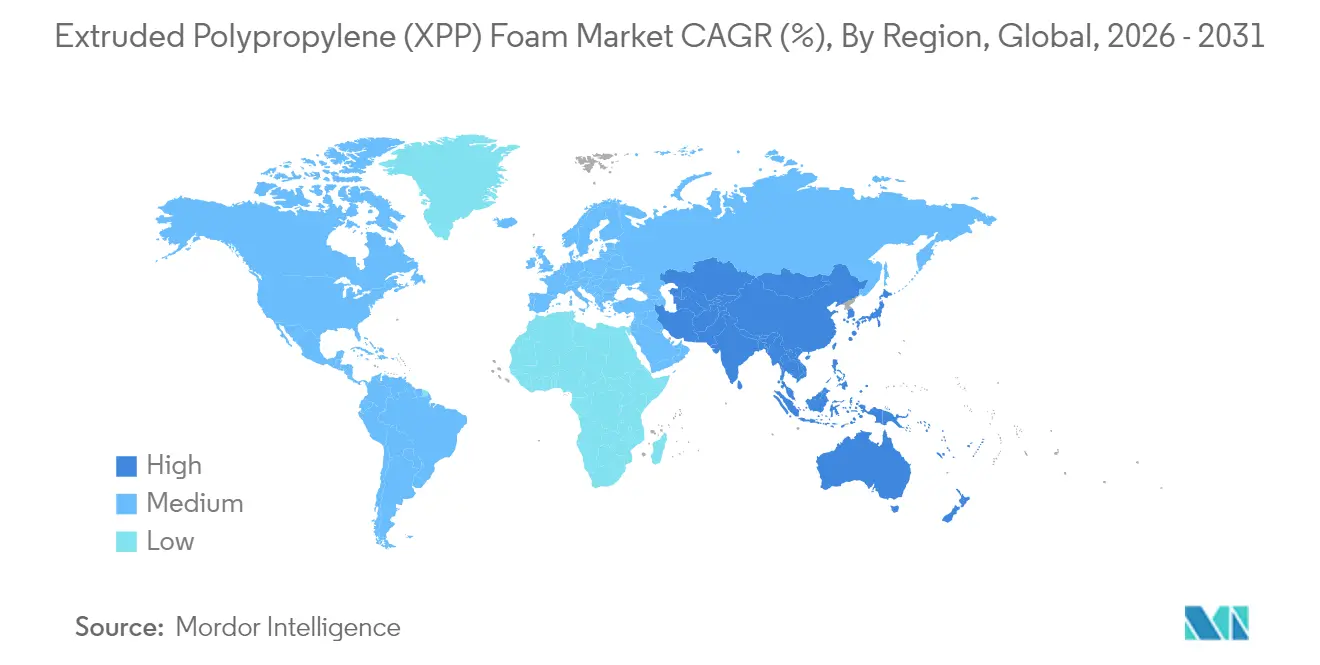
Asia-Pacific anchors the extruded polypropylene foam market with 54.12% of 2025 revenues, driven by China’s automotive exports, India’s surge in quick-service food delivery, and Japan’s early adoption of circular packaging. Regional consumption is projected to climb 7.18% CAGR through 2031 as OEMs localize electric-vehicle component production and e-commerce penetration spreads beyond tier-one cities. Government rebate programs for lightweight vehicles and restrictions on single-use plastics reinforce demand for recyclable foams. Producers enjoy shorter supply chains to regional propylene crackers, keeping cost inflation below global averages and supporting competitive pricing.
North America holds the second-largest slice, propelled by pickup and SUV platforms that require large energy-absorbing components. The United States Department of Energy’s Lightweight Materials Consortium continues to fund research into foamed polyolefin battery shields, keeping the region at the forefront of application engineering. Installations of bio-propane-to-propylene units in Texas bolster feedstock security and unlock low-carbon foam grades. However, the region still contends with propylene price volatility, which can slow downstream investment during supply disruptions. Europe fosters high-value niches tied to stringent recyclability and carbon-footprint targets. Automakers in Germany and France deploy XPP in crash-pad structures that must pass pedestrian-safety tests while remaining fully recyclable. The region’s extruded polypropylene foam market share could rise three percentage points by 2031 if PPWR compliance accelerates conversion away from expanded polystyrene in retail food trays. European converters benefit from harmonized waste-collection schemes that secure clean post-consumer streams for closed-loop programs, but higher energy prices continue to pressure operating margins relative to Asia.

Competitive Landscape
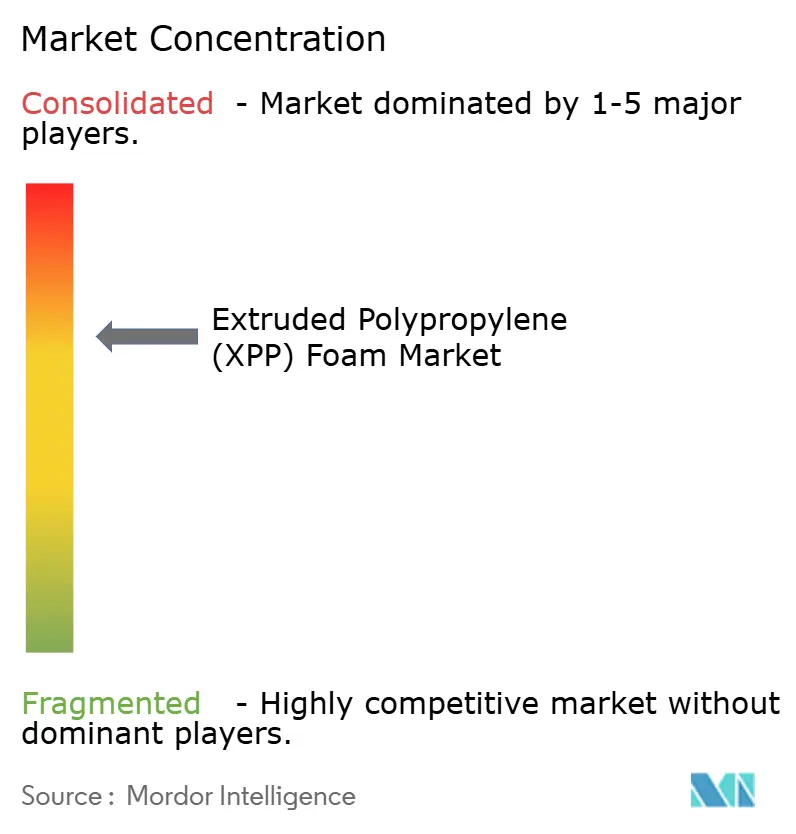
The extruded polypropylene (XPP) foam market is moderately consolidated, with key players such as Borealis, Braskem, Pregis LLC, etc. focusing on technological advancements and capacity expansions. Borealis utilizes Borcell technology and captive propylene to produce foams with cell sizes under 100 µm, critical for automotive interior panels. Producers are also advancing graphene-enhanced foams for EV battery packs and low-VOC formulations to meet China’s GB/T 27630 air-quality standards, leveraging data analytics to optimize foam density for crash simulations and strengthen OEM collaborations.
Extruded Polypropylene (XPP) Foam Industry Leaders
Pregis LLC
BOREALIS GMBH
TORAY INDUSTRIES, INC.
Zotefoams plc
DS Smith
- *Disclaimer: Major Players sorted in no particular order

Market Opportunities and Future Outlook
Opportunity areas in XPP foam increasingly connect circularity-led, mono-material polypropylene packaging with process technologies that reduce density while maintaining stiffness. In Europe, CEN work gives converters a more concrete way to standardize inputs and design choices, with EN 18064-3:2025 defining quality requirements for polypropylene recyclates for specific product families and SIST EN 18120-6:2026 setting design-for-recycling guidance for rigid PE and PP packaging. These references support the use of PCR-content PP in extruded foam sheets and inserts in applications where brand owners and retailers are moving away from formats that are harder to recycle.
A second opportunity sits in advanced foaming and application engineering, which extends XPP adoption beyond traditional automotive and general protective packaging into higher-spec segments. Microcell foaming approaches cited in May 2026 for lightweight food packaging (Promix Solutions) suggest a path to lower-density parts with more uniform cell structures, which can improve material efficiency and part-to-part consistency in thin-wall formats. Electronics and clean-room uses are also drawing attention to closed-cell grades that hold thermal stability above 120 C. Meanwhile, converter programs to introduce post-consumer recycled XPP for form-fill-seal packaging, as described by ICPG, indicate near-term commercialization work focused on combining processability with recycled-content requirements.
Recent Industry Developments
- May 2026: CEN published SIST EN 18120-6:2026, providing design-for-recycling guidelines for rigid polyethylene and polypropylene packaging. The packaging-focused DfR reference point gives converters a clearer basis for mono-material PP structures, which can translate into additional demand for recyclable XPP foam packaging components as polypropylene solutions replace harder-to-recycle formats.
- July 2025: CEN published EN 18064-3:2025, defining quality requirements for polypropylene recyclates for specific product families. Clearer recyclate quality definitions reduce material-selection risk for converters incorporating recycled PP into extruded foam products, and they also help align foam specifications with emerging recycled-content procurement targets.
- March 2024: Polypropylene pricing tightened across North America amid supply disruptions, driving higher PP costs across the value chain. The higher and more volatile resin pricing reinforces the case for scrap reprocessing, multi-month sourcing strategies, and lightweighting-driven substitution decisions in downstream XPP foam applications.


Research Methodology Framework and Report Scope
Market Definition and Coverage
This market covers extruded polypropylene (XPP) foam sold as semi-finished foam shapes, mainly sheets, boards, and blocks, that are later fabricated into parts for uses like automotive components, protective packaging, and building insulation applications. Values are tracked in USD across the full supply chain, from producer sales through distribution.
Scope exclusions: expanded or bead-molded polypropylene foams, non-PP foams (such as PE), and finished products where foam value cannot be reasonably separated are excluded.
Segmentation Overview
- Type
- Low-Density XPP Foam
- High-Density XPP Foam
- By End-User Industry
- Automotive
- Building and Construction
- Packaging
- Other End-User Industries (Consumer Goods and Toys, etc.)
- By Geography
- Asia-Pacific
- China
- Japan
- India
- South Korea
- ASEAN Countries
- Rest of Asia-Pacific
- North America
- United States
- Canada
- Mexico
- Europe
- Germany
- United Kingdom
- Italy
- France
- Rest of Europe
- South America
- Brazil
- Argentina
- Rest of South America
- Middle East and Africa
- Saudi Arabia
- South Africa
- Rest of Middle East and Africa
- Asia-Pacific
Data Sources, Market Sizing, and Validation
Desk Research
Desk work starts by building a clean fact base for polypropylene resin availability, XPP foam conversion activity, and downstream demand signals. We referenced public sources such as UN Comtrade trade statistics, USITC import and tariff databases, the US Census Bureau and similar national statistics offices, Eurostat industrial production series, and technical papers in polymer and materials journals to understand density ranges, conversion yields, and typical application use.
The model is then filled with supplier and buyer context from annual reports, investor presentations, product brochures, and credible press coverage on automotive lightweighting and protective packaging. For cross-checks, we also used paid subscriptions for company financials and intelligence, patent databases, and shipment-level trade data where classification allowed foam-related tracking. The sources named here are illustrative, and we reviewed many other public references for data collection, validation, and clarification.
Primary Interviews and Surveys
Primary work was used to validate what XPP foam is actually sold as, how pricing moves by density and thickness, and how demand splits by end use, especially automotive energy absorption parts and protective packaging. We spoke with a mix of producers, converters, distributors, and large end users across APAC, EMEA, and the Americas, so secondary signals could be checked and assumptions corrected when they drifted.
Distribution of primary research fieldwork respondents
| Company type | Respondent position | Region |
|---|---|---|
| Top tier: 34% | CXOs: 14% | APAC: 47% |
| Mid tier: 52% | Functional/Unit leaders: 42% | EMEA: 29% |
| Smaller Players: 14% | Managers: 44% | Americas: 24% |
Market-Sizing & Forecasting
Market sizing begins with a top-down build where polymer foam demand is reconstructed using application demand pools, then filtered to extruded PP foam using penetration rates and material substitution logic. For XPP, the key checks include vehicle production and lightweighting intensity, protective packaging volumes in electronics and durable goods, building and construction activity for insulation and underlayment uses, typical density and thickness mixes, and resin price movement that influences foam pricing.
Those totals are then corroborated with selective bottom-up approximations, such as sampled capacity and utilization discussions with converters, channel checks on sheet and board shipments, and an ASP times volume sanity check on the most common grades. When data is missing for smaller countries, we bridge gaps using trade signals, adjacent market intensity indicators, and proportional splits validated by interviews, and then rebalance the totals so regional sums stay consistent.
For forecasting, we primarily use scenario analysis supported by short regression-based checks on the strongest drivers, then tune results using the consensus view from primary respondents. Assumptions are updated for resin cost pass-through, automotive program ramps, and construction cycle changes, so the curve does not rely on a single trend line.
Data Validation & Update Cycle
Outputs are validated through multiple passes where market totals are compared with independent signals, including resin availability, trade directionality, and end-use production indicators, before numbers are finalized. Variance checks are run at regional and application level, so unusual jumps trigger deeper review, followed by a second analyst review to confirm logic and arithmetic.
The report is refreshed annually, and interim updates are made when material events occur, such as sharp resin price swings, major capacity additions, or policy changes affecting trade flows. Before delivery, a final update pass is done so the dataset and assumptions reflect the latest available public releases and field feedback.
Mordor Intelligence's Extruded Polypropylene Xpp Foam Market Size Compared With Other Published Estimates
Published market sizes for XPP foam often do not match because the boundaries used in each study can shift, even when the title looks similar. Differences usually come from what foam types are counted, whether values are producer-level or downstream converted values, and how currency and pricing are treated across years.
By tracking density-led grade mix and refreshing constant-currency pricing checks, Mordor Intelligence keeps the XPP foam value tied to extruded forms only, which reduces inflation drift and avoids blending bead-molded PP foam into the same total.
Benchmark comparison
| Source | Market Size | Gaps in Research Methodology |
|---|---|---|
| Mordor Intelligence | USD 1.11 B (2026) | |
| Global Consultancy A | USD 1.39 B (2024) | Uses an earlier base year and appears to include a wider polypropylene foam bucket where bead-based PP foam and some converted value can be blended into the total, which lifts the number versus an extruded-only boundary. |
| Industry Publisher B | USD 1.25 B (2025) | Starts from 2025 and applies a longer forecast window, but the pricing build is less transparent on density and thickness mix, which can shift ASPs upward in years where resin prices move quickly. |
The spread in the table is mainly explained by scope edges and pricing treatment, not by a different view on demand direction. When the product boundary is kept to extruded sheets, boards, and blocks and the same end-use demand signals are used consistently, the market total is easier to trace and repeat year after year.


Key Questions Answered in the Report
What is the current Extruded Polypropylene (XPP) Foam Market size?
The extruded polypropylene foam market is valued at USD 1.11 billion in 2026.
Which end-user sector contributes the most to sales?
Automotive applications command 52.41% of 2025 revenue and are growing at a 7.04% CAGR through 2031.
Which region leads the market and why?
Asia-Pacific holds 54.12% share in 2025 and advances at 7.18% CAGR thanks to strong vehicle output and rising packaged-goods demand.
Why are high-density XPP foams expanding faster than low-density grades?
High-density variants deliver greater compressive strength for structural parts and are projected to grow at a 7.65% CAGR to 2031.
Page last updated on:


 Your data is secure and never sold or shared.


