
Market Overview
| Study Period | 2020 - 2031 |
|---|---|
| Forecast Data Period | 2026 - 2031 |
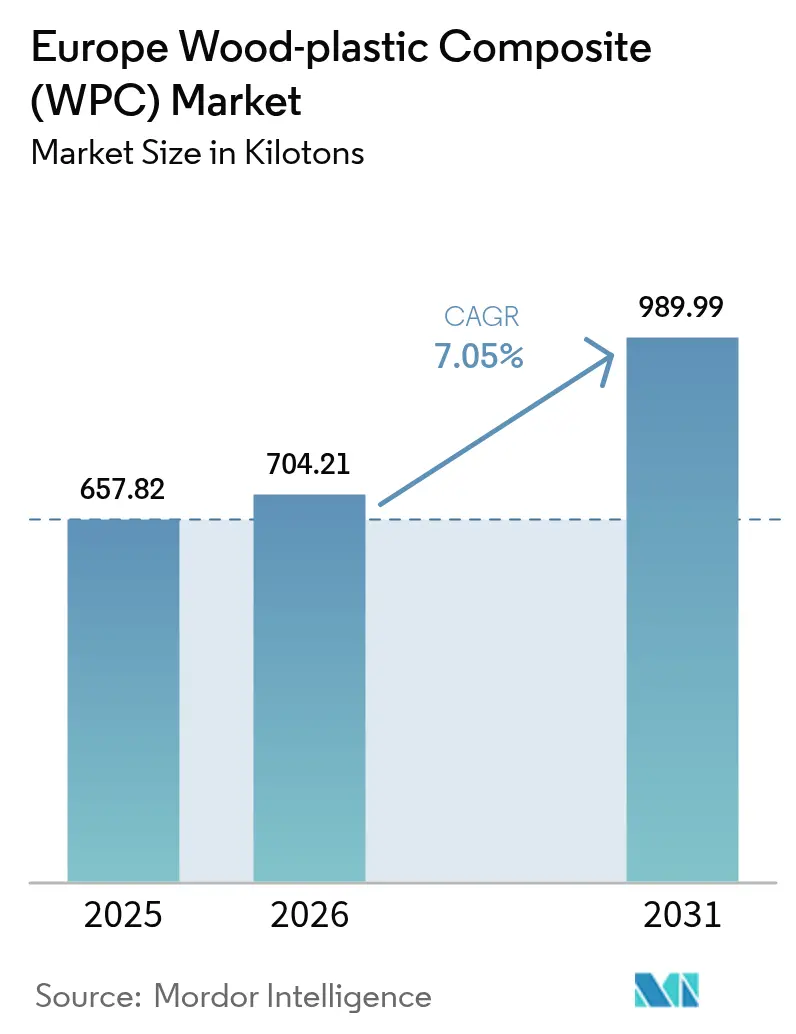
| Base Year Market Size (2025) | 657.82 kilotons |
| Market Volume (2026) | 704.21 kilotons |
| Market Volume (2031) | 989.99 kilotons |
| Growth Rate (2026 - 2031) | 7.05 % |
| Market Concentration | Medium |
Major Players *Disclaimer: Major Players sorted in no particular order Image © Mordor Intelligence. Reuse requires attribution under CC BY 4.0. | |
Europe Wood-plastic Composite (WPC) Market Analysis by Mordor Intelligence
The Europe Wood-plastic Composite market size is expected to grow from 657.82 kilotons in 2025 to 704.21 kilotons in 2026 and is forecast to reach 989.99 kilotons by 2031 at 7.05% CAGR over 2026-2031. Adoption accelerates because regulators, builders, and OEMs view the material as a direct pathway to decarbonize products without sacrificing performance. Demand gains trace to the EU-wide plywood anti-dumping duties that tilt price dynamics in favor of composites, to the recovery of Europe’s construction spending, and to automotive lightweighting imperatives that spotlight natural-fiber–reinforced plastics. Competitive intensity is rising as recyclate-friendly silicone coupling chemistry unlocks higher post-consumer content, and as corporate acquisitions consolidate technology, distribution, and brand power. Manufacturers able to verify feedstock origin under the EU Deforestation Regulation and to match regional design aesthetics with fade-resistant formulations are positioned to capture incremental share within the expanding Europe Wood Plastic Composite market.
Key Report Takeaways
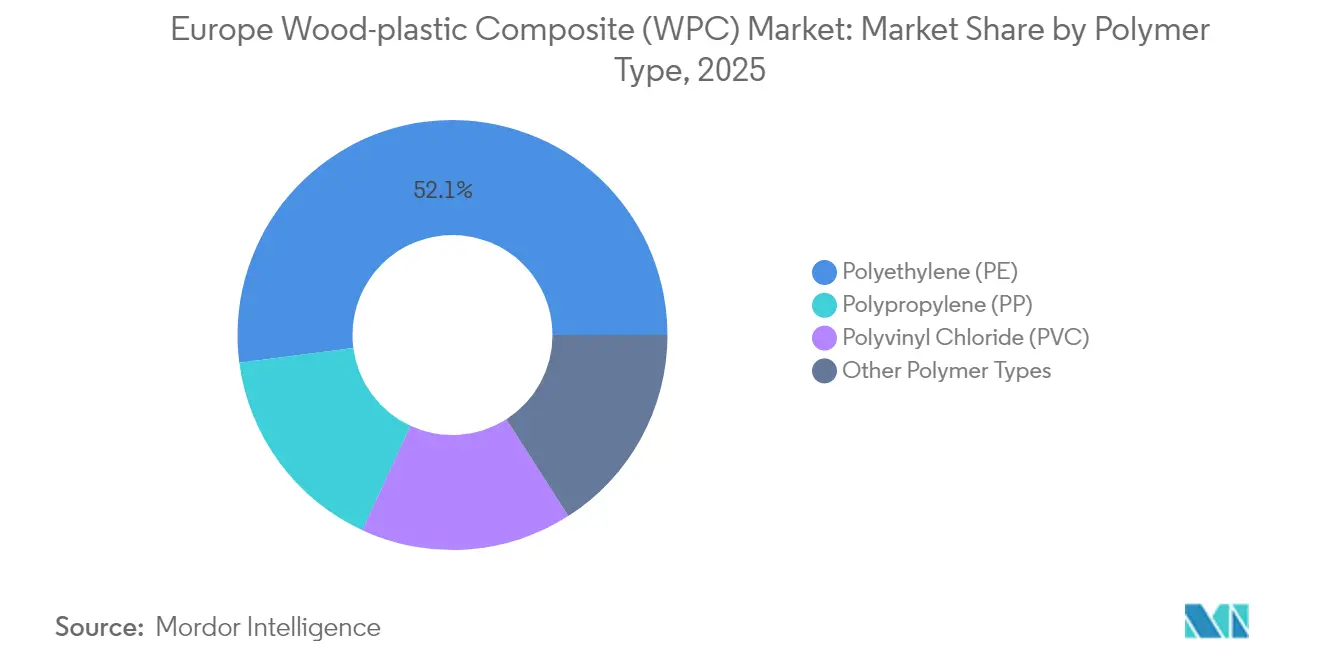
- By polymer type, polyethylene led with 52.06% of the Europe Wood Plastic Composite market share in 2025, while polypropylene is projected to expand at an 7.75% CAGR to 2031.
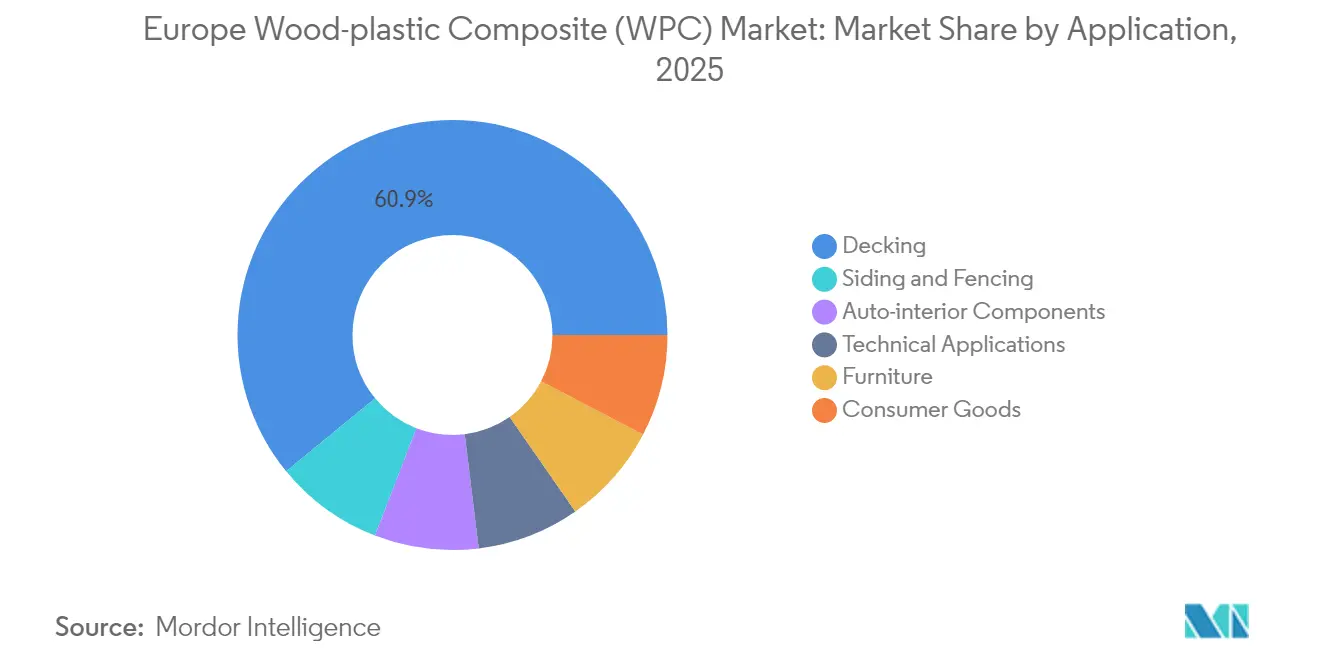
- By application, decking accounted for 60.92% share of the Europe Wood Plastic Composite market size in 2025 and siding and fencing is advancing at a 8.79% CAGR through 2031.
- By geography, Germany held 38.31% revenue share in 2025; Denmark is forecast to register the highest CAGR at 7.88% through 2031.
Note: Market size and forecast figures in this report are generated using Mordor Intelligence’s proprietary estimation framework, updated with the latest available data and insights as of 2026.
Market Trends and Insights
Drivers Impact Analysis of Europe Wood-plastic Composite (WPC) Market*
| Driver | (~) % Impact on CAGR Forecast | Geographic Relevance | Impact Timeline |
|---|---|---|---|
| Sustainable Characteristics of WPC Drive Circular Economy Adoption | +1.8% | Global, with strongest impact in Germany, Nordic countries | Long term (≥ 4 years) |
| Construction-Sector Demand Resurgence Accelerates Infrastructure Investment | +2.1% | Germany, France, UK core markets with spillover to Eastern Europe | Medium term (2-4 years) |
| Lightweighting Push in European Automotive Interiors Creates Niche Opportunities | +1.2% | Germany, France, Italy automotive manufacturing hubs | Medium term (2-4 years) |
| EU Anti-Dumping Duties on Asian Plywood Spur WPC Substitution | +1.5% | EU-wide, particularly Germany, Belgium, Netherlands import centres | Short term (≤ 2 years) |
| EUDR Traceability Boosts Demand for Certified-Origin WPC | +0.8% | EU-wide regulatory compliance requirement | Long term (≥ 4 years) |
| Low-Temperature Silicone-Coupling Tech Enables High-Recycled-Content WPC | +0.6% | Advanced manufacturing regions: Germany, Netherlands, Nordic countries | Long term (≥ 4 years) |
| Source: Mordor Intelligence | |||
Sustainable Characteristics of WPC Drive Circular Economy Adoption
European brands position Europe Wood Plastic Composite market offerings as carbon-smarter substitutes that can lock up to half of their polymer matrix in recyclate while still clearing VinylPlus audits[1]. Mechanical recyclers feed sorted film and rigids into twin-screw extruders, and coupling agents restore fiber–matrix adhesion so decking boards retain flexural strength. The integration of municipal solid-waste streams diverts landfill tonnage and shields processors from virgin polymer volatility. Germany’s take-back schemes now certify geo-tracked wood fiber streams, a regulatory advantage that increases buyer confidence. Even with polymer chain scission after multiple melt cycles, compounders maintain dimensional stability by blending virgin pellets at calibrated thresholds. As a result, the Europe Wood Plastic Composite market secures environmental credits that translate into specification wins with public-sector contractors.
Construction-Sector Demand Resurgence Accelerates Infrastructure Investment
ING’s 2025 outlook confirmed that Europe’s building output returns to positive territory, converting EU Recovery Fund disbursements into renovation outlays that favor low-maintenance cladding. Nordic developers retrofit schools and municipal offices with insulated composite façades that withstand freeze-thaw cycles. Capital projects in France bundle WPC walkways with flood-resilient flood-barrier systems for coastal towns. Suppliers embed hidden-clip systems to reduce onsite labor, an advantage in high-wage Western Europe. Re-roofing and balcony revamps fuel inventory turnover in specialty merchant channels, while public procurement frameworks increasingly score bids on life-cycle emissions. Consequently, the construction rebound supplies a durable volume baseline for the Europe Wood Plastic Composite market.
Lightweighting Push in European Automotive Interiors Creates Niche Opportunities
Original equipment manufacturers replace talc-filled PP panels with 30 wt % wood-fiber-reinforced PP to shave 12% mass and improve acoustic damping in hatchback door trim. Tier-1 molders qualify new material cards under VDA 276 emissions testing, addressing in-cabin volatile organic compound limits. Processors exploit the higher heat-deflection temperature of PP versus PE to survive paint oven bake cycles. Additive packages tailor odor, scratch, and color to meet brand interiors. Audi, Renault, and Stellantis pilot olive-pit or wheat-straw fibers, yet eucalyptus and spruce remain dominant in compound recipes due to uniform morphology. As lightweight norms tighten under the EU fleet emissions cap, automotive pull-through volumes, while modest against decking, provide a high-margin adjunct that elevates the Europe Wood Plastic Composite market profile.
EU Anti-Dumping Duties on Asian Plywood Spur WPC Substitution
On 11 June 2025 the European Commission imposed provisional duties of 62.4% on imported Chinese hardwood plywood, instantly widening the cost delta in favor of domestically extruded composite sheets. Builders that relied on bonded birch panels for temporary formwork pivot to WPC alternatives that can be reused multiple cycles. Importers redirect supply contracts toward regional compounders, unlocking roughly EUR 2.8 billion worth of demand displacement across under-roof decking and crate skids. Manufacturers with short lead times secure framework contracts from DIY chains facing seasonal surges. The tariff window lasts six months but is widely expected to convert into definitive measures, cementing an enduring addressable gain for the Europe Wood Plastic Composite market.
Restraints Impact Analysis of Europe Wood-plastic Composite (WPC) Market*
| Restraint | (~) % Impact on CAGR Forecast | Geographic Relevance | Impact Timeline |
|---|---|---|---|
| Higher Upfront Cost vs. Pressure-Treated Timber Limits Mass-Market Penetration | -1.4% | Price-sensitive markets: Eastern Europe, Southern Europe | Short term (≤ 2 years) |
| UV / Weathering and Color-Fade Challenges Require Advanced Stabilization Systems | -0.9% | High UV exposure regions: Southern Europe, outdoor applications | Medium term (2-4 years) |
| Fire-Performance Compliance Costs Under EU Building Codes | -0.7% | EU-wide, particularly high-rise construction applications | Long term (≥ 4 years) |
| Source: Mordor Intelligence | |||
Higher Upfront Cost vs. Pressure-Treated Timber Limits Mass-Market Penetration
Price comparisons in Romania and Bulgaria show WPC decking retailing at 40-60% premiums versus impregnated spruce boards, keeping cash-constrained homeowners on traditional lumber. Labor savings only accrue over years, whereas purchase decisions remain dominated by invoice totals. Builders face certification fees for CE marking under EN 15534, inflating entry barriers for small lot sizes. Subsidy programs rarely target composite materials, leaving processors to craft own-brand financing schemes. Until production economies of scale or recycled-content credits compress cost curves, this restraint moderates unit uptake in peripheral economies, tempering volume expansion for the Europe Wood Plastic Composite market.
UV / Weathering and Color-Fade Challenges Require Advanced Stabilization Systems
Accelerated xenon-arc testing confirms PP-based composites can lose up to 35% tensile strength after 1,000 hours when unprotected, while color ΔE values exceed homeowner acceptability thresholds in Mediterranean climates. Carbon-black masterbatches enhance stability but yield darker hues that limit architectural freedom. Cap-stock co-extrusion adds bill-of-material cost, and organic-pigment packages suffer photobleaching. Heat-treated fibers improve matrix adhesion yet introduce variability in moisture uptake. Suppliers experiment with nano-TiO₂ and HALS stabilizers but must verify recyclability impacts under DIN EN 13430. The net effect is a technical challenge that restrains exterior-cladding growth potential within the Europe Wood Plastic Composite market.
*Our forecasts treat driver/restraint impacts as directional, not additive. The impact forecasts reflect baseline growth, mix effects, and variable interactions.
Europe Wood-plastic Composite (WPC) Market Segment Analysis
By Polymer Type:
Polyethylene Holds Lead but Polypropylene Gains MomentumPolyethylene recorded a 52.06% share of the Europe Wood Plastic Composite market in 2025, underscoring the entrenched processing infrastructure and its compatibility with softwood fibers. Un-foamed PE profiles exhibit low melt viscosity, enabling high line speeds that translate into cost-per-linear-meter advantages. The segment benefits from widespread availability of post-consumer high-density polyethylene streams sourced from bottle reclaimers, which plug easily into extrusion recipes. Compounders leverage maleic-anhydride-grafted compatibilizers to stabilize the interface, allowing boards to pass EN 310 flexural testing with modest virgin polymer additions. Despite these strengths, PE’s comparatively low heat-deflection temperature curtails its use in automotive or technical panels that encounter service temperatures above 90 °C.
Polypropylene, although trailing in volume, is projected to register the segment-leading 7.75% CAGR as OEMs seek higher heat performance and stiffness for interior modules. Researchers at European institutes demonstrate that PP-based composites deliver 15% higher flexural modulus than PE analogues at equal fiber loadings, while absorbing 25% less moisture. Mold-in-color capability aligns with carmaker demands for class-A surfaces that avoid paint. However, PP processing necessitates tighter thermal windows to avert oxidative degradation, compelling processors to invest in nitrogen-blanketed gravimetric feeders. PVC maintains smaller niches in window profiles and marine decking where inherent UV and flame behavior outweigh cost. Emerging bio-resins such as PLA and PHA remain below 1% share due to price, yet pilot lines in the Netherlands explore their integration, signaling future possibilities for diversifying the Europe Wood Plastic Composite market.

By Application:
Decking Continues to Dominate as Siding Outpaces GrowthDecking retained a commanding 60.92% share of the Europe Wood Plastic Composite market size in 2025, supported by mature DIY segments and standardized clip-lock installation systems. Promotional financing at big-box retailers encourages homeowners to trade up from softwood planks based on lifetime maintenance savings. Slip-resistance ratings under EN 15534-1 classify grooved surfaces for poolside use, expanding hospitality demand across Mediterranean resorts. Nonetheless, growth is moderating because replacement cycles elongate and penetration is already deep in Belgium, Germany, and the Netherlands. To maintain velocity, brands introduce embossed cap-stocks that emulate exotic hardwood grain, combining visual differentiation with scratch resistance.
Siding and fencing, although smaller, accelerate at a 8.79% CAGR as façade designers prioritize materials that integrate insulation layers while resisting UV chalking. Cladding installers appreciate light weight, which simplifies scaffolding logistics on retrofit jobs. Regulatory triggers, notably France’s RE2020 energy code and Germany’s BEG subsidy, elevate demand for exterior rainscreen systems that deliver both thermal and moisture management. Boards pre-drilled for hidden fasteners cut labor hours, while color-through cores reduce on-site touch-up. Fire-performance challenges remain, but ammonium-polyphosphate additives enable C-s3, d0 classifications under EN 13501, widening acceptance in mid-rise projects. The convergence of building-physics requirements and aesthetic preferences expands end-market diversity, reinforcing medium-term scalability for the Europe Wood Plastic Composite market.
Geography Analysis
Germany Wood-plastic Composite (WPC) Market
Germany’s 38.31% share anchors the regional landscape due to its co-located automotive and building-materials value chains. Compounders benefit from access to more than 15 000 installed twin-screw extruders that permit quick recipe iteration. Municipalities demand certified recyclate content in public tenders, lifting average selling prices and margins. Dual-use lines switch from decking to interior trim, balancing seasonal order patterns and smoothing revenue. The domestic fire code pushes suppliers to certify each profile segment, increasing entry barriers that favor incumbents within the Europe Wood Plastic Composite market.
Nordics Wood-plastic Composite (WPC) Market
Nordic countries represent the fastest-growing cluster, led by Denmark’s 7.88% CAGR, thanks to aggressive carbon-neutrality schedules that incentivize low-maintenance façades across social housing. Finland institutionalizes procurement of circular products, channeling sawmill residues into composite extrusion. Sweden’s timber-house producers pair WPC terraces with cross-laminated-timber structures to simplify on-site logistics during short construction windows. Norway’s offshore infrastructure orders salt-spray-resistant gangways, leveraging WPC’s corrosion immunity. Across the bloc, life-cycle-assessment tools standardize environmental declarations, enabling specifiers to benchmark composite offerings and boosting transparency in the Europe Wood Plastic Composite market.
Western Europe Wood-plastic Composite (WPC) Market
Western Europe, encompassing the United Kingdom, France, Belgium, Italy, and Spain, delivers steady but differentiated growth paths. The United Kingdom’s retrofit push drives demand for cladding kits that integrate fire-barrier layers post-Grenfell. France aligns cladding choices with its NF DTU standards, prompting suppliers to localize testing. Belgium’s status as a polymer import gateway supplies compounders with competitive feedstock, encouraging export-oriented production. Italy and Spain draw on tourism infrastructure upgrades—boardwalks, hotel terraces, marina docks—to specify WPC. Across all sub-regions, EUDR compliance and evolving fire classifications create baselines that professionalize the supplier base and help the Europe Wood Plastic Composite market scale beyond early-adopter niches.
Regulatory Landscape
European WPC products sit within a mix of harmonized product standards and EU rules for chemicals and materials that influence what can be placed on the market and how products must be documented. The EN 15534 series remains the core reference for wood-plastic composites and natural-fibre composites across test methods and end products such as decking, cladding, and fencing, shaping CE-marking, declared performance, and specifier acceptance in construction applications.
Regulatory requirements are tightening around plastics and documentation. Under ECHA microplastics obligations, industrial manufacturers must report emissions occurring in 2025 by 31 May 2026, which increases data capture needs and raises coordination requirements across polymer and additive suppliers used in WPC. Separately, Commission Regulation (EU) 2025/2240 (amending 2023/1442) updates rules for plastic materials manufactured with untreated wood flour or fibres for food-contact contexts. Continued market placement after 31 January 2026 depends on the validity of EFSA application status, which affects companies serving adjacent profiles where food-contact claims or migration compliance are relevant.
Value Chain Analysis
The European WPC value chain begins with feedstock supply, primarily wood flour or fibres sourced from sawmill residues and other wood-processing waste, combined with thermoplastic matrices (PE, PP, PVC) and performance additives including coupling agents, stabilizers, pigments, and flame-retardant packages. Compounding concentrates these inputs into pellets or directly fed formulations, followed by extrusion, which is dominant for decking, cladding, and fencing profiles, and, in smaller volumes, injection molding for technical components. Compliance and product qualification run alongside production through EN 15534-based testing, and for building-envelope uses they also require additional fire and weathering performance validation.
Downstream, WPC profiles are sold through building-product distributors, DIY channels, and builders-merchants, and then through project-based procurement for renovation and public projects. In these routes, documentation of recycled content and traceability is increasingly scrutinized. The EU Ecodesign for Sustainable Products Regulation, which entered into force in July 2024, reinforces circular-design expectations across materials and amplifies the value of in-house recycling and secured recycled-polymer streams, reflected in strategies such as Deceuninck expanding recycling capability and broader industry focus on consistent recycled-feedstock quality. Bottlenecks persist around polymer and recycled-material price volatility and the need to control contamination and variability in post-consumer streams, which can affect mechanical performance and surface aesthetics for premium decking and facade applications.
Competitive Landscape
Consolidation reshapes the field after James Hardie’s USD 8.75 billion acquisition of AZEK in 2024, which pairs AZEK’s capped-decking know-how with James Hardie’s fiber-cement channel to broaden European distribution. Large players wield portfolio breadth and marketing budgets to lock shelf space at builders’ merchants. Deceuninck’s vertical integration embeds in-house PVC recycling that lifted reclaimed content to 18% in 2024, supporting VinylPlus accreditation and price premiums. Regional specialists in Poland and the Czech Republic concentrate on private-label production for Northern European brands, while Italian processors exploit design-centric expertise to sell premium terrace kits into luxury hospitality.
Technology partnerships differentiate competitors. Dow supplies silicone-coupling pellets that allow higher recyclate loads without downgrading mechanicals, helping processors meet circular-content quotas. Coperion and Bausano market turnkey extrusion lines that integrate melt filtration and pelletizing, reducing contamination risks associated with post-consumer streams. German toolmakers refine die geometries to combat plate-out and ensure embossing fidelity at high line speeds. Patents cluster around cap-stock UV packages, hollow-core profile geometries, and adhesive-free click-systems.
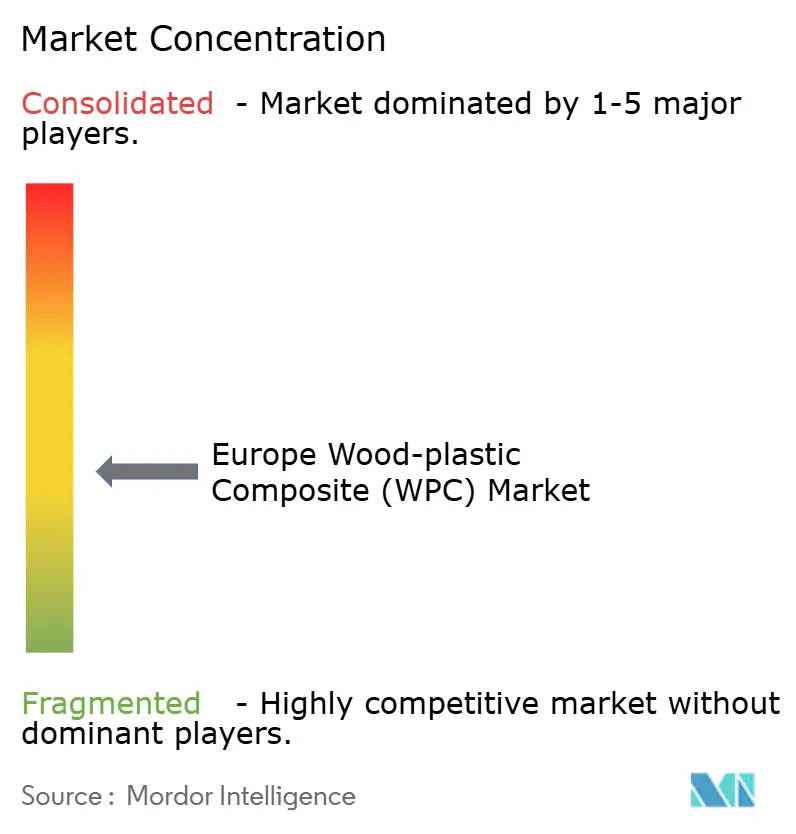
Competitive emphasis shifts toward validated traceability. Companies deploy blockchain-enabled platforms that furnish geolocation data and lab testing certificates to satisfy EUDR auditors. Those lacking verification capabilities risk exclusion from municipal contracts. Fire-performance remains another moat; proprietary formulations that achieve C-s3, d0 without halogens unlock high-rise façade jobsites. Overall, strategic moves in M&A, recycling, and compliance are intensifying market concentration, yet more than 200 active extruders keep the Europe Wood Plastic Composite market moderately fragmented.
Europe Wood-plastic Composite (WPC) Industry Leaders
-
NOVO-TECH GmbH & Co. KG
-
Silvadec
-
UPM
-
Fiberdeck
-
Deceuninck
- *Disclaimer: Major Players sorted in no particular order
Europe Wood-plastic Composite (WPC) Market Companies Covered in this Report
- Bausano S.p.A
- Beologic NV
- Coperion GmbH
- Deceuninck
- Fiberdeck
- FKuR
- JELU-WERK J. Ehrler GmbH & Co. KG
- Kosche Holzwerkstoffe GmbH & Co. KG
- MÖLLER GMBH & CO. KG
- Naftex GmbH
- NaturinForm
- NOVO-TECH GmbH & Co. KG
- Novowood by Iperwood srl
- PolyPlank Solutions AB
- RENOLIT SE
- Silvadec
- TECHWOODN Co., Ltd.
- The AZEK Company Inc.
- Trex Company, Inc.
- UPM
Read Analysis of Europe Wood-plastic Composite (WPC) Companies
Market Opportunities and Future Outlook
An actionable whitespace area is higher-circularity WPC that can be specified with stronger documentation and higher recycled or bio-based content without trading off appearance and durability. The European Commission document COM(2025) 805 final (December 2025) proposes Union-wide end-of-waste criteria for mechanically recycled plastics under the Waste Framework Directive, supporting a more standardized single market for secondary raw materials. This aligns with WPC producers efforts to lock in consistent recycled-polymer inputs and simplify cross-border sourcing.
At the same time, construction-oriented innovation programs provide near-term routes for technology transfer. Wood K, along with ATRIUM, reported work on next-generation WPC decking using bio-polyethylene (from sugar cane) and recycled wood dust, including chemical foaming and co-extrusion to reduce density versus conventional WPC, pointing to product formats that use less material per linear meter while keeping installation compatibility. A second opportunity area is expanding WPC usage in construction systems that prioritize deconstruction and materials separation, where digital product documentation and circular procurement criteria are already reflected in EU policy direction. CIDETEC concluded the BIO-UPTAKE project (May 2026), developing bio-based and recyclable composite concepts for construction using flax fibre and a 3R resin approach (reprocessable, repairable, recyclable), reinforcing a pathway for higher-performance composite architectures that fit future circularity requirements. For market participants, the opportunity is concentrated on turning these program outputs into commercial-grade formulations and validated performance claims (weathering, fire classification, and recyclability), supported by traceability and recycled-content supply agreements needed to win public-sector and renovation-led specifications.
Recent Industry Developments in Europe Wood-plastic Composite (WPC) Market
- January 2026: Silvadec published its 2026 roadmap, emphasizing greater integration of locally sourced recycled plastic into its composite formulations and continued use of the Heuliad Environnement recycling facility. This strengthens feedstock security and supports tighter circular-content claims in a market where procurement increasingly rewards traceability and recycled material integration.
- June 2025: Deceuninck invested EUR 45 million to upgrade recycling infrastructure in Belgium and France. Expanding recycling throughput and quality control supports higher and more consistent recycled content in WPC-related outputs, improving resilience against virgin polymer volatility.
- October 2024: NATURinFORM acquired parts of UPMs production facilities, enabling continued production of the Piazza Pro and Piazza One WPC decking board lines after UPM exited the WPC decking market. The asset transfer preserved installed product platforms and shifted capacity toward a specialist, reinforcing consolidation and continuity for distributors and contractors reliant on those decking systems.
Europe Wood-plastic Composite (WPC) Market Report Scope and Research Methodology
Market Definition and Coverage
This market covers wood-plastic composite (WPC) materials sold in Europe for uses such as decking, siding and fencing, auto-interior components, furniture, consumer goods, and technical applications, counted at the point where WPC products are supplied into these demand pools.
Scope exclusions: It does not include non-WPC wood composites (such as MDF or particleboard), pure plastic lumber with no wood fiber content, or raw timber and conventional plastics sold outside WPC formulations.
Segments Covered in This Report
- By Polymer Type
- Polyethylene (PE)
- Polypropylene (PP)
- Polyvinyl Chloride (PVC)
- Other Polymer Types
- By Application
- Decking
- Auto-interior Components
- Siding and Fencing
- Technical Applications
- Furniture
- Consumer Goods
- By Geography
- Germany
- United Kingdom
- France
- Belgium
- Italy
- Spain
- Finland
- Norway
- Denmark
- Sweden
- Rest of Europe
Data Sources, Market Sizing, and Validation
Desk Research
For desk work, we map demand and supply signals that can be checked publicly and repeated across countries. We use trade and production context from sources such as Eurostat (including PRODCOM where relevant) and UN Comtrade, and we also review policy and compliance signals from the European Commission and ECHA that can influence polymer and additive choices. Standards and guidance from bodies such as CEN and national standard organizations are reviewed too, since WPC use in construction products often links back to test methods and performance claims.
Next, we read company filings, investor presentations, product catalogs, and reputable press items to understand where WPC demand is shifting across construction activity and automotive interior programs. Supporting datasets from paid subscriptions are used selectively for company financials and intelligence, news and financials, and shipment-level import and export visibility when it helps confirm trade direction. The sources listed here are illustrative only, and we reviewed many additional public references to collect, cross-check, and clarify inputs.
Primary Interviews and Surveys
Primary work is used to pressure-test desk assumptions with people who see volumes and pricing movements directly, including compounders, profile and decking manufacturers, distributors, and large project buyers in construction. We also speak with technical and regulatory experts to confirm substitution trends (for example, between PE and PP systems) and realistic recyclate content adoption across Europe. Because this is a regional market, we validate inputs across major European demand centers and traded supply corridors to avoid overfitting the model to a single country.
Distribution of primary research fieldwork respondents
| Company type | Respondent position |
|---|---|
| Top tier: 33% | CXOs: 19% |
| Mid tier: 46% | Functional/Unit leaders: 30% |
| Smaller Players: 21% | Managers: 51% |
Market-Sizing & Forecasting
Sizing is built using a top-down approach where construction and renovation activity, outdoor living demand, and automotive interior build plans are converted into an addressable WPC consumption pool, and then adjusted using trade flow direction and local production indicators. To keep the totals realistic, we corroborate the result with selective bottom-up approximations like sampled supplier revenue splits, channel checks for decking and profiles, and an ASP times volume cross-check for key applications.
Key inputs that shape the model include the mix of polymer systems used in Europe (PE, PP, and other), the share of WPC going into decking versus siding and fencing, seasonal demand patterns for outdoor products, resin and wood flour price movements that influence pricing, and the pace of specification changes linked to compliance and sustainability claims. Where data is uneven by country, gaps are handled by using proxy indicators (for example, construction output and import penetration) and then validated through primary feedback before the final roll-up.
For forecasting, we rely on scenario analysis supported by a small set of drivers that can be tracked annually, such as construction spending trends, housing repair and maintenance momentum, and automotive production outlook. The driver paths are reviewed with industry respondents so short-term shocks and realistic recovery periods are reflected in the forecast.
Data Validation & Update Cycle
Outputs are checked through several passes so the numbers remain consistent with real-world signals. We compare model results against independent indicators like import and export movements, construction activity direction, and observed price ranges by application, and then investigate any sharp jumps that do not match the supporting story.
Before sign-off, assumptions and calculations go through multi-step analyst reviews, with re-contact triggered when a key variable changes materially, such as resin pricing, demand pull from decking, or a regulation-driven formulation shift. Reports are refreshed annually, and interim updates are made when major events occur, followed by a final pre-delivery review so clients receive the latest view.
Mordor Intelligence's Europe Wood Plastic Composite Market Size Measured Against Other Published Estimates
Published market sizes for Europe WPC often do not match each other because definitions, units, and price logic are not consistent across studies. Differences usually come from whether the estimate is built in value or volume terms, what countries are included under Europe, and how application splits like decking versus technical uses are handled.
Some publishers present a value number that folds in adjacent building composites or applies one blended price across very different applications. Here the count is limited to WPC types and end uses, and the volume series published by Mordor Intelligence (657.82 kilotons in 2025) is kept separate from USD value constructs that depend heavily on assumed ASP escalation.
Benchmark comparison
| Source | Market Size | Gaps in Research Methodology |
|---|---|---|
| Mordor Intelligence | USD 0.66 M (2025) | |
| Regional Consultancy A | USD 1.96 B (2023) | Uses a value-based market definition in USD and can blend pricing across applications, which tends to raise totals when higher-priced profiles are mixed with bulk volumes without a clear split. |
| Trade Journal B | USD 3.42 B (2031) | Publishes a long-range value forecast that can embed optimistic price escalation and wider category inclusion, and it is not always clear how Europe coverage and polymer mix shifts are treated year to year. |
The comparison shows that the spread is mainly explained by unit choice and how closely each publisher separates true WPC demand from nearby categories. By tying assumptions to repeatable demand drivers and then checking them with channel feedback, the final view stays balanced and easy to replicate year over year.
Key Questions Answered in the Report
What is the projected volume for Europe’s WPC demand in 2031?
The market is forecast to reach 989.99 kilo tons by 2031, reflecting a 7.05% CAGR from 2026.
Which polymer dominates European WPC formulations?
Polyethylene currently leads with 52.06% share, though polypropylene is growing faster due to higher heat-resistance needs.
Which end use is expanding the quickest?
Siding and fencing applications are advancing at a 8.79% CAGR as builders look for low-maintenance exterior cladding.
Why is Germany the largest national market?
Germany combines advanced extrusion infrastructure with strong automotive and construction activity, yielding 38.31% share in 2025.