
Market Overview
| Study Period | 2021 - 2031 |
|---|---|
| Forecast Data Period | 2026 - 2031 |
| Base Year Market Size (2025) | USD 164.26 Billion |
| Market Size (2026) | USD 168.42 Billion |
| Market Size (2031) | USD 190.64 Billion |
| Growth Rate (2026 - 2031) | 2.53 % |
| Market Concentration | Low |
Major Players *Disclaimer: Major Players sorted in no particular order Image © Mordor Intelligence. Reuse requires attribution under CC BY 4.0. | |
Europe Wine Market Analysis by Mordor Intelligence
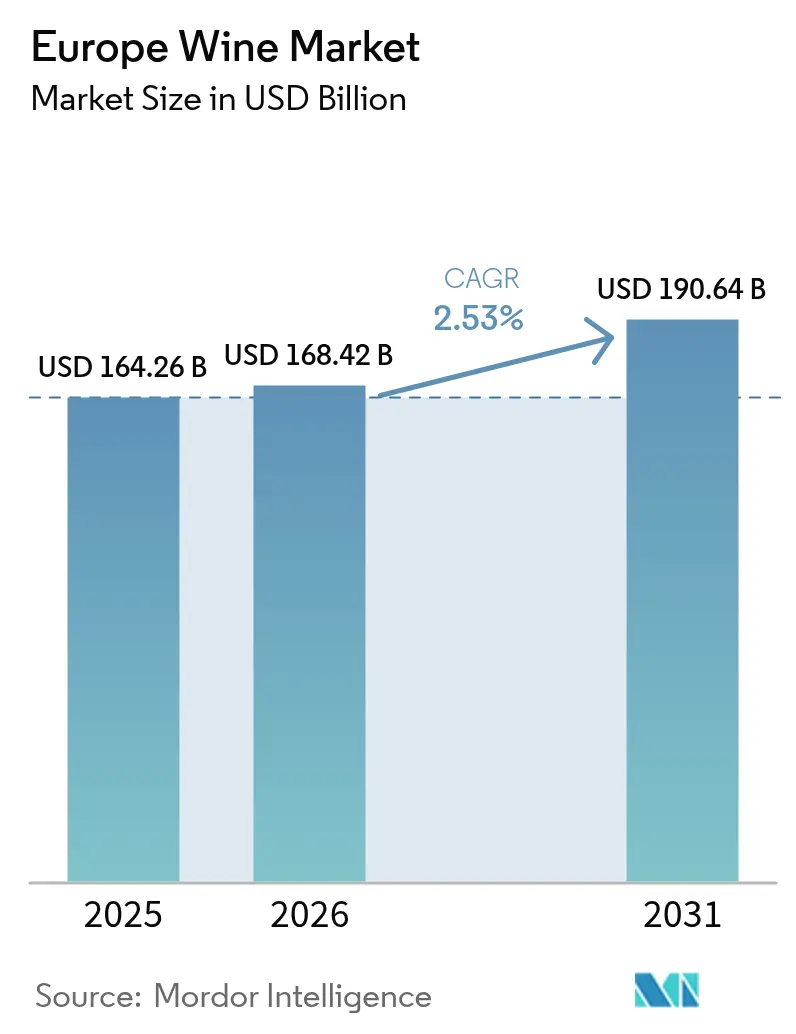
Europe wine market size in 2026 is estimated at USD 168.42 billion, growing from 2025 value of USD 164.26 billion with 2031 projections showing USD 190.64 billion, growing at 2.53% CAGR over 2026-2031. The market demonstrates measured expansion as deeply rooted consumption patterns align with increasing consumer sophistication, particularly in their preference for premium wines and environmentally responsible production methods. The resurgence of the fine dining sector, renewed interest in wine tourism experiences, and the proliferation of digital direct-to-consumer sales platforms have generated substantial revenue diversification opportunities across the European wine industry. Wine producers are responding to stringent EU regulatory requirements and evolving consumer expectations by investing in organic certifications, developing eco-friendly packaging solutions, and implementing QR-code labeling systems to ensure complete supply chain transparency.
Key Report Takeaways
- By product type, Still Wine led with 77.02% of the Europe wine market share in 2025, while Sparkling Wine is projected to expand at a 3.71% CAGR through 2031.
- By color, Red Wine accounted for 45.94% of the Europe wine market size in 2025 and Rosé Wine is set to register the fastest 3.49% CAGR between 2026 and 2031.
- By end user, Women represented 59.68% consumption share in 2025, whereas male consumers will post a 3.55% CAGR through 2031.
- By distribution channel, Off-Trade held 61.98% of value in 2025, yet On-Trade is forecast to grow at 3.66% CAGR during 2026-2031 as wine tourism rebounds.
- By geography, France dominated with a 23.95% share in 2025, while the United Kingdom is set to grow the quickest at a 3.32% CAGR through 2031.
Note: Market size and forecast figures in this report are generated using Mordor Intelligence’s proprietary estimation framework, updated with the latest available data and insights as of 2026.
Europe Wine Market Trends and Insights
Drivers Impact Analysis*
| Driver | (~) % Impact on CAGR Forecast | Geographic Relevance | Impact Timeline |
|---|---|---|---|
| Consumer preference for traditional, terroir-driven wines | +0.8% | France, Italy, Spain, Germany | Long term (≥ 4 years) |
| High quality and diverse wine varieties produced in Europe | +0.6% | Global, with concentration in EU core regions | Medium term (2-4 years) |
| Established wine tourism and wine-related experiences attracting consumers | +0.4% | France, Italy, Spain, Portugal | Medium term (2-4 years) |
| Growing popularity of low and non-alcoholic wines | +0.3% | Northern Europe, Germany, UK | Short term (≤ 2 years) |
| Innovation in wine production technologies and vineyard management | +0.2% | EU-wide, with focus on Mediterranean regions | Long term (≥ 4 years) |
| Rising interest in artisan and natural wines | +0.3% | Urban markets across EU | Medium term (2-4 years) |
| Source: Mordor Intelligence | |||
Consumer Preference for Traditional, Terroir-Driven Wines
European consumers are showing a strong inclination towards authentic wines that embody the distinct characteristics of their geographic origins and honor traditional production methods, resulting in increased demand for Protected Designation of Origin (PDO) wines. The European Union's geographical indications regulation (EU) 2024/1143 provides enhanced protection measures for wine regions, with 1,085 European wine regions currently producing PDO-labeled wines [1]. This comprehensive regulatory framework supports the development of premium wine production, as wines that express their unique terroir characteristics generate substantial profit margins and establish lasting consumer relationships through their rich regional heritage. Recent climate change vulnerability assessments have identified significant exposure risks in regions such as Romania, Croatia, and Italy, potentially increasing the market value of wines produced through traditional methods in these areas. This market development aligns with the evolving consumer behavior that emphasizes informed, quality-focused purchasing decisions, where consumers prioritize wine excellence and authenticity rather than volume consumption.
High Quality and Diverse Wine Varieties Produced in Europe
Europe maintains its dominant market position in fine wine production, representing a substantial majority of global fine wine output. This leadership stems from the region's established viticultural heritage, traditional winemaking expertise, and diverse microclimates that create ideal growing conditions. Italian wine producers project notable sales and export increases, with sparkling wines demonstrating particularly robust revenue performance compared to still wines. The market exhibits a clear divide between price segments, with premium wines experiencing substantial growth while mid-range wines face declining sales, indicating a significant consumer migration toward higher-quality offerings. Regional specialization continues to strengthen, highlighted by Prosecco's remarkable export performance and the impressive expansion of English sparkling wine sales over recent years.
Established Wine Tourism and Wine-Related Experiences Attracting Consumers
Wine tourism continues to drive substantial economic value, particularly exemplified by the French wine industry's contribution to employment and tax revenue through tourism activities. The evolution of wine tourism experiences through digital transformation has enabled wineries to implement innovative technologies, such as QR codes and virtual elements, enhancing visitor engagement while preserving the authentic human connections essential to wine experiences. Research demonstrates distinct preferences among wine tourists, with Italian and Turkish visitors both valuing expert-led tours but differing in their priorities - Italians appreciate winery aesthetics, while Turkish visitors emphasize the importance of pre-visit informational sessions. In the wake of the pandemic recovery, there has been a notable surge in demand for rural tourism experiences, creating opportunities for wine regions that showcase authentic, sustainable encounters with local terroir and cultural heritage.
Growing Popularity of Low and Non-Alcoholic Wines
The no-low alcohol (NOLO) wine market in France has achieved substantial market value, demonstrating robust growth in recent years. Market research shows that a majority of French consumers are actively reducing their alcohol consumption, reflecting a broader shift toward mindful drinking habits. The retail landscape has evolved significantly, with specialized NOLO stores expanding their footprint across France, enhancing product accessibility nationwide. This transformation is particularly noticeable among the younger generation, where a considerable portion of teenagers have chosen complete alcohol abstinence. European wine producers have strategically adapted to these changing consumer preferences by developing dealcoholized options in their portfolios, specifically catering to millennials and Gen Z consumers who seek to balance social engagement with health-conscious lifestyle choices.
Restraints Impact Analysis*
| Restraints | (~) % Impact on CAGR Forecast | Geographic Relevance | Impact Timeline |
|---|---|---|---|
| Regulatory and labeling complexity across different EU member states | -0.4% | EU-wide, particularly affecting cross-border trade | Short term (≤ 2 years) |
| Changing consumer preferences towards beer, spirits, or other beverages | -0.6% | Northern Europe, urban markets | Medium term (2-4 years) |
| Rising cost and availability of agricultural inputs and labor shortages | -0.5% | Mediterranean regions, Eastern Europe | Short term (≤ 2 years) |
| Environmental concerns over water use and pesticide application | -0.3% | Southern Europe, drought-affected regions | Long term (≥ 4 years) |
| Source: Mordor Intelligence | |||
Regulatory and Labeling Complexity Across Different EU Member States
The European Union's comprehensive wine labeling regulations, which took effect on December 8, 2023, introduce mandatory requirements for detailed nutritional information and complete ingredient lists on wine products [2]. These requirements present significant compliance challenges for wine producers, particularly due to the diverse language requirements across different member states. Although digital solutions and QR codes offer producers a practical and cost-effective path to compliance, the task of managing multiple regulatory frameworks within EU markets increases operational expenses and establishes substantial market entry barriers, especially impacting small and medium-sized producers. This regulation represents the most substantial modification to wine labeling requirements in more than a century, compelling manufacturers to find an effective balance between maintaining transparent consumer communication and managing their compliance-related expenses. The inconsistent interpretation and enforcement standards among various member states have introduced complications in cross-border trade operations, potentially undermining the unified market advantages that European wine producers have historically benefited from.
Changing Consumer Preferences Towards Beer, Spirits, or Other Beverages
European wine consumption shows a significant downward trajectory compared to previous years, primarily driven by changing preferences among younger consumers who are increasingly gravitating toward alternative alcoholic beverages and non-alcoholic options. The German wine market is experiencing unprecedented challenges, with domestic market share reaching its lowest point as consumers demonstrate a clear preference for affordable imported wines and alternative beverage choices. This shift in consumption patterns extends globally, reflecting fundamental changes in drinking habits influenced by growing health awareness, financial considerations, and evolving lifestyle preferences. The transformation is particularly noticeable in urban markets, where craft beer, premium spirits, and innovative non-alcoholic beverages are actively competing with traditional wine consumption. In response, wine producers are strategically adjusting their product portfolios and marketing approaches to maintain market relevance.
*Our forecasts treat driver/restraint impacts as directional, not additive. The impact forecasts reflect baseline growth, mix effects, and variable interactions.
Segment Analysis
By Product Type: Sparkling Wines Drive Premium Growth
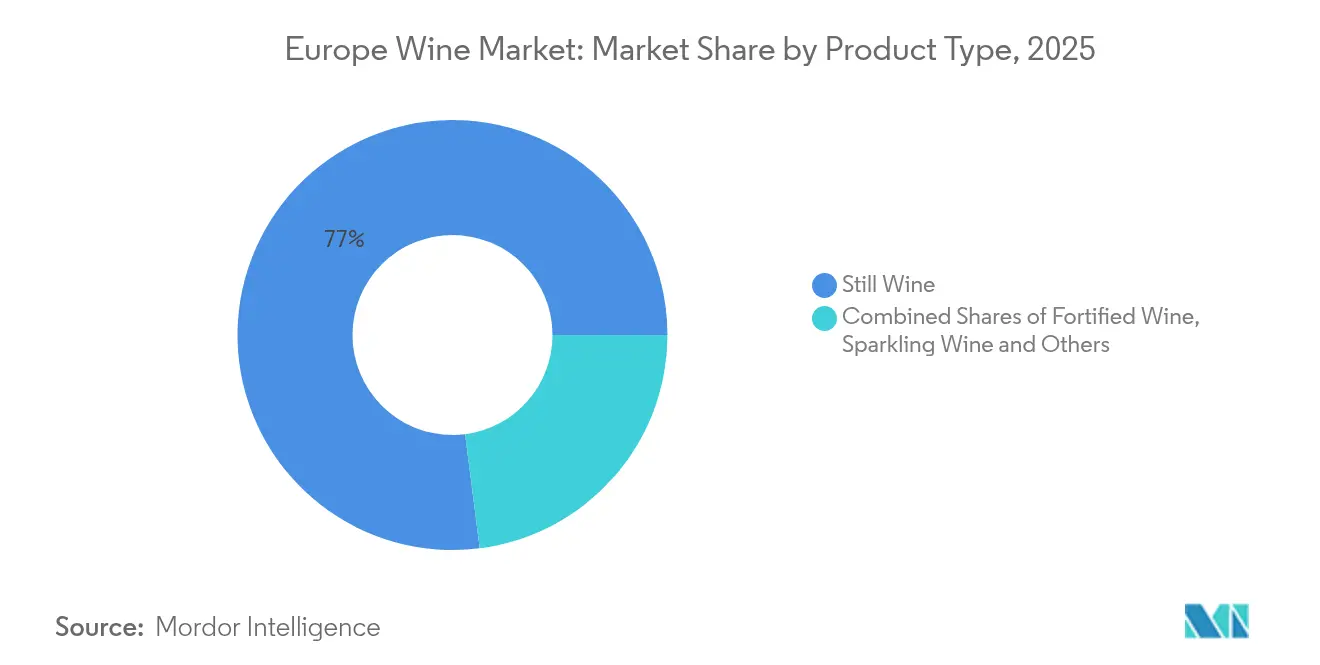
Still Wine maintains its commanding position in the market with a 77.02% share in 2025, demonstrating its fundamental importance in European wine consumption and cultural traditions. The category's dominance reflects consumer preferences for traditional wine experiences and its integration into daily dining and social occasions across European households.
Sparkling Wine demonstrates robust market performance with a projected CAGR of 3.71% through 2031, driven by increasing consumer preference for celebratory beverages and growing demand for premium products. Prosecco's remarkable performance, exceeding 1 billion bottles in exports during 2024, highlights its successful penetration into Asian markets and resonance with younger consumer demographics. While Champagne experiences market challenges with a 9% sales reduction in 2024, influenced by economic factors and increased competition from alternative sparkling wines, Crémant shows notable market strength with sales reaching 108 million bottles in 2024.

By Color: Rosé Wines Capture Millennial Preferences
Red wine dominates the European wine market with a 45.94% share in 2025, reflecting its strong cultural significance, particularly in Mediterranean countries. The wine's deep connection to regional gastronomy and traditional dining practices continues to drive consumer preferences, especially in established markets like France, Italy, and Spain, where red wine remains a fundamental element of daily meals and social gatherings.
Rosé wine demonstrates remarkable market dynamics, achieving the highest growth rate at 3.49% CAGR through 2031, despite its smaller volume share. This growth trajectory stems from increasing acceptance among younger consumers who value its adaptability across dining occasions and social settings. White wine maintains its market position between these two categories, benefiting from evolving climate conditions that have enhanced grape quality in regions traditionally known for red wine production, leading to improved white wine offerings across European vineyards.
By End User: Male Consumption Patterns Evolving Rapidly
Women account for 59.68% of wine consumption in 2025, demonstrating their significant influence in household purchasing decisions. Their preference for wine in social gatherings and entertainment venues has established them as the dominant consumer demographic in the global wine market.
Men have emerged as the fastest-growing consumer segment, exhibiting a 3.55% CAGR through 2031. This growth stems from increasing male participation in wine education programs, growing interest in wine and food pairing experiences, and rising demand for premium wine offerings. The wine industry has successfully broadened its consumer base by implementing targeted marketing strategies, positioning wine within the craft beverage category, and highlighting the technical aspects of viticulture and winemaking processes.

By Distribution Channel: On-Trade Recovery Accelerates
Off-Trade channels maintain a dominant position with a 61.98% market share in 2025, operating through an extensive network of specialty liquor stores, supermarkets, and online platforms. These channels have successfully captured consumer preferences by offering convenient shopping experiences and competitive pricing structures, enabling customers to purchase their preferred wines at their own pace and compare options effectively.
On-Trade channels demonstrate robust growth potential with a projected 3.66% CAGR through 2031, fueled by the resurgence of wine tourism activities and substantial expansion in the restaurant industry. The post-pandemic consumer behavior shows a marked shift toward experiential consumption, with On-Trade establishments becoming key venues for premium wine offerings. These venues create immersive environments for wine discovery and education, establishing deeper connections between consumers and brands, which naturally translates into stronger brand loyalty and consistent repeat purchases.
Geography Analysis
The European wine market continues to be dominated by France, which holds a substantial 23.95% market share in 2025. As the region's largest wine economy, France has successfully maintained its leadership position despite facing significant production challenges that resulted in a 22% reduction in output to 37.4 million hectoliters. The country's wine exports remain robust at EUR 12.1 billion in 2024, with a strategic focus on premium segments where traditional terroir authenticity and prestigious AOC designations enable higher profit margins . The French wine industry's strength is further reinforced by its well-developed wine tourism infrastructure and deep-rooted cultural positioning, which effectively supports premiumization strategies even in the face of volume pressures stemming from climate challenges and evolving consumption patterns.
In the evolving European wine landscape, the United Kingdom has established itself as the market's most dynamic performer, projecting a steady growth rate of 3.32% CAGR through 2031. This remarkable growth trajectory is underpinned by increasingly sophisticated consumer preferences and strong premiumization trends. The country's domestic wine industry has shown particular promise in the sparkling wine category, where production achievements have led to a threefold increase in sales over a five-year period, demonstrating the market's significant potential and growing consumer acceptance.Other major European wine producers have demonstrated notable resilience in their production capabilities. Italy has achieved significant market success with a turnover of EUR 14 billion and production volumes reaching 44.07 million hectoliters, representing a 7% increase compared to 2024. Similarly, Spain has shown strong production performance, recording 38.1 million hectoliters, marking an impressive 18% increase from 2024 levels. These figures underscore the robust nature of the European wine industry's production capacity and its ability to adapt to changing market conditions.
Regulatory Landscape
The European wine market operates under an EU-wide framework that governs production rules, market interventions, and labeling. A key recent change is the Council of the European Union approval of a wine-sector support package in February 2026, implemented through Regulation (EU) 2026/471 (adopted 24 February 2026), which amends core rules affecting wine and aromatized wine products and introduces tools for supply-demand balancing (including grubbing-up support) and higher public co-financing for climate-related investments.
At the same time, the EU continues tightening origin and transparency requirements that affect branding and cross-border trade. Regulation (EU) 2024/1143 (adopted 11 April 2024) strengthened and aligned rules for geographical indications (GI) across wine and other products, reinforcing PDO/PGI positioning. Labeling obligations that took effect from December 8, 2023 cover nutrition and ingredient disclosure (often supported through e-label/QR solutions), and the extension of the vineyard authorization scheme for new plantings through 2045, with planned reviews in 2028 and 2040, remains an important compliance anchor for producers selling across multiple member states.
Value Chain Analysis
The Europe wine value chain spans (1) viti-viniculture, including vineyard establishment, canopy management, plant protection, irrigation where applicable, and harvest operations; (2) winemaking, including crushing, fermentation, maturation, blending, and quality control; and (3) commercialization through bulk/finished-goods logistics, importers/wholesalers, off-trade retailers (supermarkets, specialty stores, e-commerce), and on-trade (restaurants, wine bars, hospitality and wine tourism). Cooperatives and producer groups act as central intermediaries in sourcing grapes, stabilizing volumes, and providing shared processing and bottling capacity, particularly in major producing regions.
Upstream variability (drought, frost, and heat events) and structural surpluses in some areas remain key bottlenecks, shaping bulk availability and price formation. Downstream, compliance and go-to-market capabilities are increasingly connected across the chain: EU labeling requirements have pushed producers to integrate packaging and label design with digital information delivery (QR/e-labels), while policy changes under Regulation (EU) 2026/471 (February 2026) tie modernization and climate adaptation financing to vineyard and winery investment decisions, affecting equipment suppliers, bottling and packaging partners, and service providers supporting traceability and sustainability reporting.
Competitive Landscape
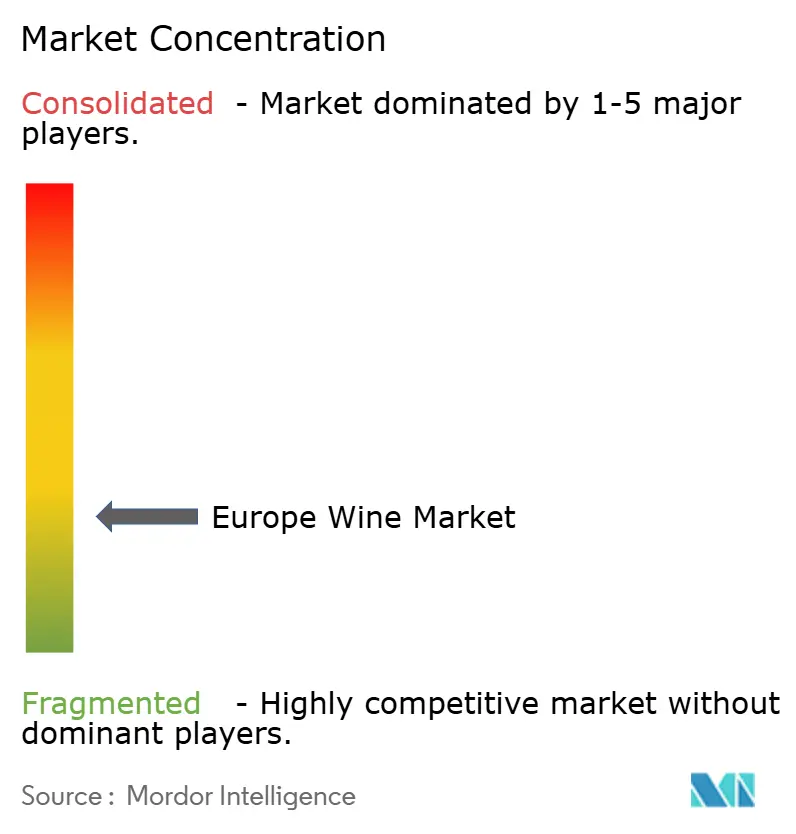
The European wine market's fragmented competitive landscape presents significant opportunities for both market consolidation and specialized niche positioning strategies. The industry underwent substantial restructuring throughout 2024-2025, marked by notable corporate transactions. In May 2025, Pernod Ricard executed a strategic divestiture of its wine assets to Australian Wine Holdco Limited, resulting in the formation of Vinarchy. This new entity emerged as a significant market player, generating over 32 million cases in annual production and achieving AUD2 billion in retail sales. In a parallel development during April 2025, Constellation Brands implemented a strategic portfolio transformation, focusing on premium wines priced above USD 15. This involved divesting mainstream brands to The Wine Group while maintaining ownership of high-margin assets, including Robert Mondavi Winery and Kim Crawford. These strategic decisions reflect broader industry shifts toward premiumization and address the fundamental challenge of sustaining growth in markets experiencing volume declines.
The integration of technology has emerged as a crucial factor in determining competitive advantage within the wine industry. Smart farming technologies have demonstrated substantial environmental benefits, achieving a remarkable 75% reduction in pesticide usage and a significant 33.4% decrease in greenhouse gas emissions. The convergence of sustainability initiatives and digital transformation has created valuable opportunities, particularly for smaller wine producers. These businesses can now effectively compete with larger established companies by implementing precision agriculture techniques and utilizing direct-to-consumer digital platforms. The market's fragmented structure continues to benefit regional wine specialists, who maintain their competitive positions through authentic terroir offerings and immersive marketing experiences, while larger industry players concentrate on optimizing their portfolios and expanding their international presence.
The regulatory environment, particularly EU labeling requirements, has established significant barriers for new market entrants. This regulatory framework potentially favors established wine producers who possess the necessary resources and expertise to navigate complex compliance requirements across multiple markets. These requirements have contributed to a gradual consolidation of market share among well-established companies that can effectively manage and adapt to evolving regulatory standards while maintaining operational efficiency.
Europe Wine Industry Leaders
-
E. & J. Gallo Winery
-
Constellation Brands
-
Castel Group
-
Pernod Ricard SA
-
Treasury Wine Estates
- *Disclaimer: Major Players sorted in no particular order
Market Opportunities and Future Outlook
Investment-led modernization tied to climate adaptation and efficiency is a visible opportunity area across European wineries and vineyards. Regulation (EU) 2026/471 (February 2026) allows member states to raise public support for climate-resilient investments up to 80%, supporting upgrades such as temperature control, water and energy management, and resilient vineyard practices. It also improves the visibility of capex cycles for equipment, services, and technology providers.
Portfolio reshaping, consolidation, and direct-to-consumer enablement are also creating room for scaled brands and digital-first route-to-market strategies. In March 2026, AdVini signed a binding agreement to acquire substantial wine-growing assets from Cordier By InVivo, including Cafe de Paris, highlighting continued M&A activity in branded wine. In April 2026, Herita Marzotto Wine Estates inaugurated an expanded Kettmeir facility in Caldaro after an investment exceeding EUR 10 million, and in April 2026 Purcari Wineries acquired CaraprodVin SRL in Vrancea, Romania, adding vineyards and production capacity. These moves point to capital being directed toward capacity, brand platforms, and regional footprint expansion, while industry programs such as the PTV Strategic Innovation Agenda 2025-2027 formalize R&D lines around digitalisation, sustainability, and process/product innovation.
Recent Industry Developments
- April 2026: E. & J. Gallo Winery finalized the acquisition of Four Roses Distillery, LLC, at an enterprise value reported at USD 775 million. The deal strengthens Gallo's premium platform and adds a globally recognizable spirits brand that can be routed through established European distribution networks, influencing competitive positioning for premium offerings in on-trade and specialist retail.
- October 2025: Castel Group (Castel Freres) acquired Tannico, an Italian online wine retailer, from LVMH and Campari Group. The transaction expands Castel's direct-to-consumer and digital commerce reach in Europe, reinforcing the role of e-commerce platforms in premium discovery, assortment breadth, and data-driven customer acquisition.
- November 2024: FC Barcelona and Raventos Codorniu signed a five-season sponsorship agreement running through June 30, 2029, making Raventos Codorniu the Official Wine and Cava Partner of Espai Barca. This embeds a major sparkling wine portfolio into a high-visibility hospitality and VIP consumption setting, supporting brand premiumization and on-trade activation tied to venue-led experiences.
Research Methodology Framework and Report Scope
Market Definition and Coverage
This market covers the value of wine sold for consumption across Europe, including sparkling, still, and other wine styles, as captured through on-trade and off-trade channels and measured in current US dollars.
Scope exclusions: We exclude non-wine alcohol such as beer and spirits, and we also exclude wine-derived cocktails and ready-to-drink products that are not sold as wine.
Segmentation Overview
- By Product Type
- Fortified Wine
- Still Wine
- Sparkling Wine
- Others
- By Color
- Red Wine
- White Wine
- Rosé Wine
- By End User
- Men
- Women
- By Distribution Channel
- On-Trade
- Off-Trade
- Specialty/Liquor Stores
- Others Off Trade Channels
- By Country
- Germany
- United Kingdom
- Italy
- France
- Spain
- Netherlands
- Poland
- Belgium
- Sweden
- Rest of Europe
Data Sources, Market Sizing, and Validation
Desk Research
We start by building a consistent fact base for Europe that can be checked country by country, then rolled up into a regional total. The desk layer typically relies on public production, trade, and consumption references such as OIV statistical publications, Eurostat datasets (agriculture and trade), the European Commission agriculture market outlook notes, and national customs or statistical offices where wine and grape-must flows are reported.
We then tighten the inputs using company filings, investor presentations, and trusted industry press, so pricing direction and channel shifts are not missed across key markets like France, Italy, and Spain. For cross-border flows and price direction, we also use an import export shipment-level database and a news and financials subscription, and we refer to patent databases when packaging, closures, or preservation technologies are material to value growth. This desk list is illustrative, and many other sources are used for data collection, validation, and clarification.
Primary Interviews and Surveys
Next, we validate the desk assumptions through expert interviews and structured surveys across producers, distributors, retailers, and foodservice-linked stakeholders, since channel mix drives value more than volume in many European countries. The fieldwork also clarified how respondents interpret on-trade versus off-trade category boundaries for wine in hospitality and retail formats. Coverage is balanced across major wine markets in Europe, and inputs are checked for consistency on pricing, trading-down or premiumization, and the impact of tourism and hospitality demand.
Distribution of primary research fieldwork respondents
| Company type | Respondent position |
|---|---|
| Top tier: 34% | CXOs: 12% |
| Mid tier: 51% | Functional/Unit leaders: 30% |
| Smaller Players: 15% | Managers: 58% |
Market-Sizing & Forecasting
The sizing starts with a top-down build that reconstructs demand using country consumption and trade flows, which are then converted into value using observable pricing and channel mix. To keep the numbers realistic, we corroborate totals with selective bottom-up approximations like sampled average selling price ranges by format, distributor channel checks, and supplier revenue splits where Europe exposure is disclosed.
In this market, analysts pay close attention to apparent consumption trends (including on-trade recovery), import and export volumes and values, vineyard area and production variability linked to harvest conditions, shifts in sparkling versus still demand, and inflation-led pricing progression in retail and hospitality. For forecasting, we apply scenario analysis anchored on a small set of variables that experts agree on, such as tourism activity, disposable income pressure, and expected normalization of supply after weak harvest years. When company disclosures do not break out Europe cleanly, we handle gaps using geography share proxies and channel-weighted pricing so the roll-up remains consistent with public signals.
Data Validation & Update Cycle
Before sign-off, model outputs are compared with independent signals like trade value direction, category growth reported by national bodies, and broad price index movements that could explain value changes. Any sharp jumps are reviewed, and assumptions are re-checked against interview notes. Follow-up calls are triggered when a variance cannot be explained by harvest, channel, or currency effects.
Reports are refreshed annually, and interim updates are made when major shocks occur, such as regulatory changes, extreme weather impacts, or abrupt shifts in on-trade demand. Right before delivery, an analyst runs a fresh pass on key inputs so clients receive an updated view that is consistent across countries and time periods.
Mordor Intelligence's Europe Wine Market Sizing Compared With Other Published Estimates
Published figures for Europe wine can look far apart, even when they sound like they are measuring the same thing, because the boundary conditions are often not aligned. In our checks, the main drivers are whether the estimate is based on retail receipts versus supply and trade signals, how on-trade value is treated, and how currency timing and inflation are applied.
Trade values, apparent consumption patterns, and on-trade recovery signals are the evidence set that keeps Mordor Intelligence tied to a wine-only Europe demand pool, rather than folding in adjacent alcohol categories or wine-based ready-to-drink. Differences also come from how some publishers treat the EU-only scope versus wider Europe, and whether they apply a single price curve across countries instead of using country-level price and channel weights that reflect local mix.
Benchmark comparison
| Source | Market Size | Gaps in Research Methodology |
|---|---|---|
| Mordor Intelligence | USD 164.26 B (2025) | |
| Trade Journal A | USD 231.00 B (2024) | Uses broad retail value statements for Europe that can blend on-trade and off-trade without a clear country roll-up, and may include wider alcoholic beverage spend linked to wine occasions. |
| Industry Source B | USD 100.30 B (2023) | Focuses on the EU wine sector economic footprint, which is closer to value chain or sold production measures and can undercount final consumer spending outside the EU and in hospitality. |
The spread is mostly explained by scope and the layer of value being counted, which is why the table shows one estimate closer to consumer spend and another closer to sector economics. By keeping the inputs anchored to country-level trade and consumption signals and then applying channel-aware pricing, we end up with a value that can be traced and repeated without relying on a single headline number.
Key Questions Answered in the Report
What is the current value of the Europe wine market?
It is valued at USD 168.42 billion in 2026 and is projected to reach USD 190.64 billion by 2031.
Which product category is showing the fastest growth across Europe?
Sparkling Wine, supported by booming Prosecco exports, is forecast to record a 3.71% CAGR from 2026 to 2031.
Which geography holds the largest share in European wine sales?
France leads with 23.95% of regional revenue thanks to its AOC portfolio and strong export base.
What channel is expected to outpace the rest for wine sales?
On-Trade outlets such as restaurants and wine bars are projected to grow at a 3.66% CAGR on the back of tourism recovery.