
Market Overview
| Study Period | 2021 - 2031 |
|---|---|
| Forecast Data Period | 2026 - 2031 |
| Base Year Market Size (2025) | USD 1.15 Billion |
| Market Size (2026) | USD 1.25 Billion |
| Market Size (2031) | USD 1.89 Billion |
| Growth Rate (2026 - 2031) | 8.62 % |
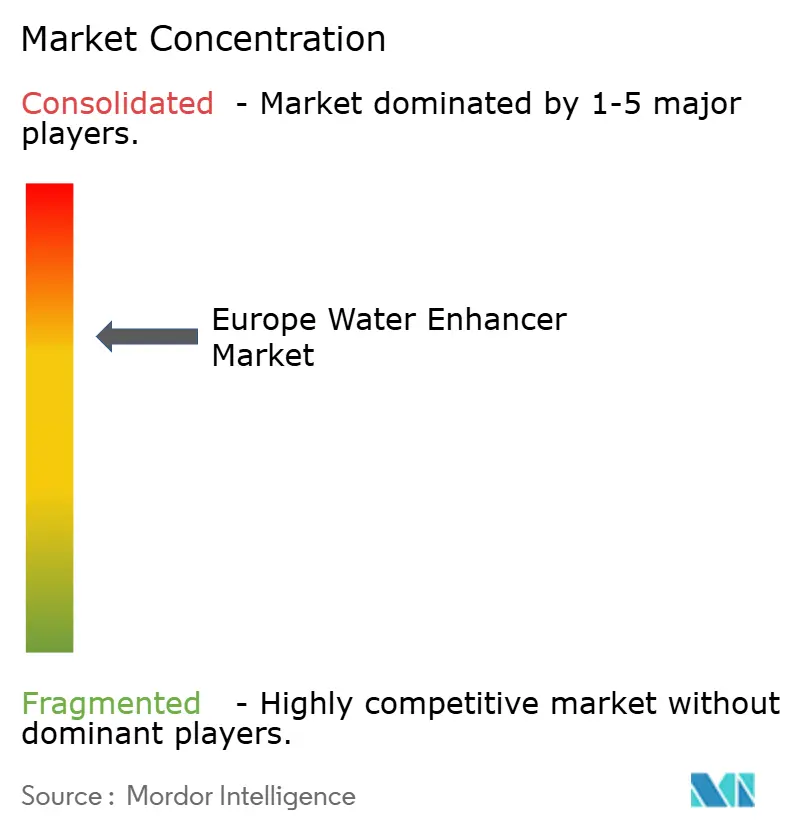
| Market Concentration | Medium |
Major Players *Disclaimer: Major Players sorted in no particular order Image © Mordor Intelligence. Reuse requires attribution under CC BY 4.0. | |
Europe Water Enhancer Market Analysis by Mordor Intelligence
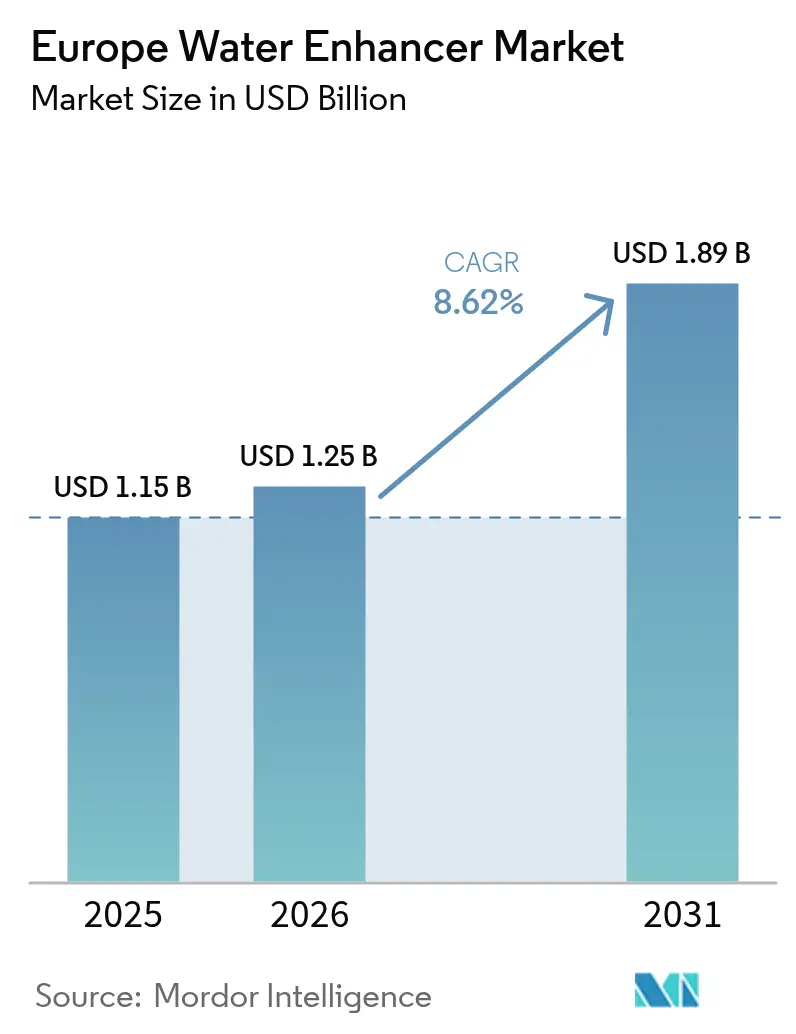
The Europe water enhancer market size was valued at USD 1.15 billion in 2025 and estimated to grow from USD 1.25 billion in 2026 to reach USD 1.89 billion by 2031, at a CAGR of 8.62% during the forecast period (2026-2031). The market landscape is characterized by significant regional variations across European countries, with Western Europe maintaining a dominant market position. Consumer behavior analysis indicates a pronounced shift toward health-conscious beverage choices, particularly among urban populations. The market's fundamental growth drivers include increasing health awareness, demand for sugar-free alternatives, and the convenience factor associated with portable water enhancement solutions. Additionally, the market benefits from technological advancements in flavor development and preservation techniques, enabling manufacturers to offer diverse product portfolios. The competitive environment features both established beverage companies and emerging specialized manufacturers, contributing to product innovation and market expansion through various distribution channels.
Key Report Takeaways
- By category, flavoured led with 64.38% revenue share in 2025; non-flavoured drops are projected to expand at a 10.41% CAGR through 2031.
- By ingredient source, artificial/synthetic ingredients held 59.88% of the European water enhancer market share in 2025, while natural/organic ingredients are set to advance at an 11.05% CAGR.
- By sweetener type, without sugar variants commanded 69.92% share of the European water enhancer market size in 2025; with sugar options are forecast to grow at a 9.34% CAGR.
- By form, liquids led with 35.12% revenue share of Europe water enhancer in 2025; tablets are forecasted to grow at a CAGR of 9.92%.
- By distribution channel, supermarkets/hypermarkets accounted for 54.72% of 2025 revenues; online retail stores are forecast to post the fastest 13.41% CAGR.
- By geography, Germany captured 24.86% of the European water enhancer market share in 2025 and is projected to grow at a 10.11% CAGR.
Note: Market size and forecast figures in this report are generated using Mordor Intelligence’s proprietary estimation framework, updated with the latest available data and insights as of 2026.
Europe Water Enhancer Market Trends and Insights
Drivers Impact Analysis*
| Driver | (~) % Impact on CAGR Forecast | Geographic Relevance | Impact Timeline |
|---|---|---|---|
| Rising health consciousness boosts demand for low-calorie and sugar-free beverage alternatives | +2.5% | Germany, the United Kingdom, France, Netherlands, Sweden | Medium term (2-4 years) |
| Increasing preference for convenient, on-the-go hydration solutions supports market growth | +2.1% | Pan-European, with stronger impact in urban centers | Short term (≤ 2 years) |
| Strong marketing and product innovation by major beverage companies drive consumer interest | +1.8% | Germany, the United Kingdom, France, Spain, Italy | Medium term (2-4 years) |
| Partnerships between beverage brands and fitness/wellness influencers enhance market traction | +1.2% | United Kingdom, Germany, Sweden, Netherlands | Short term (≤ 2 years) |
| Expanding retail distribution channels improve product accessibility across europe | +1.7% | Eastern Europe, Spain, Italy | Medium term (2-4 years) |
| Rising popularity of fitness and wellness trends increases use of electrolyte-boosting enhancers | +1.3% | Germany, the United Kingdom, France, Nordic countries | Medium term (2-4 years) |
| Source: Mordor Intelligence | |||
Rising Health Consciousness Boosts Demand for Low-Calorie and Sugar-Free Beverage Alternatives
The European Water Enhancer Market is undergoing a substantial transformation driven by increasing health-conscious consumption patterns and consumer demand for low and zero-calorie alternatives. The Union of European Beverage Associations' (UNESDA) strategic initiative to reduce added sugars in soft drinks by 10% between 2019 and 2025 has generated significant market opportunities for water enhancers as healthier alternatives to conventional sweetened beverages. Consumer preferences have evolved considerably, moving beyond basic hydration requirements to products delivering comprehensive functional benefits, including essential vitamins, minerals, and electrolytes. In response to this market demand, manufacturers are implementing advanced product development strategies that incorporate specific formulations of magnesium and B vitamins to enhance mental clarity and stress reduction, targeting a diverse consumer base comprising students and professionals seeking sophisticated functional hydration solutions.
Increasing Preference for Convenient, On-The-Go Hydration Solutions Supports Market Growth
Water enhancers are experiencing significant growth across Europe due to their portable and customizable nature. Their compact format strongly appeals to urban professionals and active consumers who seek efficient ways to flavor water without carrying multiple beverage containers. The market expansion is propelled by continuous innovations in packaging, particularly squeeze bottles and single-dose formats that maximize convenience and user experience. Waterdrop, a prominent player in this segment, has successfully expanded its microdrinks presence to over 30 countries, serving more than 2 million customers. The versatility of water enhancers has transformed beverage consumption patterns, extending their usage from homes to workplaces, fitness centers, and travel locations, establishing them as an integral part of modern consumers' daily hydration routines. The growing emphasis on personalized hydration experiences and the increasing adoption of portable beverage solutions continue to drive market momentum across European regions.
Strong Marketing and Product Innovation by Major Beverage Companies Drive Consumer Interest
Major beverage companies are driving growth in the European water enhancer market through strategic marketing initiatives and systematic product innovation. The increasing consumer focus on health and demand for functional, personalized hydration solutions has prompted these companies to utilize their brand strength, distribution networks, and Research and development capabilities. They are developing water enhancers with features like zero sugar, natural ingredients, added vitamins, and electrolytes in convenient formats. These products appeal to diverse consumer groups, including fitness enthusiasts, busy professionals, and families seeking alternatives to sugary beverages. The companies' investments in multi-channel marketing, encompassing digital campaigns, influencer partnerships, and in-store promotions, enhance brand visibility and product adoption across European markets. In the European water enhancer market, Kraft Heinz Company's Mio brand exemplifies this strategic approach through its product portfolio expansion and substantial marketing investments. The company's advertising expenditure of approximately USD 1,031 million in 2024 demonstrates its commitment to strengthening its market presence in Europe.
Rising Popularity of Fitness and Wellness Trends Increases Use Of Electrolyte-Boosting Enhancers
The expanding fitness and wellness trends across the European water enhancer market demonstrate significant growth potential, driven by consumer demand for functional hydration solutions that complement active lifestyles. The increased participation in physical activities such as gym workouts, yoga, cycling, and running has heightened awareness about maintaining proper electrolyte balance to prevent dehydration, fatigue, and muscle cramps. This market development extends beyond athletes to include general consumers focused on their well-being. According to Sport England, gym participation in England increased between November 2023 and November 2024, with 5.9 million people attending gym sessions in 2024 [1]. Moreover, the market demand for low-sugar, portable, and vitamin-enriched water enhancer products aligns with consumer requirements for convenient hydration solutions. Europe's aging population further strengthens market growth, as older consumers seek hydration products for improved energy levels and recovery.
Restraints Impact Analysis*
| Restraint | (~) % Impact on CAGR Forecast | Geographic Relevance | Impact Timeline |
|---|---|---|---|
| Stringent European Union food and beverage regulations slow product development and approvals | -1.2% | European Union-wide, with particular impact in Germany, France | Medium term (2-4 years) |
| Limited consumer awareness in certain european regions restricts market penetration | -0.9% | Eastern Europe, Southern Europe | Short term (≤ 2 years) |
| High competition from flavoured bottled water and soft drinks limits market share | -0.8% | Pan-European | Medium term (2-4 years) |
| High price points compared to traditional beverages reduce mass appeal | -0.6% | Eastern Europe, Southern Europe | Short term (≤ 2 years) |
| Source: Mordor Intelligence | |||
Stringent EU Food and Beverage Regulations Slow Product Development and Approvals.
The European regulatory framework for food additives, particularly EU Regulation EC 1333/2008, requires manufacturers of water enhancers to conduct extensive safety assessments and provide technological justification for ingredients. These regulatory requirements create barriers for smaller market entrants and startups, who often lack the resources to complete complex approval processes. The varying interpretations and implementation of European Union directives across member states create additional compliance challenges, increasing costs and time-to-market for new product formulations. The Austrian Agency for Health and Food Safety mandates that additives must be safe, technologically necessary, and not misleading to consumers, with the European Food Safety Authority (EFSA) conducting regular safety assessments. These regulations have prompted manufacturers to shift toward natural ingredients and clean-label formulations, which typically face reduced regulatory scrutiny but may affect product flavor profiles and shelf stability.
Limited Consumer Awareness in Certain European Regions Restricts Market Penetration
The European water enhancer market faces significant restraints due to limited consumer awareness, particularly pronounced in regions with deeply embedded traditional beverage preferences. This market impediment necessitates substantial capital investment in consumer education programs to communicate product functionality and consumption occasions effectively. The category's complex positioning across multiple beverage segments - soft drinks, functional waters, and nutritional supplements - creates market fragmentation and consumer uncertainty regarding product differentiation. Flavored water consumption patterns indicate distinct demographic barriers, with younger demographics gravitating toward flavor variety and sweetness profiles, while older consumer segments demonstrate preferences for functional attributes with reduced sweetness levels. These divergent consumer preferences necessitate segmented marketing approaches, presenting additional challenges for market penetration, especially in regions where category recognition remains minimal.
*Our forecasts treat driver/restraint impacts as directional, not additive. The impact forecasts reflect baseline growth, mix effects, and variable interactions.
Segment Analysis
By Category: Flavor Innovation Drives Category Growth
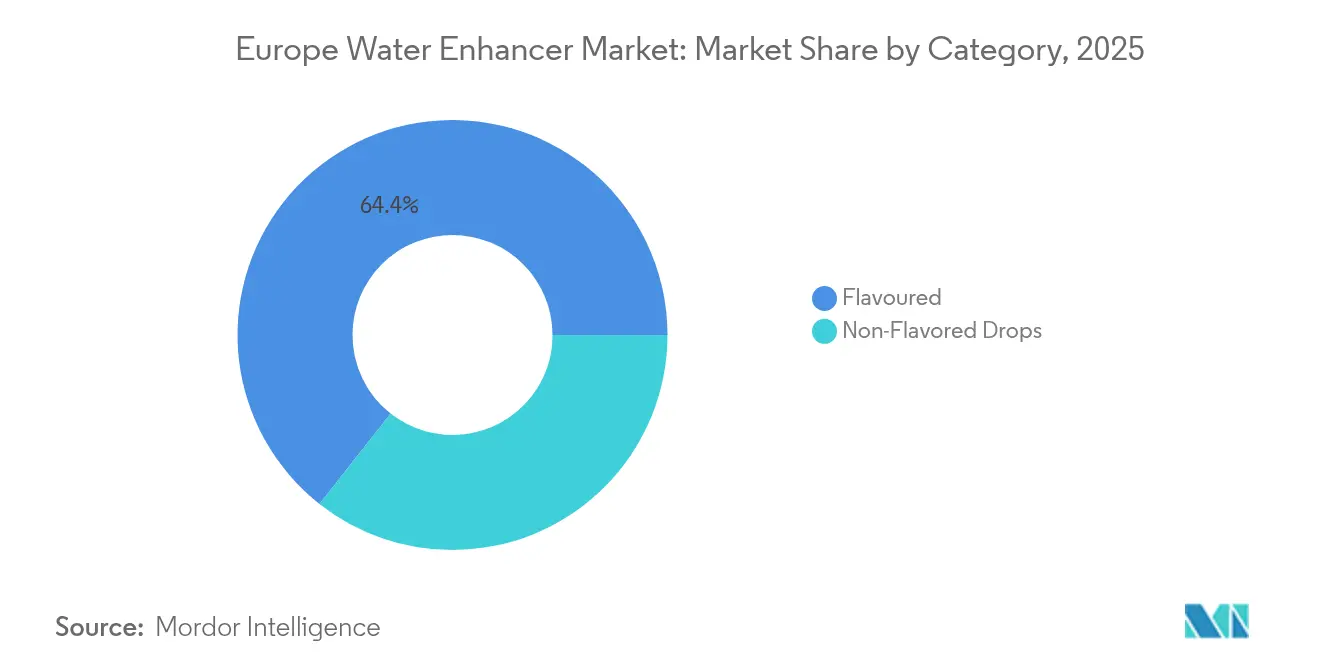
Flavored holds a 64.38% share of the European Water Enhancer Market in 2025, as consumers seek options to enhance plain water while avoiding calories and sugar. The segment's success comes from delivering familiar tastes that meet both flavor preferences and health requirements. Companies such as Kraft Heinz's MiO and Coca-Cola's Dasani Drops have introduced diverse flavor options, ranging from Lemonade, Berry Blast, and Orange Tangerine to refined taste profiles that match European preferences. Advances in flavor technology have improved taste authenticity and longevity in water applications.
Non-Flavored Drops are expected to grow at a CAGR of 10.41% from 2026-2031, driven by demand for functional hydration benefits. This segment provides specific nutritional elements such as electrolytes, vitamins, and minerals, appealing to health-focused consumers and active individuals. The growth reflects consumer interest in beverages with quantifiable functional benefits. Improvements in ingredient technology have enhanced the solubility and stability of functional components in water, allowing better delivery of active ingredients while maintaining product quality.

By Ingredient Source: Natural Formulations Gain Momentum
Despite the rise of natural options, artificial and synthetic ingredients held a 59.88% market share in 2025 due to their advantages in flavor intensity, stability, and cost efficiency. This segment benefits from established supply chains and consistent quality. However, advancements in natural ingredient technology are narrowing the gap with synthetic options. In Germany, sugar alternatives like inulin, carob, and natural syrups are gaining traction, while ingredients such as Palatinose and Fibersol are increasingly used in beverages for their health benefits. These shifts in preferences are creating opportunities for product differentiation through natural formulations that deliver both sensory appeal and wellness benefits.
From 2026 to 2031, the natural and organic ingredients segment in the European water enhancer market is projected to grow at a CAGR of 11.05%, outpacing the overall market. This growth is driven by consumers' focus on ingredient transparency and preference for plant-based components over synthetic ones. The trend aligns with the European food and beverage sector's shift toward clean-label products. Manufacturers are responding by creating water enhancers with botanical extracts, fruit essences, and natural sweeteners for authentic flavors without artificial additives. Data from the German Organic Food Industry Association (BÖLW) shows German consumers spent EUR 16.99 billion on organic products in 2024, highlighting strong demand for natural offerings .
By Sweetener Type: Sugar-Free Options Dominate Market Share
Without sugar variants held a 69.92% share of the European water enhancer market in 2025, reflecting consumer preferences for healthier hydration options. This dominant position stems from increasing demand for zero-calorie alternatives that support weight management and reduced sugar consumption. The segment's growth is supported by improved sweetener technologies that deliver better taste profiles without calories, overcoming previous flavor-related barriers. The European regulatory framework provides clear guidelines for sweeteners, with ingredients like sucralose and acesulfame potassium receiving approval from the European Food Safety Authority, enabling stable product development in the sugar-free segment.
From 2026 to 2031, with sugar options are projected to expand at a CAGR of 9.34%. This surge is fueled by a rising consumer appetite for natural formulations boasting moderate sweetness. There's a discernible shift among consumers favoring products with naturally sourced sugars, distancing themselves from artificial sweeteners. This preference stems from a belief that natural and minimally processed ingredients signify superior quality and enhanced health benefits, even when sugar content is moderate. Manufacturers are increasingly innovating to meet this demand by introducing products with clean-label claims. Additionally, regulatory support for natural sugar alternatives is further propelling market growth.
By Form: Liquid Dominance Faces Tablet Innovation
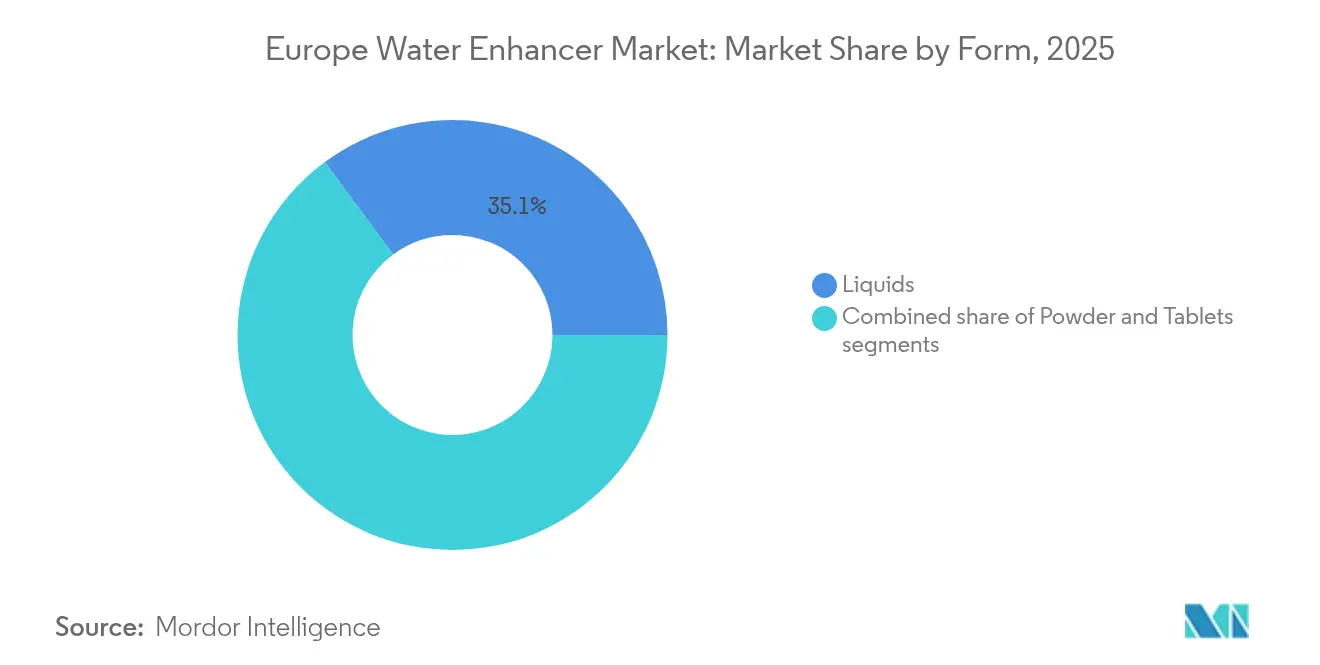
In 2025, the liquid segment commands a dominant 35.12% share of the European water enhancer market. This leadership stems from consumers' preference for the convenience of ready-to-use formats that deliver immediate flavor. The segment's supremacy is rooted in its operational simplicity and efficient flavor distribution. Leveraging advanced formulation technologies, liquid enhancers guarantee consistent flavor distribution and product stability. Their compact packaging aligns with on-the-go consumption trends. Furthermore, the segment's robust performance is bolstered by streamlined manufacturing processes and a supply chain infrastructure that ensures competitive pricing and widespread retail distribution.
Meanwhile, the tablet segment is on an upward trajectory, forecasting a CAGR of 9.92% from 2026 to 2031. This growth is fueled by innovations catering to consumers' desires for precise dosage and functional benefits. Tablets not only ensure accurate delivery of essential nutrients like vitamins, minerals, and electrolytes but also boast superior portability and stability over their liquid counterparts. This format appeals especially to health-conscious consumers who value measured nutrient intake and minimal packaging. Powder formulations, while holding a smaller market share, primarily cater to institutions and budget-conscious consumers seeking cost-effective hydration solutions.
By Distribution Channel: Digital Commerce Accelerates Growth
Supermarkets and hypermarkets led the market in 2025 with a 54.72% share, leveraging their physical presence and high foot traffic to boost visibility. By placing water enhancers near bottled water and sports drinks, they create natural purchase links. Grocery retailers are adapting to diverse consumer needs, with high-income shoppers favoring health-conscious, premium, and sustainable products, while price sensitivity shapes lower-income choices. This segmentation allows brands to offer products at varied price points. Convenience stores and pharmacies, and health stores are key secondary channels, with pharmacies effectively positioning functional water enhancers alongside wellness products.
Online retail stores are driving the European water enhancer market, projected to grow at a CAGR of 13.41% from 2026 to 2031. This growth is fueled by consumers increasingly purchasing health and wellness products online due to convenience, variety, and personalized experiences. E-commerce enables water enhancer manufacturers to adopt direct-to-consumer (DTC) strategies, bypassing traditional retail intermediaries. Companies leverage platforms like Ocado and Amazon, along with their online stores, using subscription services, promotional bundles, and wellness-focused campaigns. In 2024, 94% of EU citizens aged 16-74 used the internet, and 77% made online purchases, highlighting strong digital infrastructure supporting online sales .
Geography Analysis
Germany dominates the European water enhancers market, holding a 24.86% market share in 2025 and is expected to grow at a CAGR of 10.11% from 2026-2031. The country's market leadership is attributed to its extensive retail infrastructure, high consumer awareness of functional beverages, and focus on health and wellness. German consumers readily embrace innovative beverage solutions that support active lifestyles and health objectives. The Bundesamt für Verbraucherschutz und Lebensmittelsicherheit (Federal Office for Consumer Protection and Food Safety) enforces strict regulatory standards for food additives. While these regulations create market entry challenges, they ensure high product quality standards that enhance consumer confidence.
The United Kingdom represents a key market for water enhancers, supported by robust distribution networks and strong consumer awareness. Major international brands, including Kraft Heinz's MiO and PepsiCo's products, maintain significant market presence. British consumers favor products offering functional benefits such as vitamins, minerals, and performance-enhancing ingredients that complement active lifestyle trends. The market features continuous product innovation, with manufacturers regularly introducing new flavors and functional formulations to sustain consumer interest and market growth.
Southern European countries, including Italy, Spain, and France, offer substantial growth potential for water enhancers, despite current lower market penetration compared to Northern Europe. These markets are developing due to increasing consumer interest in hydration and growing awareness of beverage alternatives. The region's warm climate creates inherent demand for refreshing beverages, while cultural preferences for taste and quality drive consumer expectations for premium water enhancer products.
Regulatory Landscape
Water enhancers marketed in Europe as food or food supplements must comply with the EU framework for additives and flavourings, notably Regulation (EC) No 1333/2008 and the EFSA-led safety assessment and authorization process underpinning the Union lists. For formulations positioned around sweeteners, acids, colours, stabilizers, and functional carriers, compliance is anchored in approved substances and conditions of use, alongside additive specifications set under Commission Regulation (EU) No 231/2012.
In 2026, the EU updated rules to shape formulation choices relevant to water enhancer formats, with Regulation (EU) 2026/196 amending requirements for hydrocolloids, Regulation (EU) 2026/172 and Regulation (EU) 2026/175 authorising new flavouring substances, and Commission Implementing Regulations in 2026 authorising ingredients such as lacto-N-tetraose, inulin-propionate ester, rhamnogalacturonan-I enriched carrot extract, and egg membrane hydrolysate. This reinforces dossier capability and supports time-to-market planning for differentiated formulations.
Competitive Landscape
The European water enhancer market maintains a moderate consolidation, with major multinational beverage corporations, including The Kraft Heinz Company, The Coca-Cola Company, PepsiCo Inc., and Eau Exquise, holding significant market positions through their extensive distribution networks and established brand equity. The market presents substantial opportunities for product development in wellness-oriented hydration solutions, particularly addressing European consumer preferences for stress management, immune system support, and cognitive performance enhancement.
Market dynamics indicate increasing participation from smaller enterprises through strategic product launches and innovations. Manchester Drinks Co. exemplified this trend in March 2023 by introducing Strawberry and Blue Raspberry water enhancers under the Slush Puppie brand, strategically positioning these products to capitalize on the expanding market segment for drink and coffee enhancers. This development demonstrates the market's receptiveness to new entrants who can effectively differentiate their product offerings.
In response to evolving market demands, companies are implementing advanced technological solutions to strengthen their competitive positions. These initiatives encompass digital consumer engagement platforms, algorithmic product recommendations, and subscription-based distribution models. PepsiCo's introduction of Gatorade Hydration Booster represents a strategic product development approach, illustrating how established market participants are adapting their portfolios to address changing consumer preferences and maintain market relevance.
Europe Water Enhancer Industry Leaders
-
The Kraft Heinz Company
-
The Coca-Cola Company
-
PepsiCo Inc.
-
Dyla LLC
-
Eau Exquise
- *Disclaimer: Major Players sorted in no particular order
Market Opportunities and Future Outlook
Product whitespace is developing around clean-label and functional hydration propositions that fit on-the-go formats, particularly in sugar-free and better-for-you positioning. The market already skews toward without sugar variants and shows rising interest in natural and organic ingredient claims, with strong consumer pull in Germany where EUR 16.99 billion was spent on organic products in 2024.
Brands can translate this demand into reformulated offers using botanical extracts, fruit essences, and fermentation-derived ingredients, while keeping sensory performance and shelf stability in liquid drops and in the fast-growing tablet formats.
Recent Industry Developments
- July 2026: Unilever's Liquid I.V. expanded across several European markets, including Spain, Germany, France, Sweden, and Iceland, widening access to powdered functional hydration. The rollout leveraged major retail and e-commerce partners, extending multi-country distribution for portable hydration mixes and increasing competitive pressure on incumbent enhancer formats.
- May 2026: Kraft Heinz expanded Kool-Aid Hydration into multiple European and North American markets, launching a single-serve electrolyte powder with no artificial dyes or sugar, supported by existing distribution networks to accelerate consumer access. The rollout draws on Kraft Heinz's broad distribution footprint to reach new consumer segments.
- May 2024: Precision Fuel and Hydration partnered with Ironman Europe to provide Precision Hydration 1000 electrolyte tablets (1000 mg sodium per 34 oz). The partnership increased visibility for performance-oriented hydration products in Europe and highlighted sports and endurance ecosystems as adoption channels.
Research Methodology Framework and Report Scope
Market Definition and Coverage
For this methodology, the Europe water enhancer market covers flavor and functional concentrates that are added into plain water at home or on the go, and it is measured as sales value across retail and online routes in Europe.
Scope exclusions: We exclude ready-to-drink flavored waters and sports drinks that are sold as finished beverages rather than as add-in enhancer formats.
Segmentation Overview
- By Category
- Flavoured
- Non-Flavored Drops
- By Form
- Powder
- Tablets
- Liquids
- By Ingredient Source
- Natural/Organic
- Artificial/Synthetic
- By Sweetener Type
- With Sugar
- Without Sugar
- By Distribution Channel
- Supermarkets/Hypermarkets
- Convenience Stores
- Online Retail Stores
- Pharmacy and Health Stores
- Other Distribution Channels
- By Geography
- Germany
- United Kingdom
- Italy
- France
- Spain
- Netherlands
- Poland
- Belgium
- Sweden
- Rest of Europe
Data Sources, Market Sizing, and Validation
Desk Research
We started with public data that helps describe the beverage add-in demand pool and how shoppers buy these products. Useful sources included food and health consumption indicators from bodies such as Eurostat and national statistical offices, trade and tariff flows from EU customs publications, and ingredient and additive safety references from European regulators.
To ground assumptions on channel mix and pricing direction, we also reviewed company annual reports, investor presentations, retailer category pages, and reputable trade press for product launches and pack size moves. A subscription dataset for company financials and a patent database were used selectively to confirm ownership, portfolio focus, and innovation signals where public disclosures were thin. The desk sources named here are illustrative only, and other public references were also used for data collection, validation checks, and research clarification.
Primary Interviews and Surveys
Desk findings were then stress-tested through expert interviews and structured surveys across major European markets, so assumptions did not rely on a single country pattern. We spoke with brand and channel-side respondents, along with ingredient and packaging ecosystem contacts, to confirm what counts as an enhancer purchase, how fast formats are shifting, and how online versus offline pricing behaves across the year.
Distribution of primary research fieldwork respondents
| Company type | Respondent position |
|---|---|
| Top tier: 39% | CXOs: 13% |
| Mid tier: 46% | Functional/Unit leaders: 41% |
| Smaller Players: 15% | Managers: 46% |
Market-Sizing & Forecasting
Sizing is built using a top-down and bottom-up logic, where beverage category spending and channel-level sales patterns are reconstructed into an enhancer-specific value pool, and then adjusted for format mix in key European countries. To keep the model honest, we also run selective bottom-up checks using sampled average selling prices by form and pack size, and then pair that with expected volume movement implied by distribution expansion.
Inputs used in the model include (as examples) hypermarket and convenience channel relevance versus online growth, typical pack size and dosage behavior, the share shift toward sugar-free or low-sugar profiles, the pace of flavor innovation, and country-level differences in at-home hydration habits. Where direct public numbers were missing, we filled gaps with conservative ranges that were narrowed through interview feedback and then applied consistently across the same country set.
For the forecast, scenario analysis was used so upside and downside cases reflect realistic changes in pricing, distribution reach, and consumer trading behavior, and then the central case was selected when interview feedback showed alignment on the direction and speed of change.
Data Validation & Update Cycle
Each output was checked against independent signals such as expected retail route weights, visible assortment breadth, and whether implied pricing sits within what respondents see in-market. When a country or channel result looked unusual, we revisited the drivers, reran assumptions, and re-contacted sources if the variance could not be explained by seasonality or currency timing.
Before sign-off, the full model goes through a multi-step review so logic, units, and country rollups agree, and a final pass is done close to delivery to capture material updates. Reports are refreshed annually, and interim updates are completed when major market events occur that can shift pricing, channel access, or product availability.
Mordor Intelligence's Europe Water Enhancer Market Size Versus Other Published Estimates
Published market sizes for water enhancers in Europe can look different because the scope boundary is not always consistent, and because base years, pricing treatment, and country coverage vary across studies.
By tracking channel-level coverage and refreshing pricing assumptions at the pack size and dosage level, Mordor Intelligence keeps the Europe total tied to an add-in enhancer purchase rather than adjacent ready-to-drink beverages, which is a key reason results can spread.
Benchmark comparison
| Source | Market Size | Gaps in Research Methodology |
|---|---|---|
| Mordor Intelligence | USD 1.25 B (2026) | |
| Regional Consultancy A | USD 0.92 B (2025) | Uses a different base year and appears to apply a narrower current demand pool, with limited clarity on how pricing and channel mix were normalized across countries. |
| Trade Journal B | USD 1.30 B (2024) | Back-solves Europe from a global share and headline value, so the result can move based on the chosen global base and the assumed Europe share rather than country-level build-up. |
Overall, the gap between estimates is mostly explained by timing (2024 to 2026) and by whether the number is built from Europe country and channel realities or inferred from a global total. Our checks aim to keep inputs traceable to clear purchase behavior, channel presence, and practical pricing logic, which makes the figure easier to replicate and challenge.
Key Questions Answered in the Report
What is the current size of the European water enhancer market?
The market is valued at USD 1.25 billion in 2026.
How fast is the market growing?
It is expected to post a 8.62% CAGR, reaching USD 1.89 billion by 2031.
Which country leads consumption?
Germany accounts for 24.86% of 2025 sales and is projected to remain the largest as well as the fastest-growing national market.
What product type holds the biggest share?
Flavour Drops dominate with 64.38% of revenue, driven by taste familiarity and zero-calorie positioning.