
Europe Ventilation Equipment Market Size and Share
Market Overview
| Study Period | 2020 - 2031 |
|---|---|
| Forecast Data Period | 2026 - 2031 |
| Base Year Market Size (2025) | USD 5.28 Billion |
| Market Size (2026) | USD 5.59 Billion |
| Market Size (2031) | USD 7.43 Billion |
| Growth Rate (2026 - 2031) | 5.86 % |
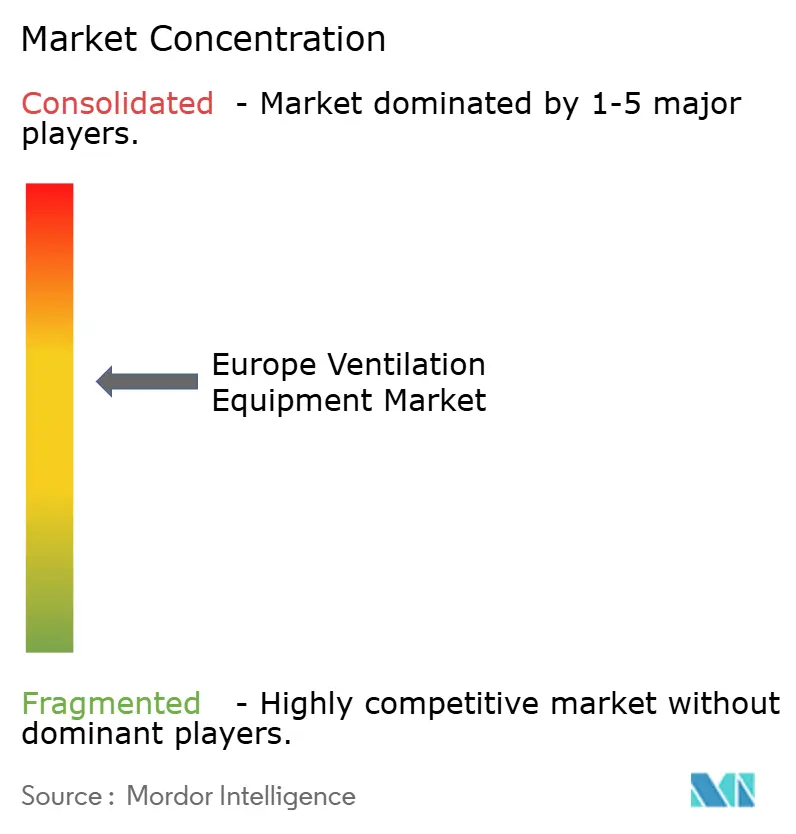
| Market Concentration | Medium |
Major Players *Disclaimer: Major Players sorted in no particular order Image © Mordor Intelligence. Reuse requires attribution under CC BY 4.0. | |
Europe Ventilation Equipment Market Analysis by Mordor Intelligence
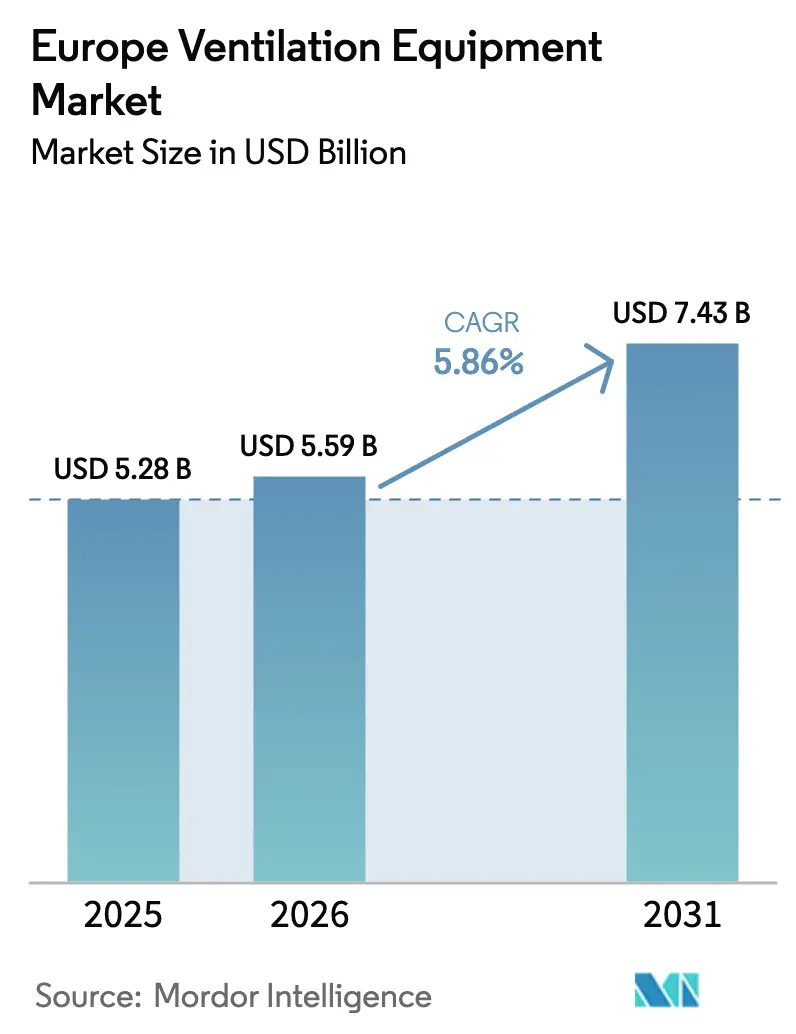
The Europe ventilation equipment market size is expected to grow from USD 5.28 billion in 2025 to USD 5.59 billion in 2026 and is forecast to reach USD 7.43 billion by 2031 at 5.86% CAGR over 2026-2031. Demand is accelerating as the Energy Performance of Buildings Directive (EPBD) mandates require heat-recovery efficiencies of at least 75%, compelling a shift from extract-only systems to balanced heat-recovery ventilation. Post-pandemic indoor-air-quality targets, rapid social-housing retrofits, and data-center expansion are reinforcing procurement decisions, while installer shortages and raw-material volatility temper near-term growth. Market leaders are adding digital controls and predictive maintenance to differentiate, and hybrid mixed-mode designs are gaining traction as building owners balance energy use with occupant comfort. The European ventilation equipment market is therefore positioned for resilient mid-single-digit expansion despite supply-side headwinds.
Key Report Takeaways
- By equipment type, balanced HRV/ERV units held 46.25% of the European ventilation equipment market share in 2025, while range/cooker hoods are forecast to grow at a 7.22% CAGR to 2031.
- By ventilation mechanism, centralized ducted systems commanded a 55.15% share of the European ventilation equipment market size in 2025; hybrid solutions are projected to expand at a 6.88% CAGR through 2031.
- By technology, HRV captured a 49.55% share of the European ventilation equipment market in 2025, and ERV is advancing at a 7.36% CAGR.
- By end-user, residential buildings accounted for 52.95% of the European ventilation equipment market size in 2025, yet industrial facilities led growth at a 7.31% CAGR.
- By application, living spaces dominated with a 46.12% share of the European ventilation equipment market in 2025; process/clean-room and data-center ventilation is expected to post the fastest 7.65% CAGR.
- By country, Germany led with a 30.85% share of the European ventilation equipment market in 2025, whereas Spain is projected to register the highest 7.88% CAGR to 2031.
Note: Market size and forecast figures in this report are generated using Mordor Intelligence’s proprietary estimation framework, updated with the latest available data and insights as of 2026.
Worldwide, activity is shaped by contributions from multiple regions, with Europe representing one of the more structurally developed among them. The global report on ventilation equipment market by Mordor Intelligence reflects how these regional layers combine into a single system.
Market Trends and Insights
Drivers Impact Analysis of Europe Ventilation Equipment Market*
| Driver | (~) % Impact on CAGR Forecast | Geographic Relevance | Impact Timeline |
|---|---|---|---|
| Tightening EPBD-mandated energy-efficiency standards | +1.8% | EU-wide; strongest in Germany, Netherlands, France | Medium term (2-4 years) |
| Rapid retrofit wave for mould mitigation in social housing | +1.2% | UK, Ireland, Netherlands; spillover to Northern Europe | Short term (≤ 2 years) |
| Post-COVID focus on indoor air quality in workplaces | +1.0% | Germany, UK, Nordics | Medium term (2-4 years) |
| Electrification driving heat-recovery ventilation demand | +0.9% | Northern and Central Europe | Long term (≥ 4 years) |
| Shift to decentralized MVHR in renovation projects | +0.7% | Germany, Austria, Switzerland, France | Medium term (2-4 years) |
| Growing data-center cooling loads | +0.6% | Ireland, Netherlands, Germany, Nordics | Long term (≥ 4 years) |
| Source: Mordor Intelligence | |||
Tightening EPBD-Mandated Energy-Efficiency Standards
The revised EPBD requires nearly zero-energy buildings from 2030, obliging designers to specify mechanical ventilation with heat-recovery efficiencies ≥75%.[1] Germany enforces the rule aggressively, with federal states mandating heat-recovery systems in multifamily projects exceeding four units. Renovation-wave provisions that target a 3% annual performance gain favor decentralized MVHR units, which avoid intrusive ductwork modifications. Compliance with EN 15251 and ISO 16814 supports uptake of balanced HRV/ERV equipment capable of documenting energy savings for regulatory reporting. As a result, the European ventilation equipment market is pivoting toward high-efficiency units across both residential and commercial segments.
Post-COVID Focus on Indoor Air Quality in Workplaces
Updated ECDC guidance raises minimum ventilation rates to 10 L/s-person, prompting capacity upgrades in existing offices.[2] Large German employers such as SAP and Siemens have added variable-air-volume systems connected to occupancy sensors, valuing real-time air-quality data over pure energy metrics. IoT-integrated ventilation that reports particulate, CO₂, and humidity levels is becoming standard rather than premium. Suppliers that bundle analytics dashboards with equipment gain preference, reinforcing digitization across the European ventilation equipment market.
Electrification Driving Heat-Recovery Ventilation Demand
Northern European bans on fossil-fuel heating increase reliance on heat pumps, making heat-recovery ventilation essential to maintain coefficient-of-performance targets. Integrated HRV-heat-pump packages improve seasonal efficiency and flatten peak-load profiles, addressing grid constraints in Denmark, Ireland, and Sweden. Commercial buildings adopt the same logic, coupling ERV with large-capacity heat pumps to moderate winter electrical peaks. The European ventilation equipment market, therefore, benefits from electrification policies that favor energy-recovery solutions.
Rapid Retrofit Wave for Mould Mitigation in Social Housing
Awaab's Law obliges UK landlords to fix damp and mould within specific timelines, catalyzing a EUR 3.1 billion retrofit budget focused on positive-input and mechanical-extract solutions. Similar proposals in Ireland and the Netherlands widen demand for humidity-controlled units with auto-boost functions. Manufacturers offering easy-fit PIV products reduce tenant disruption and installation time, supporting fast deployment. This retrofit surge is accelerating cash cycles across the European ventilation equipment market.
Restraints Impact Analysis of Europe Ventilation Equipment Market*
| Restraint | (~) % Impact on CAGR Forecast | Geographic Relevance | Impact Timeline |
|---|---|---|---|
| Shortage of certified installers and commissioning engineers | -1.4% | Germany, Netherlands, UK | Medium term (2-4 years) |
| Volatile raw-material prices inflating fan/motor costs | -1.1% | All European markets | Short term (≤ 2 years) |
| Building-fabric fire-safety rules limiting duct layouts | -0.8% | UK, Ireland; spreading to EU | Long term (≥ 4 years) |
| Cross-draft risks in hybrid natural-mechanical designs | -0.5% | Southern Europe, Mediterranean | Medium term (2-4 years) |
| Source: Mordor Intelligence | |||
Shortage of Certified Installers and Commissioning Engineers
The sector lacks roughly 40,000 qualified technicians, extending project schedules by eight weeks on average and raising installed costs by 25-30%.[3] Germany experiences the deepest gap, but shortages are visible across Northern Europe. Complex HRV balancing and digital commissioning require specialist skills that current training pipelines cannot supply. Manufacturers respond with plug-and-play units and remote-commissioning apps, yet the constraint continues to moderate growth in the European ventilation equipment market.
Volatile Raw-Material Prices Inflating Fan/Motor Costs
Aluminum futures swung between USD 2,100-2,800 per metric ton in 2024, pushing the raw-material share of production cost to 50%. Repeated price adjustments compress margins and depress volume in price-sensitive residential retrofits. Makers such as FläktGroup hedge contracts and redesign housings to reduce metal content. While strategic inventory buffering absorbs shocks, volatility remains a short-term drag on the European ventilation equipment market.
*Our forecasts treat driver/restraint impacts as directional, not additive. The impact forecasts reflect baseline growth, mix effects, and variable interactions.
Europe Ventilation Equipment Market Segment Analysis
By Equipment Type:
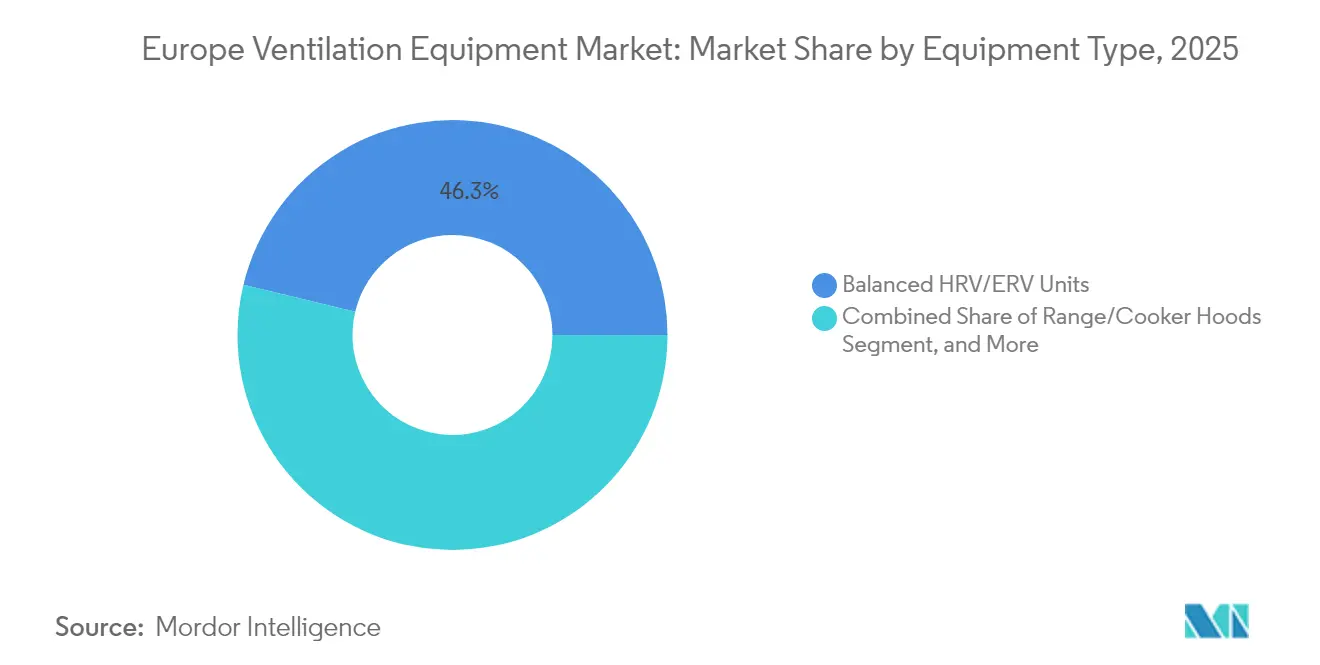
HRV/ERV Units Lead Market TransformationBalanced HRV/ERV units accounted for 46.25% of the European ventilation equipment market size in 2025 as EPBD compliance drove adoption across construction and retrofit. Range/cooker hoods are projected to grow at a 7.22% CAGR, spurred by kitchen upgrades and expanding hospitality footprints.
Strong policy alignment means HRV/ERV will continue to anchor product mixes, with Daikin’s 2024 purchase of Robert Heath adding technical depth to its portfolio. Unidirectional fans remain indispensable for directional airflow in data centers, while supply/exhaust systems sustain industrial demand. These trends reinforce value migration toward energy-recovery technologies within the European ventilation equipment market.

By Ventilation Mechanism:
Hybrid Solutions Gain TractionCentralized ducted systems captured a 55.15% share of the European ventilation equipment market size in 2025, mainly in new commercial builds. Hybrid mixed-mode ventilation is set to expand at a 6.88% CAGR as building-management software optimizes between natural and mechanical modes under EN 16798 guidelines.
Operators prioritize flexibility; hybrid solutions cut energy use in mild seasons yet uphold IAQ during high occupancy. Decentralized units thrive in historic or social-housing retrofits where ducts are impractical. Together, these patterns diversify channel demand and support the sustained expansion of the European ventilation equipment market.
By Technology:
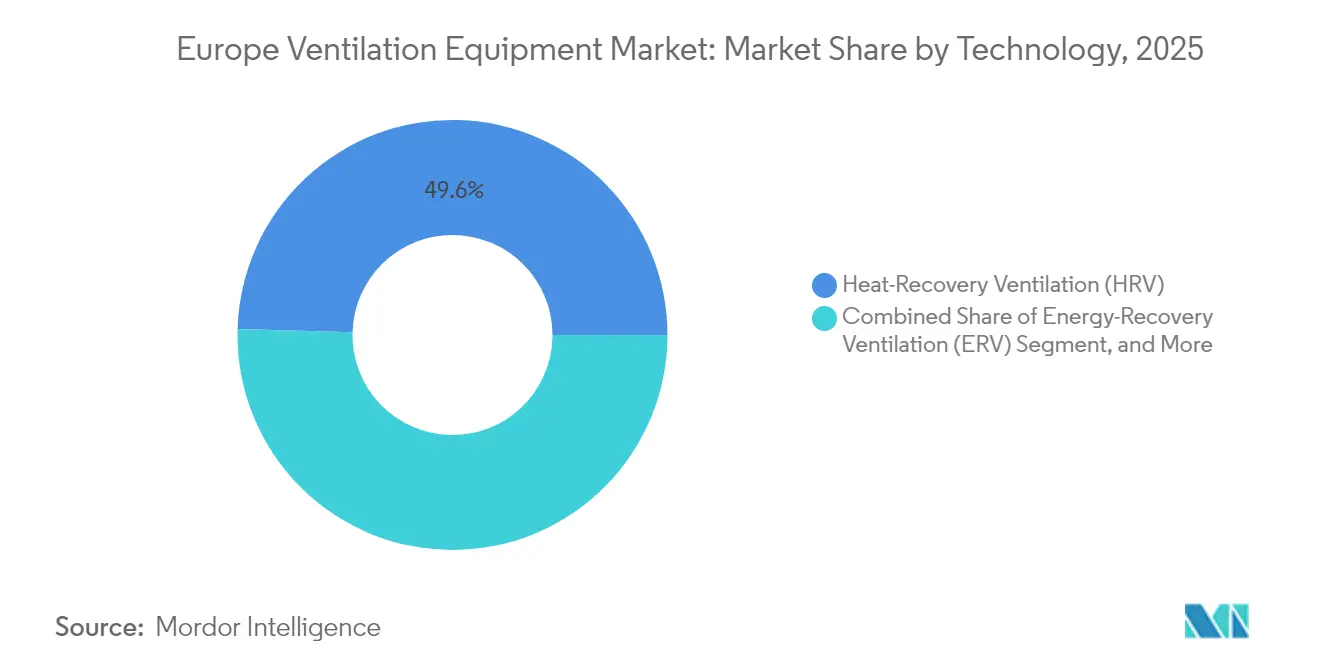
ERV Systems Accelerate Market GrowthHRV held half of 2025 sales, but ERV is forecast to outpace at a 7.36% CAGR because latent-heat recovery suits humid process and data-center environments. ERV’s ability to manage moisture contrasts with HRV’s sensible-heat focus, widening its addressable base.
Data-center operators seek ±5% RH control under ISO 14644, pushing ERV uptake in hyperscale facilities. PIV excels in UK retrofits by relieving condensation, whereas MEV stays relevant for low-budget ventilation. Technology choices thereby segment the European ventilation equipment market by climate zone and application.
By End-User Industry:
Industrial Facilities Drive GrowthResidential buildings represented 52.95% of the European ventilation equipment market size in 2025, owing to subsidy-backed retrofits. Industrial facilities, led by data centers, are projected to post a 7.31% CAGR to 2031 as hyperscale investments spread from Ireland to Germany.
Manufacturing plants integrate ventilation with occupational-safety sensors, while greenhouses require precise temperature and humidity for crop yield. This mix diversifies revenue streams and elevates the European ventilation equipment market beyond its traditional residential core.
By Application Area:
Data Centers Drive Precision Ventilation DemandLiving and sleeping areas held a 46.12% share in 2025, reflecting the residential base. Process/clean-room and data-center ventilation will rise at 7.65% CAGR as operators demand ±1 °C temperature stability.
Edge-computing facilities in Spain and Italy adopt modular air-handling units with predictive-maintenance software, mirroring trends in pharmaceutical clean-rooms. These high-spec niches accelerate premiumization within the European ventilation equipment market.
Geography Analysis
Germany Ventilation Equipment Market
Germany’s prominence stems from mature supply chains, strict energy legislation, and early heat-recovery adoption. Domestic firms refine products for 0.45 W/(m³/h) fan-power limits, then export high-efficiency units across the continent, reinforcing Germany’s 30.85% share. Persistent installer shortages, however, cap potential output and extend lead times.
Spain Ventilation Equipment Market
Spain’s 7.88% projected CAGR reflects EU-funded renovation grants, updated CTE building code ventilation clauses, and attractive renewable-energy tariffs that pull hyperscale cloud operators to Madrid’s post-pandemic data hub corridor. Retrofits in dense urban housing and green-field industrial parks converge, establishing Spain as the fastest-growing node within the European ventilation equipment market.
Europe Ventilation Equipment Market
France, Italy, and the United Kingdom post steady mid-single-digit growth. France’s RE2020 simulation requirement embeds mechanical ventilation into every new design. Italy’s modified Superbonus still funds envelope upgrades that trigger HRV installation, particularly in the North. The UK prioritizes mould-mitigation retrofits after Awaab’s Law, favoring PIV and MEV units that can be installed without decanting residents. Collectively, these markets sustain demand across a diversified European ventilation equipment market.
Regulatory Landscape
EU policy remains a key demand-side lever for ventilation specifications, led by the recast Energy Performance of Buildings Directive, Directive (EU) 2024/1275. The EPBD entered into force on 28 May 2024 and sets a national transposition deadline of 29 May 2026, pushing adoption of energy-efficient mechanical ventilation in both new-build and deep renovation workflows across EU member states.
On the equipment and controls side, the EPBD strengthens requirements that carry through ventilation design and procurement, including mandates for building automation and control systems (BACS) in non-residential buildings with heating/cooling systems above 290 kW (Article 13). Alongside this, Ecodesign Regulation (EU) 1253/2014 continues to set baseline energy-performance thresholds for ventilation units, and EU F-gas directionality supports manufacturer moves toward lower-GWP solutions and natural refrigerants, visible in new air-handling configurations such as Systemair offerings using R290.
Value Chain Analysis
The value chain covers component suppliers (fans, motors, heat exchangers, controls/sensors, housings), OEM design and assembly, and a multi-layer route to market through national wholesalers, specification-led channels (consulting engineers and architects), and direct OEM sales to large projects. Installed performance and compliance put commissioning at the center of value capture, so certified installers, balancing specialists, and service partners become critical to realized efficiency and indoor-air-quality outcomes.
Leading suppliers combine manufacturing scale with distribution reach and lifecycle service. Systemair uses a vertically managed model that pairs in-house production with international distribution coverage across 51 countries, supporting both standardized residential retrofits and complex commercial and industrial projects. Channel build-out and consolidation also help deepen local access and application capability, as shown by Swegon Group strengthening its regional footprint through the acquisition of LaminAir AG (June 2026). At the same time, OEM product development is shifting toward compact, plug-and-play units (including integrated heat-pump architectures) to reduce site labor and ease contractor execution under tightening building-performance requirements.
Competitive Landscape
The market displays moderate concentration; the top five suppliers hold roughly 45-50% of revenue. Systemair, Volution Group, and Daikin anchor the field with multi-brand portfolios, regional factories, and acquisition pipelines. Volution’s 2024 purchase of Fantech enlarged its Asia-Pacific channels and complemented its European range.[4] Daikin added UK-based Robert Heath to secure HRV expertise and social-housing contacts, strengthening its European ventilation position.
Digital capability differentiates offerings. Swegon’s AI-enabled GOLD air-handling series predicts component failures six months ahead, guarding uptime for data-center clients. TROX expands training centers to relieve the installer bottleneck and secures long-term service contracts. Manufacturers that embed IoT sensors, KNX interfaces, and machine-learning algorithms win bids in commercial and industrial tenders that value lifecycle visibility.
White-space opportunities persist for hybrid ventilation, edge-computing cooling, and plug-and-play retrofit units. Firms integrating natural-ventilation algorithms with motorized dampers target Mediterranean climates sensitive to cross-draft and energy costs. Materials engineers explore polymer heat-exchangers to reduce aluminum exposure. These innovation pathways sustain competition and encourage technical diversity across the European ventilation equipment market.
Europe Ventilation Equipment Industry Leaders
-
Systemair AB
-
Volution Group plc
-
Aldes Aéraulique S.A.
-
Daikin Industries Ltd.
-
Swegon AB
- *Disclaimer: Major Players sorted in no particular order
Europe Ventilation Equipment Market Companies Covered in this Report
- Systemair AB
- Volution Group plc
- Aldes Aéraulique S.A.
- Daikin Industries Ltd.
- Swegon AB
- FläktGroup Holding GmbH
- TROX GmbH
- Helios Ventilatoren GmbH + Co KG
- Zehnder Group AG
- Lindab International AB
- Soler and Palau Sistemas de Ventilación S.L.U.
- Rosenberg Ventilatoren GmbH
- Blauberg Ventilatoren GmbH
- Nuaire Ltd.
- Dantherm Group A/S
- Brink Climate Systems B.V.
- Vostermans Ventilation B.V.
- KCVENTS Industrial Ventilation Co., Ltd.
- Vent-Axia Ltd.
- VENTS Joint-Stock Company
- Airbox Lufttechnik GmbH
- EXHAUSTO A/S
Market Opportunities and Future Outlook
Regulation-led renovation and compliance upgrades create room for packaged solutions that simplify delivery while documenting performance. The EPBD recast (Directive (EU) 2024/1275) and the 29 May 2026 transposition milestone are directing building owners and designers toward systems that combine heat recovery, controls, and verifiable energy outcomes. That expands the addressable space for balanced HRV/ERV and smart ventilation bundles aligned with BACS requirements in larger non-residential sites, including those above the 290 kW threshold referenced in the directive. It also raises demand for equipment that can integrate with building-management platforms and supply continuous indoor environmental quality data.
A second opportunity sits at the intersection of electrification and refrigerant policy, where OEMs can differentiate through integrated air-handling and heat-pump packages using low-GWP or natural refrigerants. Systemairs June 2026 launch of an air handling unit with an integrated heat pump using R290 illustrates product commercialization aligned with EU F-gas directionality. It also responds to installer capacity constraints by consolidating functions into fewer field-installed components. Channel expansion through targeted acquisitions supports faster entry into specialty niches and local specification influence, as reflected in Swegons June 2026 acquisition of LaminAir AG to strengthen its position in Switzerland.
Recent Industry Developments in Europe Ventilation Equipment Market
- June 2026: Systemair AB launched the Geniox HP DFN air handling unit featuring integrated heat pump technology and the R290 refrigerant. The launch expands Systemair's energy efficient HRV offerings in the EU market and supports compliance with evolving EU F-gas regulations, strengthening its competitive position.
- June 2026: Systemair AB secured a contract to deliver specialized ventilation and dehumidification solutions for the Heleneholm swimming facility in Malmo Sweden. The project expands the installed base in Europe and demonstrates ongoing demand for advanced, energy efficient systems in public facilities.
- June 2026: Systemair AB announced the Geniox HP DFN air handling unit with integrated heat pump technology and R290 refrigerant, designed to align with upcoming EU regulatory trajectories. The announcement signals capacity to meet high performance requirements for energy efficient ventilation across European markets.
Europe Ventilation Equipment Market Report Scope and Research Methodology
Market Definition and Coverage
We define the Europe ventilation equipment market as the value of equipment used to move, supply, or exhaust air in buildings and industrial spaces. This includes complete ventilation units and related packaged systems sold across European countries.
Scope exclusions: This sizing excludes standalone air conditioning units, heating-only equipment, and general building automation hardware unless it is sold as part of the ventilation equipment package.
Segments Covered in This Report
- By Equipment Type
- Supply/Exhaust Ventilation Systems
- Balanced HRV/ERV Units
- Unidirectional Fans (Axial, Centrifugal, Roof)
- Range/Cooker Hoods
- By Ventilation Mechanism
- Centralised Ducted Systems
- Decentralised Room Units
- Hybrid (Mixed-Mode) Solutions
- By Technology
- Heat-Recovery Ventilation (HRV)
- Energy-Recovery Ventilation (ERV)
- Positive-Input Ventilation (PIV)
- Mechanical Extract Ventilation (MEV)
- By End-User Industry
- Residential Buildings
- Commercial and Institutional Buildings
- Industrial Facilities
- Agriculture and Controlled-Environment
- By Application Area
- Living and Sleeping Spaces
- Wet Rooms (Kitchens, Bathrooms)
- Process/Clean-Room and Data Centres
- Greenhouses and Livestock Housing
- By Country
- Germany
- United Kingdom
- France
- Italy
- Spain
- Netherlands
- Belgium
- Rest of Europe
Data Sources, Market Sizing, and Validation
Desk Research
Desk research helped set the outer guardrails for demand, regulation, and building activity before modeling the market value. We used public sources such as Eurostat indicators for construction and renovation, European Commission documentation tied to the Energy Performance of Buildings Directive, and standards references from bodies such as CEN.
To link demand to equipment categories, we also reviewed non-paywalled industry statistics and commentary from sources such as Eurovent and national building and HVAC associations, followed by customs trade flows where relevant. Company annual reports, investor presentations, and reputable business press were used to understand product mix and typical pricing moves. We also used a paid subscription for company financials and a patent database selectively to cross-check revenue direction and innovation focus. This list is illustrative only, and many other sources were used to collect, validate, and clarify the data points and assumptions.
Primary Interviews and Surveys
Primary work focused on validating what drives equipment spending in Europe by application and country, and then checking whether the modeled volumes and price ranges matched what the market is actually seeing. We spoke with a mix of manufacturers, distributors, installers, consultants, and large buyers across major European demand centers. Their feedback was used to close gaps on replacement cycles, heat-recovery take-up, and average selling price progression.
Distribution of primary research fieldwork respondents
| Company type | Respondent position |
|---|---|
| Top tier: 36% | CXOs: 13% |
| Mid tier: 48% | Functional/Unit leaders: 37% |
| Smaller Players: 16% | Managers: 50% |
Market-Sizing & Forecasting
Sizing starts with a top-down build where construction output, renovation intensity, and building stock replacement needs are translated into likely ventilation demand, and then mapped to equipment categories used in European projects. Once the demand pool is built, values are derived by applying country-level mix and price ranges that were stress-tested through primary checks.
The model tracks inputs that materially move this market, including new dwelling completions, non-residential floor-area additions, renovation rates, adoption of balanced ventilation with heat recovery, typical air handling unit capacity bands for commercial projects, and observed pricing movements for fans and packaged units. Where data is patchy by country or sub-category, gaps are filled using proxy indicators such as similar building stock structure and trade flow direction, and then adjusted after interviews point out local differences.
For forecasting, scenario analysis is used around construction outlook, retrofit momentum, and regulatory pull. The central case is anchored to the most consistent expert consensus. Bottom-up checks are then applied selectively, such as rolling up sampled supplier revenues, channel sell-through patterns, and a simple volume times average selling price sense-check. This helps avoid overstating totals in years with weak installations.
Data Validation & Update Cycle
We run multiple validation steps so the final figures do not depend on a single series or a single interview view. Model outputs are compared against independent signals such as construction spending direction, reported order trends, and category-level shipment commentary, and then exceptions are flagged for deeper review.
Before sign-off, the assumptions and calculations are reviewed by another analyst, and follow-up outreach is triggered when a country result or growth rate looks inconsistent with observed market activity. The report is refreshed annually, and interim updates are made when major policy shifts, demand shocks, or pricing changes materially affect the outlook. Right before delivery, a final pass is completed so clients receive the latest updated view.
Mordor Intelligence's Europe Ventilation Equipment Market Size Measured Against Other Published Estimates
Published market values for Europe ventilation equipment can differ because researchers do not always count the same product set, the same building applications, or the same timing for price and currency. Differences also show up when one estimate leans more on shipments and another leans more on installed value in buildings.
The main gap comes from whether industrial air handling unit turnover only is treated as the whole market, or whether residential and commercial ventilation equipment is also counted, and then split by application with price bands that match local buying behavior. Some sources also report an aggressive recovery path after weak construction years, while others hold a flatter base case because retrofit timing and installer capacity can slow conversion from intent to purchases.
Benchmark comparison
| Source | Market Size | Gaps in Research Methodology |
|---|---|---|
| Mordor Intelligence | USD 5.59 B (2026) | |
| Industry Publisher A | USD 7.00 B (2030) | Uses a shipment-value outlook to 2030 that mixes broad fan categories with air handling units, and it may apply a smoother price trend that lifts value versus a country-mix approach. |
| Industry Association B | USD 2.03 B (2024) | Tracks industrial supply and exhaust air handling units above a stated capacity threshold, which excludes many residential and light commercial ventilation products covered in a full-market view. |
The table shows that the spread is mostly explained by scope and year alignment, not only by growth expectations. This is why we keep the market build tied to clear demand pools and equipment groupings, and it also explains how the gap-driver choice changes when industrial AHUs are treated as one component inside the wider total, a counting approach applied by Mordor Intelligence.
Key Questions Answered in the Report
How large is the Europe ventilation equipment market in 2026?
The Europe ventilation equipment market size is USD 5.59 billion in 2026 with a projected rise to USD 7.43 billion by 2031.
Which segment leads by equipment type?
Balanced HRV/ERV units hold 46.25% of sales, the largest share across equipment categories.
Which country presents the fastest growth opportunity?
Spain is forecast to grow at a 7.88% CAGR owing to EU-funded renovation grants and expanding data-center construction.
What is the main growth driver through 2031?
Tightening EPBD efficiency mandates that require ?75% heat-recovery effectiveness are the primary growth catalyst.
Why are hybrid ventilation systems gaining popularity?
Building operators favor hybrid designs that switch between natural and mechanical modes to balance indoor-air-quality targets with lower energy use.
What competitive trend stands out in the market?
Vendors are integrating IoT-based predictive maintenance and building-automation compatibility to differentiate their ventilation equipment portfolios.