
Europe Van Rental Market Size and Share
Market Overview
| Study Period | 2020 - 2031 |
|---|---|
| Forecast Data Period | 2026 - 2031 |
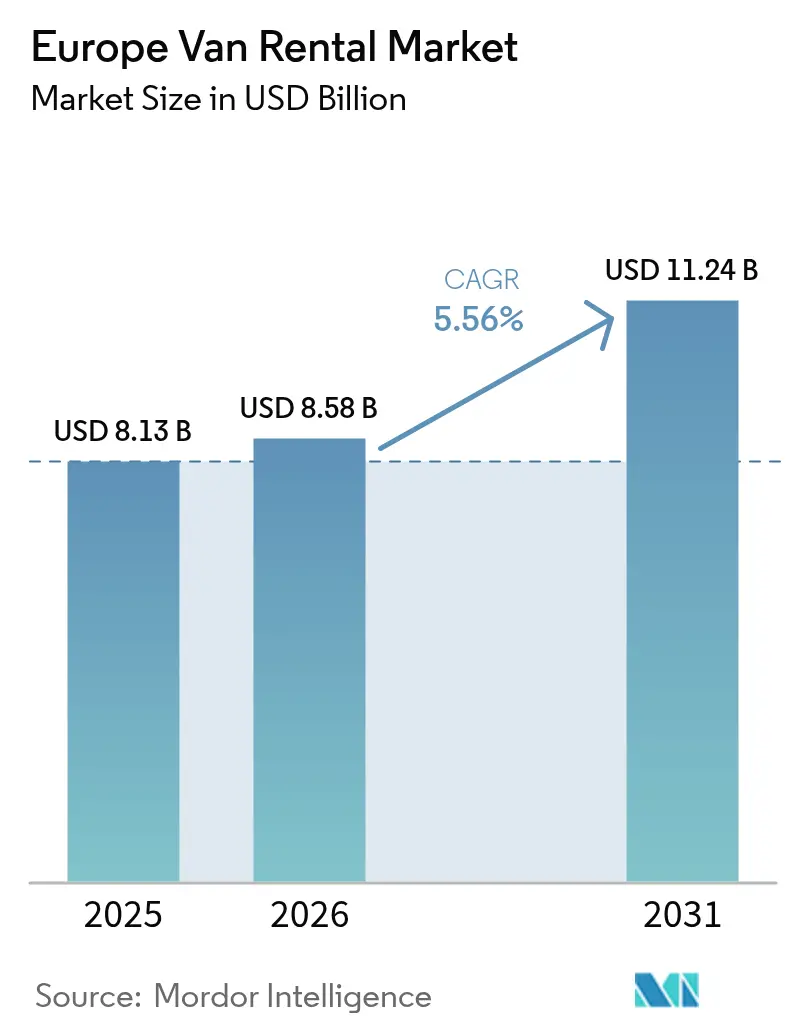
| Base Year Market Size (2025) | USD 8.13 Billion |
| Market Size (2026) | USD 8.58 Billion |
| Market Size (2031) | USD 11.24 Billion |
| Growth Rate (2026 - 2031) | 5.56 % |
| Market Concentration | Medium |
Major Players *Disclaimer: Major Players sorted in no particular order Image © Mordor Intelligence. Reuse requires attribution under CC BY 4.0. | |
Europe Van Rental Market Analysis by Mordor Intelligence
The European van rental market size is expected to grow from USD 8.13 billion in 2025 to USD 8.58 billion in 2026 and is forecast to reach USD 11.24 billion by 2031 at 5.56% CAGR over 2026-2031. E-commerce logistics demand, stricter low-emission rules, rising tourism, and the corporate shift to asset-light mobility strategies drive growth. Cargo vans provide the backbone of last-mile delivery, while passenger vans are gaining traction as Mediterranean travel rebounds. Digital platforms expand reach through instant booking and keyless access, while established operators accelerate fleet electrification to stay compliant with the growing Low Emission Zones. Competitive intensity is rising as scale players pursue acquisitions, technology upgrades, and manufacturer alliances that secure scarce electric van supply.
Key Report Takeaways
- By van type, cargo models led with 70.05% revenue share in 2025; passenger vans are projected to rise at 5.86% CAGR to 2031.
- By rental duration, daily contracts held 43.78% of the European van rental market share in 2025, whereas long-term leasing is projected to record the highest CAGR at 5.93% through 2031.
- By application, commercial usage accounted for a 58.87% share of the European van rental market size in 2025; personal usage is expanding at a faster rate of 5.67% CAGR over the same period.
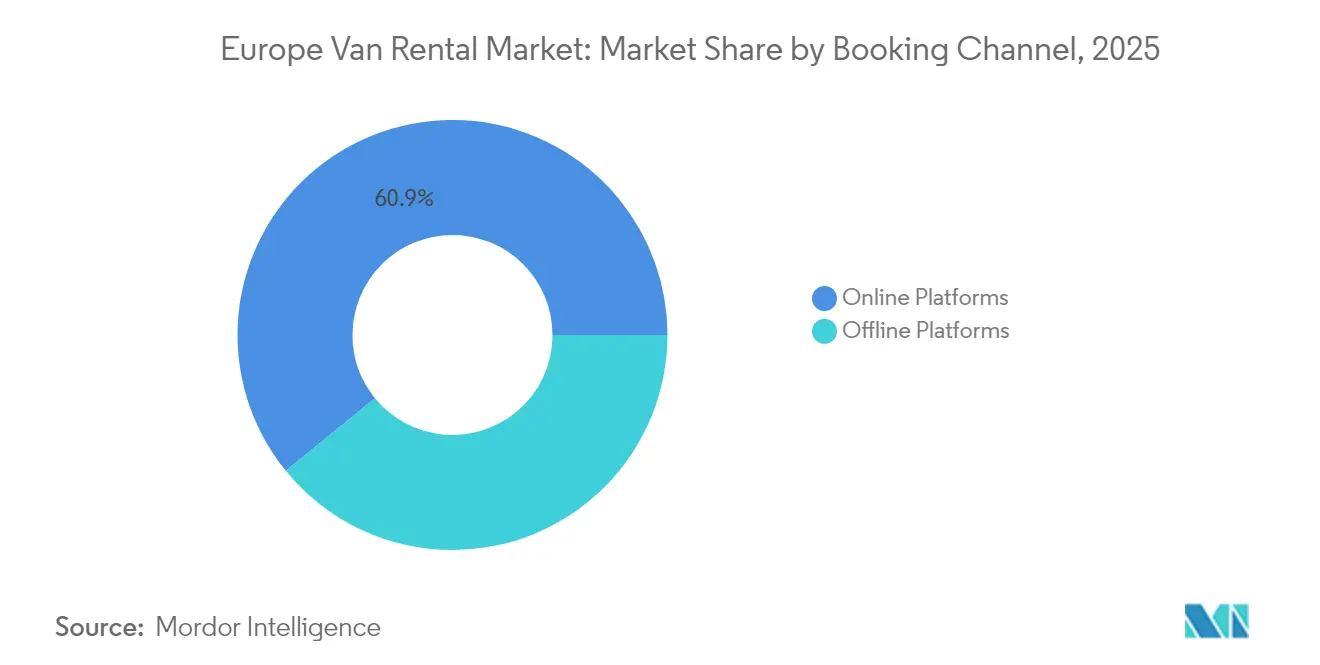
- Through the booking channel, online platforms captured a 60.88% revenue share in 2025 and are expected to continue climbing at a 6.03% CAGR to 2031.
- By customer type, corporate accounts accounted for 41.95% of bookings in 2025, while travel agencies posted the fastest growth, at a 6.12% CAGR, from 2026 to 2031.
- By country, Germany led with a 24.86% share in 2025; Spain is forecast to grow at a 5.97% CAGR through 2031.
Note: Market size and forecast figures in this report are generated using Mordor Intelligence’s proprietary estimation framework, updated with the latest available data and insights as of 2026.
Market Trends and Insights
Drivers Impact Analysis of Europe Van Rental Market*
| Driver | (~) % Impact on CAGR Forecast | Geographic Relevance | Impact Timeline |
|---|---|---|---|
| Last-Mile Delivery Boom | +1.2% | Germany, United Kingdom, France | Short term (≤ 2 years) |
| ESG-Driven EV Van Leasing | +1.1% | Germany, Netherlands, Scandinavia | Long term (≥ 4 years) |
| SME Shift to Flexible Rentals | +0.9% | Urban centers across Europe | Medium term (2-4 years) |
| Tourism Boosts Van Demand | +0.8% | Spain, Italy, France | Short term (≤ 2 years) |
| CO₂ Tolling and Low Emission Zones Impact | +0.7% | London, Paris, Amsterdam | Medium term (2-4 years) |
| App-Based Micro Rentals Rise | +0.6% | Berlin, Paris, Madrid | Short term (≤ 2 years) |
| Source: Mordor Intelligence | |||
Surge in E-Commerce-Driven Last-Mile Delivery
The rise of e-commerce across Europe is reshaping logistics strategies. Providers are adopting flexible solutions to manage fluctuating demand. Short-notice van rentals, for instance, help logistics companies handle seasonal peaks without long-term fleet investments that risk depreciation. This trend is evident with major players like Amazon, whose same-day delivery services have raised expectations for speed and reliability. Logistics firms, such as DHL Express, have increased rental van usage, reflecting the industry's shift toward more agile delivery models. These changes highlight the evolving retail logistics landscape, where adaptability and responsiveness are key competitive advantages[1]. Retailers outside the logistics sphere, including Zara and H&M, also utilize rental pools to fulfill direct-to-consumer orders. The European van rental market yields immediate scalability for carriers operating inside crowded urban hubs where depot space is scarce. High-density delivery routes further reinforce the demand for cargo vans equipped with telematics that enhance route accuracy and reduce idle time.
Corporate ESG Targets Pushing Electric-Van Leasing
Large multinationals, such as Unilever and Nestlé, require logistics vendors to curb Scope 3 emissions, triggering a fresh demand for electric van capacity [2]. Corporate procurement teams favor rentals that deliver zero-tailpipe transport without locking balance sheets into vehicle purchases. Fleet electrification is hindered by 8-12 month lead times for new e-vans, yet rental operators secure priority allocations via frame agreements with manufacturers like Mercedes-Benz. Northern European markets provide extra impetus through carbon taxes and green public procurement rules, making electric vans a compliance must-have rather than a public-relations choice.
SME Cap-Ex Avoidance Via Flexible Rentals
Europe saw an 8.3% rise in new commercial van registrations in 2024, straining SME budgets [3]. Ever-higher borrowing costs intensify scrutiny of asset purchases, nudging small firms toward the European van rental market for pay-as-you-go mobility that preserves cash flow. Project-driven sectors, such as construction, favor rentals that match contract durations, and expanded pay-per-use contracts provide the granularity needed to right-size fleets every week. Embedded maintenance and insurance simplify back-office burdens, and rental portals now offer dynamic pricing that drops idle-day charges, improving transparency and uptake among cost-sensitive operators.
Tourism Rebound Boosting Passenger Van Demand
Spain's tourism industry, having set records for international visitor numbers, is reshaping how leisure travelers approach mobility. Tourists in groups are increasingly turning to multi-seat passenger vans, particularly for scenic coastal drives and outdoor adventures. They prefer these vans for their spacious cabins, which comfortably fit both passengers and their gear. This shift not only streamlines bookings—reducing the need for multiple vehicles—but also reduces travel costs per person. In response to this growing trend, leading tour operators such as TUI have expanded their van fleets. The van rental market across Europe is riding the wave of a broader experiential travel movement. Regions such as Provence and the French Alps are witnessing a surge in van rentals, especially for camping and nature-centric trips. For rental companies, incorporating passenger vans into their fleet is a strategic move. It allows them to diversify from the fiercely competitive small-car market and cater to the growing demand for flexible, group-oriented travel experiences.
Restraints Impact Analysis of Europe Van Rental Market*
| Restraint | (~) % Impact on CAGR Forecast | Geographic Relevance | Impact Timeline |
|---|---|---|---|
| High EV Van Costs | −1.4% | Northern Europe | Medium term (2-4 years) |
| Driver Shortage Worsens | −0.8% | Germany, United Kingdom, France | Short term (≤ 2 years) |
| Diesel Van Tax Incoming | −0.7% | Netherlands and potential adopters | Short term (≤ 2 years) |
| Cross-Border License Gaps | −0.5% | EU wide | Long term (≥ 4 years) |
| Source: Mordor Intelligence | |||
Up-Front Cost / Limited Supply of Electric Vans
Despite mounting regulatory pressures and environmental incentives, Europe's rental market is facing challenges in its transition to electric vans. Electric models, still pricier than their diesel counterparts, face hurdles like extended delivery wait times. These delays stem from constraints in battery supply, shortages in semiconductors, and a sparse charging infrastructure, all of which hinder fleet renewals. Moreover, rising insurance premiums further escalate the total cost of ownership, making electric vans a less appealing choice for rental operators. These operators also face additional challenges, including investing in depot charging stations and training drivers for electric vehicle operations. While declining battery prices are slowly bridging the cost divide, ongoing availability issues are stalling the pace of electric van adoption, falling short of policymakers' projections. Consequently, the electrification trajectory for Europe's van rental sector is lagging behind expectations, underscoring the need for synchronized efforts in the manufacturing, infrastructure, and policy realms to accelerate this transition.
Cross-Border Licensing Age Inconsistencies
Member-state rules set driver minimum ages between 18 and 21, forcing rental systems to embed complex eligibility checks that frustrate cross-border users. Younger drivers relocating for work face confined operating rights, shrinking the talent pool. Insurance underwriters overlay stricter age limits, compounding the restriction. EU efforts to harmonize standards under the Professional Driver Qualification Directive will take years to implement, leaving near-term friction intact and adding admin overhead to the European van rental market.
*Our forecasts treat driver/restraint impacts as directional, not additive. The impact forecasts reflect baseline growth, mix effects, and variable interactions.
Europe Van Rental Market Segment Analysis
By Van Type:
Cargo Dominance Amid Passenger RevivalCargo vans accounted for 70.05% of 2025 revenue, representing the largest share of the European van rental market. Demand stems from last-mile shippers, such as Amazon and Zalando, which treat rentals as elastic delivery capacity. Cargo units equipped with live telematics enable route optimization, enhancing uptime and reducing per-drop costs. Meanwhile, passenger vans are projected to post the strongest growth, at a 5.86% CAGR, through 2031, tied to the resurgence of tourism and group travel preferences. Indie Campers confirmed a 34% rise in passenger van bookings across Mediterranean countries in 2024, a trend driven by family trips and outdoor pursuits. Cargo’s scale advantage is unlikely to fade; yet, the elevated growth pace of passenger models adds diversity and enhances seasonal balancing within the European van rental market.
Passenger demand also benefits corporate shuttle contracts and airport transfers, although the scarcity of professional drivers limits the availability of fully serviced offerings. Operators counteract the shortage by expanding self-drive packages, which are supported by mobile check-in and insurance bundles. For cargo fleets, electrification looms large; the expansion of Low Emission Zones nudges Amazon’s delivery partners to switch to electric vans once supply permits. Early adopters enjoy premium rates and improved access to the city center, locking in a competitive edge.


By Rental Duration:
Daily Rentals Lead While Long-Term GainsDaily rentals accounted for 43.78% in 2025, reflecting short-cycle e-commerce peaks and tourist use cases that require flexible capacity. Promotions tied to weekend leisure drives and instant online confirmation keep daily hires top of mind. However, long-term leasing shows the fastest expansion at 5.93% CAGR through 2031 as corporations secure maintenance-inclusive contracts that flatten monthly outlays. Predictable cost lines align with operating expense budgets and support asset-light strategies. Hourly hires, facilitated by micro-duration apps, remain niche but rising inside dense cities, where parking scarcity and congestion charges deter personal van ownership. The European van rental market share for weekly and monthly agreements fills interim needs for construction projects and seasonal retail campaigns, balancing vehicle utilization for operators.
In revenue terms, daily hires still dominate due to their higher rate per day, but the margin structure on long-term leases is attractive because of lower vehicle churn. Operators deploy subscription models that blend fixed payments with mileage caps, appealing to SMEs seeking transparency. Electrification aligns well with long-term contracts, providing rental providers with ample time to recover higher capital costs through multi-year fees. At the same time, daily renters still favor diesel due to its lower upfront price.
By Application:
Commercial Strength Meets Personal GrowthCommercial customers generated 58.87% of turnover in 2025, supported by logistics, utilities, and construction firms that need scalable transport without capital tie-up. The European van rental market size for commercial use is expanding in response to regulatory compliance needs, as environmental regulations prompt the adoption of fleet-as-a-service models that deliver ready-to-comply vehicles. Yet personal hires advance faster at 5.67% CAGR through 2031, propelled by holidaymakers and DIY movers using digital apps to spot nearby vans. Cargo-bike adoption and compact e-trucks offer partial alternatives, but van versatility remains a key factor in making the segment attractive.
Corporate sustainability agendas are driving commercial clients toward electric van options, although supply gaps and higher lease rates are moderating uptake. Personal renters are showing a growing awareness of urban emission rules, seeking LEZ-approved units for weekend shopping runs within city centers. Transparent fee structures and damage-waiver packages smooth uptake among first-time users.
By Booking Channel:
Digital Transformation AcceleratesOnline channels accounted for 60.88% of bookings in 2025 and are projected to grow 6.03% CAGR by 2031. Real-time inventory, instant payment, and QR-code vehicle unlock streamline the journey. Kiosk-free processes shrink wait times, fostering loyalty among time-pressed users. Mobile apps further enrich offers via add-on insurance and navigation bundles. Physical counters still matter for complex corporate contracts and oversized specialty vehicles, yet their share is eroding as even large buyers adopt self-serve portals that integrate approval workflows. The European van rental market benefits from reduced overhead when bookings migrate online, enabling sharper price competition and data-driven upselling.
Digitized bookings provide granular demand records, informing fleet allocation decisions by hour and postcode. Integration with telematics closes the loop, optimizing utilization and maintenance scheduling. Keyless technology also reduces lost-key incidents and simplifies vehicle turnover, thereby enhancing customer satisfaction and reviews.
By Customer Type:
Corporate Leadership Amid Agency GrowthCorporate accounts held 41.95% of 2025 revenue, driven by national and cross-border contracts that bundle services, telematics, and insurance. Larger firms favor multi-year master agreements that lock in pricing and secure priority access during peak seasons. Travel agencies show the quickest climb at 6.12% CAGR as group itineraries regain traction and business travel resumes. Agencies embed vans into package deals covering lodging and activities, capturing value beyond the ride itself. Individual consumers maintain a consistent share, although their growth trails that of commercial categories due to the emergence of alternative mobility options. Government buyers represent a specialized but stable segment, often prioritizing electric or low-emission vans to meet public procurement targets.
Fleet-management companies partner with rental brands to provide turnkey mobility, blurring the line between leasing and renting. Such tie-ups expand the European van rental market’s corporate reach, while loyalty apps and volume rebates cement relationships.
Geography Analysis
Germany Van Rental Market
Germany accounted for 24.86% of the European van rental market revenue in 2025. Industrial clusters in Bavaria, Baden-Württemberg, and North Rhine-Westphalia create steady cargo van rotations, while Low Emission Zones in Berlin, Hamburg, and Munich accelerate electric vehicle adoption despite supply shortages. Enterprise and Sixt each expand their warehouse charging hubs to maintain e-van uptime. Driver scarcity remains Germany’s critical pain point, lifting wage bills and compressing margins.
Spain Van Rental Market
Spain posts a 5.97% CAGR through 2031, the highest among regional growth rates. International visitors surpassed pre-pandemic totals in 2024, and van tours in Andalusia and Catalonia experienced a sharp rise. Domestic logistics networks expand as online sales grow, utilizing rental vans to circumvent ownership costs. Madrid and Barcelona introduce LEZ extensions that incentivize the conversion to electric fleets, but infrastructure density remains uneven outside the principal corridors.
Broader European Markets
The United Kingdom, France, and Italy provide a stable scale. UK rental providers juggle post-Brexit cabotage rules and driver eligibility checks, yet home-delivery volumes offset cross-border friction. France combines robust domestic tourism with strong e-commerce adoption, with passenger van rentals supporting access to rural destinations. Italy’s north-south economic split yields mixed demand, with Milan’s logistics growth balancing southern leisure hires. Eastern European nations gain relevance as EU funds upgrade highways and logistics parks, unlocking new van traffic; yet, heterogeneous compliance standards demand agile operating models.
Regulatory Landscape
Regulation affecting the European van rental market is increasingly shaped by decarbonization compliance and tighter oversight of cross-border light commercial vehicle (LCV) operations. CO2 standards for new vans under Regulation (EU) 2019/631 anchor fleet renewal decisions, while Regulation (EU) 2025/1214 introduced a temporary three-year averaging mechanism (2025-2027) for manufacturers to meet CO2 targets, which affects the timing and availability of compliant van supply for rental fleets.
Enforcement and data requirements are also being strengthened for hired vehicles and international operations. Implementing Decision (EU) 2024/2164 sets minimum data requirements for hired vehicles in national electronic registers to improve enforcement and interconnection, increasing reporting and systems needs for large multi-country lessors. From 1 July 2026, the European Labour Authority framework on smart tachographs expands requirements to certain 2.5-3.5 tonne vehicles used in international transport or cabotage, adding hardware, calibration, and process burdens for rental providers serving cross-border commercial customers. EU rules on the use of hired vehicles for goods carriage also continue to shape how undertakings deploy hired fleets across Member States.
Value Chain Analysis
The Europe van rental value chain begins with vehicle sourcing from OEMs and upfitters, covering standard cargo, high-roof, refrigerated, and passenger configurations. This is followed by financing and asset holding, including bank facilities, securitization, captive and third-party lessors, and then by fleet operations managed by rental and leasing specialists. Operators such as Europcar Mobility Group, Enterprise, and Fraikin coordinate procurement, depreciation planning, remarketing, and branch or depot networks, while digital layers for online booking, identity checks, payments, telematics, and keyless access sit between inventory and end users.
Electrification and new contracting models are reshaping upstream partnerships and midstream services. The GATE joint venture between Iveco Group and DLL illustrates how OEM capability and specialist financing are being bundled into pay-per-use, long-term rental offers for electric commercial vehicles across markets including Italy, France, and Germany, broadening options beyond traditional daily hire. Downstream, corporate accounts and last-mile operators drive demand for bundled insurance, maintenance, and uptime services, making workshop networks, charging access at depots, and data-enabled fleet management, including telematics, preventative maintenance scheduling, and utilization analytics, key differentiators for van rental providers.
Competitive Landscape
The European van rental market features moderate fragmentation. Sixt SE, Enterprise Holdings, and Europcar Mobility Group top the table, pursuing acquisitions to enlarge their footprint and secure OEM quotas for electric models. The European van rental market is expanding through acquisitions, electrification, and the introduction of new business models. Enterprise's acquisition of Europcar's commercial-van unit expanded its fleet and corporate mobility services. Sixt is investing in electrifying its vans, partnering with Mercedes-Benz and Ford. New entrants like MILES Mobility are disrupting urban markets with 30-minute micro-rentals, leveraging high vehicle density for strong utilization rates.
Technology drives efficiency and customer experience. Telematics enables predictive maintenance, while app-based integrations streamline operations. Peer-to-peer platforms like GoMore expand supply in Nordic countries, allowing private van rentals. Specialty vans, such as refrigerated and high-roof models, form a premium sub-segment with limited supply and higher profitability. Operators addressing regulatory differences, EV shortages, and driver availability gain a competitive edge. The market remains moderately concentrated, with the top five players accounting for just under half of the total revenue, leaving room for consolidation and innovation.
Europe Van Rental Industry Leaders
-
Europcar Mobility Group
-
Fraikin
-
Enterprise Holdings, Inc.
-
Avis Budget Group
-
SIXT SE
- *Disclaimer: Major Players sorted in no particular order

Europe Van Rental Market Companies Covered in this Report
- Europcar Mobility Group
- Sixt SE
- Enterprise Holdings, Inc.
- Avis Budget Group
- Hertz Corporation
- Fraikin
- Ryder System, Inc.
- Petit Forestier
- Auto Europe
- Blacksheep
- Vimianos Travel and Hospitality Pvt. Ltd.
- Roadsurfer
- Indie Campers
Market Opportunities and Future Outlook
Low Emission Zones and corporate Scope 3 requirements are creating demand for compliant electric-van capacity delivered through flexible rentals, particularly when buyers face 8-12 month lead times for new e-vans and prefer maintenance-inclusive mobility. Europcar UKs September 2025 commercial fleet expansion, which included a wider range of electric short-wheelbase vans, illustrates how operators adjust fleet mix to capture demand tied to urban access rules and corporate sustainability procurement.
Operational-model innovation is also widening the growth path for pay-per-use and short-duration urban offerings alongside longer subscription-style contracts. Online platforms already account for 60.88% of bookings in 2025, supporting faster inventory turns and add-on services such as insurance bundles and telematics-based usage pricing. Berlin-based Juna expanding its operational electric truck fleet from about 50 to 200 vehicles by end-2026 signals accelerating supply formation in electric commercial vehicle rental and subscription models, which can carry over into van rental through shared charging access, fleet operations know-how, and customer adoption of usage-based commercial mobility.
Recent Industry Developments in Europe Van Rental Market
- April 2026: Europcar Mobility Group signed an exclusive partnership with MIC Co., Ltd., operator of Japans Niconico Rent-A-Car network, marking its first exclusive partnership in Japan. This extends Europcar’s international mobility footprint and supports multi-country corporate and travel customers that increasingly demand consistent booking, insurance, and service standards across regions.
- September 2025: Europcar UK expanded its commercial vehicle fleet by adding new small, short wheelbase, and long wheelbase vans, alongside a broader selection of electric short wheelbase models. The fleet action increases available capacity for SME and last-mile users and strengthens the operator’s ability to serve customers operating under Low Emission Zone constraints.
- June 2024: Fraikin renewed its fleet financing securitization program for three years with a total commitment of EUR 1.47 billion, arranged by Bank of America. The renewed funding platform supports large-scale fleet refresh cycles and provides added headroom to fund decarbonization-oriented vehicle procurement and related infrastructure needs.
Europe Van Rental Market Report Scope and Research Methodology
Market Definition and Coverage
For this report, the Europe van rental market is defined as revenue earned from renting passenger and cargo vans to personal and commercial users across European countries, including bookings through online platforms and rental counters.
Scope exclusions: leasing outside the defined rental terms, self-drive car rentals without vans, and used vehicle sales are not counted in this market sizing.
Segments Covered in This Report
- By Van Type
- Passenger Vans
- Cargo Vans
- By Rental Duration
- Hourly Rentals
- Daily Rentals
- Weekly Rentals
- Monthly Rentals
- Long-Term Leasing (12-24 months)
- By Application
- Personal Application
- Commercial Application
- By Booking Channel
- Online Platforms
- Rental Counters
- By Customer Type
- Individual Consumers
- Corporate Clients
- Travel Agencies
- Government & Institutional Users
- By Country
- Germany
- United Kingdom
- France
- Italy
- Spain
- Rest of Europe
Data Sources, Market Sizing, and Validation
Desk Research
Desk research started by building country coverage and demand indicators for van rentals, then mapping how pricing and utilization typically move across seasons and customer segments (personal versus commercial). We used public mobility and transport statistics, such as Eurostat, national transport ministries and statistical offices, and tourism arrivals data from sources like UN Tourism, since tourism shifts short-term rental volumes.
To ground fleet and operating assumptions, we reviewed road fleet and registration indicators from sources such as ACEA and national vehicle registries, and checked public tender portals where institutional demand was relevant. We also used company annual reports, investor presentations, and reputable business press to understand fleet strategy, branch footprint, and digital booking trends. In a few cases, paid subscriptions for company financials and business news were used to cross-check reported revenues and major events. These desk research sources are illustrative, and additional public and commercial references were also used to collect, validate, and resolve open questions.
Primary Interviews and Surveys
Primary work was used to stress-test the desk assumptions that drive revenue, mainly rate structures, utilization by season, and mix shifts between passenger and cargo vans. We spoke with a mix of rental operators, fleet managers, channel partners, and large users, including corporate mobility buyers and last-mile delivery buyers, across major European markets to close data gaps and confirm the inputs used in the model before finalizing the assumptions.
Distribution of primary research fieldwork respondents
| Company type | Respondent position |
|---|---|
| Top tier: 28% | CXOs: 12% |
| Mid tier: 57% | Functional/Unit leaders: 32% |
| Smaller Players: 15% | Managers: 56% |
Market-Sizing & Forecasting
The core sizing approach used a top-down build where country-level demand pools were reconstructed using travel activity and commercial activity signals, and then translated into rental revenue through utilization and price assumptions. For example, country patterns in tourism nights, parcel and light freight activity, and urban access rules were used to estimate how often vans are rented, followed by applying realistic rental durations and daily rate bands.
Selective bottom-up checks were then used to keep totals sensible, including operator revenue scale checks, sampled price sheets, and location footprint comparisons in key countries. The inputs that mattered most were fleet availability and renewal pace, share of cargo versus passenger vans, average rental length by customer type, utilization swings in peak and shoulder months, and the rate premium or discount for online booking versus counter bookings. Where direct operator data was thin in smaller countries, we filled gaps using proxy variables such as vehicle parc direction, tourism intensity, and expert-validated utilization ranges, and then normalized results back to Europe totals.
For forecasting, scenario analysis was preferred because the market is sensitive to a few practical drivers that can shift quickly, such as fuel and electricity costs, low emission zone expansion, and e-commerce delivery volumes. The final outlook was chosen after primary experts reviewed the reasonableness of rate progression, fleet electrification timing, and demand resilience under slower macro conditions.
Data Validation & Update Cycle
Before sign-off, estimates were triangulated across multiple angles so that one noisy input did not drive the full market number. We compared outputs with independent signals like tourism direction, fleet and registration trends, and reported mobility revenue trends, and then investigated any sharp jumps at country level to confirm they were explainable.
A second analyst review was completed to check formulas, currency conversion handling, and the logic behind key assumptions. If variances were still wide versus interview feedback, follow-up calls were triggered to retest the most sensitive variables, usually utilization and rate progression. Reports are refreshed annually, and interim updates are made when material events occur, after which a final pre-delivery review is completed so clients receive the latest updated view.
Mordor Intelligence's Europe Van Rental Market Size Versus Other Published Estimates
Published market sizes for Europe van rental do not always match because firms make different choices on what to count as rental revenue, which countries are included, and how they handle price changes across booking channels and rental durations. Differences also show up when one source uses an older rate environment while another uses more recent pricing, which is relevant in a market where daily rates can shift faster than fleet size.
Key gaps usually come from how long-term leasing is treated inside rental revenue, whether passenger and cargo vans are both included in full, and how currency conversion timing is applied when local prices are collected in euros and pounds. By rechecking average selling price logic at the country level on a regular cadence and locking currency timing consistently to the base-year average, ASP drift is kept controlled in Mordor Intelligence.
Benchmark comparison
| Source | Market Size | Gaps in Research Methodology |
|---|---|---|
| Mordor Intelligence | USD 8.13 B (2025) | |
| Regional Consultancy A | USD 8.30 B (2026) | Uses a later year where rates were stronger in some countries, and the scope description suggests long-term leasing is blended with short-term rentals without a consistent duration cut. |
| Trade Journal B | USD 7.00 B (2035) | Presents a Europe value as a point estimate far out in the forecast window, with limited visibility on country coverage and on how passenger versus cargo mix and rate progression were modeled. |
Overall, the spread is mainly explained by timing and scope discipline, rather than a single demand assumption. When rental duration boundaries, channel-level pricing, and currency timing are handled consistently, the market total becomes easier to trace back to real utilization and rate drivers and to repeat each year using the same steps.
Key Questions Answered in the Report
What is the forecast value of the Europe van rental market by 2031?
The Europe van rental market is projected to reach USD 11.24 billion by 2031.
Which van type currently leads demand?
Cargo vans led with 70.05% share in 2025, anchored by e-commerce last-mile delivery.
Which country shows the highest growth rate?
Spain is expected to grow at a 5.97% CAGR through 2031, driven by tourism and e-commerce expansion.
How fast are online booking channels growing?
Online platforms are expanding at a 6.03% CAGR, already securing 60.88% of bookings in 2025.
What is the main challenge to electric van adoption?
High upfront cost and limited supply of electric models reduce near-term fleet electrification speed.