
Market Overview
| Study Period | 2020 - 2031 |
|---|---|
| Forecast Data Period | 2026 - 2031 |
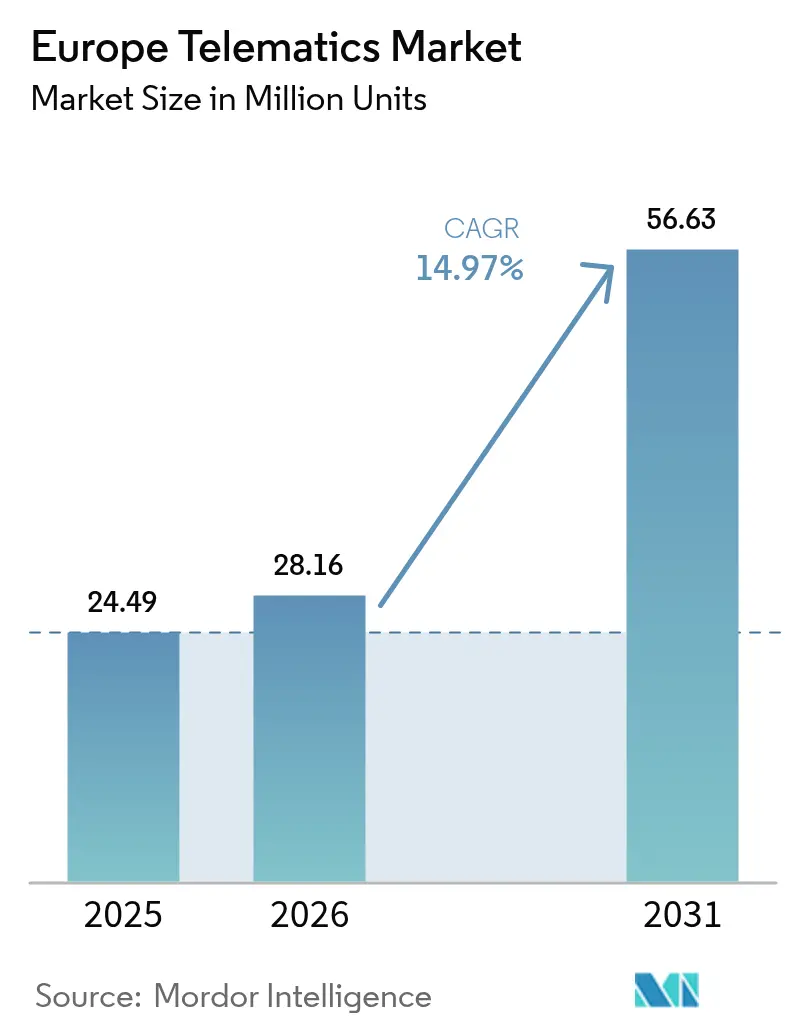
| Base Year Market Size (2025) | 24.49 Million units |
| Market Volume (2026) | 28.16 Million units |
| Market Volume (2031) | 56.63 Million units |
| Growth Rate (2026 - 2031) | 14.97% CAGR |
| Market Concentration | Medium |
Major Players *Disclaimer: Major Players sorted in no particular order Image © Mordor Intelligence. Reuse requires attribution under CC BY 4.0. | |
Europe Telematics Market Analysis by Mordor Intelligence
The Europe telematics market size is expected to grow from 24.49 million installed units in 2025 to 28.16 million installed units in 2026 and is forecast to reach 56.63 million installed units by 2031 at 14.97% CAGR over 2026-2031. Growth is underpinned by synchronized European Union (EU) mandates, original-equipment-manufacturer (OEM) connectivity strategies, and fast-moving fleet-digitization programs that pull telematics from a discretionary add-on to a core mobility infrastructure layer. Rising embedded connectivity in passenger cars, the ongoing logistics boom, and the regulatory migration from 2G/3G to 4G/5G collectively set a robust baseline for the Europe telematics market, while declining sensor costs broaden adoption beyond large fleets. Competitive intensity is reshaping around direct OEM data pipes, evidenced by Volkswagen Group’s line-fit partnerships, even as aftermarket specialists position themselves with cross-fleet analytics to defend share. Data privacy obligations and retrofit complexity temper rollout speed, but overall momentum remains firmly positive thanks to overlapping technology, regulatory, and business case catalysts across the continent.
Key Report Takeaways
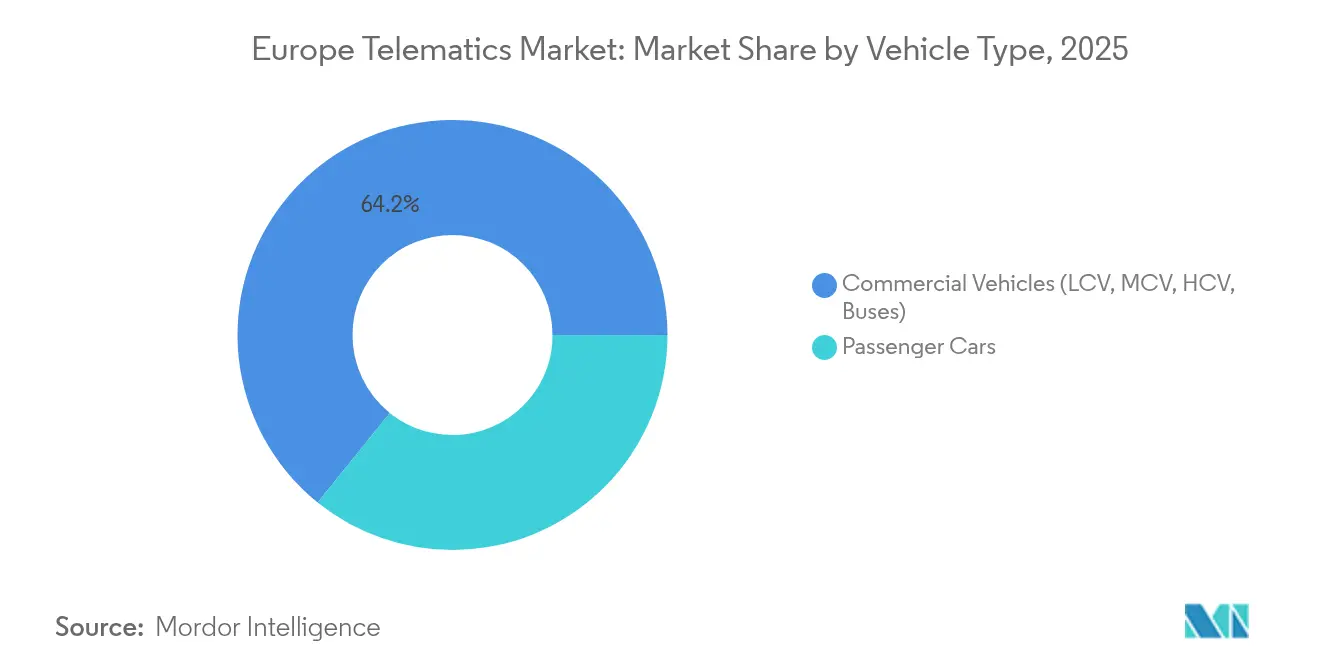
- By vehicle type, commercial vehicles led with 64.21% of the Europe telematics market share in 2025, while passenger cars are projected to expand at a 16.79% CAGR through 2031.
- By solution type, fleet management and asset tracking captured 37.12% share of the Europe telematics market size in 2025, whereas insurance and usage-based telematics are advancing at a 15.61% CAGR to 2031.
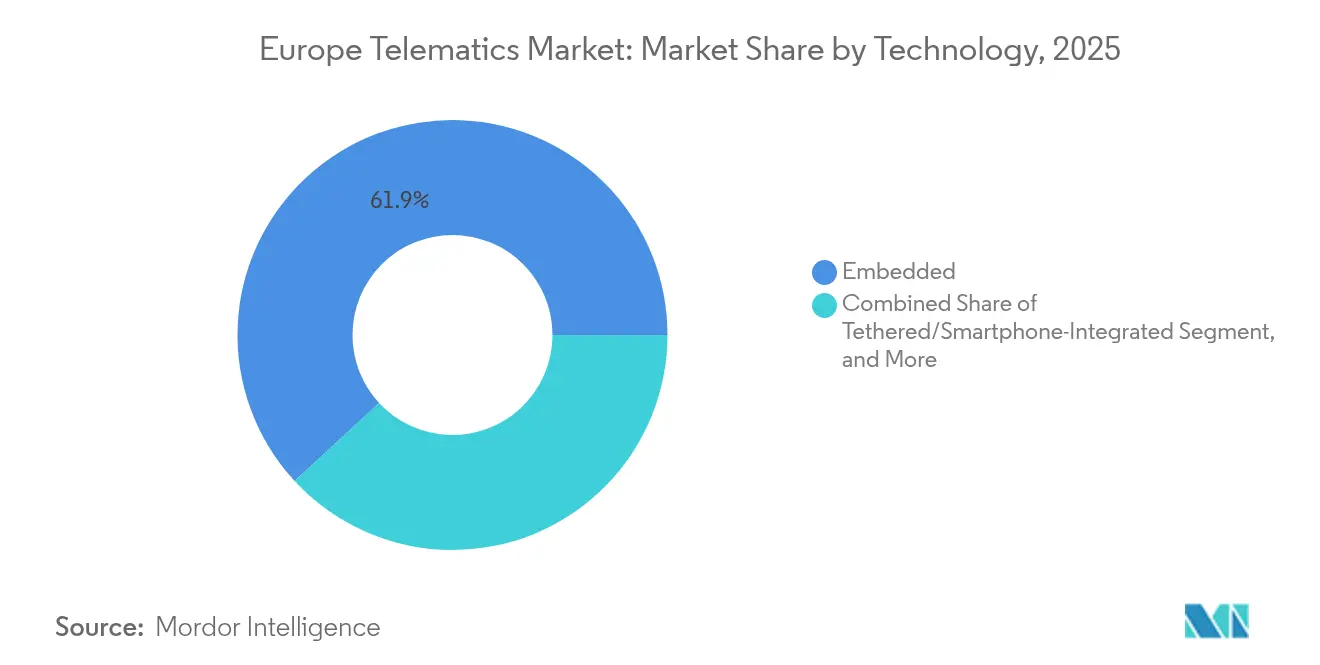
- By technology, embedded telematics commanded 61.88% share in 2025 in the Europe telematics market and is growing at a 16.76% CAGR through 2031.
- By deployment mode, OEM line-fit platforms accounted for 55.93% share in 2025 in the European Telematics market and are recording a 16.31% CAGR over the forecast horizon.
- By geography, Germany dominated with 28.52% share in 2025 and is sustaining 15.41% growth through 2031, supported by domestic OEM presence and strong compliance momentum.
Note: Market size and forecast figures in this report are generated using Mordor Intelligence’s proprietary estimation framework, updated with the latest available data and insights as of 2026.
Europe Telematics Market Trends and Insights
Drivers Impact Analysis*
| Driver | (~) % Impact on CAGR Forecast | Geographic Relevance | Impact Timeline |
|---|---|---|---|
| EU eCall and Smart Tachograph compliance timeline | +2.8% | EU-wide, strongest in Germany, France, Italy | Medium term (2-4 years) |
| Rapid OEM shift to embedded connectivity platforms | +3.2% | Germany, UK, Nordic countries | Long term (≥ 4 years) |
| E-commerce and last-mile logistics optimisation push | +2.1% | Urban centers across EU, strongest in Netherlands, UK | Short term (≤ 2 years) |
| Falling connectivity and sensor costs for fleet owners | +1.9% | Global with EU adoption acceleration | Medium term (2-4 years) |
| Next-Gen (4G/5G) eCall migration mandate | +1.5% | EU-wide regulatory requirement | Short term (≤ 2 years) |
| HDV CO₂ monitoring rules nudging eco-driving analytics | +0.8% | EU commercial vehicle operators | Long term (≥ 4 years) |
| Source: Mordor Intelligence | |||


EU eCall and Smart Tachograph Compliance Timeline
The Europe telematics market receives a direct uplift from synchronized EU directives that stipulate Next Generation eCall readiness and Smart Tachograph 2 installation across vans above 2.5 tonnes. Hardware refresh cycles concentrate around the July 2026 tachograph deadline and the January 2027 4G/5G eCall cut-over, giving providers reliable demand visibility while allowing bundling of compliance modules with higher-margin analytics services.[1]TÜV Rheinland, “TÜV Rheinland Supports Flairmicro in Achieving NG eCall Certification,” tuv.com As operators consolidate procurement to meet these immovable milestones, solution vendors benefit from fewer stakeholder objections and clearer budget approvals, effectively flattening lengthy sales funnels and accelerating unit run-rates across the Europe telematics market.
Rapid OEM Shift to Embedded Connectivity Platforms
OEMs now view connected-vehicle data as a strategic asset for lifetime customer monetization. Partnerships such as Targa Telematics and Volkswagen Group demonstrate a structural pivot: line-fit modules ship with the vehicle, streamlining fleet onboarding, enabling weekly feature drops, and reducing support queries tied to aftermarket device faults. Embedded channels also unlock proprietary diagnostics, over-the-air (OTA) updates, and energy-management controls, extending revenue streams long after initial sale. Consequently, the Europe telematics market increasingly rewards providers that master OEM data ingestion and analytic enrichment at scale.
E-commerce and Last-Mile Logistics Optimization Push
Same-day and one-hour delivery promises in dense European cities raise fleet-efficiency stakes. Telematics platforms link dynamic routing engines with inventory and parcel-locker networks, squeezing idle time and shrinking miles driven per drop. Electric vans compound complexity because charging schedules, battery health, and low-emission-zone rules must slot into dispatch algorithms in real time. As urban regulators tighten sustainability benchmarks, logistics operators turn to telematics dashboards for carbon-scorecard reporting, cementing demand among parcel and grocery chains that already underpin more than one-third of all commercial deliveries in major EU metros. This operational nexus keeps the Europe telematics market firmly on an upward trajectory.
Falling Connectivity and Sensor Costs for Fleet Owners
Volume manufacturing pushes telematics hardware bill-of-materials below the psychological EUR 100 threshold, while multi-carrier SIM bundles and 5G bandwidth price erosion slash monthly operating costs. Lower entry barriers pull small and mid-sized hauliers into the adoption funnel, expanding the Europe telematics market addressable base. Richer sensor payloads, gyroscopes, high-G accelerometers, and tire-pressure probes, elevate predictive maintenance accuracy, translating hardware savings into faster ROI payback periods. In parallel, cloud-native analytics spread fixed costs across thousands of vehicles, letting vendors tier offerings so that budget-constrained fleets can upgrade à-la-carte.
Restraints Impact Analysis*
| Restraint | (~) % Impact on CAGR Forecast | Geographic Relevance | Impact Timeline |
|---|---|---|---|
| High retrofit and integration costs for mixed fleets | -1.7% | EU-wide, particularly affecting SME fleets | Short term (≤ 2 years) |
| Data-privacy and GDPR-driven vendor liability risk | -1.2% | EU-wide regulatory compliance requirement | Medium term (2-4 years) |
| 2G/3G sunset forcing premature hardware replacement | -2.1% | Germany, UK, Nordic countries with early shutdown timelines | Short term (≤ 2 years) |
| Shortage of telematics data-science talent | -0.9% | Germany, France, Netherlands tech hubs | Long term (≥ 4 years) |
| Source: Mordor Intelligence | |||
High Retrofit and Integration Costs for Mixed Fleets
European fleets seldom buy homogenous vehicle batches; age, make, and engine technology vary widely. Installing disparate black-box devices leads to data silos and support churn, especially for owner-operators juggling thin profit margins. Integration expenses roll beyond hardware, driver onboarding, firmware updates, and legacy CAN-bus quirks consume scarce operating capital. Consequently, smaller fleets defer deployments or restrict rollouts to regulatory minimums, shaving a potential rate off the Europe telematics market CAGR in the near term.
Data-Privacy and GDPR-Driven Vendor Liability Risk
Continuous collection of vehicle coordinates and driver behavior invokes strict “personal data” obligations under GDPR and the EU Data Act. Telematics firms become data controllers, assuming breach-notification responsibilities and consent-management overheads. Insurance-telematics programs face heightened scrutiny because usage-based premiums can reveal sensitive patterns. Compliance frameworks add legal and engineering costs that smaller providers struggle to absorb, nudging sector consolidation even as established players embed robust encryption and anonymization routines to protect their positions in the Europe telematics market.
*Our forecasts treat driver/restraint impacts as directional, not additive. The impact forecasts reflect baseline growth, mix effects, and variable interactions.
Segment Analysis
By Vehicle Type: Commercial Dominance Meets Passenger Acceleration
Commercial vehicles accounted for 64.21% of the Europe telematics market share in 2025, delivering predictable ROI through fuel saving, route adherence, and driver-behavior improvements. Demand stays resilient as regulatory reporting aligns with freight-capacity expansion across pan-European corridors, anchoring the Europe telematics market size to a stable, heavy-duty foundation. Buses and coaches add incremental revenue as electrified public-transport fleets require battery-state-of-charge monitoring and depot-charging orchestration, tasks unserved by legacy ticketing systems.
Passenger cars, while smaller today, post the highest growth pace at a 16.79% CAGR to 2031 as embedded SIM penetration and usage-based insurance (UBI) unlock consumer segments. Active UBI policies are set to climb from 13.0 million in 2023 to 17.6 million in 2028, funneling fresh data volumes into actuarial models that reward safe driving with tangible premium discounts. Light commercial vehicles (LCVs) bridge both worlds, absorbing passenger-car electronics while satisfying business-grade logistics metrics, ensuring sustained double-digit adoption rates throughout the forecast window.


By Solution Type: Fleet Management Leadership Faces Insurance Disruption
Fleet-management and asset-tracking platforms held 37.12% of the Europe telematics market size in 2025, reflecting mature value proofs around fuel costs, maintenance scheduling, and duty-of-care compliance. Continuous feature enrichment, video‐based driver coaching, cargo-temperature validation, and multi-modal dashboard aggregation, keeps renewal rates high among large logistics operators.
Insurance and usage-based telematics, however, top the growth chart at a 15.61% CAGR as actuarial models migrate from static demographics to real-time behavioral scoring. Italy alone hosts 9.5 million active insurance-telematics policies, propagating best practices to Germany, the UK, and France. Safety-and-security sub-verticals ride mandatory eCall adoption, while remote diagnostics gain traction as OEMs expose prognostic code libraries to third-party developers, widening the solutions funnel across the Europe telematics market.
By Technology: Embedded Solutions Dominate Integration Strategies
Embedded units captured 61.88% of the Europe telematics market share in 2025 and are slated to grow at 16.76% CAGR, solidifying OEMs’ long-term stake in data stewardship. Such factory-installed modules enable bi-directional gateways for OTA recalls, feature paywalls, and subscription-based comfort upgrades. As a result, suppliers such as Proemion advocate OEM-grade integrations over retrofits, citing access to proprietary engine-control data that elevates service accuracy.
Tethered and smartphone solutions remain relevant for older vehicles or cost-sensitive users, but continuous price erosion in embedded-module electronics narrows that niche. Aftermarket black boxes must therefore pivot to software-first offerings, AI-powered anomaly detection, multi-fleet data aggregation, and regulatory dashboards, to retain their foothold within the evolving Europe telematics market.
By Deployment Mode: OEM Line-Fit Platforms Reshape Market Dynamics
OEM line-fit platforms constituted 55.93% of the Europe telematics market size in 2025 and expand at a 16.31% CAGR as connectivity migrates from optional upgrade to default vehicle architecture. Direct data pipes simplify fleet integrations and eliminate installation downtime, unlocking faster time-to-value for end users. Still, aftermarket providers hold strategic ground where mixed fleets require single-pane-of-glass analytics that merge line-fit feeds with legacy vehicles.
Integration middleware from firms such as Geotab helps fleets normalize heterogeneous data, a critical step when scaling analytics across brands and model years. Ultimately, the Europe telematics market rewards providers that orchestrate flexible deployments, blending OEM endpoints with value-added cloud services rather than relying solely on hardware attachments.
Geography Analysis
Germany anchored 28.52% of the Europe telematics market in 2025, assisted by OEM headquarters, industrial fleet density, and clear regulatory roadmaps that incentivize compliance-driven upgrades. The Smart Tachograph 2 rollout and Deutsche Telekom’s phased 2G shutdown accelerate hardware refreshes, locking in a 15.41% national CAGR through 2031.
Across the Channel, the United Kingdom sustains solid demand buoyed by its dynamic motor-insurance market, where UBI policies support high telematics penetration and competitive pricing. France follows closely: Direct Assurance’s YouDrive program doubled in size within two years, underscoring consumer readiness to exchange data for savings. Italy’s mature insurance-telematics ecosystem offers a template for neighboring Spain and Portugal, each witnessing fleet-modernization initiatives tied to EU recovery funds. Nordic countries present advanced digital-fleet landscapes, with ABAX tracking 500,000 assets across Sweden, Norway, Denmark, and Finland. High environmental standards support carbon-analytics dashboards, while public subsidies for electric vehicles push telematics deeper into small-business delivery fleets. Eastern Europe, though from a lower base, benefits from rising cross-border commerce and EU infrastructure grants, ensuring steady, if heterogeneous, contribution to the overall Europe telematics market.
Regulatory Landscape
Europe telematics deployments are shaped by EU-wide mandates and harmonization initiatives that raise the value of interoperable data exchange. The Intelligent Transport Systems framework (Directive 2010/40/EU as amended by Directive (EU) 2023/2661) tightened requirements around access to transport and traffic data, requiring Member States to bring the necessary national measures into force by December 21, 2025, which reinforces cross-border consistency for telematics data sharing.
In 2026, rail telematics interoperability was consolidated through Commission Implementing Regulation (EU) 2026/253, which establishes the TEL TSI as the technical specification for the rail telematics subsystem, with the European Union Agency for Railways (ERA) acting as the system authority for this digital standardization. Together with mobility mandates already influencing road fleets, including compliance-driven refresh cycles around Smart Tachograph 2 and next-generation eCall timelines referenced across the market, these requirements lift compliance and cybersecurity expectations while giving providers clearer EU-level technical anchors for standardized interfaces and data governance processes.
Competitive Landscape
The Europe telematics industry shows moderate fragmentation: the top five vendors jointly hold just under 40% of installed units, leaving room for regional specialists and vertical-focused entrants. Aftermarket stalwarts such as Webfleet Solutions and Verizon Connect face disruptive OEM–supplier tie-ups like the Targa Telematics–Volkswagen accord that bypass plug-in hardware and give fleets direct access to richer, warranty-grade data streams.
Insurance-telematics niches display higher consolidation; OCTO Telematics, Targa Telematics, and CMT collectively underwrite a majority of active policies, leveraging actuarial depth to fend off newcomers. Fleet-management, by contrast, remains regionally diverse, with southern European fleets still opting for local vendors able to navigate multi-lingual compliance forms. Strategic M&A, Ctrack buying Inseego’s telematics unit and AddSecure absorbing Astrata Europe, signals a race to scale service portfolios and balance-sheet strength in anticipation of larger OEM-data licensing fees.
Technology convergence shifts competitive emphasis toward advanced analytics and AI-driven insights: route-level carbon footprint scoring, predictive brake-wear alerts, and dynamic toll optimization. Players unable to invest in cloud-native development risk margin compression as connectivity becomes commoditized. Those forging deep API partnerships with OEMs or mobility-payments platforms stand to capture recurring revenue streams, reinforcing competitive moats across the Europe telematics market.
Europe Telematics Industry Leaders
Verizon Communications Inc.
Masternaut Limited
Webfleet Solutions B.V.
ABAX UK Ltd.
Targa Telematics S.p.A.
- *Disclaimer: Major Players sorted in no particular order


Market Opportunities and Future Outlook
Opportunity in the near term centers on compliance-led upgrades that bundle mandated functions with higher-value workflows, particularly around Smart Tachograph 2 rollout milestones (with a widely referenced July 2026 compliance point for parts of the commercial fleet) and the ongoing migration to 4G/5G-ready emergency calling capabilities. Providers that package installation-light solutions and integration toolkits for mixed fleets address a practical gap where retrofit and multi-brand normalization costs slow adoption, especially among SMEs.
Regulation-driven data openness also shifts where value is captured, creating room for independent platforms that can ingest and normalize OEM and multimodal data under clearer access rights. With the EU Data Act becoming fully applicable in 2025, the balance moves toward vehicle owners and third-party nominees for operational data access, increasing the emphasis on secure data-sharing architectures and contract structures that support third-party services rather than purely proprietary pipes. On the infrastructure side, the Smart Networks and Services Joint Undertaking published its 5G Strategic Deployment Agenda for Connected and Automated Mobility in 2026, with corridor focus (TEN-T) and service themes including logistics and digital twins, which supports use cases where telematics data feeds real-time routing, cross-border operations, and higher-frequency video and sensor payloads. In rail, Commission Implementing Regulation (EU) 2026/253 (TEL TSI) raises the bar for interoperable passenger and freight data exchange, aligning with multimodal logistics and integrated passenger services that depend on standardized APIs and consistent datasets across countries.
Recent Industry Developments
- May 2026: ABAX launched ABAX Tachograph to help light commercial vehicle fleets address upcoming EU tachograph-related compliance requirements taking effect on 1 July 2026. The launch positions ABAX to capture compliance-driven buying cycles and strengthens its ability to bundle mandated records with broader fleet-management workflows.
- October 2025: Geotab acquired the commercial operations of Verizon Connect across multiple European markets, including the UK, Ireland, Italy, France, Portugal, Poland, the Netherlands, and Germany. The move accelerates consolidation and shifts competitive dynamics by combining installed-base scale with Geotab’s platform-driven data normalization approach.
- April 2024: Verizon Connect launched a Verizon-designed equipment asset tracker in Europe, expanding its hardware portfolio for asset tracking use cases beyond vehicles. This broadened addressable demand in construction, logistics, and equipment rental fleets that require location and utilization visibility across mixed assets.


Research Methodology Framework and Report Scope
Market Definition and Coverage
For this methodology, the Europe telematics market is defined as in-vehicle connectivity systems and related subscriptions used to track, diagnose, and manage vehicles, counted as installed units across Europe for the study period.
Scope exclusions: We do not count smartphone-only tracking apps that work without a dedicated vehicle telematics unit, and we exclude non-vehicle IoT connectivity used outside road transport.
Segmentation Overview
- By Vehicle Type
- Commercial Vehicles (LCV, MCV, HCV, Buses)
- Passenger Cars
- By Solution Type
- Fleet Management and Asset Tracking
- Safety and Security (eCall, SVT)
- Insurance / Usage-Based Telematics
- Infotainment and Navigation
- Remote Diagnostics and Predictive Maintenance
- By Technology
- Embedded
- Tethered / Smartphone-Integrated
- Aftermarket Black-Box
- By Deployment Mode
- OEM Line-Fit Platforms
- Aftermarket Service Providers
- By Country
- United Kingdom
- Germany
- France
- Italy
- Spain
- Netherlands
- Sweden
- Norway
- Denmark
- Finland
- Poland
- Russia
- Rest of Europe
Data Sources, Market Sizing, and Validation
Desk Research
Desk research was used to build a clean fact base on Europe vehicle parc, new registrations, and how fast connected services are being embedded by vehicle type. Public sources such as the European Commission mobility and digital policy pages, ACEA vehicle registration statistics, Eurostat transport and trade series, EEA transport indicator reporting, and UNECE vehicle regulations helped us anchor the market context and the timing of technology adoption.
We also reviewed company annual reports, investor presentations, product documentation, and trade press to understand typical fitment patterns, replacement cycles, and subscription attachment behavior. To avoid overstating volumes, paid subscriptions in company financials and news, patent databases, and an import export shipment-level database were used selectively to cross-check supplier activity and hardware flow signals. These desk sources are not exhaustive, and other public and paid references were used as well for data collection, validation, and clarification.
Primary Interviews and Surveys
Primary interviews and surveys were run with telematics ecosystem participants such as OEM-linked stakeholders, aftermarket solution providers, fleet operators, insurers, and channel partners across major European auto markets. We used these discussions to test how the installed base builds in practice, what activation rates look like, and how retrofit demand shifts with regulation, fleet economics, and connectivity upgrades.
Distribution of primary research fieldwork respondents
| Company type | Respondent position | Region |
|---|---|---|
| Top tier: 32% | CXOs: 12% | |
| Mid tier: 51% | Functional/Unit leaders: 41% | |
| Smaller Players: 17% | Managers: 47% |
Market-Sizing & Forecasting
The core model is built using a top-down approach where vehicle parc and new registration data are used to reconstruct the connected vehicle pool, and then telematics penetration is applied to arrive at installed units over time. Once the demand pool is formed, country-level patterns are rolled up to the Europe total, and timing effects are added so step-ups do not appear unrealistically smooth.
To keep the totals practical, we also corroborate them with selective bottom-up approximations, such as sampled unit shipments and activations, channel checks on retrofit volumes, and simple volume-by-average attachment assumptions for fleets. Inputs that meaningfully move the model include passenger versus commercial parc growth, OEM embedded fitment rates, aftermarket retrofit intensity, active subscription share (activated versus fitted), replacement and vehicle scrappage cycles, and regulatory triggers such as emergency calling mandates. Forecasts are produced using scenario analysis that is guided by expert views on penetration, activation, and replacement timing, and then tightened using short-run smoothing where the year-to-year jumps looked inconsistent with installation capacity. When bottom-up signals are missing for smaller countries, we fill gaps by using peer-market proxies based on parc mix and adoption stage, and then the results are rechecked through additional calls.
Data Validation & Update Cycle
We validate results by triangulating model outputs against independent signals like vehicle registrations, installed base disclosures where available, and the adoption timing shared by interviewees. Any large variance at the country level is reviewed, and the assumptions are revised only when a clear cause is found, for example an unrealistic activation rate or a penetration step that does not match regulation timing.
Before sign-off, the work goes through multiple analyst review steps, and respondents may be re-contacted when a key input shifts or when a new event changes adoption expectations. Reports are refreshed annually, with interim updates for material events that could move near-term adoption or replacement cycles. Before delivery, we do a fresh pass so clients receive the latest updated view.
Mordor Intelligence's Europe Telematics Market Size Compared With Other Published Estimates
Published market sizes for Europe telematics often do not match because the underlying unit of measure is not the same, and because adjacent categories get bundled differently. Some sources report revenue, others report shipment volumes, and a few track the installed base, which can change the picture even when everyone is describing similar vehicle connectivity use cases.
Installed unit signals such as fitted base, activation behavior, and replacement timing are the checks that keep Mordor Intelligence's estimate tied to the Europe in-vehicle telematics installed base rather than a mixed pool of software revenue and hardware value. Differences also come from whether smartphone-only tracking is counted, how OEM embedded fitment is treated versus aftermarket retrofits, and how currency conversion timing is handled when revenue is reported.
Benchmark comparison
| Source | Market Size | Gaps in Research Methodology |
|---|---|---|
| Mordor Intelligence | USD 28.16 M (2026) | |
| Regional Consultancy A | USD 19.36 B (2025) | Reported as revenue and not installed units, which can fold in services, pricing, and application bundles beyond a unit-based installed base count. |
| Trade Journal B | USD 6.03 B (2025) | Focuses on telematics software and service revenue only, so hardware fitment and the broader installed unit pool are not directly captured in the headline figure. |
The spread in the table mainly reflects that one set of numbers is tracking installed units and the others are tracking revenue under narrower or broader definitions. When scope and unit are kept consistent, the steps in the model stay easy to audit because they map back to parc, penetration, activation, and replacement logic that can be repeated each year.


Key Questions Answered in the Report
How large is the Europe telematics market in 2026?
The Europe telematics market size is 28.16 million installed units in 2026.
What is the forecast CAGR for telematics adoption in Europe to 2031?
Installed units are projected to grow at a 14.97% CAGR between 2026 and 2031.
Which vehicle segment is expanding the fastest?
Passenger cars lead growth at a 16.79% CAGR due to embedded connectivity and insurance telematics.
Why are embedded solutions gaining share over aftermarket hardware?
Factory-fitted modules provide direct OEM data, enable OTA updates, and remove installation downtime, supporting a 16.76% CAGR for embedded technology.
What regulatory changes most influence adoption through 2027?
Next Generation eCall and Smart Tachograph 2 mandates require 4G/5G-ready units and digital driver records across light-duty vans and trucks.
Page last updated on:


