
Market Overview
| Study Period | 2020 - 2031 |
|---|---|
| Forecast Data Period | 2026 - 2031 |
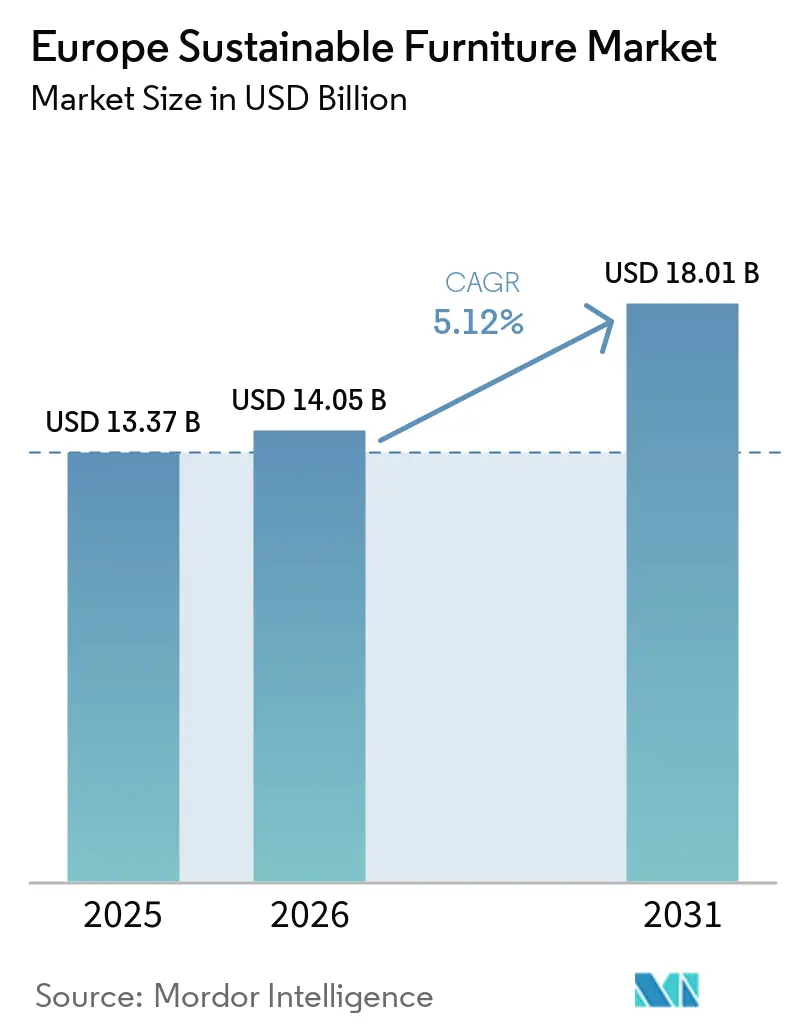
| Base Year Market Size (2025) | USD 13.37 Billion |
| Market Size (2026) | USD 14.05 Billion |
| Market Size (2031) | USD 18.01 Billion |
| Growth Rate (2026 - 2031) | 5.12 % |
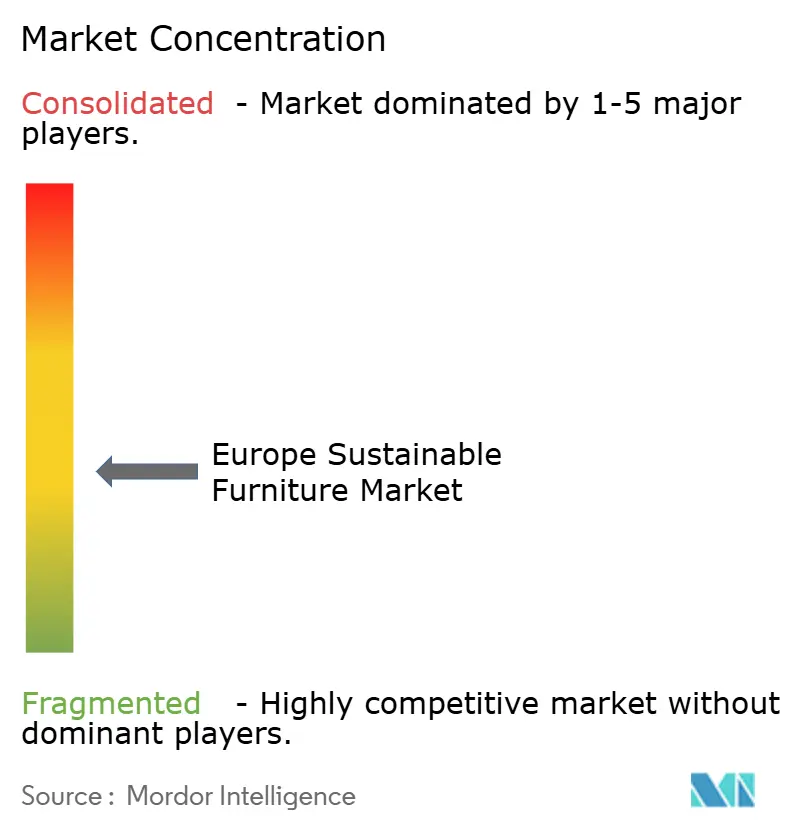
| Market Concentration | Medium |
Major Players *Disclaimer: Major Players sorted in no particular order Image © Mordor Intelligence. Reuse requires attribution under CC BY 4.0. | |
Europe Sustainable Furniture Market Analysis by Mordor Intelligence
The Europe sustainable furniture market size is expected to grow from USD 13.37 billion in 2025 to USD 14.05 billion in 2026 and is forecast to reach USD 18.01 billion by 2031 at 5.12% CAGR over 2026-2031. Market momentum stems from EU-wide circular-economy legislation, rising corporate ESG mandates, and consumer willingness to pay for certified low-VOC products. Regulatory shifts have converted sustainability from a differentiator into a de facto license to operate, prompting incumbents and start-ups alike to invest in material traceability, repairability, and take-back systems. Demand has broadened beyond eco-niche buyers to mainstream residential and commercial customers, with furniture-as-a-service (FaaS) subscriptions accelerating digital penetration and boosting the secondary-market value of certified assets. Competitive intensity is migrating toward end-of-life services, digital product passports, and innovative bio-based materials that reduce embodied carbon and improve recyclability[1].
Key Report Takeaways
- By product, chairs held 35.72% of Europe sustainable furniture market share in 2025, while beds are set to expand at a 6.74% CAGR through 2031.
- By material, reclaimed and FSC-certified wood commanded a 31.35% share of Europe sustainable furniture market size in 2025, whereas recycled and bio-based plastics will grow at a 6.39% CAGR to 2031.
- By end-user, the residential segment controlled 61.88% share of Europe sustainable furniture market size in 2025, but commercial applications are rising at a 5.98% CAGR through 2031.
- By distribution channel, the B2C/retail segment held 64.77% of Europe sustainable furniture market share in 2025. Within B2C/retail, the online segment is set to expand to a 6.88% CAGR through 2031.
- By geography, Germany led with an 18.21% revenue share in 2025; the Nordics region is forecast to post the fastest 7.42% CAGR to 2031.
Note: Market size and forecast figures in this report are generated using Mordor Intelligence’s proprietary estimation framework, updated with the latest available data and insights as of 2026.
Market Trends and Insights
Drivers Impact Analysis of Europe Sustainable Furniture Market*
| Driver | (~) % Impact on CAGR Forecast | Geographic Relevance | Impact Timeline |
|---|---|---|---|
| EU Ecodesign & Circular-Economy Legislation | +1.2% | EU-wide; strongest in Germany, France, the Nordics | Medium term (2–4 years) |
| Certified Sustainable Wood & Low-VOC Materials | +0.9% | Western Europe | Short term (≤2 years) |
| Green Building Projects & LEED/BREEAM Uptake | +0.8% | UK, Germany, Netherlands, Nordics | Medium term (2–4 years) |
| Furniture-as-a-Service Expansion | +0.7% | Urban EU, led by Nordics, BENELUX | Long term (≥4 years) |
| Advances in Bio-based Adhesives & Finishes | +0.6% | Germany, Italy, Poland | Medium term (2–4 years) |
| Digital Product Passports | +0.5% | EU-wide, early adoption in Germany | Long term (≥4 years) |
| Source: Mordor Intelligence | |||
EU Ecodesign & Circular-Economy Legislation Implementation (2025-2030)
The ESPR officially prioritized furniture on July 18, 2024, mandating material circularity, reparability, and recyclability. Draft delegated acts due 2025-2027 will make digital product passports obligatory, compelling transparent disclosure of material origin, carbon footprint, and end-of-life pathways. Vertically integrated groups able to track inputs from forest to factory gain a compliance edge, while legacy manufacturers reliant on opaque imports face 3-5% cost inflation for data gathering and design redesigns. Modular construction tailored for component replacement dovetails with FaaS contracts in which producers keep ownership and handle maintenance. Early adopters that internalize regulatory costs now are positioned to build durable competitive moats.
Rising Consumer Demand for Certified Sustainable Wood & Low-VOC Materials
European households are willing to pay a premium for eco-certified furniture and consider sustainable living essential. FSC labels have therefore shifted from marketing claim to purchase prerequisite in Germany, Denmark, and France. Manufacturers are now compelled to invest in supply chain verification systems as material transparency shifts from being a mere marketing differentiator to a key purchasing criterion. Vendors have responded by digitizing chain-of-custody records and expanding low-formaldehyde product lines, especially in the bedroom, where sleep wellness is paramount. Premiums remain 15-30% above conventional offers, yet improved durability and lower off-gassing reinforce value perceptions over lifetime ownership[2].
Rapid Expansion of Green Building Projects & LEED/BREEAM Certifications
Institutional buyers increasingly bake furniture criteria into tenders as they chase certification points. Ireland’s Green Public Procurement Strategy, for example, requires environmental attributes in all state furniture bids by 2027. Builders now demand Environmental Product Declarations (EPDs) for desks, chairs, and storage systems to address whole-building Global Warming Potential calculations. Suppliers providing turnkey EPD packs plus take-back services enjoy preferred-vendor status. Growth is steepest in the UK retrofit market, where landlords refurbish aging stock to meet Minimum Energy Efficiency Standards.
Growth of Furniture-as-a-Service Subscription Models Supporting Re-use
FaaS providers such as NORNORM logged 50% year-on-year growth in leased square meters during 2024, reinforced by a EUR 110 million (USD 114.5 million) funding round backed by the European Investment Fund. Corporate tenants value the opex model for cash-flow smoothing and rapid layout changes. They can sidestep hefty upfront furniture costs while enjoying the flexibility to reconfigure their spaces. Because ownership remains with the vendor, products are engineered for multiple life cycles, lowering waste and embedding circular principles[3]. European waste statistics reveal that 11 million tonnes of furniture end up in landfills each year, with a mere 3% being recycled. This underscores the potential of circular economy initiatives, particularly those championed by FaaS models.
Restraints Impact Analysis of Europe Sustainable Furniture Market*
| Restraint | (~) % Impact on CAGR Forecast | Geographic Relevance | Impact Timeline |
|---|---|---|---|
| Higher Up-front Costs vs. Conventional Furniture | -0.8% | Eastern & Southern Europe | Short term (≤2 years) |
| Supply-Chain Complexity for Certified Materials | -0.6% | Import-dependent markets | Medium term (2–4 years) |
| Fragmented Sustainability Standards Across EU States | -0.4% | Multinational manufacturers | Medium term (2–4 years) |
| Insufficient Reverse-Logistics Infrastructure | -0.3% | Rural EU regions | Long term (≥4 years) |
| Source: Mordor Intelligence | |||
Higher Up-front Costs vs. Conventional Furniture
Despite consumers expressing a preference for sustainability, sustainable furniture often comes with a 15-30% price premium compared to conventional options, creating a barrier to adoption. This price hike is largely due to the costs associated with certified materials, third-party verifications, and the complexities of circular design. Such pricing challenges are especially pronounced in price-sensitive segments, notably in residential markets where decisions are predominantly driven by cost, even amidst a growing awareness of sustainability. Yet, models like furniture-as-a-service are addressing these upfront cost concerns. By allowing expenses to be spread over subscription periods, companies like NORNORM have seen corporate clients embrace their premium offerings.
Supply-Chain Complexity in Sourcing Certified Materials
Certified inputs such as FSC timber often come from a handful of specialized mills, so even modest shifts in demand can trigger bottlenecks and sudden price swings that upend production schedules. Access is uneven across the continent; Nordic factories enjoy local certified logs, while plants in Spain or Italy must import wood and absorb extra freight and currency risks. Manufacturers juggling several eco-labels for wood, fabrics, and finishes find that each audit cycle adds paperwork, supplier vetting, and costly safety stock to avoid line stoppages. Progress on bio-based glues is encouraging, yet many promising formulas, such as brown-algae or soy-protein resins, remain stuck at pilot scale, limiting commercial volumes and driving up costs for early adopters. The EU’s new Ecodesign rules will further raise the bar, requiring every tier of the supply chain to prove material provenance and processing steps, a task that small and midsize firms may find especially daunting.
*Our forecasts treat driver/restraint impacts as directional, not additive. The impact forecasts reflect baseline growth, mix effects, and variable interactions.
Europe Sustainable Furniture Market Segment Analysis
By Product:
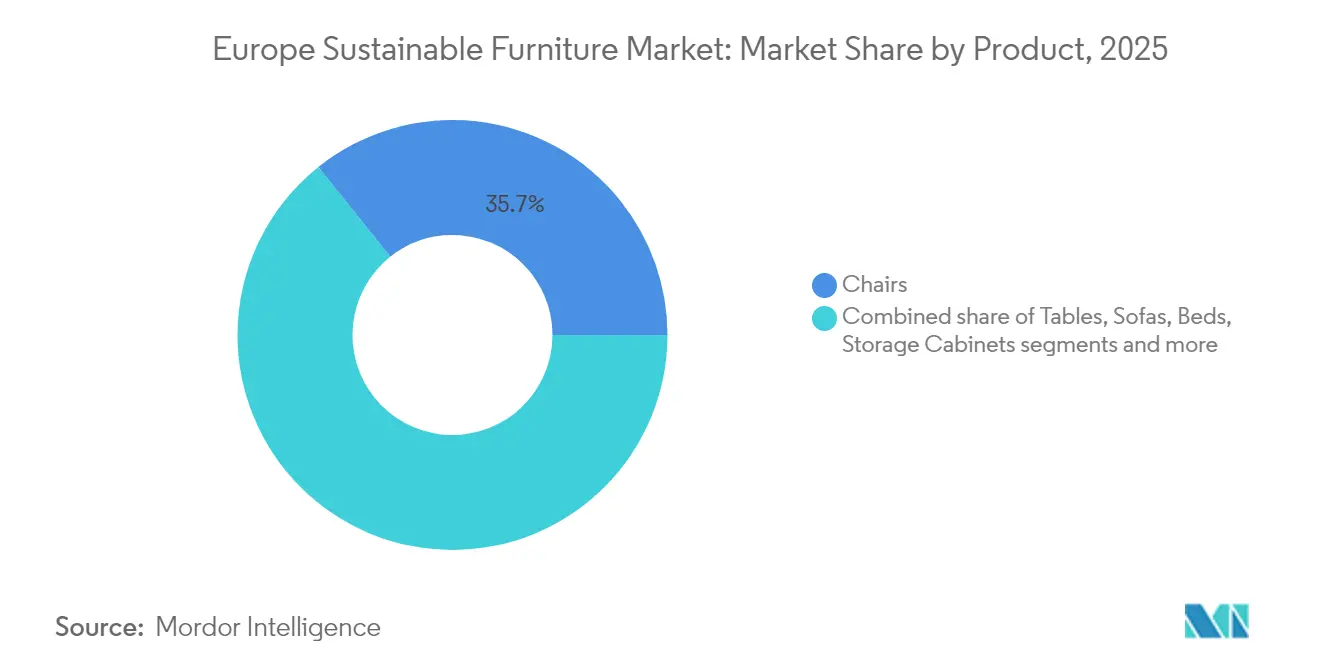
Chairs Sustain Leadership while Beds AccelerateChairs generated 35.72% of Europe sustainable furniture market share in 2025, reflecting ergonomic upgrades in hybrid workplaces and institution tenders specifying FSC timber frames. Average selling prices climbed 4.2% as buyers prioritized height-adjustable and repairable designs. Over the forecast, beds record the quickest 6.74% CAGR, helped by sleep-wellness spending and stricter formaldehyde limits in bedroom air standards. Europe sustainable furniture market size for beds is projected to climb from USD 2.17 billion in 2026 to USD 2.99 billion by 2031, backed by organic mattress cores and certified wood slats. Tables and storage units log steady mid-single-digit growth on the back of home-organization trends, while outdoor lines are experimenting with recycled aluminum frames to lower embodied carbon.
Product innovators stress modularity: snap-fit components simplify repair and enable FaaS operators to refresh worn parts rather than replace units. Chair makers incorporate ocean-bound plastics in seat shells, and bed firms introduce bolt-less joinery for tool-free assembly. Mass-market retailers bundle repair kits and extend warranties to signal durability. As ESPR right-to-repair provisions crystallize, SKUs with component access points should outperform, reinforcing the leadership of brands already running circular design audits.

By Material:
Recycled & Bio-based Plastics Outpace Certified Wood GrowthReclaimed and FSC wood kept a 31.35% revenue lead in 2025, yet recycled and bio-based plastics will deliver a 6.39% CAGR through 2031 as polymer-recycling plants mature. Europe sustainable furniture market size tied to recycled plastics is forecast to move from USD 1.99 billion in 2026 to USD 2.71 billion in 2031, supported by design freedom and color stability. Ocean-bound resin programs feed office-chair shells, while bio-PU foams derived from castor oil enter soft seating. Supply risk is lower because recycling infrastructure for PET and PP has been scaled under EU packaging rules.
Wood remains indispensable for aesthetic appeal and carbon-sequestration narratives, yet manufacturers diversify into bamboo and agrifiber panels to hedge cost swings. Recycled steel and aluminum see demand from architects targeting net-zero buildings, leveraging infinite recyclability. Adhesive innovations allow clean debonding of multi-material assemblies, raising recovery rates. Material choices increasingly factor into EPD scores as developers target embodied-carbon caps set by national building codes.
By End-User:
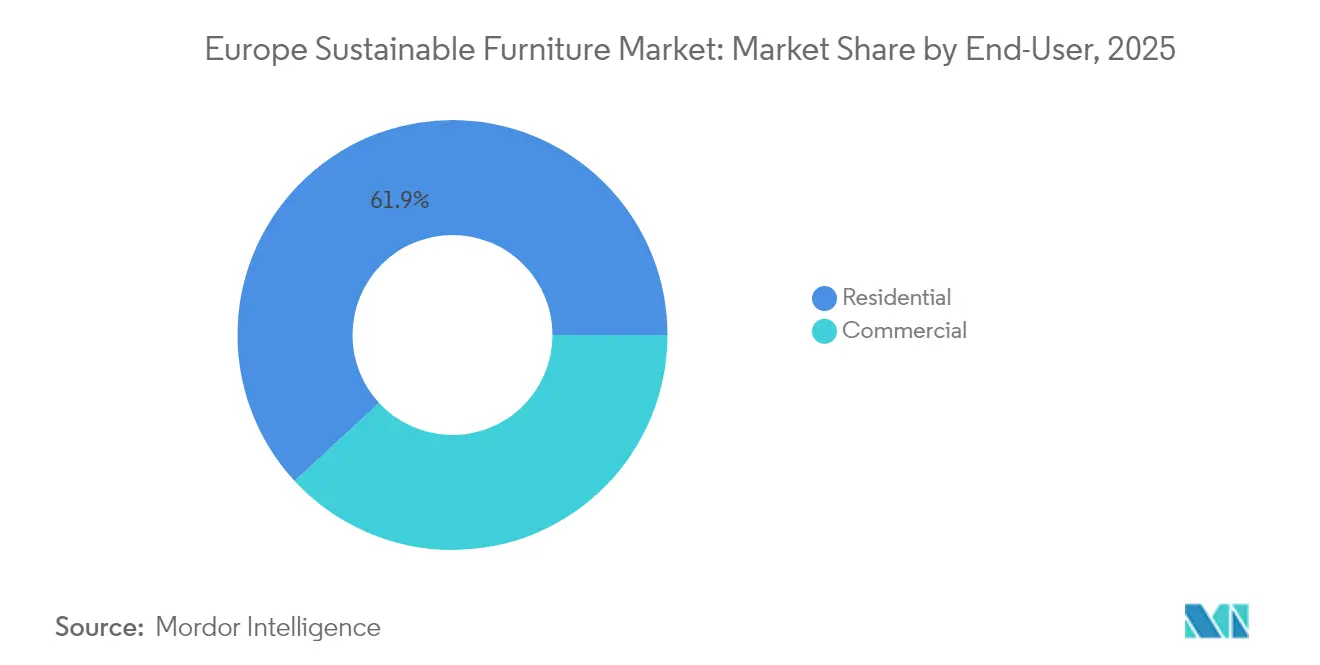
Commercial Purchases Gain Pace on ESG MandatesResidential buyers accounted for 61.88% of 2025 sales, reflecting pandemic-era home-office upgrades and lifestyle alignment, with sustainable home furniture in Europe gaining traction among households. However, commercial clients will outgrow them at a 5.98% CAGR to 2031 because corporations face ESG scorecard scrutiny and seek LEED points. Europe sustainable furniture market size for offices alone is expected to reach USD 4.58 billion by 2031. FaaS meets corporate demand for adaptability amid fluctuating occupancy, while hospitals and schools pursue antimicrobial, low-VOC furnishings that support wellness ratings.
Procurement teams now run lifecycle cost analyses that favor durable goods with buy-back clauses, shifting contracts from capex to service subscriptions. Hospitality groups refresh guest rooms on shorter cycles and thus value refurbishment programs that minimize landfill. Public-sector agencies increasingly bundle furniture with building retrofits to satisfy national climate targets, giving certified suppliers queue-jump privileges.
By Distribution Channel:
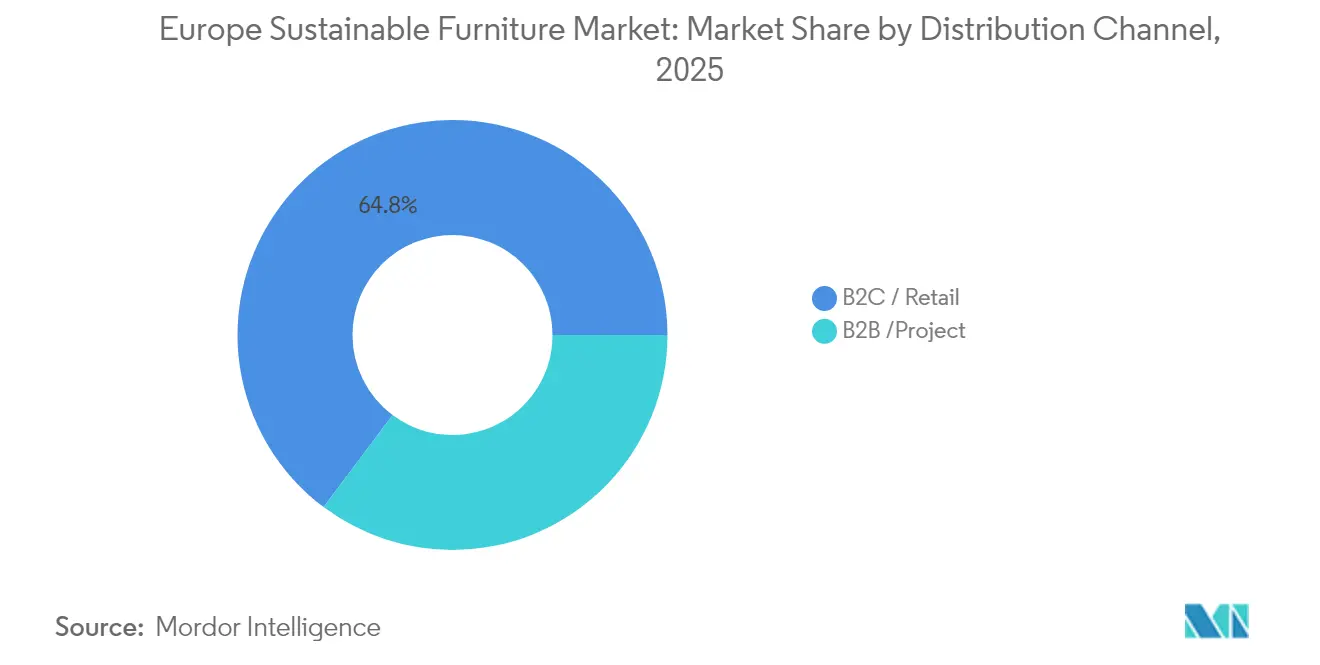
Online Acceleration Reshapes B2CB2C retail stayed dominant at 64.77% of 2025 turnover, but e-commerce within that channel is expanding 6.88% annually as consumers research eco-labels online and appreciate direct-to-door delivery of flat-pack goods. Click-through rates improve when listings show carbon scores and digital product passports. Europe sustainable furniture market size arising from online sales is forecast to break USD 3.22 billion by 2031. Traditional showrooms answer with VR visualization and in-store repair demos. Home centers carve out “circular corners” where shoppers can trade in outdated pieces.
B2B project integrators bundle furniture with acoustic panels and carpets under holistic fit-out contracts. They demand single-window accountability and KPI reporting, pressuring manufacturers to aggregate environmental data across multivendor bills of materials. QR-code scanning at site handover increasingly verifies compliance. Hybrid distributors marrying online configurators with local refurb hubs are capturing both transparency and service proximity advantages.
Geography Analysis
Germany Sustainable Furniture Market
Germany captured 18.21% of 2025 revenue, driven by rigorous indoor-air regulations and the country’s leadership in engineered-wood production. Builders and corporate occupiers view FSC and EPD documentation as default bid criteria, enabling premium pricing. Digital passport pilot consortia in Bavaria illustrate early alignment with ESPR transparency. Growth is steady rather than explosive, reflecting market maturity and saturation of green-office retrofits.
Broader European Markets
The Nordics will post the swiftest 7.42% CAGR through 2031 on the back of high disposable income, cultural environmentalism, and abundant certified forestry resources. Denmark’s FaaS penetration already exceeds 8% of new office installations, and Sweden’s tax incentives for repair services reduce lifecycle costs. Municipal waste systems recover over 60% of bulky furniture, feeding industrial material loops. Nordic design’s minimalist ethos aligns with lower-material-intensity strategies. France, Italy, Spain, BENELUX, and the UK form a diversified tier. France enforces the AGEC anti-waste law that extends producer responsibility to furniture, triggering investments in take-back logistics. Italy’s design houses merge artisanal craftsmanship with bio-based innovation to sustain export premiums. The UK post-Brexit is crafting its own eco-design rules, fostering start-ups unchecked by EU red tape. BENELUX’s dense urbanization supports FaaS pilot clusters linking Amsterdam, Brussels, and Luxembourg. Central and Eastern Europe remain cost-sensitive yet will gradually harmonize under ESPR enforcement, unlocking delayed demand in Poland and the Baltics.
Regulatory Landscape
The EU policy cycle is tightening requirements around circularity and product transparency for furniture, anchored by the Ecodesign for Sustainable Products Regulation (ESPR), Regulation (EU) 2024/1781, adopted in June 2024. Under the 2025-2030 ESPR Working Plan, furniture and mattresses are designated as priority product groups, which brings durability, reparability, recycled-content, and Digital Product Passport obligations into the compliance trajectory. Industry guidance points to the furniture delegated act as tracking toward adoption around 2028.
Complementary waste-policy measures keep producer responsibility and circular claims under closer scrutiny. The revised Waste Framework Directive entered into force on October 16, 2025 and, while focused on textiles and food waste, reinforces the direction of travel toward broader EPR and higher-quality collection systems. Alongside ESPR, this lifts expectations for take-back, documented end-of-life pathways, and auditable substantiation of sustainability attributes in cross-border sales and public procurement.
Value Chain Analysis
Input sourcing focuses on certified and reclaimed wood (FSC chain-of-custody, reclaimed feedstock), recycled metals, and recycled or bio-based polymers, along with low-VOC adhesives and finishes. Manufacturing is supported by a dense base of SMEs across Europe, and compliance-driven design changes, including modularity, repairability, and material separation, are increasingly shaped by ESPR (Regulation (EU) 2024/1781) priorities. This, in turn, pushes upstream requirements for verified provenance and downstream requirements for product data that can populate Digital Product Passports.
Downstream, distribution splits between B2C retail and online and B2B project channels, with more emphasis on service layers such as refurbishment, parts supply, and take-back logistics. Bottlenecks persist due to uneven collection and reverse-logistics capacity, and the cost of repair and refurbishment. Access to certified inputs can also vary by geography. Vertically integrated circular models show how firms are closing loops, such as Gruppo Saviola using its Savionet recovery network to source post-consumer wood for its Ecological Panel, while procurement-heavy categories like kitchens add multi-tier sourcing complexity, as Nobia reports primary wood largely from European suppliers but certain secondary components and appliances can originate from Asia.
Competitive Landscape
The arena is fragmented. IKEA, Steelcase, Herman Miller, and Haworth are leaving room for regional specialists and FaaS disruptors. IKEA earmarked EUR 1 billion (USD 1.04 billion) in 2025 for European recycling hubs, signaling a pivot from volume to circular retention. MillerKnoll eliminated PFAS across all lines by December 2024, pre-empting chemical bans. Steelcase partners with BASF on ocean-plastic seat shells, while Vestre runs carbon-negative outdoor furniture factories powered by hydro.
NORNORM and Enky champion subscription furniture, targeting tenant flexibility and lower embodied emissions. Both deploy IoT tags for asset monitoring and predictive maintenance, ensuring ≥5 life cycles per item. Regional carpentry houses in Portugal and Slovenia differentiate through locally sourced cork and beech while leveraging EU digital platforms to reach urban buyers. Competitive parity increasingly hinges on verified transparency; blockchain-backed passports and AI-based lifecycle scoring tools are replacing glossy catalogs.
Supply security is another battleground. Multinationals purchase forest concessions in Finland and Latvia to lock up FSC feedstock, whereas start-ups experiment with mycelium-based panels grown in-house. Cost advantage alone no longer assures sales; buyers demand demonstrable CO₂ reductions, toxic-chemical elimination, and convenient take-back. As ESPR enforcement tightens post-2027, players without end-of-life pathways risk losing tender eligibility, accelerating consolidation around circular-capable brands.
Europe Sustainable Furniture Industry Leaders
-
IKEA Group
-
Vitra International AG
-
Steelcase Inc.
-
Herman Miller Inc.
-
Haworth Inc.
- *Disclaimer: Major Players sorted in no particular order
Europe Sustainable Furniture Market Companies Covered in this Report
- IKEA Group
- Vitra International AG
- Steelcase Inc.
- Herman Miller Inc.
- Haworth Inc.
- Royal Auping BV
- Muuto A/S
- Vestre AS
- Hay A/S
- Fritz Hansen A/S
- Arper SpA
- Bene GmbH
- Sancal Diseño S.A.
- Lammhults Design Group AB
- Nikari Oy
- V-Zone (Kinnarps Group)
- Actiu Berbegal y Formas SA
- Vangstad Design (Mater)
- VG & Röthlisberger Kollektion
- Teknion Europe Ltd.
Market Opportunities and Future Outlook
ESPR implementation is creating near-term room for compliance-enabling services and data infrastructure. Furniture is a priority product group under Regulation (EU) 2024/1781, and the active policy workstream is visible in ongoing stakeholder consultations around ecodesign requirements, alongside an EU Ecolabel criteria revision for furniture. The survey deadline has been extended to 13 July 2026. This consultation cycle supports opportunities for manufacturers and solution providers to industrialize product data capture, including materials, repair instructions, and end-of-life routing, and to use that data in B2C listings and B2B tender documentation.
Circular value recovery still has gaps, which supports investment cases in collection, sorting, refurbishment, and recycled feedstock conditioning for wood and plastics. EU furniture waste is referenced at 10.78 million tonnes per year, and only about 10% is recycled, with the balance largely incinerated or landfilled. Operators that can aggregate returns and deliver consistent secondary raw materials are therefore likely to gain leverage as brands tighten durability and recycled-content requirements. Pilot-facing efforts, such as Cir4Fun and related CORDIS-backed Digital Product Passport development, also provide a practical platform to connect traceability to secondary-market pricing and take-back performance.
Recent Industry Developments in Europe Sustainable Furniture Market
- July 2026: The ESPR preparatory and impact-assessment study for furniture, linked to the EU Ecolabel criteria revision, extended the deadline for stakeholder surveys to 13 July 2026. Keeping the consultation window open sustains near-term activity around definitions for durability, reparability, and product information, which affects how manufacturers build data systems and redesign SKUs ahead of the furniture delegated act timeline.
- October 2025: Ingka Investments completed the acquisition of about 153,000 hectares of forestland in Latvia and Estonia from the forest owners association Sodra. The acquisition strengthens long-term access to responsibly managed wood feedstock and improves supply security and provenance documentation as traceability demands increase across EU value chains.
- April 2025: Vitra disclosed V-Foam, a recyclable polyurethane upholstery foam developed with BASF, with Vitra holding exclusive rights in the furniture sector for one year. The material innovation targets circularity in soft seating by improving end-of-life options for foam components and supports product redesign toward separability and higher recycling yields.
Europe Sustainable Furniture Market Report Scope and Research Methodology
Market Definition and Coverage
For this study, the market covers furniture sold in Europe that is positioned as sustainable based on material choice and product claims, such as recycled inputs, responsibly sourced wood, and lower-emission finishes, and it is measured in value terms at the point of sale.
Scope exclusions: We exclude furniture maintenance services, second-hand peer-to-peer resale value, and general home decor items that are not furniture.
Segments Covered in This Report
- By Product
- Chairs
- Tables
- Sofas
- Beds
- Storage Cabinets
- Other Products
- By Material
- Reclaimed / FSC-Certified Wood
- Bamboo & Rapidly Renewable Grass
- Recycled Metals (Steel & Aluminum)
- Recycled & Bio-Based Plastics
- Organic / Natural Fibers (Rattan, Jute, Hemp)
- Other Materials (parawood, rubberwood, natural fabrics, etc.)
- By End-User
- Residential
- Commercial
- Offices
- Hospitality
- Healthcare Facilities
- Educational Institutes
- Other Commercial Users (public places, retail malls, government offices, etc.)
- By Distribution Channel
- B2C/Retail
- Home Centers
- Specialty Furniture Stores
- Online
- Other Distribution Channels
- B2B /Project
- B2C/Retail
- By Geography
- United Kingdom
- Germany
- France
- Spain
- Italy
- BENELUX (Belgium, Netherlands, Luxembourg)
- NORDICS (Denmark, Finland, Iceland, Norway, Sweden)
- Rest of Europe
Data Sources, Market Sizing, and Validation
Desk Research
Desk work started with mapping demand signals and supply capacity that can be checked in public data. We referred to sources such as Eurostat for trade and macro indicators, the European Environment Agency for circular economy context, and European Commission pages on waste, chemicals, and product rules that influence materials and labeling. We also used forestry and material-related references such as FAO forestry statistics and publicly available FSC and PEFC certification information to understand sustainable sourcing signals.
To connect these signals to market value, we reviewed annual reports, sustainability reports, and investor presentations of furniture producers and retailers with meaningful European exposure. We then cross-checked with trusted press coverage on eco-material adoption and take-back programs. In addition, paid database subscriptions were used selectively for company financials, intelligence, patent databases, and shipment-level import and export checks where public series lacked detail. This list is not exhaustive, and many other public and paid sources were also used to collect data, validate assumptions, and clarify open questions.
Primary Interviews and Surveys
Primary work focused on validating what gets counted as sustainable in real buying decisions, and how price premiums vary by material and channel. We spoke with a mix of manufacturers, distributors, retailers, and material and certification stakeholders across major European furniture markets so desk assumptions could be corrected where they did not match how products are actually sold. These discussions were also used to confirm adoption pace for low-VOC finishes, recycled content, repairability, and take-back models, which then tightened the forecast assumptions.
Distribution of primary research fieldwork respondents
| Company type | Respondent position |
|---|---|
| Top tier: 28% | CXOs: 15% |
| Mid tier: 57% | Functional/Unit leaders: 36% |
| Smaller Players: 15% | Managers: 49% |
Market-Sizing & Forecasting
Sizing was built using a top-down approach where production and trade indicators, combined with furniture consumption proxies by country, were used to reconstruct the addressable value pool for sustainable furniture in Europe. Once that pool was set, we applied adoption rates that reflect how often sustainable materials and verified claims show up in real product lines, and then adjusted the value using observed price premiums by material and by channel.
A few market fingerprints were treated as core inputs because they tend to move the total value in predictable ways. These include the share of wood-based furniture that is certified or responsibly sourced, recycled-content penetration in panels and textiles, the spread of low-VOC finishes and related product labeling, online versus offline mix (which affects average selling price and assortment), and renovation and housing activity that drives replacement cycles. To keep totals realistic, we corroborated results with selective bottom-up checks, including sampled ASP times volume for representative categories and channel checks on sustainable assortments, followed by targeted adjustments where gaps were found.
Forecasting leaned on scenario analysis supported by trend lines in housing and renovation, material availability, and policy momentum tied to circular economy actions. Where company disclosures did not split sustainable revenue clearly, we handled the gap with conservative allocation rules anchored to product mix, certification intensity, and the share of sustainable SKUs observed in key channels.
Data Validation & Update Cycle
Validation was done through several passes so that one unusual data point did not distort the market totals. We compared model outputs against independent signals like furniture trade movements, certification growth patterns, and directional changes in pricing and promotions, and then re-checked countries or categories that showed sharp jumps. When variances were large, follow-up calls were triggered to confirm whether the change was driven by real demand, a scope shift, or timing and currency effects.
Before sign-off, the model and assumptions are reviewed by another analyst to check logic, math, and whether the inputs align with what buyers and sellers described in interviews. The report is refreshed annually, and interim updates are made when material events occur, such as major policy changes, sharp input-cost moves, or visible shifts in retail pricing. Right before delivery, a final pass is done so clients receive an up-to-date view.
Mordor Intelligence's Europe Sustainable Furniture Market Estimate Compared With Other Published Estimates
Published market values for sustainable furniture in Europe can differ widely because researchers draw the boundary in different places and then apply different pricing and adoption assumptions. Differences usually come from what counts as sustainable, whether the value is measured at manufacturer level or retail level, and how quickly price premiums are assumed to normalize over time.
By tracking certification-linked mix shifts, price premium movements by material, and annual refresh checks, Mordor Intelligence keeps the estimate tied to furniture products with clearer sustainable signals, instead of broadly counting all eco-themed furniture claims that are not consistently verified.
Benchmark comparison
| Source | Market Size | Gaps in Research Methodology |
|---|---|---|
| Mordor Intelligence | USD 13.37 B (2025) | |
| Regional Consultancy A | USD 14.75 B (2026) | Uses a later base year and a broader sustainable definition that can include wider eco-themed assortments, which tends to lift the starting value when retail pricing is applied more uniformly. |
| Industry Publisher B | USD 18.50 B (2024) | Appears to mix furniture with adjacent home categories and applies an aggressive price premium assumption across markets, with limited transparency on how verified materials and low-VOC criteria are separated. |
The spread in the table is mainly explained by boundary choices and how price premiums are applied, rather than a disagreement on Europe's overall furniture demand. Our approach stays traceable because the total is built from observable consumption signals and then filtered using adoption and pricing assumptions that were re-checked with market participants. This makes the final value easier to repeat and update when policy, materials, or channel mix changes.
Key Questions Answered in the Report
What is the current value of the Europe sustainable furniture market?
The market stands at USD 14.05 billion in 2026.
How fast is the market expected to grow?
It is projected to register a 5.12% CAGR and reach USD 18.01 billion by 2031.
Which product category leads in revenue?
Chairs lead with a 35.72% share of Europe sustainable furniture market size in 2025.
Why are the Nordics growing the fastest?
Comprehensive circular-economy policies, high disposable income, and robust reverse-logistics systems are driving a 7.42% CAGR.
What business model is reshaping procurement?
Furniture-as-a-Service subscriptions are gaining traction, offering flexibility and circular benefits to corporate clients.
Which material segment is expanding the quickest?
Recycled and bio-based plastics are forecast to grow at a 6.39% CAGR through 2031.