
Market Overview
| Study Period | 2021 - 2032 |
|---|---|
| Forecast Data Period | 2027 - 2032 |
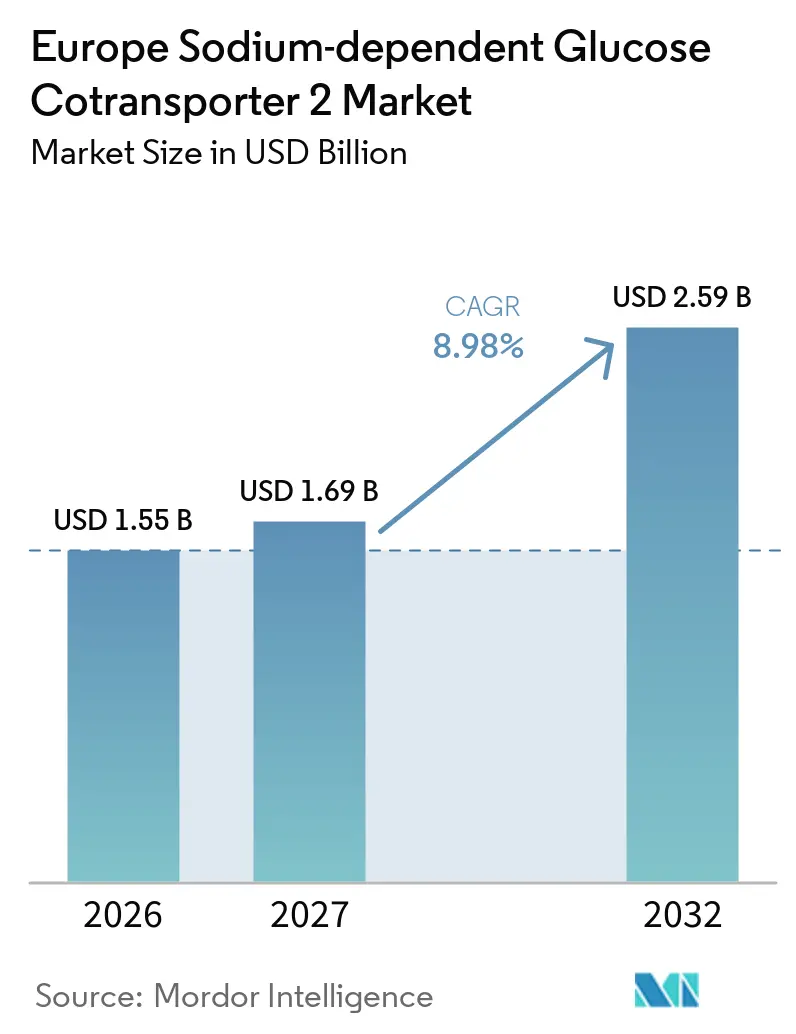
| Base Year Market Size (2026) | USD 1.55 Billion |
| Market Size (2027) | USD 1.69 Billion |
| Market Size (2032) | USD 2.59 Billion |
| Growth Rate (2027 - 2032) | 8.98 % |
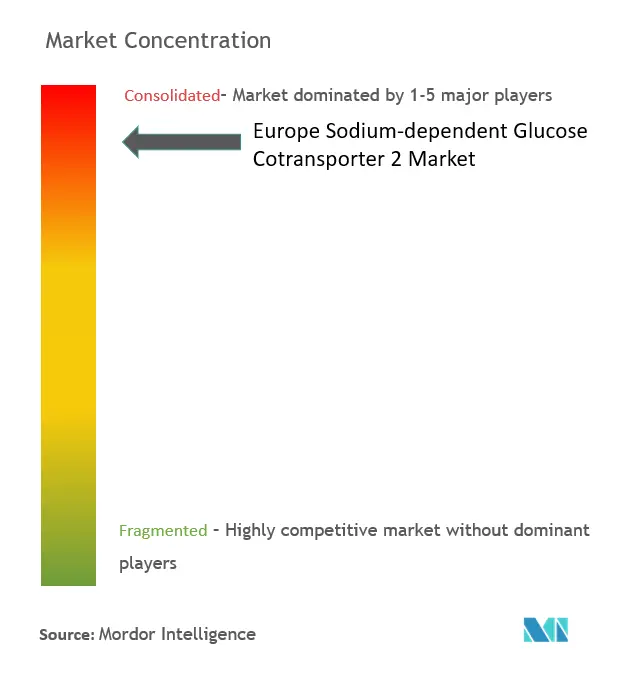
| Market Concentration | High |
Major Players *Disclaimer: Major Players sorted in no particular order Image © Mordor Intelligence. Reuse requires attribution under CC BY 4.0. | |
Europe Sodium-dependent Glucose Cotransporter 2 Market Analysis by Mordor Intelligence
The Europe Sodium-dependent Glucose Cotransporter 2 Market size is projected to be USD 1.55 billion in 2026, USD 1.69 billion in 2027, and reach USD 2.59 billion by 2032, growing at a CAGR of 8.98% from 2027 to 2032.
The European region had witnessed an alarming increase in the prevalence of diabetes, in recent years. Diabetes is associated with many health complications. Patients with diabetes require many corrections throughout the day for maintaining nominal blood glucose levels, such as medications or ingestion of additional carbohydrates by monitoring their blood glucose levels.
The disease's growing incidence, prevalence, and progressive nature encouraged the development of new drugs to provide additional treatment options for diabetic patients. Non-insulin treatments, used as first-line therapies for patients with type 2 diabetes, currently capture more than half the sales in the anti-diabetic market. Over the past decade, two important classes entered this market: dipeptidyl peptidase-4 inhibitors (DPP-4) and sodium-glucose cotransporter-2 inhibitors (SGLT-2). These agents work in various ways to reduce blood sugar levels in people with type 2 diabetes. Some stimulate insulin secretion by the pancreas, and others improve the responsiveness of cells to insulin or prevent glucose production by the liver. Others slow the absorption of glucose after meals.
Therefore, owing to the aforementioned factors the studied market is anticipated to witness growth over the analysis period.
Note: Market numbers in this report are based on Mordor Intelligence's proprietary estimation framework, which combines nine months of actuals with Q4 projections for base year 2026.
Europe Sodium-dependent Glucose Cotransporter 2 Market Trends and Insights
Increasing diabetes prevalence
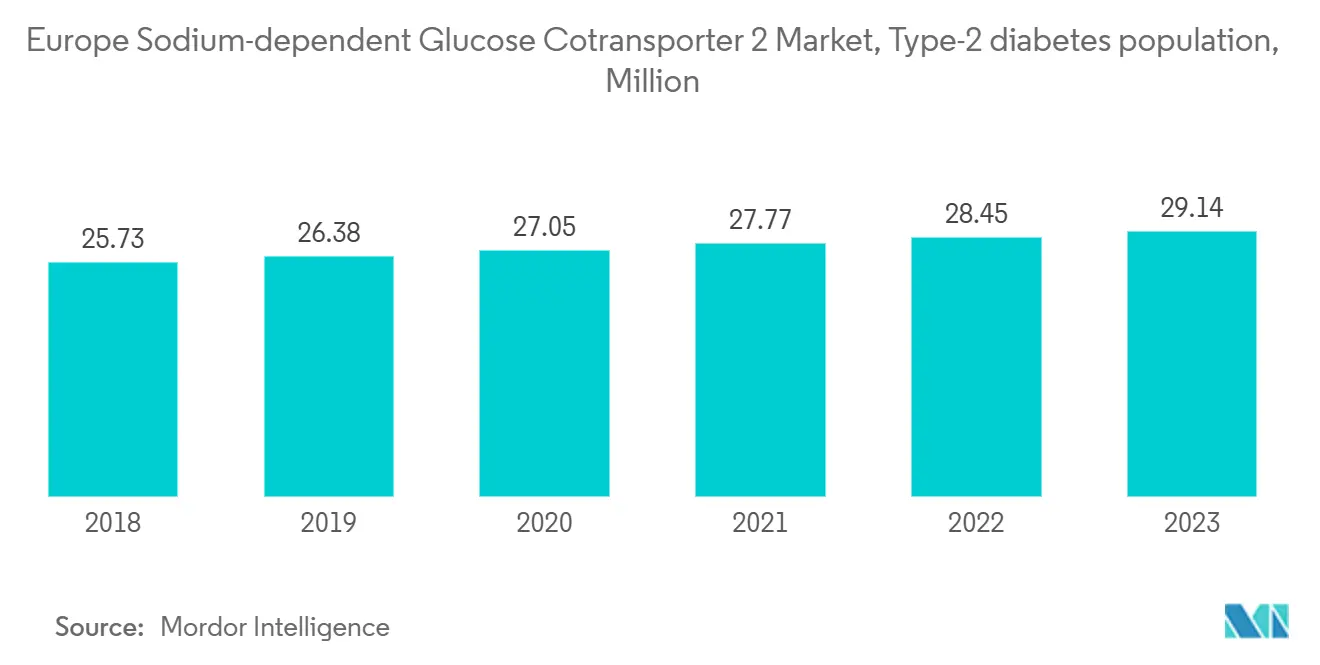
The diabetes population in the European region is expected to rise by more than 5% over the forecast period.
The rapidly increasing incidence and prevalence of diabetic patients and healthcare expenditure are indications of the increasing usage of diabetic drugs. SGLT-2 inhibitor drugs are available internationally and are recommended for use when escalation of treatment for type 2 diabetes is required, along with lifestyle management. Oral agents are typically the first medications used in treating type 2 diabetes due to their wide range of efficacy, safety, and mechanisms of action. SGLT-2 inhibitor drugs help diabetes patients control their condition and lower the risk of diabetes complications. People with diabetes may need to take anti-diabetic drugs for their whole lives to control their blood glucose levels and avoid hypoglycemia and hyperglycemia. Oral anti-diabetic agents present the advantages of easier management and lower cost, so they became an attractive alternative to insulin with better acceptance, which enhances adherence to the treatment.
The government and the companies are working towards better diabetes management. For instance, the National Service Framework (NSF) program is improving services by setting national standards to drive up service quality and tackle variations in care. The Association of British HealthTech Industries (ABHI) launched a diabetes section, enabling diabetes technology companies to work together in the first forum of its kind. Such advantages helped in the market growth.
Germany held the highest market share in the European Sodium-dependent Glucose Cotransporter 2 Market in the current year
Germany held the highest market share of about 28% in the European Sodium-dependent Glucose Cotransporter 2 Market in the current year.
Diabetes is a significant health problem and one of the extraordinary challenges for healthcare systems all over Germany. The prevalence of known type 1 & 2 diabetes in the German adult population is very high, along with many patients not yet diagnosed with the disease. Due to an aging population and unhealthy lifestyle, the prevalence of type 2 diabetes is expected to increase steadily over the next few years. High-quality care, including adequate monitoring, control of risk factors, and active self-management, are the key factors for preventing complications in German patients with type 2 diabetes.
According to the German Diabetes Centre (DDZ), about 8.5 million people in Germany are affected by diabetes. The number of people with type 2 diabetes in Germany will continue to increase over the next twenty years. German law requires public plans to cap out-of-pocket health care costs and to cover all medically necessary treatment, including insulin. Germany is one of the developed countries with advanced healthcare facilities.
Moreover, reimbursement and pricing policies are highly regulated, which drives the market. The roll-out of many new products, increasing international research collaborations in technology advancement, and increasing awareness about diabetes among people are some of the market opportunities for the players in the German market.
Competitive Landscape
The European SGLT-2 market is consolidated, with a few significant global manufacturers: Janssen, Eli Lilly, AstraZeneca, and Bristol Myers Squibb. The joint ventures that occurred between players in the recent past helped the companies strengthen their market presence. For example, Eli Lilly and Boehringer Ingelheim make Jardiance, a very popular SGLT-2 class drug.
Europe Sodium-dependent Glucose Cotransporter 2 Industry Leaders
-
Bristol Myers Squibb
-
AstraZeneca
-
Boehringer Ingelheim
-
Janssen Pharmaceuticals
-
Eli Lilly and Company
- *Disclaimer: Major Players sorted in no particular order
Recent Industry Developments
- July 2026: The UK Court of Appeal rejected AstraZeneca's appeal and upheld a prior ruling that the European patent covering dapagliflozin was invalid. The decision increased the risk of earlier competitive entry around dapagliflozin in the UK and may affect parallel challenges and commercial strategy across key European markets.
- July 2025: The Netherlands National Health Care Institute (Zorginstituut Nederland) issued advice adopted by the Minister of Health, Welfare and Sport to remove reimbursement conditions for SGLT2 inhibitors (including canagliflozin, dapagliflozin, empagliflozin, and ertugliflozin), effective 1 August 2025. This policy action simplified access criteria and can broaden utilization by reducing administrative and prescribing barriers within the Dutch reimbursement system.
- May 2025: NICE recommended AstraZeneca's Forxiga (dapagliflozin) for the treatment of chronic kidney disease in adults, expanding eligibility in England and Wales. The recommendation supported wider adoption of SGLT-2 inhibitors beyond glycemic control and reinforced cardio-renal indications as a competitive dimension for established brands in Europe.
Research Methodology Framework and Report Scope
Market Definition and Coverage
This market covers the revenues generated in Europe from prescription sodium-dependent glucose cotransporter 2 (SGLT2) inhibitor medicines used mainly for adult type 2 diabetes care, as captured at the drug sales value level across the covered countries.
Scope exclusions: We exclude non-SGLT2 antidiabetic classes and non-prescription products, and we do not count hospital procedure revenues that are not directly tied to these drugs.
Segmentation Overview
- Drugs
- Invokana (Canagliflozin)
- Jardiance (Empagliflozin)
- Farxiga/Forxiga (Dapagliflozin)
- Geography
- France
- Germany
- Italy
- Spain
- United Kingdom
- Russia
- Rest of Europe
Data Sources, Market Sizing, and Validation
Desk Research
Desk research was used to set the clinical and commercial backdrop before the model was built. We leaned on public epidemiology and treatment guidance for diabetes care in Europe, and then aligned it with country-level medicine use patterns and public pricing signals where they are available.
Source types referenced include, for example, the World Health Organization and OECD health statistics, European Commission and national health ministry publications, the European Medicines Agency for approvals and label changes, and peer reviewed journals tracking outcomes and utilization. To understand company-level performance directionally, we also reviewed annual reports, investor decks, and credible press coverage. Where needed, we checked paid subscription sources for company financials and for patent and clinical pipeline context, mainly to validate launch timing and product lifecycle assumptions. These examples are illustrative only and not exhaustive, since many other public sources were also consulted for data collection, validation, and clarification.
Primary Interviews and Surveys
Primary work focused on validating what desk research cannot fully pin down, especially the on-ground mix across countries and how demand is shifting between diabetes and cardio-renal use. We spoke with prescribers, pharmacy channel stakeholders, and industry participants across major European markets, and then used their inputs to confirm adoption pace, pricing behavior, and near-term policy impacts.
Distribution of primary research fieldwork respondents
| Company type | Respondent position |
|---|---|
| Top tier: 31% | CXOs: 14% |
| Mid tier: 55% | Functional/Unit leaders: 32% |
| Smaller Players: 14% | Managers: 54% |
Market-Sizing & Forecasting
Sizing starts from a top-down build where the treated type 2 diabetes pool is reconstructed by country, then filtered through SGLT2 class penetration and average therapy cost to reach a value estimate. After that picture is formed, we test it using selective bottom-up checks such as sampled country sales roll-ups, channel feedback on unit volumes, and price per pack signals, which we use to adjust outliers.
Key inputs used in the model include diagnosed type 2 diabetes prevalence and treated share, new initiation rates for SGLT2 therapy, switching patterns from other oral classes, average daily dose and persistence assumptions, and net price progression after tenders or reimbursement updates. We track label expansions and guideline adoption as well, since they change the eligible patient pool and therefore the demand curve.
For forecasting, scenario analysis was used so adoption and pricing can be flexed in a simple but realistic way. Assumptions for each country were aligned to the consensus view collected from interviews, and then cross-checked against recent policy and prescribing signals. Where a bottom-up check could not be built cleanly for a smaller country, we used peer country analogs and then revalidated the resulting shares with experts.
Data Validation & Update Cycle
Validation is handled through several passes, where we compare the model outputs against independent signals like diabetes drug spend direction, therapy mix trends, and country-level reimbursement movements. If a country output deviates sharply from expected uptake or pricing behavior, we re-check the input chain and, when needed, reconnect with primary sources to understand what changed.
Before sign-off, the model and narrative go through multi-step internal reviews so the calculation logic, assumptions, and country splits are consistent. The report is refreshed annually, and interim updates are made when major events occur such as a label change, pricing shock, or a meaningful shift in guidelines. Right before delivery, a final analyst pass is completed so clients receive the most current view available.
Mordor Intelligence's Europe Sodium Dependent Glucose Cotransporter 2 Market Size Versus Other Published Estimates
Published market sizes for Europe SGLT2 inhibitors can differ even when the topic name looks similar, since each publisher may count different drugs, years, and pricing concepts. Differences also come from how countries are grouped, whether volume is converted using list price or estimated net price, and how quickly assumptions are refreshed when reimbursement and tender outcomes change.
The main gap comes from whether fixed-dose combinations and expanded cardio-renal use are counted inside the SGLT2 total. Mordor Intelligence treats the market as SGLT2 inhibitor drug revenues, and it keeps country pricing aligned to net, not list, by updating discount assumptions when new policy signals appear.
Benchmark comparison
| Source | Market Size | Gaps in Research Methodology |
|---|---|---|
| Mordor Intelligence | USD 1.42 B (2025) | |
| Global Publisher A | USD 2.86 B (2025) | This estimate appears to use a wider inclusion of fixed-dose combinations and may layer in heart failure and chronic kidney disease use as separate demand blocks, which increases the counted value versus a core SGLT2 inhibitor revenue model. |
| Industry Publisher B | USD 4.24 B (2023) | This estimate is anchored to an earlier base year and can reflect higher list-price conversions and broader channel assumptions, which can lift the reported number when net discounts are not normalized consistently by country. |
Across the three figures, the spread is mostly explained by what is counted as SGLT2 revenue and by how price is translated into a comparable USD value across countries and years. When the model is tied back to treated patients, adoption rates, and country price behavior, it is easier to reproduce and simpler to update without breaking the logic chain.
Key Questions Answered in the Report
How big is the Europe Sodium-dependent Glucose Cotransporter 2 Market?
The Europe Sodium-dependent Glucose Cotransporter 2 Market size is expected to reach USD 1.69 billion in 2027 and grow at a CAGR of 8.98% to reach USD 2.59 billion by 2031.
What is the current Europe Sodium-dependent Glucose Cotransporter 2 Market size?
In 2026, the Europe Sodium-dependent Glucose Cotransporter 2 Market size is expected to reach USD 1.55 billion.
Who are the key players in Europe Sodium-dependent Glucose Cotransporter 2 Market?
Bristol Myers Squibb, AstraZeneca, Boehringer Ingelheim, Janssen Pharmaceuticals and Eli Lilly and Company are the major companies operating in the Europe Sodium-dependent Glucose Cotransporter 2 Market.
What years does this Europe Sodium-dependent Glucose Cotransporter 2 Market cover, and what was the market size in 2025?
In 2025, the Europe Sodium-dependent Glucose Cotransporter 2 Market size was estimated at USD 1.42 billion. The report covers the Europe Sodium-dependent Glucose Cotransporter 2 Market historical market size for years: 2021, 2022, 2023, 2024, and 2025. The report also forecasts the Europe Sodium-dependent Glucose Cotransporter 2 Market size for years: 2027, 2028, 2029, 2030, 2031, and 2032.