
Market Overview
| Study Period | 2020 - 2031 |
|---|---|
| Forecast Data Period | 2026 - 2031 |
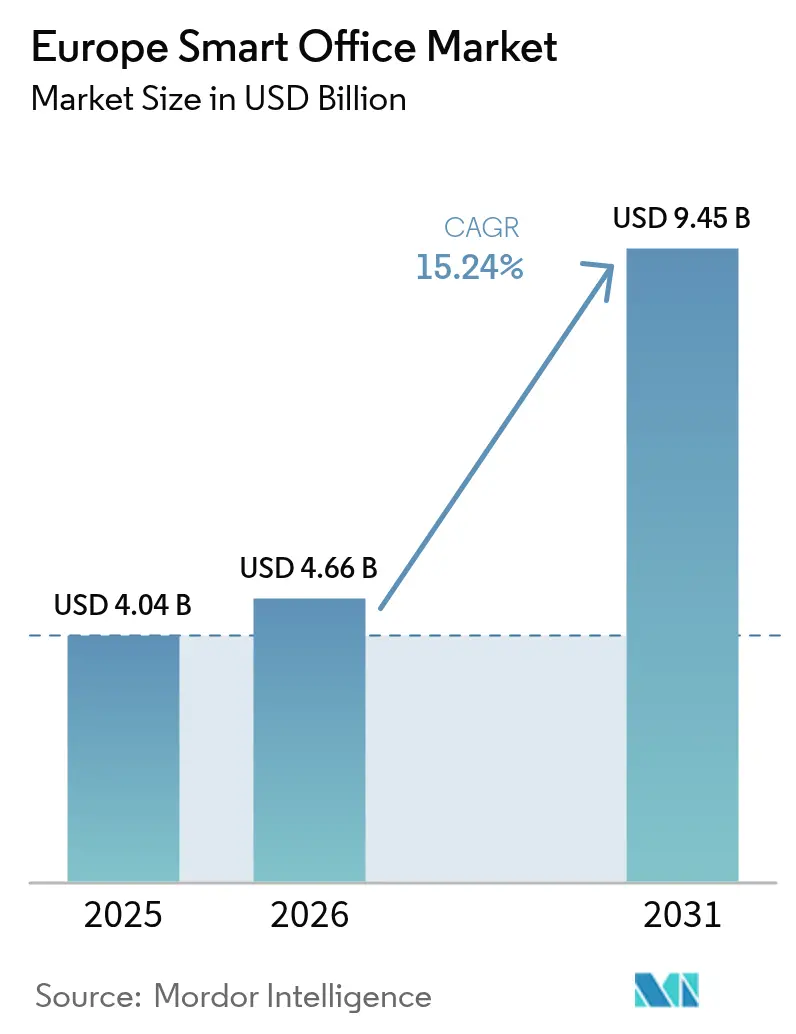
| Base Year Market Size (2025) | USD 4.04 Billion |
| Market Size (2026) | USD 4.66 Billion |
| Market Size (2031) | USD 9.45 Billion |
| Growth Rate (2026 - 2031) | 15.24 % |
| Market Concentration | Medium |
Major Players *Disclaimer: Major Players sorted in no particular order Image © Mordor Intelligence. Reuse requires attribution under CC BY 4.0. | |
Europe Smart Office Market Analysis by Mordor Intelligence
The Europe Smart Office Market size in 2026 is estimated at USD 4.66 billion, growing from 2025 value of USD 4.04 billion with 2031 projections showing USD 9.45 billion, growing at 15.24% CAGR over 2026-2031. Firm European Union efficiency rules shape growth, the spread of hybrid work patterns, and a steady fall in Internet of Things (IoT) sensor prices. Real-time workplace analytics running on 5G private networks are cutting operating costs by as much as 30% in pilot sites.[1] Germany leads the current adoption, buoyed by federal retrofit incentives, while Italy forms the fastest-growing cluster due to grants from the National Recovery and Resilience Plan. Smart lighting retains the largest revenue slice, yet space-focused workplace analytics tools hold the strongest forward momentum. Vendors battle interoperability gaps in older heating, ventilation, and access control hardware, but the arrival of open standards such as Matter and Thread is reducing lock-in barriers.
Key Report Takeaways
- By product category, Smart Lighting Systems led with a 28.12% Europe Smart Office Market Share in 2025. Workplace Analytics Solutions are projected to post the fastest 15.73% CAGR through 2031.
- By building type, retrofits captured 54.84% share of the Europe Smart Office Market Size in 2025. New Buildings are forecast to expand at a 16.01% CAGR between 2026 and 2031.
- By geography, Germany accounted for 17.95% Europe Smart Office Market Share in 2025; Italy is set to grow at a 16.45% CAGR to 2031.
- Siemens, Schneider Electric, Honeywell, Johnson Controls, and ABB together held 41.30% share of the Europe Smart Office Market in 2025.
Note: Market size and forecast figures in this report are generated using Mordor Intelligence’s proprietary estimation framework, updated with the latest available data and insights as of 2026.
Europe Smart Office Market Trends and Insights
Drivers Impact Analysis*
| Driver | (~) % Impact on CAGR Forecast | Geographic Relevance | Impact Timeline |
|---|---|---|---|
| EU energy efficiency regulations | +3.2% | Pan-European, strongest in Germany, France, Netherlands | Medium term (2-4 years) |
| Hybrid and flexible work models | +2.8% | Major cities, IT and BFSI hubs | Short term (≤ 2 years) |
| Decline in IoT sensor and connectivity costs | +2.5% | Nordics, Germany, United Kingdom | Medium term (2-4 years) |
| 5G private networks in offices | +2.1% | Germany, United Kingdom, France, Italy | Long term (≥ 4 years) |
| Corporate ESG and net-zero goals | +2.4% | Publicly listed firms across Europe | Medium term (2-4 years) |
| Digital twins for predictive management | +1.9% | Nordics, Germany, United Kingdom | Long term (≥ 4 years) |
| Source: Mordor Intelligence | |||
Stringent European Union Energy Efficiency Regulations
The 2024 revision of the Energy Performance of Buildings Directive forces every new commercial building to reach zero-emission status by 2030.[2] Germany set aside EUR 14.5 billion (USD 15.5 billion) in retrofit grants that favor AI-driven energy optimization. The directive introduces smart readiness indicators that score a building’s response to occupant needs and grid signals, pushing demand for dense sensor networks. France’s RE2020 code limits lifecycle carbon, steering developers toward prefabricated modules with embedded controls. Together, these rules replace incremental upgrades with full digital orchestration across lighting, HVAC, and security.
Growing Adoption of Hybrid and Flexible Work Models
Average office footprints shrank 18% between 2020 and 2024, yet daily occupancy swings from 40% to 70% create planning uncertainty. Finance regulators note that 82% of U.K. financial firms now run flexible policies, accelerating hot-desking and analytics investments. Real-time data lets facility teams shut unused floors and trim energy budgets. Activity-based working also demands granular comfort controls that legacy systems lack.
Rapid Decline in IoT Sensor and Connectivity Costs
Component prices for occupancy sensors slid 42% from 2020 to 2024, while wireless modules dropped 38%. Siemens cut materials costs for its Enlighted sensor by 35% in two years, expanding mid-market reach. Battery-free, energy-harvesting devices erase maintenance overhead, and Schneider Electric now manages over 1.2 million sensors across Europe.
Integration of Digital Twins for Predictive Workplace Management
Siemens deployed digital twins in 450 European buildings, predicting failures 72 hours ahead. Johnson Controls reported a 28% cut in heating and cooling energy for OpenBlue users. Although setup costs of up to USD 213,000 curb mass uptake, headquarters and premium assets see rapid payback from reduced downtime and optimized layouts.
Restraints Impact Analysis*
| Restraint | (~) % Impact on CAGR Forecast | Geographic Relevance | Impact Timeline |
|---|---|---|---|
| High retrofit capital outlay | -1.8% | Southern and Eastern Europe | Short term (≤ 2 years) |
| Legacy system interoperability gaps | -1.5% | Buildings built before 2010 | Medium term (2-4 years) |
| GDPR-driven privacy and cyber concerns | -1.2% | Germany, France, Netherlands | Medium term (2-4 years) |
| Skilled labor shortages | -1.1% | Nordics and Germany | Long term (≥ 4 years) |
| Source: Mordor Intelligence | |||
High Upfront Capital Expenditure for Retrofit Projects
Smart office retrofits can cost EUR 150-400 (USD 160-426) per square meter, placing a EUR 1.6 million bill on a 5,000 square-meter site.[3] Italy’s generous Superbonus fell from 110% to 70% coverage, slowing activity until fresh deductions arrived. Payback horizons stretching beyond seven years deter smaller landlords, even as European Investment Bank grants remain oversubscribed.
Heightened Data Privacy and Cybersecurity Concerns under GDPR
A Paris real estate firm was fined EUR 800,000 (USD 931520.00) for sensor over-tracking without consent. Legal uncertainty around cloud hosting outside the European Economic Area fuels audit costs. The U.K. National Cyber Security Centre now urges network segmentation and regular penetration tests, yet market compliance varies widely.
*Our forecasts treat driver/restraint impacts as directional, not additive. The impact forecasts reflect baseline growth, mix effects, and variable interactions.
Segment Analysis
By Product Type: Workplace Analytics Platforms Gain Strategic Priority
Smart Lighting Systems held 28.12% of Europe Smart Office Market Share in 2025. Europe Smart Office Market Size for workplace analytics is on track to expand at 15.73% CAGR, driven by demand for real-time space data. Microsoft’s Viva Insights covers 3,200 locations and links with Azure Digital Twins to offer predictive heatmaps. Security and access systems stay resilient due to growing biometric use. Energy management tools see rising orders as Germany’s commercial power price averaged EUR 0.28 (USD 0.30) per kilowatt-hour in 2024.
Hardware advances spur audio-video systems with spatial audio and auto-framing, while fire and safety controls integrate deeper into building networks. Commodity pressure on sensors pushes suppliers toward bundling hardware with analytics subscriptions. The Europe Smart Office Industry continues to emphasize interoperability so that lighting, HVAC, and security data converge in one analytics layer.


By Building Type: New Construction Gains Momentum
Retrofits represented 54.84% of deployments yet face higher labor costs. Europe Smart Office Market Size for new buildings is projected to rise at 16.01% CAGR. Skanska embeds AI-ready building management in every project started after January 2024, adding 3% to cost but earning 8-12% rental premiums. Mass timber structures demand precise humidity control, pushing early adoption of smart sensors.
Retrofit activity remains vast because 70% of offices pre-date 2010 and must meet new efficiency rules. However, unforeseen legacy wiring issues and the need for live-occupied installation prolong payback. Developers increasingly choose smart-enabled rebuilds where local rules allow demolition, especially in Germany, France, and the Nordics.
By Connectivity Technology: Wireless Protocols Dominate
Wireless links covered 62.07% of the market in 2025 and will grow at 16.92% CAGR. Wi-Fi 6 and soon Wi-Fi 7 handle audio-video loads and analytics dashboards. Zigbee and Bluetooth Low Energy underpin most smart lighting and occupancy sensors. Thread adoption surged after Apple and Google enabled cross-vendor support. Europe Smart Office Market Size for wired Ethernet remains stable for life-safety systems where deterministic latency is vital.
Power over Ethernet Plus supplies up to 90 watts, allowing a single cable for lights, sensors, and access readers. Z-Wave stays niche in small offices, and legacy BACnet and Modbus persist for HVAC backbones. Hybrid designs that feed wireless edge nodes through wired backhaul are emerging as the default topology.
By Offering: Services Segment Accelerates
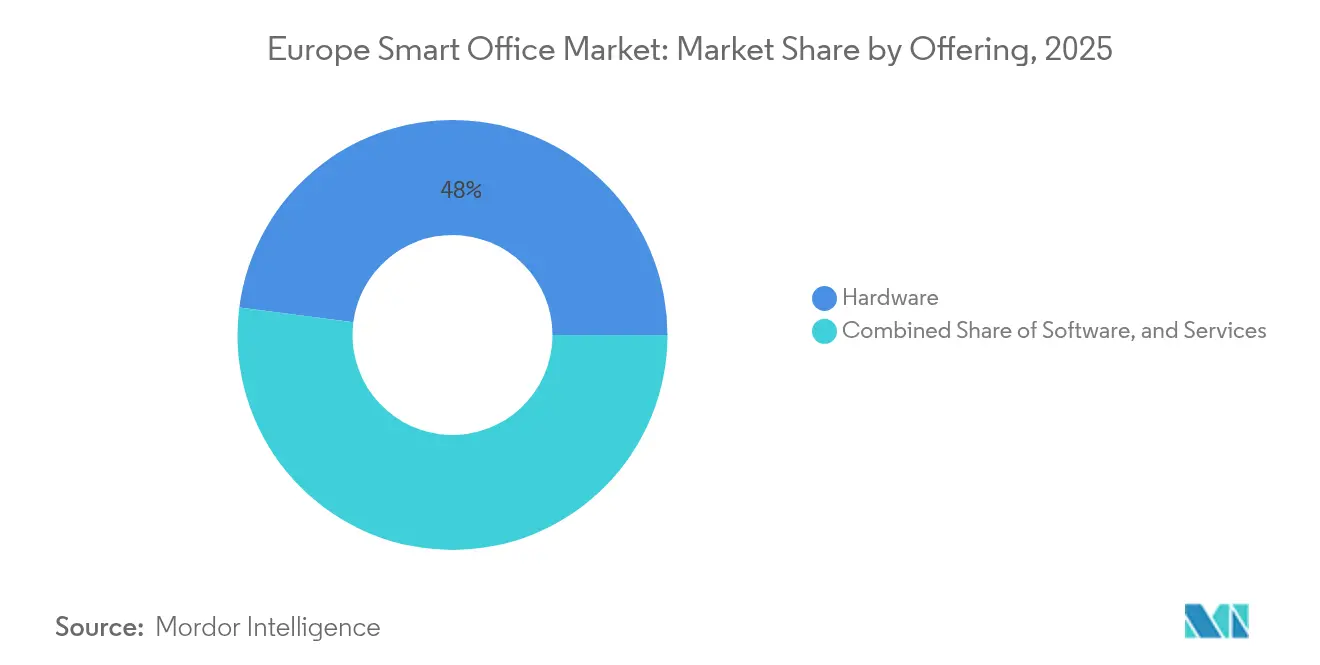
Hardware produced 47.95% of revenue in 2025, but services will climb at 16.05% CAGR. Professional design and commissioning dominate today, followed by managed services with uptime guarantees. Honeywell Forge logged 32% European revenue growth with average contracts above USD 150,000 per year.
Europe Smart Office Market Size for software expands as AI modules forecast faults and give efficiency guidance. Sensors commoditize, so vendors pair them with cloud dashboards. Controllers gain edge logic that trims latency and safeguards against connectivity loss. Europe Smart Office Industry participants are steering toward annual subscription models rather than one-off equipment sales.
By End-User Industry: Healthcare Leads Growth
IT and Telecom captured 26.31% of the Europe Smart Office Market in 2025. Healthcare and Life Sciences will grow at 16.89% CAGR as laboratories need strict environmental control and audit trails. Roche linked 8,500 sensors in Basel to its lab information system for instant deviation alerts. Banking rules also keep physical security budgets strong. Government retrofits accelerate through the United Kingdom’s GBP 1.2 billion program to outfit 600 offices with smart energy platforms. Manufacturing, retail, and education continue prioritizing energy-saving lighting and HVAC, with advanced analytics often deferred to later phases.
Geography Analysis
Germany held 17.95% of the Europe Smart Office Market in 2025, supported by EUR 14.5 billion of federal retrofit subsidies and strict building codes. The country benefits from deep integrator networks established by Siemens and Bosch, which shorten project lead times. The United Kingdom continues to invest, driven by London’s financial hub and the 2050 net-zero mandate. France benefits from RE2020 rules that favor sensor-embedded prefabricated modules.
Italy shows the fastest 16.45% CAGR outlook. EUR 15.2 billion (USD 17.70 billion) of Recovery Plan grants cover up to 65% of qualifying retrofit costs, driving rapid adoption in Milan and Rome. Nordic nations maintain an early adoption of digital twins, aided by high digital literacy and robust broadband infrastructure. Sweden funds pilots that merge building data with vehicle-to-grid systems. Spain and the Netherlands continue to grow steadily, with the latter focusing on circular economy goals that align with real-time material tracking. Russia remains muted amid sanctions and vendor exits. Central and Eastern European capitals exhibit healthy demand for smart offices, but secondary cities lag due to financing gaps. Overall, the Europe Smart Office Market continues to broaden as EU policy coherence increases technology confidence among landlords and tenants alike.
Regulatory Landscape
The recast Energy Performance of Buildings Directive (EU) 2024/1275 tightens requirements for non-residential buildings by pushing higher-performing building automation and control systems (BACS) and broader monitoring of indoor environmental quality (IEQ). A key compliance anchor is the 29 May 2026 transposition deadline, after which national rules increasingly reference BACS capability levels aligned with EN 52120-1. This raises demand for integrated HVAC, lighting, and sensor platforms, rather than standalone controls.
Smart office deployments also face tighter digital governance as AI-enabled building functions expand. From 2 August 2026, applicable provisions of the EU AI Act for high-risk AI systems introduce documentation, oversight, and deployer obligations for certain AI-driven building management and safety-related functions, creating an additional compliance layer alongside energy rules. Separately, the European Commission has a 30 June 2026 reporting deadline on Smart Readiness Indicator (SRI) testing and implementation, which keeps SRI-related data capture and interoperability central in procurement.
Value Chain Analysis
The Europe smart office value chain begins with component and subsystem suppliers (sensors, controllers/actuators, lighting drivers, access devices, networking). It then extends to platform software (BMS, analytics, digital twins) and deployment partners, including system integrators, MEP contractors, and facility services. Interoperability across protocols such as KNX, BACnet, DALI, Modbus, and LoRaWAN often depends on gateways and hybrid controllers. Standardization is progressing through items including EN 50090-6-2:2025 (HBES IoT semantic ontology) and BS EN 14908-10:2025 (web services for control networking), which supports multi-vendor data aggregation for workplace analytics and energy optimization.
Downstream, procurement frequently bundles design, commissioning, and managed services to reduce operational risk and meet performance commitments. This reinforces the shift from one-off hardware sales to recurring software and service contracts. Recent ecosystem moves reflect that service-led chain: PassiveLogic partnered with Aroundtown (October 2025) to deploy autonomous controls and digital twins across European portfolios, Willow worked with BNP Paribas Real Estate Property Management (December 2025) to implement conversational building capabilities, and Signify launched Pineapple CoRE with Schneider Electric (June 2025) to offer a turnkey decarbonization pathway for commercial properties. These partnerships expand the influence of platform providers and property managers in specifying outcomes (energy, comfort, utilization), pulling demand through installers and OEM channels.
Competitive Landscape
The top five vendors Siemens, Schneider Electric, Honeywell, Johnson Controls, and ABB commanded 42% of Europe Smart Office Market revenue in 2024. Traditional automation firms use installed bases and service arms to defend share, yet face commoditizing hardware margins. Cloud giants Microsoft and Google chase recurring analytics income through platform ties with Office 365 and Google Workspace.
Open standards advocacy and proprietary ecosystem battles run in parallel. Siemens and Schneider Electric back the Matter alliance yet also extend proprietary APIs for differentiated controls. Cybersecurity accreditation such as IEC 62443 certification is now a key tender requirement in health and finance sectors. Mid-market offices, often between 2,000 and 10,000 square meters, form a white-space opportunity for modular, cloud-managed bundles.
Partnership moves abound. Schneider Electric embedded Azure Digital Twins into EcoStruxure, while Johnson Controls linked OpenBlue with Google Vertex AI. Edge computing inside controllers allows local fault detection even if cloud links fail. Disruptors that combine desk booking, visitor check-in, and environmental feedback in one mobile app challenge incumbents by focusing on the employee experience rather than only infrastructure.
Europe Smart Office Industry Leaders
-
ABB Ltd.
-
Bosch Building Technologies GmbH
-
Cisco Systems, Inc.
-
CommScope Holding Company, Inc.
-
Crestron Electronics, Inc.
- *Disclaimer: Major Players sorted in no particular order

Market Opportunities and Future Outlook
Compliance-driven retrofits remain a primary opportunity area as the recast Energy Performance of Buildings Directive (EU) 2024/1275 raises requirements for building automation and expands attention to indoor environmental quality monitoring in occupied spaces. That direction supports dense sensor networks and integrated BACS upgrades across existing commercial stock. In the report context, retrofits already represent the majority of deployments (54.84% share in 2025), and procurement is increasingly oriented toward interoperable, API-first platforms that connect lighting, HVAC, security, and workplace analytics into a shared operational layer.
There is also opportunity in resilience and electrification-adjacent building infrastructure, including power management, grid-interactive controls, and the electronics that enable efficient automation at scale. In 2026, investment announcements by major suppliers provide evidence of supply-chain and capability buildout relevant to smart office deployments: ABB announced USD 200 million of investments across Europe for grid automation and medium-voltage technologies (including a new facility in Dalmine, Italy), and Infineon opened its Smart Power Fab in Dresden as a large-scale expansion for intelligent power semiconductors used across connected building and energy systems. Together, these moves support larger multi-site rollouts where smart office modernization is bundled with broader energy efficiency, electrification, and monitoring upgrades.
Recent Industry Developments
- June 2026: ABB announced an integration between ABB Ability BuildingPro and Samsung SmartThings Pro to connect building intelligence with enterprise IoT, with proof-of-concept sites cited in Eschborn, Amsterdam, and Middelfart. The move strengthens cloud-to-cloud interoperability between building management and workplace-facing IoT workflows, supporting faster deployment of cross-vendor analytics without ripping and replacing all legacy subsystems.
- January 2026: Bosch unified its global building technologies integrator operations under the single name Bosch Building Technologies. The consolidation streamlines go-to-market and delivery for multi-country projects, which supports pan-European customers standardizing smart office and smart building rollouts across portfolios.
- October 2024: ABB formed a strategic alliance with Zumtobel Group to advance smart building technologies, combining ABB i-bus KNX, DALI, and direct current protection devices with Zumtobel lighting systems. The partnership targets integrated, multi-domain building solutions, reinforcing lighting as a key entry point for broader smart office sensing and control layers.
Research Methodology Framework and Report Scope
Market Definition and Coverage
For this study, the Europe smart office market is defined as revenues from connected hardware, software, and related services that automate and optimize office buildings and workplaces, including energy, lighting, HVAC controls, security and access control, sensors, and workplace analytics.
Scope exclusions: We exclude non-office building deployments and purely consumer smart home devices that are not procured and managed as part of an office workplace system.
Segmentation Overview
- By Product Type
- Security and Access Control Systems
- Energy Management Systems
- Smart HVAC Control Systems
- Smart Lighting Systems
- Audio-Video Conferencing Systems
- Fire and Safety Control Systems
- Smart Sensors
- Workplace Analytics Solutions
- Others
- By Building Type
- Retrofits
- New Buildings
- By Connectivity Technology
- Wired
- Wireless
- Wi-Fi
- Zigbee
- Bluetooth
- Z-Wave
- Thread
- Others
- By Offering
- Hardware
- Sensors
- Controllers and Actuators
- Networking Equipment
- Software
- Building Management Platforms
- Analytics and AI Software
- Services
- Professional Services
- Managed Services
- Hardware
- By End-User Industry
- IT and Telecom
- BFSI
- Healthcare and Life Sciences
- Government and Public Sector
- Manufacturing
- Retail and Hospitality
- Education
- Others
- By Country
- Germany
- United Kingdom
- France
- Italy
- Spain
- Netherlands
- Nordics
- Russia
- Rest of Europe
Data Sources, Market Sizing, and Validation
Desk Research
Desk research was used to set the starting structure of the market and to keep assumptions anchored to visible indicators for Europe. We typically review public sources such as Eurostat for construction and energy series, the European Commission for building and digital policy signals, and the European Environment Agency for energy efficiency and emissions context that influences retrofit demand.
To translate market activity into dollars, we also used sources such as national statistics offices for non-residential building stock signals, and standards and industry bodies such as ISO and CEN for connectivity and safety requirements that impact solution uptake. Company annual reports, investor presentations, product documentation, and credible press coverage were used to map solution mixes and typical deployment patterns, followed by selective use of paid subscriptions for company financials and intelligence, patent databases, and contract and tender tracking where it helped validate spending direction. These sources were illustrative, and we reviewed additional materials to support data collection, cross-checks, and clarification.
Primary Interviews and Surveys
Primary work focused on validating what actually gets deployed in offices across Europe and how budgets are split between security, energy, lighting, HVAC controls, sensors, and analytics. We spoke with a mix of solution suppliers, systems integrators, facility managers, and enterprise buyers across major European sub-regions so pricing ranges, rollout timelines, and retrofit versus new-build shares could be confirmed.
Survey inputs were then used to test adoption assumptions by office size and industry, and to confirm how wired and wireless connectivity choices affect configuration and spend levels.
Distribution of primary research fieldwork respondents
| Company type | Respondent position |
|---|---|
| Top tier: 34% | CXOs: 14% |
| Mid tier: 49% | Functional/Unit leaders: 35% |
| Smaller Players: 17% | Managers: 51% |
Market-Sizing & Forecasting
Sizing was built using a combined top-down and bottom-up approach, where European office activity is reconstructed from demand signals and then reconciled with supplier-side reality checks. The top-down view starts from office floor space and retrofit intensity, and then applies smart system penetration rates and typical spend per site to arrive at value by solution group.
Several market-specific inputs were tracked to make the model reflect the European market rather than a generic technology curve. These include retrofit versus new building shares, average deployment scope per office (for example, whether energy management is bundled with lighting and HVAC controls), workplace security and access control requirements, wireless versus wired adoption in dense office layouts, and typical refresh cycles for sensors, controllers, and analytics software. Where data was thin for smaller countries, gap handling was done by applying peer-country ratios based on office stock, digitization readiness, and construction activity, and then rechecked through interviews.
For forecasting, scenario analysis was used so the base case could reflect how quickly retrofit projects convert, how energy prices and sustainability targets influence payback periods, and how hybrid work affects office utilization driven upgrades. These scenarios were adjusted using expert consensus from primary respondents, and the final trajectory was kept consistent with observable construction and building modernization signals.
Data Validation & Update Cycle
Model outputs were triangulated against independent signals such as smart building tender activity, office construction and renovation indicators, and reported direction of enterprise facility digitization spend. Outliers were flagged early, and assumptions were revisited when a country-level result drifted from what installers and buyers described as plausible rollout capacity.
Before sign-off, the build is reviewed in multiple steps by another analyst to confirm that scope, currency timing, and growth drivers are applied consistently across countries and solution types. The report is refreshed annually, with interim updates when a material event changes office investment behavior, and a final pre-delivery check is completed so clients receive the latest updated view.
Mordor Intelligence's Europe Smart Office Market Sizing Compared With Other Published Estimates
Published market sizes for Europe smart office often do not match because the word smart office is used differently across studies, and the year chosen as the starting point can shift the total by a lot. Currency conversion timing and whether values are reported as installed-system revenue versus broader digital workplace spending also tends to create visible gaps.
The main drivers in this market are whether building-level controls (HVAC, lighting, access control, and sensors) are counted only when deployed for office workplaces, and how retrofit project scope is treated when multiple systems are bundled in one modernization contract. Some estimates also lean on global splits to derive Europe values, which can miss country differences in retrofit cycles and energy-driven upgrades, while other estimates use more conservative or more aggressive adoption curves without checking them with installers and enterprise facility teams.
Benchmark comparison
| Source | Market Size | Gaps in Research Methodology |
|---|---|---|
| Mordor Intelligence | USD 4.66 B (2026) | |
| Regional Consultancy A | USD 3.50 B (2024) | Uses an earlier base year and a narrower interpretation that leans toward core technology components, which can undercount bundled retrofit contracts and later-stage analytics and services. |
| Global Consultancy B | USD 53.90 B (2024) | Reports a global smart office total, and Europe is typically derived as a regional share, which can blur office-only boundaries and fold in adjacent workplace and building digitization spend. |
The spread in the table is mostly explained by year choice and what gets counted as office-specific system revenue versus broader workplace technology. By tying the Europe total to office retrofit intensity, penetration assumptions, and deployment level spending checks, and then reconciling it with supplier and buyer feedback, the estimate stays traceable to repeatable steps, a modeling choice applied by Mordor Intelligence.
Key Questions Answered in the Report
What is the current value of the Europe Smart Office Market?
The market is worth USD 4.66 billion in 2026.
How fast is the Europe Smart Office Market expected to grow?
It is set to expand at a 15.24% CAGR through 2031.
Which product category leads revenue?
Smart Lighting Systems lead with 28.12% share in 2025.
Which country shows the quickest growth outlook?
Italy is projected to post a 16.45% CAGR from 2026 to 2031.
Who are the top vendors in the region?
Siemens, Schneider Electric, Honeywell, Johnson Controls, and ABB hold the largest combined share.
What is the main barrier for retrofits?
High upfront capital costs ranging from EUR 150-400 (USD 174.66 - 465.76) per square meter deter smaller landlords.