
Market Overview
| Study Period | 2020 - 2031 |
|---|---|
| Forecast Data Period | 2026 - 2031 |
| Base Year Market Size (2025) | USD 7.21 Billion |
| Market Size (2026) | USD 7.96 Billion |
| Market Size (2031) | USD 13.1 Billion |
| Growth Rate (2026 - 2031) | 10.46 % |
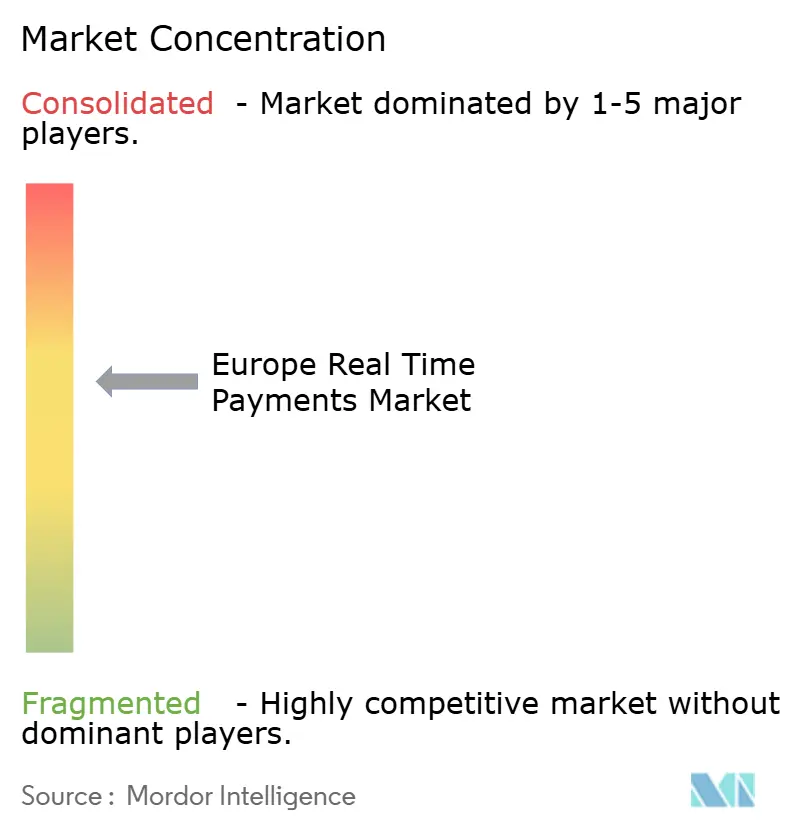
| Market Concentration | Medium |
Major Players *Disclaimer: Major Players sorted in no particular order Image © Mordor Intelligence. Reuse requires attribution under CC BY 4.0. | |
Europe Real Time Payments Market Analysis by Mordor Intelligence
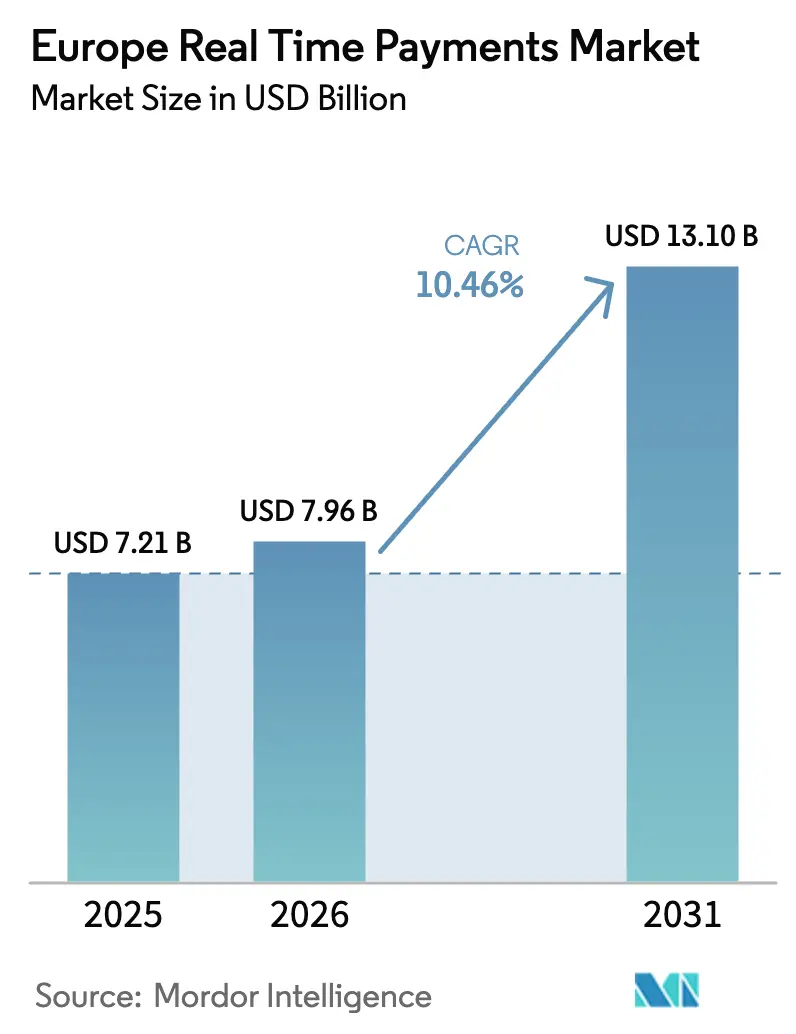
Europe real time payments market size in 2026 is estimated at USD 7.96 billion, growing from 2025 value of USD 7.21 billion with 2031 projections showing USD 13.1 billion, growing at 10.46% CAGR over 2026-2031. Rapid regulatory harmonization—most notably the Instant Payments Regulation mandating cost-parity for euro-denominated instant transfers—has removed the EUR 2.19 (USD 2.52) average premium that previously restrained adoption. [1] The pricing reset forces banks to compete on service quality, triggering accelerated investment in API connectivity, risk controls and liquidity optimisation. Pan-European pilots such as the SEPA Payment Account Access (SPAA) scheme are unlocking premium data-sharing revenue streams, while large corporates fast-track ISO 20022 migration to achieve real-time cash visibility. Corporates’ need for unified, cross-border cash pooling aligns with regulators’ goal of friction-free Single Euro Payments Area infrastructure, giving the Europe real time payments market unique momentum relative to other regions. Poland’s 16.5% CAGR and the United Kingdom’s 27.8% revenue share underline the region’s blend of fast-growing challenger markets and scale-oriented incumbents, sustaining a balanced outlook for providers across software, services and clearing infrastructure.
Key Report Takeaways
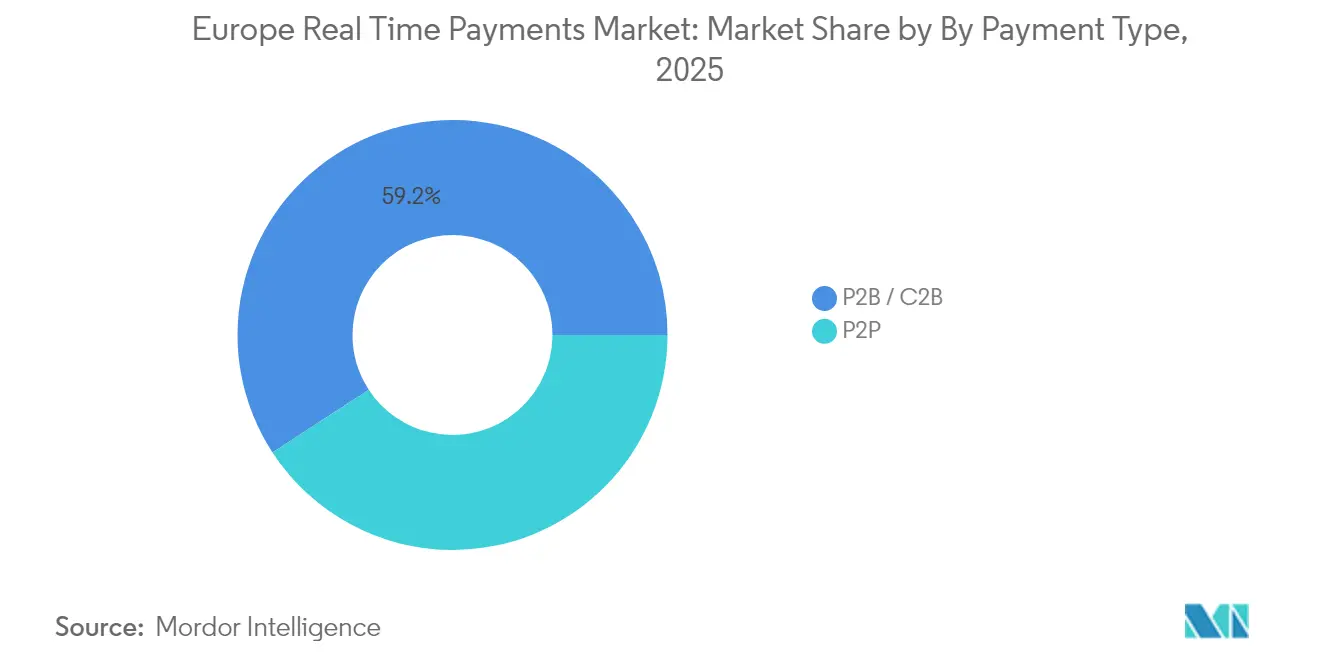
- By payment type: P2P transfers led with 40.80% of the Europe real time payments market share in 2025, whereas P2B/C2B volumes are projected to expand at a 13.59% CAGR through 2031.
- By component: Platform/Software captured 62.70% revenue in 2025; the Services segment is forecast to grow at 15.32% CAGR as institutions outsource compliance and integration.
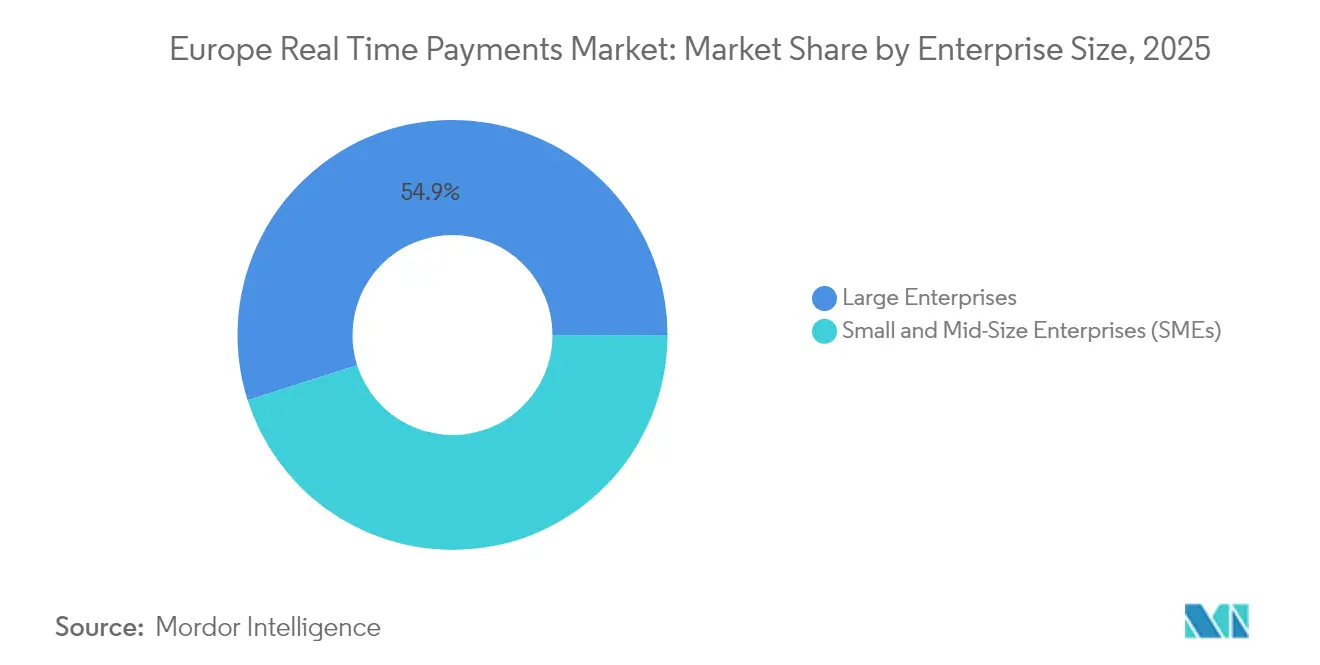
- By enterprise size: Large Enterprises held 54.90% share in 2025, while SMEs are forecast to grow at 12.18% CAGR on the back of simplified onboarding via pan-regional wallets.
- By end-user industry: Banking and Financial Services controlled 38.20% in 2025, but Retail and eCommerce is advancing at a 13.66% CAGR as merchants switch to account-to-account rails.
- By geography: The United Kingdom dominated with 27.30% share in 2025; Poland leads growth at 15.92% CAGR through 2031 on the strength of BLIK and Express Elixir adoption.
Note: Market size and forecast figures in this report are generated using Mordor Intelligence’s proprietary estimation framework, updated with the latest available data and insights as of 2026.
Europe Real Time Payments Market Trends and Insights
Drivers Impact Analysis*
| Driver | (~) % Impact on CAGR Forecast | Geographic Relevance | Impact Timeline |
|---|---|---|---|
| Adoption of Pan-European Instant SEPA Mandate (SCT Inst) | +3.2% | Eurozone, extending to full SEPA area by 2027 | Medium term (2-4 years) |
| PSD3 and SPAA-Driven Open-Banking Use-Cases | +2.8% | EU-wide, with tactical pilots in Germany and Belgium | Long term (≥ 4 years) |
| Corporate Treasury Shift to ISO 20022 for Instant Liquidity | +1.9% | Global with EU early adoption focus | Short term (≤ 2 years) |
| Rise of Request-to-Pay (R2P) for Utilities and Public Sector | +1.4% | Nordic countries leading, expanding to Western Europe | Medium term (2-4 years) |
| Source: Mordor Intelligence | |||
Adoption of Pan-European Instant SEPA Mandate (SCT Inst) Drives Market Acceleration
Mandatory SCT Inst adherence compels Eurozone banks to receive instant payments by January 2025 and dispatch them by October 2025. [2] Cost-parity clauses cut average instant transfer fees from EUR 2.19 to EUR 0.76, eliminating the economic barrier that had capped consumer uptake. The latest rulebook also tightens execution to 5 seconds and lifts single-transaction limits close to EUR 1 billion (USD 1.08 billion), positioning the rail for high-value corporate flows. Banks are therefore shifting investment from per-transaction pricing models to value-added overlay services such as Request-to-Pay and fraud-verified account matching. As liquidity settles in near-real time, corporates gain faster access to incoming funds, further perpetuating volume growth in the Europe real time payments market.
PSD3 and SPAA-Driven Open-Banking Use-Cases Expand Beyond Payment Initiation
SPAA’s remuneration framework finally introduces a viable economic model for premium APIs, encouraging banks to commercialise data products rather than treating open banking as a compliance cost. Dynamic Recurring Payments, pilot-tested in 2025, allow merchants to vary debits without fresh mandates, reducing rejection rates and smoothing cash flow. PSD3 harmonises licensing for Payment and Electronic Money Institutions, closing loopholes that had supported fragmented market entry. These reforms deepen integration between instant clearing rails and value-added digital services, creating new monetisation paths for banks and fintechs.
Corporate Treasury Shift to ISO 20022 for Instant Liquidity Management
ISO 20022’s structured data unlocks real-time reconciliation and richer remittance information, a capability corporates view as critical ahead of the November 2025 cross-border deadline. Early adopters report consolidated multibank cash views and reduced working-capital buffers. Airbus’s use of Swift trackers to monitor end-to-end payment status exemplifies how treasurers harness data granularity to automate cash positioning. The linkage of ISO-formatted messages to instant payment schemes eliminates information asymmetry between high-value and retail payments, reinforcing end-user demand across the Europe real time payments market.
Rise of Request-to-Pay (R2P) for Utilities and Public Sector Applications
R2P overlays digitise billing, remove paper reconciliation and embed contextual data such as energy consumption or tax identifiers. Nordic utilities show reduced late-payment ratios after adopting SEPA R2P flows, while public-sector pilots have demonstrated faster tax settlement and improved citizen satisfaction. [3] By shifting customer interactions into real time, billers align receivables with operational funding cycles, further validating instant rails as the default pathway for recurring payments.
Restraints Impact Analysis*
| Restraint | (~) % Impact on CAGR Forecast | Geographic Relevance | Impact Timeline |
|---|---|---|---|
| Fragmented RTP Clearing Infrastructure (TIPS vs. RT1 vs. Domestic) | -2.1% | EU-wide with varying domestic implementations | Long term (≥ 4 years) |
| Payment Fraud such as Authorized Push Payment Scams | -1.8% | UK leading, expanding across EU with instant payments | Short term (≤ 2 years) |
| High AML/SCA Compliance Costs | -1.3% | Global with EU regulatory complexity | Medium term (2-4 years) |
| Source: Mordor Intelligence | |||
Fragmented RTP Clearing Infrastructure Creates Operational Complexity
TIPS processed 196 million payments worth EUR 122 billion (USD 132 billion) in H1 2024 with 99% completion inside 5 seconds. Yet PSPs must still fund liquidity across TIPS, RT1 and domestic schemes, tying up working capital and raising settlement risk. The ECB’s project for a single liquidity pool aims to consolidate cash buffers, but divergent implementation timelines keep liquidity siloed, disproportionately burdening smaller PSPs and tempering scale economics in the Europe real time payments market.
Payment Fraud Escalation Threatens Consumer Confidence
Authorized Push Payment scams rose sharply in 2024, prompting the European Payments Council to call fraud the primary obstacle to instant payment adoption. Liability shifts under the forthcoming Payment Services Regulation compel banks to reimburse victims, increasing compliance costs and necessitating AI-enabled pre-transaction screening. Providers must therefore balance sub-10-second processing against enhanced due-diligence, an operational tension that could restrain user experience if not addressed through advanced analytics.
*Our forecasts treat driver/restraint impacts as directional, not additive. The impact forecasts reflect baseline growth, mix effects, and variable interactions.
Segment Analysis
By Payment Type: Commercial Volumes Redefine the Use-Case Mix
P2P transfers controlled 40.80% of 2025 volumes; however, P2B/C2B flows are forecast to grow 13.59% annually through 2031. The Europe real time payments market size for P2B transactions is expected to add USD 3.36 billion in incremental revenue between 2026 and 2031 as merchants pivot away from card interchange. Wero’s July 2024 launch in Germany and Belgium showcases the strategic sequencing from P2P to online checkout, an expansion that brings competitive pressure to global card schemes. Emerging multi-scheme routing—Spain’s Bizum, Italy’s Bancomat Pay and Portugal’s MB Way—illustrates regional collaboration designed to maintain domestic sovereignty while meeting cross-border consumer expectations. For merchants, account-to-account rails lower acceptance costs and improve settlement speed, strengthening loyalty propositions and solidifying the Europe real time payments market as a credible alternative to established card networks.
Second-order dynamics suggest a gradual re-balancing of revenue pools. Payment‐service providers able to deliver single-API access across multiple instant schemes are best positioned to capture scaled P2B volumes. As Request-to-Pay matures, utilities and public entities will shift from episodic batch collections to interactive billing, adding recurring traffic that sustains infrastructure utilisation. The Europe real time payments market therefore pivots from consumer-initiated transfers to enterprise-led cash management, accelerating monetisation potential across service layers.

By Component: Services Outpace Software as the Integration Race Intensifies
Platform/Software licences represented 62.70% of 2025 spending, but Services are forecast to grow 15.32% CAGR. Mandatory eurozone Send-capability by October 2025 drives a wave of consulting engagements and managed-service contracts, moving the Europe real time payments market size for Services from USD 2.3 billion in 2025 to USD 5.41 billion by 2031. Tier-1 banks frequently adopt “lift-and-shift” strategies—modernising legacy payment hubs while outsourcing non-differentiating functions such as ISO 20022 mapping and scheme certification. ACI Worldwide’s cloud-native deployments and IBM Z-based scaling examples prove demand for resilient, high-volume platforms complemented by expert service wrappers.
Institutions with thin IT budgets increasingly favour shared-service utilities, allowing them to meet regulatory timelines without heavy capital spend. This shift also opens cross-selling potential for analytics, fraud management and value-added overlay services. As real-time volumes rise, continuous performance tuning becomes critical, keeping specialised integrators in constant demand and reinforcing the Europe real time payments market’s service-centric revenue trajectory.
By Enterprise Size: SMEs Catch Up Through Simplified Wallet Onboarding
Large Enterprises retained 54.90% volume share in 2025, yet SME adoption is climbing at 12.18% CAGR. The Europe real time payments market share held by SMEs is projected to approach 47.80% by 2031 as regulatory cost-parity and one-click onboarding erase historical disadvantages. Unified wallets such as Wero eliminate multi-bank integration overheads, while open-banking APIs standardise pay-by-link and instant payout functions. Germany’s projected USD 9 billion open-banking revenue pool by 2030 signals how standardised connectivity translates into concrete SME demand for plug-and-play payment modules.
SMEs focus on cash-flow acceleration rather than complex treasury optimisation. Instant receipt of funds reduces reliance on overdrafts and unlocks inventory cycles. Financial institutions have responded with bundled offerings that combine identity verification, e-money accounts and settlement management, embedding value-added compliance services. As SME penetration grows, transaction diversity and volume density improve, making the Europe real time payments industry more attractive for fintech entrants.
By End-User Industry: Retail and eCommerce Leads Volume Upswing
Banking and Financial Services accounted for 38.20% of 2025 spending as institutions upgraded internal rails and customer interfaces; however, Retail and eCommerce payments are expanding at 13.66% CAGR. Smartphones facilitated 53% of European online sales in 2024, creating natural affinity with tap-to-pay and pay-by-bank checkout flows. Unified commerce strategies championed by Worldline, where every sales channel exchanges data in real time, rely on instant settlement to sync inventory, loyalty and refunds. Healthcare and Telecom remain niche adopters, using instant payouts primarily for claims and subscription billing.
Visa’s launch of AI-powered account-to-account fraud protection underscores how network vendors adapt existing risk assets to the new rail, offering merchants continuity of brand while reducing chargeback exposure. As retailers normalise instant refunds and payouts, customer experience gaps between traditional and real-time rails widen, further driving volumes inside the Europe real time payments market.
Geography Analysis
The United Kingdom maintained 27.30% of the Europe real time payments market in 2025 thanks to mature Faster Payments rails and active open-banking regulation. The National Payments Vision promotes account-to-account consumer payments, and early adopters report higher conversion and lower costs than card equivalents. Yet post-Brexit exclusion from SEPA instant schemes forces UK PSPs to manage dual technical stacks, raising operational overhead. The Financial Conduct Authority’s safeguarding and APP-scam reimbursement rules elevate compliance but reinforce user trust, sustaining volumes.
Germany and France form the industrial core. German open-banking revenues are forecast to hit USD 9 billion by 2030, underpinned by Berlin Group API standards and high smartphone penetration. TARGET2’s daily throughput of 350,000 payments worth EUR 1.7 trillion (USD 1.84 trillion) demonstrates systemic scale ready for instant overlays. France benefits from Wero’s August 2025 launch and national policy to reduce dependence on non-European schemes, steering domestic issuers toward pan-regional wallet acceptance.
Poland exemplifies high-velocity adoption, growing at 15.92% CAGR on the back of BLIK’s 20.2% transaction gain and Express Elixir’s user expansion. Government investment in digital-economy initiatives and ISO 20022 migration of core clearing systems provide long-term structural support. Spain and Italy benefit from Bizum-Bancomat Pay cooperation and TIPS connectivity but must still elevate consumer awareness to Nordic levels. Collectively these dynamics indicate sustained geographic diversification, widening the addressable base for providers active in the Europe real time payments market.
Regulatory Landscape
The EU Instant Payments Regulation (Regulation (EU) 2024/886) anchors reachability for euro instant credit transfers, imposes price parity with standard credits, and introduces a 10-second execution SLA with strengthened verification-of-payee controls across banks and non-bank PSPs on SEPA instant rails.
At scheme level, the European Payments Council SCT Inst rulebook governs technical and messaging requirements. In March 2026, the EPC opened public consultation on 2026 SCT Inst change requests (closing 11 June 2026), and the rulebook trajectory includes a data standard milestone: from 15 November 2026, unstructured postal address formats are no longer permitted, aligning SEPA messaging with Swift MX and reinforcing cross-PSP interoperability.
Value Chain Analysis
The value chain spans payers and payees using banks, wallets, and merchant checkout, payment service providers that originate and receive SCT Inst transactions, scheme governance via the EPC, and clearing and settlement through Eurosystem's TIPS and EBA Clearing’s RT1, along with domestic instant schemes. Technology and services vendors provide payment hubs, orchestration layers, ISO 20022 transformation, fraud screening, and compliance tooling to enable PSP connectivity and sub-10-second processing.
A key bottleneck remains multi-rail operational complexity and 24/7 liquidity management across TIPS, RT1, and domestic rails, amplified by mandatory migration timetables under the Instant Payments Regulation. At the infrastructure layer, scaling signals show RT1 participation (97 participants as of March 2026) and 6.1 million average daily transactions in January 2026, while cross-border enablement expands through EBA Clearing’s One-Leg Out OCT Inst, launched on 17 November 2024, which supports instant payments that include one non-SEPA leg. The November 2026 deadline to stop using unstructured addresses drives demand across vendors for data-quality tooling, directory services, and robust exception handling.
Competitive Landscape
Competition remains moderate-fragmented, shaped more by regulatory mandates than organic market cycles. Direct-connection fintechs such as Adyen posted 34.5% revenue CAGR (2019-2023), whereas heritage processors like Worldpay grew only 3% year-over-year in Q4 2023, revealing a structural advantage for single-platform architectures capable of rapid local scheme onboarding. Global Payments’ planned acquisition of Worldpay, if approved, would create the largest UK merchant acquirer with 30% share, signalling consolidation pressure among legacy firms seeking scale economies to fund compliance and innovation.
Incumbent banks pursue vertical integration: BNP Paribas extended its instant clearing capabilities to corporate treasury clients, bundling cash-forecasting analytics. Fintech entrants differentiate through specialist services—Banking Circle offers low-value cross-border instant payouts, whereas Trustly focuses on merchant A2A checkout across 30 markets. European Payments Initiative’s co-ordinated rollout of Wero underscores a strategic sovereignty agenda, giving regional banks a stake in consumer wallets and merchant checkout, thereby challenging global card networks’ dominance in the Europe real time payments market.
White-space opportunities emerge around cross-border interoperability and SME enablement. Providers building AI-driven risk engines for APP-fraud detection or offering managed liquidity services across TIPS and RT1 pools stand to capture premium pricing. The forthcoming digital euro could re-shape value pools; European pure-plays collectively added USD 23 billion in market value after positive CBDC updates, highlighting investor expectation that native players can monetise central-bank digital infrastructure more effectively than non-European rivals.
Europe Real Time Payments Industry Leaders
-
ACI Worldwide Inc.
-
Fiserv Inc.
-
Paypal Holdings Inc.
-
Mastercard Inc.
-
Visa Inc.
- *Disclaimer: Major Players sorted in no particular order
Market Opportunities and Future Outlook
Compliance-driven modernization creates monetizable whitespace in implementation services, fraud and verification layers, and ISO 20022 data transformation that support 24/7 instant settlement. The combination of mandatory verification-of-payee, the 10-second execution requirement, and the November 2026 deadline to stop using unstructured addresses concentrates near-term demand on data-quality tooling, directory services, and automation that reduces false positives while maintaining scheme SLAs.
Cross-border interoperability initiatives widen the scope for instant settlement platforms and overlay services beyond domestic euro use cases. The Eurosystem advanced TIPS capability in 2026 with the TIPS R2026.JUN release entering production on 27 May 2026 (ISO 20022 Maintenance Release 2024) and activation of the TIPS cross-currency service on 10 June 2026 for instant settlement between EUR, DKK, and SEK. The ECB also signed an agreement with Seðlabanki Íslands on 24 June 2026 for Iceland to join TIPS by 2028, and Pontes, a DLT-based tokenised settlement solution, is scheduled for Q3 2026, creating integration tracks for PSPs and vendors to connect tokenised settlement workflows with existing processing and reconciliation.
Recent Industry Developments
- July 2026: The European Central Bank selected 36 payment service providers to participate in the digital euro pilot, with the pilot scheduled to begin in the second half of 2027. This creates a defined integration cohort for wallet onboarding and back-end processing aligned with instant settlement rails.
- June 2026: ACI Worldwide announced a partnership with the European Payments Initiative to integrate the Wero digital wallet into ACI’s payments orchestration platform. This expands cross-border and merchant connectivity across pan-European use cases as Wero broadens from P2P into wide commerce flows.
- November 2024: EBA Clearing launched its One-Leg Out (OCT Inst) service in RT1 to facilitate cross-border instant payments involving one non-SEPA leg. This broadened PSP reach beyond SEPA corridors and shaped the roadmap for cross-border routing, compliance services, and integration tooling.
Research Methodology Framework and Report Scope
Market Definition and Coverage
For this study, the Europe real-time payments market is defined as revenues linked to instant credit transfer processing where funds are cleared and confirmed in near real time, across 24/7 availability, through regulated schemes and interoperable rails used by consumers, merchants, and enterprises.
Scope exclusions: We exclude batch ACH credit transfers, card-based push payments, and pure wholesale RTGS liquidity fees that are not tied to instant retail payment processing.
Segmentation Overview
- By Payment Type
- P2P
- P2B / C2B
- By Component
- Platform / Software
- Services (Consulting, Integration, Managed)
- By Enterprise Size
- Large Enterprises
- Small and Mid-Size Enterprises (SMEs)
- By End-User Industry
- Banking and Financial Services (BFSI)
- Retail and eCommerce
- Telecom and Media
- Healthcare
- Other End-user Industries
- By Country
- United Kingdom
- Germany
- France
- Spain
- Italy
- Poland
- Rest of Europe
Data Sources, Market Sizing, and Validation
Desk Research
Desk work started by mapping how instant payments are defined and reported across Europe, and then aligning that to measurable public indicators. We relied on non-paywalled sources such as the European Central Bank payments statistics, European Commission regulation releases on instant payments, SEPA scheme documentation from the European Payments Council, central bank and national payments authority publications, and Bank for International Settlements reference material.
After that, the data was shaped using public company filings and investor presentations from payment infrastructure and banking technology firms, along with reputable financial press and association websites. For gap areas like cross-border corridor activity and product rollouts, we also used paid subscriptions for company financials and intelligence, news and financials, patent databases, and a global contracts and tenders database to track confirmed deployments and timelines. The sources listed here are illustrative, and many other public documents were also used to collect data, validate assumptions, and clarify open questions.
Primary Interviews and Surveys
Primary discussions were used to confirm what gets priced in instant payments in Europe, and how pricing evolves as volumes scale and regulation tightens. We spoke with a balanced set of respondents across payment schemes, banks, processors, infrastructure providers, and advisory participants, with coverage across major European corridors so assumptions could be tested against on-the-ground implementation realities.
Distribution of primary research fieldwork respondents
| Company type | Respondent position |
|---|---|
| Top tier: 38% | CXOs: 16% |
| Mid tier: 40% | Functional/Unit leaders: 32% |
| Smaller Players: 22% | Managers: 52% |
Market-Sizing & Forecasting
Sizing was built using a top-down and bottom-up blend, where SEPA Instant and related instant-credit-transfer adoption is reconstructed from public payments statistics and scheme participation, and then converted into revenue pools using interview-tested pricing and monetization logic. The model is then corroborated through selective bottom-up approximations, such as sampled pricing schedules, channel checks on scheme and platform fees, and a sanity roll-up of supplier revenue exposure, which helps us adjust totals when one data stream is lagging.
Key inputs used in the model include instant credit transfer share within total credit transfers, scheme participation and reach (for example, receiving and sending readiness by country), average fee per transaction trends as volumes rise, the pace of ISO 20022 and fraud screening upgrades tied to instant mandates, and cross-border corridor usage where interoperability is active. When a country indicator is missing or delayed, we fill gaps by using neighboring-market proxies, and then the implied results are re-checked with interview feedback before assumptions are locked.
For forecasting, scenario analysis is used around regulatory milestones and migration pace, and then the year-by-year curve is smoothed with exponential smoothing so short-term spikes do not distort the medium-term trend. The final forecast is anchored to what banks and infrastructure providers say is realistically deliverable in rollout timing, pricing pressure, and operational limits.
Data Validation & Update Cycle
Validation is done through multiple passes that look for breaks between modeled revenues and independent market signals, such as changes in instant payment shares, scheme participation updates, and major regulatory dates. If a modeled country result appears too high or too low versus its adoption indicators, the assumptions are re-opened and respondents are re-contacted to clarify what changed.
Before sign-off, a second analyst reviews the calculations, units, and logic, and then a final variance check is completed to ensure all sub-parts reconcile to the total. Reports are refreshed annually, and interim updates are made when material events occur, such as major mandate changes or confirmed scheme rule updates. Right before delivery, we run a fresh scan so the client receives the latest view available at that time.
Mordor Intelligence's Europe Real Time Payments Market Sizing Compared With Other Published Estimates
Published market sizes for Europe real-time payments can look far apart because the term real-time is not treated the same way by every publisher, and because revenue can be counted at different points in the payment chain. Differences also come from how cross-border instant corridors are treated, which year is used for FX conversion, and whether forecasts assume aggressive price compression or a steadier fee curve.
Some estimates bundle adjacent electronic payment revenues, like broader payments processing stacks or card push transfers, which increases the reported total but reduces traceability to instant credit transfer fundamentals. Other estimates swing the opposite way by counting only transaction fees and leaving out scheme-connected platform and compliance services, and Mordor Intelligence counts those enabling revenues only when they are directly tied to SEPA Instant credit transfer flows that clear within seconds.
Benchmark comparison
| Source | Market Size | Gaps in Research Methodology |
|---|---|---|
| Mordor Intelligence | USD 7.96 B (2026) | |
| Industry Research House A | USD 7.44 B (2024) | Uses an earlier base year and typically applies a transaction-fee-only construct, which can miss platform and compliance service revenues that scale with mandate-driven rollouts. |
| Trade Journal B | USD 10.80 B (2026) | Appears to broaden scope to include near-instant electronic transfers beyond scheme-based instant credit transfers, and may apply higher average fee assumptions without cross-checking price compression from regulation and competition. |
Across the three figures, the spread is mainly explained by what each source counts as real-time revenue and how enabling services are treated. By keeping the unit of analysis tied to instant-clearing rails and then stress-testing fees and adoption against participation and regulation milestones, our estimate stays easier to reconcile and to update when new data points arrive.
Key Questions Answered in the Report
How big is the Europe real time payments market in 2026?
The Europe real time payments market size is USD 7.96 billion in 2026 and is forecast to reach USD 13.1 billion by 2031 at a 10.46% CAGR.
Which segment is growing fastest?
P2B/C2B transactions represent the fastest-growing payment type, advancing at a 13.59% CAGR through 2031 as merchants migrate away from card-based fees.
Why is Poland considered a high-growth country?
Poland posts a 15.92% CAGR due to BLIK’s 20.2% transaction growth and Express Elixir’s expanding user base, supported by proactive ISO 20022 migration and government digital-economy funding.
What are the main challenges to instant-payment adoption?
Infrastructure fragmentation among TIPS, RT1 and domestic schemes and rising Authorized Push Payment fraud are the primary restraints, shaving an estimated 3.9 percentage points off projected CAGR.
How are banks monetising open-banking APIs under PSD3?
PSD3 and SPAA introduce remuneration models that let banks charge for premium data services, such as Dynamic Recurring Payments, turning compliance investments into new revenue streams.
Will the digital euro disrupt existing instant-payment providers?
Providers anticipate the digital euro could boost volumes by embedding central-bank money in retail wallets; firms with agile, API-centric architectures are best placed to integrate the new instrument rapidly.