Market Overview
| Study Period | 2020 - 2031 |
|---|---|
| Forecast Data Period | 2026 - 2031 |
| Base Year Market Size (2025) | USD 108.23 Billion |
| Market Size (2026) | USD 115.52 Billion |
| Market Size (2031) | USD 160.19 Billion |
| Growth Rate (2026 - 2031) | 6.74% CAGR |
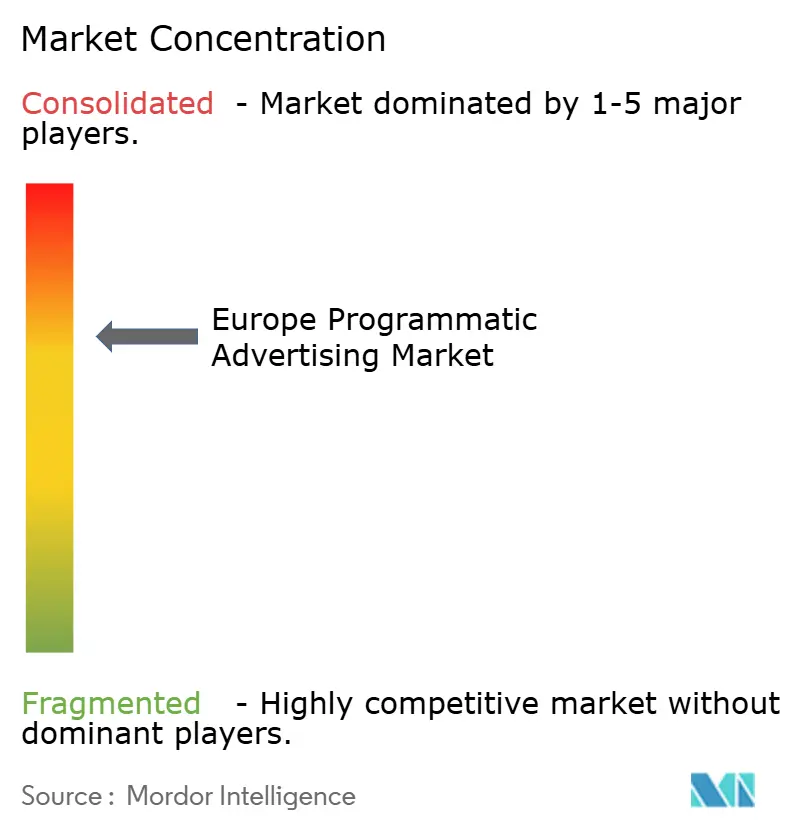
| Market Concentration | Medium |
Major Players *Disclaimer: Major Players sorted in no particular order Image © Mordor Intelligence. Reuse requires attribution under CC BY 4.0. | |
Europe Programmatic Advertising Market Analysis by Mordor Intelligence
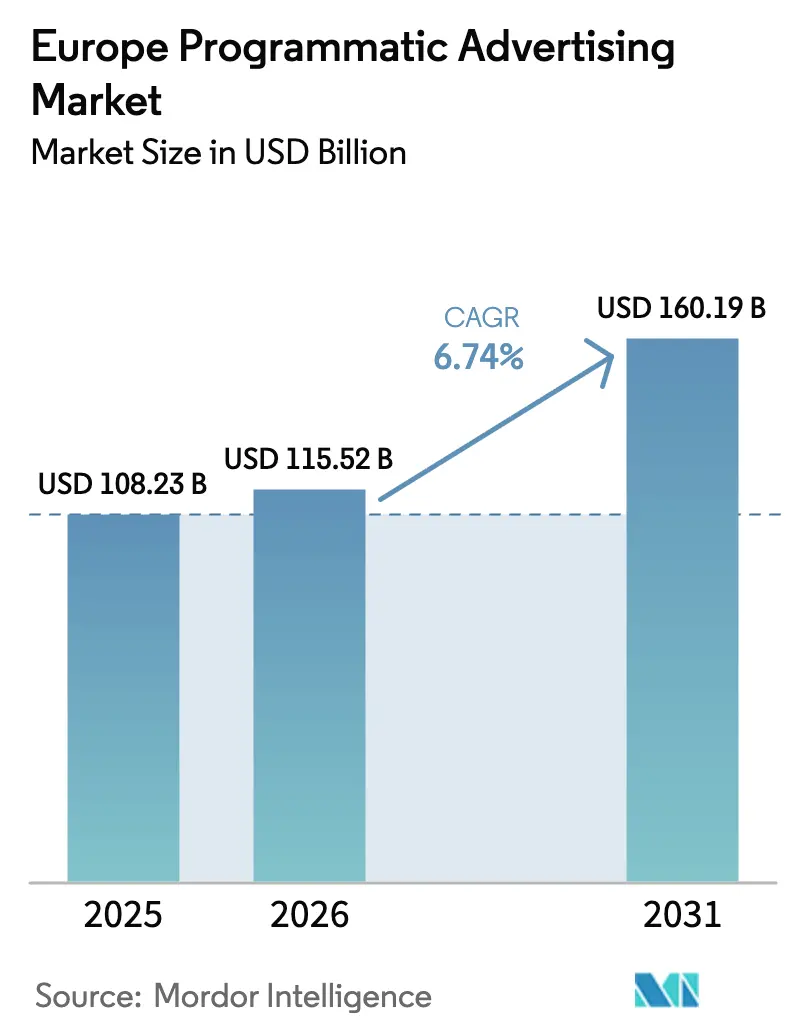
Europe Programmatic Advertising market size in 2026 is estimated at USD 115.52 billion, growing from 2025 value of USD 108.23 billion with 2031 projections showing USD 160.19 billion, growing at 6.74% CAGR over 2026-2031. This solid outlook stems from surging digital media consumption, rapid Connected TV (CTV) adoption, and the broad rollout of GDPR-compliant data strategies. Real-Time Bidding (RTB) continues to anchor automated trading, while programmatic guaranteed deals scale quickly as publishers seek revenue stability. Retail media networks deepen the addressable inventory pool, and investments in supply-chain transparency standards bolster advertiser confidence. Simultaneously, stringent privacy laws, rising sustainability expectations, and persistent ad-fraud pressures require ongoing technology and governance upgrades across the Europe Programmatic Advertising market.[1]IAB Europe, “AdEx Benchmark 2024 Report,” iabeurope.eu
Key Report Takeaways
- By trading platform, RTB held 42.98% of Europe Programmatic Advertising market share in 2025, while programmatic guaranteed is forecast to grow at 8.28% CAGR to 2031.
- By advertising media, CTV and online video commanded 37.12% of Europe Programmatic Advertising market size in 2025, and digital out-of-home is advancing at an 8.16% CAGR through 2031.
- By enterprise size, large enterprises accounted for 61.05% of Europe Programmatic Advertising market size in 2025, whereas the SME segment is progressing at an 8.58% CAGR between 2026-2031.
- By industry vertical, retail and e-commerce led with 29.35% revenue share in 2025 in Europe Programmatic Advertising market ; healthcare and pharmaceuticals is projected to register the fastest 7.83% CAGR to 2031.
- By country, the United Kingdom retained 29.21% share of Europe Programmatic Advertising market size in 2025, while Poland is expected to record the highest 7.96% CAGR through 2031
Note: Market size and forecast figures in this report are generated using Mordor Intelligence’s proprietary estimation framework, updated with the latest available data and insights as of 2026.
Europe Programmatic Advertising Market Trends and Insights
Drivers Impact Analysis*
| Driver | (~) % Impact on CAGR Forecast | Geographic Relevance | Impact Timeline |
|---|---|---|---|
| Surge in digital media consumption and online video | +2.1% | Global, with DACH and Nordics leading | Medium term (2-4 years) |
| Proliferation of GDPR-compliant data for audience targeting | +1.8% | EU-wide, strongest in Germany and France | Long term (≥ 4 years) |
| Growth of Connected TV (CTV) programmatic inventory | +2.3% | UK, Germany, Netherlands core markets | Short term (≤ 2 years) |
| Accelerating adoption of mobile in-app advertising | +1.6% | Pan-European, mobile-first markets like Spain, Italy | Medium term (2-4 years) |
| Expansion of retail-media networks' programmatic offerings | +1.9% | Western Europe, retail-dense markets | Medium term (2-4 years) |
| EU Digital Markets Act spurring open-web alternatives | +1.4% | EU-27, gatekeeper-dependent markets | Long term (≥ 4 years) |
| Source: Mordor Intelligence | |||
Surge in Digital Media Consumption and Online Video
European viewers allocated more than half of their digital attention to video formats in 2024, and the imbalance between time spent and ad spend in audio and short-form video signals incremental inventory growth potential. CTV spend climbed to EUR 3.6 billion, a 23.5% year-over-year jump as broadcasters unlocked premium streams through supply-side platforms. Advanced measurement frameworks now link CTV impressions to verified outcomes, encouraging brand and performance advertisers alike to shift budgets toward Europe Programmatic Advertising market campaigns that blend reach with precision. Cross-screen sequencing tools further amplify video’s effectiveness, increasing message recall and reducing frequency waste. With near-ubiquitous fiber and 5G rollouts across the continent, bandwidth no longer limits high-definition ad delivery, enabling richer creative and seamless user experiences.[2]IAB Europe, “Vendor List TCF,” iabeurope.eu
Proliferation of GDPR-Compliant Data for Audience Targeting
Publishers and retailers invested heavily in first-party data infrastructure after the GDPR milestone year of 2018. Email, loyalty, and transaction datasets are now complemented by consented address, IP, and SDK signals, giving rise to robust audience graphs that operate without third-party cookies. IAB Europe’s Transparency and Consent Framework (TCF) lists more than 1,000 certified vendors, and 73% of major publishers have implemented ads.txt and sellers.json to ensure authorized selling paths. These measures elevate trust, cut invalid supply, and allow Europe Programmatic Advertising market participants to deploy real-time creative optimization based on lawful data triggers. The net result is a deeper, privacy-safe seed pool for look-alike modeling and contextual overlays, which expands monetization possibilities across web, app, and emerging metaverse surfaces.
Growth of Connected TV Programmatic Inventory
Broadcasters, smart-TV OEMs, and streaming platforms opened more than 200 new private marketplace lanes in 2024, bringing scalable, brand-safe inventory to demand-side platforms. Automated auction mechanisms reduce manual insertion-order friction, while multi-currency frequency management now caps ad repetition across linear and streaming feeds. Coupled with outcome-based guarantees, these advances draw incremental budget from traditional television to the Europe Programmatic Advertising market ecosystem. Marketers also benefit from household graph integrations that tie CTV exposures to e-commerce conversions, narrowing attribution loops. As national regulators phase in cross-media measurement standards, CTV’s share of video outlays is set to rise steadily throughout the forecast period.
Expansion of Retail-Media Networks’ Programmatic Offerings
European retailers monetized EUR 14.3 billion of onsite and offsite inventory in 2024, guided by commerce data that maps SKU-level intent to ad placements. Programmatic pipes now facilitate second-price auctions inside retailer ad servers, giving brands real-time visibility into bid landscapes and allowing dynamic budget shifts. Third-party marketplaces such as Mirakl bolster this capability by embedding AI-driven bid optimization modules that operate across Amazon and eBay channels. The result is a self-reinforcing flywheel: granular shopper insights fuel better targeting, leading to higher return on ad spend and yet more investment in the Europe Programmatic Advertising market retail segment. This closed-loop paradigm attracts SME advertisers who previously lacked scaled first-party insights.[3]Mirakl, “Mirakl Acquiert Adspert,” mirakl.com
Restraints Impact Analysis*
| Restraint | (~) % Impact on CAGR Forecast | Geographic Relevance | Impact Timeline |
|---|---|---|---|
| Stringent privacy laws (GDPR, ePrivacy) limiting third-party cookies | -1.7% | EU-wide, strictest enforcement in Germany, France | Long term (≥ 4 years) |
| Persistent ad-fraud and brand-safety concerns | -1.2% | Global, heightened scrutiny in premium markets | Medium term (2-4 years) |
| Supply-path complexity and transparency issues | -0.9% | Complex programmatic markets like UK, Germany | Short term (≤ 2 years) |
| Emerging carbon-footprint scrutiny of ad-tech supply chains | -0.6% | Northern Europe sustainability leaders | Long term (≥ 4 years) |
| Source: Mordor Intelligence | |||
Stringent Privacy Laws Limiting Third-Party Cookies
The GDPR, ePrivacy Directive, and a patchwork of national rules restrict identifiers and mandate explicit consent, elevating compliance costs for ad-tech vendors. French watchdog CNIL catalogued more than 620 discrete systems in a typical programmatic transaction chain, each of which must now substantiate purpose limitation and data minimization claims. Large publishers deploy consent-management platforms, but smaller sites struggle with legal overhead, tempering inventory growth in the Europe Programmatic Advertising market. Parallelly, browser-level interventions curtail cookie lifespans, pushing advertisers toward contextual, cohort-based, and clean-room solutions that often carry higher implementation expenses.
Persistent Ad-Fraud and Brand-Safety Concerns
Invalid traffic siphons an estimated 5%-8% of programmatic budgets, according to registry data compiled by the Trustworthy Accountability Group. While 73% of authorized-seller files are correctly formatted, sellers.json mismatches expose lingering vulnerabilities. BidSwitch’s ads.txt targeting function mitigates some risk by filtering unauthorized domains before bid execution, yet brand-safety lapses still surface in user-generated content environments. Advertisers respond by reallocating spend to curated marketplaces and instituting impression-level log audits, raising transaction costs across the Europe Programmatic Advertising market.
*Our forecasts treat driver/restraint impacts as directional, not additive. The impact forecasts reflect baseline growth, mix effects, and variable interactions.
Segment Analysis
By Trading Platform: RTB Anchors While Guaranteed Deals Accelerate
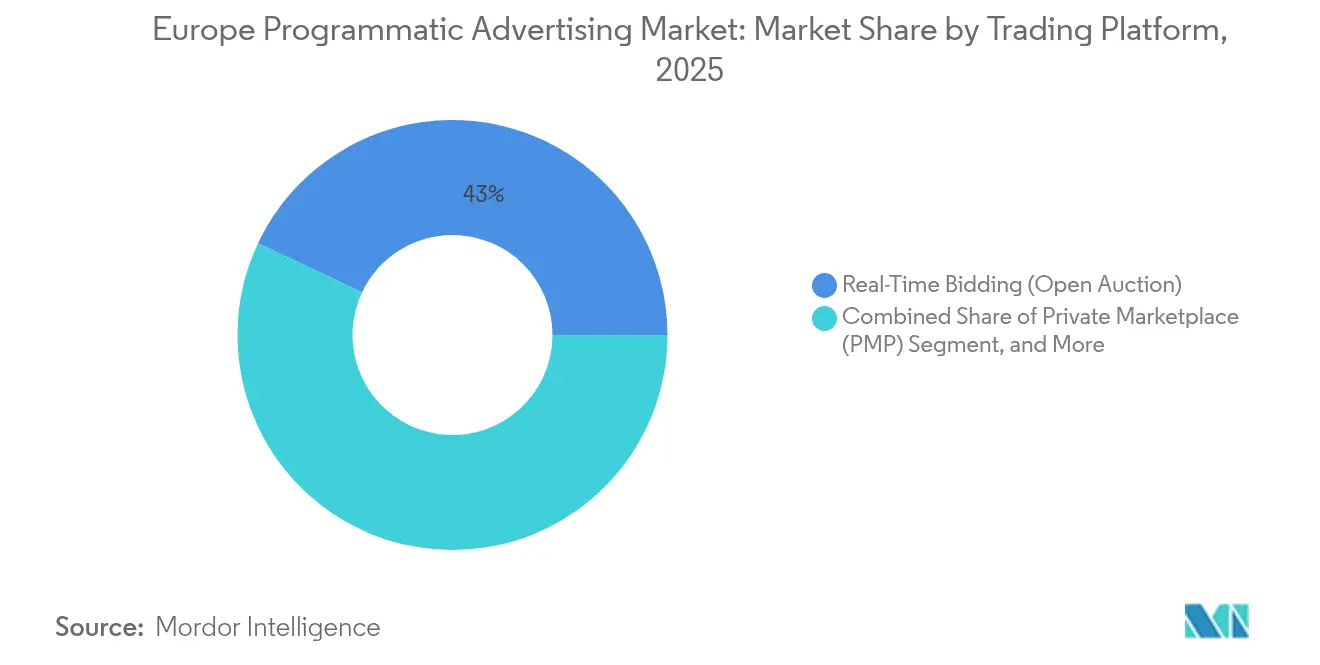
RTB contributed 42.98% of Europe Programmatic Advertising market share in 2025. Advertisers favor its auction efficiency, broad reach, and budget pacing flexibility. However, heightened emphasis on media quality drives publishers to augment RTB with private marketplaces that bundle audience segments and contextual signals at negotiated floors. Programmatic guaranteed, growing at an 8.28% CAGR, enables direct, IO-like commitments within automated pipes, giving both parties predictable delivery and performance. The Europe Programmatic Advertising market size for guaranteed deals is projected to climb steadily as broadcast and retail networks codify inventory packages around tent-pole events and seasonal peaks.
Private marketplaces serve as a strategic bridge, offering “first-look” access without volume guarantees. This format appeals to verticals with strict brand-safety requirements, finance, health, and government, where context and creative adjacency matter more than scale. DSP and SSP compliance with TCF v2.2 reduces legal friction, streamlines deal activation, and widens advertiser participation. Over the forecast horizon, hybrid buying frameworks that combine RTB’s reach with guaranteed deals’ certainty will become commonplace across the Europe Programmatic Advertising market, balancing cost efficiency with inventory quality.


By Advertising Media: CTV and Video Dominate as DOOH Surges
Online video and CTV accounted for 37.12% of Europe Programmatic Advertising market size in 2025. Household addressability, advanced audience segments, and high-impact creative drive premium pricing, and publishers leverage dynamic ad-insertion to maximize yield. Display banners remain an essential performance channel, particularly for retargeting and full-funnel sequencing. Yet the fastest-growing slice is digital out-of-home, expanding at an 8.16% CAGR as DOOH networks integrate real-time data triggers such as weather and transit flows to personalize screens.
Mobile in-app inventory is buoyed by contextual data layers that offset signal loss from cookie depreciation. App-SDK telemetry maps intent, enabling conversion-oriented formats such as playable ads and rewarded video. Audio, despite representing only 4.5% of ad spend relative to 21% of media time, offers incremental reach and low-clutter environments. As measurement unifies across screens, cross-format allocations will tighten, but video’s share should remain resilient given its superior engagement metrics within the Europe Programmatic Advertising market.
By Enterprise Size: Automation Levels the Playing Field
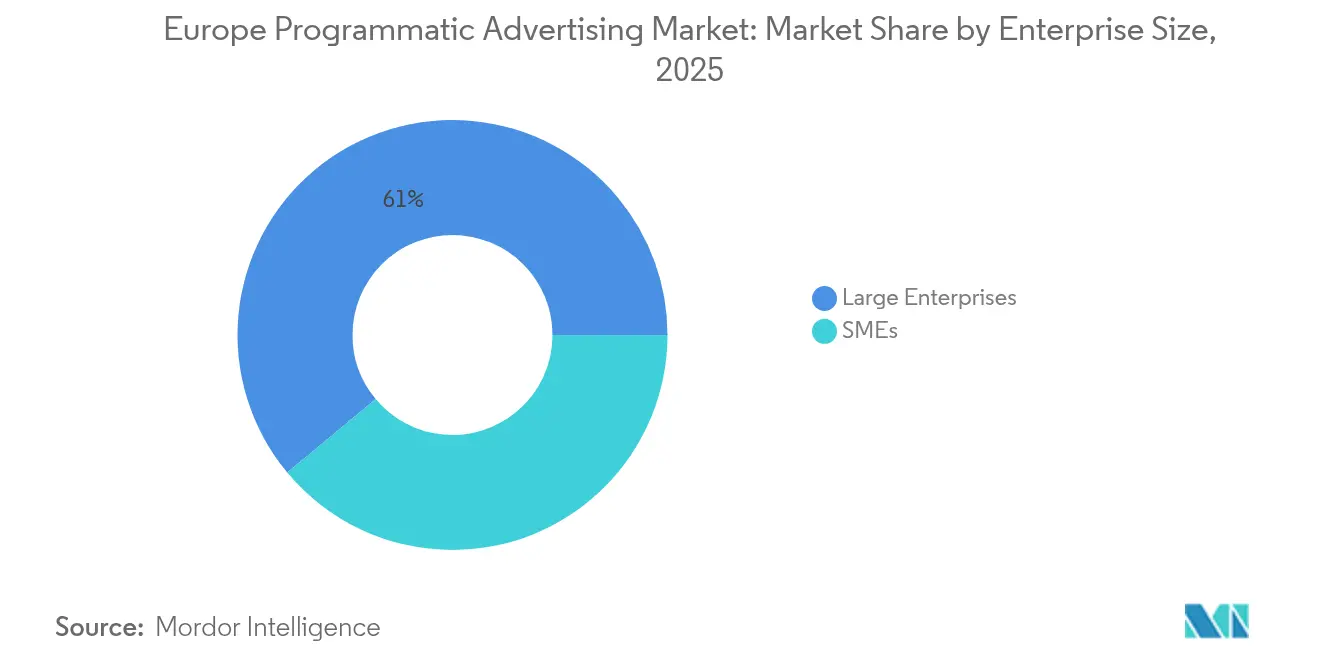
Large enterprises captured 61.05% of Europe Programmatic Advertising market share in 2025, leveraging in-house trade desks and proprietary data lakes. These players orchestrate omnichannel activations that blend upper-funnel branding with lower-funnel conversion tactics. Yet SMEs, advancing at an 8.58% CAGR, benefit from turnkey DSP interfaces and AI-driven optimization engines that trim campaign setup time from days to minutes. Minimum-spend thresholds have fallen sharply, and templated creative assets further lower barriers.
E-commerce integrations give SMEs visibility into SKU-level performance, enabling incremental budget shifts toward high-margin products within the Europe Programmatic Advertising market. Payment-on-results pricing models also appeal to resource-constrained advertisers, assuring spend efficacy. Over the forecast period, expect collaborative alliances between regional publishers and local business associations to offer curated packages designed specifically for SME objectives, amplifying grassroots adoption.
By Industry Vertical: Retail Leads, Healthcare Scales Fast
Retail and e-commerce held 29.35% of Europe Programmatic Advertising market size in 2025. First-party transaction data and closed-loop attribution underpin this dominance, and retailers monetize digital shelves through on-site sponsored listings and off-site audience extension. Consumer packaged goods brands tap these networks to influence purchase decisions closer to the point of sale. Healthcare and pharmaceuticals, forecast to rise at 7.83% CAGR, capitalize on telehealth adoption and clarified marketing guidelines across major EU markets. Contextual targeting combined with verified publisher lists ensures compliance and mitigates patient-data risks.
Financial services emphasize fraud-mitigation overlays, while automotive manufacturers employ sequential storytelling, from awareness to dealer footfall, across CTV and DOOH canvases. Media and entertainment firms funnel promotional spend into dynamic trailers aligned with release dates, and technology-telecom operators advertise device launches via high-impact video roadblocks. Government entities increasingly use programmatic channels for public-service communications, reflecting digital-first citizen engagement mandates. These diverse use cases reinforce the multi-vertical breadth of the Europe Programmatic Advertising market.
Geography Analysis
The United Kingdom commanded 29.21% of Europe Programmatic Advertising market share in 2025, buoyed by deep advertiser sophistication and a robust publisher ecosystem. London-based agencies pioneered programmatic innovation, and although post-Brexit regulatory nuances are complex, they have not curtailed spend growth. Germany ranks second, propelled by high GDP per capita and strong sectoral advertisers such as automotive and engineering. Its stringent privacy culture encourages early adoption of consent-first frameworks, reinforcing quality perceptions for Germany-origin inventory.
France’s luxury and retail media momentum elevates its market influence, while Italy and Spain showcase rapid mobile-first expansion, fueled by high smartphone penetration and social video consumption. The Netherlands and Belgium serve as cross-border testing grounds due to bilingual populations and strong logistics hubs that facilitate pan-EU campaigns. Poland leads Eastern Europe in vibrant DOOH and CTV deployments, illustrating how emerging-market agility can outpace the incremental growth of mature markets. Nordic countries are setting benchmarks for carbon-aware ad-tech, incorporating lifecycle emissions metrics into their buying algorithms. Collectively, these dynamics underscore the geographically heterogeneous yet interconnected landscape of the Europe Programmatic Advertising market.
Regulatory Landscape
Europe programmatic advertising operates under the EU privacy and platform-transparency stack anchored by GDPR and the ePrivacy Directive (notably Article 5(3) consent rules for device storage/access used by cookies and similar identifiers). The EU Digital Services Act (Regulation (EU) 2022/2065) adds ad-level transparency duties, including user-facing disclosures for each advertisement (for example, advertiser identity and main targeting parameters). For Very Large Online Platforms, Article 39 also introduces ad-repository and reporting requirements, increasing auditability of targeting and funding sources across CTV, video, and open-web supply.
Compliance is being embedded through industry and platform standards, including IAB Europe TCF implementations and DSA transparency guidance. Platform enforcement also matters, for example, Google Display and Video 360 requiring valid TCF strings for personalized bidding behaviors across CTV inventory in the EEA and UK as of 31 July 2024 (and across web/app/CTV inventory in Switzerland). Separately, the EU Data Act (Regulation (EU) 2023/2854) entered into application on 12 September 2025, shaping contractual and technical expectations around access to and use of data from connected products and related services. This intersects with audience measurement, data-sharing arrangements, and clean-room style activation approaches used in the Europe programmatic ecosystem.
Value Chain Analysis
The Europe programmatic advertising value chain runs from advertisers and agencies (buy-side planning, budgets, and creative) through DSPs (bidding, audience and measurement integrations) into exchange/auction infrastructure and SSPs (yield management, deal curation, consent signal handling), then to publishers and app developers delivering inventory across display, mobile in-app, online video/CTV, audio, and DOOH. Identity and consent infrastructure (for example, consent management platforms and IAB Europe TCF strings), verification and fraud/brand-safety providers, and measurement/attribution vendors sit across the chain and affect clearing prices, supply access, and campaign outcomes.
Key friction points include supply-path complexity and the operational cost of reconciling fees, authorized-selling signals (ads.txt/sellers.json), and bidstream controls. Header bidding is frequently cited as a bottleneck because of supply-path inefficiencies and higher energy consumption versus more direct paths. Regulatory-driven transparency is also reshaping handoffs between intermediaries, with the Digital Markets Act imposing machine-readable daily reporting requirements for gatekeepers on price, fees, and publisher remuneration. In parallel, the Digital Services Act requires per-ad disclosures, which pushes platforms and intermediaries to harden logging, reporting, and data lineage across transactions. Industry coordination remains important for practical implementation, reflected in IAB Europe supply-chain transparency guidance (2024-2025) and ongoing market focus areas surfaced at Virtual Programmatic Day 2026, including AI-enabled optimization, CTV monetization, and supply-path transparency.
Competitive Landscape
Market power is concentrated among a handful of global platforms, yet regional specialists introduce competitive tension through privacy-centric and omnichannel innovations. Google’s and Meta’s extensive logged-in user graphs deliver scale, but their walled-garden stance motivates advertisers to diversify spend into the open web. Amazon’s retail data advantages spur both collaboration and competition with European grocers developing their own retail media plays.
Independent supply-path partners target transparency-seeking buyers. Verve Group’s acquisitions of Jun Group and Captify added search-intelligence and demand-side heft, lifting its net revenues to EUR 447 million and sharpening cross-device identity resolution. Mirakl’s purchase of Adspert embeds predictive bidding across more than 400 marketplace brands, establishing a commerce-oriented differentiation. SSPs embed carbon calculators to attract sustainability-minded clients, while clean-room providers forge alliances with broadcasters to activate first-party data without raw-data transfers. This mosaic fosters healthy rivalry within the Europe Programmatic Advertising market, preserving choice while raising benchmarks for accountability and innovation.
Europe Programmatic Advertising Industry Leaders
Yieldbird Sp. z o.o.
Amobee, Inc.
MediaMath, Inc.
Adform A/S
The ADEX GmbH
- *Disclaimer: Major Players sorted in no particular order

Market Opportunities and Future Outlook
Regulatory transparency requirements under the Digital Services Act are creating whitespace for tools and services that industrialize per-ad disclosures, ad repositories (where applicable), and log-level governance across the open web and CTV supply chain. IAB Europe has published DSA transparency implementation guidance, and platform policy moves such as Google Display and Video 360 requiring valid TCF strings for personalized bidding on EEA/UK CTV inventory (effective 31 July 2024) reinforce consent-first activation, consent signal QA, and data-lineage controls that reduce disruption when scaling across markets.
Market structure is also shifting toward collaborative, first-party-data led alternatives to dominant platforms, opening routes for cross-border deal supply, shared measurement, and privacy-safe addressability. A concrete anchor is the July 2026 launch of a cross-border programmatic marketplace initiative backed by major European telecom groups, including Deutsche Telekom, Orange, Vodafone, and Virgin Media O2. At the same time, retail media and CTV continue expanding programmatic addressable inventory pools in Europe, while sustainability and supply-path optimization efforts create room for SPO-led buying models and tech that cuts bid-request waste, particularly where legacy header bidding paths raise both cost and compute.
Recent Industry Developments
- July 2026: A coalition of European telecom groups, including Deutsche Telekom, Orange, Vodafone, and Virgin Media O2, launched a cross-border programmatic advertising marketplace positioned as an alternative route to reach audiences outside dominant platform ecosystems. The initiative expands addressable, first-party data backed supply across markets and supports pan-European buying patterns with fewer intermediaries.
- November 2025: Nexxen reported the renewal and expansion of its partnership with VIDAA, securing exclusive third-party video and display ad monetization rights on VIDAA media and extending global access to VIDAA ACR data through at least 2029. The agreement strengthens OEM-level data and inventory access that can be activated programmatically, supporting CTV audience targeting and measurement workflows.
- April 2024: Infillion announced the relaunch of the MediaMath demand-side platform within its end-to-end platform and reintegrated supply connections with over 20 SSPs following MediaMaths prior bankruptcy. The relaunch restores an independent DSP option for buyers and adds competitive pressure around transparency, supply-path optimization, and cost control in programmatic buying.


Research Methodology Framework and Report Scope
Market Definition and Coverage
For this report, we define the Europe programmatic advertising market as the value of digitally delivered advertising that is bought and sold through automated platforms and software, across key formats such as display and video, and across European countries.
Scope exclusions: This sizing excludes non-digital media buying and any services that sit outside the paid media transaction itself, such as creative production or broader marketing consulting.
Segmentation Overview
- By Trading Platform
- Real-Time Bidding (Open Auction)
- Private Marketplace (PMP)
- Programmatic Guaranteed
- Preferred Deal (Unreserved Fixed-Rate)
- By Advertising Media
- Display Banner
- Online Video and CTV
- Mobile In-App
- Audio
- Digital Out-of-Home (DOOH)
- By Enterprise Size
- Small and Medium-Sized Enterprises (SMEs)
- Large Enterprises
- By Industry Vertical
- Retail and E-Commerce
- Consumer Packaged Goods (CPG)
- Automotive
- Financial Services
- Media and Entertainment
- Travel and Hospitality
- Healthcare and Pharmaceuticals
- Technology and Telecommunications
- Government and Public Sector
- By Geography
- United Kingdom
- Germany
- France
- Italy
- Spain
- Netherlands
- Poland
- Rest of Europe
Data Sources, Market Sizing, and Validation
Desk Research
Desk research was used to set the market boundaries, build the initial demand pool, and create a consistent view of regional advertising spend patterns. We reviewed public sources such as IAB Europe publications, Eurostat digital economy datasets, national statistics offices, and European Commission updates tied to privacy and advertising-related regulation, to understand adoption signals and constraints.
We also referenced items such as company annual reports, investor presentations, audited financial statements, and reputable press coverage to see how programmatic revenue is described and where it is booked. In selective cases, we used paid subscriptions for company financial intelligence, patent databases, and news and financials tracking, so corporate-level signals could be checked consistently. The desk sources mentioned here are illustrative, and many other public and paid sources were reviewed for data collection, validation, and clarification.
Primary Interviews and Surveys
Primary work focused on validating the split between programmatic channels and deal types, and on testing assumptions that do not show up cleanly in public data. We spoke with a mix of ad buyers, publishers, ad operations specialists, and platform-side practitioners across major European markets, so pricing, fill rates, and adoption trends could be cross-checked against the desk model.
Distribution of primary research fieldwork respondents
| Company type | Respondent position | Region |
|---|---|---|
| Top tier: 36% | CXOs: 21% | |
| Mid tier: 42% | Functional/Unit leaders: 21% | |
| Smaller Players: 22% | Managers: 58% |
Market-Sizing & Forecasting
The sizing approach starts with a top-down reconstruction of Europe digital advertising and programmatic participation, then it is narrowed to the in-scope programmatic formats and transaction types. To keep the totals realistic, we corroborated the outputs with selective bottom-up approximations, such as sampled spend by format multiplied by observed pricing ranges, along with channel checks from buyers and publishers.
In the model, a few practical inputs mattered most, including programmatic share of digital ad spend by country, the mix shift between open auction and private marketplace deals, the share of video and CTV within programmatic, typical CPM and take-rate movements, and the degree of privacy-led targeting changes that affect measurable inventory. Where bottom-up views were incomplete, for example smaller markets with limited disclosures, we used proxy indicators such as country-level digital spend growth and adoption of private marketplace deals, then scaled using expert-confirmed ranges.
For forecasting, we ran scenario analysis around macro advertising cycles and privacy enforcement, and we selected the mid-case after checking consensus ranges from primary discussions. Year-by-year projections were reviewed for smoothness and realism against known seasonality patterns in ad budgets and major event-driven spend spikes.
Data Validation & Update Cycle
Outputs were triangulated through multiple checks so that single-source bias is reduced. We compared modeled totals with independent signals such as region-level digital ad spend publications, company-reported advertising revenue commentary, and observed programmatic format mix shifts shared during interviews.
Variance checks were performed at the country and format levels, and any outliers triggered a re-check of assumptions, currency timing, and scope alignment before internal sign-off. The report is refreshed annually, and we also make interim updates when material events occur, such as major privacy changes or sharp ad cycle swings. Before delivery, an analyst completes a final pass to ensure clients receive the most current view available.
Mordor Intelligence's Europe Programmatic Advertising Market Estimate Compared With Other Published Estimates
Published market sizes for Europe programmatic advertising can vary a lot because sources do not always count the same transaction types, media formats, or even the same geography set within Europe. Differences also show up when one estimate reports net platform revenue and another reports gross media spend, which can change the final value even if the underlying ad activity is being described in similar terms.
Evidence such as IAB Europe programmatic spend benchmarks, country-level digital ad spend totals, and primary checks on deal-type mix are the anchors used to keep Mordor Intelligence aligned to the paid media transaction value, rather than adjacent services or narrowly defined subsets. The largest gaps typically come from whether social is included, whether only open auction RTB is counted, how CTV is treated, and which exchange rates and base years are used for currency conversion.
Benchmark comparison
| Source | Market Size | Gaps in Research Methodology |
|---|---|---|
| Mordor Intelligence | USD 115.52 B (2026) | |
| Industry Association A | USD 17.00 B (2024) | Often reports a narrower definition that can exclude social and may not fully capture private marketplace and programmatic guaranteed flows, and it is frequently published in constant currency terms that are not directly comparable to nominal USD totals. |
| Trade Journal B | USD 20.00 B (2024) | Commonly relies on a spend snapshot for a subset of European markets and formats, and it may blend net and gross values when translating from local currency, which can shift the total even before growth assumptions are applied. |
The spread in the table is mainly explained by scope and measurement choices, not by disagreement that programmatic is growing in Europe. When the market is sized with consistent inclusions (formats, deal types, and countries) and a clear gross-spend definition, the resulting number becomes easier to track and to replicate over time using the same inputs and review steps.


Key Questions Answered in the Report
How large is Europe’s programmatic ad spend today?
Europe Programmatic Advertising market size reached USD 115.52 billion in 2026 and is projected to hit USD 160.19 billion by 2031.
Which media channel leads automated buying?
CTV and online video jointly captured 37.12% of spend in 2025, the largest share among trading media.
What is driving the fastest growth in the next five years?
Programmatic guaranteed deals and digital out-of-home are forecast to post CAGRs of 8.28% and 8.16%, respectively, through 2031.
How do privacy regulations affect strategy?
GDPR and ePrivacy limit third-party cookies, prompting publishers and advertisers to rely on first-party and contextual data assets within consent frameworks.
Are SMEs adopting programmatic at scale?
Yes, automated self-serve platforms and AI optimization tools support an 8.58% CAGR for SME spending between 2026-2031.
Page last updated on: