Market Overview
| Study Period | 2020 - 2031 |
|---|---|
| Forecast Data Period | 2026 - 2031 |
| Base Year Market Size (2025) | 2.02 Million tonnes |
| Market Volume (2026) | 2.09 Million tonnes |
| Market Volume (2031) | 2.45 Million tonnes |
| Growth Rate (2026 - 2031) | 3.23% CAGR |
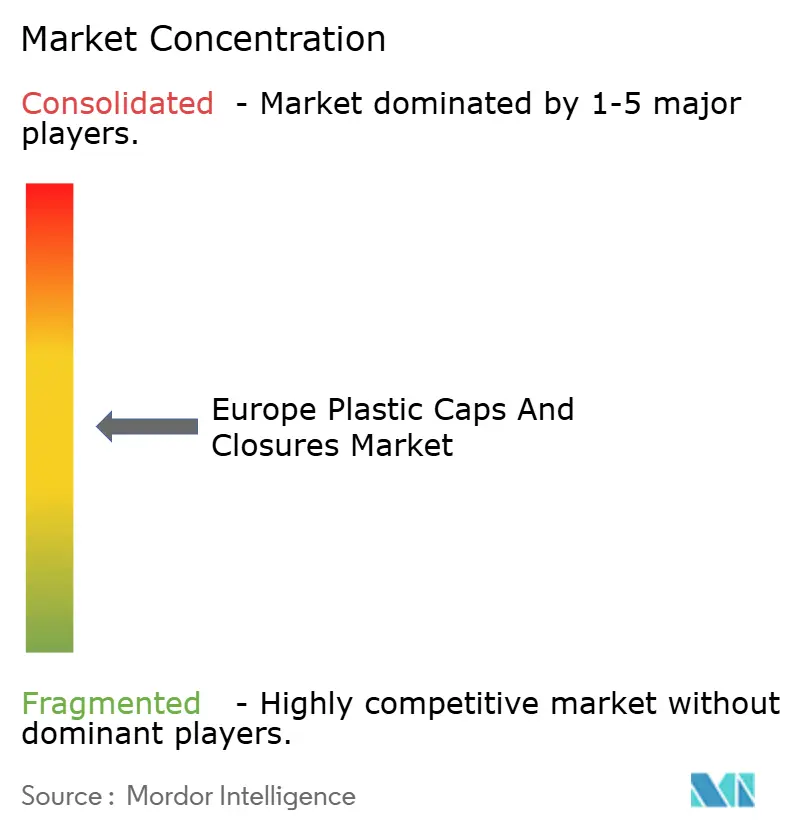
| Market Concentration | Medium |
Major Players *Disclaimer: Major Players sorted in no particular order Image © Mordor Intelligence. Reuse requires attribution under CC BY 4.0. | |
Europe Plastic Caps And Closures Market Analysis by Mordor Intelligence
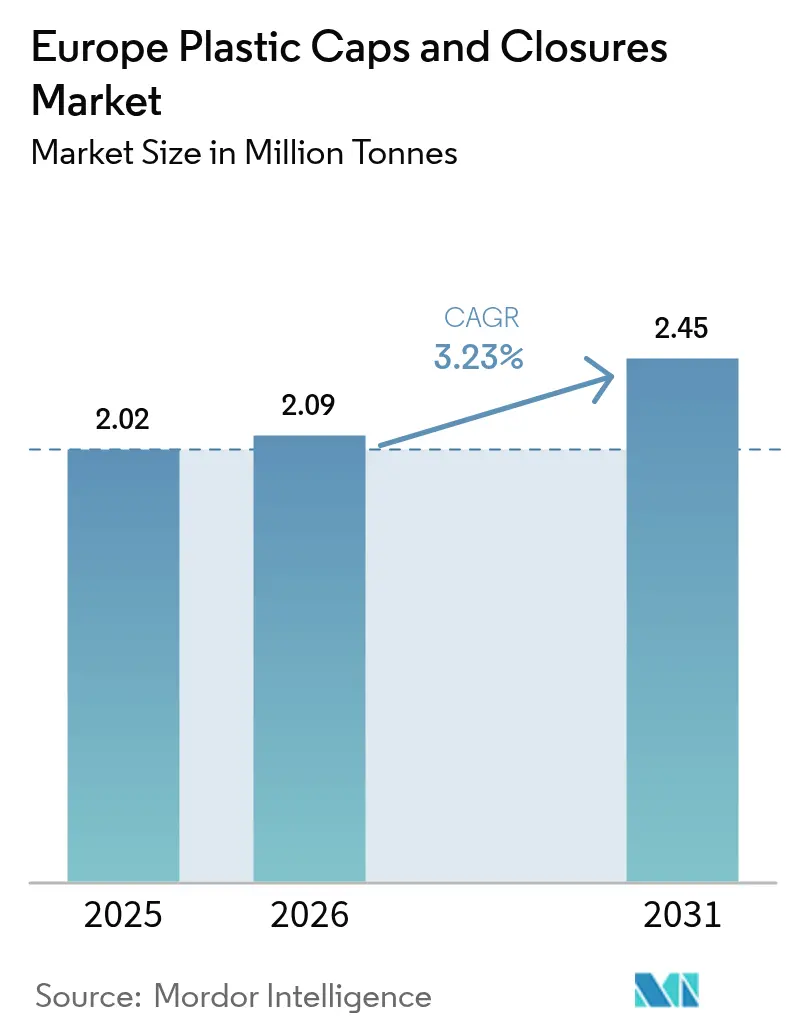
The Europe plastic caps and closures market size is projected to be 2.02 Million Tonnes in 2025, 2.09 Million Tonnes in 2026, and reach 2.45 Million Tonnes by 2031, growing at a CAGR of 3.23% from 2026 to 2031. Brand owners are racing to retrofit tethered-cap designs before enforcement penalties bite, even as lightweighting rules pressure converters to shave grams without jeopardizing seal integrity. Recycled-content quotas under Regulation 2025/40 have shifted material choices toward food-grade rPET and rHDPE, tightening resin supply and nudging converters into backward integration deals. Flexible pouches are eliminating closures in certain household-chemical lines, yet premium cosmetics, dairy RTD, and craft spirits continue to specify higher-value dispensing and tamper-evident formats, balancing the competitive landscape. Leading suppliers are therefore diversifying across dispensing technologies and verticalizing into recycling to stabilize margins as the Europe plastic caps and closures market navigates its next legislative wave.
Key Report Takeaways
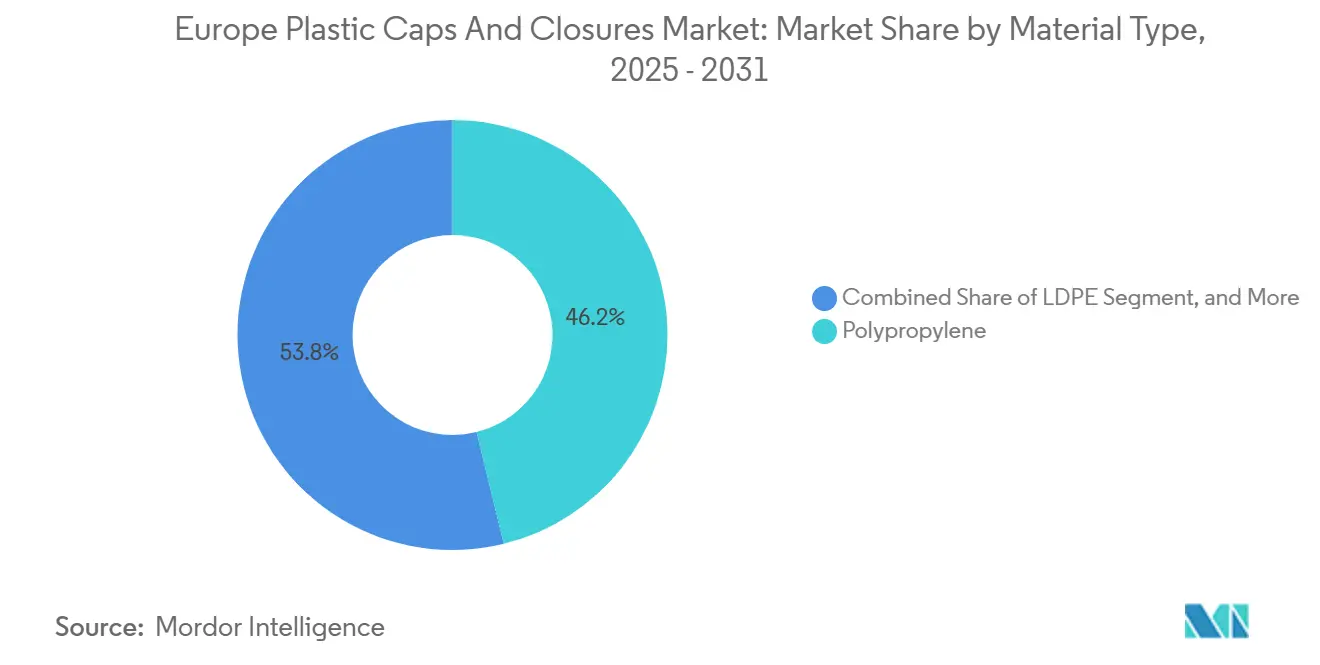
- By material type, polypropylene captured 46.16% of the Europe plastic caps and closures market share in 2025, while low-density polyethylene is advancing at a 5.52% CAGR through 2031.
- By product type, screw caps accounted for 57.85% revenue share in 2025; dispensing closures are set to expand at a 5.21% CAGR to 2031.
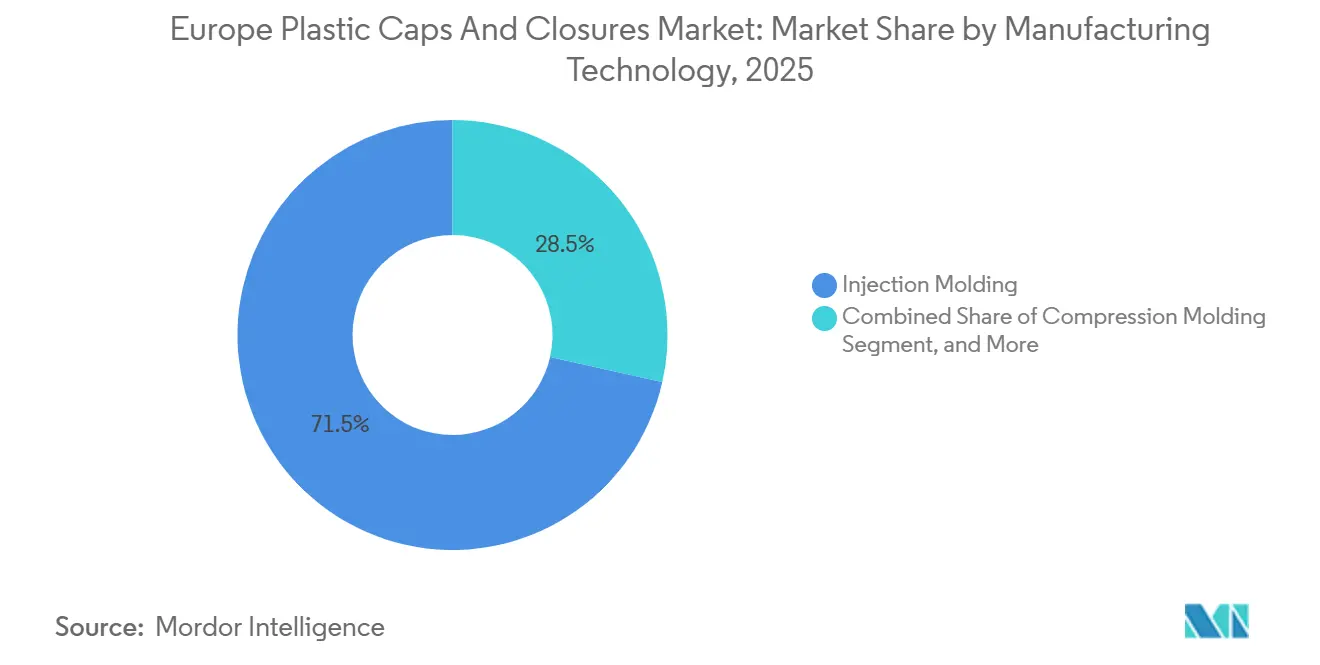
- By manufacturing technology, injection moulding held 71.49% of the Europe plastic caps and closures market size in 2025, whereas compression moulding is forecast to rise at a 4.91% CAGR.
- By end-user industry, beverage applications led with 42.75% share of the Europe plastic caps and closures market size in 2025, while cosmetics and toiletries register the fastest growth at 4.96% CAGR.
Note: Market size and forecast figures in this report are generated using Mordor Intelligence’s proprietary estimation framework, updated with the latest available data and insights as of 2026.
Europe Plastic Caps And Closures Market Trends and Insights
Drivers Impact Analysis*
| Driver | (~) % Impact on CAGR Forecast | Geographic Relevance | Impact Timeline |
|---|---|---|---|
| Lightweighting Mandates from EU Packaging and Packaging-Waste Regulation | +0.90% | EU-27, with early compliance in Germany, France, Netherlands | Medium term (2-4 years) |
| High Adoption of Tethered Caps Ahead of 2024 EU Directive Deadline | +1.20% | EU-27, particularly beverage-intensive markets (Germany, Spain, Italy) | Short term (≤ 2 years) |
| Growing Demand for High-Barrier, Aseptic-Ready Closures in Dairy RTD Lines | +0.70% | Western Europe (Germany, France, UK), expanding to Poland, Czech Republic | Medium term (2-4 years) |
| Brand-Owner Shift Toward Recycled-Content Caps | +0.80% | EU-27, driven by France, Germany, Benelux sustainability mandates | Long term (≥ 4 years) |
| Craft Spirits Boom Driving Premium, Tamper-Evident Closures | +0.50% | UK, Ireland, Germany, Scandinavia | Medium term (2-4 years) |
| Rapid Growth of E-Commerce Refill Formats Requiring Leak-Proof Closures | +0.60% | Western Europe urban centers, expanding to Southern Europe | Short term (≤ 2 years) |
| Source: Mordor Intelligence | |||
High Adoption of Tethered Caps Ahead of the 2024 Deadline
Demand for tethered designs spiked once the Single-Use Plastics Directive became enforceable, forcing 450 million beverage lines to retool at speed. Orders at Guala Closures surged 340% in 2024, stretching mold lead times to 16 weeks. The new hinges must withstand 10,000 open-close cycles, effectively excluding commodity PP grades. Patent-protected stress-relief grooves from BERICAP keep failure rates below 0.5% in field trials. Although tethering raises per-cap resin use by 8-12%, the design is now non-negotiable for carbonated drinks, locking in a near-term volume uplift for the Europe plastic caps and closures market.
Lightweighting Mandates from EU Packaging Regulation
Regulation 2025/40 caps closure mass and links compliance to design-for-recycling criteria under ISO 18604. Coca-Cola European Partners reported an 18% resin saving after switching to thin-wall caps, equivalent to 12,000 metric tons in 2025. Thin walls, however, risk hinge brittleness at sub-zero haulage temperatures, pushing converters toward higher-molecular-weight PP grades. Precision tooling for sub-2-gram closures gives early movers a cost edge, even as higher scrap rates accompany the learning curve. The combined effect is a measurable 0.9% uplift to CAGR across the forecast period.
Aseptic-Ready Closure Demand in Dairy RTD Lines
Shelf-stable dairy and plant-based beverages need closures that survive 135 °C filling and 90-day ambient storage. Multi-layer liners with EVOH keep oxygen ingress below 0.5 cm³ per day, extending flavour life. A EUR 35 million (USD 39.6 million) German line will add 800 million aseptic caps annually by 2026. Premium closures fetch 40-60% price uplifts, securing a 0.7% push on market CAGR as brands pay for cold-chain avoidance.
Brand-Owner Shift Toward Recycled-Content Caps
Amcor lifted its rHDPE usage to 18% in 2025 by tapping chemical-recycling streams. Food-grade rHDPE trades at a 25-35% premium, but vertical integration and long-term offtake agreements are narrowing differentials. Scarcity of recycled PP that meets EFSA limits keeps supply tight, positioning recyclate access as a competitive moat. Model projections assign an extra 0.8% boost to CAGR for the Europe plastic caps and closures market as recycled-content mandates scale.
Restraints Impact Analysis*
| Restraint | (~) % Impact on CAGR Forecast | Geographic Relevance | Impact Timeline |
|---|---|---|---|
| Stand-Up Pouches Encroaching on Household-Chemical SKUs | -0.60% | Western Europe, particularly UK, Germany, France | Medium term (2-4 years) |
| Deposit-Return Schemes Steering Beverage Players to Aluminum Cans | -0.90% | Germany, Netherlands, Scandinavia, expanding to France, Spain | Short term (≤ 2 years) |
| Lack of Continent-Wide rPET/rHDPE Food-Grade Supply | -0.50% | EU-27, acute in Southern and Eastern Europe | Long term (≥ 4 years) |
| High Capital Intensity for Tethered-Cap Retrofits in Legacy PET Lines | -0.70% | EU-27, concentrated in Italy, Spain, Poland with aging bottling infrastructure | Short term (≤ 2 years) |
| Source: Mordor Intelligence | |||
Deposit-Return Schemes Steering Brands Toward Aluminium Cans
Collection rates for cans now exceed 92% in key DRS markets, compared with 78-82% for PET bottles. Coca-Cola Europacific Partners raised its can mix to 38% of European volume in 2025. Each 1-point share shift removes 450 million plastic closures per year, a structural drag that subtracts 0.9% from forecast CAGR. Closure suppliers are pivoting toward non-carbonated beverages and functional waters to cushion the blow.
High Capital Intensity for Tethered-Cap Retrofits
Older PET bottling lines, especially in Italy and Spain, need EUR 8-10 million (USD 9-11 million) upgrades to handle tethered closures, often exceeding mid-tier converters’ financing capacity. Licensing fees for patented hinges add ongoing royalty burdens. These economics deter reinvestment, locking in a -0.7% CAGR impact for the Europe plastic caps and closures market as some plants downsize or exit.
*Our forecasts treat driver/restraint impacts as directional, not additive. The impact forecasts reflect baseline growth, mix effects, and variable interactions.
Segment Analysis
By Material Type: Polypropylene Anchors Beverage Demand
Polypropylene claimed 46.16% of the Europe plastic caps and closures market share in 2025 because it balances heat resistance with low unit cost. Growth skews toward low-density polyethylene, which is advancing at a 5.52% CAGR through 2031 as squeezable tubes in beauty and condiment lines favour softer resins for fingertip control.
Lower melt viscosity allows LDPE to form thinner walls, shaving 12% average resin per cap. High-density polyethylene retains pharma and child-resistant niches that demand ISO 8317 torque resistance, while bio-attributed PP under ISCC PLUS is on track for price parity by 2028, giving sustainability-minded brands a drop-in alternative without tooling changes.


By Product Type: Dispensing Closures Gain Premium Traction
Threaded screw caps still accounted for 57.85% of 2025 revenue, confirming their ubiquity in water and CSD segments of the Europe plastic caps and closures market. Dispensing variants, however, are growing 5.21% per year as airless pumps protect antioxidant serums from oxidation.
Aptar’s silicone-free valve removes elastomer migration, a key clean-beauty ask. Child-resistant push-and-turn formats climbed 4.3% in 2025, and NFC-enabled tamper-evident bands are turning closures into authentication tools. Sports caps and flip-tops round out the portfolio, chasing hydration and condiment trends.
By Manufacturing Technology: Compression Moulding Eyes Spirits
Injection moulding delivered 71.49% of the Europe plastic caps and closures market size in 2025, thanks to 32-64 cavity stacks that churn out sub-USD 0.01 caps. Compression moulding, though higher in unit cost, is gaining a 4.91% CAGR slice by offering cork-like textures and lower leak rates for premium whisky closures.
BERICAP’s Hungarian plant underscores the pivot toward premium spirits willing to pay a 25% uplift for tactile branding. Blow moulding stays limited to closures exceeding 50 mm diameter in agrochemical and industrial drums where drop impact is king.
By End-User Industry: Cosmetics Sprint Ahead
Beverages kept a 42.75% revenue share in 2025, yet cosmetics and toiletries are expanding fastest at 4.96% CAGR. Refillable palettes and magnetic-lock closures from L’Oréal cut plastic per use by 70%, but still command double-digit premiums, cushioning margins.
Food closures are rebounding with food-service sachets, pharmaceuticals demand stricter child-resistant validation, and household cleaners migrate to trigger sprayers with adjustable dosing. Automotive and agrochemical niches contribute the remaining 8%, with concentred formulations shrinking closure diameters but raising chemical-compatibility standards.
Geography Analysis
Germany, France, and Italy provided 58% of installed moulding capacity in 2025, giving the Europe plastic caps and closures market a central-western production hub. Germany’s Bavaria and Baden-Württemberg clusters supply Coca-Cola, Nestlé, and Procter and Gamble, while France leads early recycled-content adoption as Danone’s Evian line hit 50% rHDPE in closures by 2025. Italy specializes in premium spirits seals but faces retrofit pain for tethered compliance in Southern wineries.
Post-Brexit United Kingdom rules added 10% compliance cost for incoming closures, yet its craft-spirits boom offsets the burden. Spain's shift of 15% CSD volume to aluminium cans cut PET closure demand, though mineral-water producers in Catalonia hold the fort. Slovenia and Austria are rising low-cost moulding hubs, sitting within four-hour trucking to Vienna, Zagreb, and Budapest, perfect for Eastern European brand proximity.
Scandinavia shows the highest aluminium-can penetration, stunting beverage-closure growth, but craft beer and aquavit brands still require tamper-evident designs. Poland and Czech Republic lure pharma-closure investors with skilled labour and API proximity. The January 2026 Packaging Waste Regulation will finally harmonize recycled-content thresholds across member states, reducing certification duplication for converters operating in multiple EU jurisdictions.
Regulatory Landscape
The European regulatory environment for plastic caps and closures is being reshaped by the EU Packaging and Packaging Waste Regulation, Regulation (EU) 2025/40 (PPWR). It entered into force on 11 February 2025 and applies from 12 August 2026, bringing key packaging sustainability, labeling, and design requirements into a directly applicable EU-wide framework and reducing cross-country rule divergence for converters selling across multiple member states.
Closures on beverage containers are also governed by the tethered-cap requirement under Directive (EU) 2019/904 (Single-Use Plastics Directive), which mandates that caps and lids remain attached to containers during the product use stage. For food-contact plastic closures, European Commission updates are tightening compliance: Commission Regulation (EU) 2026/245 (February 2026) updates the authorized substances list for plastic food-contact materials, while Commission Regulation (EU) 2026/250 restricts Bisphenol A (BPA) in food-contact materials, with transition timelines ending 20 July 2026 for first placement on the market of certain single-use articles. Commission Regulation (EU) 2025/351 further updates requirements tied to recycled plastic food-contact materials, with transition deadlines spanning 2025 to 2026.
Value Chain Analysis
The value chain starts with polymer and additive suppliers (PP, HDPE, LDPE, and recycled grades such as rHDPE/rPET) and extends to tooling and mold makers that support tethered hinges, tamper-evident bands, and thin-wall designs. Conversion is concentrated in injection and compression molding operations supplying beverage, food, household-chemical, cosmetics, and pharmaceutical packaging lines, with output shipped either directly to brand owners and fillers or to packaging integrators that bundle containers, preforms, and closures.
Policy is a key upstream and midstream constraint and accelerator. The tethered-cap requirement under the Single-Use Plastics Directive became applicable on 3 July 2024, pushing line retooling, mold redevelopment, and qualification testing across beverage supply chains. PPWR (Regulation (EU) 2025/40), effective from February 2025 and applicable from August 2026, reinforces design-for-recycling and recycled-content requirements, raising demand for compliant secondary feedstock and strengthening the role of recyclers and compounders as strategic partners. This also supports vertical moves, including larger groups integrating closure production and technical centers such as ALPLA via KM PACKAGING, while increasing the importance of quality systems for food and pharma-grade closures.
Competitive Landscape
Europe’s top five converters BERICAP, Guala Closures, UNITED CAPS, Berry Global, and Aptar collectively hold roughly 38% share, indicating a moderately fragmented structure. They are racing to lock in rHDPE feedstock, with Guala acquiring a Romanian recycler that adds 15,000 t annual capacity. Patent licensing for tethered hinges is emerging as a royalty stream as smaller converters opt to pay rather than design new systems.
Aseptic dairy and clean-beauty dispensing closures remain lucrative white spaces were certification and material science act as high entry barriers. Aptar’s silicone-free valve and UNITED CAPS’ aluminium-look compression caps illustrate innovation aimed at premium margins. Private-label supermarkets source from regional mid-sized moulders, squeezing commodity-closure prices and forcing larger players to emphasize patented or recycled-content offerings.
Compliance costs under ISO 15378 and ISO 22000 continue to shield established converters from low-cost Asian entrants. Yet disruptors leveraging bio-attributed PP and mono-material designs are courting eco-conscious niche brands ready to accept 10-15% price mark-ups for verified circularity, adding fresh competitive tension to the Europe plastic caps and closures market.
Europe Plastic Caps And Closures Industry Leaders
BERICAP GmbH and Co. KG
Guala Closures Group
Amcor plc
ALPLA Werke Alwin Lehner GmbH and Co KG
AptarGroup Inc.
- *Disclaimer: Major Players sorted in no particular order

Market Opportunities and Future Outlook
A primary opportunity lies in compliance-driven redesign and qualification work for tethered and lightweight closures across EU-27 beverage systems, where converters can monetize validated hinge performance, tooling know-how, and platformed designs that reduce SKU proliferation for multinational fillers. PPWR creates additional whitespace in recycled-content and design-for-recycling compliant closures as it applies from 12 August 2026, which lifts demand for food-contact compliant rHDPE/rPET sourcing, testing, and documentation capabilities, particularly among suppliers able to secure stable recyclate streams and support audits across multiple member states.
Investment and portfolio moves in Europe show where capacity and product focus are shifting. Guala Closures inaugurated a new production facility in Gartcosh, Scotland, in July 2025 with an investment exceeding EUR 60 million, supporting regional supply to premium and regulated end markets and reducing lead times for UK and nearby European customers. ALPLA has expanded its closures footprint through acquisitions, including KM Packaging (announced July 2025, adding six sites into ALPLAinject) and a closure production facility from Energoplast in Serbia (November 2025), pointing to South-East Europe as an operational corridor for closures supply to food, beverage, and personal-care brands. With plastic packaging volumes still significant (the Joint Research Centre noted plastic as the only packaging category increasing between 2011 and 2025, up 11% in absolute terms, published July 2026), differentiation is leaning toward high-barrier aseptic-ready caps, premium dispensing formats in cosmetics, and child-resistant or tamper-evident solutions for nutraceutical and pharmaceutical-adjacent applications.
Recent Industry Developments
- April 2026: BERICAP announced the acquisition of Embankment Plastics, a Dublin-area manufacturer focused on dairy, food, and technical closures. The deal expands BERICAPs manufacturing footprint and adds localized capability in closure types aligned with chilled and shelf-stable food applications.
- October 2025: Guala Closures announced its entry into the pharmaceutical closures market. The move broadens its addressable end-use base beyond beverages and spirits, increasing competitive intensity in regulated, higher-specification closure formats where qualification and compliance capabilities act as barriers to entry.
- June 2024: The European Commission published EN 17665:2022+A1:2023, standardizing test protocols for tethered-cap attachment. Harmonized testing supports faster validation cycles across EU markets and reduces re-testing friction for converters supplying multinational beverage lines.


Research Methodology Framework and Report Scope
Market Definition and Coverage
This market is defined as the demand and supply of plastic caps and closures used to seal, dispense, and protect packaged products across Europe, measured in terms of volume used by end users and packaging converters.
Scope exclusions: Metal and glass closures, and non-closure packaging components such as labels and bottles, are excluded.
Segmentation Overview
- By Material Type
- Polyethylene Terephthalate (PET)
- Polypropylene (PP)
- Low-Density Polyethylene (LDPE)
- High-Density Polyethylene (HDPE)
- Polyvinyl Chloride (PVC)
- Other Materials
- By Product Type
- Screw Caps
- Snap-On Caps
- Dispensing Closures
- Child-Resistant Closures
- Tamper-Evident Closures
- Other Product Types
- By Manufacturing Type
- Injection Molding
- Compression Molding
- Blow Molding
- By End-User Industry
- Beverage
- Food
- Pharmaceutical and Healthcare
- Cosmetics and Toiletries
- Household Chemicals
- Other Industries
- By Country
- Germany
- United Kingdom
- Spain
- France
- Italy
- Slovenia
- Austria
- Switzerland
- Hungary
- Croatia
- Romania
- Greece
- Russia
- Rest of Europe
Data Sources, Market Sizing, and Validation
Desk Research
Desk research was used to build the starting point for the model and to anchor it to publicly visible packaging and polymer signals in Europe. We reviewed sources such as Eurostat, national statistical offices in key European countries, European Commission policy releases on packaging waste, and customs trade statistics for plastics and packaging-related categories to understand demand direction.
To make inputs usable for modeling, we also relied on company annual reports, investor presentations, and press releases to interpret capacity additions, lightweighting programs, and product mix changes. Patent databases were used selectively to sanity check technology adoption themes in closures (for example, tethered designs and dispensing formats), and a paid subscription source for company financials and intelligence was used only to standardize company coverage and basic comparables. The sources listed here are illustrative and not exhaustive, and other public references were also used for data collection, validation, and clarification.
Primary Interviews and Surveys
Primary work focused on confirming what is actually shipped and consumed in Europe by closure type and end use, then stress-testing the assumptions behind material splits and growth rates. We spoke with a mix of packaging converters, resin-linked ecosystem participants, and downstream users across beverage, food, household, personal care, and healthcare, so gaps from desk research could be filled and then cross-checked by more than one viewpoint.
Distribution of primary research fieldwork respondents
| Company type | Respondent position | Region |
|---|---|---|
| Top tier: 37% | CXOs: 16% | |
| Mid tier: 46% | Functional/Unit leaders: 29% | |
| Smaller Players: 17% | Managers: 55% |
Market-Sizing & Forecasting
Sizing was built using a top-down approach where packaging demand signals and end-use output are used to reconstruct the implied closures consumption pool for Europe, and then converted into tonnes using typical material weights by closure family. To keep the model realistic, we corroborated results using selective bottom-up approximations such as sampled volume-by-application checks and converter-level reality checks gathered during interviews.
Key inputs that moved the model included bottled beverage and packaged food output trends, the mix shift between screw, snap-on, dispensing, child-resistant, and tamper-evident formats, and the material mix across PP, PE grades, PET, and other plastics. We also tracked lightweighting intensity (grams per closure trends), tethered-cap adoption timing in the region, and changes in healthcare and household demand that influence higher-spec closures. Where bottom-up visibility was uneven for smaller countries, gaps were handled through calibrated per-capita packaging use proxies adjusted using import-export signals and expert feedback.
For forecasting, scenario analysis was used so that regulation-led changes (for example, tethering timelines and recycled-content pressures) could be reflected without overfitting a single trend line. The final growth path was aligned to variables that interviewees could validate, including expected format shifts and the pace of weight reduction programs.
Data Validation & Update Cycle
Validation was done through triangulation across independent signals, followed by structured variance checks at the country and application level. When a country-level output looked inconsistent with packaging production, trade direction, or known demand events, assumptions were reopened and the relevant primary contacts were re-engaged.
Before sign-off, the model and its outputs go through multi-step analyst reviews, including logic checks on material splits and growth rates so that extreme outcomes are filtered out early. Reports are refreshed annually, with interim updates when material events occur, and a final pre-delivery review so clients receive the most current view available at the time of purchase.
Mordor Intelligence's Europe Plastic Caps and Closures Market Estimate Compared With Other Published Estimates
Published market sizes for Europe plastic caps and closures can look far apart because the market can be counted in different units, and because the included products are not always identical. Differences also show up when one source relies more on value pricing assumptions, while another leans on volume consumption signals.
Metal caps and closures sit outside Mordor Intelligence's scope here, which removes a common overlap seen in broader caps and closures write-ups that mix plastic and non-plastic formats. Another recurring gap driver is measurement choice, since value-based estimates depend heavily on ASP progression, currency timing, and whether premium dispensing formats are priced using list prices or realized prices, whereas our model is built around tonnes and then checked against end-use packaging output and trade signals.
Benchmark comparison
| Source | Market Size | Gaps in Research Methodology |
|---|---|---|
| Mordor Intelligence | USD 2.09 M (2026) | |
| Global Consultancy A | USD 11.37 B (2023) | Uses value-based sizing in USD and a different base year, and results will swing based on pricing inputs, currency conversion timing, and whether broader caps and closures categories (beyond plastics-only closures) are included. |
| Regional Consultancy B | USD 16.80 B (2031) | Forecast is value-led to a later year, which amplifies differences from assumed ASP inflation and mix premiumization, and it may apply a more aggressive adoption curve for higher-priced dispensing and specialty closures. |
The comparison mainly shows that unit-of-measure and scope alignment matters before the numbers can be read side by side. By keeping the model tied to observable volume drivers and then stress-testing the growth path with format and weight assumptions, the final estimate stays traceable to clear inputs and repeatable steps.


Key Questions Answered in the Report
How fast is demand growing for tethered closures in Europe?
Orders surged 340% in 2024 as bottlers moved to meet the July 2024 directive, adding a 1.2% uplift to overall CAGR.
Which resin currently dominates closure production?
Polypropylene held 46.16% market share in 2025 due to its balance of heat resistance and cost.
Why are dispensing closures gaining traction?
Airless pumps and controlled-dose valves in premium cosmetics and pharma are expanding at a 5.21% CAGR to 2031.
What is the biggest geographic market for closures?
Germany, France, and Italy together account for 58% of installed molding capacity and remain the supply backbone.
How are recycled-content rules affecting material choices?
Regulation 2025/40 is pushing brand owners toward rHDPE and rPET, adding a projected 0.8% CAGR tailwind.
Are aluminum cans a threat to plastic closures?
Yes, deposit-return schemes have shifted 6 percentage points of soft-drink volume into cans since 2023, removing about 2.7 billion plastic caps annually.
Page last updated on: