
Market Overview
| Study Period | 2021 - 2031 |
|---|---|
| Forecast Data Period | 2026 - 2031 |
| Base Year Market Size (2025) | USD 1.37 Billion |
| Market Size (2025) | USD 1.42 Billion |
| Market Size (2030) | USD 1.71 Billion |
| Growth Rate (2026 - 2031) | 3.79 % |
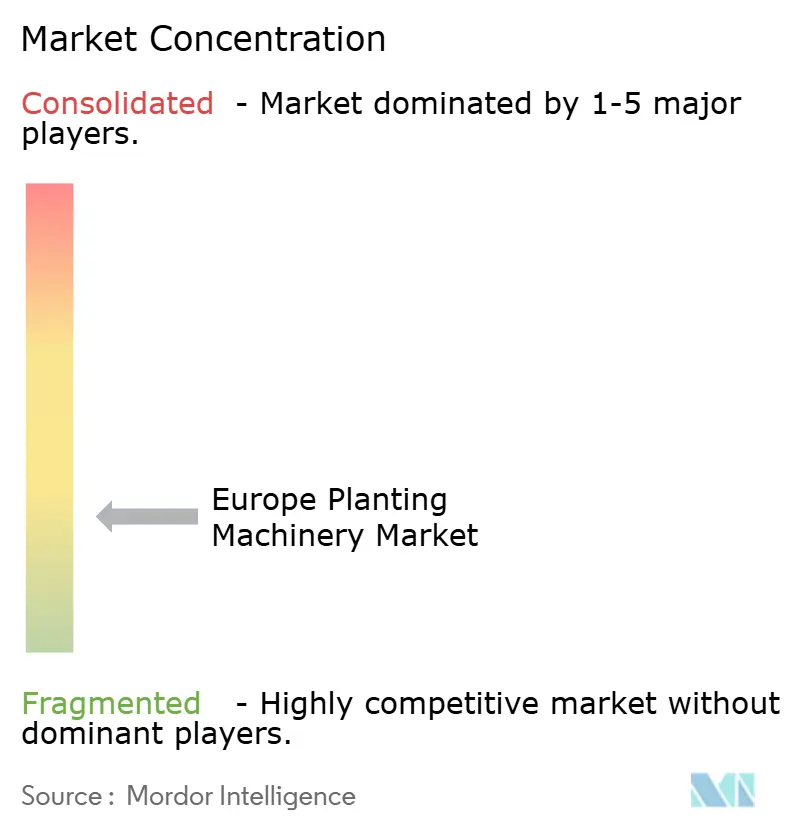
| Market Concentration | Low |
Major Players *Disclaimer: Major Players sorted in no particular order Image © Mordor Intelligence. Reuse requires attribution under CC BY 4.0. | |
Europe Planting Machinery Market Analysis by Mordor Intelligence
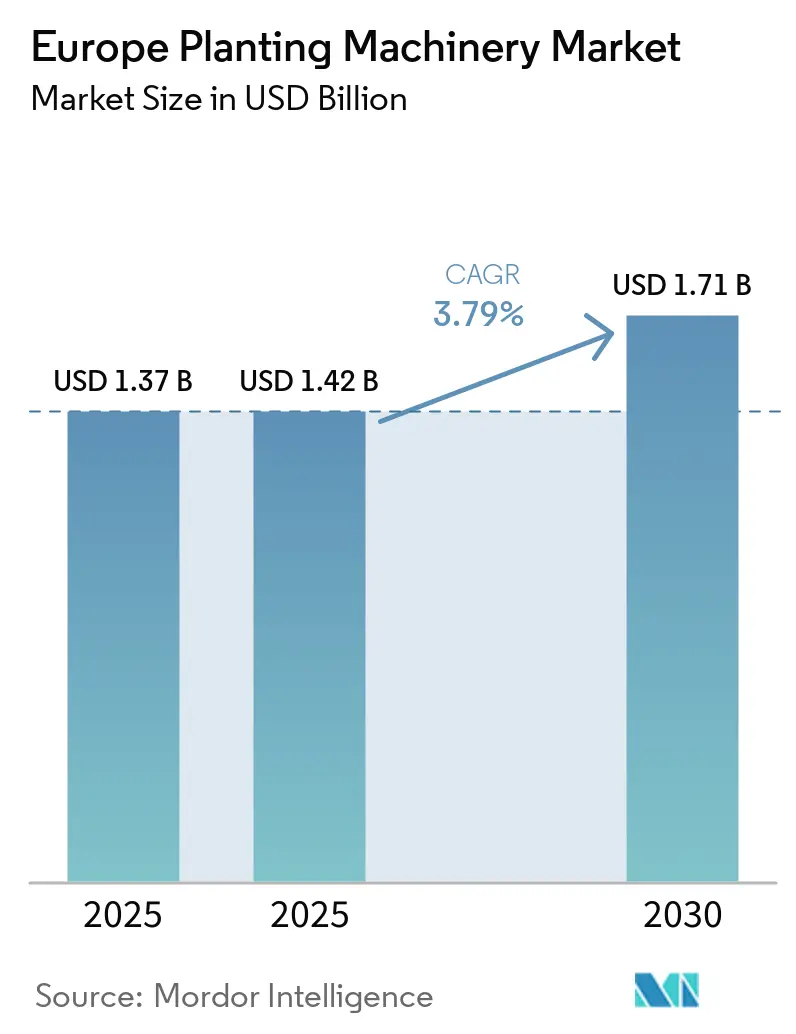
The Europe planting machinery market was valued at USD 1.37 billion in 2025 and is forecasted to grow from USD 1.42 billion in 2026 to USD 1.71 billion by 2031, at a CAGR of 3.79% during the forecast period 2026-2031. Replacement demand in Western Europe and first-time precision upgrades in Central and Eastern Europe support equipment purchases across different farm scales. The market favors suppliers that can offer both basic equipment and connected, high-precision systems within the same product portfolio. Public co-financing has become an important part of capital planning, as eligible precision equipment can reduce upfront costs for farms. Labor shortages and shorter planting windows are increasing demand for equipment that can operate accurately at higher working speeds. Equipment compatibility is also gaining importance, as many farms operate tractors, implements, and data systems from multiple manufacturers. These factors are encouraging suppliers to focus on flexible, interoperable equipment that can be integrated into existing farm operations without requiring complete fleet replacement.
Key Report Takeaways
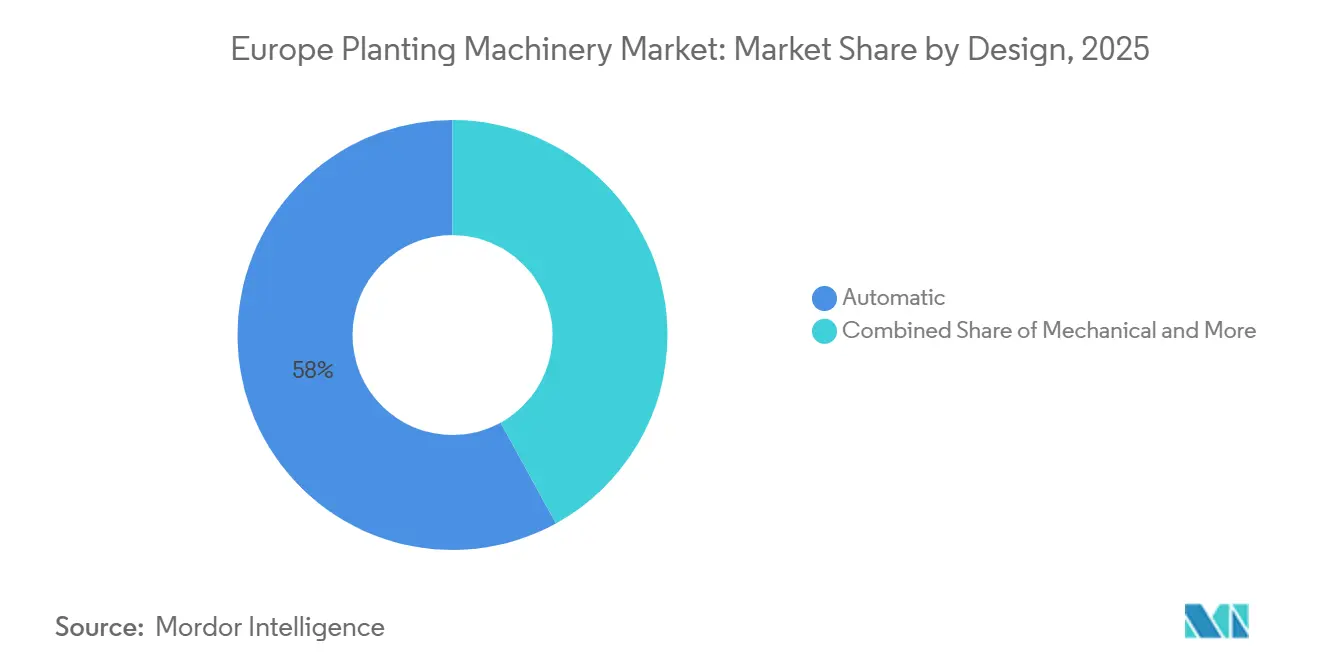
- By design, automatic was the largest segment and held 58.0% of the Europe planting machinery market share in 2025, while it is also the fastest-growing segment and is anticipated to expand at a 7.0% CAGR between 2026 and 2031.
- By operation, mounted equipment was the largest segment and held 48.0% of the Europe planting machinery market size in 2025, while it is also the fastest-growing segment and is anticipated to expand at a 6.0% CAGR between 2026 and 2031.
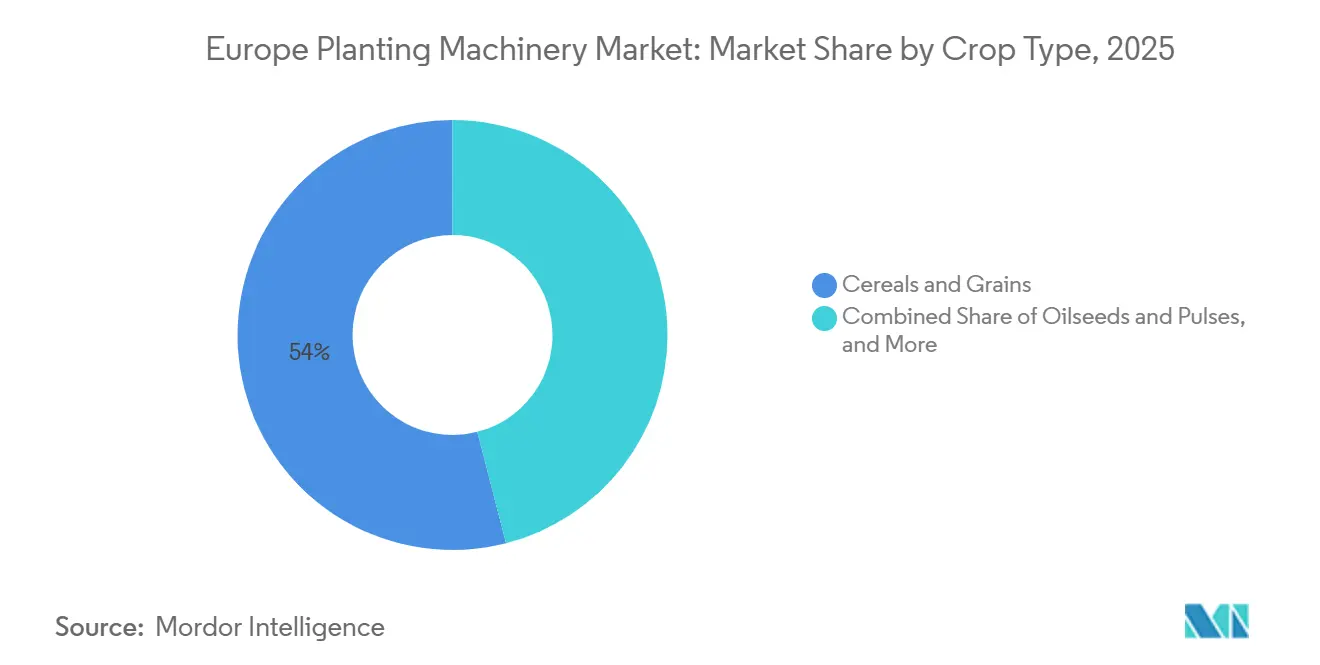
- By crop type, cereals and grains were the largest segment and held 54.0% of the market share in 2025, while fruits and vegetables were the fastest-growing segment and are anticipated to expand at a 7.0% CAGR between 2026 and 2031.
- By geography, Germany was the largest country with 22.2% revenue share in 2025, while the Netherlands is forecast to grow at a CAGR of 8.0% between 2026 and 2031.
Note: Market size and forecast figures in this report are generated using Mordor Intelligence’s proprietary estimation framework, updated with the latest available data and insights as of January 2026.
Market Trends and Insights
Drivers Impact Analysis of Europe Planting Machinery Market*
| Driver | (~) % Impact on CAGR Forecast | Geographic Relevance | Impact Timeline |
|---|---|---|---|
| European Union CAP strategic plans and national machinery grants | +0.7% | Germany, Poland, France, Italy | Medium term (2-4 years) |
| European farm-labor shortages and rising agricultural wages | +0.6% | Europe, with greater relevance in Western and Northern Europe | Short term (≤ 2 years) |
| Climate volatility and compressed European planting windows | +0.4% | United Kingdom, France, Germany, Netherlands | Short term (≤ 2 years) |
| Precision seeding for EU input-reduction and sustainability targets | +0.8% | European Union (EU) core, with relevance in the United Kingdom | Long term (≥ 4 years) |
| Replacement demand from aging European machinery fleets | +0.5% | Germany, France, Italy, Spain | Short term (≤ 2 years) |
| Interoperable planting systems for fragmented European farms | +0.3% | Central and Eastern Europe, including Poland, Denmark, and Austria | Long term (≥ 4 years) |
| Source: Mordor Intelligence | |||
European Union CAP Strategic Plans and national machinery grants
The Common Agricultural Policy (CAP) Strategic Plans for 2023–2027 support farm modernization through investment measures covering precision farming equipment and digital technologies. According to European Commission data in 2023, investment support under the approved CAP Strategic Plans was targeted to benefit close to 400,000 farms for modernization of infrastructure and practices[1]. These measures strengthen the investment case for planting machinery with precision-control, data-capture, and input-management capabilities. As each European Union Member State implements its own CAP Strategic Plan according to national and regional priorities, the availability and design of machinery-support programs vary across Europe. This creates opportunities for planting-machinery manufacturers and dealers to align equipment specifications, financing options, and technical support with locally funded investment programs, supporting demand for modern planting machinery.
European Farm-Labor Shortages and Rising Agricultural Wages
A declining agricultural workforce is increasing the importance of mechanization and labor-saving technologies across European farms. According to Eurostat data published in 2026, agricultural employment in the European Union fell from 5.2% of total employment in 2013 to 3.9% in 2023, with 8.4 million people employed in agriculture. This reduction in available farm labor encourages growers to use planting machinery that can cover larger areas with fewer operators and reduce repetitive manual adjustments. Demand is therefore shifting toward equipment with automated seed metering, coulter-pressure adjustment, guidance, and in-cab controls that improve operating efficiency. As labor availability becomes more constrained, reliable and easy-to-operate planting equipment can help farms maintain planting capacity while reducing dependence on manual intervention, supporting demand for advanced planting machinery across Europe.
Climate Volatility and Compressed European Planting Windows
Increasing climate variability is creating greater uncertainty around field operations and planting schedules across Europe, with drought, heavy rainfall, frost, and other extreme events affecting agricultural production. According to European Environment Agency data published in 2026, drought accounted for 54%, heavy rain for 21%, frost for 16%, and hail for 9% of agricultural losses in the European Union, together representing 80% of reported agricultural losses[2]. These conditions can shorten workable planting windows and increase the value of machinery that can complete field operations quickly and maintain consistent seed placement under variable conditions. This supports demand for high-capacity planting systems with automated adjustments, precision controls, and reliable operation. As weather-related disruptions increase the cost of delays, farms and contractors may place greater emphasis on field performance, equipment reliability, and parts availability when purchasing planting machinery.
Replacement Demand from Aging European Machinery Fleets
Replacement demand is supporting opportunities for planting-machinery manufacturers as European farms continue to renew agricultural equipment and adopt more advanced technologies. According to the European Agricultural Machinery Industry Association (CEMA) data published in 2025, 144,400 agricultural tractors were registered across Europe in 2024, representing an 8.1% decline from 2023 and the lowest registration level since at least 2014[3]. The subdued replacement cycle indicates cautious farm-equipment investment, while necessary fleet renewal creates opportunities for growers to upgrade to machinery with precision seed metering, automated adjustments, guidance, and data connectivity. Manufacturers offering modular equipment, financing options, and dealer support can therefore address replacement needs while encouraging the adoption of more technologically advanced planting systems.
Restraints Impact Analysis of Europe Planting Machinery Market*
| Restraint | (~) % Impact on CAGR Forecast | Geographic Relevance | Impact Timeline |
|---|---|---|---|
| High equipment prices and elevated European farm financing costs | -0.9% | Europe, concentrated in Western and Southern Europe | Short term (≤ 2 years) |
| Small and fragmented holdings limiting annual machine utilization | -0.7% | Central and Eastern Europe, Mediterranean countries | Long term (≥ 4 years) |
| Shortage of trained technicians for connected planting equipment | -0.5% | Europe, with greater pressure in Northern and Eastern Europe | Medium term (2-4 years) |
| Cross-brand data and implement compatibility gaps across European fleets | -0.4% | European Union (EU), particularly mixed-fleet farms in Central Europe | Medium term (2-4 years) |
| Source: Mordor Intelligence | |||
High Equipment Prices and Elevated European Farm Financing Costs
High equipment prices and financing costs can constrain investment in advanced planting machinery, particularly for farms operating with limited cash flow or uncertain profitability. Precision-capable planting systems typically require greater upfront investment than conventional equipment, while higher borrowing costs can further increase the total cost of equipment ownership. These conditions can encourage farmers to postpone machinery replacement, choose lower-specification configurations, or continue using existing equipment for longer. The Europe planting machinery market therefore faces greater pressure when equipment costs and financing constraints coincide with weaker farm profitability. Leasing, seasonal payment structures, and flexible equipment financing can help reduce the initial capital burden, while manufacturers and dealers offering financing support can improve access to advanced planting technologies.
Limited Technical Service Capacity for Connected Planting Equipment
The increasing integration of electronic controls, ISOBUS connectivity, telematics, sensors, and automated functions into planting machinery is raising the technical requirements for equipment servicing. Compared with conventional mechanical seed drills, connected planting systems require technicians to diagnose both mechanical components and electronic or software-related issues. The European Agricultural Machinery Industry Association (CEMA) and the International Confederation of National Associations of Dealers and Repairers of Agricultural and Gardening Machinery (CLIMMAR) continue to emphasize dealer and service capabilities as part of the agricultural machinery distribution and support network. CLIMMAR's 2025 Congress brought together dealer and repairer associations from 17 countries, highlighting the importance of the dealer network in supporting increasingly sophisticated agricultural machinery. Farms may therefore face higher service requirements when adopting connected planting equipment, particularly where specialized technical support is limited. Remote diagnostics, software updates, technician training, and broader regional service coverage can help manufacturers and dealers reduce this barrier and support adoption of advanced planting systems.
*Our forecasts treat driver/restraint impacts as directional, not additive. The impact forecasts reflect baseline growth, mix effects, and variable interactions.
Europe Planting Machinery Market Segment Analysis
By Design:
Automatic Systems Consolidate Market LeadershipAutomatic systems held 58.0% of the Europe planting machinery market by design in 2025, making them the largest design segment, and are forecast to expand at a 7.0% CAGR between 2026 and 2031. Their leading position reflects increasing demand for electronic seed metering, section control, and connected operation, particularly on larger arable farms seeking greater planting accuracy and reduced manual adjustments. Automatic configurations also align with the broader adoption of precision-farming technologies across Europe. In November 2025, LEMKEN GmbH & Co. KG introduced the Faya MF precision seed drill, featuring ISOBUS iQblue operation, individual row hoppers, and automatic section control, demonstrating the continued integration of automated functions into planting equipment. As European farms increasingly adopt precision-oriented planting practices, demand for automated systems is anticipated to support growth in the segment.
Semi-Automatic systems provide an intermediate option for farms seeking selected electronic functions without the full automation of higher-specification equipment. These systems can support features such as electronic monitoring and control while retaining greater reliance on operator intervention. Mechanical Systems remain relevant where equipment affordability, operational simplicity, and established servicing capabilities are important purchasing considerations. The availability of automatic, semi-automatic, and mechanical configurations allows manufacturers to address differences in farm size, investment capacity, technical requirements, and local service availability across European markets. This broad range of equipment configurations is anticipated to maintain demand across the design segment, even as adoption of automated planting technologies increases.

By Operation:
Mounted Equipment Leads, High-Capacity Formats AccelerateMounted equipment held 48.0% of the Europe planting machinery market by operation in 2025, making it the largest operation segment, and is forecast to expand at a 6.0% CAGR between 2026 and 2031. Their leading position reflects the suitability of tractor-mounted configurations for farms requiring relatively compact, maneuverable equipment and lower operational complexity. Mounted planters and drills can be transported easily between fields and are well suited to operations where field access, headland space, and equipment flexibility are important considerations. Their compatibility with modern tractors also allows farmers to combine planting equipment with existing farm machinery, supporting adoption across a broad range of European farming operations.
Trailed equipment remains important for larger arable farms and contractors that prioritize wider working widths, greater seed capacity, and higher field productivity. These systems are particularly suited to large-scale cereal and grain production where completing planting within limited weather windows is important. Self-propelled equipment serves more specialized applications, including vegetable and specialty-crop production where independent steering and greater maneuverability can be beneficial. Walk-behind and ride-on equipment primarily serves smaller-scale horticulture, market gardens, and specialized operations. Equipment selection across Europe therefore varies according to field size, crop type, tractor power, labor availability, transport requirements, and investment capacity, maintaining demand for multiple planting-machinery configurations.
By Crop Type:
Cereals Anchor Volume, Fruits and Vegetables Set the PaceCereals and grains held 54.0% of the Europe planting machinery market by crop type in 2025, making them the largest crop segment. Their leading position reflects the extensive area devoted to cereal and grain production across Europe and the recurring requirement for seed drills and planting equipment. Large-scale cereal production also supports demand for equipment that can deliver consistent seed placement across extensive fields while improving operational efficiency. Precision planting is gaining relevance in crops such as maize, where single-grain planters can provide greater control over seed spacing and placement. At Agritechnica 2025, HORSCH presented the Maestro 12 TX, featuring adjustable row spacing from 45 cm to 75 cm and AirSpeed pneumatic seed delivery, illustrating the continued development of precision planting equipment for row crops. As cereal and grain production remains a major source of planting-machinery demand, the segment is anticipated to provide a stable volume base for the Europe planting machinery market.
Fruits and vegetables are forecast to expand at a 7.0% CAGR between 2026 and 2031, making them the fastest-growing crop segment. Their growth is supported by the greater need for specialized planting equipment in labor-intensive horticultural production, where accurate seed placement, row spacing, and planting depth can influence crop establishment and production efficiency. Higher-value crops can also support investment in specialized mechanization where the productivity benefits justify equipment costs. Oilseeds and pulses represent another important application, supported by their cultivation across European arable regions, while cotton, sugarcane, and other crops remain more geographically concentrated and require equipment adapted to specific row spacing, seed-metering, planting-depth, and implement-width requirements. The diversity of crop-production systems across Europe therefore supports demand for planting machinery with adaptable configurations and specialized operating capabilities.
Geography Analysis
Germany Planting Machinery Market
Germany held the largest share of the Europe planting machinery market at 22.2% in 2025, supported by its highly mechanized agricultural sector, established machinery manufacturing base, and investment in modern farm equipment. Germany's agricultural support framework continues to provide investment opportunities for machinery that improves resource efficiency and reduces environmental impacts. The country's Joint Task for the Improvement of Agricultural Structures and Coastal Protection (GAK) framework for 2025–2028 provides the basis for agricultural investment support, with implementation and specific measures determined at the state level. Germany's established dealer, demonstration, and technical-service network further supports adoption of advanced planting equipment, including systems incorporating precision metering, electronic controls, and automated adjustments.
Western and Central Europe Planting Machinery Market
The Netherlands is forecast to be the fastest-growing geography, expanding at an 8.0% CAGR between 2026 and 2031. Its intensive horticulture and high-value crop production support demand for specialized seeding, transplanting, and precision planting equipment, particularly where accurate placement and efficient use of inputs are important. France is also an important market for advanced agricultural equipment, with France 2030 supporting the development and deployment of digital technologies, robotics, and new generations of agricultural equipment. In 2025, the French Ministry of Agriculture announced new France 2030 programs supporting innovative agricultural technologies, including digitally enabled machinery and equipment. Poland benefits from CAP-based investment support and an expanding farm-modernization base. Its 2025 agricultural investment programs included support for competitiveness-enhancing investments under the 2023–2027 CAP Strategic Plan. The United Kingdom also supports investment in planting technology: its 2025 Farming Equipment and Technology Fund included direct drills with precision metering for cereals, pulses, oilseeds, and cover crops.
Broader European Markets
Italy remains an important market for agricultural mechanization, supported by the National Recovery and Resilience Plan (PNRR), which includes measures for agricultural machinery modernization and innovation. Spain benefits from its large arable and horticultural production base, while Denmark and Austria provide opportunities for precision-oriented machinery in highly mechanized and specialized agricultural systems. Russia and other Eastern European markets present a more varied operating environment because machinery demand is influenced by farm investment capacity, equipment availability, and market conditions. Across the remainder of Europe, differences in farm size, crop mix, mechanization levels, investment support, and dealer coverage create varied requirements for planting equipment. Suppliers therefore need country-specific product configurations, financing approaches, and service networks to address differences in agricultural structures and technology-adoption levels.
Competitive Landscape
The Europe planting machinery market is fragmented, with competition distributed across diversified agricultural machinery manufacturers, precision planting specialists, seed-drill manufacturers, and regional farm-equipment companies. Key players include Deere & Company, CNH Industrial N.V., AGCO Corporation, KUHN SAS (Bucher Industries AG), and Kubota Corporation, while European specialists such as AMAZONEN-WERKE H. DREYER, HORSCH Maschinen GmbH, LEMKEN GmbH & Co. KG, Väderstad, MASCHIO GASPARDO, and PÖTTINGER compete through specialized planting portfolios and regional market presence. Competitive positioning is supported by precision-seeding technologies, crop-specific equipment configurations, electronic controls, dealer and distribution networks, financing, spare-parts availability, and after-sales service. Manufacturers serve a wide range of farm sizes and production systems, with high-capacity seed drills and precision planters particularly relevant to large arable farms, while specialized equipment serves row crops, horticulture, and smaller farming operations.
HORSCH Maschinen GmbH reported EUR 1.08 billion (USD 1.27 billion) in group turnover in 2025, maintaining annual turnover above EUR 1 billion (USD 1.18 billion) for the third consecutive year and continuing investments in research and development, production, and sales infrastructure. Väderstad introduced a next-generation row unit for its Tempo and Proceed planters in September 2025, incorporating developments in planting precision and machine control. LEMKEN GmbH & Co. KG introduced the Faya MF precision seed drill in November 2025, with a modular frame and adjustable row configurations designed for high-capacity precision seeding, series production is planned for 2027. These developments demonstrate continued competition around planting accuracy, machine flexibility, capacity, and electronic control technologies.
Other players differentiate through specialized crop equipment, precision technologies, compact machinery, and localized dealer and service networks. AMAZONEN-WERKE H. DREYER continues to expand its agricultural machinery and digital-technology portfolio, while KUHN, Kverneland, PÖTTINGER, and MASCHIO GASPARDO offer planting and seeding equipment adapted to different European crop and farm systems. Companies increasingly compete through integrated precision functions, electronic machine control, digital connectivity, financing, technical support, and spare-parts availability. As European farms adopt more automated and data-enabled planting systems, competitive differentiation is increasingly centered on planting accuracy, operating capacity, equipment flexibility, compatibility with precision-farming technologies, and the strength of regional dealer and after-sales networks.
Europe Planting Machinery Industry Leaders
-
Deere & Company
-
Kubota Corporation
-
CNH Industrial N.V.
-
AGCO Corporation
-
KUHN SAS (Bucher Industries AG)
- *Disclaimer: Major Players sorted in no particular order
Europe Planting Machinery Market Companies Covered in this Report
- Deere & Company
- AGCO Corporation
- KUHN S.A. (Bucher Industries AG)
- Kverneland AS (Kubota Corporation)
- YANMAR HOLDINGS CO., LTD.
- Kubota Corporation
- Mahindra & Mahindra Limited
- CNH Industrial N.V.
- ISEKI & CO., LTD.
- DAEDONG CORPORATION
- YTO Group Corporation (China National Machinery Industry Corporation)
- Zoomlion Heavy Industry Science & Technology Co., Ltd.
- MASCHIO GASPARDO S.p.A.
- AMAZONEN-WERKE H. DREYER SE & Co. KG
- HORSCH Maschinen GmbH
Recent Industry Developments in Europe Planting Machinery Market
- June 2026: LEMKEN GmbH & Co. KG introduced the Saphir XMR as a new generation of mechanical seed-drill technology. The launch is relevant to the European planting machinery market, as it represents an expansion of LEMKEN's seed-drill portfolio and demonstrates continued development of conventional mechanical seeding systems alongside precision equipment.
- January 2026: Precision Planting launched ArrowTube, a seed-delivery system designed to improve seed spacing at high planting speeds and orient corn seeds tip-down to support more uniform emergence. The product was unveiled at the 2026 PTx Winter Conference.
- November 2025: LEMKEN GmbH & Co. KG introduced the Faya MF precision seed drill. The machine is available in 8-, 9-, and 12-row configurations, with a modular frame supporting 45–80 cm row spacing. Its overpressure singulation system supports precision seeding at speeds of up to 16 km/h, while series production is planned for 2027.
- September 2025: Väderstad announced the redesigned row unit. The system includes prescription-map-based planting-depth adjustment, updated electronics, redesigned seed meters, and cab-controlled planting-depth and closing-wheel-pressure adjustments.
Europe Planting Machinery Market Report Scope
Planting machinery encompasses equipment designed for seed planting and soil preparation for crop cultivation. This includes seed drills, row-crop planters, and sowing machines.
The Europe Planting Machinery Market Report is Segmented by Design (Mechanical, Automatic, and Semi-Automatic), by Operation (Mounted equipment, Trailed equipment, Self-Propelled equipment, Walk-Behind equipment, Ride-On equipment), by Crop Type (Cereals and Grains, Oilseeds and Pulses, Fruits and Vegetables, Cotton, Sugarcane, and Other Crop Types), and by Geography (United Kingdom, France, Germany, and More). The Market Forecasts are Provided in Terms of Value (USD).
Segmentation Overview
By Design
| Mechanical |
| Automatic |
| Semi-Automatic |
By Operation
| Mounted equipment |
| Trailed equipment |
| Self-Propelled equipment |
| Walk-Behind equipment |
| Ride-On equipment |
By Crop Type
| Cereals and Grains | Rice |
| Wheat | |
| Maize | |
| Other Cereals and Grains | |
| Oilseeds and Pulses | Soybean |
| Groundnut | |
| Pulses | |
| Fruits and Vegetables | Vegetables |
| Fruit Crops | |
| Cotton | |
| Sugarcane | |
| Other Crop Types |
By Geography
| Germany |
| United Kingdom |
| France |
| Italy |
| Spain |
| Netherlands |
| Poland |
| Russia |
| Rest of Europe |
| By Design | Mechanical | |
| Automatic | ||
| Semi-Automatic | ||
| By Operation | Mounted equipment | |
| Trailed equipment | ||
| Self-Propelled equipment | ||
| Walk-Behind equipment | ||
| Ride-On equipment | ||
| By Crop Type | Cereals and Grains | Rice |
| Wheat | ||
| Maize | ||
| Other Cereals and Grains | ||
| Oilseeds and Pulses | Soybean | |
| Groundnut | ||
| Pulses | ||
| Fruits and Vegetables | Vegetables | |
| Fruit Crops | ||
| Cotton | ||
| Sugarcane | ||
| Other Crop Types | ||
| By Geography | Germany | |
| United Kingdom | ||
| France | ||
| Italy | ||
| Spain | ||
| Netherlands | ||
| Poland | ||
| Russia | ||
| Rest of Europe | ||
Key Questions Answered in the Report
What is the Europe planting machinery market size?
The Europe planting machinery market is forecast to grow from USD 1.42 billion in 2026 to USD 1.71 billion by 2031, at a 3.79% CAGR.
Which country leads planting machinery demand in Europe?
Germany leads with a 22.2% market share in 2025, supported by high mechanization and investment support.
Which crop type is growing fastest?
Fruits and vegetables are forecast to grow at a 7.0% CAGR from 2026 to 2031, driven by demand for mechanized horticultural planting.
What limits adoption of precision planting systems?
High equipment prices, financing costs, fragmented holdings, technician shortages, and compatibility gaps can delay adoption.