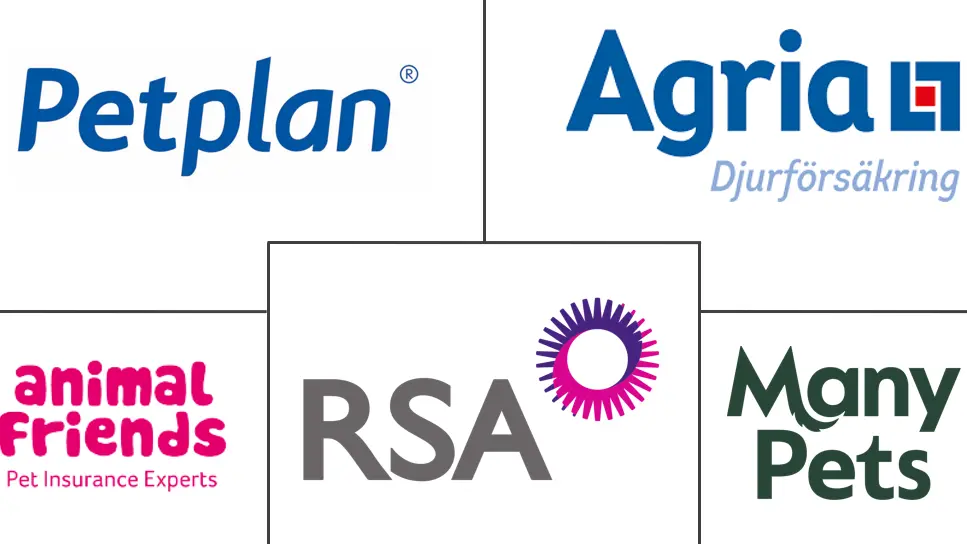
Top 5 Europe Pet Insurance Companies


Agria Djurförsäkring
Petplan
RSA Group
ManyPets
Animal Friends Insurance
Source: Mordor Intelligence
Europe Pet Insurance Companies Matrix by Mordor Intelligence
Our comprehensive proprietary performance metrics of key Europe Pet Insurance players beyond traditional revenue and ranking measures
The MI Matrix can diverge from simple revenue ranking because it weighs observable delivery strength alongside buyer recognition and footprint. Some firms score higher when they show strong claims automation, consistent servicing, or fast product iteration, even if their pet books are still smaller. Others rank lower when they depend on third party underwriting, face restructuring, or have limited reach beyond one country. Capability indicators that tend to move scores include multi country distribution, clinic integration for direct pay, digital claims throughput, and evidence of sustained profitability in pet lines. Many buyers also want to know which providers handle older pets fairly and which ones minimize claim friction through portals and direct vet payment. They also compare how clearly exclusions are explained and how predictable renewals feel. This MI Matrix by Mordor Intelligence is more useful for supplier and competitor evaluation than revenue tables alone because it reflects execution signals that affect real customer outcomes.
MI Competitive Matrix for Europe Pet Insurance
The MI Matrix benchmarks top Europe Pet Insurance Companies on dual axes of Impact and Execution Scale.
Analysis of Europe Pet Insurance Companies and Quadrants in the MI Competitive Matrix
Comprehensive positioning breakdown
Agria Djurfrskring
Premium income rose in 2024, supported by stronger growth outside Sweden. Agria is a top manufacturer in pet coverage and pairs underwriting with veterinary guidance tools that can steer owners toward the right care pathway. Regulatory focus on animal welfare and traceability can lift adoption, yet it may also raise service load and fraud pressure. Agria's what if scenario is faster growth in the UK and Ireland, where brand building takes real spend discipline. The main risk is veterinary fee inflation outpacing pricing, which can weaken renewal value in price sensitive households.
Petplan (Allianz)
Claims speed and renewal stickiness appear central to Petplan's operating model in the UK. The company, a leading service provider, combines long standing vet relationships with self service account features that reduce contact center strain. Consumer protection rules around pricing transparency can favor providers that keep policy language clear and stable across renewals. Petplan's upside case is continued conversion from first time buyers who want lifetime coverage and fewer penalties after claims. Reputation harm is a key downside if claims expectations and exclusions are not explained consistently at point of sale.
ManyPets (Bought By Many)
Profitability returned for the year ending 31 March 2025 after a period of restructuring. This specialist insurer differentiates through automation in claims and policy servicing, which can shorten cycle times when volumes spike. Stronger controls can also support regulators' growing interest in fair handling and fraud management for digital claims. ManyPets's upside scenario is using its platform to expand partner distribution without adding large fixed costs. The operational risk is that aggressive pricing changes can drive churn if households perceive sudden premium jumps, even when loss costs rise.
Animal Friends Insurance
Defaqto recognition in October 2024 signals strong customer perception and product fit. Animal Friends, one of the biggest names in UK pet cover, links brand equity with an animal welfare mission that supports trust at renewal. The compliance angle is clear disclosure on limits and exclusions, especially for older pets and higher risk breeds. One realistic what if is that tighter household budgets push customers toward lower limits, raising complaints after big claims. The main weakness is limited multi country scale, which can restrict learning effects in pricing and provider contracting compared with pan European groups.
AXA SA
In Spain AXA actively promotes both veterinary assistance cover and dog liability cover for pet owners. AXA, a leading company in European insurance, also pursued broader distribution through an agreement with Correos that includes pet policies among initial products. Compliance exposure rises when sales occur through large networks, since scripts and disclosures must stay consistent across thousands of touchpoints. The upside scenario is faster reach into secondary cities where agent density is lower. Key risk is uneven claims experience if underwriting rules differ by channel and training quality varies across partners.
Zurich Insurance Group
In Germany Zurich's pet offerings show the company's ability to bundle liability, surgery cover, and broader health options. Zurich, a major supplier, can use scale in claims analytics and fraud controls to keep service reliable during inflationary periods. Regulation around fair disclosures is increasingly important for products that mix prevention benefits with accident and illness coverage. The upside case is stronger cross sell to existing personal lines customers who already trust Zurich with core household needs. The critical risk is that complex option sets can confuse buyers, raising cancellations and complaints after denied claims unless guided carefully.


Frequently Asked Questions
Which provider capabilities most reduce claim frustration for pet owners in Europe?
Look for direct to vet payment options, fast digital claim submission, and clear document checklists. Also confirm how pre existing conditions are treated at renewal and after switching.
What is the most important question to ask about lifetime policies?
Ask whether the annual limit resets and whether the same condition remains covered after you claim. Also ask how deductibles and co insurance change as the pet ages.
How should buyers evaluate bank branded pet policies versus specialist insurers?
Verify who underwrites and administers the policy, then confirm where claims are submitted. If the underwriter changes, ask what stays the same for renewals and ongoing claims.
What is a practical way to compare pet liability cover across countries?
Start with legal requirements for dog liability where applicable, then compare limits and who is covered when someone else handles the pet. Confirm whether cover applies outside the home country when traveling.
How can insurers and buyers reduce exposure to digital claims fraud?
Insurers should tighten invoice validation and use structured medical record requests for high value claims. Buyers can reduce delays by submitting itemized invoices and clinical notes quickly and consistently.
What Europe regulatory trend could affect pet policy adoption over the next few years?
Traceability and microchipping related rules can increase verified pet identity data, which supports underwriting accuracy. Over time, better data can also improve fraud controls and pricing fairness.


Methodology
Research approach and analytical framework
Data sourcing used public annual reports, regulatory statements, company press rooms, and named journalist coverage. Private firm scoring relied on observable footprints such as launches, underwriter transitions, and service tooling. Indicators were triangulated when numbers were not disclosed, prioritizing consistent signals across sources. Scoring reflects Europe pet insurance activity only.
Country coverage and channel access determine how easily pet owners can buy and renew policies.
Trust matters because coverage is intangible until a claim, and word of mouth drives switching.
Larger pet books signal pricing data depth and negotiating leverage with partners and service vendors.
Claims staffing, vet networks, and policy administration platforms drive speed, accuracy, and complaint rates.
New digital claims, vet tele support, and direct to vet payment reduce friction and help control loss costs.
Profitable pet lines can sustain stable pricing and service investment through veterinary fee inflation cycles.