
Market Overview
| Study Period | 2020 - 2031 |
|---|---|
| Forecast Data Period | 2026 - 2031 |
| Historical Data Period | 2020 - 2024 |
| Base Year Market Size (2025) | USD 2.29 Billion |
| Market Size (2026) | USD 2.36 Billion |
| Market Size (2031) | USD 2.77 Billion |
| Growth Rate (2026 - 2031) | 3.24 % |
Major Players *Disclaimer: Major Players sorted in no particular order Image © Mordor Intelligence. Reuse requires attribution under CC BY 4.0. | |
Europe Nuclear Imaging Market Analysis by Mordor Intelligence
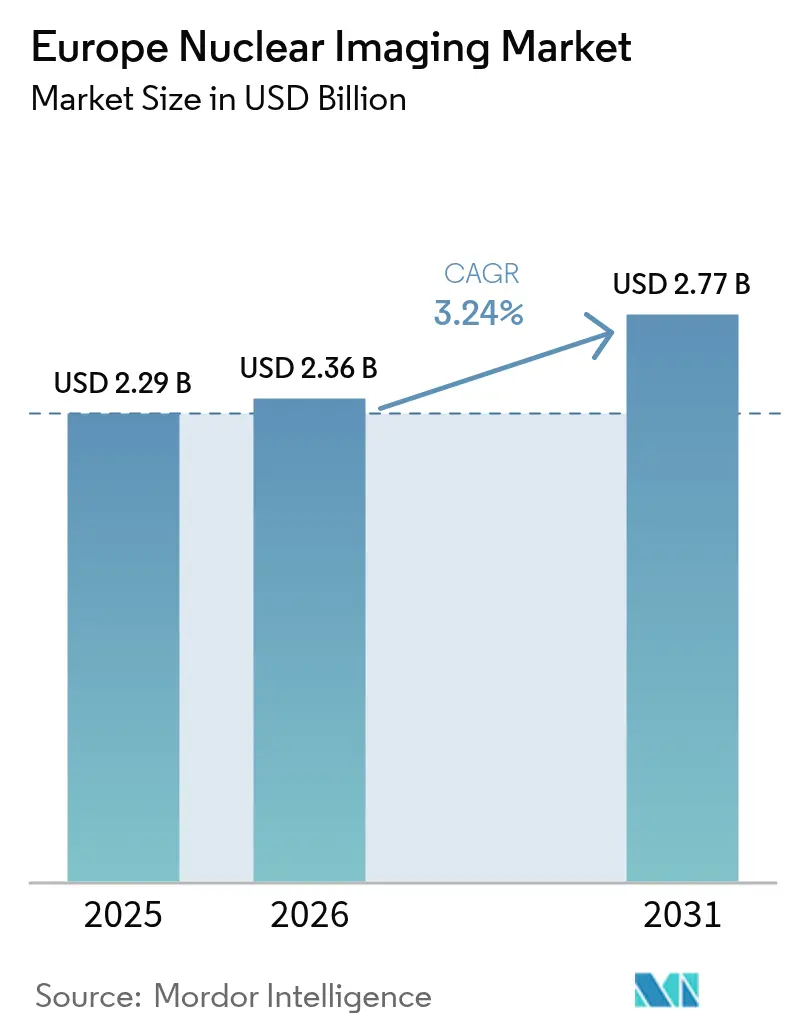
The Europe Nuclear Imaging Market size was valued at USD 2.29 billion in 2025 and estimated to grow from USD 2.36 billion in 2026 to reach USD 2.77 billion by 2031, at a CAGR of 3.24% during the forecast period (2026-2031).
The COVID-19 pandemic has impacted market growth. For instance, as per an article published in seminars in Nuclear Medicine in January 2022, it has been observed that some departments encountered delays in the delivery of radiopharmaceuticals or technical support in Europe during the pandemic. In addition, the pandemic resulted in a significant reduction of diagnostic and therapeutic nuclear medicine procedures as well as a reduced level of care for patients affected by diseases other than COVID-19, such as cancer or acute cardiovascular disease. However, a study published in PLOS One in August 2022 stated that the practice and supply of nuclear medicine and radioactive isotopes have recovered, and the practice of nuclear medicine has increased by 30% in 2021. Thus, the studied market is expected to witness stable growth during the forecast period.
Factors such as the rising prevalence of cancer and cardiac disorders, the increase in technological advancements, and the growing applications of nuclear medicine and imaging are expected to boost the market growth over the forecast period.
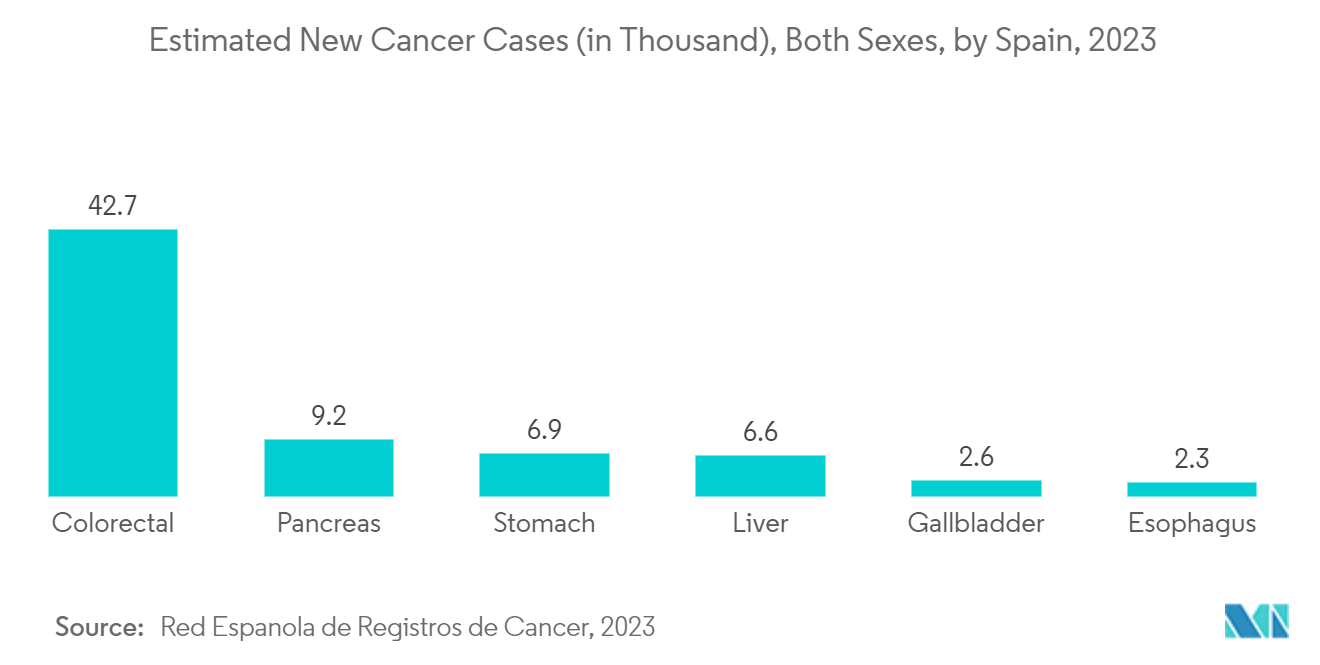
The growing burden of chronic diseases such as cancer, neurological disorders, and cardiac disorders among the population in Europe increases the demand for nuclear medicine and imaging applications that help in identifying the molecular activity within the body. This is anticipated to fuel market growth. For instance, according to the 2023 statistics data published by the Spanish Network of Cancer Registries, about 279,260 new cancer cases are expected to be diagnosed in Spain in 2023, including 42,721 new colorectal cancer cases, 9,280 pancreatic cancer, 6,932 stomach cancer, and 6,695 liver cases.
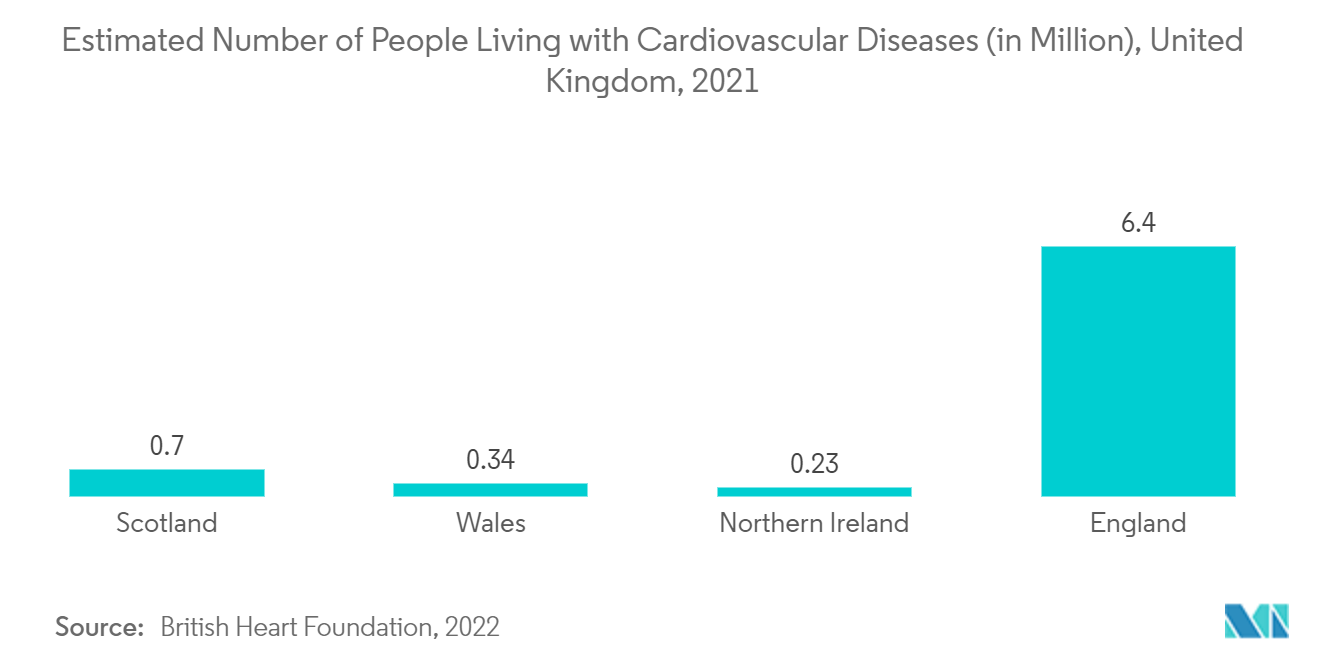
Additionally, as per the data published by the British Heart Foundation, in July 2021, about 6.4 million people in England and 700,000 people in Scotland were living with cardiovascular diseases in 2021. Thus, the growing prevalence of cancer and heart disease among the population is anticipated to increase demand for early and effective diagnosis, thereby boosting the growth of the nuclear imaging market over the forecast period.
The technological advancements in the field of imaging have always been challenging to practitioners in terms of how best to optimize them in patient care. Over the past few years, scientists, researchers, and technologists have been able to bring systems into clinical practice in which two or even more standalone diagnostic imaging modalities are combined. Some of those multimodality imaging systems include PET/CT, SPECT/CT, PET/MRI, and PET/SPECT/CT. For instance, in October 2021, PRISMAP, a new medical radionuclide program, was launched to streamline access to medical research in the European Union and the United Kingdom. PRISMAP serves a consortium of 23 institutions from 13 countries, providing access to intense neutron sources, isotope mass separation facilities, and high-power accelerators and cyclotrons to the biomedical and healthcare research institutions putting those radioisotopes into use in medical diagnosis and treatment.
Furthermore, the growing company's focus on adopting various key strategies such as mergers, acquisitions, collaborations, partnerships, and product launches is also contributing to the market growth in the country. For instance, in April 2021, the Oncidium Foundation, Belgium, a non-profit organization, in partnership with Telix Pharmaceuticals Limited, launched the NOBLE Registry, an international clinical collaboration for the development of 99mTc-iPSMA SPECT imaging for prostate cancer. The NOBLE demonstrates that PSMA single-photon emission computed tomography (PSMA SPECT) diagnostic imaging technology is a cost-effective and viable alternative.
Therefore, owing to factors such as the high burden of cancer and cardiac disorders, growing technologically advanced products, and increasing company activities, the studied market is anticipated to grow over the forecast period. However, regulatory issues and lack of reimbursement are likely to hinder the growth of the nuclear imaging market in Europe over the forecast period.
Note: Market size and forecast figures in this report are generated using Mordor Intelligence’s proprietary estimation framework, updated with the latest available data and insights as of 2026.
Europe Nuclear Imaging Market Trends and Insights
Equipment Segment Expects to Witness Significant Growth Over the Forecast Period
The equipment segment is used in the diagnosis of diseases by using small amounts of radioactive substances in patients and is used in a wide range of medical applications, including cardiology, cancer, obstetrics/gynecology, vascular, urology, and other medical applications.
The factors attributing to the segment growth are the increasing burden of chronic diseases such as cancer and others, as well as the growing technological advancements. For instance, according to the statistics published by the REDECAN Spanish Network of Cancer Registries 2021 report, about 276,239 incidence cancer cases were reported in Spain in 2021. In addition, as per the same source, colon and rectum cancer were the most common cancers reported in Spain, which accounted for 43,581 cases in 2021 as compared to 40,441 cases in 2020. Thus, the increasing number of cancer cases raises the need to diagnose and treat cancer, which in turn is anticipated to fuel the demand for advanced nuclear imaging equipment, hence bolstering the market growth.
Furthermore, the growing key strategies by the companies, such as collaboration, partnerships, and others, as well as increasing product launches, increase the availability of advanced nuclear imaging equipment in the region, hence contributing to the segment's growth. For instance, in June 2022, Siemens Healthineers, Germany, launched Symbia Pro. Spectra is a single photon emission computed tomography/computed tomography (SPECT/CT) system having advanced SPECT and CT imaging technologies. The system offers enhanced SPECT and CT imaging functionalities, including 64-slice CT and automated SPECT motion correction management, as well as automated workflow.
Also, in May 2022, Turku PET Centre launched the total-body PET scanner, a new generation of medical imaging devices that offers novel methods for studying diseases, such as diabetes, coronary artery disease, and multiple sclerosis, that affect the entire body, not only a single organ.
Therefore, owing to the aforementioned factors, such as the high burden of cancer and new product launches, the studied segment is anticipated to grow over the forecast period.
United Kingdom is Expected to Have the Significant Market Share Over the Forecast Period
The United Kingdom is anticipated to hold significant growth in the nuclear imaging market in Europe over the forecast period owing to the factors such as the high burden of cancer and cardiac disorders, increasing application of nuclear medicines, and growing company activities.
The increasing prevalence and incidence of cancer and cardiovascular diseases among the population is the key factor driving the demand for the nuclear imaging market, hence propelling the market growth. For instance, according to the data published by the British Heart Foundation, in July 2021, about 7.4 million people were living with heart and circulatory diseases in the United Kingdom in 2021. Also, as per the 2022 statistics published by Bower Cancer United Kingdom shows that bowel cancer (colorectal cancer; CRC) is the 4th most common cancer, and approximately 43,000 people are diagnosed with bowel cancer every year in the United Kingdom. The high burden of CRC and heart diseases in the United Kingdom raises the demand for nuclear imaging and medicines for treating chronic diseases, thereby contributing to market growth.
Furthermore, the increasing product approvals raise the availability of the products in the country which is expected to fuel the market growth over the forecast period. For instance, in August 2022, the United Kingdom MHRA granted marketing authorization in Great Britain for lutetium (177Lu) vipivotide tetraxetan, for the treatment of adult patients with prostate-specific membrane antigen (PSMA)-positive metastatic castration-resistant prostate cancer (mCRPC). Also, in April 2022, the United Kingdom's Medicines and Healthcare Products Regulatory Agency (MHRA) issued lutetium (177Lu) vipivotide tetraxetan, an investigational radioligand therapy (RLT), a positive scientific opinion through the Early Access to Medicines Scheme (EAMS) for the treatment of adult patients with prostate-specific membrane antigen (PSMA)-positive metastatic castration-resistant prostate cancer (mCRPC).
Moreover, the rising product launches are also anticipated to augment the market growth in the country. For instance, in March 2022, Spectrum Dynamics Medical introduced a digital SPECT/CT scanner for higher energy imaging, using Kromek's digital, VERITON-CT 400 Series, detectors technology provides the benefits of increased sensitivity and throughput for Nuclear Medicine clinical applications using up to 400keV high-energy isotopes.
Therefore, owing to the aforementioned factors, such as the high burden of cancer, increasing product approvals, and new product launches, the studied market is expected to grow over the forecast period.
Regulatory Landscape
Nuclear imaging equipment placed on the EU market is regulated primarily under the EU Medical Device Regulation (MDR) 2017/745. Active diagnostic devices for imaging are generally captured under Annex VIII classification rules (including Rule 10), which drives conformity assessment requirements, notified body involvement where applicable, and UDI obligations. Separately, the use of ionising radiation in clinical imaging is governed by the Euratom Basic Safety Standards under Directive 2013/59/Euratom, covering justification and optimization of exposures, staff training, and patient protection across European member states.
Recent implementation activity has increased compliance touchpoints for manufacturers and providers. In May 2026, mandatory use of multiple EUDAMED modules commenced following the transition linked to a European Commission decision, raising expectations around structured device registration and post-market data submission. For radiopharmaceuticals used in PET and SPECT workflows, the European Medicines Agency (EMA) has been updating quality expectations, with the public consultation for the revised guideline on the quality of radiopharmaceuticals closing on 30 April 2026. This signals continued harmonization of standards that affect manufacturing controls and release testing across the region.
Competitive Landscape
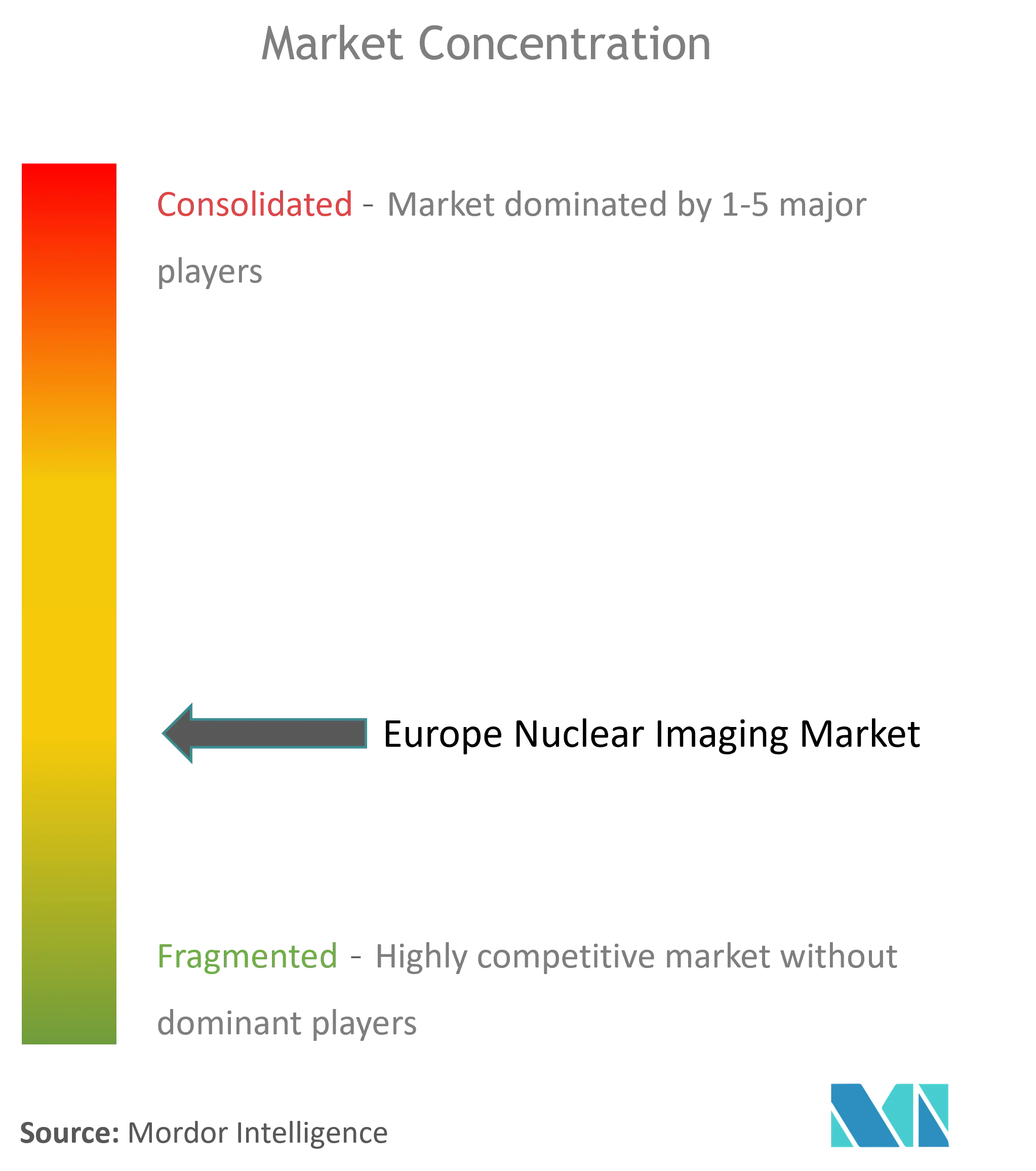
The European nuclear imaging market is fragmented owing to the presence of small and large players in the market. The strategic initiatives taken by the market players for the development of new products and research and development. Some of the key companies in the market are Bracco Imaging SpA, Cardinal Health Inc., Koninklijke Philips NV, GE Healthcare, and Siemens Healthineers, among others.
Europe Nuclear Imaging Industry Leaders
-
Bracco Imaging SpA
-
Cardinal Health Inc.
-
GE Healthcare
-
Koninklijke Philips NV
-
Siemens Healthineers
- *Disclaimer: Major Players sorted in no particular order
Market Opportunities and Future Outlook
Hardware upgrades and the move toward higher-sensitivity imaging create near-term whitespace for vendors that support quantification, throughput, and theranostics workflows. Recent installations and launches illustrate this shift: in January 2026, Hannover Medical School reported installing a total-body PET/CT system with a 150 cm field of view (noted as the first in Germany), and in May 2026 Institut Curie installed a Siemens Healthineers Biograph Trinion.X mid-field PET-CT scanner at its Saint-Cloud facility. On the SPECT side, GE HealthCare received CE Mark in November 2025 for StarGuide GX, a digital 4D SPECT/CT system positioned for imaging a range of energy levels, aligning equipment roadmaps with emerging isotope and radioligand therapy pathways.
Market access and supply-chain programs are also shaping opportunity areas beyond equipment alone. In December 2025, European Council political agreement on the revision of EU Pharmaceutical Legislation signaled continued efforts to streamline regulation for medicines, including radiopharmaceuticals, while the European Commission adopted Implementing Regulation (EU) 2025/2086 setting procedural rules for joint clinical assessments. This is relevant to evidence generation approaches for devices and associated diagnostics. Alongside policy, professional and supply resilience initiatives are becoming more visible: in May 2026, EANM launched its Policy Pulse and engaged on critical-medicines discussions for radiopharmaceutical availability, supporting investment and partnerships aimed at improving isotope access and continuity for PET and SPECT services.
Recent Industry Developments
- June 2026: ARCHIMED Life Science Tools & Services acquired Institut de Radiofarmacia Aplicada de Barcelona, S.L. (IRAB), a PET radiopharmaceuticals specialist based at the Barcelona Biomedical Research Park. The deal expands regional production capabilities and technical infrastructure, supporting tighter lead times and broader service coverage for PET tracer supply into European nuclear medicine networks.
- May 2026: SHINE Technologies received European centralized marketing authorization for Ilumira (non-carrier-added lutetium-177), enabling sales across the European Union. This authorization strengthens the availability of a key therapeutic isotope used in radioligand therapy supply chains, supporting theranostics programs that rely on consistent isotope access.
- April 2026: Bracco Imaging entered a multi-year strategic research alliance with NYU Langone Health to advance medical imaging innovation. The collaboration indicates continued supplier investment in translational research partnerships that can seed new imaging agents, protocols, and clinical evidence relevant to nuclear imaging workflows.
Research Methodology Framework and Report Scope
Market Definition and Coverage
For this study, the Europe nuclear imaging market is defined as revenues linked to nuclear medicine imaging systems and the key radiopharmaceutical inputs used to run SPECT and PET diagnostic imaging in clinical settings across Europe.
Scope exclusions: Pure nuclear therapy products and non-nuclear imaging modalities (such as MRI or CT when not part of a nuclear hybrid workflow) are not counted.
Segmentation Overview
- By Product
- Equipment
- Radioisotope
- SPECT Radioisotopes
- Technetium-99m (TC-99m)
- Thallium-201 (TI-201)
- Gallium(Ga-67)
- Other SPECT Radioisotopes
- PET Radioisotopes
- Fluorine-18 (F-18)
- Rubidium-82 (RB-82)
- Other PET Radioisotopes
- SPECT Radioisotopes
- By Application
- SPECT Applications
- Cardiology
- Neurology
- Thyroid
- Other SPECT Applications
- PET Applications
- Oncology
- Cardiology
- Neurology
- Other PET Applications
- SPECT Applications
- Geography
- Germany
- United Kingdom
- France
- Italy
- Spain
- Rest of Europe
Data Sources, Market Sizing, and Validation
Desk Research
Desk research was used to set the ground rules for what should be counted, and to collect the measurable indicators that can be checked year over year. We relied on public sources such as Eurostat health and trade statistics, OECD health data, the European Commission health and industry publications, and IAEA nuclear medicine resources, followed by country level health ministry and national statistical office releases where available.
To convert these signals into a workable market model, we also reviewed company annual reports and investor presentations, tender portals and procurement notices for imaging equipment, and peer reviewed clinical literature that tracks SPECT and PET procedure use. In addition, paid subscriptions that compile company financials and news, patent filings, and shipment level import and export records were used where they helped confirm timing, pricing direction, and adoption pace. This list is not exhaustive, and many other public sources were also used for data collection, validation, and clarification during the work.
Primary Interviews and Surveys
Primary work focused on validating what drives demand in each country and how purchasing and utilization patterns are shifting between SPECT and PET. We spoke with a mix of hospital imaging users, diagnostic center decision makers, radiopharmacy participants, and distribution and service partners across Europe so assumptions on procedure volumes, system replacement cycles, and radiotracer availability could be stress tested.
Distribution of primary research fieldwork respondents
| Company type | Respondent position |
|---|---|
| Top tier: 28% | CXOs: 16% |
| Mid tier: 51% | Functional/Unit leaders: 38% |
| Smaller Players: 21% | Managers: 46% |
Market-Sizing & Forecasting
Sizing starts with a top-down build where procedure activity and installed-base signals are reconstructed at the Europe level, and then translated into value using realistic pricing ladders for equipment and radiotracer consumption. For the cross-check, we selectively roll up a bottom-up view from sampled system shipments, service and replacement patterns, and indicative ASP bands gathered from procurement checks, and then adjust totals when the two views disagree beyond a reasonable range.
Key inputs used in the model include SPECT and PET procedure growth, hybrid system uptake, scanner replacement cycle timing, radiotracer availability constraints, and country level reimbursement direction. When the main clause is reached, the model becomes easier to defend because each variable is tied to a simple demand story that interviewees can confirm. For forecasting, we used scenario analysis supported by short-run trend smoothing, so policy shifts, isotope supply events, and hospital capital budget cycles can be reflected without overfitting. Where country level gaps exist, proxy indicators from similar health systems are applied and then challenged again through expert follow-ups.
Data Validation & Update Cycle
Validation is done through multiple checks, starting with whether country totals align with independent signals such as procedure trends, procurement pipelines, and reported imaging capacity additions. Outliers are reviewed by looking back at assumptions on pricing, replacement cycles, and radiotracer usage, and then we re-contact sources when the variance cannot be explained cleanly.
Before sign-off, the model and commentary go through an internal review so arithmetic links, unit logic, and year-to-year movement are consistent. The dataset is refreshed annually, and interim updates are triggered when material events occur (for example, reimbursement changes or supply disruptions). Right before delivery, a final analyst pass is completed to ensure the latest public releases are reflected.
Mordor Intelligence's Europe Nuclear Imaging Market Market Size Compared Against Other Published Estimates
Published market sizes for Europe nuclear imaging rarely match exactly because different studies choose different scope lines, mix equipment with consumables in different ways, and use their own base years. The spread also increases when one estimate is built from procedure demand signals and another is built mainly from supplier revenue roll ups.
The main gap comes from whether radiopharmaceutical inputs are counted alongside imaging equipment, where Mordor Intelligence includes both equipment and radioisotopes while some estimates cover equipment only or apply broader radiopharmacy revenues beyond diagnostic SPECT and PET. Timing choices also matter, since currency conversion year, inflation handling, and how replacement cycles are treated can push the starting value up or down. Some publishers also extend growth using a single headline CAGR, while others use country and modality level pacing that is later reconciled back to Europe.
Benchmark comparison
| Source | Market Size | Gaps in Research Methodology |
|---|---|---|
| Mordor Intelligence | USD 2.29 B (2025) | |
| Global Research Desk A | USD 1.70 B (2024) | Figures are for Europe nuclear imaging equipment revenue only, which typically excludes radiopharmaceutical inputs and can understate value where tracer spend is material. |
| Regional Consultancy B | USD 2.67 B (2024) | Uses a different base year and may bundle a wider definition of nuclear imaging activities, so growth and pricing assumptions are not directly traceable to SPECT and PET demand indicators country by country. |
Taken together, the estimates mainly separate on scope and on how demand is translated into dollars. Our approach stays practical by tying Europe totals to observable signals like modality mix, procedure momentum, and replacement timing, and then checking that the implied spending pattern remains realistic across countries.
Key Questions Answered in the Report
How big is the Europe Nuclear Imaging Market?
The Europe Nuclear Imaging Market size is expected to reach USD 2.36 billion in 2026 and grow at a CAGR of 3.24% to reach USD 2.77 billion by 2031.
What is the current Europe Nuclear Imaging Market size?
In 2026, the Europe Nuclear Imaging Market size is expected to reach USD 2.36 billion.
Who are the key players in Europe Nuclear Imaging Market?
Bracco Imaging SpA, Cardinal Health Inc., GE Healthcare, Koninklijke Philips NV and Siemens Healthineers are the major companies operating in the Europe Nuclear Imaging Market.
What years does this Europe Nuclear Imaging Market cover, and what was the market size in 2025?
In 2025, the Europe Nuclear Imaging Market size was estimated at USD 2.36 billion. The report covers the Europe Nuclear Imaging Market historical market size for years: 2019, 2020, 2021, 2022, 2023 and 2024. The report also forecasts the Europe Nuclear Imaging Market size for years: 2026, 2027, 2028, 2029, 2030 and 2031.