
Market Overview
| Study Period | 2020 - 2031 |
|---|---|
| Forecast Data Period | 2026 - 2031 |
| Historical Data Period | 2020 - 2024 |
| Base Year Market Size (2025) | USD 34.63 Billion |
| Market Size (2026) | USD 43.24 Billion |
| Market Size (2031) | USD 131.28 Billion |
| Growth Rate (2026 - 2031) | 24.87 % |
Major Players *Disclaimer: Major Players sorted in no particular order Image © Mordor Intelligence. Reuse requires attribution under CC BY 4.0. | |
Europe MHealth Market Analysis by Mordor Intelligence
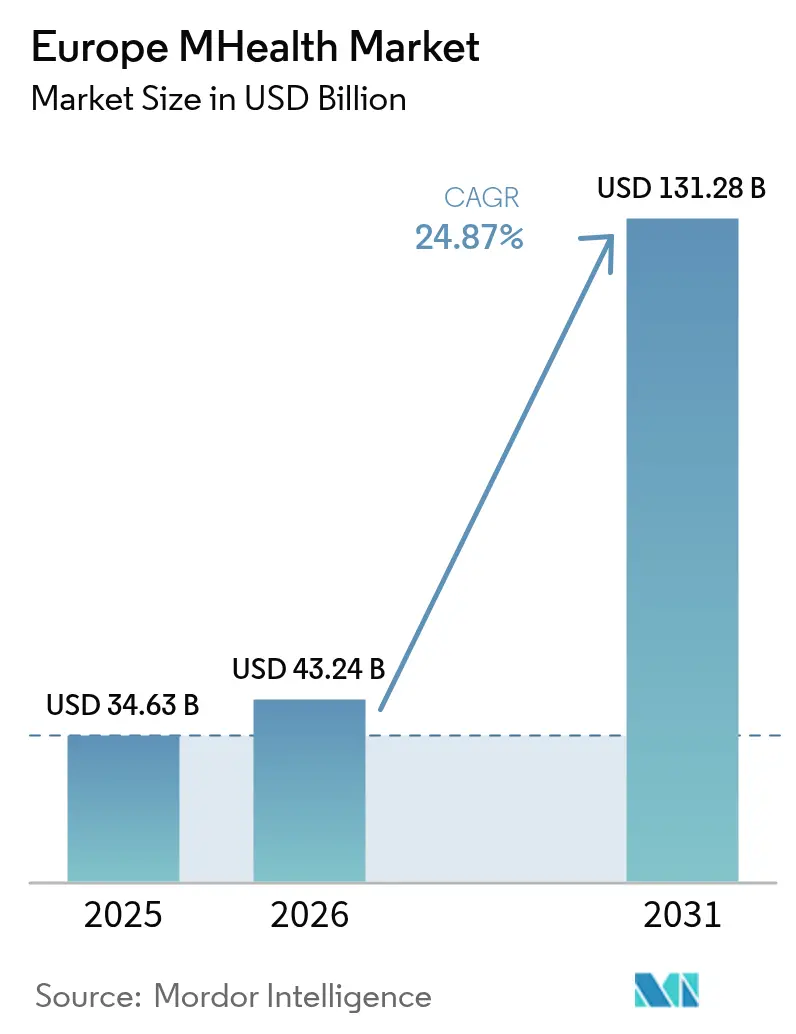
The Europe MHealth Market size was valued at USD 34.63 billion in 2025 and estimated to grow from USD 43.24 billion in 2026 to reach USD 131.28 billion by 2031, at a CAGR of 24.87% during the forecast period (2026-2031).
Thus, COVID-19 has impacted positively the demand for the mhealth market in Europe, and it is expected to increase with time. According to the article 'The European digital health revolution in the wake of COVID-19' published in April 2021, the European Commission proposed the EU4Health program as part of a COVID-19 recovery response program. The initiative aims to raise EUR 5.1 billion for the digital transformation of the European health sector and ensure preparedness for future cross-border health threats. Thus, increasing investments by European governments toward the digital transformation of healthcare will drive market growth over the study period. Remote patient monitoring (RPM) is a one-to-many telemedicine solution that can rapidly increase healthcare system capacities. MedTech company COVID-19 Telemedicine ApS provides COVID-19 clinical protocols for remote screening and monitoring of patients. The European Commission-funded project COVID-19 Telemedicine started in August 2020, will take the solution to the next level of technological readiness. In addition to reducing staff exposure to contagions, the number of emergency department visits and hospitalizations, as well as the duration of hospital stays are also expected to reduce. The remote patient monitoring (RPM solution provides comfort to anxious patients in home isolation and quarantine. The automated triage makes it a highly scalable and resource-efficient infectious disease management tool for COVID-19 and future pandemics. Such government-funded projects are expected to positively impact market growth. Thus, the abovementioned factors are likely to increase the market growth.
mHealth or Mobile Health is the use of mobile and wireless technologies to support the achievement of health objectives. The most common application of mHealth is the use of mobile devices to educate consumers about preventive healthcare services. However, mHealth is also used for disease surveillance, treatment support, epidemic outbreak tracking, and chronic disease management. Factors such as growing burden of chronic diseases, advancements in technology, rising awareness about the health of the population, and initiatives taken by the government are driving the growth of the market segment over the forecast period. Additionally, European Union is promoting a program titled 'Promoting a trusted mHealth label in Europe: uptake of Technical specifications for 'Quality and Reliability of Health and Wellness Apps' with the aim to prioritize digital tools for citizen empowerment and for person-centered care whose submission date was in September 2021. such initiatives taken by the government are also driving the growth of the market. The market segment growth has boosted the launch of new products incorporated with advanced technology such as Artificial Intelligence etc. For Instance, in April 2021, TytoCare the healthcare industry's first all-in-one modular device and examination platform for AI-powered, on-demand, remote medical exams, has launched in Italy, enabling the adoption of its mhealth solution throughout the country. The launch is taking place via a partnership with Multimed. Additionally, in March 2021, Spanish mobile network Yoigo also launched a mhealth service named Doctor Go. The Doctor Go telemedicine service offers video consultations with family doctors and specialists, as well as telepharmacy services for electronic prescriptions and the delivery of medicines. Similarly, in May 2021, Royal Philips launched the new Philips Interventional Applications Platform, IntraSight Mobile that brings together imaging and physiology applications on a mobile system for coronary and peripheral artery disease therapy in Europe. Furthermore, the support from the government by providing grants is also driving the growth of the market over time. For Instance, in May 2021, the United Kingdom health tech company my mhealth, and collaborators were awarded EUR 2.5 million Eurostars Grants for the development of their project named CUOREMA. The CUOREMA project will focus on developing a new, patient-centered cardiac rehabilitation support system. Thus, owing to the abovementioned factors, the mhealth market is expected to project growth over the forecast period.
However, data security issues and stringent regulatory policies for mHealth applications are likely to hinder the market growth.
Note: Market size and forecast figures in this report are generated using Mordor Intelligence’s proprietary estimation framework, updated with the latest available data and insights as of 2026.
Europe MHealth Market Trends and Insights
Blood Glucose Monitors are Expected to Have the Largest Share in Device Type Segment
A blood glucose monitor is a test system for use at home or in health care settings to measure the amount of sugar (glucose) in the blood. The prevalence of diabetes is increasing among all the age groups in the European region, mostly due to an increase in the overweight and obese population, an unhealthy diet, and a lack of physical activity. These are also the major drivers propelling the growth of glucose monitors in the mhealth market over the forecast period. As per the statistics provided by the International Diabetes Federation (IDF), an estimated 59 million adults aged 20-79 years were living with diabetes in the IDF Europe Region in 2019. It has been estimated by the IDF that by the year 2045, the prevalence of Diabetes will reach up to 10.8% and the number of people having this disease would reach 81 million. Diabetes is found to be one of the leading causes of death in the European region. As the prevalence continues to increase even in the future, the demand for continuous monitoring of glucose levels in diabetic patients is also anticipated to increase in the future. The companies are using leading-edge technology to make these devices compatible with various mobile platforms to remove the extra bulk devices. For instance, in June 2021, Medtronic launched Guardian 4 continuous glucose monitor and its InPen smart insulin pen in Europe. Both devices have been approved in Europe for people with diabetes. Thus, the rise in the number of patients suffering from diabetes and technological advancements in the glucose/insulin monitoring wearable devices are expected to boost the growth of the European mHealth market.
Spain is Expected to have Significant Share in the Market Over the Forecast Period
Factors such as the initial increasing pandemic effect, research studies, increasing funding, and product launches by key market players are expected to increase the market growth. According to an article published in the European union of private hospitals in June 2021, general hospitals in Spain increased their workforce by 6% in 2020 compared to 2019, incorporating 5,000 new professionals as the hospital admission rate in the country was around 33% for the COVID-19 patients. However, the healthcare professional issues were very critical as around 26.3% of the staff was found COVID positive at a time. In November 2021, a paper named 'Hospitalization budget impact during the COVID-19 pandemic in Spain' published that the impact on the hospital's budget for the 3 months (26th February to 21st May 2020) was calculated at EUR 15,633,180, out of which the 97.4% was related to health care and hospitalization. Intensive care unit stays costs accounted for 5.3% of the total costs. Whereas the mean cost per patient was around EUR 10,744. The main costs were staffing costs (EUR 10,131 to EUR 11,357 per patient for physicians and EUR 10,274 to EUR 11,215 per patient for nurses). Hence, the impact of COVID-19 on the Spanish public health budget (12.3% of total public health expenditure) is greater than multiple sclerosis, cancer, and diabetes cost. The mhealth can decrease the cost as it does not require patients to visit until its necessary. This would free up space in the hospitals and increase productivity by decreasing the cost. Similarly, in June 2020, the Catalan Health Department launched the app, called Gestioemocional, to provide support to the patients with anxiety and stress that were triggered by the COVID-19. The app has been downloaded more than 370,000 times and has more than 200,000 users. These applications have accelerated the use of telemedicine in Spain with an increase in virtual consultation and positive impact on workflow.
Thus, due to abovementioned factors the market is expected to increase in the future.
Regulatory Landscape
In Europe, mHealth solutions that qualify as software as a medical device (SaMD) or connect to regulated devices fall under the Medical Devices Regulation (EU) 2017/745 (MDR), and in applicable cases the In vitro Diagnostic Medical Devices Regulation (EU) 2017/746 (IVDR). Developers and manufacturers are required to support conformity assessment with technical documentation, risk management, and clinical or performance evaluation aligned to the General Safety and Performance Requirements (GSPRs), which shapes how monitoring apps, connected wearables, and mobile-enabled diagnostics are designed, validated, and maintained.
Health-data interoperability and access are also being reworked through the European Health Data Space (EHDS) Regulation (EU) 2025/327, published on 5 March 2025. The program has moved into an execution phase, including establishment of the EHDS governance structure via Commission Implementing Regulation (EU) 2026/771 (adopted 7 April 2026), which set up the EHDS Board to support consistent application and technical implementation guidance for EHR-system requirements, including cross-border exchange format and interoperability obligations relevant to mHealth-integrated care pathways.
Competitive Landscape
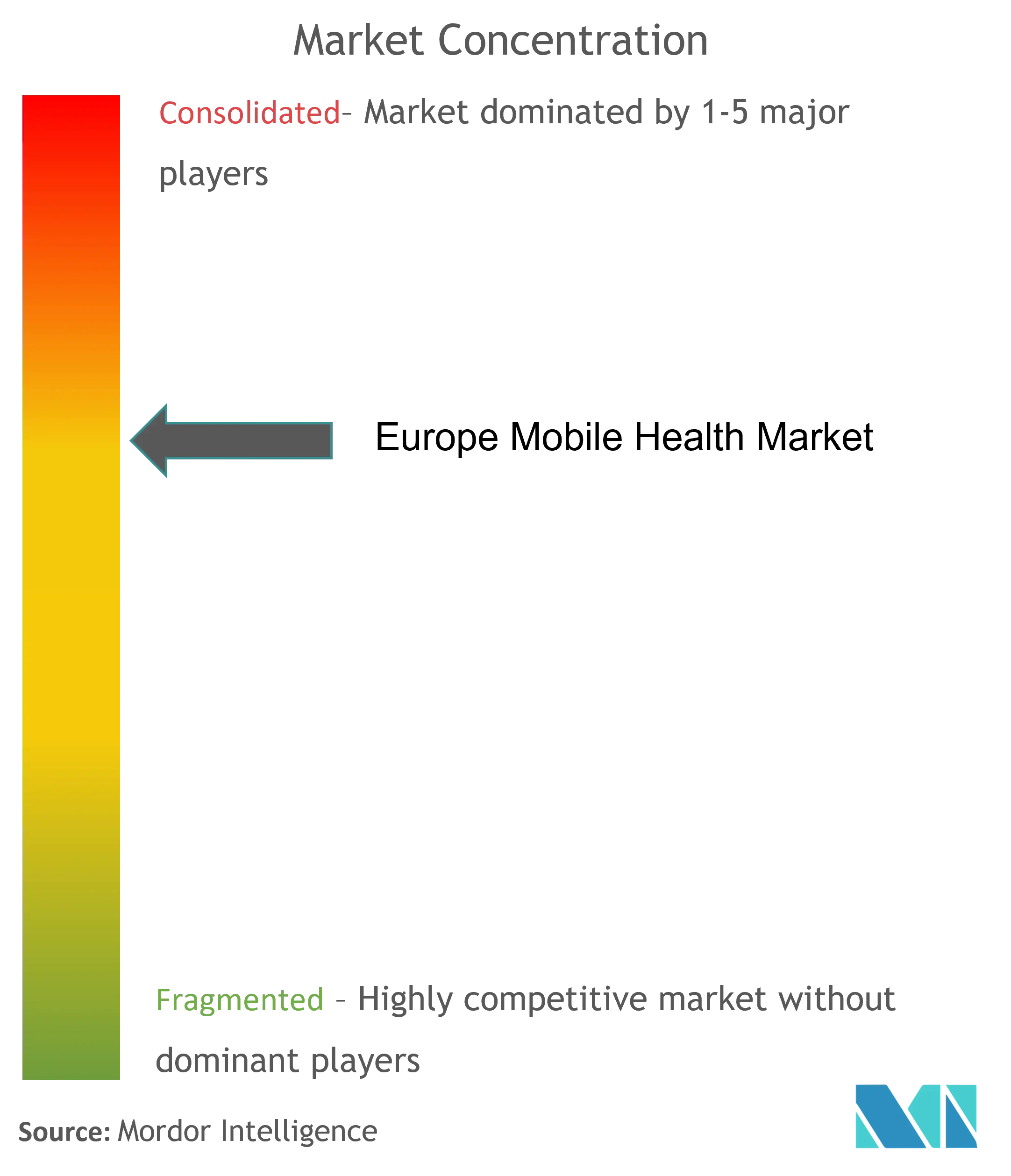
The market for mHealth in Europe is moderately competitive and consists of global players mostly. With the rising technological advancements in mhealth services and products, more companies are expected to penetrate the market. Small to mid-sized companies are believed to grab a substantial share in the European market in the coming future. Some of the companies which are currently dominating the market are Koninklijke Philips N.V., Medtronic Plc, Johnson and Johnson, Cisco Systems, Inc., and Samsung among others.
Europe MHealth Industry Leaders
-
Medtronic Plc
-
Koninklijke Philips N.V.
-
Johnson and Johnson
-
Cisco Systems, Inc.
-
Samsung
- *Disclaimer: Major Players sorted in no particular order
Market Opportunities and Future Outlook
EHDS implementation is creating actionable openings for mHealth vendors that can operationalize interoperability, consent, and auditability across multi-country deployments, especially when apps and remote-monitoring workflows connect to electronic health record (EHR) systems. The EHDS Board formed under Implementing Regulation (EU) 2026/771 (7 April 2026) places added emphasis on technical implementation guides and consistent application across Member States, which tends to benefit suppliers with integration tooling, data-governance capabilities, and documentation practices that fit regulated software lifecycles under MDR/IVDR.
Demand also shows up through EU-backed efforts aimed at clinical validation and data infrastructure that reduce friction for scaling AI-enabled and imaging-adjacent mHealth workflows. In May 2026, the European Commission advanced its network of AI-powered advanced screening centres, including opening a further call for expressions of interest with applications accepted until September 2026, which provides a pathway for performance assessment and real-world evidence generation alongside device and data compliance. By end-2026, Cancer Image Europe is targeting access to 60 million cancer images, supporting mobile-enabled screening pathways, patient follow-up, and clinician decision support where solutions can integrate with imaging data services and comply with evolving EU requirements for cross-border data use.
Recent Industry Developments
- May 2026: Philips announced a consortium with Cuviva and Vingmed was selected via a tender led by Karolinska University Hospital to support Region Stockholm's hospital-at-home initiative, providing remote monitoring technology for up to 15,000 patients annually. The win indicates how regional procurement is consolidating demand into platform-led, multi-partner deployments that combine wearables, monitoring services, and clinical workflows at scale.
- July 2025: Medtronic secured CE Mark for the MiniMed 780G system, expanding indications to include children aged 2 years and older, during pregnancy, and for type 2 insulin-requiring diabetes. The broader label supports wider clinical adoption of connected diabetes management, reinforcing demand for integrated mobile apps that unify sensor data and dosing support in regulated care settings.
- May 2024: Philips completed a rollout of its wearable ePatch with the Cardiologs AI analytics platform across 14 hospitals in Spain for monitoring heart patients for cardiac arrhythmias. The deployment points to increasing provider uptake of wearable-plus-analytics models that extend monitoring beyond the hospital and into routine care pathways.
Research Methodology Framework and Report Scope
Market Definition and Coverage
This market covers revenue generated in Europe from mobile health solutions used for medical and public health use, including mobile-based services and connected monitoring supported by phones and wireless devices.
Scope exclusions: We do not count general consumer gadgets or lifestyle apps that do not have a healthcare use case or a health monitoring or clinical workflow link.
Segmentation Overview
- By Service Type
- Monitoring Services
- Independent Aging Solutions
- Chronic Disease Management
- Post Acute Care Services
- Diagnostic Services
- Self Diagnosis Services
- Telemedicine Solutions
- Medical Call centers manned by Healthcare Professionals
- Treatment Services
- Remote Patient Monitoring Services
- Teleconsultation
- Wellness and Fitness Solutions
- Other Services
- Monitoring Services
- By Device Type
- Blood Glucose Monitors
- Cardiac Monitors
- Hemodynamic Monitors
- Neurological Monitors
- Respiratory Monitors
- Body and Temperature Monitors
- Remote Patient Monitoring Devices
- Other Device Types
- By Stake Holder
- Mobile Operators
- Healthcare Providers
- Application/Content Players
- Other Stake Holders
- Geography
- Germany
- United Kingdom
- France
- Italy
- Spain
- Rest of Europe
Data Sources, Market Sizing, and Validation
Desk Research
Desk work started with a clear boundary for what qualifies as mobile health in Europe, and then we mapped the demand and supply signals that can be checked in public data. We used sources such as the World Health Organization (digital health and mHealth definitions), the European Commission and Eurostat (health and ICT indicators), the OECD (health system spend and utilization), and the European Medicines Agency plus national health ministries for policy and program signals that affect adoption.
To translate this into market sizing inputs, we also reviewed company annual reports, investor presentations, product literature, and trusted press coverage for pricing logic and rollout timing. Patent databases were used selectively to understand innovation density in remote monitoring and mobile-enabled diagnostics. A paid subscription focused on company financials and news was used to standardize revenue splits and to sanity-check smaller entities where public disclosures are thin. These desk sources are illustrative only, and many additional public references were used for collection, validation, and clarification.
Primary Interviews and Surveys
Fieldwork was used to pressure-test adoption and monetization in different European care settings, and to clarify what is counted as mobile health revenue versus adjacent digital health spend. We spoke with stakeholders such as healthcare providers, mobile operators, and application or content participants, followed by discussions with country-focused experts across major European markets to validate assumptions around service mix and device-linked revenue.
Distribution of primary research fieldwork respondents
| Company type | Respondent position |
|---|---|
| Top tier: 31% | CXOs: 15% |
| Mid tier: 54% | Functional/Unit leaders: 34% |
| Smaller Players: 15% | Managers: 51% |
Market-Sizing & Forecasting
The core sizing model uses a top-down build that starts from Europe healthcare delivery and digital enablement signals, and then allocates realistic mobile health penetration and spending intensity by service and device use. Because the total can drift if adoption is overstated, results are then corroborated with selective bottom-up approximations, such as sampled supplier revenue splits, country channel checks, and simple price times volume checks for common monitored conditions.
Inputs that mattered in this market included smartphone and broadband readiness, chronic disease monitoring demand, uptake of remote patient monitoring programs, the mix of monitoring versus wellness and fitness services, and reimbursement and regulatory pathways (which affect what gets paid for and how fast it scales). When a bottom-up check was missing for a smaller country or niche service, we bridged the gap using peer-country ratios and then re-tested it through expert feedback.
For forecasting, we used scenario analysis supported by variable-level expectations gathered in interviews, and then applied cautious ramps for service adoption and device attach rates rather than assuming linear growth. Price progression was kept transparent by anchoring to observed subscription and device price bands, and by adjusting for inflation and currency timing in a consistent way across countries.
Data Validation & Update Cycle
Estimates were triangulated across multiple checkpoints, and large variances were investigated before the final number was signed off. We compared model outputs to independent signals such as program rollouts, device shipment and install base direction, and disclosed revenue hints from major ecosystem participants, and then we re-contacted sources if an assumption moved the total more than expected.
A second analyst review is used to spot unit errors, double counting between services and devices, and unusual country splits. Reports are refreshed annually, with interim updates triggered by material policy changes, reimbursement decisions, or step-changes in deployment. Right before delivery, we do a fresh pass on the key inputs so clients receive the latest view.
Mordor Intelligence's Europe Mobile Health Market Size Measured Against Other Published Estimates
Published market sizes for Europe mobile health often vary because the boundary between mobile health, broader digital health, and general consumer wellness is not drawn the same way each time. Differences also come from how services versus connected devices are valued, how currency timing is handled, and whether the forecast uses cautious adoption ramps or faster scenario assumptions.
Program-level rollout evidence, device-linked monitoring penetration signals, and country reimbursement cues are the checks that keep Mordor Intelligence tied to paid healthcare use cases, which tends to lift the 2025 value versus estimates that treat parts of mobile health as mostly consumer spend.
Benchmark comparison
| Source | Market Size | Gaps in Research Methodology |
|---|---|---|
| Mordor Intelligence | USD 34.63 B (2025) | |
| Regional Consultancy A | USD 25.28 B (2024) | Uses an earlier base year and a narrower revenue capture that leans on connected device categories and selective service lines, which can miss reimbursed monitoring and provider-led mobile workflows in parts of Europe. |
| Industry Association B | USD 12.20 B (2024) | Applies a tighter product boundary that is closer to apps plus connected devices sold through limited channels, and the valuation base year and growth path appear to use more conservative adoption and pricing ramps. |
The spread mainly comes down to what gets counted as mobile health revenue in Europe and how quickly paid use cases are assumed to scale across countries. By keeping service and device revenue logic explicit and then cross-checking it against observable deployment and policy signals, the final number stays traceable and repeatable when the model is refreshed.
Key Questions Answered in the Report
How big is the Europe mHealth Market?
The Europe mHealth Market size is expected to reach USD 43.24 billion in 2026 and grow at a CAGR of 24.87% to reach USD 131.28 billion by 2031.
What is the current Europe mHealth Market size?
In 2026, the Europe mHealth Market size is expected to reach USD 43.24 billion.
Who are the key players in Europe mHealth Market?
Medtronic Plc, Koninklijke Philips N.V., Johnson and Johnson, Cisco Systems, Inc. and Samsung are the major companies operating in the Europe mHealth Market.
What years does this Europe mHealth Market cover, and what was the market size in 2025?
In 2025, the Europe mHealth Market size was estimated at USD 43.24 billion. The report covers the Europe mHealth Market historical market size for years: 2019, 2020, 2021, 2022, 2023 and 2024. The report also forecasts the Europe mHealth Market size for years: 2026, 2027, 2028, 2029, 2030 and 2031.