
Market Overview
| Study Period | 2020 - 2031 |
|---|---|
| Forecast Data Period | 2026 - 2031 |
| Base Year Market Size (2025) | USD 19.49 Billion |
| Market Size (2026) | USD 19.92 Billion |
| Market Size (2031) | USD 22.21 Billion |
| Growth Rate (2026 - 2031) | 2.20 % |
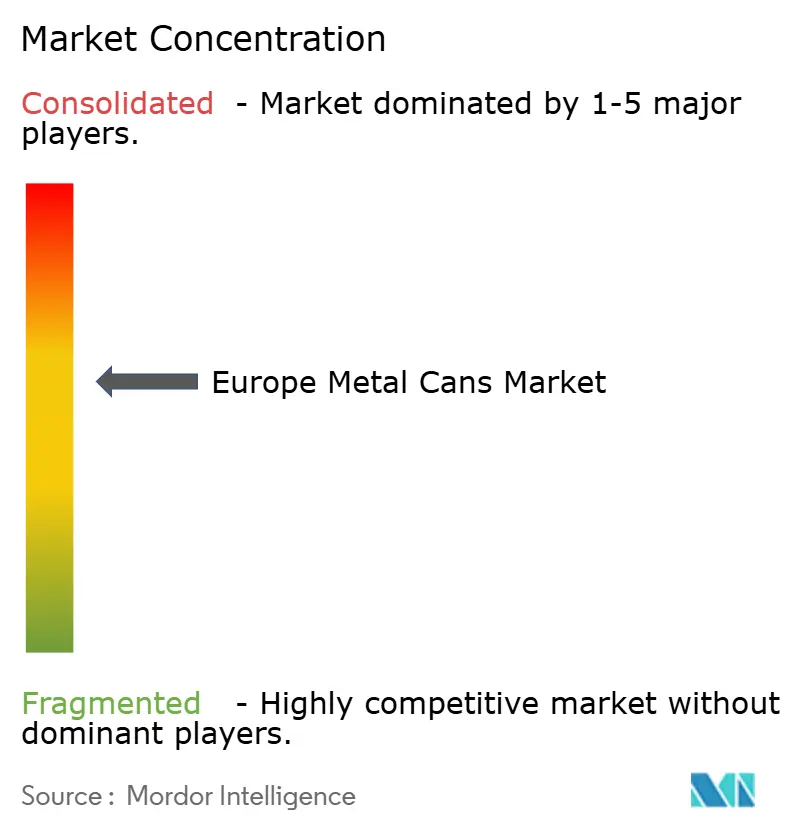
| Market Concentration | Medium |
Major Players *Disclaimer: Major Players sorted in no particular order Image © Mordor Intelligence. Reuse requires attribution under CC BY 4.0. | |
Europe Metal Cans Market Analysis by Mordor Intelligence
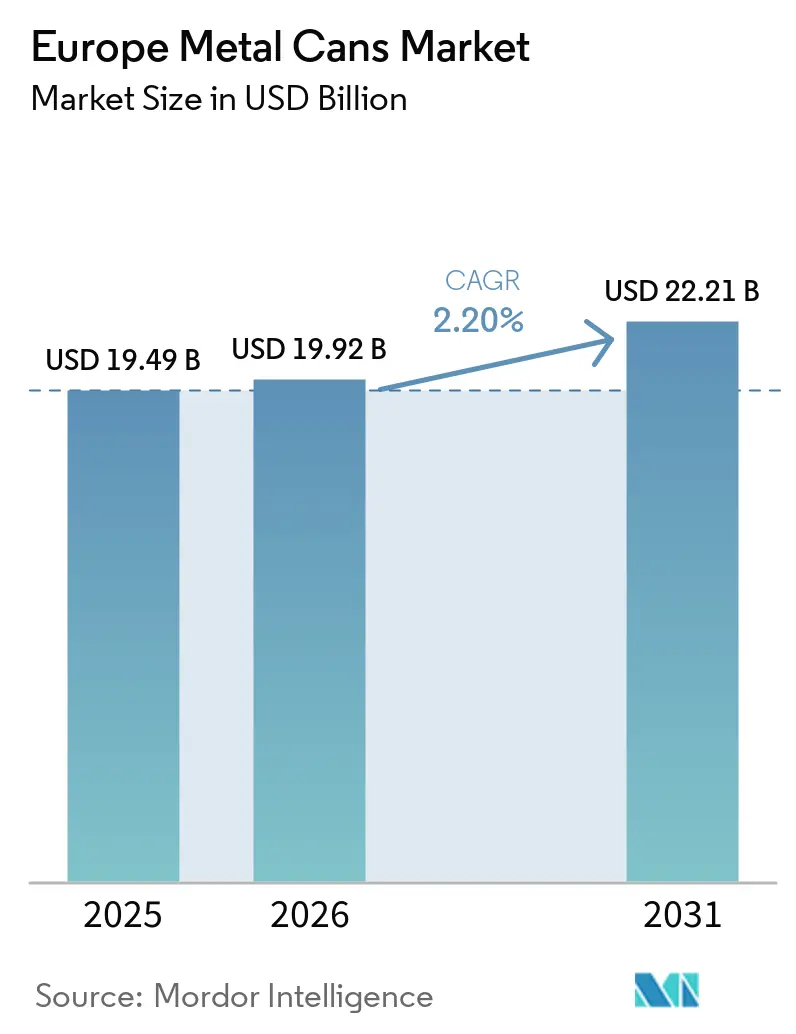
The Europe metal cans market size was valued at USD 19.49 billion in 2025 and estimated to grow from USD 19.92 billion in 2026 to reach USD 22.21 billion by 2031, at a CAGR of 2.20% during the forecast period (2026-2031). This steady climb reflects a mature yet resilient landscape in which stringent circular-economy rules, high recycling rates for aluminum and steel, and brand owner decarbonization targets jointly reinforce demand for infinitely recyclable packaging. Deposit-return systems that routinely exceed 90% collection rates, Germany’s upcoming 98% benchmark among them, underpin a dependable secondary raw-material loop that stabilizes supply. Ongoing PET-to-can conversion by craft brewers and premium ready-to-drink cocktail brands, together with e-commerce-driven aerosol demand, broadens the addressable volume base while expanding value per unit. Meanwhile, green-steel deployment and aluminum down-gauging temper emissions footprints and enable compliance with the European Commission’s requirement that all packaging be recyclable by 2030.[1] Taken together, these forces keep the European metal cans market on a measured growth path despite raw-material cost volatility and substrate substitution risks.
Key Report Takeaways
- By material type, aluminum captured 68.31% of the Europe metal cans market share in 2025.
- By end-user, the Europe metal cans market size for food is projected to grow at a 3.68% CAGR between 2026-2031.
- By structure, 2-piece captured 62.02% of the Europe metal cans market size in 2025.
- By capacity, the Europe metal cans market size for up to 250 ml is projected to grow at a 3.44% CAGR between 2026-2031.
- By country, Germany captured 21.91% of the Europe metal cans market share in 2025.
Note: Market size and forecast figures in this report are generated using Mordor Intelligence’s proprietary estimation framework, updated with the latest available data and insights as of 2026.
Market Trends and Insights
Drivers Impact Analysis of Europe Metal Cans Market*
| Driver | (~) Impact on CAGR Forecast | Geographic Relevance | Impact Timeline |
|---|---|---|---|
| High recyclability rates of metal packaging | +0.4% | EU-27, UK, Switzerland, Norway | Medium term (2–4 years) |
| EU circular-economy regulations tightening in 2025–30 | +0.3% | EU-27 core, spillover to UK | Long term (≥ 4 years) |
| PET-to-can conversion by craft brewers and RTD cocktails | +0.2% | Germany, UK, France, Netherlands | Short term (≤ 2 years) |
| Steelmakers’ low-carbon alloy launches cut Scope 3 emissions | +0.2% | Germany, France, Italy, Spain | Medium term (2–4 years) |
| Deposit-return-scheme harmonization across EU-27 | +0.3% | EU-27, early gains in France, Austria | Medium term (2–4 years) |
| Aerosol can growth in e-commerce home-care refills | +0.1% | Germany, UK, France, Netherlands | Short term (≤ 2 years) |
| Source: Mordor Intelligence | |||
High recyclability rates of metal packaging
Europe’s 76% aluminum beverage-can recycling rate and 80.5% steel-pack recovery underscore an unmatched circular advantage that resonates with carbon-conscious consumers and regulators alike. The European Aluminium Packaging Group’s push to reach 100% recycled content for can ends lowers life-cycle emissions by up to 95%, creating a strong value proposition for brand owners seeking quick carbon wins. Robust deposit-return systems, Germany already collects 98% of cans—ensuring a steady feedstock that cushions against primary-metal price swings. As the European Commission targets a 23.2% circular-material-use rate by 2030, metal’s infinite recycling loop positions the Europe metal cans market ahead of plastic and glass substitutes.[2] Producer-responsibility fees linked to recycled content further tilt cost structures in favor of metal, reinforcing long-term demand.
EU circular-economy regulations tightening in 2025–30
The Packaging and Packaging Waste Regulation that took effect in February 2025 obliges every package to be “recyclable by design” by 2030 and imposes minimum recycled-content thresholds. Metal cans, being mono-material and already compliant, gain a clear competitive edge while multi-layer plastics face redesign costs and technical hurdles. Additional requirements to trim packaging waste 15% per capita by 2040 incentivize down-gauged aluminum and thin-wall steel formats, aligning material efficiency with compliance savings. Extended-producer-responsibility levies will be harmonized, ending today’s patchwork of fees and easing cross-border logistics. Standardized labeling rules favor the simple composition of cans, which consumers can sort easily, further enhancing collection rates and reinforcing the European metal cans market.
PET-to-can conversion by craft brewers and RTD cocktails
Premium RTD cocktails are forecast to reach USD 2.43 billion by 2030, propelling a shift toward aluminum cans that offer superior light protection and a large branding canvas. Craft breweries embrace cans for lower shipping weight and oxidation resistance, fueling 4-6% annual can volume gains in European beverage channels. Aluminum’s 82% recycling rate aligns with craft brands’ authenticity narratives, attracting environmentally minded consumers. Nitro-infused cocktails and low-alcohol variants leverage can geometrics to create creamy textures that bottles cannot replicate, adding functional differentiation. Single-serve convenience resonates with younger demographics and supports the growth of smaller 200–250 mL formats within the European metal cans market.
Steelmakers’ low-carbon alloy launches cut Scope 3 emissions
Hydrogen-based direct-reduced iron and electric-arc furnaces could deliver up to 172 Mt of green steel capacity in Europe by 2030, slashing embedded carbon in steel cans. Although current production carries a 20–60% cost premium, rising EU carbon prices and green-procurement rules are narrowing the gap. Automotive willingness to pay EUR 57 extra per vehicle for clean steel signals brand acceptance of modest premiums, a mindset that is migrating to packaging. Closed-loop recycling programs that return used steel cans to mills within 60 days augment supply security and reinforce circular objectives. As these alloys proliferate, steel gains relevance in food and aerosol niches, lifting overall segment attractiveness inside the European metal cans market.
Restraints Impact Analysis of Europe Metal Cans Market*
| Restraint | (~) Impact on CAGR Forecast | Geographic Relevance | Impact Timeline |
|---|---|---|---|
| Proliferation of tethered-cap aluminum bottles | -0.3% | EU-27, early adoption in Germany, Netherlands | Short term (≤ 2 years) |
| Volatility in European rolled-aluminum premiums | -0.2% | Germany, France, Italy, Spain | Medium term (2–4 years) |
| Brand owner down-gauging hitting mill utilization rates | -0.1% | Germany, UK, France, Netherlands | Medium term (2–4 years) |
| PFAS phase-out costs for epoxy can linings | -0.1% | EU-27, UK, Switzerland, Norway | Short term (≤ 2 years) |
| Source: Mordor Intelligence | |||
Proliferation of tethered-cap aluminum bottles
The EU Single-Use Plastics Directive now requires beverage closures to stay attached, accelerating the appeal of re-sealable aluminum bottles that natively comply while distinguishing themselves from conventional cans. Coca-Cola and PepsiCo rolled out more than 400 million tethered closures in Europe by mid-2025, habituating consumers to the new ergonomics. Because bottles enable on-the-go re-closure, they siphon volume from single-serve cans in flavored water and energy-drink niches. Premium perception of slender bottle silhouettes reinforces this drift, challenging can fill-lines geared for traditional formats. Although both packages recycle well, the functional edge of bottles subtracts incremental growth from the Europe metal cans market in the near term.
Volatility in European rolled-aluminum premiums
Average 2025 European rolled-aluminum premiums near USD 2,575 per tonne, inflated by U.S. tariffs and sanctions on Russian supply, compress converter margins. European smelters cover only 11% of regional demand, exposing can makers to imported-ingot price swings. German output shrank 7% in Q1 2024, and recycled-aluminum production fell 6%, widening the supply gap. Energy-price turbulence and currency shifts amplify volatility, complicating long-term contract negotiations with fillers. While hedging mitigates some risk, sustained unpredictability tempers investment appetite, marginally dragging the CAGR for the Europe metal cans market.
*Our forecasts treat driver/restraint impacts as directional, not additive. The impact forecasts reflect baseline growth, mix effects, and variable interactions.
Europe Metal Cans Market Segment Analysis
By Material Type:
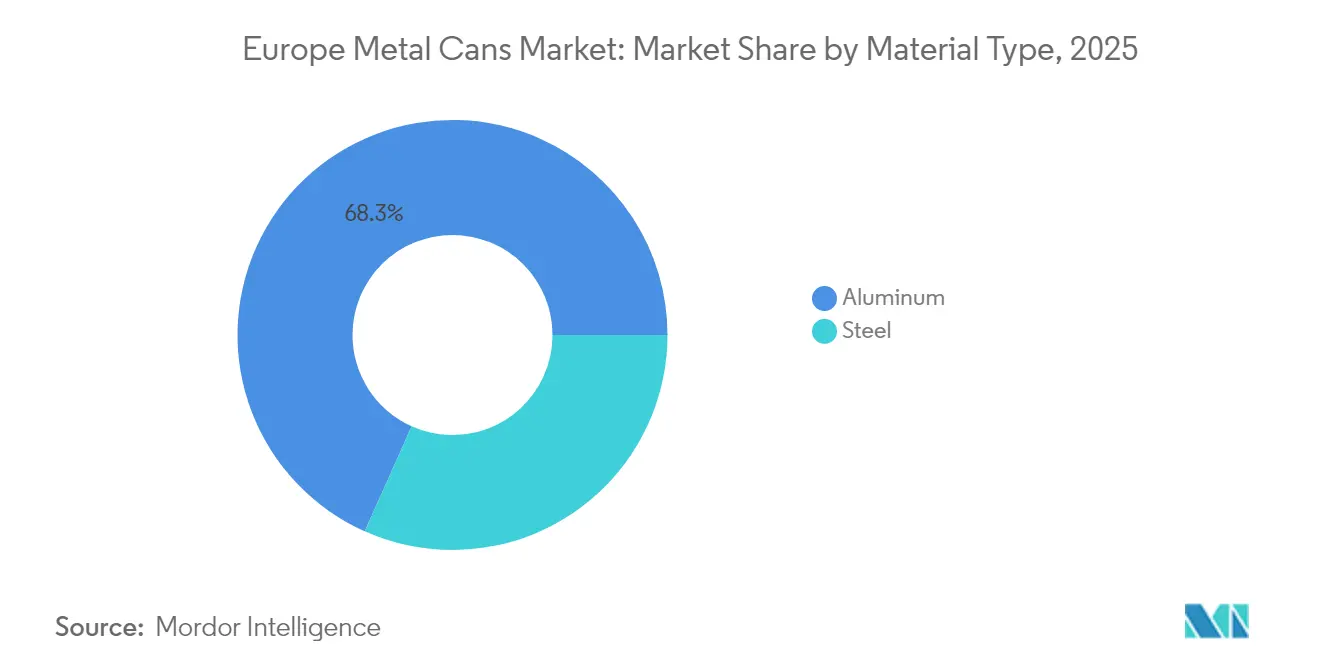
Aluminum leadership sustained as green steel gathers paceAluminum captured 68.31% of 2025 revenue thanks to its low weight, corrosion resistance, and entrenched beverage relationships, while steel is on course for a 3.11% CAGR to 2031 as hydrogen-based alloys broaden its sustainability credentials. Ball Corporation shipped 36 billion aluminum containers in EMEA during 2024, equal to a 39% share of regional can volumes, underscoring aluminum’s scale economics. In value terms, aluminum remains the linchpin of the European metal cans market; yet steel’s renaissance, powered by anticipated 172 Mt of green capacity, is widening the material choice for food and aerosol fillers looking to cut Scope 3 emissions.
Steel’s closer coupling with electric-arc furnaces slashes energy use by 30% and permits full circularity through magnetic separation, making “can-to-can in 60 days” a realistic slogan. Simultaneously, the European Aluminium Packaging Group targets 100% recycled content, reinforcing metal’s infinite recyclability narrative. Cross-material competition spurs innovation: aluminum down-gauging and easy-open ends meet steel’s improved formability and lacquer compatibility. Both substrates thus consolidate the European metal cans market by offering distinct performance ladders that satisfy diverging end-use needs.

By End-User:
Beverage weight still dominant; food races ahead on innovationBeverages retained 46.85% of 2025 turnover, propelled by craft brewing, energy drinks, and RTD cocktail momentum, whereas food cans are expected to chart a 3.68% CAGR through 2031. Europe drinks close to 93 billion canned servings yearly, anchoring filler demand for high-speed 2-piece aluminum lines that underpin the Europe metal cans market size. Crown Holdings saw beverage-can income climb 62% in 2024 on stronger contract terms and value-added ends, confirming sustained profitability.
Food cans, long criticized for dated aesthetics, are rejuvenating via glossy lithography, peel-foil membranes, and reseal features that lift shelf appeal. Their five-year shelf life combats food waste, a priority as the EU targets a 50% cut by 2030. Pet food’s switch to metal for nutrient retention and premium grain-free lines magnifies volume. Combined, these forces inject growth into a traditionally slower segment, balancing portfolio reliance that historically skewed toward beverages within the European metal cans market.
By Structure:
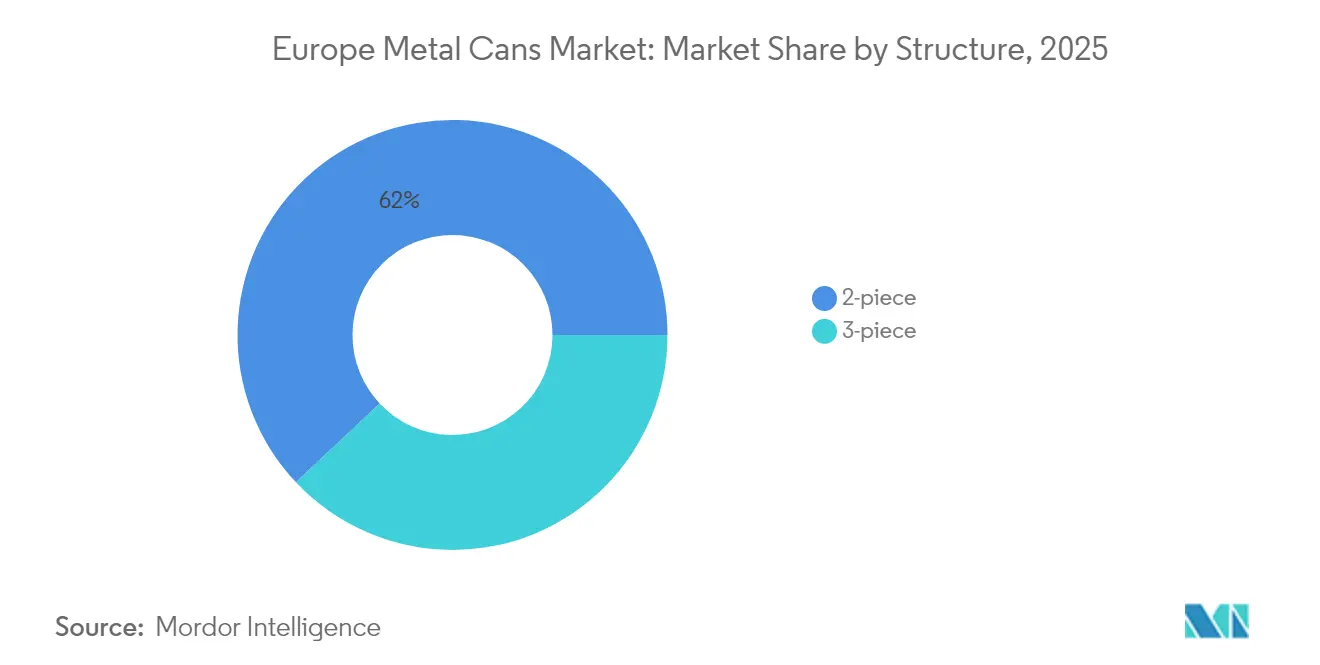
Two-piece efficiency versus three-piece adaptabilityTwo-piece cans held 62.02% of 2025 output on the back of draw-and-wall-iron manufacturing speed, yet three-piece variants are tracking a 3.49% CAGR to 2031 owing to aerosol and specialty food appeal. One plant can crank out 2,000 two-piece bodies a minute, ideal for soft-drink economics. Conversely, three-piece bodies accept welded side seams and domed ends, suited to viscous foods or pressurized contents. Ball’s EUR 82 million Alucan acquisition expands its footprint in extruded aluminum aerosol technology, a signal that three-piece niches will command more strategic focus.
Resource conservation drives advances in both formats. Tata Steel Nederland’s newly commissioned food-can line maximizes material utilization while lifting output flexibility. Down-gauging mostly favors two-piece cans where wall thickness uniformity can be shaved without seam issues, but internal-lacquer upgrades benefit three-piece formats prone to weld stress. These technical nuances let fillers precisely match product needs, ensuring both structures remain pillars of the European metal cans market.
By Capacity:
Mid-range formats rule; small serves gain tractionThe mainstream 251–500 mL band delivered 46.05% share in 2025, reflecting European preferences for 330 mL beer and 500 mL soft drink sizes, yet sub-250 mL cans are poised for the fastest 3.44% CAGR through 2031. Single-serve indulgence aligns with premium cocktails and functional beverages, letting brands charge a higher price-per-ounce while cutting calorie counts. Deposit-return economics also favor small sizes: a fixed EUR 0.25 deposit represents a bigger relative share of product price, motivating consumer returns and boosting recycling rates.
Larger family-size containers over 500 ml lose ground to PET multipacks and glass growlers that are enjoyed in-home sharing rituals. Equipment innovation, quick-change filling valves, and modular decorators now let converters switch between 150 mL sleek cans and 473 mL standards without extended downtime, reducing unit economics barriers. Capacity right-sizing thus broadens SKU repertoires and feeds the volume cadence of the European metal cans market.
Geography Analysis
Germany Metal Cans Market
Germany’s commanding 21.91% revenue share in 2025 stemmed from high-volume beverage production and unparalleled 98% deposit-return performance that secures a closed-loop material stream. Crown’s post-acquisition integration of Helvetia Packaging unlocked extra capacity, cementing the country’s leadership. Even as primary aluminum output dipped 7% in Q1 2024, abundant scrap inflows kept can-sheet supply uninterrupted, highlighting the strategic insulation afforded by circularity.
France Metal Cans Market
France is gaining momentum as the fastest-growing market in the European metal cans market. Rapid harmonization of deposit schemes lifted aluminum beverage-can collection above 90%, while eco-taxes on multi-layer plastics nudged fillers toward metal alternatives. Crown’s heat-recovery upgrade at Custines improved line economics, and craft brewers embraced sleek 250 mL cans to capture premium-price points, widening addressable demand.
Broader European Markets
Elsewhere, the UK, Spain, Italy, and Poland add depth. Novelis’ Latchford expansion guarantees domestic remelt capacity post-Brexit. Crown scaled new beverage-can lines in Spain and Italy, exploiting growing soft-drink consumption. Poland, buoyed by rising disposable income, absorbs extra can volumes, while the Netherlands’ 27.5% circular-material-use rate sets a benchmark for northern neighbors. Such geographic diversity cushions the Europe metal cans market against local shocks and fosters a pan-regional growth platform.
Regulatory Landscape
The European Union is shifting packaging compliance from directive-based implementation to a directly applicable regime through the Packaging and Packaging Waste Regulation (PPWR), Regulation (EU) 2025/40. The PPWR entered into force on 11 February 2025 and applies from 12 August 2026, replacing Directive 94/62/EC and tightening harmonized requirements around packaging design, labeling, and circularity, with collection-performance targets that include a 90% collection target for metal beverage cans at Member State level.
For metal cans used in food applications, EU food-contact compliance remains anchored by Regulation (EC) No 1935/2004 (framework requirements for inertness and consumer safety), alongside applicable GMP requirements for manufacturing. In March 2026, the European Commission issued implementation guidance (C(2026) 2151 final) to support PPWR interpretation, while detailed, format-specific obligations continue to depend on forthcoming delegated acts and implementing measures over 2026-2028, including timelines that trigger design-for-recycling compliance windows after delegated-act adoption.
Competitive Landscape
Three global suppliers, Ball, Crown, and the newly enlarged Sonoco-Eviosys platform, jointly control roughly 60% of Europe's volume, marking a moderately consolidated field. Sonoco’s EUR 3.615 billion takeover of Eviosys in December 2024 delivered 44 plants across 17 countries, promising USD 100 million capture in two years.
Ball’s 39% EMEA beverage hold is underpinned by 36 billion annual shipments and reinforced by the Alucan acquisition that expands aerosol and bottle competency in Spain and Belgium. Crown divested its European tinplate division yet posted a 62% income rise in 2024 as favorable price/mix offset lower tonnage. Technology rivalry centers on down-gauging; Neuman Aluminium’s Neucan 3.1 cuts thickness 17.2% while stitching 25% post-consumer scrap into coil, slashing CO₂ output 40%.
Coating innovators AkzoNobel and PPG accelerate PFAS-free roll-outs; more than 20% of European beverage volumes now use non-BPA systems. Emerging niche players exploit gaps in refill aerosols and decorative specialty cans, but capital intensity and stringent ISO 14855 testing limit rapid scale-up, conferring an advantage to established incumbents in the European metal cans market.
Europe Metal Cans Industry Leaders
-
Ball Corporation
-
Ardagh Group S.A.
-
Crown Holdings, Inc.
-
Silgan Holdings Inc
-
Can-Pack S.A.
- *Disclaimer: Major Players sorted in no particular order
Europe Metal Cans Market Companies Covered in this Report
- Ball Corporation
- Ardagh Group S.A.
- Crown Holdings, Inc.
- Silgan Holdings Inc.
- CANPACK Spółka Akcyjna
- Massilly Holding SAS
- Tgp Tecnocap Group Partecipazioni S.r.l.
- Tata Steel Europe Limited
- ASA Group
- Eurobox Metal Packaging
- Nampak Plastics Europe Limited
- Impress Metal Packaging Ltd.
- Trivium Packaging B.V.
- Envases Europe A/S
- Colep Packaging Portugal, S.A.
- Greif, Inc.
- Pano Verschluss GmbH
- DS Containers, Inc.
- CPMC Ltd
- Toyo Seikan Co., Ltd.
Market Opportunities and Future Outlook
A near-term opportunity is compliance-led upgrading of canmaking lines to align with tightening EU packaging rules taking effect from 12 August 2026 under Regulation (EU) 2025/40 (PPWR), particularly where brand owners and fillers need clearer proof of design-for-recycling, harmonized labeling, and auditable circular-performance metrics. Industry bodies have been actively shaping the cost pass-through mechanics: Metal Packaging Europe published positions in May 2026 calling for harmonized minimum requirements and material neutrality in Extended Producer Responsibility approaches under the Circular Economy Act context, signaling commercial whitespace for can makers and suppliers that can offer documentation, standardized specifications, and recycled-content pathways that reduce cross-border complexity.
Capacity and capability investments provide additional whitespace in countries absorbing incremental beverage-can demand and export volumes. CANPACK is bringing on production operations for its expanded beverage can facility in Bydgoszcz, Poland (a PLN 440 million project, scheduled to start operations in Q2 2026), strengthening Central Europe as a manufacturing and logistics node. In parallel, producers are pairing expansion with emissions-control retrofits, such as Ardagh Metal Packagings April 2026 installation of advanced VOC abatement technology (regenerative thermal oxidation) at its Valdemorillo, Spain beverage can plant, which supports higher utilization while keeping pace with environmental compliance requirements and customer sustainability screening.
Recent Industry Developments in Europe Metal Cans Market
- May 2026: Ardagh Metal Packaging selected Durr CTS to deliver a turnkey emissions treatment system at its plant near Madrid, Spain, aligning environmental controls with a production expansion program. The move embeds VOC management into capacity additions, reducing compliance friction for higher output and supporting customer sustainability requirements in beverage packaging supply.
- February 2026: Crown Holdings announced a USD 550 million capital expenditure plan for 2026 that includes capacity expansions and facility upgrades in Greece and Spain. The allocation reinforces a strategy of debottlenecking and upgrading existing European sites, strengthening regional responsiveness for beverage can demand without relying on greenfield builds.
- December 2024: Sonoco completed its EUR 3.615 billion acquisition of Eviosys, creating an enlarged platform with 44 plants across 17 countries. The combination reshaped competitive dynamics in European metal packaging by expanding manufacturing footprint and scale, raising the bar for network efficiency and procurement leverage.
Europe Metal Cans Market Report Scope and Research Methodology
Market Definition and Coverage
For this market, we count the value of aluminum and steel can packaging sold across Europe for end uses such as food, beverages, aerosols, and other packaged products, measured in USD for a consistent comparison.
Scope exclusions: Closures, lids, and non-can metal packaging formats (such as drums, pails, and trays) are excluded unless sold as part of a complete can unit.
Segments Covered in This Report
- By Material Type
- Aluminum
- Steel
- By End-User
- Food
- Vegetables
- Fruits
- Pet Food
- Soups and Condiments
- Other Food Cans
- Beverage
- Alcoholic
- Non-Alcoholic
- Aerosol Cans
- Other End-users
- Food
- By Structure
- 2-piece
- 3-piece
- By Capacity
- Up to 250 ml
- 251 - 500 ml
- More than 500 ml
- By Country
- United Kingdom
- Germany
- France
- Spain
- Italy
- Poland
- Rest of Europe
Data Sources, Market Sizing, and Validation
Desk Research
Desk research was used to set the outer guardrails for demand and supply, and then to sanity check country level patterns before we finalized the market model. For Europe metal cans, we relied on public datasets such as Eurostat production and trade series, UN Comtrade customs data, OECD industry indicators, and European Commission circular economy and packaging waste publications.
To convert these signals into market inputs, we also reviewed company annual reports and investor presentations, trade association updates for packaging and beverage categories, and reputable industry press for capacity additions and line conversions. Where public financial detail was limited, we used paid subscriptions for company financials and intelligence, plus patent databases and an import and export shipment-level database to validate product mix and cross-border flows. These examples are not exhaustive, and many other public sources were also checked for data collection, validation, and clarification.
Primary Interviews and Surveys
Primary work was used to test assumptions that desk research cannot confirm cleanly, especially aluminum versus steel mix shifts, and how prices move by can type and end use. We spoke with manufacturers, distributors, and large buyers across major European markets and the Rest of Europe so gaps in public statistics could be filled and then triangulated back into the model assumptions.
Distribution of primary research fieldwork respondents
| Company type | Respondent position |
|---|---|
| Top tier: 36% | CXOs: 14% |
| Mid tier: 45% | Functional/Unit leaders: 40% |
| Smaller Players: 19% | Managers: 46% |
Market-Sizing & Forecasting
Sizing started with a top-down build where country demand was reconstructed from packaging consumption signals, production, and trade movements, and then aggregated to a Europe total. The totals were then corroborated using selective bottom-up approximations, such as supplier roll-ups in sampled countries and ASP times volume checks by can type. This helped us adjust when coverage in public data was uneven.
Inputs used in the model included indicators such as beverage can demand tied to beer and soft drink volumes, canned food consumption trends, aerosol can usage in household and personal care categories, aluminum versus steel mix shifts, and capacity utilization changes reported by the industry. Pricing used a practical ASP progression logic that reflects metal input cost direction, conversion cost changes, and mix. We then reconciled this pricing view with what respondents reported as typical contract pricing movements.
For forecasting, scenario analysis was used so the outlook could reflect different paths for inflation, recycling and packaging policy pressure, and consumer preference shifts across countries. Where interview feedback pointed to a near-term disruption, assumptions were stepped in the forecast rather than smoothed, and then rechecked with follow-up calls.
Data Validation & Update Cycle
Validation was done through several checks so that one noisy input did not drive the output. We compared model results against independent signals like trade balances, capacity announcements, and per-capita packaging usage, and then reviewed large variances at the country and can-type level before sign-off.
A second analyst review was used to challenge assumptions, followed by a final consistency check across historical years so growth did not jump without a clear reason. Reports are refreshed annually, and interim updates are made when material events occur, such as major capacity moves, policy changes, or sharp raw material price shifts. Before delivery, we do a fresh pass on recent news and data releases so the client receives the latest updated view.
Mordor Intelligence's Europe Metal Cans Market Estimate Compared With Other Published Estimates
Published numbers for Europe metal cans can vary even when the topic sounds identical, since different studies may mix can formats, apply different price logic, or include a wider packaging basket by accident. The benchmark table shows a visible spread that mainly comes from scope boundaries, the year chosen as the reference point, and how country totals are converted into USD.
The table also hints at a key modeling difference around what is counted as a can market versus a broader metal packaging value. In Mordor Intelligence's model, the total is built at the can format level (food, beverage, aerosol, and other cans) and then rolled up across Europe, which reduces the chance that adjacent metal packaging formats inflate the value.
Benchmark comparison
| Source | Market Size | Gaps in Research Methodology |
|---|---|---|
| Mordor Intelligence | USD 19.92 B (2026) | |
| Regional Consultancy A | USD 18.40 B (2024) | Uses an earlier base year and applies a higher growth curve through the forecast window, which can understate the current-year level when inflation and mix shifts are updated later. |
| Industry Publisher B | USD 21.30 B (2025) | May include a wider metal packaging scope or double count certain can-related components, and may rely on a broader average pricing assumption instead of can-type level ASP progression. |
Taken together, the differences are explainable once you line up the same year, the same product boundary, and the same price treatment. By keeping the steps traceable to country demand signals and can-type mix, the sizing stays repeatable and easier to validate when new data or interview feedback arrives.
Key Questions Answered in the Report
What is the current value of the Europe metal cans market?
The market is valued at USD 19.92 billion in 2026 and is projected to reach USD 22.21 billion by 2031.
Which material dominates can production in Europe?
Aluminum leads with 68.31% 2025 revenue share thanks to lightweight, infinitely recyclable attributes.
Which end-use segment is growing fastest?
Food applications are forecast to rise at a 3.68% CAGR to 2031 as brands switch from PET and glass.
Why are deposit-return systems important to this market?
DRS programs secure more than 90% collection of used cans, feeding a closed-loop recycling stream that stabilizes raw-material supply.
How will EU regulations affect packaging choices?
The Packaging and Packaging Waste Regulation requires all packaging to be recyclable by 2030, favoring mono-material metal cans over composite alternatives.
What technological shift is shaping the future of steel cans?
Hydrogen-based green steel and electric-arc furnaces are cutting energy and carbon, making steel cans more attractive for low-emission supply chains.