
Europe Medium And Heavy Duty Truck Rental Market Size and Share
Market Overview
| Study Period | 2019 - 2031 |
|---|---|
| Forecast Data Period | 2026 - 2031 |
| Base Year Market Size (2025) | USD 16.53 Billion |
| Market Size (2026) | USD 17.51 Billion |
| Market Size (2031) | USD 23.41 Billion |
| Growth Rate (2026 - 2031) | 5.97 % |
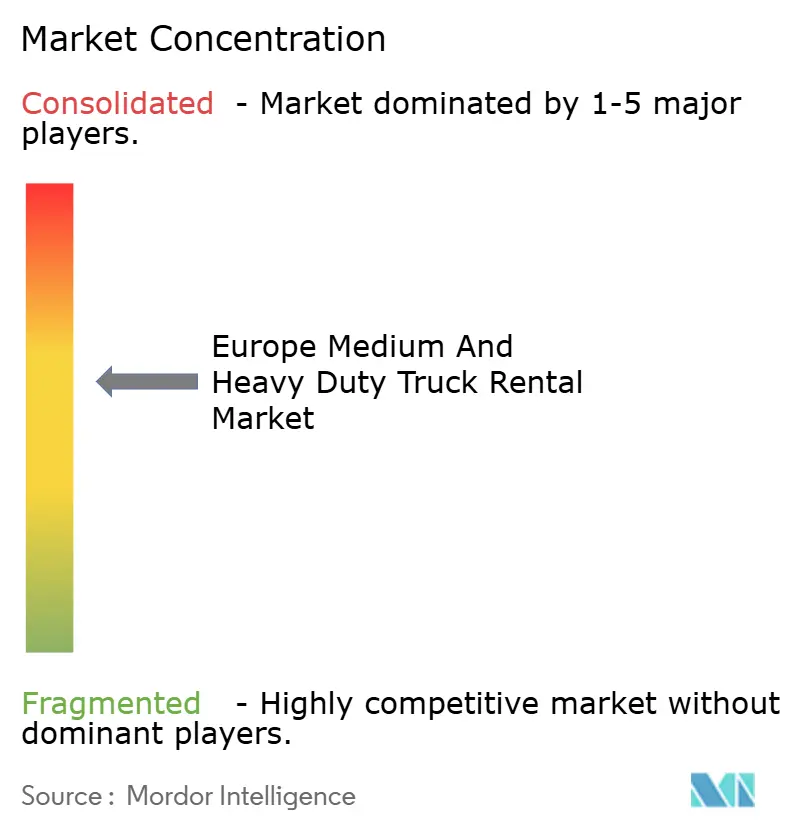
| Market Concentration | Medium |
Major Players *Disclaimer: Major Players sorted in no particular order Image © Mordor Intelligence. Reuse requires attribution under CC BY 4.0. | |
Europe Medium And Heavy Duty Truck Rental Market Analysis by Mordor Intelligence
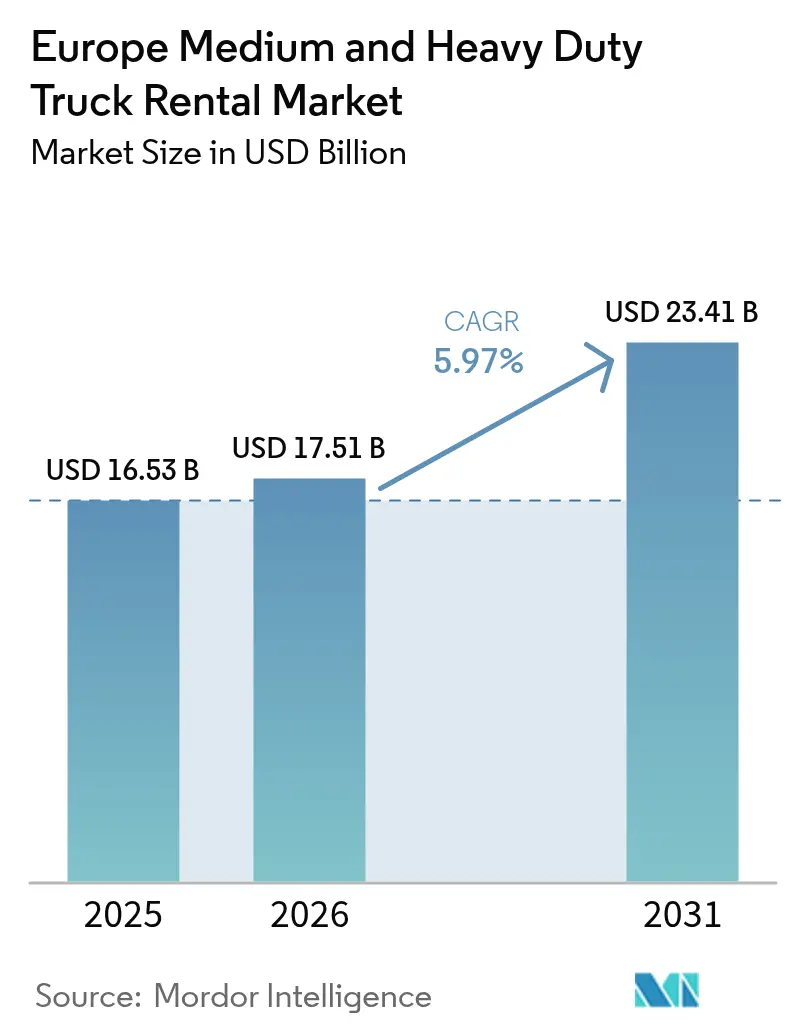
The Europe Medium and Heavy Duty Truck Rental Market size is projected to be USD 16.53 billion in 2025, USD 17.51 billion in 2026, and reach USD 23.41 billion by 2031, growing at a CAGR of 5.97% from 2026 to 2031. Fleet operators are increasingly turning to rental models. This shift comes as Euro 7 compliance significantly raises per-vehicle costs, increasing ownership expenses amidst volatile freight volumes. E-commerce retail sales in the five largest European economies are expected to grow substantially over the coming years. This growth creates seasonal peaks that rental fleets can manage more effectively than owned assets. Adoption of battery-electric trucks is gaining momentum, especially with the EU extending zero-emission heavy-duty toll exemptions for a longer period. This move skews the total cost of ownership in favor of electric rentals, particularly on high-toll routes. At the same time, with elevated interest rates, the weighted average cost of capital for direct purchases rises, making off-balance-sheet leasing more attractive.
Key Report Takeaways
- By booking type, offline bookings held 73.14% of revenue in 2025, while online channels are projected to expand at a 5.99% CAGR through 2031.
- By rental type, long-term leasing accounted for 63.27% of 2025 revenue, while short-term contracts recorded the highest CAGR of 6.03% through 2031.
- By truck class, heavy-duty models above 16 tons accounted for 57.61% of the European medium- and heavy-duty truck rental market in 2025 and are advancing at a 6.16% CAGR through 2031.
- By end-user, 3PLs account for 45.54% share in 2025, whereas postal, parcel, and E-commerce operators are expanding at a 6.07% CAGR.
- By propulsion, diesel’s 87.73% share in 2025 begins to erode as battery-electric trucks are growing at a 6.13% CAGR.
- By geography, Germany led the European medium- and heavy-duty truck rental market with 28.83% share in 2025; the Netherlands is forecast to post the fastest 6.11% CAGR through 2031.
Note: Market size and forecast figures in this report are generated using Mordor Intelligence’s proprietary estimation framework, updated with the latest available data and insights as of 2026.
Market Trends and Insights
Drivers Impact Analysis of Europe Medium And Heavy Duty Truck Rental Market*
| Driver | (~) % Impact on CAGR Forecast | Geographic Relevance | Impact Timeline |
|---|---|---|---|
| E-Commerce-Led Surge | +1.2% | Germany, Netherlands, France, UK, with spillover to Poland and Spain | Short term (≤ 2 years) |
| Stricter Euro 7 Norms Favoring Rental Over Ownership | +1.1% | EU-27, with early compliance pressure in Germany, Netherlands, France | Medium term (2-4 years) |
| Cost-Avoidance Focus Amid High Interest-Rate Cycle | +0.9% | Pan-European, strongest in Germany, France, Italy | Medium term (2-4 years) |
| Subsidized E-Truck Pilots De-Risking Rental Adoption | +0.8% | Germany, France, Netherlands, Spain; pilot corridors in Scandinavia | Long term (≥ 4 years) |
| OEM "Truck-as-a-Service" Roll-Outs | +0.6% | Germany, France, Netherlands, UK; expanding to Italy and Spain | Medium term (2-4 years) |
| Cross-Border Carbon Tolls Amplifying Seasonal Demand Swings | +0.5% | EU-27, particularly high-toll corridors linking Germany, France, Benelux | Short term (≤ 2 years) |
| Source: Mordor Intelligence | |||
E-Commerce-Led Surge in Flexible Freight Capacity
Online retail is expected to grow exponentially across Europe’s five largest economies by 2029, creating Black Friday, Cyber Monday, and pre-Christmas peaks that overwhelm owned fleets[1]. Short-term rentals are becoming the go-to solution for third-party logistics providers grappling with demand spikes. This shift is underscored by steady growth in the postal, parcel, and e-commerce segments, projected over the coming years. As cross-border orders surge within the single market, demand for heavy-duty rentals is rising, particularly on routes linking Germany, Poland, and the Netherlands. Digital platforms like Saloodo! are revolutionizing the game, enabling carriers to effortlessly book trucks for short durations. This innovation sidesteps traditional phone negotiations and allows operators to promptly return assets after delivery. Such flexibility diminishes the economic justification for ownership, a sentiment that is especially resonant among small and midsize carriers who struggle to justify year-round buffer capacity.
Stricter Euro 7 Norms Favoring Rental Over Ownership
Euro 7 regulations will significantly reduce permissible nitrogen oxide emissions compared to Euro 6d. These regulations also introduce real-world testing, resulting in a notable increase in compliance costs per vehicle. For fleets with older trucks, retrofitting expenses can become substantial. In contrast, rental contracts transfer this financial burden to major lessors, who can distribute the cost of upgrades across a large number of vehicles. Enforcement of these regulations is already intensifying in Germany and the Netherlands. In these countries, low-emission zones prohibit older truck models, further driving the trend towards rentals. OEM-affiliated lessors, like PACCAR Leasing, are capitalizing on their direct access to DAF's CF Electric and XF Electric models. This strategic advantage allows their customers to comply with the new standards without the hassle of subsidy documentation.
Cost-Avoidance Focus Amid High Interest-Rate Cycle
In early 2025, the European Central Bank's deposit rate is set at a high level, pushing financing costs higher. As a result, a diesel tractor priced at a significant amount now incurs substantial annual interest [2]. In Germany and France, where rising fuel and labor costs are tightening margins, long-term leases offer a lifeline. These leases not only cover maintenance, insurance, and telematics but also provide predictable monthly payments, safeguarding working capital. Moreover, leasing transfers the residual-value risk to the lessors. For instance, diesel trucks from the 2024 model year are projected to experience a significant decline in value within a few years, especially with the introduction of Euro 7 standards and the expansion of urban zero-emission zones. As a result, long-term contracts accounted for a significant portion of 2024's revenue. However, there's a notable uptick in short-term agreements as carriers seek to navigate macroeconomic uncertainties.
Subsidized E-Truck Pilots De-Risking Rental Adoption
Germany's KsNI program subsidizes a significant portion of electric truck prices, covering a large percentage of the cost up to a specified limit per unit [3]. Meanwhile, France has allocated substantial funding, allowing grants of up to a considerable amount per battery-electric truck. The Netherlands, through its DKTI scheme, provides notable financial incentives for electric trucks. Such financial backing significantly reduces the cost disparity between electric and diesel options. This has led to notable orders, including TIP Group's acquisition of a large number of electric trucks and Fraikin's ambition to secure a significant fleet of zero-emission vehicles by 2025. Additionally, with zero-emission toll exemptions valid for an extended period, the financial landscape increasingly favors electric rentals, especially on high-toll routes.
Restraints Impact Analysis of Europe Medium And Heavy Duty Truck Rental Market*
| Restraint | (~) % Impact on CAGR Forecast | Geographic Relevance | Impact Timeline |
|---|---|---|---|
| Residual-Value Volatility of Diesel Assets | -0.7% | Germany, France, UK, Netherlands; urban centers with zero-emission zone plans | Medium term (2-4 years) |
| Grid-Connection Delays for Depot Chargers | -0.6% | Germany, UK, Poland, Spain; infrastructure bottlenecks in Eastern Europe | Short term (≤ 2 years) |
| Driver Shortages Limiting Utilization | -0.5% | Pan-European, acute in Germany, Poland, UK | Short term (≤ 2 years) |
| Digital Freight Platforms' Asset-Light Competition | -0.4% | Germany, Netherlands, France, UK; urban logistics hubs | Short term (≤ 2 years) |
| Source: Mordor Intelligence | |||
Residual-Value Volatility of Diesel Assets
By the late 2020s, cities like Munich, Paris, and Amsterdam will ban Euro 6 diesel trucks from their downtown areas. This move is expected to significantly accelerate depreciation on conventional assets. As Eastern Europe and North Africa establish their own emission standards, export channels that previously absorbed aging rigs from Western Europe are shrinking. This shift leaves lessors grappling with stranded inventory. While Shell's extensive network of LNG stations provides a transitional outlet, uncertainty looms large amid a deceleration in demand amid tightening greenhouse gas targets. The Green Finance Institute's working group on residual values is crafting standardized valuation methods, but their adoption remains inconsistent. Consequently, lessors lacking access to OEM electric pipelines are squeezed, facing both declining resale prices and escalating upgrade costs.
Driver Shortages Limiting Utilization
The International Road Transport Union highlights a significant number of unfilled driver vacancies expected in the near future, with a substantial portion likely to persist further. Germany, Poland, and the UK are experiencing the most severe labor shortages, a situation worsened in the UK due to Brexit's impact on cross-border recruitment. Carriers facing understaffing challenges struggle to operate rented vehicles during peak seasons, which hampers utilization and limits demand growth. To address this issue, lessors are integrating driver-training modules and telematics-driven fuel-saving incentives into their lease packages. While these efforts provide some relief, they do not completely resolve the problem. Looking ahead, autonomous truck pilots by Scania and Einride offer a potential long-term solution. However, regulatory approval for driverless heavy-duty operations is still expected to take several years.
*Our forecasts treat driver/restraint impacts as directional, not additive. The impact forecasts reflect baseline growth, mix effects, and variable interactions.
Europe Medium And Heavy Duty Truck Rental Market Segment Analysis
By Booking Type:
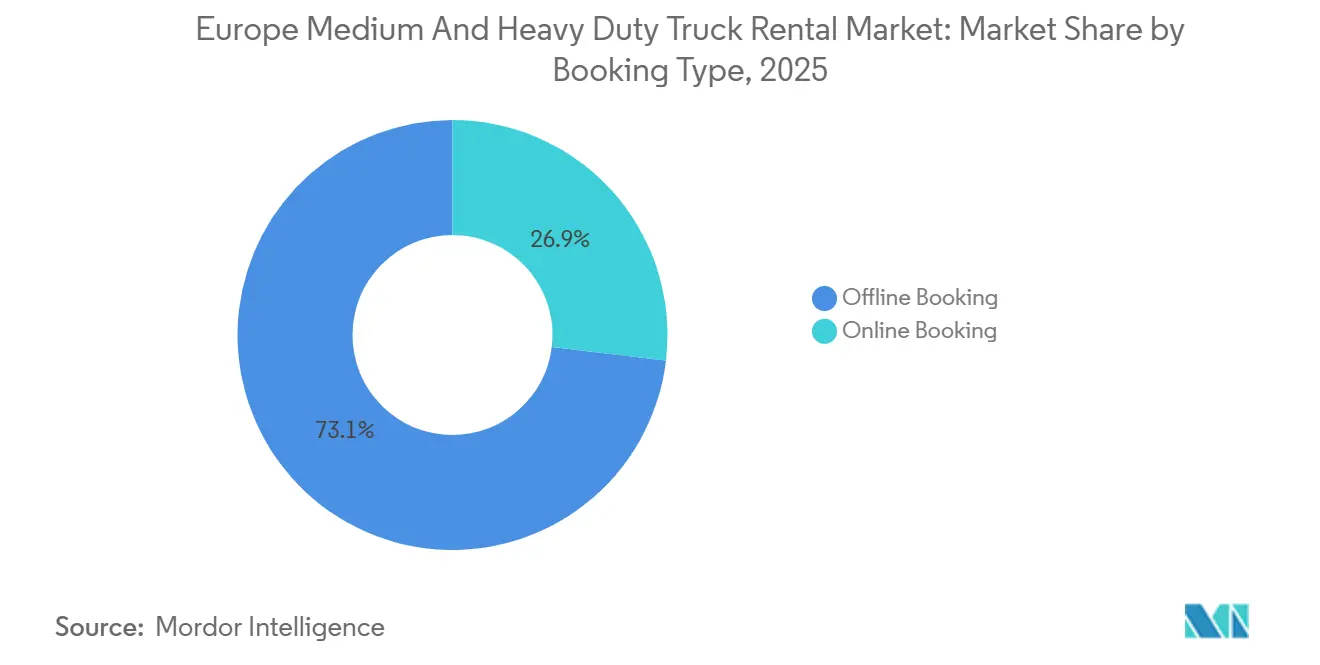
Digital Channels Erode Offline DominanceOffline booking accounted for 73.14% of rental volume in 2025, a dominance rooted in direct relationship selling for complex multi-year contracts. Online portals are expanding at a 5.99% CAGR as platforms such as Saloodo! and Uber Freight automate pricing and reservation workflows. Germany and the Netherlands lead adoption because high e-commerce penetration forces logistics managers to secure trucks within hours rather than days. Dynamic price discovery on digital channels lets lessors fine-tune rates in line with regional utilization, a flexibility unattainable through phone-based negotiations.
Carriers without dedicated procurement teams gain particular value from 24/7 access and transparent tariffs, prompting small and midsize firms to shift incremental capacity online. Offline channels still dominate contracts that bundle bespoke maintenance, insurance riders, and telematics integrations, but configurators and chatbots are narrowing that service gap. The European medium and heavy-duty truck rental market benefits as digital self-service lowers transaction costs and improves fleet utilization, reinforcing the structural pivot toward data-driven asset allocation.
By Rental Type:
Short-Term Flexibility Gains GroundLong-term leasing captured 63.27% of 2025 spending because it spreads costs and embeds services, yet short-term contracts are growing at a 6.03% CAGR through 2031. Postal and e-commerce operators regularly rent trucks for one- to three-month windows to cover fourth-quarter peaks, then return assets in January. Construction firms display similar seasonality, ramping volumes in warm months and scaling back in winter. Mercedes-Benz CharterWay’s 2025 rollout of more than 100 eActros 600 tractors includes 90-day trial packages that let customers test charging logistics before committing to multiyear agreements.
Interest-rate pressure further tilts economics toward rental over ownership, with the European medium and heavy-duty truck rental market capturing operators reluctant to lock in multi-year capital commitments. Long-term leases remain indispensable for general freight carriers seeking predictable cost structures, but incremental growth leans toward flexible tenures aligned with volatile demand cycles.
By Truck Class:
Heavy-Duty Assets Drive Volume and GrowthHeavy-duty vehicles above 16 tonnes accounted for 57.61% of 2025 rentals and are advancing at a 6.16% CAGR, as cross-border freight favors high payload and range. TCO parity for battery-electric tractors in 2025-2026 accelerates the segment’s electrification, aided by toll exemptions that last through 2031. Medium-duty trucks between 7.5 and 16 tonnes serve municipal and last-mile routes, but growth trails that of heavy-duty trucks because frequent stops exacerbate driver shortages and limit daily kilometers.
Rental companies prioritize heavy-duty electrics to maximize KsNI and DKTI subsidies, making them the most cost-effective compliance pathway. Medium-duty electrics such as the eEconic are gaining traction in refuse collection mandates, yet their lower annual mileage extends payoff periods. Overall, the European medium- and heavy-duty truck rental market channels capital to classes with the strongest utilization outlook and the greatest subsidy leverage.
By End-User Industry:
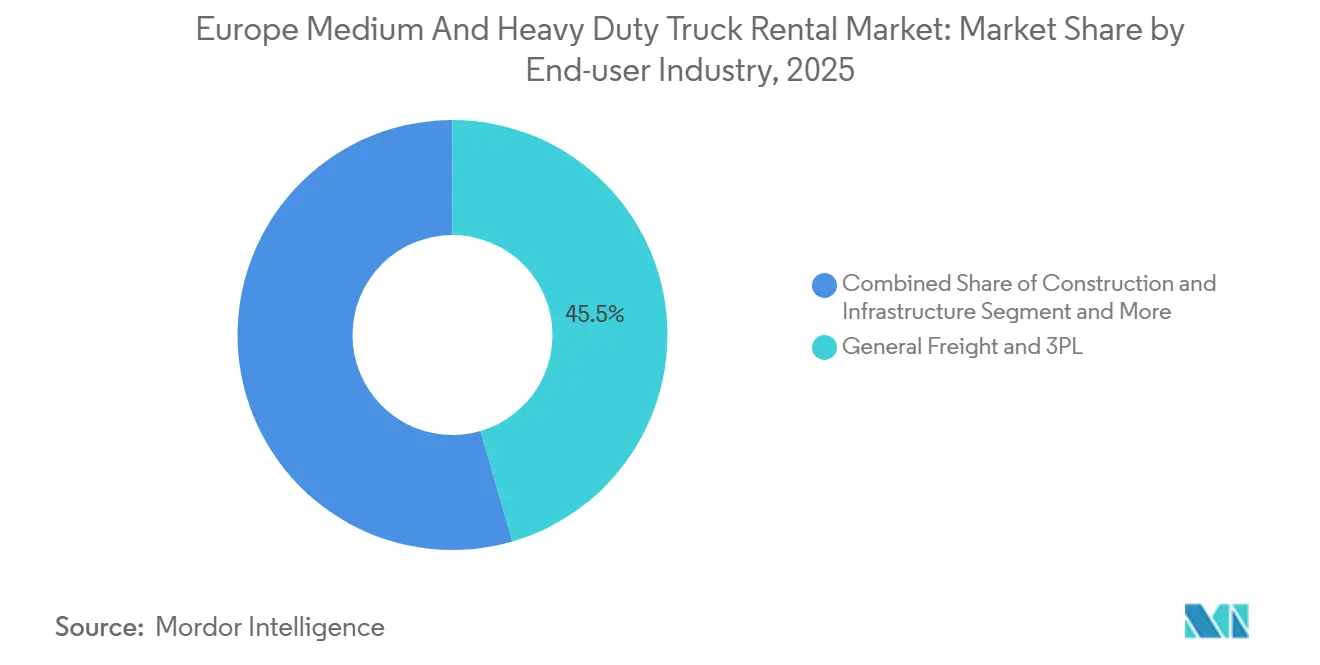
E-Commerce Outpaces General FreightGeneral freight and 3PLs accounted for 45.54% of 2025 demand, underscoring their role in intra-European trade, while postal, parcel, and e-commerce operators are expanding at a 6.07% CAGR as online retail surges. DHL and UPS already lease incremental tractors each November, returning units after the holiday rush. Construction shows similar cyclical patterns tied to building-season weather, whereas FMCG fleets maintain steadier flows tied to grocery replenishment.
Zero-emission mandates are opening a niche for municipal and waste services that rent electric trucks rather than purchase assets with uncertain residual values. Volvo’s electric refuse chassis and Mercedes-Benz’s eEconic meet Paris and Amsterdam collection mandates for 2028. Seasonality creates revenue volatility for lessors, but dynamic pricing engines and predictive analytics help smooth fleet utilization, preserving margins while supporting the European medium and heavy-duty truck rental market’s diversification.

By Propulsion Type:
Diesel Dominance Erodes as Electric TCO Reaches ParityDiesel retained a 87.73% share in 2025 because fueling infrastructure is ubiquitous and upfront costs are lower. Battery-electric trucks, however, are growing at a 6.13% CAGR as KsNI, DKTI, and French subsidies compress capital outlays and the EU extends zero-emission toll relief. LNG/CNG remains a transitional niche supported by Shell’s station network but faces uncertain post-2030 emission rules. Hybrid trucks struggle to justify the complexity compared with diesel’s ever-tightening NOx controls.
Grid connection delays hamper charger rollout, with German permitting taking 18–24 months despite EUR 1.6 billion earmarked for depot infrastructure. Large lessors with balance-sheet capacity and OEM pipelines absorb the electrification risk, while smaller independents confront potential consolidation. As electric range improves and megawatt charging pilots emerge, the European medium and heavy-duty truck rental market is poised for a structural propulsion shift toward zero-emission fleets.
Geography Analysis
Western Europe Medium and Heavy Duty Truck Rental Market
Germany captured 28.83% of 2025 revenue due to its central location for freight and federal charger investment. The Netherlands, however, is forecast to record a 6.11% CAGR. As the Port of Rotterdam sees its throughput expand, the DKTI subsidy now offers substantial financial support for each electric truck. France is reaping the rewards of a significant grant pool, hastening the electrification of its postal and parcel services. Meanwhile, the UK faces challenges: Brexit-induced driver shortages are limiting potential utilization gains.
Southern, Eastern and Northern Europe Medium and Heavy Duty Truck Rental Market
While Spain and Italy experience slower growth due to fragmented logistics and a shallower e-commerce penetration, TIP Group's strategic eastward expansion is spotlighting Poland. Once merely a transit point, Poland is now emerging as a pivotal bridge to Ukraine and the Baltics, poised for above-average growth, bolstered by EU cohesion funds. In Scandinavia, autonomous electric trucks are being piloted on less-trafficked corridors. In contrast, Eastern Europe remains tethered to diesel, hampered by sparse charging networks.
Germany, France and Benelux Medium and Heavy Duty Truck Rental Market
Carbon pricing introduces another layer of complexity. Starting in the near future, the ETS extension will increase diesel operating costs. This shift makes battery-electric rentals increasingly appealing, especially on toll-heavy routes connecting Germany, France, and Benelux. In urban centers like Munich, Paris, and Amsterdam, zero-emission zones are tightening the resale windows for diesel assets. This pressure is pushing lessors to accelerate their electrification efforts to safeguard their balance sheet values. Furthermore, Germany's automated license-plate recognition system is ensuring compliance, setting a precedent that other EU member states are beginning to follow.
Regulatory Landscape
EU CO2 policy for heavy-duty vehicles is tightening and reshaping fleet economics for rental and leasing operators. Regulation (EU) 2024/1610 (adopted 14 May 2024) reinforces CO2 emission performance standards for new heavy-duty vehicles, linking OEM product planning to the availability of low- and zero-emission models that lessors can source. In April 2026, Regulation (EU) 2026/1046 amended Regulation (EU) 2019/1242 by introducing targeted flexibility for manufacturers to collect emission credits during 2025-2029 when their specific CO2 emissions come in below the target, a mechanism connected to the practical pace of charging and infrastructure rollout.
Road charging rules are also being aligned more explicitly with CO2 classes, increasing the need for operators to manage toll exposure through vehicle choice and contract duration. The Eurovignette framework (Directive 1999/62/EC) enables CO2-differentiated charging for heavy-duty vehicles, with updated implementation provisions referenced as effective from 1 July 2026. For rental providers, reinforced CO2 standards and CO2-based tolling increase the value of compliant, newer assets and support demand for full-service contracts that shift compliance and technology risk away from end users.
Value Chain Analysis
The value chain begins with truck OEMs and their captive or partner leasing arms supplying medium- and heavy-duty assets. Rental and leasing operators then configure vehicles, finance fleets, and deliver full-service packages, including maintenance, telematics, insurance, and uptime support, through workshop networks and roadside partners. Customers include 3PLs, general freight carriers, construction fleets, and postal and parcel operators that procure capacity via offline account management for complex multi-year deals and increasingly via online platforms for short-duration needs. Fleet remarketing and residual-value management close the loop, as lessors balance de-fleeting timing against tightening urban access rules and changing diesel resale windows.
Two policy-linked inputs increasingly show up in day-to-day operations: toll and charging economics. Directive (EU) 2025/2459 (adopted 26 November 2025) extends the window for Member States to apply significantly reduced charges or full exemptions for zero-emission heavy-duty vehicles to 30 June 2031, strengthening the case for electrified rental fleets on toll-heavy corridors. At the same time, AFIR-driven infrastructure milestones scheduled for 2026 raise the role of charging access as a service component, making depot grid connections, site permitting, and high-power charger sourcing key bottlenecks that affect fleet utilization, contract terms, and the pace of electrification across major European routes.
Competitive Landscape
In the European medium- and heavy-duty truck rental market, TIP Group stands out with its extensive fleet, claiming the largest independent share but accounting for only a relatively small portion of the market's revenue. Meanwhile, OEMs are innovating: Mercedes-Benz CharterWay bundles a significant number of eActros 600 tractors into its Truck-as-a-Service, complete with maintenance, insurance, and telematics, sidestepping traditional lessors. On another front, PACCAR Leasing taps directly into DAF CF Electric units, offering fleets compliant with Euro 7 standards, all without the hassle of customer subsidy paperwork.
Digital freight platforms are shaking up the scene by introducing asset-light competition through the aggregation of third-party capacity. Notably, DKV Mobility’s Saloodo! and Uber Freight’s European division harness real-time matching algorithms, boosting fleet utilization but tightening rental margins. In response, lessors are turning to predictive analytics, cutting downtime significantly, and employing dynamic pricing engines to navigate demand fluctuations.
Strategic moves in the market are increasingly centered on scaling electric fleets. TIP Group has placed a substantial order for electric trucks, while Fraikin aims to secure a notable number of zero-emission units in the near future. Smaller players are eyeing mergers or partnerships with OEMs to mitigate the costs of Euro 7 compliance. Additionally, ACEA’s suggested open telematics standard, if embraced, could democratize data integration, leveling the competitive playing field.
Europe Medium And Heavy Duty Truck Rental Industry Leaders
-
TIP Group
-
Fraikin SAS
-
Ryder System Inc.
-
Penske Truck Leasing
-
PACCAR Leasing Company
- *Disclaimer: Major Players sorted in no particular order
Europe Medium And Heavy Duty Truck Rental Market Companies Covered in this Report
- TIP Group
- Fraikin SAS
- Ryder System Inc.
- Penske Truck Leasing
- PACCAR Leasing Company
- Heisterkamp Transportation Solutions
- Easy Rent Truck & Trailer GmbH
- Mercedes-Benz CharterWay
- Scania Group
- SIXT SE
- Enterprise Flex-E-Rent
- Dawsongroup Truck & Trailer
- DKV Mobility
Market Opportunities and Future Outlook
A key whitespace is turnkey electric truck rental that packages vehicles with charging access planning and predictable cost structures, reducing adoption friction for carriers navigating Euro 7 and CO2-based toll pressure. The 26 November 2025 adoption of Directive (EU) 2025/2459, extending zero-emission heavy-duty toll relief to 30 June 2031, provides a durable operating-cost lever for lessors that can place battery-electric trucks on high-toll routes and incorporate that benefit into rental pricing. Supply-side signals also point to faster electrification at the fleet level, including Daimler Truck adding the eActros 600 to Mercedes-Benz CharterWay rental fleets (June 2025), alongside rental-focused electrification efforts such as the Scania-Sennder joint venture Juna, which confirmed a target of 200 battery-electric trucks by end-2026.
Regulatory and compliance uncertainty is also creating room for shorter-duration and usage-based products. The 1 July 2026 enforcement date for tachograph rules affecting 2.5 to 3.5 tonne vans in international transport narrows the regulatory gap between light-vans and heavy-duty operations, giving logistics operators more flexibility to use rentals when network design or cross-border compliance changes. In practice, offerings that combine pay-per-kilometer pricing, route simulation, and fleet sizing analytics are becoming more relevant commercially for small and midsize carriers looking to hedge residual-value and infrastructure risks while still meeting customer service levels during peak seasons.
Recent Industry Developments in Europe Medium And Heavy Duty Truck Rental Market
- April 2026: The EU adopted Regulation (EU) 2026/1046, amending the heavy-duty CO2 standards framework to provide manufacturers targeted flexibility for collecting emission credits during the 2025-2029 reporting period. By adjusting how credits are earned versus targets, the change influences the pace and mix of compliant new-truck supply reaching lessors, which in turn affects rental fleet refresh cycles and availability of low-CO2 models.
- January 2026: TIP Group and MAN Truck & Bus signed a three-year framework agreement for delivery of up to 1,800 trucks across 18 European countries during 2026-2028, covering diesel and battery-electric vehicles from 7.5 to 42 tonnes. Securing multi-year vehicle supply at scale supports fleet modernization and improves the ability to serve both long-term leasing and peak-demand rental requirements across cross-border corridors.
- August 2025: Daimler Truck Financial Services Germany launched eService Leasing, combining financing with service contracts and optional add-ons aimed at simplifying electric truck adoption. The bundled approach supports Truck-as-a-Service style offers in the rental and leasing channel by reducing operational complexity for fleets evaluating battery-electric trucks.
Europe Medium And Heavy Duty Truck Rental Market Report Scope and Research Methodology
Market Definition and Coverage
This market covers revenues earned from renting medium-duty and heavy-duty trucks to customers across Europe, including short-term rentals and longer-term leasing-style contracts, where the customer pays for access to the vehicle for an agreed duration.
Scope exclusions: It excludes outright truck sales, trailer-only rentals, and in-house captive fleets that are used only for a companys own transport needs.
Segments Covered in This Report
- By Booking Type
- Offline Booking
- Online Booking
- By Rental Type
- Short-term Leasing
- Long-term Leasing
- By Truck Class
- Medium-Duty (7.5-16 t)
- Heavy-Duty (Above 16 t)
- By End-user Industry
- General Freight and 3PL
- Construction and Infrastructure
- Retail and FMCG
- Postal, Parcel and E-commerce
- Waste and Municipal Services
- By Propulsion Type
- Diesel
- Battery-Electric
- LNG / CNG
- Hybrid
- By Country
- Germany
- United Kingdom
- France
- Spain
- Italy
- Netherlands
- Poland
- Rest of Europe
Data Sources, Market Sizing, and Validation
Desk Research
Desk work started with framing a fact base for the European truck parc, new registrations, and freight activity, because these signals shape rental replacement and utilization. We referenced public sources such as Eurostat transport statistics, the European Commission mobility and emissions publications, national vehicle registration agencies, and customs trade releases where relevant for fleet imports and exports.
To keep pricing and operating assumptions realistic, we also reviewed company annual reports and investor presentations, industry association updates (such as road transport and leasing bodies), and reputable press coverage of fleet demand and contract terms. When needed, paid subscriptions for company financials and news, and an import export shipment-level database, were used to sanity check revenue intensity and cross-border fleet movement patterns. These sources are illustrative, and many other public materials were also used for data collection, validation, and clarification.
Primary Interviews and Surveys
Primary work focused on rental and leasing operators, fleet managers, and ecosystem experts who track demand by truck class and contract duration. Interviews and surveys were used to confirm Europe-level utilization ranges, typical contract mix, and how rates shift with seasonality, emissions rules, and supply tightness across major markets.
Distribution of primary research fieldwork respondents
| Company type | Respondent position |
|---|---|
| Top tier: 39% | CXOs: 16% |
| Mid tier: 41% | Functional/Unit leaders: 27% |
| Smaller Players: 20% | Managers: 57% |
Market-Sizing & Forecasting
Sizing was built using a top-down approach where the demand pool is reconstructed from active fleets, rental penetration by use case, and the average revenue generated per truck under different contract types, and then converted into a consistent Europe total. To keep the totals honest, results were checked with selective bottom-up approximations, such as roll-ups of sampled operator revenues, country channel checks, and ASP times utilization snapshots for a few high-visibility corridors.
A few inputs matter most in this market, so we kept them explicit in the model. These include the split between medium-duty (7.5 to 16t) and heavy-duty (above 16t) trucks, the share of long-term leasing versus short-term contracts, offline versus online booking mix, utilization days, and day-rate or month-rate progression under inflation and financing conditions. For forecasting, scenario analysis was used around macro and logistics cycles, and the forward path was aligned to expert views on fleet replacement timing, regulatory cost pressure, and expected normalization of supply constraints. When a country data gap appeared, it was filled using proxy indicators like truck parc, freight intensity, and nearby market rate patterns, and then re-tested in primary checks.
Data Validation & Update Cycle
Before sign-off, outputs are compared against independent signals like registration trends, fleet parc direction, operator commentary on utilization, and visible shifts in long-term versus short-term contracting. Any sharp variance is investigated, and if it cannot be explained by a clear driver, assumptions are revisited and selective respondents are re-contacted to confirm what changed.
The work goes through more than one analyst review so arithmetic, units, and country roll-ups stay consistent. Reports are refreshed annually, and interim updates are made when material events occur, such as major regulatory moves, demand shocks, or step changes in rate levels. Right before delivery, a fresh pass is completed so clients receive the most up-to-date view.
Mordor Intelligence's Europe Medium and Heavy Duty Truck Rental Leasing Market Size Measured Against Other Published Estimates
It is normal to see different market size values for this space because publishers do not always count the same services, geographies, or truck classes, even if the title sounds similar. Numbers can also drift when day-rate assumptions, utilization, and currency timing are handled differently, which then changes how fast the market scales in the model.
The main spread usually comes from scope choices, especially whether CIS countries are added to Europe, whether full-service leasing bundles are treated as in-scope revenue, and how medium-duty and heavy-duty definitions are applied in practice. Another driver is how long-term leasing is valued, since some studies treat it as a finance-style product and others treat it as a rental service with operational add-ons, which changes reported totals.
Benchmark comparison
| Source | Market Size | Gaps in Research Methodology |
|---|---|---|
| Mordor Intelligence | USD 16.53 B (2025) | |
| Regional Consultancy A | USD 71.30 B (2024) | This figure blends Europe with CIS coverage and also emphasizes full-service leasing bundles, which expands the counted revenue pool beyond a Europe-only rental market view. |
| Trade Publisher B | USD 17.48 B (2026) | The timing differs by using a later base year and a slightly different forecast window, and the write-up suggests a rental-focused scope where leasing-style contracts may be treated differently across contract durations. |
The table shows that the largest gap is driven by geography and what is counted inside leasing-related services, and not by one single growth assumption. By keeping Europe as the geography and treating long-term leasing as a rental-type contract only when it is truck access revenue, the total stays traceable to fleet, utilization, and rate inputs used by Mordor Intelligence.
Key Questions Answered in the Report
What is the projected value of the European medium and heavy-duty truck rental market in 2031?
It is forecast to reach USD 23.41 billion by 2031.
Which truck class is growing fastest in Europe’s rental segment?
Heavy-duty vehicles above 16 tonnes are expanding at a 6.16% CAGR through 2031.
Why are battery-electric rentals gaining traction among European carriers?
Subsidies in Germany, France, and the Netherlands compress upfront costs, while zero-emission toll exemptions through 2031 lower operating expenses.
How are rising interest rates influencing rental demand?
Policy rate elevates financing costs for purchases, making off-balance-sheet leasing more attractive.
Which European country shows the fastest rental market growth?
The Netherlands is projected to record a 6.11% CAGR from 2026 to 2031 due to port expansion and generous DKTI subsidies.
What major challenge limits rental fleet utilization in the near term?
Shortage of commercial drivers across Europe constrains how many rented trucks can be staffed and operated.