
Market Overview
| Study Period | 2020 - 2031 |
|---|---|
| Forecast Data Period | 2026 - 2031 |
| Base Year Market Size (2025) | USD 1.89 Billion |
| Market Size (2026) | USD 2.18 Billion |
| Market Size (2031) | USD 4.45 Billion |
| Growth Rate (2026 - 2031) | 15.32 % |
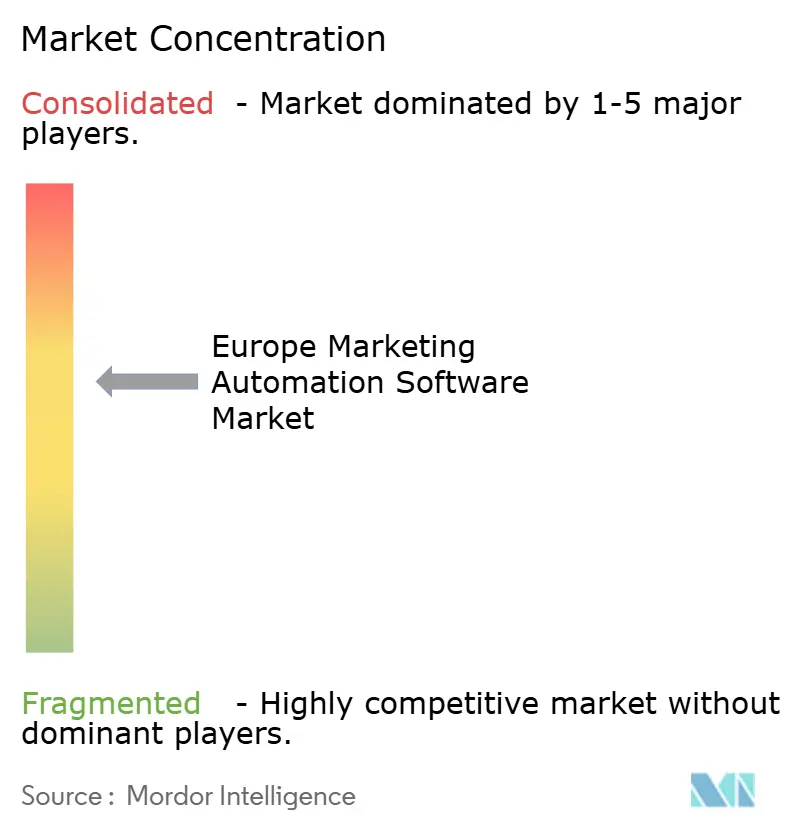
| Market Concentration | Medium |
Major Players *Disclaimer: Major Players sorted in no particular order Image © Mordor Intelligence. Reuse requires attribution under CC BY 4.0. | |
Europe Marketing Automation Software Market Analysis by Mordor Intelligence
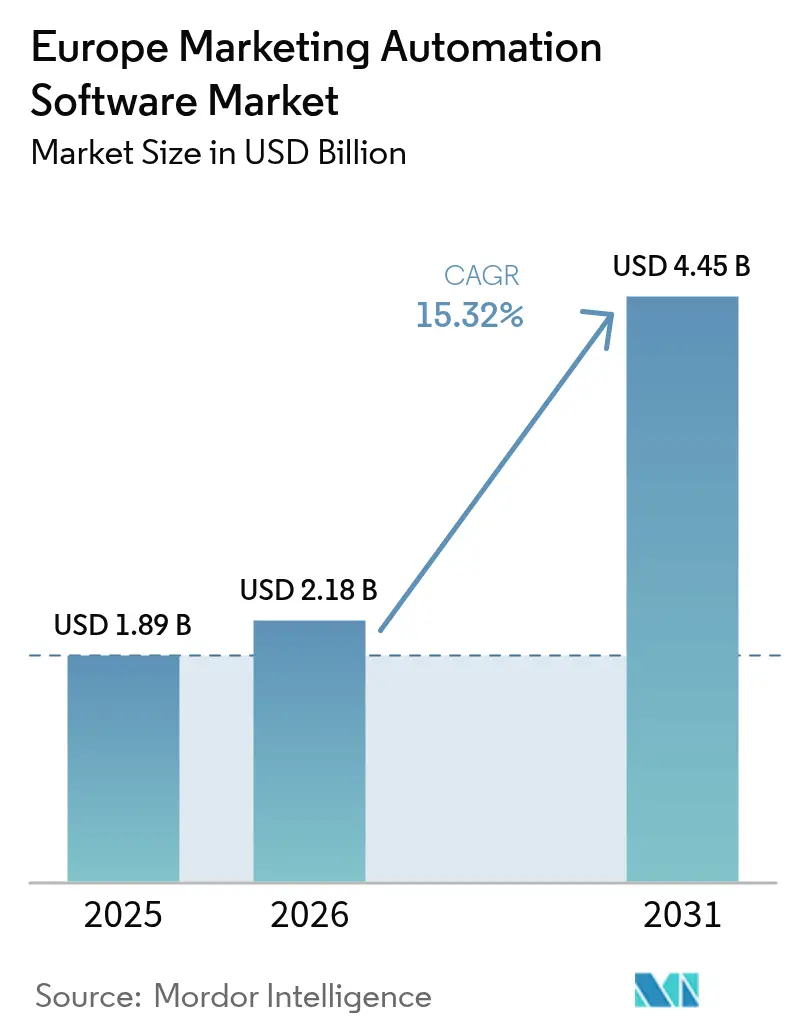
The Europe marketing automation software market size was valued at USD 1.89 billion in 2025 and estimated to grow from USD 2.18 billion in 2026 to reach USD 4.45 billion by 2031, at a CAGR of 15.32% during the forecast period (2026-2031). [1] Ongoing EU Digital Single Market measures that target 75% cloud adoption by 2030, together with the EUR 7.9 billion (USD 8.55 billion) Digital Europe Programme, underpin near-term expansion by subsidizing SaaS adoption among small and medium-sized enterprises. Meanwhile, the region’s EUR 887 billion (USD 960 billion) e-commerce economy in 2023 fuels demand for customer-centric engagement tools that remain compliant with GDPR while still delivering granular personalization. Competitive intensity is increasing as global platform vendors reinforce European footprints while local specialists differentiate through multilingual and regulatory expertise. Cloud deployment models dominate because they offer scalable compliance controls, yet the fastest corporate spending shift is toward managed services that bundle technology with GDPR-fluent implementation talent. Germany’s 18.5% CAGR and the DACH–Nordics focus on AI-driven personalization highlight the link between AI readiness and marketing automation uptake, whereas EU AI Act obligations and a scarcity of certified data-privacy architects temper roll-out velocity.
Key Report Takeaways
- By component, software led with 71.30% revenue share of the Europe marketing automation software market in 2025; managed services are advancing at a 15.92% CAGR through 2031.
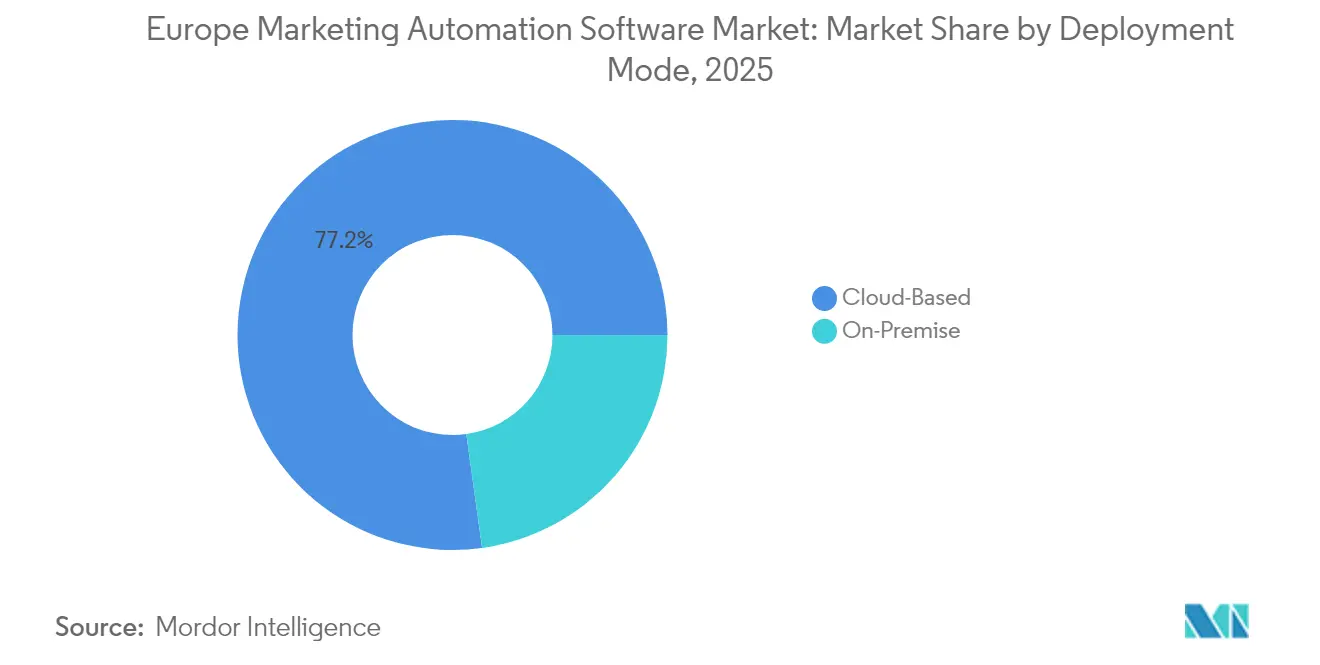
- By deployment mode, cloud solutions held 77.20% share of the Europe marketing automation software market in 2025, while cloud remains the fastest-growing option at a 15.62% CAGR to 2031.
- By organization size, large enterprises accounted for 59.20% of Europe marketing automation software market share in 2025; the SME segment is projected to expand at 17.32% CAGR to 2031.
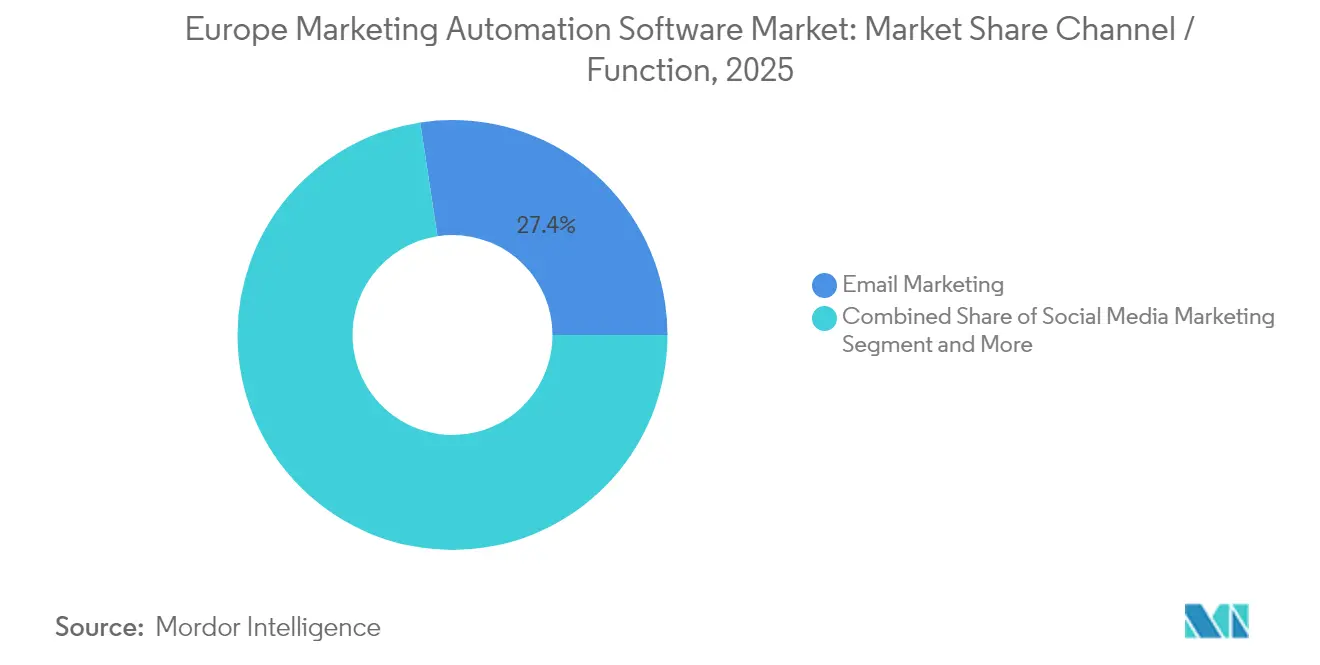
- By channel/function, email marketing commanded 27.40% share of the Europe marketing automation software market size in 2025, whereas customer-journey orchestration is forecast to grow at 17.48% CAGR.
- By end-user industry, retail and e-commerce captured 23.60% of the Europe marketing automation software market size in 2025; BFSI is delivering the fastest CAGR at 15.98% through 2031.
- By geography, the United Kingdom contributed 33.40% revenue in 2025; Germany posts the strongest country-level CAGR at 18.12% through 2031.
Note: Market size and forecast figures in this report are generated using Mordor Intelligence’s proprietary estimation framework, updated with the latest available data and insights as of 2026.
Market Trends and Insights
Drivers Impact Analysis of Europe Marketing Automation Software Market*
| Driver | (~) % Impact on CAGR Forecast | Geographic Relevance | Impact Timeline |
|---|---|---|---|
| AI-Powered Personalisation Surge in DACH and Nordics E-commerce | +3.2% | Germany, Netherlands, Nordics | Medium term (2-4 years) |
| EU Digital Single-Market Initiatives Boosting SME SaaS Uptake | +2.8% | EU-wide, concentrated in DACH | Long term (≥ 4 years) |
| Account-Based Marketing Adoption in B2B Tech Hubs | +2.1% | Netherlands, Germany, UK | Short term (≤ 2 years) |
| Open-Banking API Integration in European Financial Services | +1.9% | UK, Germany, France | Medium term (2-4 years) |
| Multi-Lingual Journey Orchestration Across Fragmented Markets | +1.7% | EU-wide, emphasis on multilingual regions | Long term (≥ 4 years) |
| Source: Mordor Intelligence | |||
AI-Powered Personalisation Surge in DACH and Nordics E-commerce Drives the Market
AI-enabled engines have permeated DACH and Nordic retail, with 65% of executives naming AI a core growth lever in 2025. [2] Marketers exploit the regions’ advanced cloud infrastructure and high data-sharing consent rates to roll out recommendation models that elevate conversion. Telmore recorded an 11% uplift in sales after adopting AI-driven personalization, illustrating quantifiable ROI that accelerates peer adoption. As 80% of companies earmark higher AI budgets yet only 12% prove ROI, early adopters with strong measurement frameworks gain competitive distance. German practitioners use generative AI to streamline campaign production and reporting, cutting repetitive tasks and redeploying staff toward analytics. Consequently, the DACH–Nordic corridor functions as a test bed for next-wave personalization capabilities that subsequently diffuse across Europe.
EU Digital Single-Market Initiatives Boosting SME SaaS Uptake
The EUR 7.9 billion (USD 8.55 billion) Digital Europe Programme lowers barriers for SMEs by harmonizing cloud regulations and funding European Digital Innovation Hubs that provide hands-on guidance. Standardized APIs improve data portability, easing integration among disparate marketing applications and mitigating vendor lock-in risks. Cloud adoption among EU enterprises stands at 41% and is slated to reach 75% by 2030, translating into a sizeable new customer pool for SaaS-based marketing automation. These policy tailwinds curtail compliance complexity for mid-market buyers and amplify addressable demand within the Europe marketing automation software market.
Account-Based Marketing Adoption in B2B Tech Hubs Drives the Market
European B2B software vendors confront long buying cycles and multi-stakeholder purchasing, prompting a shift toward account-based marketing (ABM). Dutch and German tech clusters spearhead ABM deployment, combining AI insights and predictive scoring to pinpoint high-value accounts. Vendors that seamlessly integrate ABM modules with CRM workflows win traction because they unify pipeline visibility across marketing and sales teams. Growth in hybrid working intensifies the need for synchronized digital interactions, reinforcing ABM as a mainstream tactic in the Europe marketing automation software market.
Open-Banking API Integration in European Financial Services Drives the Market
PSD2-mandated open banking compels financial institutions to enable secure data sharing, allowing marketers to tie real-time transaction triggers to personalized messaging. Nearly 90% of European banks already utilize unified communications platforms, and 62% plan larger IT budgets to speed up digital initiatives. Marketing automation tools that can ingest banking APIs and adhere to stringent security norms position BFSI users to realize 16.2% CAGR in platform spend. Vendors that map regulatory reporting straight into their data pipelines reduce compliance overhead for clients and consolidate stickiness.
Restraints Impact Analysis of Europe Marketing Automation Software Market*
| Restraint | (~) % Impact on CAGR Forecast | Geographic Relevance | Impact Timeline |
|---|---|---|---|
| Scarcity of GDPR-Fluent Marketing-Automation Architects | -2.4% | EU-wide, acute in smaller markets | Short term (≤ 2 years) |
| High TCO for Multi-Language Personalisation Modules | -1.8% | Multilingual regions, fragmented markets | Medium term (2-4 years) |
| Stringent EU Anti-Spam Rules Impacting Email Deliverability | -1.3% | EU-wide, varying enforcement | Long term (≥ 4 years) |
| Source: Mordor Intelligence | |||
Scarcity of GDPR-Fluent Marketing-Automation Architects
Implementation projects increasingly stall because only a narrow cadre of professionals combines martech proficiency with legal insight. Banking workforce realignment illustrates cross-industry competition for data specialists after a 21% employment contraction in traditional roles between 2007 and 2022. SMEs are disproportionately affected, leading to a reliance on external managed services, which explains their 16.1% CAGR within the services component. Certification initiatives by European Digital Innovation Hubs provide relief, but near-term talent gaps constrain uptake within smaller economies.
High TCO for Multi-Language Personalisation Modules
Running localized campaigns across 24 EU official languages strains budgets, especially for content adaptation and compliance reviews. Even where AI translation tools exist, brands still fund cultural editing and tone checks that escalate total cost of ownership. Companies phase linguistic expansion, beginning with core markets before incremental roll-outs, slowing revenue capture for vendors. AI localisation advances hold promise, yet human oversight remains mandatory for regulated sectors, maintaining downward pressure on growth for the Europe marketing automation software market.
*Our forecasts treat driver/restraint impacts as directional, not additive. The impact forecasts reflect baseline growth, mix effects, and variable interactions.
Europe Marketing Automation Software Market Segment Analysis
By Component:
Services Acceleration Outpaces Software DominanceSoftware continued to generate 71.30% of Europe marketing automation software market revenue in 2025, though managed services outpaced with a 15.92% CAGR to 2031, underscoring corporates’ preference for outsourced compliance know-how. The services surge signals that enterprises consider technical execution and regulatory validation equally critical as core functionality. Within software, integrated suites eclipse point tools because buyers demand one source of truth for data privacy audits and AI model governance. Professional services thrive on legacy-system integration and GDPR gap analysis, positioning consultancies and system integrators as gatekeepers for vendor selection.
Heightened AI Act scrutiny places a premium on solution blueprints that embed auditability by design. Vendors combine packaged software with advisory retainers, generating annuity-style revenue. The Europe marketing automation software industry will therefore see blended business models, where software margins pair with high-touch services to address dynamic rule-sets spanning GDPR, PSD2, and sector-specific mandates.

By Deployment Mode:
Cloud Infrastructure Drives Regulatory ComplianceCloud options owned 77.20% of the Europe marketing automation software market in 2025, bolstered by EU backing for sovereign and trusted cloud frameworks. Cloud deployments are expanding at 15.62% CAGR because continuous platform updates help clients absorb new data-handling obligations without capex spikes. Marketing teams benefit from elastic compute to run AI models that personalize journeys in real time. On-premise persists only where public-sector or defense clients demand strict data residency.
Regulators favor cloud’s centralized control planes that support automated consent logging, breach notification, and encryption management. This regulatory alignment reduces perceived risk, spurring broader cloud migration. Partnerships, such as Oracle’s tie-up with Palantir for secure EU cloud regions, illustrate how hyperscale providers localize stacks to satisfy sovereignty narratives. As uptake matures, cloud vendors will compete on value-add layers like zero-trust architectures and pre-certified AI sandboxing.
By Organisation Size:
SME Digital Transformation Accelerates Market ExpansionLarge enterprises retained 59.20% revenue share in 2025 yet SMEs will drive volume growth at 17.32% CAGR, reflecting EU subsidies that close affordability gaps. The Europe marketing automation software market size for SMEs is set to expand as European Innovation Council financing of EUR 1.4 billion (USD 1.52 billion) fuels adoption. Freemium packaging, intuitive UX, and self-serve templates shorten onboarding cycles for resource-constrained firms.
In contrast, large enterprises negotiate enterprise-wide licenses with advanced AI tooling, cross-border compliance modules, and premium support SLAs. They also allocate budgets for custom feature requests that embed proprietary algorithms, reinforcing their spending weight. SMEs, however, dominate incremental customer counts, reshaping vendor go-to-market playbooks toward partner-led channels and localized onboarding academies.
By Channel/Function:
Journey Orchestration Disrupts Email Marketing LeadershipEmail remained the top individual channel with 27.40% share in 2025, yet customer-journey orchestration plus analytics is climbing fastest at 17.48% CAGR, redefining feature roadmaps across the Europe marketing automation software market. Brands shifting from campaign blasts to lifecycle management need AI to coordinate content, timing, and channel mix. Adobe’s 2025 Marketo Engage update embeds generative content engines that align messages with behavioral triggers, pointing to escalating innovation cycles.
Orchestration suites integrate inbound, social, mobile, and loyalty datasets into one decision hub, increasing incremental ROI over siloed tools. As measurement sophistication grows, attribution demands unify analytics, pushing vendors to deploy built-in dashboards that surface revenue impact at segment, cohort, and persona levels. Regulatory concerns about consent and tracking cookies accelerate first-party data strategies, further fuelling orchestration uptake.
By End-user Industry:
BFSI Transformation Challenges Retail DominanceRetail and e-commerce delivered 23.60% of the Europe marketing automation software market in 2025 because large catalogues and high purchase frequency make personalization pay off quickly. BFSI’s 15.98% CAGR reflects banks harnessing open-banking APIs for contextual offers that align with transaction events, lifting cross-sell. Use cases extend to credit-card upsell journeys and wealth-management nudges, where compliance logging is mandatory.
Manufacturing, guided by Industry 4.0 digital twins, adopts automation for account-based marketing targeting OEM buyers. Creative Foam’s CRM revamp illustrates how industrial firms leverage segmentation to deepen aftermarket sales. Healthcare, telecom, and public sectors follow, each demanding verticalized consent rules, thus encouraging vendors to package industry accelerators that compress deployment.
Geography Analysis
United Kingdom and Germany Marketing Automation Software Market
The United Kingdom contributed 33.40% of 2025 revenue, benefitting from fintech density, early cloud concession frameworks, and long-standing digital marketing sophistication. Post-Brexit divergence prompts dual compliance architectures that manage both UK GDPR and EU GDPR, incentivizing multi-tenant instances with jurisdiction-aware data routing. Germany rises fastest at 18.12% CAGR as Industry 4.0 factories integrate marketing data streams into PLM and ERP systems while DACH retailers pilot AI personalization engines.
Western Europe and Nordics Marketing Automation Software Market
France emphasizes data-sovereignty certifications like SecNumCloud, pushing vendors to offer localized hosting pods. Italy and Spain exhibit high mobile-commerce growth that propels SMS and WhatsApp automation features. The Netherlands operates as a regional hub for software headquarters, attracting ABM usage that drives platform expansion. Nordic states showcase the most advanced AI personalization use cases due to high digital literacy and willingness to share behavioural data.
Eastern and Southeastern Europe Marketing Automation Software Market
Eastern and South-Eastern Europe, covered under Rest of Europe, benefit from EU Structural Funds and Digital Europe grants aimed at SME digitization, yet purchase cycles remain longer because of budget constraints. EU initiatives standardizing e-commerce taxation and sustainability disclosures reduce compliance burdens, encouraging cross-border marketing campaigns. Vendors that package language packs and country-specific rule templates position themselves to win multi-country tenders, amplifying the addressable share of the Europe marketing automation software market.
Regulatory Landscape
Regulation in Europe is dominated by privacy, communications, and platform-advertising rules that shape how marketing automation vendors collect consent, target audiences, and document automated decisions. GDPR remains the core framework for personal-data processing in marketing workflows, driving platforms toward built-in consent capture, data-subject rights automation (access/erasure/portability), and audit-ready logging. The ePrivacy Directive governs electronic marketing (including email) and often limits the practical use of legitimate interest for outreach in favor of explicit consent or soft opt-in, which makes deliverability and list-hygiene controls a product requirement.
AI governance for martech features embedded into CRM and automation suites is tightening. The EU AI Act entered into force in August 2024, and its transparency obligations (including labeling and disclosure requirements for AI-generated content and AI-mediated interactions) apply from August 2, 2026. This reinforces the need for AI inventories, explainability notes, and documented human oversight for automated campaign steps. The Digital Services Act (Regulation (EU) 2022/2065) also raises expectations around advertising transparency and interface practices, including restrictions on certain forms of behavioral advertising and prohibitions on dark patterns. This affects how automation platforms build ad-disclosure controls, preference centers, and recommender-like targeting features for EU audiences.
Value Chain Analysis
The value chain starts with cloud infrastructure and data foundations (identity, consent, and first-party data capture), then moves into marketing automation core software (email, lead management, orchestration, analytics) and embedded AI layers used for content generation, segmentation, and decisioning. Integrations are a key gate, since connectors to CRM, data warehouses, ad platforms, and commerce systems influence time-to-value, which lifts the importance of iPaaS tools, marketplace apps, and API management.
In Europe, data residency and governance needs add a parallel layer of compliance tooling (policy management, audit trails, encryption/key management, and documentation) that has to move with the workflow across systems. Downstream, channel activation and performance measurement depend on ecosystem partners, including cloud providers, agencies, and system integrators that implement consent, localization, and cross-border rule templates. Recent ecosystem moves illustrate this chain: ActiveCampaign introduced a Google Ads connector in July 2026 to link paid media execution with AI-guided campaign creation and reporting, while Braze announced EU-hosted support for parts of its AI decisioning stack on Google Cloud in April 2026, reflecting how hosting and connector availability can support regulated enterprise deployments. Bottlenecks remain integration complexity, multilingual content operations, and a scarcity of GDPR-fluent implementation talent, which keeps managed services and partner-led delivery central to commercialization across fragmented European markets.
Competitive Landscape
Industry structure shows moderate consolidation. Alphabet’s aborted bid for HubSpot underscored the strategic premium attached to unified marketing, sales, and service stacks. Salesforce invests in autonomous multi-agent systems that cut manual campaign management, while Adobe integrates IBM watsonx AI to bolster compliance-first personalization inside its Experience Platform. Regional players emphasize multilingual orchestration and sector-specific templates.
Platform differentiation revolves around: 1) embedded compliance engines that automate consent retrieval and proof; 2) AI-driven content generation tuned for European languages; and 3) low-code connectors to ERP and banking APIs. Ecosystem alliances matter, as shown by UiPath and HCLTech’s agentic automation lab that packages martech workflows with robotic process automation. SAP’s RISE cloud migration path ensures its ERP clients gain native access to marketing automation modules, expanding the stickiness of its suite. Competitive intensity pivots on time-to-value and the ability to guarantee audit-grade data lineage across journeys.
Europe Marketing Automation Software Industry Leaders
-
Salesforce Inc.
-
Oracle Corporation
-
Microsoft Corporation
-
Hubspot Inc.
-
Adobe Inc.(Marketo Inc.)
- *Disclaimer: Major Players sorted in no particular order
Europe Marketing Automation Software Market Companies Covered in this Report
- Salesforce, Inc.
- Adobe Inc.(Marketo Inc.)
- HubSpot Inc.
- Oracle Corporation
- Microsoft Corporation
- SAP SE
- SAS Institute Inc.
- Act-On Software, Inc.
- Dotdigital Group PLC
- Force24 Ltd.
- ActiveCampaign LLC
- Mailchimp (Intuit Inc.)
- Sendinblue SAS (Brevo)
- GetResponse Sp. z o.o.
- Zoho Corporation
- Pipedrive OU
- SugarCRM Inc.
- Acoustic LP
- Iterable Inc.
- Klaviyo Inc.
Read Analysis of Europe Marketing Automation Software Companies
Market Opportunities and Future Outlook
One opportunity is compliance-first AI and governance features packaged for marketing teams that need to maintain inventories of AI capabilities, document data inputs, and operationalize transparency disclosures. With the EU AI Act transparency obligations applying from August 2, 2026, vendors that ship standardized AI documentation artifacts (feature fact sheets, disclosure logging, approval workflows, and audit trails) alongside core journey orchestration can reduce effort for regulated users that already require proof of consent and traceable decision logic. This also points to partner opportunities for system integrators and managed service providers, since repeatable compliance playbooks can speed deployments where internal GDPR-fluent marketing-automation architects are scarce.
A second opportunity involves EU-hosted and jurisdiction-aware deployment patterns that simplify vendor due diligence and support data residency requirements while enabling AI-assisted personalization. Evidence for this direction includes vendor moves toward EU hosting for AI decisioning components, such as Braze’s hosting initiatives in EU regions on Google Cloud, plus broader product roadmaps emphasizing governance and transparency. Additional whitespace persists in consolidating fragmented point tools into integrated stacks that connect CRM, consent, and paid media execution through robust connectors, reducing integration burden and making cross-border campaigns easier to run with consistent controls across languages and differing interpretations of ePrivacy and GDPR.
Recent Industry Developments in Europe Marketing Automation Software Market
- July 2026: HubSpot announced the acquisition of Warmly to add buyer-intent signals and strengthen AI-assisted selling inside its CRM platform. The acquisition supports tighter alignment between intent data, lead qualification, and automated nurture journeys, reinforcing the convergence of CRM, sales agents, and marketing automation into a single workflow layer for European go-to-market teams.
- September 2025: Salesforce announced a USD 6 billion investment plan for its UK business through 2030, positioning the UK as its European AI hub tied to initiatives such as Agentforce. The commitment signals continued expansion of regional delivery and product engineering capacity that can influence how AI-enabled marketing automation features are developed, localized, and governed for UK and EU customers.
- June 2024: The EU AI Act (Regulation 2024/1689) entered into force, establishing a region-wide framework that later brings transparency obligations for AI-generated content and AI-mediated interactions into operational requirements for martech stacks. This regulatory milestone increased the urgency for marketing automation vendors to build disclosure, documentation, and human-oversight controls directly into orchestration and content-generation features.
Europe Marketing Automation Software Market Report Scope and Research Methodology
Market Definition and Coverage
For this study, the Europe marketing automation software market is defined as revenues earned from licensed or subscription platforms that automate marketing tasks like email campaigns, lead nurturing, workflow triggers, and reporting for business users across Europe.
Scope exclusions: We exclude stand-alone CRM systems, pure-play web analytics tools, and agency service fees that are billed separately from software subscriptions.
Segments Covered in This Report
- By Component
- Software
- Integrated Platforms
- Stand-Alone Tools
- Lead Management
- Social Media
- Email and Analytics
- Services
- Professional Services
- Managed Services
- Software
- By Deployment Mode
- Cloud-Based
- On-Premise
- By Organisation Size
- Small and Medium Enterprises
- Large Enterprises
- By Channel / Function
- Email Marketing
- Social Media Marketing
- Campaign Management
- Mobile / SMS Marketing
- Inbound and Content Marketing
- Other Channels
- By End-user Industry
- Retail and E-commerce
- BFSI (Banking, FinServ and Insurance)
- IT and Telecom
- Manufacturing
- Healthcare and Life-Sciences
- Media and Entertainment
- Government and Public Sector
- Other End-user Industries
- By Country
- United Kingdom
- Germany
- France
- Italy
- Spain
- Netherlands
- Nordics
- Rest of Europe
Data Sources, Market Sizing, and Validation
Desk Research
Desk research was used to set the factual base for the model and to avoid building assumptions in isolation. We reviewed public, non-paywalled references such as Eurostat digital economy indicators, OECD ICT and productivity datasets, European Commission updates on data protection and digital regulation, national statistics portals, and trade and technology association releases tied to marketing and software.
To connect demand with monetization, we also screened annual reports and investor presentations of relevant software providers, plus credible press coverage on pricing, packaging shifts, and buying trends in Europe. Where needed, paid subscriptions for company financials and intelligence, patent databases, and a news and financials service were used to cross-check revenue mix and product direction signals. The sources listed here are illustrative, and many additional public documents were used for collection, validation, and clarification.
Primary Interviews and Surveys
Primary inputs came from interviews and surveys with software providers, channel partners, and enterprise users who run marketing operations and manage budgets. These discussions clarified what counts as marketing automation in practice, how pricing is typically packaged (seat-based, usage-based, or module-based), and how adoption varies by country and industry, before we locked assumptions into the model.
Distribution of primary research fieldwork respondents
| Company type | Respondent position |
|---|---|
| Top tier: 35% | CXOs: 14% |
| Mid tier: 49% | Functional/Unit leaders: 39% |
| Smaller Players: 16% | Managers: 47% |
Market-Sizing & Forecasting
Sizing started with a top-down build where the Europe software spend pool and digital marketing adoption signals were reconstructed into a realistic addressable demand layer, then filtered to marketing automation eligible use cases. We corroborated totals with selective bottom-up approximations, such as sampled vendor revenue checks, channel feedback on average contract values, and volume proxies like customer counts by company size, which helped us adjust for gaps.
Key inputs that shaped the model included cloud versus on-premise mix, automation module attach rates inside broader marketing stacks, average subscription price movements by bundle type, renewal and churn patterns, and country-level maturity signals like marketing digitization intensity and privacy-driven workflow changes. Since pricing and adoption both shift over time, forecasts were built using scenario analysis supported by a small set of macro and tech adoption variables, then tuned using primary feedback on budget cycles, expected platform consolidation, and sales cycle length. Where bottom-up checks were incomplete for smaller suppliers, we applied conservative ranges and aligned them with observed regional price bands and penetration ceilings.
Data Validation & Update Cycle
Outputs were validated through triangulation across independent signals, including vendor disclosures, public adoption indicators, and interview-based pricing reality checks. We ran variance checks by country and by deployment type so outliers could be investigated, and follow-up calls were triggered when a result conflicted with multiple external indicators or when a major packaging change was flagged.
Before sign-off, the model goes through multi-step analyst review so assumptions, conversions, and growth logic stay consistent across the time series. Reports are refreshed annually, and interim updates are made when material events occur, such as regulation changes, sharp currency moves, or major product re-bundling. Right before delivery, a final validation pass is performed so clients receive the latest updated view.
Mordor Intelligence's Europe Marketing Automation Software Market Size Compared With Other Published Estimates
Published market sizes for Europe marketing automation software often do not match because the boundaries are not identical, even when the market name sounds the same. Differences usually show up in what gets counted as marketing automation, whether services are included, and how pricing and currency are treated for the base year.
A refresh-led gap is also common because software pricing is frequently re-bundled, discounts shift by quarter, and exchange rates can move the USD view even when local demand is steady. In this study, quarterly pricing checks, currency timing aligned to the base-year averaging, and re-validation calls after notable packaging changes are the steps that keep the 2025 figure stable, which is why Mordor Intelligence lands at a different total than sources using older price points or a broader software definition.
Benchmark comparison
| Source | Market Size | Gaps in Research Methodology |
|---|---|---|
| Mordor Intelligence | USD 1.89 B (2025) | |
| Industry Publisher A | USD 2.40 B (2025) | Uses a wider software-only scope that can over-count adjacent capabilities, and it is less explicit about aligning base-year currency timing with contract renewal and discount seasonality. |
| Global Publisher B | USD 1.76 B (2025) | Appears to apply more conservative pricing and adoption assumptions for Europe, and the treatment of bundle-led ASP progression is less transparent, which can pull the base-year total down. |
The spread in the table is mainly explained by refresh cadence and by what is included around the core automation module, followed by how ASP changes are carried into the base year. By tying the model to observable adoption signals, realistic subscription pricing, and repeatable validation checks, the final number remains traceable and practical to update when market conditions shift.
Key Questions Answered in the Report
What is the value of the Europe marketing automation software market in 2026 and how fast is it growing?
The market stands at USD 2.18 billion in 2026 and is projected to expand at a 15.32% CAGR to reach USD 4.45 billion by 2031.
Which deployment model is preferred by European buyers?
Cloud-based solutions account for 77.20% of 2025 revenue because they offer scalable GDPR-compliant infrastructure and easier AI upgrades.
Why are small and medium enterprises driving the fastest growth?
EU funding initiatives, freemium pricing, and low-code platforms cut adoption barriers, propelling the SME segment at a 17.32% CAGR through 2031.
Which country shows the highest growth momentum?
Germany leads with an 18.12% CAGR, supported by Industry 4.0 investment and DACH region AI-personalization pilots.
What end-user industry is expanding quickest?
Banking and financial services are increasing spending at a 15.98% CAGR as open-banking APIs enable real-time, regulated customer outreach.
What is the main talent-related obstacle to wider adoption?
There is a shortage of professionals who combine marketing-automation skills with deep GDPR expertise, slowing roll-outs and boosting demand for managed services.