
Market Overview
| Study Period | 2020 - 2031 |
|---|---|
| Forecast Data Period | 2026 - 2031 |
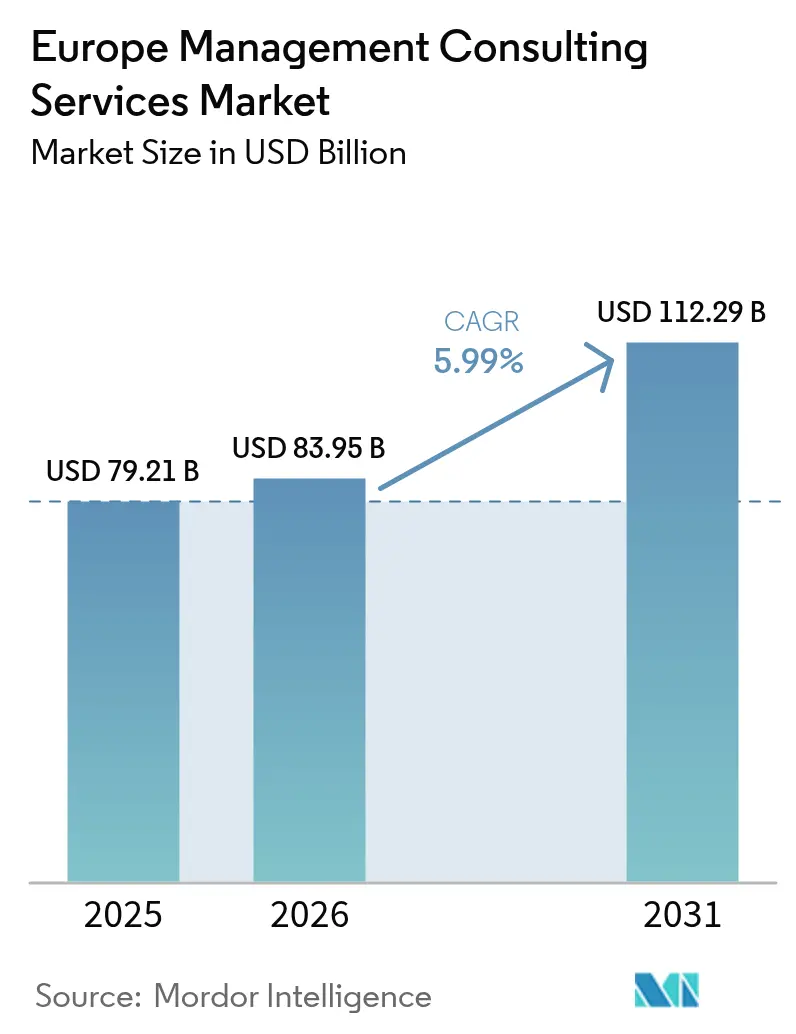
| Base Year Market Size (2025) | USD 79.21 Billion |
| Market Size (2026) | USD 83.95 Billion |
| Market Size (2031) | USD 112.29 Billion |
| Growth Rate (2026 - 2031) | 5.99% CAGR |
| Market Concentration | Medium |
Major Players.webp) *Disclaimer: Major Players sorted in no particular order Image © Mordor Intelligence. Reuse requires attribution under CC BY 4.0. | |
Europe Management Consulting Services Market Analysis by Mordor Intelligence
Europe management consulting market size in 2026 is estimated at USD 83.95 billion, growing from 2025 value of USD 79.21 billion with 2031 projections showing USD 112.29 billion, growing at 5.99% CAGR over 2026-2031. Surging digital-transformation investments, expanding ESG regulations, and accelerating AI adoption position consulting firms as indispensable partners for strategic realignment and operational efficiency. Operations excellence engagements dominate current spending, yet the rapid scale-up of generative-AI programs is shifting wallet share toward digital and analytics advisory. Regionally, DACH retains leadership on the back of Germany’s strong industrial base, while Central and Eastern Europe (CEE) posts the quickest gains as EU funds flow toward modernization. Competitive intensity is rising as boutique specialists and freelance platforms pressure traditional fee structures, prompting the Big Four to double down on technology ecosystems and outcome-based pricing.
Key Report Takeaways
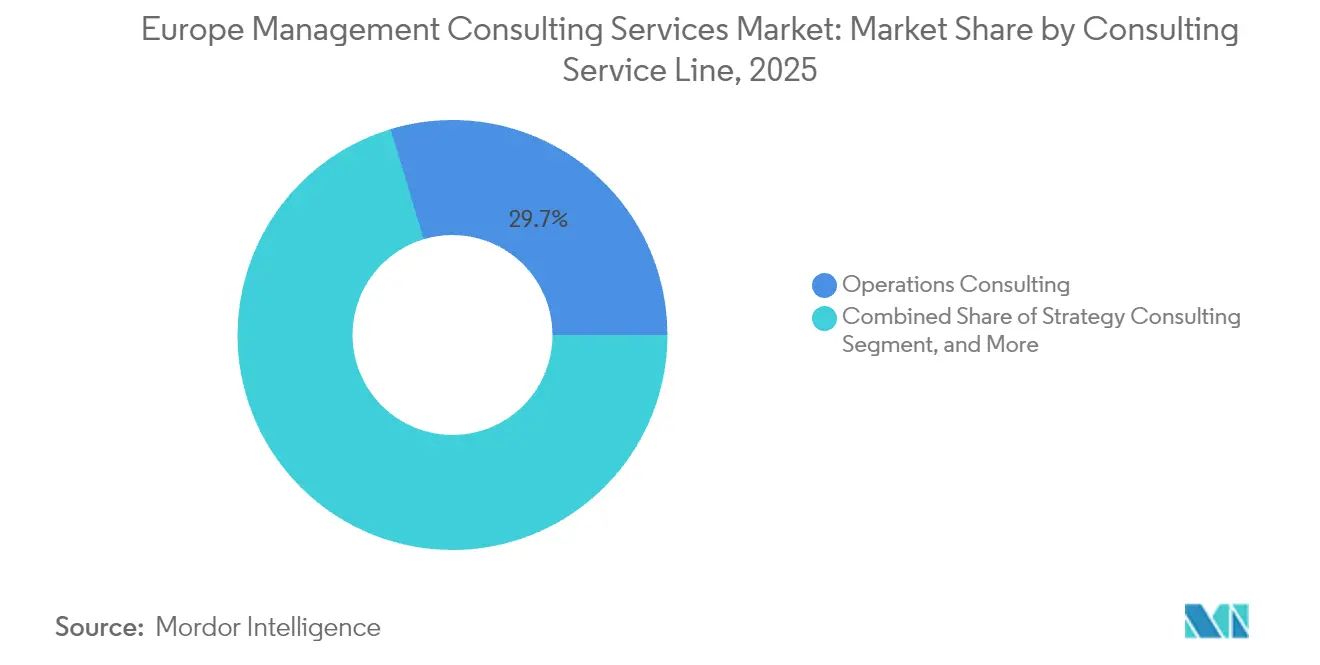
- By consulting service line, Operations Consulting held 29.65% of the Europe management consulting market share in 2025; Digital/AI Consulting is advancing at a 12.29% CAGR through 2031.
- By client industry, Financial Services led with 33.05% share of the Europe management consulting market size in 2025, while Healthcare and Life Sciences posts the fastest 9.92% CAGR to 2031.
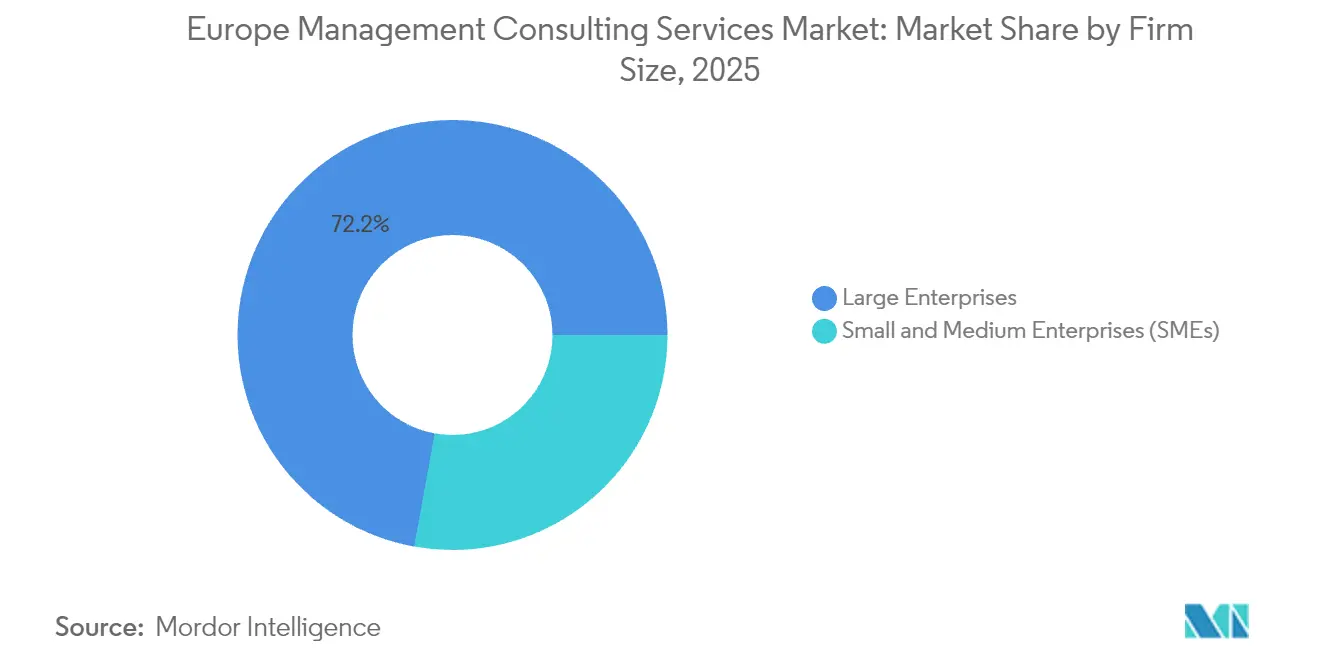
- By firm size, large enterprises accounted for 72.15% of the Europe management consulting market size in 2025, and SMEs are expanding at an 8.33% CAGR on the back of subscription-based models.
- By delivery model, on-site projects captured 57.62 of % Europe management consulting market share in 2025, whereas fully remote delivery recorded the highest 14.71% CAGR to 2031.
- By geography, DACH dominated with 26.28% European management consulting market share in 2025, and CEE is projected to grow at a 7.71% CAGR through 2031.
Note: Market size and forecast figures in this report are generated using Mordor Intelligence’s proprietary estimation framework, updated with the latest available data and insights as of 2026.
Europe Management Consulting Services Market Trends and Insights
Drivers Impact Analysis*
| Driver | (~) % Impact on CAGR Forecast | Geographic Relevance | Impact Timeline |
|---|---|---|---|
| Surge in digital-transformation spending | +1.8% | Global; strongest in DACH and UK | Medium term (2-4 years) |
| Escalating demand for advanced analytics and AI | +1.5% | DACH; Nordics; spillover to Southern Europe | Long term (≥ 4 years) |
| ESG-linked regulatory complexity | +1.2% | EU-wide; notable in DACH and France | Medium term (2-4 years) |
| Cyber-security compliance mandates | +1.0% | EU-wide; focus on Financial Services | Short term (≤ 2 years) |
| Subscription-based consulting uptake | +0.8% | UK and DACH; expanding to Southern Europe | Long term (≥ 4 years) |
| SME decarbonization road-maps demand | +0.6% | EU-wide; Nordic leadership | Long term (≥ 4 years) |
| Source: Mordor Intelligence | |||


Surge in Digital-Transformation Spending
European companies lifted digital-transformation outlays to USD 1.1 trillion in 2024, up 9% year on year, with software and IT services absorbing most of the budget [1]Cognizant, “Gen AI is taking hold in DACH businesses,” cognizant.com. DACH businesses plan average generative-AI investments of USD 37 million during 2025, yet 71% concede progress is lagging due to talent gaps. Industrial icons such as Fresenius cut SAP administration time by 50% following cloud migration, proving hard ROI to boards. Nordic consultancies, now worth EUR 2.77 billion, attribute over one-third of revenue to digital projects. Manufacturing players like Evyap have shaved 23% scrap using IoT analytics, reinforcing demand for end-to-end technology advisory.
Escalating Demand for Advanced Analytics and AI Advisory
Generative-AI adoption moved from proof-of-concept to mission-critical, with 77% of European financial-services leaders expecting significant productivity lifts and 68% predicting job-role redesign within 12 months. Despite appetite, 35% lack concrete upskilling road-maps, opening advisory opportunities. UK consulting firms earmark GBP 1.9 million per firm for AI-capability build-outs through 2026. Partnership ecosystems are pivotal, illustrated by NTT Data’s tie-up with Mistral AI to deliver sovereign enterprise AI for regulated sectors. The Big Four collectively plan more than USD 5 billion in AI platform investments by 2030, signaling long-run advisory capacity expansion.
ESG-linked Regulatory Complexity
The EU’s Corporate Sustainability Reporting Directive (CSRD) introduces 80 disclosure requirements and 800 data points, expanding compliance to roughly 50,000 companies beginning 2024. Double-materiality assessments now inform capital-allocation strategies, embedding consulting support deep in finance and risk functions. BBVA’s ESG-infused digital banking overhaul, underpinned by advisors, produced EUR 8.02 billion profit while growing digital customer acquisition to 65%. SMEs struggle most; although 72% leverage data, specialized ESG expertise remains scarce, driving demand for modular advisory offerings. Consultancies now embed sustainability analytics into core transformation road-maps to secure license-to-operate credentials for clients.
Cyber-security Compliance Mandates
The Digital Operational Resilience Act (DORA) and the NIS2 directive impose binding cyber-security standards on financial entities and critical infrastructure, effective January 2025. European firms allocate 9% of IT budgets to information security, up 1.9 percentage points year on year, while 89% foresee additional hiring to meet NIS2 obligations. Average breach costs have hit EUR 4.4 million, with human error driving 68% of incidents, underlining the need for integrated technical and change-management consulting. Compliance-linked demand accelerates short-cycle assessments, SOC modernization projects, and multi-year cyber-risk governance programs for banks and insurers.
Restraints Impact Analysis*
| Restraint | (~) % Impact on CAGR Forecast | Geographic Relevance | Impact Timeline |
|---|---|---|---|
| Severe talent shortage and attrition | −1.2% | Global; acute in DACH and UK | Short term (≤ 2 years) |
| Fee-rate pressure from professional procurement | −0.8% | EU-wide; mature markets | Medium term (2-4 years) |
| AI-driven self-service strategy platforms | −0.6% | DACH, UK, Nordics | Long term (≥ 4 years) |
| Rise of freelance consulting marketplaces | −0.4% | UK, DACH; gradual EU expansion | Medium term (2-4 years) |
| Source: Mordor Intelligence | |||
Severe Talent Shortage and Attrition
Turnover in European consulting averages 13.25%, with junior attrition at the Big Four hitting 22%, fueled by long hours and burnout. The gap widens in cyber-security, where 76% of staff lack formal credentials, amplifying delivery risk. German firms are hiking salaries 2.5% on average for 2025 as part of retention pushes, with entry-level bumps of 3.5%. Persistent shortages limit project-ramp speed, compelling firms to prioritize margin-rich accounts and further squeeze growth in commoditized workstreams.
Fee-rate Pressure from Professional Procurement
Sophisticated procurement teams leverage macro uncertainty to negotiate down day rates and demand performance guarantees. Deloitte UK saw consulting revenue slip 1% in 2024 under pricing strain. German consultants expect 11.9% growth in 2025 versus 9.4% for international peers, pointing to local price competition and market maturation. Sustainability consulting illustrates the squeeze: basic assignments run GBP 300-400, but specialized ESG expertise climbs past GBP 1,000, forcing firms to prove differential value. Freelance marketplaces intensify the dynamic, creating transparent benchmarks and eroding legacy premium margins.
*Our forecasts treat driver/restraint impacts as directional, not additive. The impact forecasts reflect baseline growth, mix effects, and variable interactions.
Segment Analysis
By Consulting Service Line: Operational Excellence Holds Leadership
Operations Consulting captured 29.65% of the European management consulting market size in 2025 as companies aimed to streamline costs and future-proof supply networks amid volatile demand. Strategy Consulting, while foundational, now ranks behind digital engagements as boardrooms seek tangible quick wins from productivity projects. Digital/AI Consulting is scaling fastest, advancing at a 12.29% CAGR into 2031, fueled by AI roadmap design, data-platform integration, and cloud-migration mandates.
The Europe management consulting market increasingly values specialized sub-services such as sustainability advisory and risk compliance, which spike alongside new EU directives. Technology-centric mandates dominate procurement pipelines; banks like Credit Europe reduced onboarding time from two weeks to 15 minutes after micro-services re-platforming, illustrating payback from tech-led operational redesign . Risk and compliance work accelerates due to DORA and NIS2, while ESG advisory gains momentum under CSRD rules. Firms building cross-domain squads that blend sector expertise with analytics talent are winning multiyear retainer deals.


By Client Industry: Financial Services Stays in Front
Financial Services commanded 33.05% of the Europe management consulting market share in 2025 on the back of regulatory complexity, fintech disruption, and multi-cloud modernization. Healthcare and Life Sciences posts the fastest 9.92% CAGR as providers digitize clinical pathways and pharma accelerates RandD analytics.
In banking, BBVA’s fully digital acquisition engine delivered 11.1 million new customers and EUR 8.02 billion profit, underscoring advisory ROI. Manufacturing workloads emphasize Industry 4.0 retrofits, whereas public-sector projects focus on citizen-experience redesign. Energy, retail, and logistics segments increasingly seek decarbonization blueprints, bundling strategy with execution support. Integration of AI across verticals is broadening addressable spend for consultancies equipped with sectorized IP.
By Firm Size: Enterprise Wallet Dominates, but SME Growth Surges
Large enterprises retained 72.15% of spend in 2025, reflecting their need for full-stack transformation partners across global footprints. Yet SMEs deliver the fastest 8.33% CAGR as modular, subscription-based consulting makes high-quality advice affordable.
Euroclear’s phased transformation showcases enterprise appetite for multi-year programs marrying business and IT alignment. On the SME side, the COSME guarantee facility unlocked EUR 54 billion in financing, spurring outsourced advisory uptake as firms pivot toward e-commerce and cross-border trade. Networked delivery models allow consultancies to blend local talent with remote centers of excellence, optimizing price-to-value ratios for smaller clients.
By Delivery Model: Hybrid Engagements Gain Ground
On-site projects still account for 57.62% Europe management consulting market share, particularly for complex change programs requiring executive alignment and workshop-intensive design. Yet fully remote engagements grow 14.71% CAGR as clients embrace virtual collaboration to cut travel costs and access niche skills.
The Central Denmark Region’s RPA initiative automated 80 processes via a largely remote consulting team, saving 50,000 hours within the first year. Hybrid models that blend short on-site sprints with continuous virtual delivery are emerging as the default for pan-European rollouts, enabling firms to manage carbon footprints and offer competitive pricing.
Geography Analysis
DACH remained the anchor of the Europe management consulting market in 2025, securing 26.28% market share and generating EUR 3.86 billion revenue in Germany alone with 11.9% growth . Strong industrial players and high RandD intensity sustain consulting demand, while Switzerland’s finance-centric economy and Austria’s gateway role to CEE add further momentum. Generative-AI investment plans averaging USD 37 million per firm highlight future advisory pipelines despite talent constraints. Regulatory complexities such as DORA across financial institutions layer in recurring compliance engagements.
The UK and Ireland form Europe’s second-largest consulting cluster, benefiting from London’s global finance hub and Dublin’s tech concentration. The UK market eyes 6.1% growth in 2026 as consultancies earmark GBP 1.9 million each for AI capability build-out. Post-Brexit, firms have opened over 312 regional offices to tap local talent pools and offset wage inflation. Energy-transition projects fuel double-digit growth in Scotland and Northern England, while financial-services compliance remains a London mainstay.
France and Benelux leverage large industrial and public-sector clients; France’s sovereign-cloud strategy accelerated after Carlyle’s EUR 525 million acquisition of Ciril Group. The Nordics, valued at EUR 2.83 billion, excel in digital government, with Sweden growing 6.7%. CEE posts the strongest 7.71% CAGR, propelled by EU structural funds and near-shoring of manufacturing. Poland and Czech Republic are scaling advisory contracts in supply-chain digitization, while Hungary benefits from automotive electrification projects.
Regulatory Landscape
EU-wide digital, cyber, and sustainability regulation continues to shape demand for European management consulting engagements, especially across financial services, critical infrastructure, and large enterprises with multi-country operations. The EU AI Act (Regulation (EU) 2024/1689) entered into force on 1 August 2024 and becomes fully applicable on 2 August 2026, raising requirements for AI governance, risk management, documentation, and controls that influence how consultancies design AI roadmaps, operating models, and audit-ready implementations.
On the cybersecurity front, the Cyber Resilience Act (Regulation (EU) 2024/2847) introduced horizontal security requirements for products with digital elements (consolidated as of 20 November 2024), increasing the need for cross-functional programs covering product security, supplier risk, and compliance-by-design. Regulatory centralization is also moving forward in connectivity and digital policy: the European Commission published the Digital Networks Act (DNA) proposal on 21 January 2026 to replace the European Electronic Communications Code with a directly applicable regulation, and on 3 June 2026 proposed a European Technological Sovereignty Package (including the Cloud and AI Development Act, CADA, and Chips Act 2.0). These steps are sharpening advisory demand around sovereignty, assurance levels, and EU-compliant cloud and AI sourcing strategies.
Value Chain Analysis
The Europe management consulting services value chain begins with demand origination from boards, CIOs, and functional leaders targeting transformation outcomes. It then progresses through scoping and procurement (RFPs, framework agreements, and performance-based contracting), delivery using on-site, hybrid, and remote teams, and finally change adoption plus run/operate phases that increasingly include managed services. Key input enablers include specialist talent (industry SMEs, data and AI practitioners, cyber and risk experts), reusable IP (methodologies, accelerators, benchmarks), and technology ecosystems spanning hyperscalers, SaaS vendors, and industrial platforms.
Partnerships and platform integration are playing a bigger role in delivery as clients push for faster time-to-value and tighter alignment with enterprise systems. In 2026, Kearney announced a strategic partnership with Beroe to develop agentic AI solutions for procurement and supply chain management, and BearingPoint announced a global partnership with Loftware to accelerate SAP-aligned supply chain digital transformation, showing how consultancies are turning productized capabilities into both advisory and implementation work. At the same time, constraints and cost pressures propagate through the chain: technology and component bottlenecks (for example, extended semiconductor lead times and advanced packaging constraints noted in 2026) increase complexity in client operating-model decisions. This draws consultancies further into execution-oriented program management, supplier governance, and redesign of end-to-end processes rather than stand-alone strategy work.
Competitive Landscape
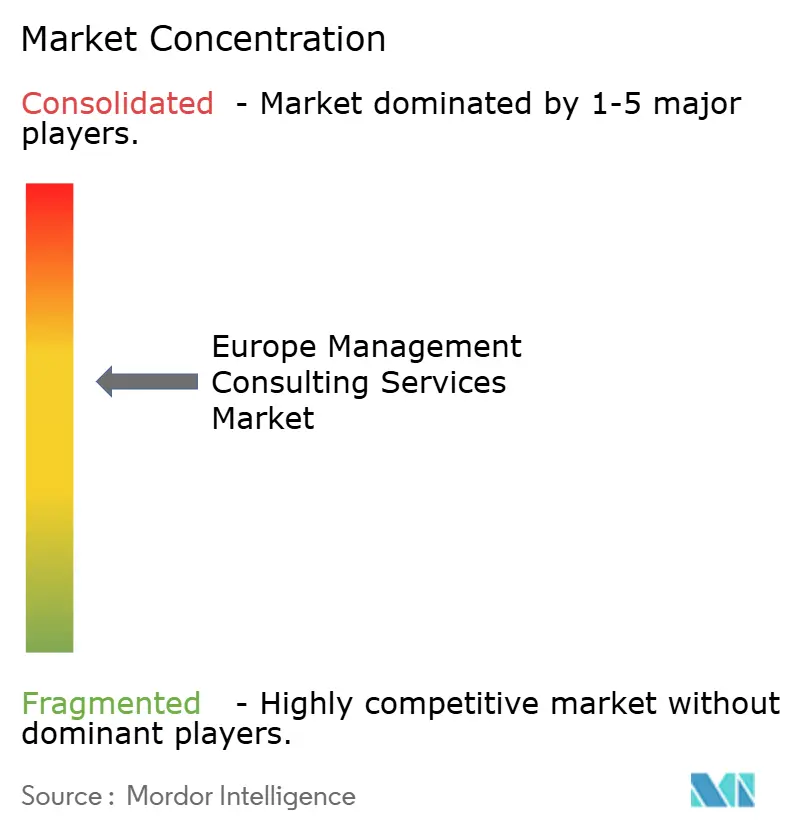
The Europe management consulting market reflects moderate concentration: the Big Four capture an estimated 55-60% of regional revenue, yet boutique specialists and digital-first challengers are rapidly eating share. Deloitte posted USD 67.2 billion global revenue in 2024, with EMEA leading at 8.5% growth. PwC, EY, and KPMG each surpassed USD 38 billion globally, but UK consulting revenues slipped as procurement scrutiny tightened and discretionary spend fell. To defend margins, incumbents are funneling USD 5 billion-plus into generative-AI studios, data-platform accelerators, and managed-services offerings.
Strategic alliances underpin differentiation: NTT Data’s pact with Mistral AI positions it as a sovereign-AI leader for regulated clients across finance and defense. Meanwhile, Carlyle’s buy-out of Ciril Group signals private-equity appetite for cloud and cybersecurity horizontal plays. The gig economy exerts price pressure; high-caliber independents now win complex sustainability work by leveraging platforms that match niche expertise to short-cycle mandates, pushing traditional firms toward outcome-based contracts and proprietary IP solutions.
Boutique strategy houses—Roland Berger, Oliver Wyman, PA Consulting—capitalize on sector depth and agile delivery to secure transformation road-maps in aerospace, healthcare, and energy. Technology giants such as Accenture and Capgemini blend consulting with system-integration scale, offering clients one-stop execution. The competitive chessboard thus oscillates between breadth of capability and depth of specialization, driving acquisitions, talent poaching, and co-innovation partnerships.
Europe Management Consulting Services Industry Leaders
Deloitte Touche Tohmatsu LLP
Ernst & Young Global Limited
Boston Consulting Group
PricewaterhouseCoopers LLP
KPMG International Limited
- *Disclaimer: Major Players sorted in no particular order

Market Opportunities and Future Outlook
Regulation-driven advisory creates whitespace for industrialized, repeatable offerings that combine compliance, technology, and operating model change, particularly when requirements cut across multiple functions and jurisdictions. CSRD implementation needs (including double-materiality, data collection, and audit trails) and the EU AI Act timetable (fully applicable on 2 August 2026) are encouraging enterprises to formalize AI governance, model risk management, and documentation workflows. That shift is moving engagements from proofs-of-concept toward control frameworks, enterprise architecture, and operating procedures that can withstand scrutiny.
Sovereign cloud and digital autonomy initiatives also open space for consultancies to package sourcing strategy with security, data governance, and implementation partnerships. The European Commission published the Digital Networks Act proposal on 21 January 2026, and on 3 June 2026 proposed a European Technological Sovereignty Package that includes the Cloud and AI Development Act (CADA), which introduces assurance levels to address dependencies on non-European cloud and AI providers. This policy direction aligns with observed market moves such as NTT Data partnering with Mistral AI to deliver managed sovereign enterprise AI for regulated sectors, reinforcing demand for firms that can build target-state architectures, vendor assurance approaches, and transformation roadmaps across finance, defense, and the public sector.
Recent Industry Developments
- July 2026: Boston Consulting Group expanded its DACH leadership footprint by appointing 15 new partners across functional and industry practices. The move increases senior capacity in one of Europe’s largest consulting clusters and supports delivery depth for large transformation and AI programs across Germany, Austria, and Switzerland.
- May 2026: EY and Microsoft announced a global initiative backed by more than USD 1 billion in investment to help clients scale enterprise-wide AI value creation beyond experimentation. The initiative strengthens hyperscaler-aligned delivery models and expands packaged capabilities that European clients can procure for AI strategy, implementation, and governance.
- July 2025: NTT Data partnered with Mistral AI to launch managed sovereign enterprise-AI services for finance, defense, and public sectors. The partnership operationalizes sovereign AI delivery options for regulated buyers and reinforces demand for advisory work spanning architecture, security, compliance, and organizational change.


Research Methodology Framework and Report Scope
Market Definition and Coverage
For this study, the market covers revenues earned from management consulting services delivered to organizations in Europe, where advice and project support are provided to improve strategy, operations, organization design, and performance outcomes.
Scope exclusions: This sizing excludes pure staff augmentation, software licensing revenue, and legal or audit-only engagements when no management consulting work is delivered.
Segmentation Overview
- By Consulting Service Line
- Strategy Consulting
- Operations Consulting
- Technology / Digital Consulting
- HR Consulting
- Financial Advisory
- Risk and Compliance Consulting
- Sustainability and ESG Advisory
- By Client Industry
- IT and Telecommunications
- Manufacturing
- Energy and Resources
- Public Sector
- Retail and Consumer Goods
- Healthcare and Life Sciences
- Financial Services
- Transportation and Logistics
- By Firm Size
- Large Enterprises
- Small and Medium Enterprises (SMEs)
- By Delivery Model
- On-site Consulting
- Hybrid (On-site and Remote)
- Fully Remote / Virtual Consulting
- By Country
- DACH (Germany, Austria, Switzerland)
- UK and Ireland
- France and Benelux (France, Belgium, Netherlands, Luxembourg)
- Nordics (Sweden, Norway, Denmark, Finland)
- Southern Europe (Spain, Italy, Portugal, Greece)
- Central and Eastern Europe (Poland, Czech Republic, Hungary, etc.)
Data Sources, Market Sizing, and Validation
Desk Research
Desk research was used to set the basic frame of the market and to make sure our assumptions matched what is visible in public economic and services data. We typically reviewed sources such as Eurostat service statistics, national statistical offices, the European Commission publications, OECD datasets, and trade bodies for management consulting in Europe. These references helped us align the model with signals like business services output, enterprise spending sentiment, and country level differences.
We also used company filings, annual reports, investor presentations, and trusted press coverage to understand revenue mix, service demand themes, and pricing direction where it could be reasonably inferred. A paid subscription for company financials and intelligence and a news and financials platform were used selectively to speed up cross checks on scale and to capture recent deal and restructuring signals. The sources listed here are illustrative only, and many other public materials were reviewed to collect data, validate numbers, and clarify open questions.
Primary Interviews and Surveys
Primary work focused on interviews and short surveys with consulting practitioners, buyers of consulting, and channel partners involved in project staffing and delivery. We covered major European economies as well as smaller markets so that country level spending patterns, buying cycles, and sector mix differences could be tested before finalizing assumptions.
Distribution of primary research fieldwork respondents
| Company type | Respondent position | Region |
|---|---|---|
| Top tier: 26% | CXOs: 12% | |
| Mid tier: 60% | Functional/Unit leaders: 35% | |
| Smaller Players: 14% | Managers: 53% |
Market-Sizing & Forecasting
Sizing was built using a top-down approach where Europe level demand is reconstructed from business services activity and consulting spend intensity, and then apportioned across countries based on economic weight and enterprise activity. Once that structure was in place, selective bottom-up checks were run using sampled revenue disclosures, observed project volumes, and typical fee rate bands to see if the totals looked realistic.
Inputs that were used (as examples) include services output indicators, headcount and wage inflation for professional services, the share of consulting tied to transformation programs, large enterprise investment cycles, and public sector modernization budgets. Where bottom-up inputs had gaps in smaller countries or niche service lines, assumptions were filled using peer country analogs and then re-tested in calls so the final totals did not lean on one weak data point.
For forecasting, scenario analysis was applied around macro growth, business confidence, and transformation spending, and then annual values were smoothed to avoid step changes that do not match typical consulting budget cycles. When we reached the final trajectory, short country and service line sanity checks were done so growth rates stayed consistent with the underlying demand pool.
Data Validation & Update Cycle
Validation was done through triangulation across three angles, desk indicators, primary feedback, and internal consistency checks within the model. Outliers were flagged when a country, service line, or implied price trend moved away from what wage inflation, utilization patterns, and buyer budgeting signals would normally support.
Before sign-off, the model goes through at least two analyst reviews where assumptions are re-checked and calculations are re-run to catch variance drivers. If a key metric shifts materially (for example, a major recession signal, a policy change affecting public spend, or a sudden hiring freeze), we re-contact sources and refresh the affected assumptions. Reports are refreshed annually, and before delivery we do a final update pass so the view reflects the most recent public information.
Mordor Intelligence's Europe Management Consulting Services Market Size Measured Against Other Published Estimates
Different published market sizes can be seen for Europe management consulting because firms often do not apply the same service boundaries, timing, and currency handling. Some estimates also mix demand signals with supplier revenue roll ups in ways that are hard to reconcile, which can create a wider range in the final number.
IT outsourcing and systems integration revenue is a common add-on, and it sits outside Mordor Intelligence's scope here, which is limited to management consulting service revenues rather than broader IT services delivery. Another gap comes from the base year chosen, since some sources quote 2024 values while our report is anchored on 2025 and then builds 2026 onward, which changes the implied starting point. We also see differences when pricing is pushed forward using aggressive rate inflation, or when coverage extends beyond the defined Europe footprint through multi-region revenue allocation.
Benchmark comparison
| Source | Market Size | Gaps in Research Methodology |
|---|---|---|
| Mordor Intelligence | USD 79.21 B (2025) | |
| Regional Consultancy A | USD 107.10 B (2024) | Uses an earlier base year and appears to reflect a broader definition that can blend management consulting with adjacent advisory and delivery revenues, which raises the total for Europe. |
| Industry Publisher B | USD 64.03 B (2025) | Uses a narrower demand pool and a tighter interpretation of business management consulting, which can exclude parts of change and transformation work that buyers still contract under management consulting. |
Taken together, the spread mainly tracks back to what is counted as consulting versus adjacent delivery services, and to how base year timing is handled. By keeping the model tied to clear service revenue definitions and then checking totals against practical pricing and activity indicators, we end up with a value that is easier to explain and repeat for planning.


Key Questions Answered in the Report
What revenue does the Europe management consulting market generate in 2026?
The market generates USD 83.95 billion in 2026 and is on track to reach USD 112.29 billion by 2031.
Which service line is growing fastest across European consultancies?
Digital/AI Consulting is the fastest-growing, expanding at a 12.29% CAGR through 2031 as generative-AI adoption scales.
How large is consulting demand from financial-services clients?
Financial Services accounts for 33.05% of spending, the largest share among all client industries.
Which region leads European consulting activity?
The DACH region (Germany, Austria, Switzerland) holds 26.28% market share, the highest of any regional cluster.
Page last updated on:


