
Market Overview
| Study Period | 2021 - 2031 |
|---|---|
| Forecast Data Period | 2026 - 2031 |
| Base Year Market Size (2025) | USD 1.56 Billion |
| Market Size (2026) | USD 1.65 Billion |
| Market Size (2031) | USD 2.15 Billion |
| Growth Rate (2026 - 2031) | 5.48 % |
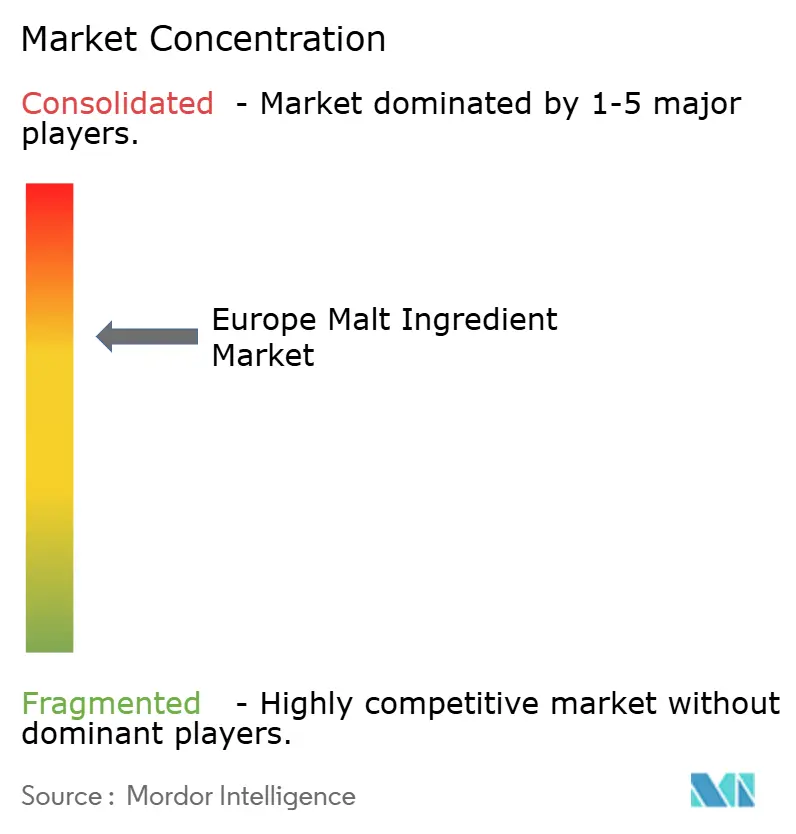
| Market Concentration | Medium |
Major Players *Disclaimer: Major Players sorted in no particular order Image © Mordor Intelligence. Reuse requires attribution under CC BY 4.0. | |
Europe Malt Ingredient Market Analysis by Mordor Intelligence
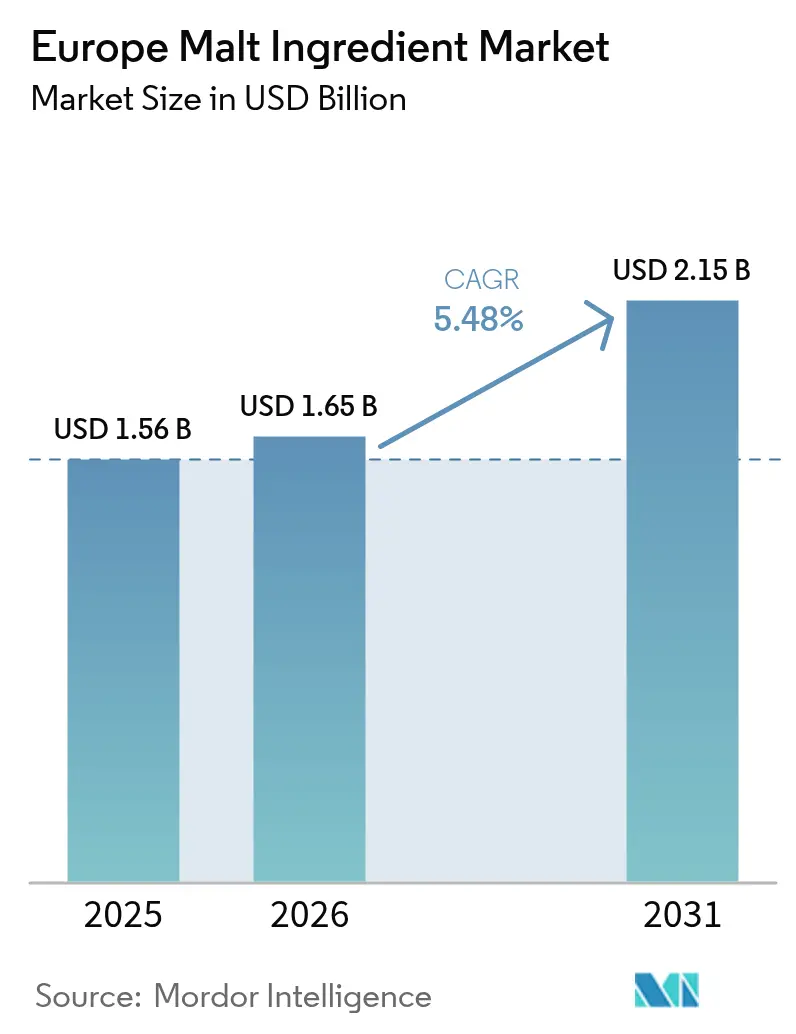
Europe malt ingredients market size in 2026 is estimated at USD 1.65 billion, growing from 2025 value of USD 1.56 billion with 2031 projections showing USD 2.15 billion, growing at 5.48% CAGR over 2026-2031. As demand surges for premium craft beer and non-alcoholic brews increasingly seek flavor-rich malts, the long-term growth of malted barley, rye, wheat, and oats remains robust. This growth is further bolstered by expanded Scotch and continental distilling capacities. Clean-label demands from bakers and breakfast cereal makers, coupled with the broader availability of organic raw materials under EU Regulation 2018/848, present amplified opportunities across the value chain[1]. Additionally, brewers are showing heightened interest in certified low-carbon supply chains. Key innovation themes include energy-efficient kilning, custom blends that give brewers a unique edge, and liquid malt extracts that streamline bakery operations. However, challenges persist: drought-induced fluctuations in barley yields and rising electricity and natural gas prices jeopardize margins for smaller maltsters. This scenario accentuates the competitive advantage for players who have embraced vertical integration and invested in decarbonization.
Key Report Takeaways
- By category, conventional products captured 76.60% of the Europe malt ingredients market share in 2025, while organic variants are set to expand at a 6.85% CAGR through 2031.
- By source, barley led with 47.80% share in 2025; rye malt is poised for the fastest 5.92% CAGR through 2031.
- By form, dry malt commanded 67.55% revenue share in 2025, yet liquid malt extract is projected to rise at a 7.15% CAGR to 2031 on bakery and contract-brewing uptake EUROMALT.EU.
- By application, beverages accounted for 82.65% share in 2025, whereas breakfast cereals will record the top 6.86% CAGR through 2031.
- By geography, Germany generated 23.35% of 2025 revenue; Spain is set for the highest 6.98% CAGR to 2031.
Note: Market size and forecast figures in this report are generated using Mordor Intelligence’s proprietary estimation framework, updated with the latest available data and insights as of 2026.
Europe Malt Ingredient Market Trends and Insights
Drivers Impact Analysis*
| Driver | (~) % Impact on CAGR Forecast | Geographic Relevance | Impact Timeline |
|---|---|---|---|
| Europe’s craft brewery proliferation and premiumization | +1.2% | Germany, United Kingdom, Netherlands, Belgium, France | Medium term (2-4 years) |
| Non-alcoholic and low-alcohol beer surge needs flavor-rich malts | +0.9% | Germany, United Kingdom, Spain, Nordics | Short term (≤ 2 years) |
| Scotch and European distilling capacity additions | +0.7% | United Kingdom (Scotland), Ireland, France | Long term (≥ 4 years) |
| Clean-label reformulation in bakery, cereals, and RTD beverages | +0.8% | Germany, France, United Kingdom, Italy, Netherlands | Medium term (2-4 years) |
| Custom blends and specialty malts accelerating brewer innovation | +1.0% | Germany, Belgium, United Kingdom, Netherlands, Poland | Short term (≤ 2 years) |
| Decarbonization budgets and low-carbon malt procurement | +0.6% | EU-wide led by Germany, France, Netherlands, Belgium | Long term (≥ 4 years) |
| Source: Mordor Intelligence | |||
Europe's craft brewery proliferation and premiumization
Even as the number of breweries stabilizes in certain regions, thousands of small breweries are actively reshaping the malt ingredients market in Europe. These surviving breweries are pivoting towards higher-margin lagers and IPAs, utilizing roasted and caramel malts to enhance the ingredient value per hectoliter. In Germany, craft labels command a premium, with drinkers shelling out 15-20% more. This trend has led malt houses, like Weyermann, to expand their portfolios, introducing a wider range of smoked and acidulated malts. Meanwhile, Belgian abbey traditions sustain a robust demand for richly colored malts. In the UK, brewers are turning to organic pale ale malt, catering to the clean-label trend, a demand met by Viking Malt’s launch in January 2025. Today, emphasizing malt provenance on packaging is integral to premium brand narratives, fostering multi-year supply commitments. Maltsters that provide a diverse range, ensure traceability, and offer brew-house support are reaping the benefits with higher margins.
Non-alcoholic and low-alcohol beer surge needs flavor-rich malts
In 2024, the mainstreaming of the 0.0% ABV category is underscored by production upgrades at Guinness. Brewers, noting that fermentation imparts less flavor, turn to specialty roasted and high-enzyme diastatic malts to enrich their 0.0% ABV recipes and achieve a balanced taste profile. Germany and the Nordics continue to dominate per-capita consumption due to their established beer culture and preference for innovative brewing techniques. Meanwhile, Spain's hospitality resurgence, driven by increased tourism and consumer spending, is fueling a significant surge in off-trade sales. Techniques that halt fermentation require 10-15% more malt per hectoliter, meaning even a stable beer volume results in heightened malt demand. This creates opportunities for suppliers who can customize malt specifications for low-alcohol brewing, allowing them to capitalize on this burgeoning premium niche and cater to the evolving preferences of health-conscious consumers.
Scotch and European distilling capacity additions
GlenDronach invests USD 38 million to expand its warehouse capacity, underscoring the ongoing commitment to malt-based spirits and ensuring sufficient storage for future production needs. New regulations in Irish whiskey now require traceable malted barley, leading to a surge in certified supply programs aimed at maintaining quality and compliance with these tightened standards. Meanwhile, craft houses in Cognac and Armagnac are venturing into barley and rye spirits, diversifying their product offerings to cater to evolving consumer preferences. Additionally, rising trends in rye whisky across Germany and Poland are boosting the demand for rye malt, driven by increasing consumer interest in unique and regionally influenced spirits. Furthermore, extended barrel aging not only secures future malt usage but also provides maltsters with clearer visibility into long-term demand, reinforcing their barley contracts with cooperatives like Axéréal and ensuring a stable supply chain.
Clean-label reformulation in bakery, cereals, and rtd beverages
In 2024, FoodDrinkEurope advocates for the use of malted cereals, emphasizing their ability to provide natural sweetness and enhance dough functionality, making them a versatile ingredient in various applications. The EU's approval of partially hydrolyzed barley protein in breakfast cereals further highlights malt's potential as a protein-rich and functional component in the food industry. To meet stringent acrylamide benchmarks without compromising crust color, industrial bakeries in Germany and the Netherlands are increasingly replacing synthetic colorants with malt extract, showcasing its dual role in safety and aesthetics. In Spain and Italy, ready-to-drink beverage producers are reintroducing malt-based soft drinks, leveraging malt's distinct maltose content and umami profile to cater to evolving consumer preferences for unique and nostalgic flavors. Additionally, suppliers who provide comprehensive documentation for allergen, organic, and vegan compliance are gaining priority in reformulation processes, reflecting the growing demand for transparency and adherence to dietary standards.
Restraints Impact Analysis*
| Restraint | (~) % Impact on CAGR Forecast | Geographic Relevance | Impact Timeline |
|---|---|---|---|
| Barley yield/price volatility and climate shocks | -0.8% | Northwest Europe; offset by Spain, Romania | Short term (≤ 2 years) |
| Energy- and carbon-intensive kilning economics | -0.6% | Germany, France, Belgium, Netherlands, Poland | Medium term (2-4 years) |
| Europe beer volume decline and on-trade share loss | -0.5% | Germany, United Kingdom, France, Italy | Medium term (2-4 years) |
| Acrylamide rules constrain malt use in bakery | -0.3% | Germany, France, Netherlands, United Kingdom | Long term (≥ 4 years) |
| Source: Mordor Intelligence | |||
Barley yield/price volatility and climate shocks
In France and Germany, a severe drought in Northwest Europe slashed 2024 spring barley yields by as much as 15%[2]. This has tightened the supply of malting-grade barley and driven up spot premiums. While surpluses in Spain and Romania help stabilize the region's overall barley availability, they also increase freight distances to malting hubs in Belgium and Germany. Currently, malting-barley commands a premium of 15-20% over feed barley, a gap that widens when there's a dip in protein or germination quality. The EU Common Market Organisation for cereals provides public intervention mechanisms and private storage aid for barley, yet these tools are rarely activated and offer limited relief during acute shortages[3]. Given that public intervention tools are slow to activate, maltsters are turning to forward contracts with farmer cooperatives like Axéréal and VIVESCIA as a risk buffer. However, with climate-adapted barley varieties still over five years from a significant market release, the European malt ingredients market faces vulnerabilities in the short term.
Energy- and carbon-intensive kilning economics
In H1 2024, electricity prices averaged 197 EUR/MWh, while natural gas prices fluctuated between 30-40 EUR/MWh. These figures represent a stark increase, ranging from double to quadruple, compared to pre-pandemic benchmarks. The kilning process, essential for reducing green malt moisture from 45-50% to nearly 4%, accounts for approximately two-thirds of the total energy consumption at the site. The volatility introduced by LNG imports poses challenges, especially for mid-sized maltsters lacking heat-recovery systems or biomass integration. While EU tax reforms offer relief for electrified heating, this benefit won't be realized until post-2026, leaving a window of short-term cost exposure. Furthermore, brewers find it challenging to pass on these surcharges, especially with the competitive pressure from Canadian and Australian malt imports, which enjoy lower energy costs. This dynamic is further compressing margins across the European malt ingredients market.
*Our forecasts treat driver/restraint impacts as directional, not additive. The impact forecasts reflect baseline growth, mix effects, and variable interactions.
Segment Analysis
By Category: Organic Certification Unlocks Premium Channels
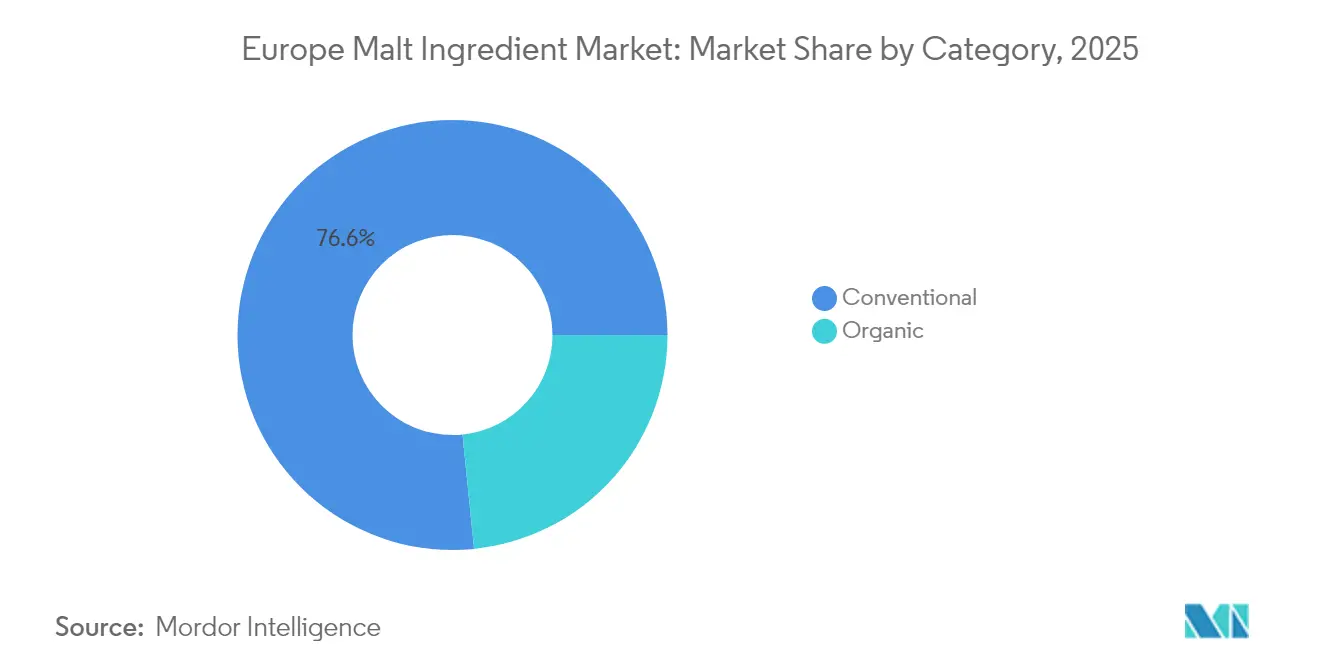
In 2025, conventional grades dominated the European malt ingredients market, securing 76.60% of total revenues. Their stronghold is attributed to well-established supply chains, reduced production costs, and versatility across brewing, baking, and food processing, all without the constraints of certification timelines. Major maltsters leverage scale advantages in conventional sourcing, ensuring consistent volumes for mainstream brewers and distillers. Yet, as organic regulations tighten, conventional players feel the squeeze, prompting them to adopt hybrid strategies to navigate rising compliance demands.
Organic grades are the market's fastest-growing segment, projected to advance at a 6.85% CAGR through 2031, driven by Regulation 2018/848's stipulation of 95% organic content in processed foods. A three-year land conversion window leads to supply scarcity, sustaining 35% price premiums. Meanwhile, initiatives like Viking Malt’s 2025 organic Brewer’s Pale Ale, aimed at premium German, Dutch, and Scandinavian brewers, command a 20–30% shelf markup. Germany, France, and the Netherlands spearhead the organic movement, buoyed by affluent consumers and deep retail penetration. This momentum is further fueled by the looming December 2024 deadline for non-organic yeast transitional allowances. Maltsters adept in agronomy, certification, and multi-crop rotations are seizing high-margin opportunities, especially with integrated malt-yeast traceability solutions.

By Source: Rye Malt Gains in Craft Distilling and Bakery
In 2025, barley dominated the European malt ingredients market, securing 47.80% of total revenues. This stronghold is attributed to barley's superior enzymatic strength and its long-standing role in brewing mainstream lagers and ales. Barley’s versatility in brewing processes, coupled with its ability to produce consistent flavor profiles, further reinforces its dominance. Even with stagnant growth in the wheat-beer segment, established supply chains and the ability to scale operations keep barley at the forefront. Suppliers ensure profitability by leveraging a cereal processing infrastructure specifically designed for barley's unique germination needs, which allows for efficient production and cost management.
Rye malt is the market's fastest-growing segment, projected to grow at a 5.92% CAGR through 2031, driven by its sought-after peppery flavor. Craft distillers in Poland, Germany, and Ireland are ramping up rye whisky initiatives, capitalizing on the growing consumer preference for unique and premium spirits. Simultaneously, artisan bakers in Germany and the Netherlands are infusing rye malted flour into their sourdough and crisp breads, catering to the rising demand for artisanal and health-focused baked goods. While dedicated rye malting lines are scarce, requiring unique steeping and germination methods, maltsters like Palatia (BESTMALZ) are strategically reallocating their capacity to seize premium pricing opportunities. This agile shift in product mix not only boosts supplier margins but also positions rye ahead of the slower-growing oat and wheat alternatives, reflecting its increasing importance in both the beverage and bakery industries.
By Form: Liquid Malt Extract Gains in Bakery and Brewing Convenience
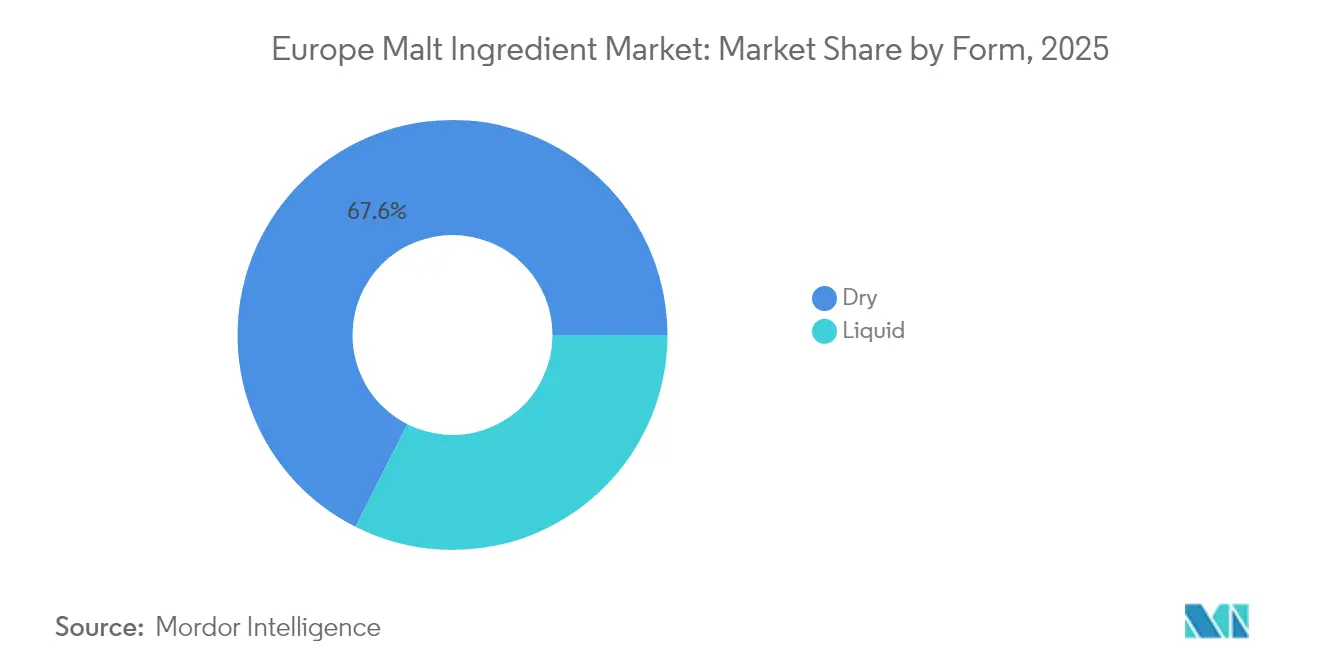
In 2025, dry malt dominated the European malt ingredients market, securing 67.55% of total revenues. With a moisture content of just 4–5%, dry malt boasts efficient silo storage and an extended shelf life. This makes it a preferred choice for high-volume operations in brewing, baking, and food processing. Additionally, its ability to maintain quality and stability under varying conditions makes it highly reliable for manufacturers. Furthermore, specialty roasted flavors lean towards dry formats, ensuring precise control and stability during transport and formulation. Even with the rise of liquid alternatives, established infrastructure, including widespread availability and established supply chains, bolsters dry malt's leading position.
Liquid malt extract is the market's fastest-growing segment, projected to grow at a 7.15% CAGR through 2031. Large bakeries are turning to pumpable concentrated wort, not only for streamlined handling but also to avoid synthetic colorants. This choice helps maintain enzyme activity during mashing and evaporation, ensuring optimal crust development while staying within acrylamide limits. The convenience of liquid malt extract also reduces operational complexities, making it an attractive option for large-scale production. Meanwhile, contract brewers lacking mash tuns are opting for liquid formats. They’re willing to pay a premium of 10–15% more per extract unit, valuing the superior consistency it offers. This growth in liquid malt extract complements the overall product mix, yet it doesn't overshadow dry malt's dominant volume leadership.
By Application: Breakfast Cereals Leverage Functional Malt Ingredients
In 2025, beverages dominated the European malt ingredients market, accounting for a substantial 82.65% of total revenues. This stronghold is underscored by the EU's production of 34.7 billion liters of beer and a significant output of Scotch whisky, both of which depend on malt for enzymatic conversion and flavor. The enduring demand for lagers bolsters the processing infrastructure of mainstream breweries, ensuring consistent high-volume production. Additionally, non-alcoholic beer variants utilize 10–15% more malt per hectoliter compared to their alcoholic counterparts, presenting a notable growth opportunity even as alcoholic beer consumption remains stagnant. This trend highlights the evolving preferences of consumers and the adaptability of malt producers in catering to these shifts.
Breakfast cereals are emerging as the fastest-growing sector, projected to grow at a 6.86% CAGR through 2031. This surge follows the novel-food approval for using up to 5 g of partially hydrolyzed barley protein per 100 g. Prominent cereal brands in Germany and the UK are now blending malted barley flour into their health-focused products, enhancing them with beta-glucan fiber and a natural honey-like sweetness. These formulations align with the increasing consumer demand for nutritious and functional foods. While bakery applications experience limited growth due to acrylamide regulations, this is somewhat balanced by the increasing adoption of liquid extracts, which offer versatility and ease of use in various recipes. Dairy applications, on the other hand, remain a niche market, primarily driven by specialty products. This diversification beyond traditional beverage applications bolsters malt producers' revenue stability, even as alcohol consumption trends evolve.
Geography Analysis
In 2025, Germany accounted for 23.35% of the revenue, bolstered by its extensive maltster network, adherence to the Reinheitsgebot barley standard, and its closeness to Central European breweries. With a notable craft premiumization trend, specialty malt throughput has solidified Germany's position as the primary market. Meanwhile, Spain is on a rapid ascent, boasting the fastest CAGR at 6.98%. With a beer output of 41.1 million hl in 2024 and 279 breweries tapping into caramel and roasted grades for their premium lagers, Spain is making its mark. The UK, blending its Scotch distilling heritage with a lively craft segment, continues to drive demand for specialty products from renowned suppliers like Simpsons and Crisp Malt.
France enjoys the advantage of robust barley harvests, aided by parent cooperatives VIVESCIA and InVivo, which mitigate risks associated with raw material imports. While Italy primarily sources malt for its bakery and pasta industries, its lower per-capita beer consumption curtails any significant beverage-driven growth. Belgium produces more malt than it consumes, strategically directing its plants towards exports, thanks to the logistical advantages of the Antwerp port. To ensure a steady supply of malt ingredients across Europe, the Netherlands, Belgium, and Northern ports import barley from Canada and Australia, safeguarding against climatic uncertainties. Poland's geographical positioning allows it to channel its barley surplus eastward while catering to demand centers in the west. However, limitations in rail and silo capacities temper its growth. In Scandinavia, there's a notable surge in the adoption of organic and zero-alcohol beers, positioning the region as a testing ground for sustainable malt production. Spain's bountiful barley harvest in 2024 underscored its potential as a contingency supply source, especially when Northwest Europe grapples with droughts, enhancing its strategic significance. While Germany's robust beer demand remains central to the landscape, Spain is poised to outstrip its counterparts, buoyed by a resurgence in tourism and an expanding craft beer market.
Regulatory Landscape
The Europe malt ingredients market operates under harmonized EU food-law frameworks that cover labeling, additives, enzymes, and organic claims for malted cereals, malt extracts, and malt-derived ingredients used in beverages and foods. Regulation (EU) No 1169/2011 (Food Information to Consumers) sets mandatory ingredient and allergen labeling requirements relevant to cereal-based ingredients containing gluten, and it interacts with origin rules for primary ingredients (notably when the barley origin differs from the final product origin). For organic malt, EU Regulation 2018/848 sets process and labeling requirements that shape sourcing and certification timelines across maltsters and downstream food and beverage manufacturers.
On the ingredient-compliance side, Regulation (EC) No 1333/2008 and Regulation (EC) No 1332/2008 apply to additives and food enzymes used in processing chains adjacent to malt-based formulations (for example, in beverage and bakery applications where processing aids, enzymes, or stabilizers are used). In January 2026, the European Commission adopted Commission Regulation (EU) 2026/196, updating specifications and authorized uses for selected additives, with application from 18 August 2026. This reinforces the need for malt ingredient users to validate formulation compatibility and documentation during transition periods. EFSA remains the scientific authority supporting safety evaluations that underpin EU authorization and re-evaluation activities for additives and enzymes used in food production.
Value Chain Analysis
The European malt ingredients value chain starts with seed selection and malting barley cultivation, including cooperative-led contracting, followed by grain collection, cleaning, storage, and malting operations (steeping, germination, kilning) that convert cereals into malt and derivative ingredients such as dry malt, roasted specialty malts, and liquid malt extracts. Maltsters then supply brewers, distillers, bakeries, breakfast cereal manufacturers, and RTD beverage producers, either directly under multi-year supply agreements or through ingredient distributors and specialized brewing supply channels. Export-oriented production hubs in Western Europe play a central role in balancing regional deficits, with logistics anchored around established industrial clusters and ports that support intra-European trade, and imports of barley and malt when local supply is constrained.
Supply risk concentrates around consistent access to malting-grade barley (protein, germination, and moisture specifications) and the cost and availability of energy for kilning, which is typically the most energy-intensive step in the chain. Evidence from 2024 points to volatility in European grain availability and quality, including weather impacts that disrupted output, such as UK winter barley production declines tied to wet conditions, and trade shifts where domestic production pressure coincided with higher imports reported for Germany in 2024. These dynamics increase the importance of forward contracting with farmer cooperatives, quality segregation in storage and silo infrastructure, and procurement diversification across origins, while maltsters with advanced process control, heat recovery, or alternative fuels can compete on cost and carbon advantages when brewers and food manufacturers request traceability and lower-carbon documentation.
Competitive Landscape
In the European malt ingredients market, moderate consolidation is evident. Soufflet Malt, Boortmalt, and Malteurop dominate the landscape, yet they contend with specialty rivals like Simpsons, Weyermann, and Viking. Soufflet's acquisition of United Malt in 2023, followed by a rebranding in 2024, has positioned it as the world's largest maltster, boasting a capacity of 3.7 million tonnes. With an eye on the future, Soufflet is now pivoting towards low-carbon barley supply chains and exploring adjacent food markets. Meanwhile, Boortmalt has forged a partnership with Soil Capital, aiming to cut down 200,000 tonnes of CO2 emissions and source two-thirds of its barley regeneratively by 2030. This move not only underscores Boortmalt's commitment to sustainability but also enhances its standing in brewer tenders that prioritize Scope 3 reporting.
Through farmer-cooperative ownership, vertical integration ensures a steady barley supply and cost efficiencies. Regional players carve out niches with organic certifications, unique cereals, and collaborative recipe development via pilot roasters. Opportunities abound in organic malt, rye for distilling, and liquid malt extract, all outpacing the average growth of the European malt ingredients market.
Investments in technology spotlight energy-efficient kilns, digital batch tracing, and automated steeping processes. Simpsons Malt's announcement of an April 2025 capacity extension, incorporating heat-recovery systems, underscores the industry's push towards utility efficiency. While farmer co-ops eye partial downstream ventures, specialty houses are winning over craft brewers, ensuring a competitive landscape and thwarting any drift towards monopoly.
Europe Malt Ingredient Industry Leaders
-
Malteries Soufflet
-
Boortmalt
-
Malteurop
-
Viking Malt
-
Holland Malt
- *Disclaimer: Major Players sorted in no particular order
Market Opportunities and Future Outlook
Decarbonization and verified low-carbon procurement are creating actionable whitespace for maltsters that can document Scope 1 and 2 reductions at the plant level and support Scope 3 measurement upstream in barley farming. Recent investments provide clear signals: in May 2025, Malteurop inaugurated a EUR 40 million biomass power plant at its Intermalta site in Seville, targeting a major reduction in site greenhouse gas emissions, and in June 2026 Boortmalt signed a partnership with Dalkia to launch a biomass unit at its Issoudun malting plant with a stated CO2-reduction pathway. On the farm side, regenerative agriculture programs are moving from pilots into structured partnerships, including Boortmalt and Asahi UK work announced in April 2026 that uses third-party measurement, reporting, and verification to quantify emissions reductions on British barley farms.
A second opportunity area is capacity and capability optimization that supports specialty malt, liquid malt extracts, and traceability-driven applications in non-alcoholic beer, distilling, and clean-label foods. In June 2026, Soufflet Malt initiated a capacity expansion at its Strasbourg facility in France, lifting annual capacity from 90,000 tonnes to 130,000 tonnes, which indicates continued emphasis on scale and efficiency in core European hubs even as some legacy assets are rationalized. Parallel agronomy and quality programs also support supply resilience: the LIFE Innocereal EU work showed precision input management approaches that reduce fertilizer use without compromising economic performance or industry quality standards, aligning with brewer and food customer requests for lower-impact raw materials while maintaining malting specifications. Taken together, these moves suggest that competitive advantage is increasingly tied to plant energy systems, data-backed sustainability credentials, and barley programs that protect malting-grade quality under variable European weather conditions.
Recent Industry Developments
- June 2026: Boortmalt signed a partnership agreement with Dalkia Centre-West to launch a biomass unit at its Issoudun malting plant in France. The project aligns the site with a stated trajectory to cut CO2 emissions per tonne of malt by 85% by 2030, strengthening Boortmalt's ability to compete for brewer and distiller tenders that prioritize lower-carbon supply.
- December 2025: Boortmalt announced the permanent closure of its Gembloux malting plant in Belgium and the non-renewal of a toll-malting agreement with Cargill in Salzgitter, Germany. The footprint adjustment reflects demand-side pressure and shifts capacity toward more competitive assets, tightening available tolling options for some customers while supporting utilization at remaining plants.
- May 2024: The European Commission reported that severe drought conditions in Northwest Europe reduced 2024 spring barley yields by up to 15% in affected areas. The resulting quality and supply variability increased the importance of multi-origin procurement and forward contracts with farmer cooperatives for maltsters supplying brewers, distillers, and food manufacturers.
Research Methodology Framework and Report Scope
Market Definition and Coverage
For this study, the market covers the value of malt-based ingredients sold for use in European food and beverage manufacturing, where the ingredient is used for flavor, color, fermentable sugars, or functional performance.
Scope exclusions: On-farm barley cultivation and bulk unmalted grain trading are excluded, and retail beer or spirit sales are not counted as malt ingredient revenue.
Segmentation Overview
- By Source
- Barley
- Wheat
- Rye
- Oats
- Others
- By Form
- Dry
- Liquid
- By Category
- Organic
- Conventional
- By Application
- Bakery and Confectionery
- Beverages
- Breakfast Cereals
- Dairy
- Others
- Country
- Germany
- United Kingdom
- France
- Italy
- Spain
- Russia
- Netherlands
- Poland
- Belgium
- Sweden
- Rest of Europe
Data Sources, Market Sizing, and Validation
Desk Research
Desk work starts with mapping the malt ingredient value chain in Europe, then tying the total to measurable signals that can be checked year over year. We rely on public and official references such as Eurostat production and trade series, FAOSTAT crop balances, UN Comtrade customs lines, and customs or agriculture releases from national statistical offices in key European countries.
To make assumptions more realistic, we also review sources such as brewer and distiller association publications, food ingredient association pages, peer reviewed articles on malting and brewing science, and company annual reports and investor presentations for capacity and demand commentary. In a few places, paid subscriptions that compile company financials, patents, and shipment-level trade records are used to speed up cross-checking and reduce missed players. The sources listed above are illustrative and not exhaustive, and additional public references were also used for data collection, validation, and research clarification.
Primary Interviews and Surveys
Primary interviews and short surveys were used to pressure-test the model assumptions around malt ingredient pricing, mix shifts between dry and liquid forms, and the share moving into brewing versus food applications. We spoke with ingredient suppliers, distributors, and industrial buyers across major European consuming markets, so the final view reflects what customers report as purchasing patterns, not only published averages.
Distribution of primary research fieldwork respondents
| Company type | Respondent position |
|---|---|
| Top tier: 31% | CXOs: 13% |
| Mid tier: 51% | Functional/Unit leaders: 36% |
| Smaller Players: 18% | Managers: 51% |
Market-Sizing & Forecasting
Sizing is built using a combined top-down and bottom-up approach, where the top-down view is reconstructed from Europe-level production and trade flows of malt and malt-based ingredient lines, and then filtered through application-level demand indicators. Those indicators include beer output and brewery counts, spirits production trends, industrial bakery output, and the relative pull for organic versus conventional ingredients, which together explain how much malt input is realistically absorbed.
After the first total is formed, it is corroborated with selective bottom-up approximations using supplier revenue exposure, sampled pricing by form (dry versus liquid), and channel checks on typical contract structures. Gaps are handled by scaling known country totals using import dependence, processing intensity, and end-use mix, then re-checking that the implied per-ton values stay aligned with observed price bands. For forecasting, scenario analysis is used because energy costs, barley quality swings, and beverage demand shifts can move volumes and pricing in different directions, and the final path is set after reconciling the scenario ranges with what interviewees expect for capacity use and reformulation activity.
Data Validation & Update Cycle
Model outputs are checked against independent signals such as import to consumption ratios, malt production capacity announcements, and consistency between implied volume growth and beer and bakery production trends. Where variances appear, assumptions are revisited, and clarifications are re-confirmed with relevant respondents before the numbers are signed off.
A multi-step internal review is followed so calculations, unit conversions, and currency treatment are consistent across countries. Reports are refreshed annually, and interim updates are made when material events occur such as major capacity changes, regulatory shifts on labeling, or sharp commodity and energy price moves. Before delivery, the model is re-opened for a fresh pass so clients receive the latest updated view.
Mordor Intelligence's Europe Malt Ingredient Market Size Compared Against Other Published Estimates
Published market values for Europe malt ingredients can differ even when the topic name sounds the same, since teams do not always use the same scope, time base, or pricing logic. Differences also show up when one estimate is closer to malt as a commodity, while another is closer to processed ingredient revenue sold into food and beverage manufacturing.
By tracking application pull signals and refreshing scope checks each year, Mordor Intelligence keeps the estimate aligned to ingredient revenue sold into brewing and food uses, instead of mixing in broader malted grain value or finished beverage sales.
Benchmark comparison
| Source | Market Size | Gaps in Research Methodology |
|---|---|---|
| Mordor Intelligence | USD 1.56 B (2025) | |
| Industry Database A | USD 1.08 B (2025) | This estimate appears to apply a narrower definition that leans toward selected ingredient types and may under-count cross-border sales into brewing and industrial bakery, which reduces the priced volume captured in the same year. |
| Syndicated Publisher B | USD 2.00 B (2024) | The higher value is consistent with a broader boundary and an earlier base year, where commodity-like malt and adjacent malted products can be mixed into the total, and currency timing and pricing assumptions are not clearly reconciled to end-use demand. |
Overall, the spread in published numbers is mainly explained by what is counted as an ingredient sale versus a wider malt value, and by how pricing is applied across forms and uses. Our approach stays traceable to observable demand indicators and repeatable checks, which makes year-to-year movement easier to validate when market conditions change.
Key Questions Answered in the Report
What are the current size and forecast value for the Europe malt ingredients market?
The Europe malt ingredients market size stands at USD 1.65 billion in 2026 and is expected to reach USD 2.15 billion by 2031.
Which segment will grow fastest between 2026 and 2031?
Breakfast cereals will post the fastest 6.86% CAGR, supported by novel-food approval for partially hydrolyzed barley protein.
How big is rye malt’s opportunity?
Rye malt is forecast to advance at 5.92% CAGR as craft distillers and artisan bakers seek peppery flavor profiles.
Why is Spain the fastest-growing geography?
Spain couples a 41.1 million hl beer base with a hospitality recovery and 279 breweries that upgrade to specialty malts, driving a 6.98% CAGR.