
Europe Magnet Free Electric Axle System Market Size and Share
Market Overview
| Study Period | 2019 - 2031 |
|---|---|
| Forecast Data Period | 2026 - 2031 |
| Base Year Market Size (2025) | USD 1.68 Billion |
| Market Size (2026) | USD 1.91 Billion |
| Market Size (2031) | USD 3.64 Billion |
| Growth Rate (2026 - 2031) | 13.76 % |
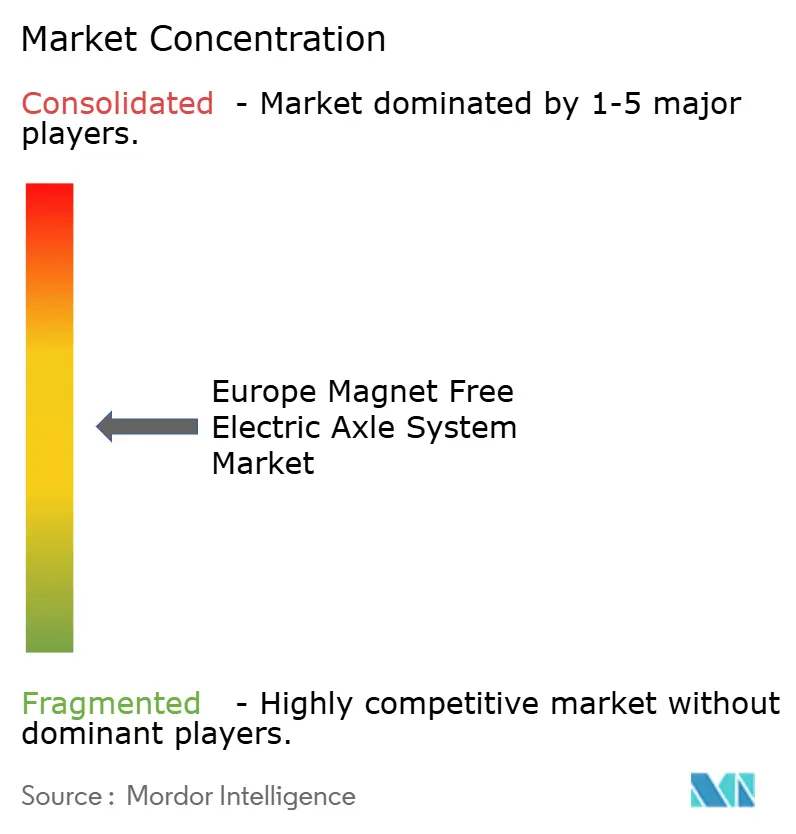
| Market Concentration | Medium |
Major Players *Disclaimer: Major Players sorted in no particular order Image © Mordor Intelligence. Reuse requires attribution under CC BY 4.0. | |
Europe Magnet Free Electric Axle System Market Analysis by Mordor Intelligence
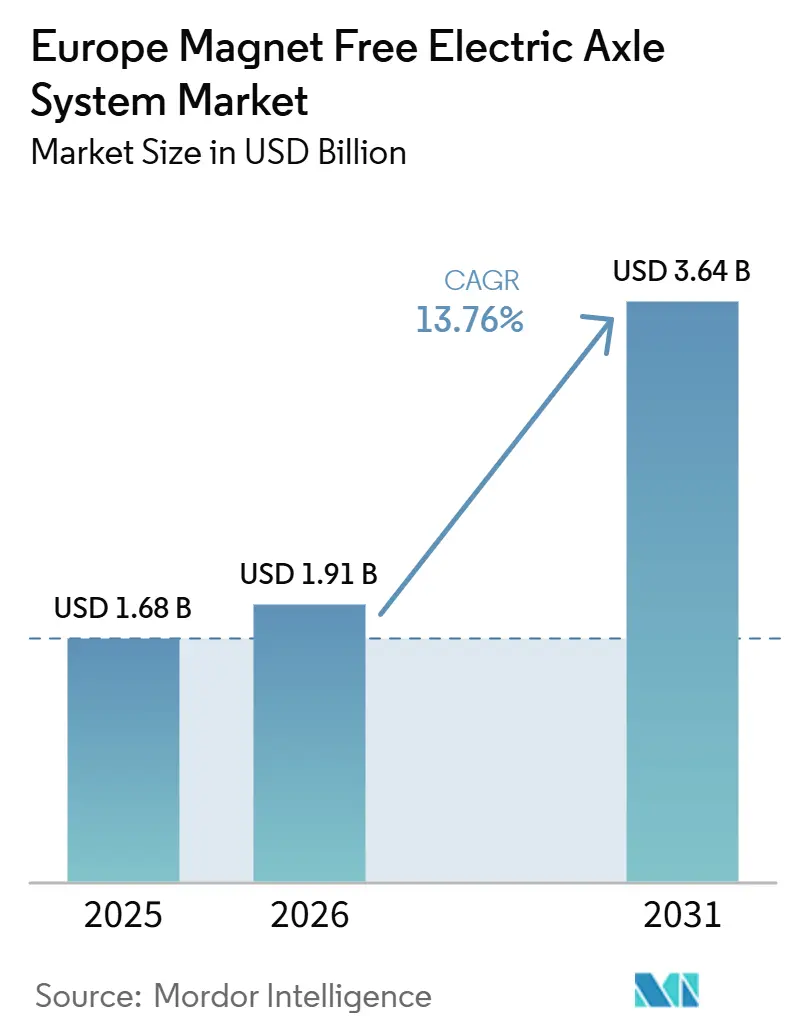
The Europe magnet free electric axle system market size was valued at USD 1.68 billion in 2025 and is estimated to grow from USD 1.91 billion in 2026 to reach USD 3.64 billion by 2031, at a CAGR of 13.76% during the forecast period (2026-2031). In a bid to sidestep China's looming expansion of export controls, automakers are swiftly pivoting towards rare-earth-free propulsion. This move comes as China's new regulations now encompass processing know-how. Externally excited synchronous motors (EESM) are poised to capture the lion's share of revenues, thanks to their ability to maintain high highway-cycle efficiency without the need for permanent magnets. Meanwhile, switched reluctance motors (SRM), though heralded for their rapid growth potential, still rely on waveform-shaping inverters to mitigate noise, vibration, and harshness (NVH). OEMs are increasingly gravitating towards integrated e-axles, which consolidate the motor, inverter, and gearbox, in their quest for lighter and more cost-effective drivetrains. Simultaneously, silicon carbide (SiC) electronics are improving efficiency in these magnet free machines. On the regional front, Germany leads in revenue, buoyed by BMW's Gen6 launch. However, Spain is witnessing the swiftest growth, fueled by a lithium-iron-phosphate gigafactory set to debut in the near future.
Key Report Takeaways
- By motor type, externally excited synchronous motors led with 46.56% of the magnet free electric axle system market share in 2025, while switched reluctance motors are advancing at a 15.42% CAGR through 2031.
- By drive type, fully electric configurations captured 63.28% share of the magnet free electric axle system market size in 2025 and are expanding at an 18.28% CAGR to 2031.
- By e-axle configuration, integrated designs accounted for 41.13% of 2025 installations and are growing at a 14.16% CAGR over 2026-2031.
- By vehicle type, passenger cars accounted for 57.21% of revenue in 2025, whereas buses and coaches are projected to record the highest CAGR of 15.22% through 2031.
- By geography, Germany accounted for 32.47% of revenue share in 2025; Spain is the fastest-growing market, with a 15.19% CAGR through 2031.
Note: Market size and forecast figures in this report are generated using Mordor Intelligence’s proprietary estimation framework, updated with the latest available data and insights as of January 2026.
Proportional positioning is established by comparing regional contributions against the global total, including that of Europe. The magnet free electric axle system market share in our global report expresses these relative weights.
Market Trends and Insights
Drivers Impact Analysis of Europe Magnet Free Electric Axle System Market*
| Driver | (~) % Impact on CAGR Forecast | Geographic Relevance | Impact Timeline |
|---|---|---|---|
| Stricter EU CO₂ Mandates | +3.2% | EU-27 with strongest impact in Germany, France, Netherlands | Medium term (2-4 years) |
| OEM Strategy Shift | +2.8% | Global with primary focus on Germany, UK, France | Long term (≥ 4 years) |
| Battery Cost Parity | +2.1% | EU-27 with early adoption in Nordic countries, Netherlands | Short term (≤ 2 years) |
| Fleet TCO Advantage | +1.9% | Germany, UK, Spain with commercial vehicle concentration | Medium term (2-4 years) |
| High-Voltage SiC Inverters | +1.7% | Germany, France, Italy with semiconductor manufacturing base | Medium term (2-4 years) |
| Joint IP Innovations | +1.5% | Germany, France with automotive R&D clusters | Long term (≥ 4 years) |
| Source: Mordor Intelligence | |||
EV-led CO₂-cut Mandates Across EU-27 Tighten Post-2025
Penalties of EUR 95 per gram over the 93.6 g CO₂/km passenger-car limit expose OEMs to significant compliance costs, driving battery-electric adoption and boosting demand for magnet free electric axle systems[1]. With the engine phase-out, hybrid fallback strategies are no longer available. This shift accelerates ROI cycles for magnet free e-axles, which avoid the pitfalls of rare-earth dependencies. While fleet averaging provides a brief respite, manufacturers are hastening their platform rollouts. Stellantis allocated significant investments to several of its Italian plants to align with these new targets. As WLTP and the forthcoming regulations impose real-world evaluations, magnet free motors gain an advantage. These motors maintain their output on highways without facing thermal derating.
OEM Shift to Rare-Earth-Free Motors to De-Risk China Supply Chain
China's tighter export rules on rare-earth processing triggered a swift shift towards wound-field and reluctance machines in the electric axle system market. BMW's Gen6 e-axle, now free of neodymium, boasts significantly lower losses and reduced weight compared to its predecessor[2]. Valeo and MAHLE introduced an EESM platform with a substantially smaller carbon footprint than traditional permanent-magnet systems. While Europe's ResourceEU initiative aims to increase domestic recycling, current capacities remain limited, making magnet free architectures a pragmatic choice.
Battery Cost Parity Accelerates Demand for Fully Electric E-Axles
Lithium-iron-phosphate cells have achieved cost reductions, reaching total cost of ownership (TCO) parity for heavy users. This development has further propelled the market for magnet free electric axle systems. Stellantis and CATL's Zaragoza plant are expected to drive costs even lower, widening the gap with plug-in hybrids. As a result, fully electric e-axles are surpassing their hybrid counterparts annually. Notably, corporate fleets, which account for a significant share of new-car sales in Germany and France, follow a strict lifetime-cost logic, reinforcing this trend.
Fleet-Operator TCO Models Favor Integrated E-Axles
Fleet operators are increasingly turning to advanced total cost of ownership (TCO) analytics, underscoring the operational cost benefits of integrated e-axle systems over traditional distributed-motor setups. These economic advantages arise from reduced cabling complexity, easier thermal management, and fewer maintenance needs, all of which are especially beneficial for commercial vehicles with high usage. Logistics firms have reported maintenance cost savings when using integrated e-axle systems rather than dual-motor configurations. Integrated thermal management modules also feature simpler designs than their conventional counterparts. The TCO benefits are even more pronounced in urban delivery scenarios, where the frequent stop-start nature of driving places a heavier strain on distributed systems than on their integrated counterparts. As fleet electrification gains momentum, operators are recognizing that integrated e-axles enable standardization of vehicle platforms across various payloads, resulting in streamlined inventory management and reduced driver training requirements.
Restraints Impact Analysis of Europe Magnet Free Electric Axle System Market*
| Restraint | (~) % Impact on CAGR Forecast | Geographic Relevance | Impact Timeline |
|---|---|---|---|
| Stator Copper Price Volatility Inflates BOM Cost | -1.8% | Global with manufacturing concentration in Germany, Italy | Short term (≤ 2 years) |
| Limited Field Experience with SRM Acoustic NVH in Europe Buses | -1.2% | Germany, UK, Netherlands with established bus fleets | Medium term (2-4 years) |
| Standards Gap for EESM Rotor Insulation Longevity | -0.9% | EU-27 with regulatory focus in Germany, France | Long term (≥ 4 years) |
| Scarcity of EU-Scale Laminations Stamping Capacity | -0.7% | Germany, Italy, France with automotive manufacturing base | Medium term (2-4 years) |
| Source: Mordor Intelligence | |||
Stator Copper Price Volatility Inflates BOM Cost
LME futures experienced significant volatility, leading to higher bill-of-materials costs for magnet free motors, which require more copper than magnet-based designs. Without robust hedging markets, tier-1 suppliers faced margin pressures, necessitating renegotiation of long-term contracts or a shift towards recycled feedstock. Although the EU's initiative aims to increase the use of recycled copper, the recovery rate for motor-grade copper remains low.
Limited Field Experience with SRM Acoustic NVH in Europe Buses
SRMs increase sound levels within a specific frequency range, emphasizing the importance of passenger comfort. This rise in noise creates a significant challenge for integration into public transport systems, where ensuring a positive passenger experience is critical. Advanced waveform controls, while effective in addressing certain harmonics, have not yet achieved widespread adoption. Only a small number of buses in Europe currently utilize SRM technology, highlighting the slow pace of implementation. In some regions, operators require specific certifications for broader deployment, further hindering the growth of SRMs in the magnet free electric axle system market. These regulatory barriers, combined with the need for technological advancements, continue to limit the expansion of SRM usage in this sector.
*Our forecasts treat driver/restraint impacts as directional, not additive. The impact forecasts reflect baseline growth, mix effects, and variable interactions.
Europe Magnet Free Electric Axle System Market Segment Analysis
By Motor Type:
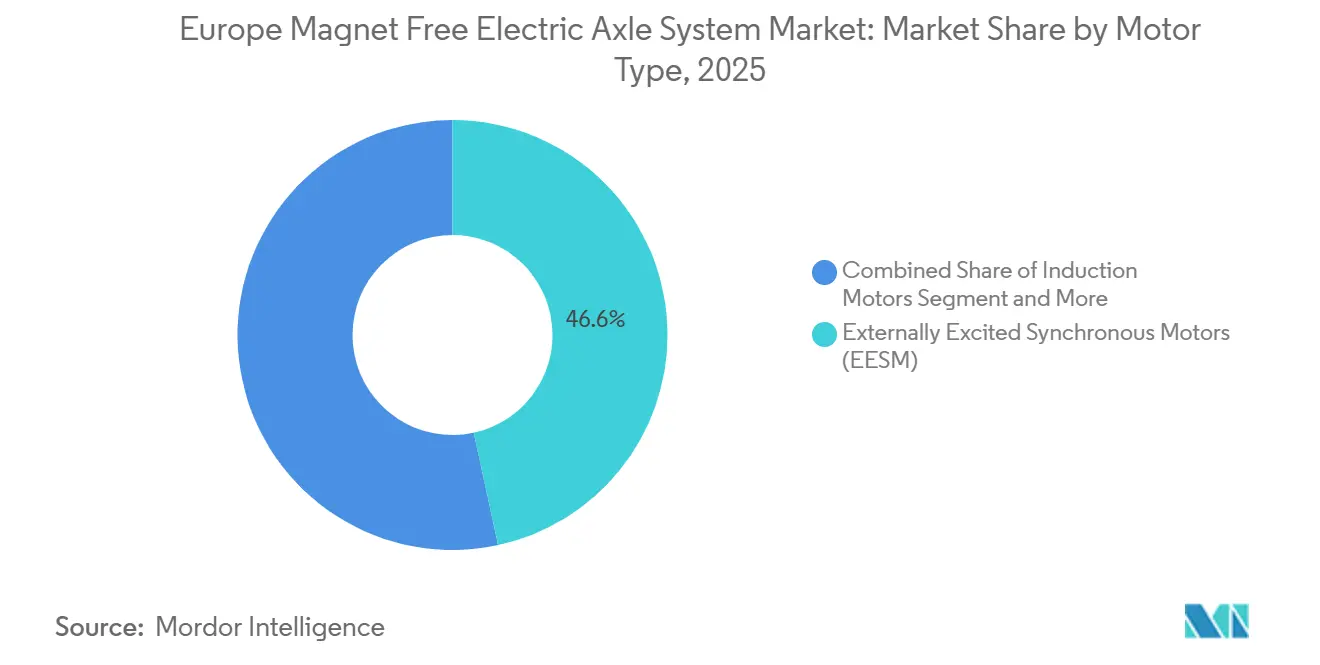
EESM Dominance Faces SRM DisruptionExternally excited synchronous motors held 46.56% revenue in 2025, reflecting their balance of efficiency and geopolitical resilience within the magnet free electric axle system market. Switched reluctance motors are forecast to expand at 15.42% CAGR, the highest among motor types, once waveform-shaping inverters verify ISO-compatible noise levels for bus duty cycles. Induction machines, while aiding front axles in dual-motor setups, compromise efficiency at highway speeds, resulting in a modest market share. Meanwhile, permanent-magnet units find their niche solely in budget-conscious compact car programs.
A joint platform is set to enter series production, aiming to achieve a significant reduction in carbon footprint. A flexible solution allows OEMs to choose between a rare-earth-free or magnet-based design. An upcoming induction module, tailored for a premium client, highlights the transatlantic exchange of technology. Lastly, patents addressing NVH challenges underscore the final hurdle for the mass adoption of SRM, leaving its market forecast vulnerable to the timing of execution.

By Drive Type:
Fully Electric Systems Dominate GrowthFully electric drivetrains captured 63.28% of installations in 2025 and are growing at an 18.28% CAGR, vastly outpacing plug-in and mild hybrids in the magnet free electric axle system market. As battery prices drop significantly, the total cost of ownership (TCO) advantages of dual-powertrain models diminish. Meanwhile, regulations are set to halt the sale of combustion engines in the future.
While plug-in hybrids are projected to account for a notable share of the market volume, their margin for maneuvering shrinks as compliance credits become scarcer. Although hybrids continue to operate in duty cycles where public chargers are absent, data indicate that toll incentives are rapidly bridging this gap. In a clear shift, a major automaker is launching its new platform exclusively as a pure electric model, underscoring the industry's move away from plug-in architecture.
By E-Axle Configuration:
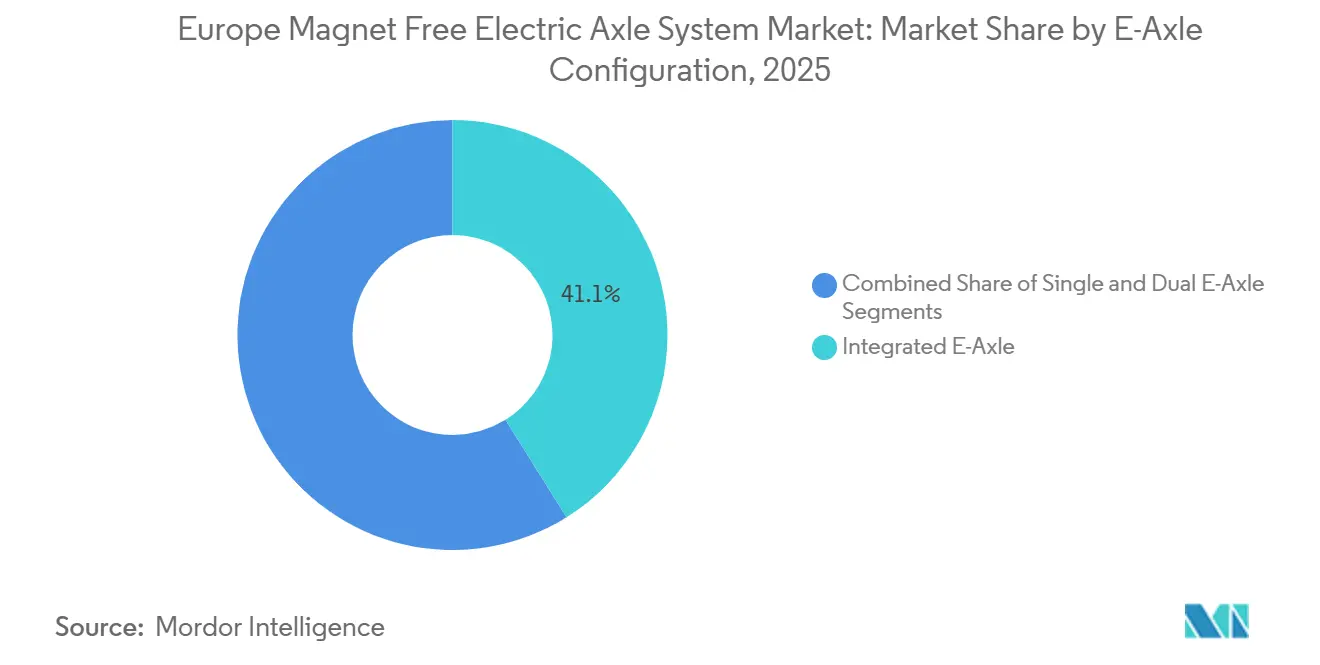
Integration Drives EfficiencyIntegrated units accounted for 41.13% of 2025 installations and posted a 14.16% CAGR, thanks to shrinking parts by 18-22% and lower warranty claims. Front-wheel-drive hatchbacks continue to favor single e-axles for their cost-effectiveness, while premium SUVs are increasingly adopting dual setups for enhanced torque vectoring.
With the advancements in power density, highlighting the trend of tighter packaging through integration. Meanwhile, a new proof solution was unveiled, further streamlining operations by consolidating into a single control microcontroller, thereby reducing both weight and the number of suppliers. However, due to significant cost premiums, the adoption of dual e-axles is confined to segments that can afford them.
By Vehicle Type:
Commercial Vehicles Drive InnovationPassenger cars delivered 57.21% of the 2025 volume but grew more slowly than buses in the magnet free electric axle system market. Municipal procurement rules and predictable depot charging raise bus CAGR to 15.22% through 2031.
Telematics-enabled route density is increasing for light commercial vans, optimizing their regenerative braking benefits. Meanwhile, medium and heavy trucks lag, awaiting the expansion of advanced charging infrastructure. To align performance with magnet independence, a leading automaker has introduced a rear axle with enhanced efficiency and an induction front axle in its premium SUVs.
Geography Analysis
Europe Magnet Free Electric Axle System Market
Germany generated 32.47% revenue in 2025, driven by advancements in production lines and recycling initiatives involving multiple partners. Spain, forecast to grow at a 15.19% CAGR, is leveraging a new battery facility powered by renewable energy. Italy's market share is attributed to increased electrified production at multiple locations and the introduction of additional motor components in manufacturing.
Broader European Markets
France holds a notable share of the volume, supported by research and development efforts and a strong cost profile in the transportation sector. Strategic initiatives, advanced manufacturing facilities, and the transition of production to electric drive units strengthen the United Kingdom's position[3]. The Netherlands is progressing toward cost parity in commercial vehicles. Other European highlights include production advancements in Austria, technological developments in Belgium, and ongoing infrastructure improvements in Central and Eastern Europe.
Mordor Intelligence examines the magnet free electric axle system market across diverse other regional markets as well, offering granular country-level perspectives for China, Japan, India, United States, and South Korea and more.
Competitive Landscape
Key suppliers dominate the magnet-free electric axle system market, holding a significant combined share. While major players pursue an in-house strategy, others rely on modular partnerships, enabling smaller tier-1 players to remain competitive. Innovations in cooling technology for wound-rotor designs continue to shape the market, with advancements in oil-cooling methods and hollow conductor designs leading the way.
Differentiation in the aftermarket segment is becoming increasingly important, as evidenced by the development of specialized repair tools. Additionally, new protection technologies are being introduced to support future architectures that aim to enhance efficiency and reduce material usage. However, companies without in-house inverter design capabilities face growing margin pressures as manufacturers increasingly integrate vertically to optimize performance.
Europe Magnet Free Electric Axle System Industry Leaders
-
ZF Friedrichshafen AG
-
Robert Bosch GmbH
-
Vitesco Technologies Group AG
-
Valeo SA
-
MAHLE GmbH
- *Disclaimer: Major Players sorted in no particular order
Europe Magnet Free Electric Axle System Market Companies Covered in this Report
- ZF Friedrichshafen AG
- Robert Bosch GmbH
- Vitesco Technologies Group AG
- GKN Automotive Ltd
- Valeo SA
- MAHLE GmbH
- Dana Incorporated
- BorgWarner Inc.
- Schaeffler AG
- AVL List GmbH
- Siemens AG
- Magna International Inc.
- Punch Powertrain NV
- Nidec Corporation
- Continental AG
- Allison Transmission Holdings Inc.
- American Axle and Manufacturing Holdings Inc.
- Hitachi Astemo Ltd
- Infinitum Electric Inc.
- Parker Hannifin Corp.
Recent Industry Developments in Europe Magnet Free Electric Axle System Market
- January 2026: Schaeffler AG spearheads the ReDriveS lighthouse project, aiming to develop an industrial, automated, and scalable recycling concept for electric axle drives while ensuring non-destructive methods. With a budget surpassing EUR 25 million, the initiative has secured over EUR 16 million in funding from the German Federal Ministry for Economic Affairs and Energy. The project boasts collaboration from 25 partners spanning industry, SMEs, and academia.
- August 2025: BMW has begun producing its latest eDrive system at a facility, achieving a significant reduction in energy loss and completely eliminating the use of rare-earth materials. This development marks a major step forward in BMW's commitment to sustainable and efficient electric vehicle technology, aligning with the company's broader strategy to reduce environmental impact and reliance on critical raw materials.
Europe Magnet Free Electric Axle System Market Report Scope
The Europe magnet free electric axle system market report is segmented by motor type (externally excited synchronous motors, induction motors, switched reluctance motors and permanent magnet motors), drive type (fully electric drive, hybrid drive, and plug-in hybrid drive), e-axle configuration (single e-axle and dual e-axle), vehicle type (passenger cars and commercial vehicles), and country. The market forecasts are provided in terms of value (USD).
| Externally Excited Synchronous Motors (EESM) |
| Induction Motors |
| Switched Reluctance Motors |
| Permanent Magnet Motors |
| Fully Electric Drive |
| Hybrid Drive |
| Plug-in Hybrid Drive |
| Single E-Axle |
| Dual E-Axle |
| Integrated E-Axle |
| Passenger Cars | Hatchbacks |
| Sedans | |
| SUV and MUVs | |
| Commercial Vehicles | Light Commercial Vehicles |
| Medium and Heavy Commercial Vehicles | |
| Buses and Coaches |
| Germany |
| United Kingdom |
| Spain |
| Italy |
| France |
| Netherlands |
| Rest of Europe |
| By Motor Type | Externally Excited Synchronous Motors (EESM) | |
| Induction Motors | ||
| Switched Reluctance Motors | ||
| Permanent Magnet Motors | ||
| By Drive Type | Fully Electric Drive | |
| Hybrid Drive | ||
| Plug-in Hybrid Drive | ||
| By E-Axle Configuration | Single E-Axle | |
| Dual E-Axle | ||
| Integrated E-Axle | ||
| By Vehicle Type | Passenger Cars | Hatchbacks |
| Sedans | ||
| SUV and MUVs | ||
| Commercial Vehicles | Light Commercial Vehicles | |
| Medium and Heavy Commercial Vehicles | ||
| Buses and Coaches | ||
| By Country | Germany | |
| United Kingdom | ||
| Spain | ||
| Italy | ||
| France | ||
| Netherlands | ||
| Rest of Europe | ||
Key Questions Answered in the Report
What revenue is Europe’s magnet free electric axle system expected to reach by 2031?
The segment is projected to generate USD 3.64 billion by 2031, advancing at a 13.76% CAGR from 2026 to 2031.
Which motor architecture currently holds the largest share of installations?
Externally excited synchronous motors lead with 46.56% of 2025 revenue, reflecting OEM preference for rare-earth-free, highway-efficient designs.
How quickly are switched reluctance motors expected to grow in Europe?
They are forecast to expand at a 15.42% CAGR through 2031 as waveform-shaping inverters mitigate NVH concerns.
Which European market shows the fastest growth trajectory?
Spain is set to rise at a 15.19% CAGR to 2031, backed by a 50 GWh lithium-iron-phosphate gigafactory coming online in late 2026.