Market Overview
| Study Period | 2020 - 2031 |
|---|---|
| Forecast Data Period | 2026 - 2031 |
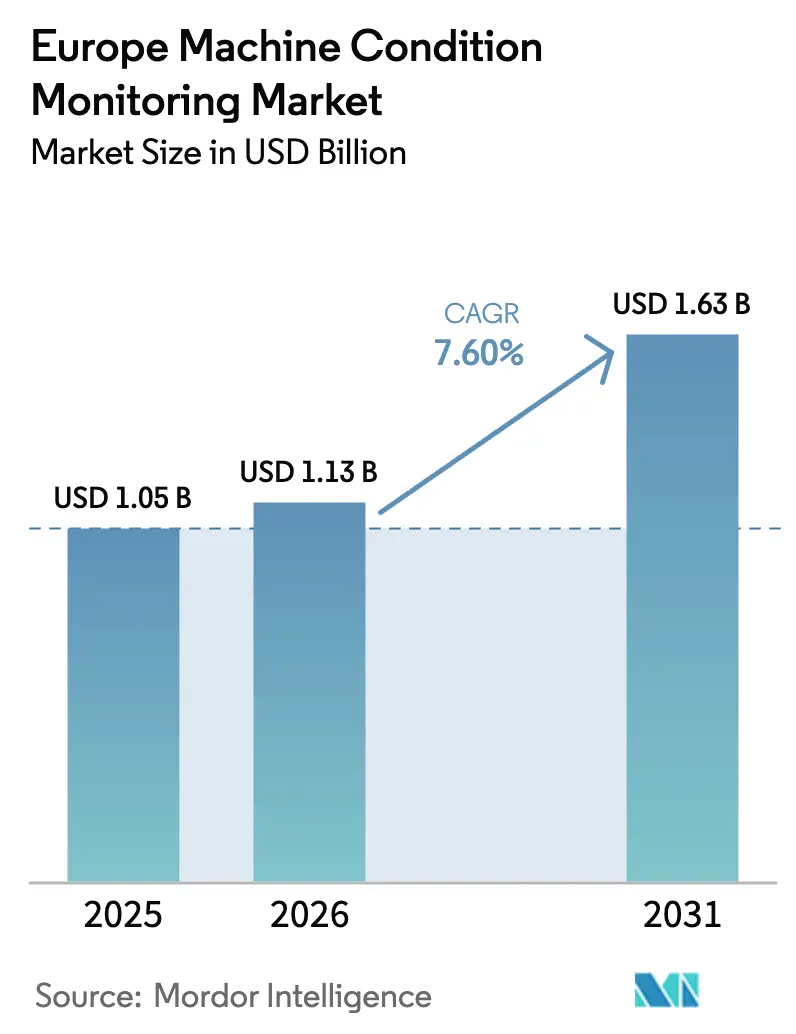
| Base Year Market Size (2025) | USD 1.05 Billion |
| Market Size (2026) | USD 1.13 Billion |
| Market Size (2031) | USD 1.63 Billion |
| Growth Rate (2026 - 2031) | 7.60% CAGR |
| Market Concentration | Medium |
Major Players *Disclaimer: Major Players sorted in no particular order Image © Mordor Intelligence. Reuse requires attribution under CC BY 4.0. | |
Europe Machine Condition Monitoring Market Analysis by Mordor Intelligence
Europe machine condition monitoring market size in 2026 is estimated at USD 1.13 billion, growing from 2025 value of USD 1.05 billion with 2031 projections showing USD 1.63 billion, growing at 7.60% CAGR over 2026-2031. This expansion aligns with accelerated Industry 4.0 programs, especially in German automotive plants and Spanish process lines, where edge-enabled diagnostics curtail downtime and avert costly line stoppages. Regulatory catalysts such as the NIS2 Directive elevate cybersecurity expectations for connected assets, prompting greater demand for secure, real-time monitoring platforms. Vendors that fuse legacy vibration analytics with artificial-intelligence-driven contextual insights gain competitive traction, while subscription pricing converts large capital outlays into manageable operating expenses. Meanwhile, Europe’s 5G rollout, together with rising labor shortages for skilled maintenance technicians, bolsters the business case for automated health-assessment solutions.
Key Report Takeaways
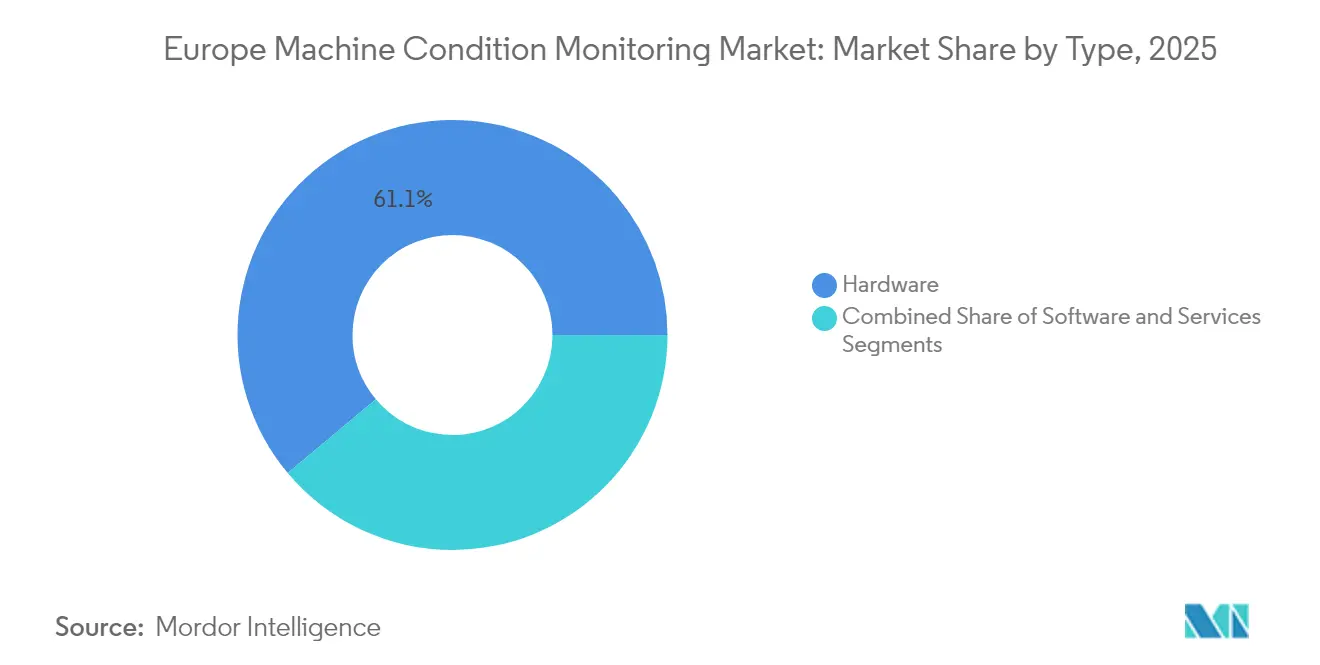
- By type, hardware led with 61.10% revenue share of the European machine condition monitoring market in 2025, whereas services are on track for the fastest 8.65% CAGR through 2031.
- By monitoring technique, online systems accounted for 56.20% of the European machine condition monitoring market share in 2025; edge-AI sensors posted the quickest 8.72% CAGR.
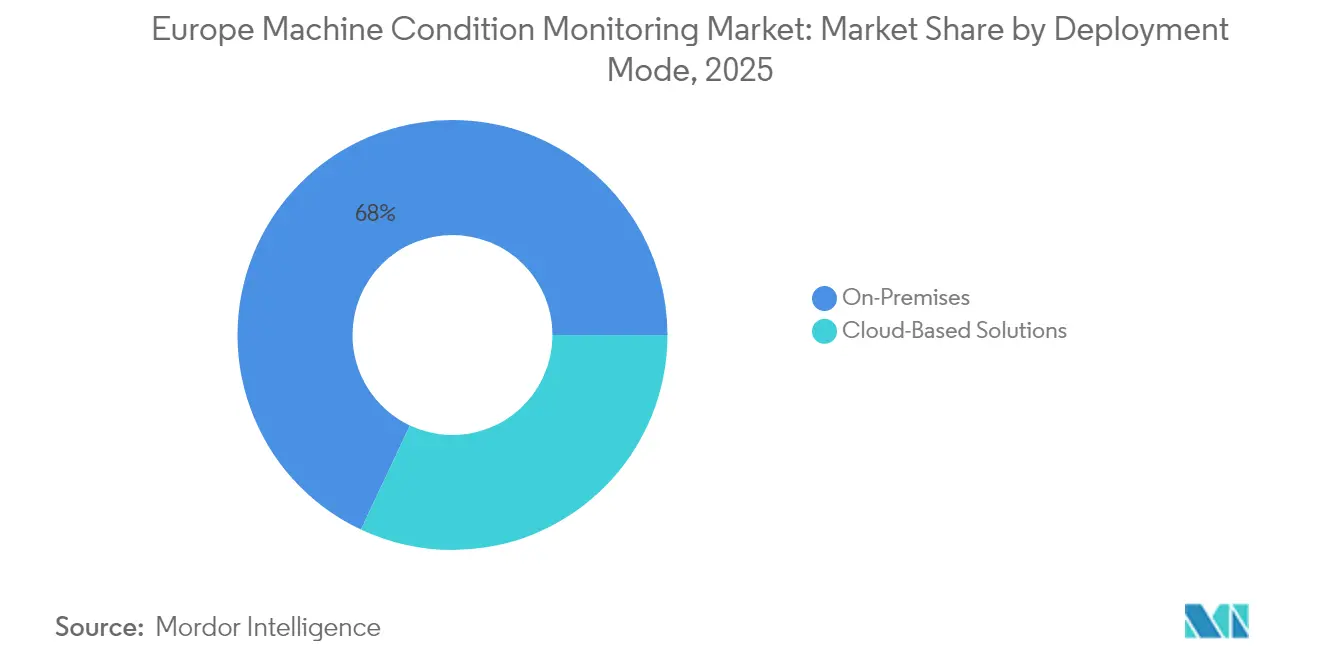
- By deployment mode, on-premises platforms dominated with a 68.00% share of the European machine condition monitoring market in 2025, while cloud solutions are set to expand at an 8.55% CAGR as security frameworks mature.
- By end-user vertical, oil and gas captured 29.90% of the European machine condition monitoring market size in 2025, and discrete manufacturing shows the strongest 9.05% CAGR to 2031.
- By country, Germany contributed 28.10% of the 2025 revenue of the European machine condition monitoring market, whereas Spain will accelerate at a 8.95% CAGR over the forecast horizon.
Note: Market size and forecast figures in this report are generated using Mordor Intelligence’s proprietary estimation framework, updated with the latest available data and insights as of 2026.
Europe Machine Condition Monitoring Market Trends and Insights
Drivers Impact Analysis*
| Driver | (~) % Impact on CAGR Forecast | Geographic Relevance | Impact Timeline |
|---|---|---|---|
| Increasing equipment performance via predictive maintenance | +1.8% | Germany, France, Netherlands | Medium term (2-4 years) |
| Industry 4.0 expansion across manufacturing | +2.1% | Germany, Italy, Spain | Long term (≥ 4 years) |
| Shift toward remote operations and worker safety | +1.2% | United Kingdom, France, Germany | Short term (≤ 2 years) |
| Rising regulatory pressure on critical-infrastructure uptime | +0.9% | Germany, Netherlands, United Kingdom | Medium term (2-4 years) |
| Edge-AI smart sensors enabling real-time analytics | +1.4% | Germany, Spain, Netherlands | Long term (≥ 4 years) |
| Emergence of subscription-based monitoring platforms | +0.7% | United Kingdom, Germany, France | Medium term (2-4 years) |
| Source: Mordor Intelligence | |||


Increasing Equipment Performance via Predictive Maintenance
German, French, and Dutch manufacturers now view reactive maintenance as a profit drain, with studies showing it can squander 70% of potential asset life. Germany’s Manufacturing-X consortium, backed by EUR 133 million (USD 150.5 million), blends machine-health data and production metrics to cut unplanned downtime 25-30% and stretch asset life 15-20%. Schaeffler’s online system across 58 drives at its European logistics hub delivered six-figure cost savings, validating ROI expectations.[1]Plant & Works Engineering, “Condition Monitoring Case Studies,” pwemag.co.uk Integrating vibration and electrical-signature insights uncovers root-cause faults sooner, reallocating maintenance labor toward continuous-improvement tasks. The resulting gains elevate plant availability and make predictive approaches standard practice across mid-sized factories.
Industry 4.0 Adoption Across Manufacturing and Process Industries
Europe’s transition toward data-centric production unifies plant-floor sensors with enterprise resource planning and manufacturing-execution applications. Strong 5G coverage in Germany, Italy, and Spain allows secure, high-speed data flow between machines and digital twins, unlocking continuous improvement loops. Siemens’ Digital Drivetrain (released in 2024) exemplifies how an automation incumbent embeds embedded analytics directly into motor drive packages.[2]Siemens AG, “Digital Drivetrain Launch,” siemens.com Process operators integrate temperature, pressure, and vibration streams into a single pane of glass, exposing correlations between asset health and product yield that once remained invisible. Standardization efforts under Manufacturing-X lower integration barriers, accelerating multi-plant rollouts, and fueling the European machine condition monitoring market.
Edge-AI Smart Sensors Enabling Real-Time Analytics
Embedding machine-learning cores within sensors eliminates latency and bandwidth obstacles. Fraunhofer IPMS’s multimodal platform trims data traffic 90% while issuing millisecond-level alarms for mission-critical gear. Analog Devices’ Voyager4 integrates MEMS accelerometers and on-board AI to spot bearing defects without a server or gateway. Such devices recalibrate sampling rates based on load, extending battery life in remote pumps and conveyors. TinyML algorithms foster pattern recognition once affordable only to Fortune 500 plants, democratizing advanced diagnostics to small and medium enterprises and widening the adoption corridor for the European machine condition monitoring market.
Rising Regulatory Pressure on Asset Uptime in Critical Infrastructure
The NIS2 Directive now captures manufacturing and essential infrastructure, penalizing inadequate resilience programs with fines up to EUR 10 million or 2% of global turnover.[3]Kaan Ozdogan, “Who Does NIS2 Apply To?,” Lexology, lexology.com ENISA’s 2024 NIS360 report highlights six sectors in a “risk zone,” pushing operators to justify proactive fault-detection schemes. Because operators must file incident reports within 24 hours, continuous monitoring has become a compliance requirement rather than an optional productivity tool. This shift directs fresh capital toward secure, always-on systems and lifts long-term spending projections in the European machine condition monitoring market.
Restraints Impact Analysis*
| Driver | (~) % Impact on CAGR Forecast | Geographic Relevance | Impact Timeline |
|---|---|---|---|
| Cost implications of retrofits and integration | -1.4% | Italy, Spain, Eastern Europe | Short term (≤ 2 years) |
| Macroeconomic and geopolitical uncertainties | -0.8% | Germany, United Kingdom, France | Medium term (2-4 years) |
| Cybersecurity and data-ownership concerns | -1.1% | Germany, Netherlands, France | Medium term (2-4 years) |
| Shortage of vibration analysts | -0.9% | Germany, United Kingdom, Spain | Long term (≥ 4 years) |
| Source: Mordor Intelligence | |||
Cost Implications of Retrofits and Integration
Legacy pumps, turbines, and extruders often lack mounting points or digital interfaces for today’s multi-axis accelerometers. Integrating wireless networks with 1990-era programmable-logic controllers can inflate project expense by 30-40% over sensor costs alone. Hazard-area certifications in petrochemical plants further double the spending on explosion-proof hardware, particularly across mature facilities in Italy, Spain, and Eastern Europe. Diverse national electrical codes, CE-marking nuances, and ATEX rules extend project timelines and dilute ROI calculations, slowing adoption in price-sensitive segments within the European machine condition monitoring market.
Cybersecurity and Data-Ownership Concerns in Connected Assets
Adding thousands of radio-equipped nodes multiplies attack vectors. Manufacturers worry that a compromised sensor network could trigger NIS2 fines or force unplanned shutdowns. German automakers insist on zero-trust architectures with device-level encryption before allowing cloud connections. Data-sovereignty statutes demand that analytics servers reside in EU jurisdictions, complicating multi-country fleet management. Many mid-market plants lack in-house security talent, leaning on third-party managed security services that raise operating costs and elongate deployment cycles in the European machine condition monitoring industry.
*Our forecasts treat driver/restraint impacts as directional, not additive. The impact forecasts reflect baseline growth, mix effects, and variable interactions.
Segment Analysis
By Type: Hardware Foundation Underpins Services Growth
Hardware retained a 61.10% revenue lead in 2025, supported by indispensable accelerometers, ultrasonic probes, and infrared cameras forming any monitoring program’s front line. Vibration instruments dominate because rotating machinery remains pervasive, while thermography devices gain traction for high-voltage switchgear audits. The European machine condition monitoring market size for hardware reached USD 641.55 million in 2025. Services, however, exhibit an 8.65% CAGR as subscription models surge. Vendors now bundle sensor leasing, data hosting, and monthly health reports, accepted by CFOs eager for cost certainty. Software, although a smaller slice, supplies the analytics engine that converts signal streams to actionable work orders. Machine-learning modules automate fault classification, closing a skill gap for scarce vibration experts.
Because hardware acts as the beachhead for follow-on service revenues, vendors pursue razor-and-blade strategies, offering low-cost wireless kits that later anchor multi-site service contracts. Hybrid solutions integrating lubrication analysis and electrical-signature monitoring enrich context for root-cause troubleshooting, strengthening cross-sell opportunities. Thermography and ultrasonic skids safeguard electrical assets and compressed-air systems, respectively, broadening wallet share within mature blue-chip accounts.


By Monitoring Technique: Online Systems Anchor, Edge-AI Sensors Excel
Online installations accounted for 56.20% of 2025 revenue as critical-asset owners refuse to rely on periodic checks. High-speed turbines, compressors, and rail switches now stream data nonstop, enabling degradations to be caught hours, not weeks, before failure. The European machine condition monitoring market share for online solutions rests on maturing wireless mesh protocols and long-life batteries that cut cabling labor. Portable devices still appear across non-critical conveyors, chosen for their flexibility and low upfront cost.
Edge-AI sensors capture headlines with a 8.72% CAGR forecast. By shifting pattern matching into the device, these nodes forward only condensed fault indicators, slashing bandwidth fees and enabling private-LTE deployments deep inside refineries. Deutsche Bahn’s KONUX rollout demonstrates how continuous rail-switch monitoring triggers preemptive field crews, shrinking network disruption minutes. Hybrid approaches emerge: technicians collect quick-route readings via Bluetooth handhelds, then upload to fleet dashboards for trend correlation, maximizing coverage while controlling spend.
By Deployment Mode: On-Premises Security Prevails, Cloud Gains Ground
On-premises platforms secured 68.00% of 2025 spend, reflecting European manufacturers’ insistence on local data custody amid evolving cybersecurity laws. Plants host servers in secure racks, ensuring sub-millisecond access to alarms and simplifying NIS2 audit trails. Yet cloud growth at 8.55% CAGR proves momentum toward scalable analytics. Hyperscalers now operate EU-only data centers with ISO 27001 controls, easing sovereignty fears and unlocking enterprise-wide benchmarking on gigabytes of vibration spectra.
Hybrid architectures combine the two: preprocessing occurs at the edge for real-time alarms, then trend features are upload to regional clouds for deeper machine-learning training. This topology offers a safety-by-design path for risk-averse sectors, especially pharmaceuticals and defense, where latency, privacy, and compliance intersect. As insurance carriers begin rewarding plants for documented predictive programs, CFOs accept subscription OPEX fees in lieu of unpredictable breakdown costs, nudging additional workloads to the cloud.
By End-User Vertical: Oil and Gas Leads, Discrete Manufacturing Accelerates
Oil and gas retained 29.90% of 2025 revenue; offshore platforms, pipelines, and downstream refineries rely on continuous diagnostics to mitigate environmental and safety risks. Aging compressors and pumps mandated under the EU Methane Regulation must prove mechanical integrity, fueling sensor retrofits. Yet discrete manufacturing shows a 9.05% CAGR through 2031. Automotive, electronics, and packaging lines embed smart diagnostics at each servo and gearbox, linking health metrics with just-in-time schedules.
Process manufacturing chemicals, food, and beverages remains a strong adopter where nonstop throughput demands high reliability. Aerospace, marine, and defense sectors require ruggedized, EMI-resistant gear and encrypted comms, positioning niche suppliers for premium margins. Power-generation utilities integrate condition data with energy-trading platforms, predicting plant availability for day-ahead markets.
Geography Analysis
Germany generated 28.10% of the Europe machine condition monitoring market in 2025, anchored by automotive, chemical, and machinery clusters. Government-funded Manufacturing-X bridges OT-IT data across 115 firms, creating fertile ground for sensor rollouts. Labor deficits estimated at 200,000 technicians by 2027 press companies to automate health checks. Despite robust 5G, patchy fiber access can slow cloud adoption in rural facilities, sustaining on-prem demand. The presence of Siemens, Schaeffler, and Bosch fosters a deep ecosystem of pilots and early-adopter case studies.
Spain represents the region’s fastest-growing locale: 8.95% CAGR. High AI-adoption rates (70% of firms seeing productivity gains) dovetail with Industry 4.0 subsidies. Renewable-energy expansion, particularly in wind-farm fleets scattered across harsh terrains, calls for wireless, solar-powered monitoring nodes. Lear’s acquisition of local integrator WIP Industrial Automation in 2024 highlights global confidence. Madrid’s push for digital upskilling further accelerates adoption, positioning Spain as a technology export hub to Latin America.
The United Kingdom, France, and Italy compose mature but opportunity-rich markets where asset replacement drives steady sensor refresh cycles. Post-Brexit customs complexity nudges U.K. plants to optimize uptime through predictive insights. The Netherlands leverages its petrochemical ports and logistics hubs, requiring ATEX-classified sensors and advanced lubrication analytics. Eastern Europe, grouped as Rest of Europe, shows promising greenfield projects in automotive and battery-manufacturing corridors, although budget limitations often steer buyers toward portable kits first.
Regulatory Landscape
The European regulatory environment for machine condition monitoring is tightening around connected machinery, cybersecurity, and information transparency. Regulation (EU) 2023/1230 on machinery replaces Directive 2006/42/EC and becomes mandatorily applicable from January 20, 2027, expanding compliance expectations to cybersecurity and AI-enabled functions that intersect with remote monitoring portals and connected diagnostic systems.
In the run-up to applicability, Member States are required to notify the European Commission of national penalty rules by October 2026, increasing compliance urgency for OEMs, integrators, and end users retrofitting sensors and gateways. At the same time, cybersecurity resilience requirements for connected assets, including NIS2-driven risk management and incident response expectations referenced in the market context, support demand for hardened architectures, audit trails, and secure data handling across monitoring deployments.
Value Chain Analysis
The value chain covers sensor and hardware component sourcing, including MEMS accelerometers, piezoelectric elements, and embedded electronics, followed by device and system integration such as gateways, edge processing, and connectivity. Analytics software, deployed either on-premises or in the cloud, then underpins recurring services including remote diagnostics, reliability engineering, and managed monitoring.
Europe's reliance on imported raw materials and critical components for industrial-grade sensors and electronics, including MEMS fabrication and custom ASICs, can affect lead times and cost for edge-AI sensor programs. In the midstream, assembly and integration activity is concentrated in Central and Eastern Europe for parts of the production chain, while incumbents and specialists such as Siemens, SKF, and Schaeffler bundle hardware, analytics, and services into lifecycle offerings. Downstream, end users in oil and gas, power, process manufacturing, and discrete manufacturing typically buy through a mix of direct enterprise contracts and channel partners, with more value captured in software subscriptions and services that translate sensor data into work orders, compliance documentation, and uptime outcomes.
Competitive Landscape
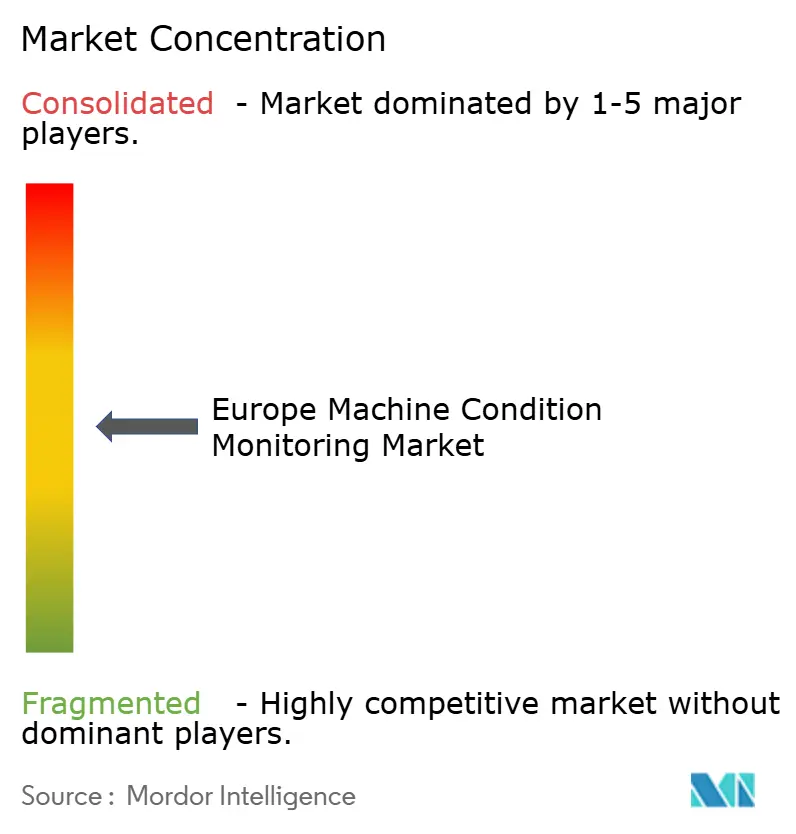
The European machine condition monitoring market balances between diversified automation conglomerates and agile sensor specialists. Siemens, Emerson, and Honeywell exploit installed-base leverage, bundling software, gateways, and professional services. Emerson’s USD 7.2 billion AspenTech buyout in 2025 signals an appetite to own high-margin analytics.[4]Emerson, “Emerson to Acquire AspenTech,” emerson.com SKF, Schaeffler, and NSK tighten grip on bearing-centric diagnostics, integrating smart lubricators and electro-mechanical drive data. Honeywell and Danfoss unite cybersecurity-hardened controllers with cloud dashboards, meeting stricter NIS2 clauses.
Edge analytics startups fill the white space. Samotics captured EUR 20 million EIB funding to refine electrical-signature analysis for submerged pumps. KONUX leverages AI to monitor rail turnout geometry, partnering with Deutsche Bahn on multi-year rollouts. Fraunhofer spin-offs commercialize ultralow-power neural networks, courting SMEs that lack data scientists. Meanwhile, distributors such as EU Automation publish implementation guides, easing adoption hurdles for mid-tier plants.
Pricing power favors vendors delivering closed-loop solutions and measurable ROI. As predictive programs cut warranty claims, OEM alliances emerge: ABB’s Födisch Group acquisition strengthens environmental compliance diagnostics. M&A momentum is poised to continue, as firms seek portfolio breadth spanning sensors, connectivity, AI, and services to satisfy end-users, consolidating supplier lists under cybersecurity procurement policies.
Europe Machine Condition Monitoring Industry Leaders
SKF AB
Schaeffler Technologies AG and Co. KG
Emerson Electric Co.
Honeywell International Inc.
General Electric Company
- *Disclaimer: Major Players sorted in no particular order

Market Opportunities and Future Outlook
Compliance-driven modernization is a key opportunity ahead of the Machinery Regulation's mandatory applicability on January 20, 2027. The regulation's stronger emphasis on cybersecurity and digital functionality increases demand for secure condition monitoring stacks that combine hardened devices, controlled remote access, and traceable digital documentation, particularly as plants move from portable checks to always-on monitoring and as OEMs embed monitoring-ready designs.
Capability expansion is already visible in the market. SKF's March 2026 acquisition of G-Tech Instruments is designed to broaden diagnostic tooling across marine, railway, and energy sectors, while Schaeffler's FAG OPTIME E-CM launch in February 2026 targets electrical condition monitoring of three-phase motors. The separate April 2026 sovereign AI compute partnership between SKF AB and Sferical AI in Sweden supports additional work on predictive maintenance and digital product development.
Recent Industry Developments
- March 2026: SKF AB signed an agreement to acquire G-Tech Instruments Inc., a Taiwan-headquartered specialist in vibration analyzers and diagnostic tools, to enhance its condition monitoring service portfolio. The move expands SKF's sensor and diagnostics ecosystem and strengthens its competitive positioning in European and Mordor-relevant markets. The acquisition broadens regional capabilities and accelerates integration of advanced diagnostics into existing offerings.
- February 2026: SKF AB introduced an enhanced version of the SKF Quick Collect Sensor (CMDT 392) at the Maintenance Dortmund 2026 trade fair. This product upgrade improves vibration and condition monitoring device capabilities, enabling more precise data capture at the edge. The refreshed hardware strengthens SKF's portfolio and supports faster deployment of real-time analytics for maintenance teams.
- January 2026: Schaeffler Technologies AG & Co. KG announced the launch of FAG OPTIME E-CM, a system for electrical condition monitoring of three-phase motors by analyzing electrical currents and voltages. The expansion broadens the motor condition monitoring scope into the electrical domain. It enables more integrated monitoring solutions across drive systems, reinforcing Schaeffler's position in intelligent bearing and motor diagnostics.


Research Methodology Framework and Report Scope
Market Definition and Coverage
This market covers solutions used to track the health of industrial machines in Europe so failures can be detected early, typically using sensors, software, and related services that support maintenance decisions.
Scope exclusions: We exclude general plant automation controls that do not measure equipment condition, and we also exclude one-time repair labor that is not sold as a monitoring service.
Segmentation Overview
- By Type
- Hardware
- Vibration Condition Monitoring Equipment
- Thermography Equipment
- Ultrasonic Detection Systems
- Lubricating Oil Analysis
- Current Signature Analysis
- Acoustic Emission Monitoring
- Software
- Services
- Hardware
- By Monitoring Technique
- Online Condition Monitoring
- Portable Condition Monitoring
- Edge AI-enabled Sensors
- By Deployment Mode
- On-Premises
- Cloud-Based Solutions
- By End-user Vertical
- Oil and Gas
- Power Generation
- Process Manufacturing
- Discrete Manufacturing
- Aerospace and Defense
- Automotive and Transportation
- Marine, Mining, and Metals
- Other End-user Verticals
- By Country
- United Kingdom
- Germany
- France
- Italy
- Spain
- Netherlands
- Rest of Europe
Data Sources, Market Sizing, and Validation
Desk Research
Desk research is used to set the market boundaries, build the country view, and create reality checks for demand. We reviewed public sources that explain Europe industrial activity and maintenance priorities, such as Eurostat industrial production series, European Commission documents on manufacturing and digitalization, and national statistics offices for large economies.
To anchor the technical side, we also used open publications and guidance from groups such as ISO/IEC pages around condition monitoring concepts, EU-OSHA safety materials where relevant, and peer-reviewed papers on vibration monitoring and rotating equipment diagnostics. Company annual reports, investor presentations, and reputable trade press were reviewed to understand offering mix across hardware, software, and services. We used a paid subscription for company financials and news to track product launches, partnerships, and regional footprint changes. This list is not exhaustive, and many other public sources were used for data collection, validation, and clarification.
Primary Interviews and Surveys
Primary work was used to confirm what is actually purchased in Europe, how budgets split between online systems and portable routes, and how cloud deployments are progressing by plant type. We spoke with a mix of solution providers, distributors, maintenance service firms, and end users across process and discrete industries. We then cross-checked assumptions using country level context across major European economies.
Distribution of primary research fieldwork respondents
| Company type | Respondent position | Region |
|---|---|---|
| Top tier: 32% | CXOs: 17% | |
| Mid tier: 47% | Functional/Unit leaders: 31% | |
| Smaller Players: 21% | Managers: 52% |
Market-Sizing & Forecasting
The sizing model starts from a top-down demand pool build, where industrial installed base intensity and maintenance digitization signals are used to reconstruct spending for condition monitoring across Europe. Country totals are first shaped using indicators such as industrial production trends, rotating equipment density in energy and process plants, typical monitoring penetration for critical assets, and the split between continuous online monitoring and periodic portable checks.
Those outputs are then corroborated through selective bottom-up approximations, including supplier revenue cues by region, channel checks on common price bands (sensors, analyzers, and software subscriptions), and sample volume by application multiplied by an observed average selling price range. Where bottom-up information is incomplete, gaps are handled by applying conservative coverage ratios and then adjusting with interview feedback so small-country estimates do not get overstated.
For forecasting, we used scenario analysis supported by a simple multivariate regression to keep the path realistic. Inputs include factory automation investment direction, energy and utilities retrofit cycles, skilled labor availability in maintenance, and the pace of cloud adoption for analytics. Growth rates were stress-tested by shifts in technique mix (for example, vibration and ultrasound adoption patterns) and by end-user exposure to downtime costs.
Data Validation & Update Cycle
Outputs are validated through cross-checks against independent signals such as manufacturing output direction, large-asset capex cycles in power and oil and gas, and observed adoption statements in filings and interviews. Where a country or technique shows a sharp jump, the model is re-opened and the assumptions are reviewed. If the mismatch cannot be explained by known events, we run a second round of calls.
Before sign-off, the work is reviewed in steps so that inputs, calculations, and conversion assumptions stay consistent across countries and years. Reports are refreshed annually, and interim updates are made when material events occur, such as regulatory shifts, large pricing changes, or sudden slowdowns in industrial activity. Right before delivery, a final review pass is completed so clients receive the most current view possible.
Mordor Intelligence's Europe Machine Condition Monitoring Market Size Versus Other Published Estimates
Published market values for this space can vary more than buyers expect, mainly because firms draw the line differently between condition monitoring, broader predictive maintenance software, and adjacent automation systems. Timing also matters since Europe industrial spending can move quickly with energy price shifts and production cycles, which changes the base year and the starting point.
Key gaps usually come from what gets counted as market revenue, how cloud subscriptions are annualized, and whether services are treated as recurring monitoring contracts or as general maintenance labor. By tracking installed base exposure and refresh cadence, Mordor Intelligence ties the market total to online and portable monitoring spending only when it is sold as condition monitoring hardware, software, or services. This keeps the boundary consistent across countries and reduces double counting with broader automation budgets.
Benchmark comparison
| Source | Market Size | Gaps in Research Methodology |
|---|---|---|
| Mordor Intelligence | USD 1.05 B (2025) | |
| Regional Consultancy A | USD 0.69 B (2019) | Uses an older base year and a shorter horizon, and it appears to undercount newer cloud analytics subscriptions that became more common after 2020 in several European industries. |
| Trade Publisher B | USD 1.03 B (2027) | Tracks a narrower period and may apply a lower penetration curve for online condition monitoring in process plants, which reduces the total when compared on a similar year basis. |
The comparison shows that the spread is mostly explained by base year choice and by how subscription software and monitoring services are recognized in revenue. Using clear boundaries, practical demand drivers, and repeatable checks by country makes the final number easier to trace and reuse when planning budgets or estimating growth.


Key Questions Answered in the Report
How large is the Europe machine condition monitoring market in 2026?
It is valued at USD 1.13 billion and is forecast to reach USD 1.63 billion by 2031 at a 7.60% CAGR.
Which country contributes the most revenue?
Germany leads with 28.10% of 2025 revenue, owing to its robust manufacturing base and early Industry 4.0 adoption.
Which monitoring technique is growing the fastest?
Edge-AI-enabled sensors are projected to expand at a 8.72% CAGR between 2026 and 2031.
Why are services outpacing hardware growth?
Subscription-based contracts that bundle analytics and maintenance convert CAPEX to OPEX and deliver predictable cost savings, driving an 8.65% CAGR for services.
What regulation is influencing investment decisions?
The NIS2 Directive imposes stringent cybersecurity and resilience requirements, making real-time monitoring essential for compliance.
Which vertical offers the highest growth opportunity beyond oil and gas?
Discrete manufacturing—particularly automotive and electronics—will grow at 9.05% CAGR as plants tie machine health to production-quality metrics.
Page last updated on: