
Market Overview
| Study Period | 2020 - 2031 |
|---|---|
| Forecast Data Period | 2026 - 2031 |
| Base Year Market Size (2025) | USD 389.44 Billion |
| Market Size (2026) | USD 401.98 Billion |
| Market Size (2031) | USD 471.42 Billion |
| Growth Rate (2026 - 2031) | 3.23 % |
| Market Concentration | Low |
Major Players *Disclaimer: Major Players sorted in no particular order Image © Mordor Intelligence. Reuse requires attribution under CC BY 4.0. | |
Europe Long Haul Transport Market Analysis by Mordor Intelligence
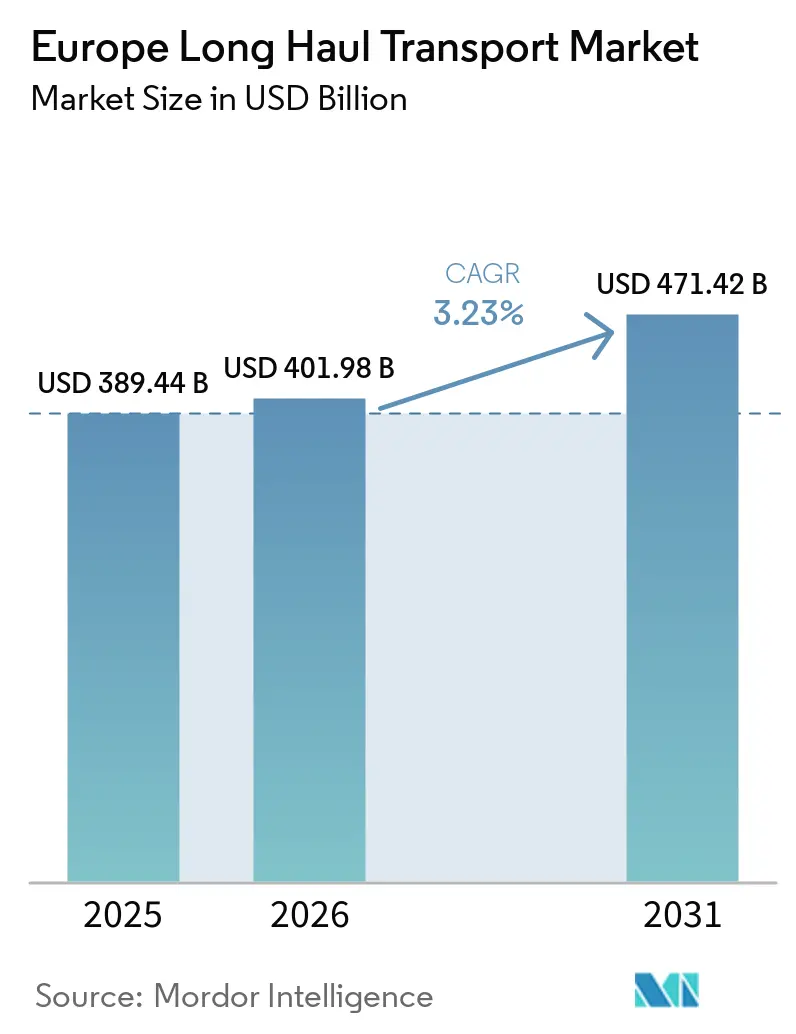
The Europe Long Haul Transport Market size was valued at USD 389.44 billion in 2025 and is estimated to grow from USD 401.98 billion in 2026 to reach USD 471.42 billion by 2031, at a CAGR of 3.23% during the forecast period (2026-2031).
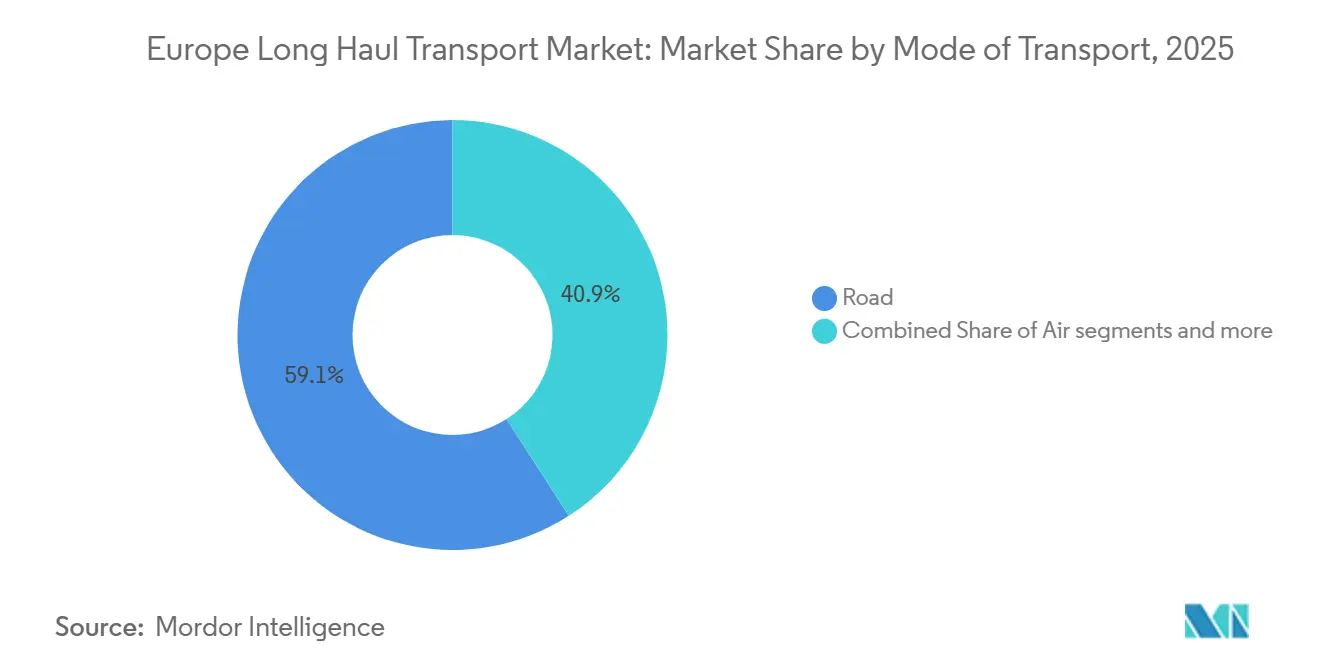
The market growth trajectory rests on manufacturing’s entrenched freight needs, the rapid rise of e-commerce, and an active M&A pipeline that concentrates volume with a shrinking set of multimodal providers. At the same time, decarbonization deadlines and infrastructure gaps impose capital and operational stresses that pull margins in opposite directions. Road transport preserved a 59.10% Europe Long Haul Transport market share in 2025, as just-in-time production and high-frequency retail replenishment still require door-to-door flexibility. Air freight is emerging as the fastest-growing transport mode, expanding at 4.75% annually through 2031, supported by increasing cross-border parcel flows and time- and temperature-sensitive pharmaceutical shipments requiring stringent delivery conditions.
Key Report Takeaways
- By mode of transport, road commanded 59.10% of the Europe Long Haul Transport market share in 2025 and continues to expand, though air freight is forecast to post the highest 4.75% CAGR to 2031.
- By end-user industry, manufacturing accounted for 32.55% of the Europe Long Haul Transport market size in 2025 while wholesale and retail trade is advancing at a 3.72% CAGR through 2031.
- By geography, Germany captured 23.40% revenue in 2025; Poland records the strongest 3.83% CAGR to 2031 as near-shoring accelerates.
Note: Market size and forecast figures in this report are generated using Mordor Intelligence’s proprietary estimation framework, updated with the latest available data and insights as of 2026.
Europe Long Haul Transport Market Trends and Insights
Drivers Impact Analysis*
| Driver | (~) % Impact on CAGR Forecast | Geographic Relevance | Impact Timeline |
|---|---|---|---|
| EU Green Deal & Fit-for-55 modal-shift targets | 0.9% | EU-wide, strongest in Germany, Netherlands, France | Medium term (2-4 years) |
| Expansion of TEN-T megaprojects (Rail Baltica, Fehmarn Belt, etc.) | 0.6% | Baltic States, Germany, Denmark, Poland | Long term (≥4 years) |
| Explosive e-commerce boosting parcel & air-cargo lane demand | 1.1% | Global, concentrated in UK, Germany, France, Netherlands | Short term (≤2 years) |
| Consolidation & 4PL integration across modes | 0.5% | EU-wide, led by Germany, Netherlands, Belgium | Medium term (2-4 years) |
| Roll-out of zero-carbon fuel & shore-power infrastructure | 0.4% | Major ports: Rotterdam, Hamburg, Antwerp, Barcelona | Long term (≥4 years) |
| Post-pandemic resilience & near-shoring strategies | 0.7% | Poland, Czech Republic, Hungary, with spillover to Germany | Medium term (2-4 years) |
| Source: Mordor Intelligence | |||
EU Green Deal & Fit-for-55 Modal-Shift Targets
The Fit-for-55 package fixes legally binding CO₂ cuts that push shippers to reroute long-haul volume from road toward rail or inland waterways, yet terminal backlogs and last-mile constraints still tilt day-to-day demand toward trucks. Rail’s 80% lower emissions per tonne-kilometer give it a clear environmental edge, but capacity on core corridors hovers above 85%, leaving little surge headroom. The carbon-border adjustment mechanism extends the pressure by inserting logistics emissions into import compliance audits, so procurement teams now assess freight carbon data with the same rigor once reserved for cost. Certification schemes such as ISO 14083 have become de facto tender prerequisites, compelling smaller carriers to buy telematics and data-reporting tools they had long deferred. Consequently, fleet renewal and digital visibility projects are pacing quicker than anticipated, even if modal shifts lag policy intent.
Expansion of TEN-T Megaprojects
Rail Baltica’s 870 km of standard-gauge track, supported by EUR 1.4 billion in EU co-financing, promises a seamless Tallinn-Warsaw route, yet permitting delays push commissioning beyond 2030. The Fehmarn Belt rail tunnel slashes Copenhagen–Hamburg transit to under three hours when operational in 2029, unlocking freight flows that today navigate ferry bottlenecks[1]. Parallel German network upgrades receive EUR 2.5 billion of annual funding, but localized land-acquisition disputes slow diggers on the ground. Each delay holds back the rail share of Europe Long Haul Transport market growth, leaving road hauliers to soak up volume despite carbon targets. Secondary investments in intermodal yards and electrification hinge on main-line completion, amplifying the knock-on effect of every missed milestone. Long-term, these links still reshape continental freight geometry by embedding a high-speed, low-carbon spine into the network.
Explosive E-commerce
Air cargo tonnage at Frankfurt, Leipzig, and Paris climbed 8%, fueled by small parcels and temperature-controlled pharma consignments requiring sub-48-hour delivery windows. Cross-border parcels jumped 15% as marketplace platforms integrate EU inventories, yet customs digitalization still lags at non-Schengen borders, extending lead times on southeast routes. To stay competitive, integrators are retrofitting freighters with IoT-driven temperature controls and AI routing that predicts congestion down to neighborhood level.
Consolidation & 4PL Integration
DSV’s USD 14.3 billion purchase of DB Schenker creates a forwarding titan topping USD 39 billion in revenue, yielding purchasing clout with ocean carriers and airlines that mid-tier forwarders cannot match. Scale also allows end-to-end contract bundling across air, sea, rail, and road, simplifying procurement for large shippers and nudging share toward integrated providers. Digital freight platforms such as sennder, armed with EUR 160 million in fresh capital, use algorithms to force down empty running and broker margins, compelling legacy 3PLs to either invest in proprietary tech or cede spot loads. Automotive and retail verticals lead the shift to 4PL models where a single coordinator orchestrates multiple carriers in real time. This trend indirectly elevates data-governance and cybersecurity requirements in contracts, creating a new barrier to entry for smaller players..
Restraints Impact Analysis*
| Restraint | % Impact on CAGR Forecast | Geographic Relevance | Impact Timeline |
|---|---|---|---|
| Rail-line, port & intermodal terminal capacity bottlenecks | -0.70% | Germany, Netherlands, Belgium, Italy | Short term (≤2 years) |
| Heavier-truck Directive risk of reverse modal shift | -0.30% | Germany, France, Poland, Spain | Medium term (2-4 years) |
| Driver & skills shortages across road, rail & maritime | -0.60% | EU-wide, acute in Germany, UK, France | Medium term (2-4 years) |
| Energy & bunker-fuel price volatility | -0.40% | Global, impacting sea and air freight | Short term (≤2 years) |
| Source: Mordor Intelligence | |||
Rail-Line, Port & Intermodal Capacity Bottlenecks
Rail freight utilization on Rhine-Alpine and North Sea–Mediterranean corridors exceeded 85% in 2024, leaving minimal headroom for extra trains and increasing schedule unreliability. Rotterdam, Antwerp, and Hamburg terminals ran near saturation during peak weeks, extending container dwell times beyond 48 hours and eroding rail’s theoretical door-to-door speed advantage. Terminal automation projects are underway, yet land acquisition and permitting often span three to five years, so meaningful relief is not expected before 2027. Diesel motive power still covers 46% of European track, limiting the emissions benefit of modal shift and exposing operators to fuel-price volatility. These bottlenecks collectively cap the rail share of the Europe Long Haul Transport market until new capacity comes online.
Driver & Skills Shortages
Road freight lacked 400,000 drivers in 2024, equal to about 7% of its workforce, due to aging demographics and limited appeal of long-haul jobs among younger workers. Cabotage restrictions compound the issue by limiting how many domestic hauls a foreign truck may perform, fragmenting capacity during seasonal peaks. Rail operators also face two-year training cycles for locomotive engineers, a lag that slows service additions despite available wagons. Short-sea shipping reports officer shortfalls that forced 10% to 15% wage hikes in 2024, costs ultimately passed through freight rates. Persistent talent gaps therefore tighten spot capacity and inflate logistics budgets for shippers across the board.
*Our forecasts treat driver/restraint impacts as directional, not additive. The impact forecasts reflect baseline growth, mix effects, and variable interactions.
Segment Analysis
By Mode of Transport: Road Dominance Meets Air’s Ascent
Road transport maintained a 59.10% Europe Long Haul Transport market share in 2025 as the continent’s dense highway network underpins time-critical deliveries, yet escalating diesel costs and driver scarcity compress operator margins. Air freight carries the fastest growth outlook at a 4.75% CAGR through 2031, fueled by e-commerce parcel volume and GDP-compliant cold-chain pharmaceuticals that command premium rates. Rail’s lower emissions per tonne-kilometer align with Fit-for-55 policy, but capacity bottlenecks and first-mile/last-mile transfers temper its immediate share gains. Inland waterways, moving 300 million t of Rhine traffic annually, face climate-linked low-water disruptions that shift cargo onto rail and road, highlighting the climate resilience imperative.
Digital freight platforms reduced empty running on primary road corridors from 25% to under 18%, boosting small-fleet competitiveness and lowering emissions intensity. Rail intermodal operators deploy IoT sensors that track location and shock to mimic road-level transparency, narrowing a historic information gap. Meanwhile, EU funds of EUR 500 million target lock modernization on Rhine and Danube stretches, a step meant to safeguard waterway competitiveness against drought risk. The Europe Long Haul Transport market size attached to air freight is forecast to climb steadily as parcel density rises, underscoring modal diversification in corporate shipping strategies.

By End-User Industry: Manufacturing Leads, Retail Accelerates
Manufacturing retained 32.55% of the Europe Long Haul Transport market size in 2025, propelled by automotive and machinery supply chains that run lean inventories and rely on synchronized inbound flows. Wholesale and retail trade will grow at a 3.72% CAGR through 2031 as omnichannel models multiply fulfillment nodes and spike demand for cross-dock and parcel services. Agriculture, fishing, and forestry sustain steady refrigerated-freight demand, with reefer truck fleets expanding 8% in 2024 to move Mediterranean produce northward. Oil, gas, and extractive segments confront decarbonization headwinds but still require heavy-haul capacity and specialized tank equipment for fossil fuels and bulk mineral movements.
Construction freight pivots with public-works cycles; EU recovery funds spurred a 2024 surge that pulled cement and steel volumes back to pre-pandemic highs. The “Others” bucket, spanning pharma, chemicals, and electronics, carries stringent chain-of-custody protocols; GDP-certified carriers command premium pricing thanks to validated cold-chain processes. Retail’s fragmentation into micro-fulfillment adds shipment frequency yet shrinks average consignment size, lifting express-mode share and monetizing last-mile logistics—key contributors to Europe Long Haul Transport industry profitability. Near-shoring tilts manufacturing freight eastward but also intensifies shipment cadence, benefiting less-than-truckload specialists positioned on central European corridors.
Geography Analysis
Germany commanded 23.40% of the Europe Long Haul Transport market in 2025, leveraging its automotive export corridors and multimodal hubs in Duisburg and Hamburg, although rail congestion on the Rhine-Alpine axis and a 7% driver shortfall curb growth potential. Poland is the pace-setter with a 3.83% CAGR forecast to 2031, powered by EUR 8 billion in near-shoring FDI and a pipeline of 4 million m² in new logistics real estate that clusters along east-west highways. The United Kingdom’s post-Brexit freight now stabilizes; yet new border-entry systems expected in late 2025 will layer compliance time and cost onto cross-Channel routes, prompting some shippers to reroute via Benelux ports.
France exploits Atlantic and Mediterranean dual-sea access, with the Seine-Nord Europe canal linking Paris to northern waterways by 2030, a move set to recalibrate barge competitiveness on north–south trades. Spain positions the Port of Barcelona as a southern gateway; EUR 400 million in automation cuts vessel dwell times and anchors catalytic rail-barge links inland. Italy confronts Alpine road congestion; the Brenner Base Tunnel, targeted for 2032, will push a meaningful slice of north–south flows to rail, trimming transit times between Verona and Munich.
The Netherlands, through Rotterdam’s 440 million t throughput, remains a continental pivot, integrating deep-sea, barge, and rail in a high-density hinterland network. Nordic states invest in electric-truck corridors, while Balkan members upgrade roads with cohesion funds, collectively lifting capacity in the “Rest of Europe” segment. Germany’s EUR 2.5 billion rail-digitalization plan aims to raise freight capacity 20% by 2030, but permitting drag risks schedule slippage beyond 2028. Poland’s warehouse rents climb as e-commerce and auto suppliers chase scarce labor, nudging logistics budgets and fueling automation spending. Finally, UK freeport zones, announced in 2024, attract measured interest as operators balance customs incentives against dual-regime complexity.
Regulatory Landscape
EU transport policy is tightening around measurable decarbonization and cross-border performance. In 2026, Regulation (EU) 2026/1030 mandated EN ISO 14083:2023 as the common methodology for calculating and reporting greenhouse gas emissions for transport services. The change brings emissions accounting into daily pricing, tendering, and audit workflows for transport operators and hub operators on EU-linked lanes.
Digital compliance is also moving from optional to standardized. The eFTI framework under Regulation (EU) 2020/1056, supported by Implementing Regulation (EU) 2025/2243, requires Member State authorities to accept electronic regulatory transport information across modes. That accelerates adoption of certified data platforms within carrier TMS/ERP stacks. On the infrastructure side, the revised TEN-T Regulation (EU) 2024/1679 sets staged completion milestones (core by 2030, extended core by 2040, comprehensive by 2050) and adds performance expectations for cross-border rail freight operations. Regulation (EU) 2026/1184 also introduces a new EU approach to railway capacity management, with the framework to be established by 12 December 2027.
Value Chain Analysis
The value chain covers shippers (manufacturing, retail, pharma), freight forwarders and 4PLs, asset-based carriers across road, rail, sea and inland waterways, and air, plus an enabling layer of digital platforms, terminals, ports, and inspection authorities. Consolidation among large forwarders supports bundled procurement across modes, while digital freight platforms and telematics providers improve truck utilization and service visibility. Intermodal terminals and port-rail interfaces remain pivotal nodes, since reliability on core long-distance corridors is often decided at these interfaces. Congestion or limited slot availability at these nodes can also offset rail or short-sea transit advantages.
Policy-led digitalization and corridor funding are reshaping how information and capacity flow through the chain. The eFTI rollout is pushing paperless regulatory data exchange into routine operations, linking carriers, forwarders, and authorities through certified eFTI platforms and interoperability efforts coordinated via EU logistics digitalization fora. On the physical layer, EU funding programs are directing capital toward TEN-T connectivity and modal shift infrastructure. In July 2025, the European Commission selected 94 transport projects for EUR 2.8 billion in Connecting Europe Facility (CEF) grants, and in June 2026 it launched a new EUR 1.1 billion CEF call emphasizing rail, inland waterways, and corridor resilience. This directly influences where terminals, rail access, and cross-border bottlenecks get addressed first.
Competitive Landscape
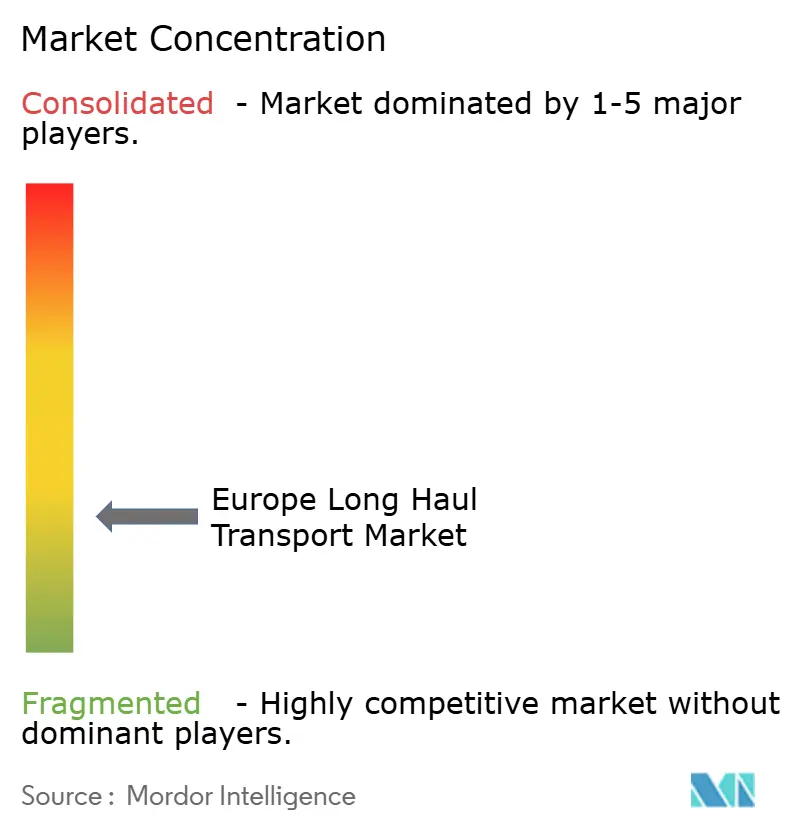
The Europe Long Haul Transport market remains fragmented. DSV’s pending merger with DB Schenker will vault the combined entity into a revenue league with DHL and Kuehne+Nagel, creating 150,000-plus headcount and unmatched bargaining heft across modal contracts. Scale advantages now extend beyond volume discounts to technology spend; multi-billion-dollar players amortize visibility platforms and data-science teams across thousands of lanes, a hurdle that asset-light forwarders fend off through partnerships or divestitures.
Specialists defend turf with expertise in hazardous goods, pharma cold-chain, or urban micro-fulfillment, where regulatory compliance and asset specificity deter generalists. Digital challengers such as sennder and Transporeon compress broker margins by 20% in some lanes via algorithmic matching, pushing incumbents to invest or acquire to stay relevant. Sustainability differentiation grows in importance; operators sign renewable-energy PPAs, deploy battery-electric trucks, and pilot hydrogen rigs to appeal to shipper decarbonization scorecards embedded in 2025 RFQs..
Rail Cargo Group filed patents for automated coupling that cuts yard dwell, illustrating technology’s role in unlocking capacity without new track. Autonomous-truck pilots run platoons on German autobahns, yet commercial rollout awaits harmonized liability rules, still fragmented across member states. Private-equity roll-ups thrive in fragmented sub-segments, stitching together regional hauliers to gain density and negotiate fuel or toll rebates—a model active in Benelux and the UK.
Europe Long Haul Transport Industry Leaders
-
Girteka Logistics
-
DHL Group
-
DSV A/S
-
Dachser
-
Kuehne + Nagel
- *Disclaimer: Major Players sorted in no particular order
Market Opportunities and Future Outlook
Compliance-driven digitization and standardized carbon reporting are creating near-term whitespace for service providers that can package emissions visibility and paperless documentation into long-haul offerings. Regulation (EU) 2026/1030 (EN ISO 14083:2023) makes comparable GHG calculation a requirement rather than a differentiator. That raises demand for auditable lane-level emissions data, hub-level reporting, and integrated workflows that can pass shippers procurement and authority checks. At the same time, eFTI implementation (Regulation (EU) 2020/1056 and the 2025 implementing rules) creates an operational incentive to replace document-heavy cross-border processes with certified electronic exchanges, favoring forwarders and carriers that can embed eFTI-ready capabilities across multimodal moves.
Decarbonized long-haul operations and corridor-aligned infrastructure upgrades also provide commercially tangible space for early movers using electric-truck and intermodal solutions. In June 2026, EU ministers endorsed the first two roadmaps under the Clean Transport Corridor Initiative for the Scandinavian-Mediterranean and North Sea-Baltic corridors, tying long-haul deployment more tightly to TEN-T charging and corridor readiness. Company actions point to monetizable use cases as well. In May 2026, VELUX and LOTS Group partnered to run electrified logistics on a 1,250 km round-trip route, showing that long-distance battery-electric operations are being executed on specific lanes rather than staying confined to pilots. On the infrastructure pipeline, the EU continued to steer capital toward corridor capacity via CEF, including the June 2026 EUR 1.1 billion call. This supports opportunities for carriers and 4PLs to secure capacity on upgraded rail and inland waterway links, and to build corridor-specific service products that blend road with rail or short-sea legs.
Recent Industry Developments
- June 2026: DHL Group announced an around EUR 160 million investment program in France for 2026-2027 to strengthen logistics infrastructure and support the clean energy transition. The plan targets capacity and facility upgrades and includes measures to expand electrification-related capabilities, aligning network development with shipper decarbonization requirements in a major European freight market.
- May 2025: DSV A/S completed its acquisition of DB Schenker for about EUR 14.3 billion. The deal materially increases scale in European forwarding and contract logistics, strengthening DSVs ability to bundle multimodal long-haul solutions and negotiate capacity across carriers.
- August 2024: Kuehne+Nagel won a 5-year inbound logistics mandate spanning 12 European automotive plants. The contract consolidates long-haul transport and logistics coordination across multiple sites, reinforcing the role of large integrators in managing synchronized manufacturing flows.
Research Methodology Framework and Report Scope
Market Definition and Coverage
This market covers the revenue earned from long-haul freight transport services within Europe, where shipments move over longer distances and are executed through organized transport networks across countries.
Scope exclusions: Passenger transport services and local short-haul or last-mile delivery activity are excluded from the market values.
Segmentation Overview
- By Mode of Transport
- Road
- Rail
- Sea and Inlandwaterways
- Air
- By End-user Industry
- Agriculture, Fishing, and Forestry
- Construction
- Manufacturing
- Oil and Gas, Mining and Quarrying
- Wholesale and Retail Trade
- Others
- By Country
- Germany
- United Kingdom
- Spain
- Italy
- Netherlands
- France
- Poland
- Rest of Europe
Data Sources, Market Sizing, and Validation
Desk Research
We start by mapping the industry with public statistics and policy documents that describe freight demand, network capacity, and modal trends across Europe. Typical references include Eurostat freight transport datasets, European Commission transport and climate packages, UNECE transport statistics, and OECD transport indicators, which help keep assumptions tied to visible activity.
Next, we layer in supporting facts from company annual reports and investor presentations, reputable logistics and transport press, and association websites covering trucking, rail freight, air cargo, and intermodal corridors. For a few checks that are hard to confirm from open sources alone, we also use paid subscriptions for company financials and news, import and export shipment-level signals, and tender and contract tracking where relevant. These examples are not exhaustive, and many other sources were reviewed to collect data, validate assumptions, and clarify open questions.
Primary Interviews and Surveys
To pressure-test the model, we run expert interviews and structured surveys with transport operators, freight forwarders, shippers, and industry advisors, so we can confirm how rates, capacity, and utilization moved by lane and service type. We also use these discussions to close gaps on contract versus spot pricing, cross-border volumes, and how regulations and fuel cost pass-through affected pricing outcomes on major European corridors.
Distribution of primary research fieldwork respondents
| Company type | Respondent position |
|---|---|
| Top tier: 34% | CXOs: 14% |
| Mid tier: 52% | Functional/Unit leaders: 42% |
| Smaller Players: 14% | Managers: 44% |
Market-Sizing & Forecasting
Our sizing starts with a top-down build that reconstructs the demand pool from Europe freight activity signals, and then ties that activity to service revenue using observed pricing and mix. In practice, indicators such as freight tonne-kilometers by mode, cross-border trade flows, heavy-duty vehicle parc and utilization direction, fuel cost trends that influence rate resets, and the share shift between contract and spot lanes are used to keep totals realistic.
Once the headline value is formed, we corroborate it with selective bottom-up approximations, such as sampled lane rate benchmarks multiplied by implied shipment volumes, and revenue roll-ups for a set of representative operators where financial disclosure is available. Where company reporting is incomplete, gaps are handled by applying conservative coverage factors, which we then check with interview feedback and adjust so the totals remain consistent with the broader demand signals.
For forecasting, we rely on scenario analysis supported by a light multivariate regression layer. The main drivers include GDP and industrial production direction, trade outlook, the fuel cost path, and regulation-linked operating constraints. Assumptions are then refined through primary feedback so the forecast reflects how capacity and pricing typically react during both soft and strong freight cycles.
Data Validation & Update Cycle
We validate outputs through repeated cross-checks against independent signals, including freight volume series, trade direction, and carrier profitability cues, and then investigate any sharp deviations before results are signed off. If a variance cannot be explained by a clear event, the team re-contacts respondents and revisits the pricing and utilization assumptions until the mismatch is resolved.
Each report is refreshed annually, and interim updates are considered when material events occur, such as major regulation changes, fuel price shocks, or large network disruptions. Before delivery, a final analyst review pass is completed so clients receive the latest updated view based on newly available public data and confirmed field inputs.
Mordor Intelligence's Europe Long Haul Transport Market Estimate Compared With Other Published Estimates
Published market values for long-haul transport in Europe can look far apart because the underlying scope and pricing basis are not the same from one estimate to the next. Differences usually come from what modes are counted, whether short-haul legs are mixed in, which year is treated as the base, and how currency and inflation assumptions are applied.
Parcel and last-mile delivery revenue sits outside Mordor Intelligence's scope, which can pull the value down versus estimates that treat all road freight spending as long-haul. Another common gap is whether multimodal legs (rail, air, sea, inland waterways) are included as part of the long-haul service, and whether the model uses constant-price reporting or current-price revenue with fuel and surcharge pass-through updated during the year.
Benchmark comparison
| Source | Market Size | Gaps in Research Methodology |
|---|---|---|
| Mordor Intelligence | USD 389.44 B (2025) | |
| Trade Journal A | USD 480.00 B (2025) | Uses a broader road freight spend view that likely blends long-haul with regional distribution activity, and it can overstate value when last-mile and parcel movements are not separated. |
| Global Consultancy B | USD 250.00 B (2025) | Appears closer to long-distance general trucking only, which can omit non-road long-haul legs and parts of multimodal service revenue, and it may rely on macro allocation shares without lane-level pricing checks. |
The spread in the table is mainly explained by what gets counted as long-haul service revenue and how the price base is treated across years. By keeping the scope tight and then checking totals against freight activity signals plus interview-led rate and utilization reality, the final number stays traceable to simple inputs that can be reviewed and repeated.
Key Questions Answered in the Report
What is the 2026 value of Europe Long Haul Transport?
The Europe Long Haul Transport market stands at USD 401.98 billion in 2026.
Which mode is forecast to grow fastest through 2031?
Air freight is projected to expand at a 4.75% CAGR, driven by cross-border e-commerce and pharma cold-chain demand.
How large is the German share of continental long-haul freight?
Germany held 23.40% of the market in 2025, anchored by automotive and machinery export corridors.
What CAGR is expected for Poland’s long-haul sector?
Poland is forecast to post a 3.83% CAGR between 2026 and 2031 as near-shoring attracts new manufacturing.
Which end-user segment is gaining share fastest?
Wholesale and retail trade leads segment growth at a 3.72% CAGR as omnichannel fulfillment multiplies shipment frequency.
How does consolidation impact freight pricing power?
Scale from deals like DSV-DB Schenker gives large 4PLs negotiating leverage with carriers, compressing broker margins and pushing smaller firms toward technology partnerships.