
Europe Less-Than Container Load Market Size and Share
Market Overview
| Study Period | 2020 - 2031 |
|---|---|
| Forecast Data Period | 2026 - 2031 |
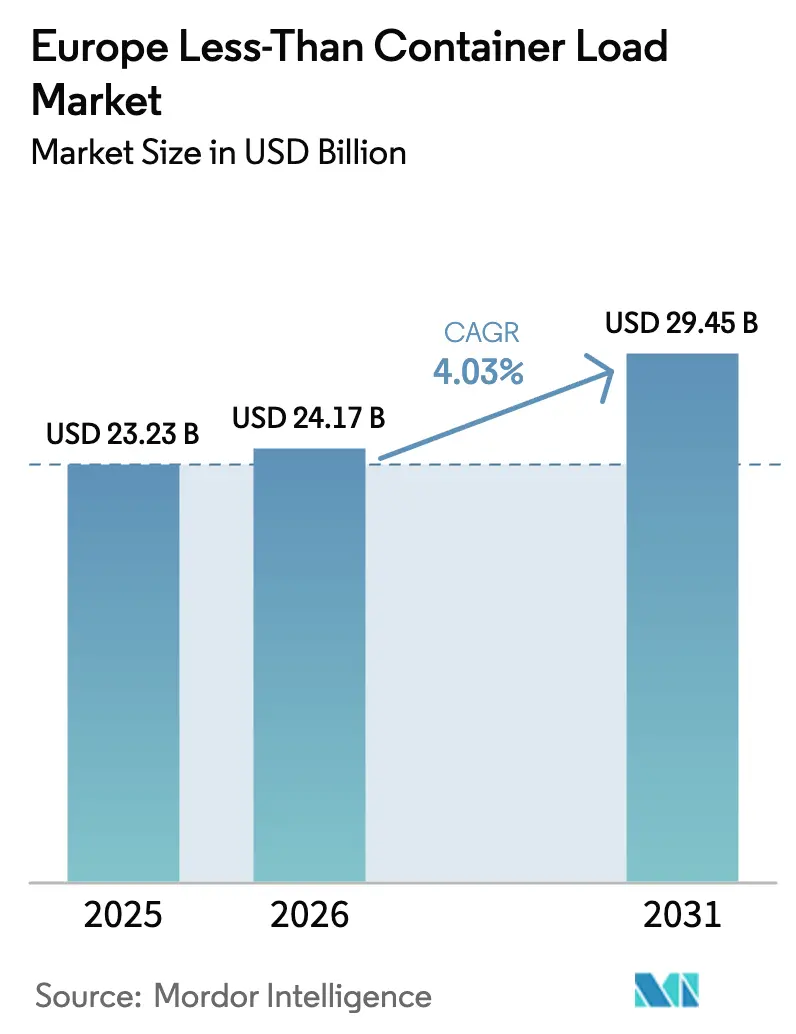
| Base Year Market Size (2025) | USD 23.23 Billion |
| Market Size (2026) | USD 24.17 Billion |
| Market Size (2031) | USD 29.45 Billion |
| Growth Rate (2026 - 2031) | 4.03 % |
| Market Concentration | Low |
Major Players *Disclaimer: Major Players sorted in no particular order Image © Mordor Intelligence. Reuse requires attribution under CC BY 4.0. | |
Europe Less-Than Container Load Market Analysis by Mordor Intelligence
The Europe Less-Than Container Load Market size is expected to grow from USD 23.23 billion in 2025 to USD 24.17 billion in 2026 and is forecast to reach USD 29.45 billion by 2031 at 4.03% CAGR over 2026-2031.
The solid growth outlook is underpinned by escalating cross-border e-commerce volumes, digital booking platforms that shrink lead times, and regulatory incentives that make ocean consolidation more attractive than air and road alternatives. A steady pipeline of green shipping corridors and the post-Brexit compliance burden are further tilting European shippers toward flexible LCL solutions that optimize container utilization while easing customs administration. Meanwhile, the sector is learning to manage higher carbon-pricing pass-throughs and port congestion that periodically stretch transit times yet also stimulate demand for inventory-buffering consolidation services.
Key Report Takeaways
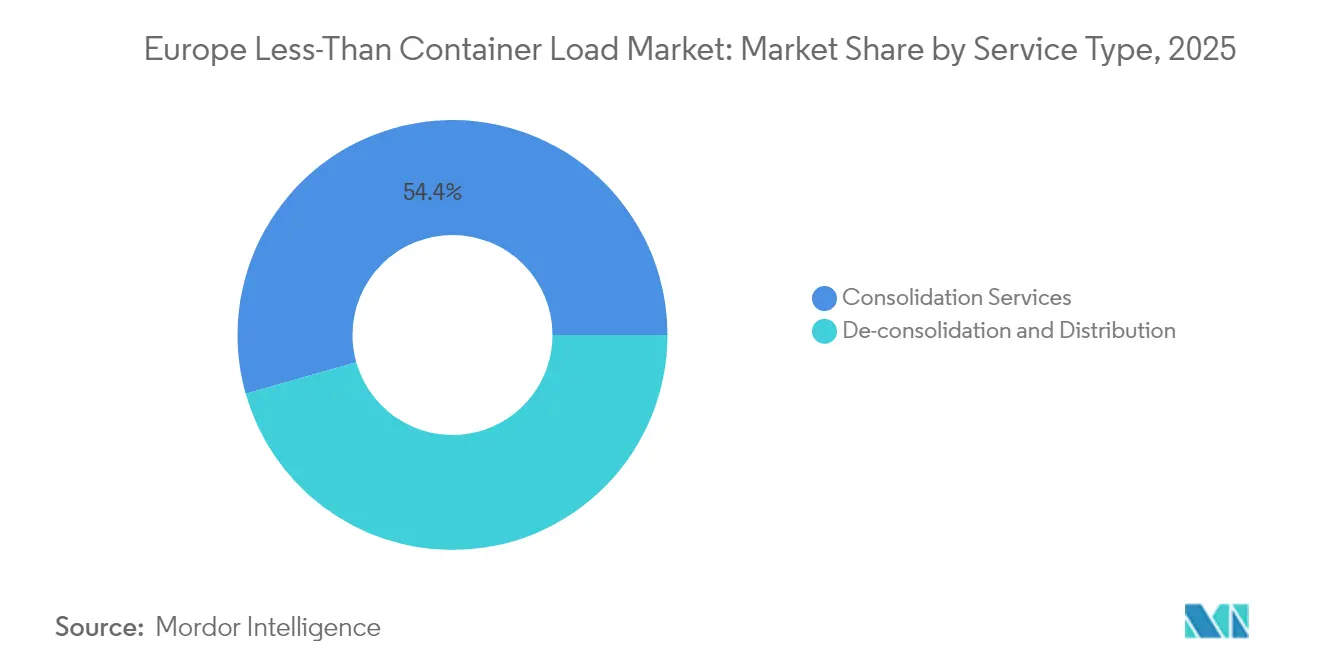
- By service type, consolidation services captured 54.40% of the Europe less than container load (LCL) market share in 2025, while de-consolidation and distribution is projected to expand at a 4.67% CAGR to 2031.
- By destination, international services accounted for 70.55% of the Europe less than container load (LCL) market size in 2025 and are poised to grow at a 4.26% CAGR through 2031.
- By nature of business, freight forwarding dominated with a 89.30% share in 2025 and is advancing at a 3.98% CAGR over the forecast period.
- By end user, retail and e-commerce led with a 31.60% revenue share in 2025; healthcare and pharmaceuticals record the fastest growth at a 5.15% CAGR to 2031.
- By geography, Germany held 15.70% of the Europe less than container load (LCL) market share in 2025, whereas Spain is set to rise at a 4.93% CAGR through 2031.
Note: Market size and forecast figures in this report are generated using Mordor Intelligence’s proprietary estimation framework, updated with the latest available data and insights as of 2026.
Europe Less-Than Container Load Market Trends and Insights
Drivers Impact Analysis*
| Driver | (%) Impact on CAGR Forecast | Geographic Relevance | Impact Timeline |
|---|---|---|---|
| E-commerce parcel surge boosts LCL demand | +1.2% | Global, early gains in Germany, Netherlands, UK | Medium term (2-4 years) |
| Digital freight platforms enable instant LCL booking | +0.8% | North & Central Europe, spill-over to Southern Europe | Short term (≤ 2 years) |
| EU ETS / Med-ECA compliance shifts freight from air & road to LCL | +0.9% | EU-wide, pronounced on Mediterranean lanes | Long term (≥ 4 years) |
| Post-Brexit customs complexity diverts UK flows to LCL services | +0.6% | UK-EU corridors, focused on Dover, Calais, Rotterdam | Medium term (2-4 years) |
| Asia-Europe green shipping corridors increase sailing frequency | +0.7% | Northern European ports, Eastern European hinterlands | Long term (≥ 4 years) |
| Resilience strategies after Red-Sea rerouting diversify entry ports | +0.5% | Mediterranean, Atlantic and Baltic gateways | Medium term (2-4 years) |
| Source: Mordor Intelligence | |||
E-commerce Parcel Surge Propels LCL Consolidation Demand
European parcel carriers moved 6.2 billion shipments during the 2024 holiday peak, a 9% jump that gave freight forwarders rich opportunities to aggregate smaller orders into containerized loads. Roughly 70% of that volume required direct-to-consumer delivery, encouraging providers to apply algorithmic matching that raises container fill rates and lowers handling costs. Chinese platforms alone sent 4.6 billion packets into Europe in 2024, magnifying the need for reliable LCL consolidation that can clear customs at scale. The EU plan to withdraw the EUR 150 duty-free threshold in 2025 will standardize declarations, strengthening the competitive position of LCL operators that already run integrated brokerage capabilities. Together these forces add structural tailwinds to the Europe less than container load (LCL) market[1]“Changes to the Existing ETS and MRV Applying from 1 January 2024,” European Commission, climate.ec.europa.eu.
Digital Freight Platforms Transform LCL Booking Infrastructure
Platforms such as Cargoboard and Shypple compress traditional quote cycles from several days to a few minutes, giving shippers on-demand price discovery and slot confirmation. Kuehne + Nagel’s myKN expands this capability with CO₂-neutral options and real-time tracking, contributing to the forwarder’s 15% revenue increase in Q1 2025[2]“New Requirements for EU-GB Imports from 31 January,” ICAEW, icaew.com. Algorithmic route design and machine-learning-driven capacity pooling consistently lift container utilization 20-30 percentage points above manual methods. Maersk flags digitalization as a top logistics theme for 2025, highlighting how automated workflows are redefining freight forwarding complexity. These advancements widen adoption of Europe less than container load (LCL) market solutions among small and midsized shippers that previously lacked purchasing leverage.
EU ETS Implementation Accelerates Modal Shift to LCL Services
The addition of maritime transport to the EU Emissions Trading System in 2024 obliges carriers to buy allowances covering 70% of emissions in 2025, climbing to full coverage in 2026. Ocean Network Express responded with an Environment Surcharge that aligns with both EU ETS and FuelEU Maritime rules. CMA CGM estimates the regulation inflates base freight rates by 7-8 EUR per 100 kg, a 75% rise that erodes air-cargo price parity. Because the per-unit carbon cost drops sharply when shipments are consolidated, the Europe less than container load (LCL) industry gains a comparative edge for medium-distance traffic once served by trucks or planes.
Asia-Europe Green Shipping Corridors Enhance Sailing Frequency
Public-private coalitions are building low-carbon corridors linking main Asian export hubs to northern Europe, prompting carriers to schedule more intra-European feeders to synchronize transshipment windows. Higher sailing frequency diminishes dwell times at consolidation points, raising service reliability for the Europe less than container load (LCL) market. The expansion extends hinterland reach into Eastern Europe, widening addressable demand among exporters seeking consistent weekly departures.
Restraints Impact Analysis*
| Restraint | (%) Impact on CAGR Forecast | Geographic Relevance | Impact Timeline |
|---|---|---|---|
| Port congestion & container shortages elevate transit variability | -1.1% | Hamburg, Antwerp, Rotterdam, other North European hubs | Short term (≤ 2 years) |
| Fragmented CFS infrastructure in Eastern Europe | -0.7% | Central & Eastern Europe, Balkan corridors | Long term (≥ 4 years) |
| Carbon-compliance surcharges narrow LCL price advantage | -0.8% | EU-wide, heavier on Mediterranean lanes | Medium term (2-4 years) |
| Rising insurance/security costs on high-risk routes | -0.6% | Red Sea, Black Sea, other high-risk corridors | Medium term (2-4 years) |
| Source: Mordor Intelligence | |||
Port Congestion Crisis Disrupts LCL Transit Reliability
Vessel wait times of 7–10 days at key consolidation hubs reflect yard utilization beyond 92%, pushing container dwell at Rotterdam past 9 days and stretching barge delays in Antwerp to 96-120 hours. Belgian strikes in early 2025 shut port access for 36 hours, cascading backlogs across Northern Europe. End-to-end lanes that once delivered in 45 days now require up to 90 days, pressuring inventory planning for users of the Europe less than container load (LCL) market.
Carbon-Compliance Surcharges Tighten Cost Parity
While consolidated loads dilute carbon fees, some deep-sea carriers levy blanket surcharges that raise all-in LCL rates by 8-10%, trimming but not eliminating the discount versus air freight. On Mediterranean routes the added cost narrows historical differentials, forcing LCL providers to sharpen vessel-space procurement and enhance cargo-mix optimization to preserve their value proposition within the Europe less than container load (LCL) market.
*Our forecasts treat driver/restraint impacts as directional, not additive. The impact forecasts reflect baseline growth, mix effects, and variable interactions.
Segment Analysis
By Service Type: Consolidation Services Dominate Market Share
Consolidation services captured 54.40% of 2025 revenue within the Europe less than container load (LCL) market, reflecting the core economics of aggregating multiple consignments into a single container move. Sophisticated matching engines on platforms including Ship4wd raise load factors, allowing forwarders to distribute cost savings to small and midsize exporters. The Europe less than container load (LCL) market size for consolidation is projected to expand steadily as algorithms cut empty slots and reduce manual planning time. De-consolidation and distribution, though smaller, post the fastest 4.67% CAGR thanks to the surge in last-mile e-commerce fulfillment that needs break-bulk capability close to consumption centers.
The segment’s evolution now incorporates AI-driven stowage plans that respect cargo affinity rules while squeezing every cubic meter, a capability especially attractive to high-value healthcare and temperature-sensitive loads. Import Control System 2, rolling to road and rail legs in 2025, raises data-quality thresholds, tilting business toward providers with seamless digital compliance. As carbon pricing tightens, consolidated voyages spread ETS costs across more shippers, strengthening the dominance of consolidation services in the Europe less than container load (LCL) industry.


By Destination: International Services Drive Market Growth
International lanes represented 70.55% of 2025 turnover, underlining Europe’s deep cross-border trade integration. The Europe less than container load (LCL) market size for international moves is forecast to grow at a 4.26% CAGR, buoyed by trade liberalization with Asia-Pacific and corridor diversification around the Red Sea disruption. Post-Brexit customs procedures add documentation layers that make consolidated services more cost-effective on UK-EU corridors.
Longer transit distances embedded in international moves command better margins and support premium add-ons such as CO₂-neutral offerings and time-definite agreements. Domestic LCL retains relevance in feeding hub ports and balancing inland distribution loops, yet its shorter haul and competitive truckload rates restrain expansion. As EU decarbonization turns road transport costlier, some intra-EU freight will convert to short-sea LCL, creating incremental upside for international-style operations inside the Europe less than container load (LCL) market.
By Nature of Business: Freight Forwarding Maintains Market Leadership
Traditional freight forwarders controlled 89.30% of 2025 revenue, validating their expertise in juggling consolidation, customs and multimodal orchestration. Digital layers such as myKN help incumbents scale visibility without losing relationship depth, underpinning a 3.98% growth trajectory. The Europe less than container load (LCL) market share of forwarders is bolstered by the April 2025 closing of DSV’s EUR 14.3 billion (USD 15.78 billion) purchase of DB Schenker, which lifts combined scale to 41.6 billion EUR (USD 45.91 billion) turnover.
NVOCCs play a smaller but strategically important role, offering dynamic pricing tied to spot indices and positioning themselves as neutrality custodians for logistics marketplaces. As compliance burdens rise, cargo owners lean on forwarders’ brokerage licenses and bonded facilities, reinforcing forwarder primacy in the Europe less than container load (LCL) industry. Yet competition heats as digital-native entrants leverage API-driven capacity pooling, compelling legacy players to accelerate tech investment.

By End User: Retail & E-commerce Leads Demand Generation
Retail and e-commerce produced 31.60% of 2025 billings, mirroring shifts toward omnichannel fulfillment that values smaller, more frequent restocks. Cross-border sellers favor consolidation to limit duty exposure while accessing continental delivery networks, a key growth driver for the Europe less than container load (LCL) market. Healthcare and pharmaceuticals top the growth charts at 5.15% CAGR, propelled by demand for GDP-compliant cold-chain services and pandemic-era re-shoring of critical supplies.
Manufacturing and automotive demand remains subdued amid excess capacity and tepid vehicle sales, but tightening working-capital targets motivate original equipment manufacturers to swap full container commitments for flexible LCL arrivals. Agricultural exporters turn to consolidation for seasonal pulses and specialty crops that cannot fill a 20-foot box alone, adding another layer of diversified demand in the Europe less than container load (LCL) market.
Geography Analysis
Germany’s 15.70% share confirms its anchor role in Northern Europe’s freight matrix even as port volumes retreat to 20-year lows because of competitiveness issues and limited digital adoption. The government’s investment push into rail-linked multimodal yards aims to regain momentum, yet in the interim shippers diversify to nearby Dutch and Belgian gateways, spreading Europe less than container load (LCL) market demand across the region. The United Kingdom, despite Brexit complexities, still channels sizeable LCL flows; mandatory safety and security declarations from January 2025 shift many small importers toward forwarders equipped with automated border-compliance engines.
Spain is the breakout performer, on track for a 4.93% CAGR through 2031 as carriers steer Asia-Europe services around Red Sea risks and unload at Mediterranean and Atlantic ports such as Valencia and Algeciras. France and Italy leverage domestic consumption and trans-Alpine feeder networks but wrestle with sporadic labor actions that dent schedule dependability. The Netherlands retains Rotterdam’s mega-hub status, yet dwell times averaging 9 days pressure consolidation timetables and spark modal reassessment for time-sensitive cargo.
Poland commands regional distribution despite a 30,000-50,000 driver deficit that tightens inland trucking capacity. Scandinavian nations advance maritime decarbonization with Denmark’s distance-based heavy-vehicle toll and Sweden’s electrified road pilots, moves that indirectly favor longer-reach sea consolidation solutions. Central & Eastern Europe offers white-space upside, though fragmented CFS standards hinder rapid penetration of the Europe less than container load (LCL) market. Russian participation remains constrained by sanctions that have reshaped continental trade corridors.
Regulatory Landscape
In Europe, decarbonization and reporting rules are tightening around ocean and multimodal freight, influencing LCL pricing and product design. Maritime inclusion in the EU Emissions Trading System (EU ETS) from 2024 increases carbon-cost pass-through (rising from partial coverage in 2025 to full coverage in 2026 in the report context), and carriers have operationalized recovery mechanisms such as Ocean Network Express environment surcharges aligned to EU ETS and FuelEU Maritime requirements.
Data and emissions transparency requirements are also strengthening. Regulation (EU) 2026/1030 sets rules for greenhouse gas emissions accounting of transport services that start or end in the Union, pushing forwarders and NVOCCs to formalize calculation and disclosure practices across legs and subcontractors. In parallel, the EU eFTI Regulation requires Member State authorities to accept electronic freight transport information, accelerating the shift toward digital documentation and compliance workflows that benefit LCL operators with integrated customs and data-exchange capabilities.
Value Chain Analysis
The Europe LCL value chain typically runs from shipper booking and consolidation planning (often via forwarders and digital platforms) to origin collection, CFS-based consolidation, main carriage (deep sea or short sea), destination CFS deconsolidation, customs and brokerage, and final-mile distribution into regional DCs and parcel networks. Freight forwarders remain the primary orchestrators in this market, contracting ocean carrier space, managing CFS partners and bonded operations, and bundling compliance, visibility, and claims handling for fragmented shipments.
Two operating realities are shaping where value is created and captured along the chain. First, digital documentation and emissions accounting requirements are raising the importance of data quality at booking, CFS, and linehaul handoffs, strengthening the position of providers with integrated digital portals and brokerage. Second, network resilience is increasingly designed around alternative gateways and inland routings: capacity constraints from infrastructure upgrades on the German rail network and periodic port congestion in Northern Europe are pushing LCL operators to buffer schedules, diversify inland hubs, and use multimodal options where available, while large players such as DSV optimize network design and productivity as part of post-acquisition integration.
Competitive Landscape
Industry concentration is moderate, a level that fuels price competition yet still allows differentiated service niches. The April 2025 DSV-DB Schenker merger crowns a USD 45 billion-plus global heavyweight poised to integrate newly acquired air and sea capacity into its pan-European LCL network. Kuehne + Nagel sustains leadership through continuous tech investment, securing a Leader spot in Gartner’s 2025 3PL Magic Quadrant for its balanced vision and execution.
Digital natives such as Freightos, Shypple and Cargoboard scale rapidly by providing instant rate discovery and API connectivity into e-commerce checkout flows, a model that wins small-parcel merchants now priced out of air solutions. Strategic plays emphasize sustainability, with operators offering biofuel or book-and-claim mechanisms to shippers chasing science-based net-zero targets.
White-space opportunities lie east of the Elbe, where disjointed CFS capacity creates an opening for asset-light players to establish bonded facilities. Insurance premiums up 900% on Red Sea routes push volumes onto Cape of Good Hope rotations or rail-road combinations, requiring agile network redesign. In response, incumbents pilot machine-learning engines that rebuild consolidation plans in near real time, reinforcing technology as the decisive battleground in the Europe less than container load (LCL) market.
Europe Less-Than Container Load Industry Leaders
Vanguard Logistics
DSV
Geodis
CEVA Logistics
ECU Worldwide (Part of All Cargo Logistics)
- *Disclaimer: Major Players sorted in no particular order


Market Opportunities and Future Outlook
Compliance-driven digitization is opening an operational whitespace for LCL providers that can industrialize data capture across quote-to-customs-to-delivery workflows. The EU eFTI requirement for authorities to accept electronic freight transport information and Regulation (EU) 2026/1030 on greenhouse gas emissions accounting increase demand for standardized shipment-level data, auditable carbon footprints, and API-based exchange across carriers, CFS operators, and customs brokers. Providers that can package emissions reporting with booking and clearance, for example through forwarder portals and automated customs workflows, are better positioned to retain SME shippers dealing with post-Brexit documentation and evolving e-commerce declaration rules.
Gateway and network reconfiguration is a practical growth lane as shippers and forwarders adapt routing to reduce disruption exposure and congestion risk. Recent operator moves reflect this: Geodis inaugurated a new multi-service port hub in Le Havre in 2026, and Savino Del Bene expanded infrastructure in Spain through acquisitions tied to Mediterranean and Atlantic connectivity, reinforcing port-centric LCL handling and intermodal access. At the same time, scale-led integration programs such as DSV's ongoing DB Schenker integration, including targeted synergy and productivity initiatives, are accelerating investment in network design, technology, and procurement leverage, intensifying competition for LCL volumes across major European gateways and emerging Central and Eastern European corridors.
Recent Industry Developments
- July 2026: cargo-partner (NX Group) accelerated organizational integration across Poland, Slovakia, and Austria to unify LCL sea freight gateways and regional multimodal logistics networks. This enhances cross-border LCL capacity in Central Europe and strengthens regional multimodal logistics networks.
- June 2026: Geodis inaugurated a multi-service port hub at Le Havre, France, with a 20,000-square-meter bonded container yard and capacity to handle over 250,000 containers. The expansion increases capacity, enables bonded warehousing, and improves transit resilience for LCL flows.
- May 2026: Savino Del Bene acquired three companies from Grupo Marítima Sureste, adding logistics infrastructure in Murcia, Almeria, and Algeciras, including a 50,000 sqm hub in El Estrecho and rail terminal access in Nonduermas. This strengthens intermodal capabilities and hub presence to support European LCL consolidation.


Research Methodology Framework and Report Scope
Market Definition and Coverage
For this study, the market covers revenues earned from organizing and executing less-than-container-load ocean freight movements in Europe. In practice, multiple shippers share container space, and consolidation, handling, documentation, and delivery are priced as part of the LCL move.
Scope exclusions: We exclude full-container-load moves, pure trucking or air-only forwarding, and warehousing that is billed as a standalone contract rather than tied to an LCL shipment.
Segmentation Overview
- By Service Type
- Consolidation Services
- De-consolidation and Distribution
- By Destination
- Domestic
- International
- By Nature of Business
- Freight Forwarding
- NVOCCs
- By End User
- Manufacturing and Automotive
- Retail and E-commerce
- Healthcare and Pharmaceuticals
- Agriculture and Forestry
- Other End Users
- Geography
- Germany
- United Kingdom
- France
- Italy
- Spain
- Netherlands
- Poland
- Scandinavia (Denmark, Sweden, Norway, Finland)
- Central and Eastern Europe (Czechia, Slovakia, Hungary)
- Russia
- Rest of Europe
Data Sources, Market Sizing, and Validation
Desk Research
Desk research was used to map Europe trade and containerized freight activity into a demand pool that can support LCL services. We leaned on public, repeatable indicators such as Eurostat trade and transport series, UN Comtrade, port authority throughput releases in major European gateways, and International Maritime Organization materials that explain shipping conditions and compliance trends.
We also reviewed materials that clarify how freight forwarding and consolidation markets behave in practice, including customs and border agency publications, industry association updates, and company filings and investor presentations that discuss volumes, pricing, and service mix. Where it helped close gaps, our analysts used paid subscriptions for company financials and intelligence, shipment-level import and export checks, and tender and contract tracking. This mainly helped confirm directionality and avoid missed shifts. The sources listed here are illustrative, and many other public documents and datasets were also referenced for collection, validation, and clarification.
Primary Interviews and Surveys
Primary work focused on validating what is actually driving LCL spend in Europe, including how consolidation fees, origin and destination handling, and peak-season surcharges move across key lanes. We spoke with a mix of freight forwarders, NVOCC-style consolidators, and shipper-side logistics teams across main European import and export corridors, so assumptions from desk research could be corrected where needed.
Distribution of primary research fieldwork respondents
| Company type | Respondent position |
|---|---|
| Top tier: 25% | CXOs: 14% |
| Mid tier: 58% | Functional/Unit leaders: 26% |
| Smaller Players: 17% | Managers: 60% |
Market-Sizing & Forecasting
Sizing starts from a top-down rebuild of the LCL spend pool, where Europe container trade, port throughput signals, and the share of shipments that typically move as consolidated loads are translated into billable LCL service value. To keep it practical, we apply lane and service-level pricing logic using observed freight rate direction, fuel-linked surcharges, and handling fee behavior. We then adjust for mix shifts between intra-Europe short sea and deep-sea flows.
The totals are cross-checked with selective bottom-up approximations, such as sampling forwarder revenue disclosures, doing channel checks on typical LCL charges per cubic meter, and stress-testing implied volumes against TEU and shipment trends. When company reporting is partial or a lane is under-disclosed, gaps are handled through proxy variables like port pair activity, industrial output trends for key shipper sectors, and inventory restocking cycles.
For forecasting, we primarily use scenario analysis supported by a light multivariate view of drivers, including Europe import and export growth, port congestion and schedule reliability, bunker and energy cost direction, regulatory and customs friction, and e-commerce shipment density. Assumptions are finalized only after the driver outlook is reviewed with primary respondents, so the curve is not driven by one-off rate spikes.
Data Validation & Update Cycle
Validation is done through several passes, where model outputs are checked against independent signals like container throughput trends, trade value changes, and known freight rate cycles. We then re-check at the country and lane level for outliers. If a result looks inconsistent, analysts re-open the assumption, compare it to interview notes, and re-contact sources when the variance cannot be explained by seasonality or mix.
Before sign-off, the work is reviewed by another analyst to confirm that formulas, currency handling, and year alignment are consistent across the model. Reports are refreshed annually, and interim updates are made when major events materially change rates or volumes. Right before delivery, a fresh pass is completed so clients receive the most current view available.
Mordor Intelligence's Europe Less Than Container Load Lcl Market Size Compared With Other Published Estimates
Published market values for Europe LCL can vary because groups define what counts as LCL service revenue differently, and because some use rate-heavy assumptions from unusual quarters. Differences also come from how domestic and short-sea moves are treated, and whether handling, documentation, and distribution charges are counted inside the market total.
By tracking lane-level rate movements and refreshing key conversion factors with field checks, Mordor Intelligence keeps the estimate tied to chargeable LCL services in Europe instead of broader forwarding revenue buckets.
Benchmark comparison
| Source | Market Size | Gaps in Research Methodology |
|---|---|---|
| Mordor Intelligence | USD 23.23 B (2025) | |
| Trade Journal A | USD 28.00 B (2025) | Often bundles LCL with wider sea freight forwarding fees, and may include contract logistics add-ons that are not always billed per LCL shipment, which inflates the addressable value. |
| Industry Association B | USD 18.70 B (2025) | Typically anchored on a narrower port-to-port consolidation view and may exclude destination distribution and documentation revenue, which reduces the modeled value for Europe. |
The spread mainly comes down to what is counted as LCL revenue and how tightly pricing is linked to real lane behavior. With clear service boundaries, practical demand indicators, and repeatable checks, the estimate stays easier to reconcile when users compare it to operational reality.


Key Questions Answered in the Report
What is the 2026 value of the Europe less than container load (LCL) market?
The sector is valued at USD 24.17 billion in 2026 and is projected to climb to USD 29.45 billion by 2031.
Which service type leads LCL revenue in Europe?
Consolidation services hold 54.40% of 2025 revenue, far ahead of de-consolidation and distribution.
How will EU ETS affect LCL competitiveness?
Carbon pricing raises all-in ocean freight costs, but consolidation dilutes per-unit fees, making LCL more compelling than air or road.
Which geography is growing fastest?
Spain is forecast to expand at a 4.93% CAGR thanks to rerouted Asia-Europe flows and strong domestic demand.
What end-user segment is expanding quickest?
Healthcare and pharmaceuticals post a 5.15% CAGR due to heightened demand for temperature-controlled, GDP-compliant moves.
How concentrated is the competitive landscape?
With the top five providers controlling about 45% of revenue, the market scores 6 on a 1–10 concentration scale.
Page last updated on:


 Your data is secure and never sold or shared.


