
Europe LCV Rental Market Size and Share
Market Overview
| Study Period | 2020 - 2031 |
|---|---|
| Forecast Data Period | 2026 - 2031 |
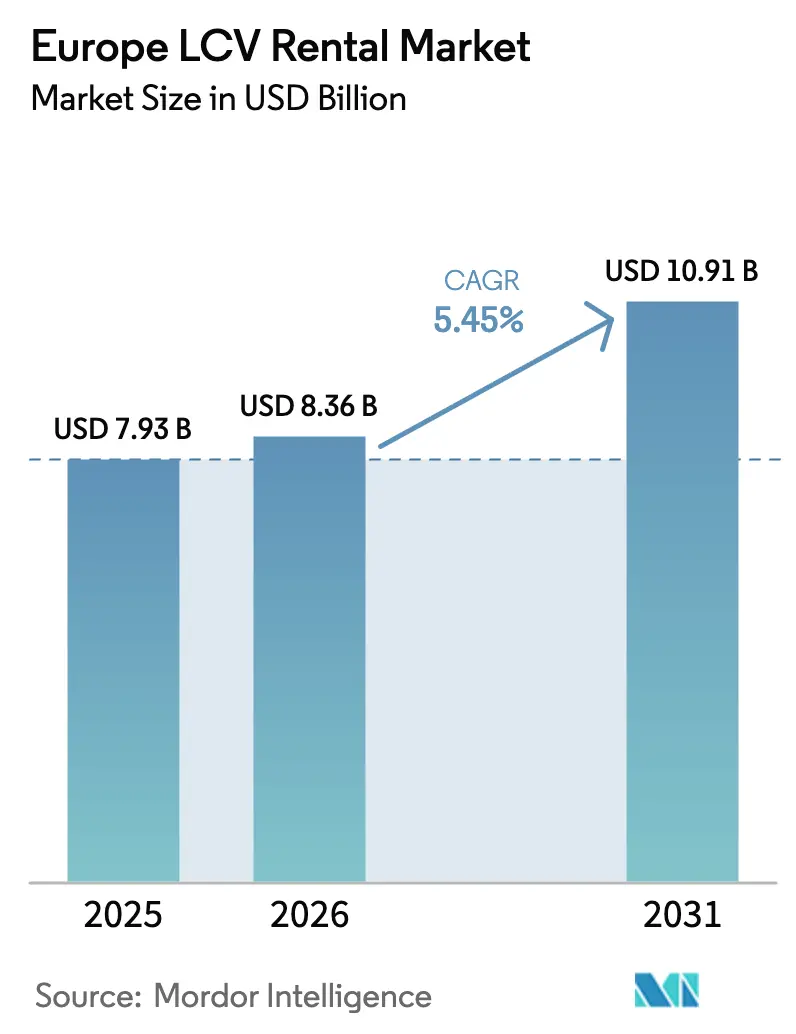
| Base Year Market Size (2025) | USD 7.93 Billion |
| Market Size (2026) | USD 8.36 Billion |
| Market Size (2031) | USD 10.91 Billion |
| Growth Rate (2026 - 2031) | 5.45 % |
| Market Concentration | Medium |
Major Players *Disclaimer: Major Players sorted in no particular order Image © Mordor Intelligence. Reuse requires attribution under CC BY 4.0. | |
Europe LCV Rental Market Analysis by Mordor Intelligence
The Europe LCV Rental Market size was valued at USD 7.93 billion in 2025 and estimated to grow from USD 8.36 billion in 2026 to reach USD 10.91 billion by 2031, at a CAGR of 5.45% during the forecast period (2026-2031). Strong parcel growth tied to e-commerce, widening adoption of asset-light logistics models, and accelerating electrification agendas are the core forces shaping the competitive trajectory. Operators with dense depot networks and digital booking capabilities are best positioned to capture geographically fragmented demand. At the same time, supply-side constraints linked to semiconductor shortages and WLTP compliance costs continue to tighten fleet renewal cycles. Germany anchors growth on the back of its dominant manufacturing and logistics ecosystem. In contrast, the United Kingdom outperforms on a percentage basis as post-Brexit distribution patterns favor cross-border flexibility. Meanwhile, rising corporate ESG commitments are nudging procurement teams toward battery-electric models, prompting rental companies to refine charging partnerships and telematics integration.
Key Report Takeaways
- By booking type, offline reservations held 52.84% of the European LCV rental market size in 2025; online bookings are advancing at a 5.49% CAGR during the forecast period (2026-2031).
- By rental type, long-term contracts commanded a 63.05% share of the European LCV rental market size in 2025, while short-term rentals are expanding at a 5.52% CAGR during the forecast period (2026-2031).
- By vehicle type, large vans accounted for 40.95% of the European LCV rental market share in 2025; compact vans posted the highest projected CAGR of 5.55% during the forecast period (2026-2031).
- By propulsion, diesel units retained 77.10% of the European LCV rental market size in 2025, whereas battery-electric vehicles are growing at a 5.53% CAGR during the forecast period (2026-2031).
- By end-user, CEP & e-commerce logistics captured 36.42% of the European LCV rental market size in 2025, leading growth at a 5.58% CAGR during the forecast period (2026-2031).
- By country, Germany held the top position with 38.40% share of the European LCV rental market in 2025, whereas the United Kingdom is forecast to record the fastest expansion at a 5.56% CAGR during the forecast period (2026-2031).
Note: Market size and forecast figures in this report are generated using Mordor Intelligence’s proprietary estimation framework, updated with the latest available data and insights as of 2026.
Europe LCV Rental Market Trends and Insights
Drivers Impact Analysis*
| Driver | (~) % Impact on CAGR Forecast | Geographic Relevance | Impact Timeline |
|---|---|---|---|
| Accelerated E-Commerce Parcel Volumes | +1.2% | Global, strongest in Germany, UK, France | Short term (≤ 2 years) |
| Shift To Asset-Light Gig-Economy Delivery Fleets | +0.8% | Urban centers across EU-27, Nordic expansion | Medium term (2-4 years) |
| Corporate ESG Targets | +0.7% | Germany, Netherlands, Nordics lead adoption | Long term (≥ 4 years) |
| Post-Brexit Cross-Border Rental Synergies | +0.6% | UK-EU corridor, Ireland-UK routes | Medium term (2-4 years) |
| Adoption Of Real-Time Telematics | +0.5% | Germany, France, UK leading implementation | Medium term (2-4 years) |
| OEM-Captive Subscription Pilots | +0.4% | Germany, France focus with EU-wide expansion | Long term (≥ 4 years) |
| Source: Mordor Intelligence | |||
Accelerated E-Commerce Parcel Volumes
Explosive online retail activity lifts daily parcel counts, making flexible van access indispensable for peak-season coverage [1]. Same-day and next-day delivery promises to intensify the call for distributed depots that only large European LCV rental market networks can satisfy. Short-term peaks tied to Black Friday and holiday surges now account for an increasingly large slice of annual parcel flows, sharpening demand for daily and weekly hires. Rental fleets also help couriers avoid the idle-asset burden during off-peak months, a key cost distinction versus ownership. Compact van formats become even more vital as warehouse footprints migrate closer to dense city cores. Operators combining a nationwide footprint with real-time booking APIs outperform peers on utilization and yield.
Shift to Asset-Light Gig-Economy Delivery Fleets
Platform-based couriers such as Uber Eats and Gorillas push drivers to furnish their own vehicles, yet many lack the capital for outright purchases. The European LCV rental market offers a scalable workaround with flexible terms and usage-based pricing. TIMOCOM reported a high year-on-year jump in freight requests in 2024, underlining the strain on traditional fleet planning at [2]. Rental providers now craft gig-focused packages that blend short-duration contracts, lower deposits, and app-enabled onboarding. Such offerings help independent drivers comply with insurance and emission rules while minimizing working-capital exposure. In response, mainstream rental firms are rolling out weekend-only or evening-only rates aligned with peak food-delivery slots.
Corporate ESG Targets Boosting Electric LCV Leasing
Multinationals with science-based carbon targets are pivoting to battery-electric vans but remain wary of technology obsolescence risk. Renting allows pilot deployment without residual-value exposure, so demand for electric units within the European LCV rental market is accelerating. Europcar has pledged significant electric fleet additions, mirroring Avis Budget and Sixt commitments. Early movers lock in green-fleet availability contracts, often coupled with charging-as-a-service bundles that guarantee route-specific uptime. Regulators add impetus: the EU’s 2030 zero-emission fleet mandate effectively caps future diesel acquisitions, tilting corporate procurement toward electric rental agreements. Over time, higher residual values and falling battery costs will compress the total cost of operation gaps, widening the addressable customer base.
Post-Brexit Cross-Border Rental Synergies
Logistics firms straddling the UK-EU corridor must meet divergent registration and road-user charges. Instead of owning two parallel fleets, many book-compliant vehicles are in-country via rental partners. This reality has boosted cross-channel asset pools and fostered alliances among leading European LCV rental market operators. Rental agreements now often include customs documentation services, vehicle telematics pre-configured for EU roaming, and insurance endorsements that satisfy both jurisdictions. Reciprocal fleet-swap programs are emerging, especially on Ireland-UK routes, ensuring consistent vehicle standards across depots. These synergies create incremental revenue streams and raise fleet utilization, offsetting post-Brexit administrative overhead.
Restraints Impact Analysis*
| Restraint | (~) % Impact on CAGR Forecast | Geographic Relevance | Impact Timeline |
|---|---|---|---|
| Tight EU-27 WLTP Emission Caps | -0.4% | EU-27 wide, Germany and France leading implementation | Short term (≤ 2 years) |
| Chip-Shortage-Induced Delivery Lags | -0.3% | Global supply chain impact, strongest in Germany manufacturing | Medium term (2-4 years) |
| Rising Insurance Premiums | -0.2% | Urban centers across EU-27, UK particularly affected | Short term (≤ 2 years) |
| Municipal Access Charges For Diesel Vans | -0.2% | London, Paris, Amsterdam, Berlin expanding to other cities | Medium term (2-4 years) |
| Source: Mordor Intelligence | |||
Tight EU-27 WLTP Emission Caps Raising Fleet Costs
Successive WLTP stages oblige rental firms to purchase pricier Euro 6e and electric models. Germany’s 2025 updates expand reporting obligations, adding administrative costs and pre-delivery retrofit work for telematics tracking [3]. France complements EU rules with weight-based penalties that further elevate diesel van acquisition prices. These costs squeeze EBITDA margins unless passed through as surcharges, which can temper demand from price-sensitive SME clients. Many operators respond by front-loading electric orders to secure subsidies before expiry, temporarily inflating capital outlays. Over the long term, stricter standards indirectly accelerate fleet modernization, lifting residual values and lowering maintenance events per rental day.
Chip-Shortage-Induced Delivery Lags
Semiconductor bottlenecks have extended order lead times for new vans over the past 12 months, forcing operators to retain older assets longer. German OEMs report intermittent assembly pauses, narrowing the supply funnel for high-spec telematics-ready vehicles. Aged fleets carry higher maintenance spend and risk SLA breaches when breakdowns occur during peak season. Rental companies counter with proactive refurbishment programs, but workshop downtime still trims available fleet days. This capacity pinch limits the European LCV rental market’s ability to fully monetize current demand upswings, especially during Q4 parcel peaks. Until chip fabs reach planned European expansion volumes, delivery reliability will remain a headwind.
*Our forecasts treat driver/restraint impacts as directional, not additive. The impact forecasts reflect baseline growth, mix effects, and variable interactions.
Segment Analysis
By Booking Type: Digital Transformation Accelerates
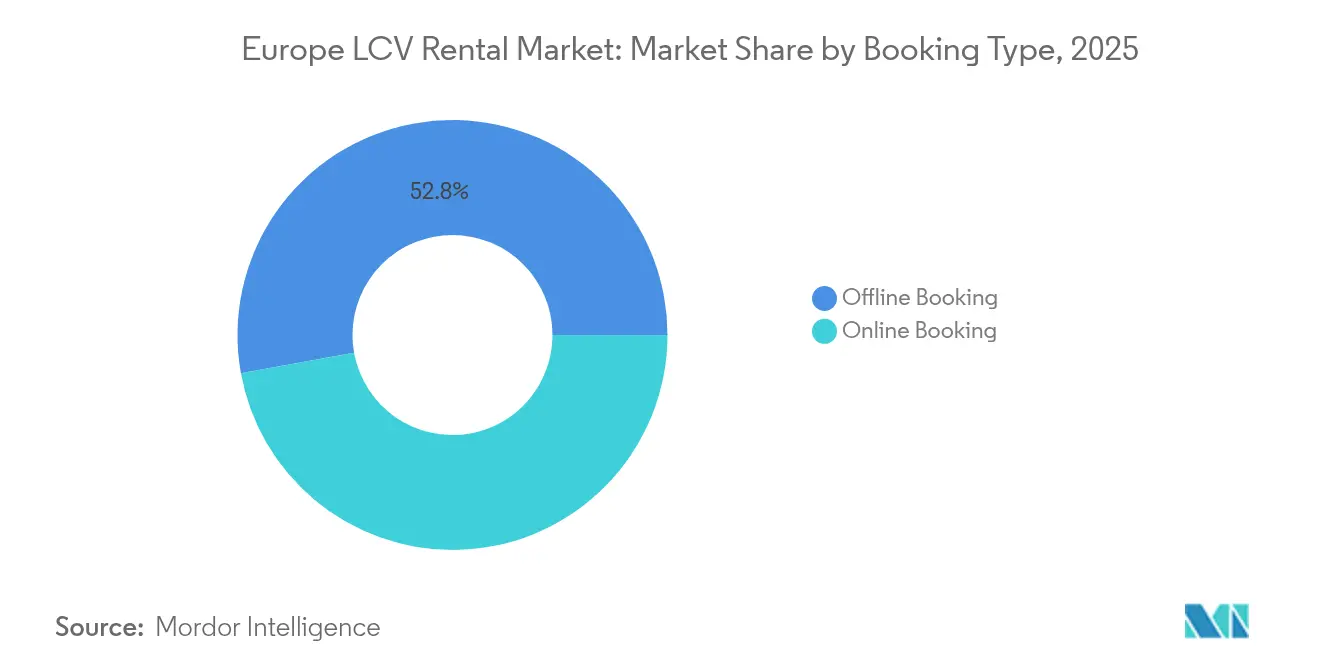
Offline contracts controlled the most significant slice of the European LCV rental market share in 2025 at 52.84%, underscoring entrenched relationship-based procurement for multi-year logistics agreements. Online portals, however, posted a 5.49% CAGR and are forecast to keep outpacing overall market growth through 2031.
Growth in digital reservations reflects rising smartphone penetration among depot managers and gig-economy drivers. SIXT’s 2024 roll-out of in-app charging integration showcased how application programming interfaces streamline ancillary services, driving repeat bookings. Online platforms offer dynamic pricing and real-time availability that offline channels cannot replicate, lifting fleet utilization. As artificial intelligence-based demand forecasting matures, digital channels will underpin margin expansion by aligning day-to-day pricing with parcel activity fluctuations across postal codes. Therefore, the European LCV rental market will see hybrid models where account managers handle framework contracts while tactical peaks flow through apps.

By Rental Type: Long-Term Contracts Sustain Fleet Planning
Long-term leases contributed 63.05% to the Europe LCV rental market size in 2025, giving operators predictable cash flows that support multi-year fleet financing. Short-term hires are growing faster at 5.52% CAGR, a trend fueled by volatile parcel volumes and on-demand food delivery startups.
Extended leases allow logistics majors to lock in emission-compliant vans at fixed rates, shielding budgets from residual-value swings. Rental firms can align depreciation schedules with WLTP phase-ins, keeping utilization high. Short-term expansion, meanwhile, is underpinned by weekend flash sales and festival peaks where courier demand multiplies for a few days. Telematics dashboards let operators shift idle inventory across depots overnight, minimizing repositioning costs. As subscription economics spread from passenger cars to light commercials, mid-length contracts of 3-12 months may blur the conventional long-versus short-term divide within the European LCV rental market.
By Vehicle Type: Compact Vans Win Urban Efficiency Battle
Large vans held 40.95% of the European LCV rental market size in 2025, due to their versatile payload-to-footprint ratio. Compact vans are rising fastest, projected at 5.55% CAGR through 2031, as low-emission zones reward smaller formats with easier access.
City freight consolidation centers push parcels into micro-hubs from which compact vans complete the final leg. Reduced turning radius and tighter curb clearances help drivers meet stringent delivery windows in congested downtown zones. Rental operators allocate more capex toward small-wheelbase models to ensure compliance with municipal ULEZ restrictions. Box trucks remain the workhorses for specialized goods but face stagnation given license hurdles and scarce urban loading bays. Looking ahead, modular cargo pod systems may further elevate compact van appeal by enabling quick switchover between refrigerated and parcel configurations.
By Propulsion Type: Electric Adoption Gains Speed
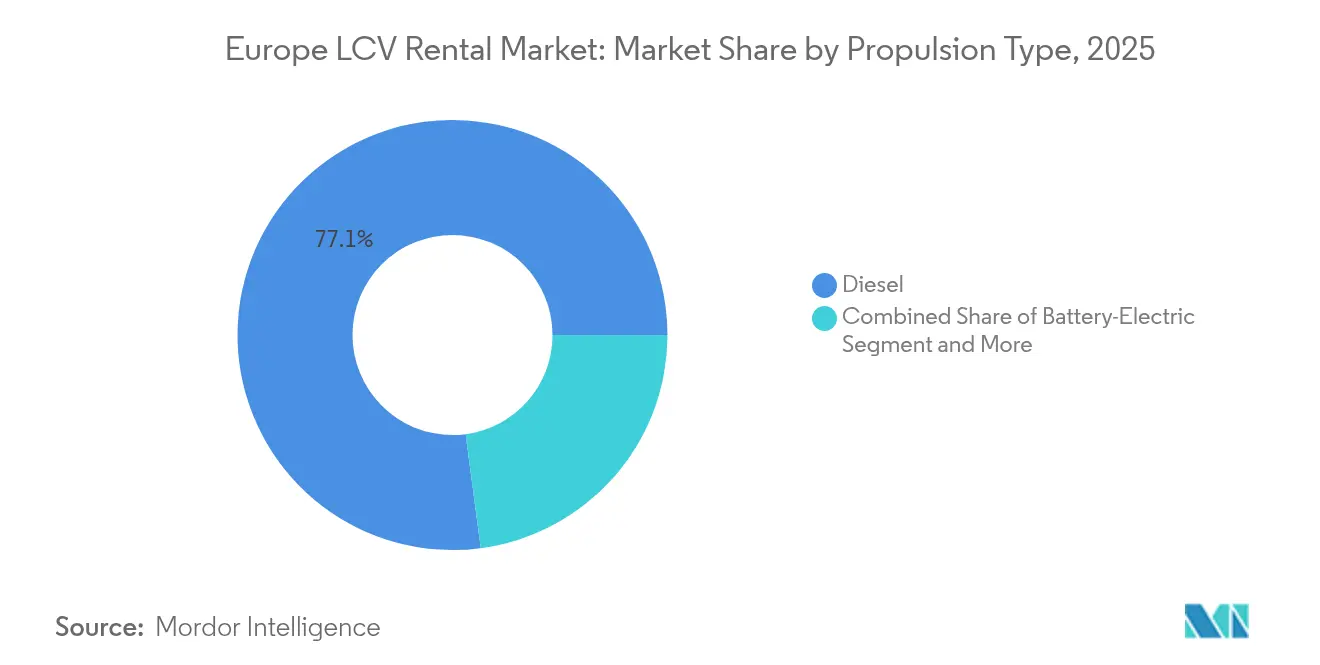
Diesel engines still represented 77.10% of the European LCV rental market in 2025, reflecting unparalleled refueling convenience on long-haul lanes. Battery-electric units boast the highest CAGR at 5.53% and are central to meeting Scope 3 emission targets.
Public charging points across 17 European nations reached a record number in 2024, including multiple high-power sites suitable for commercial van duty cycles. Rental companies partner with charging-network operators to bundle power costs into daily rates, simplifying client accounting. Hybrid and gas-powered alternatives offer transitional compliance for duty cycles beyond current battery ranges, yet technological leapfrogging may compress their relevance window. By 2030, WLTP tailpipe thresholds will effectively force new fleet purchases toward zero-emission platforms, accelerating the shift within the European LCV rental market.
By End-User Industry: CEP & E-Commerce Leads Demand Curve
Courier, express, and parcel services captured 36.42% of the European LCV rental market in 2025 while expanding at a 5.58% CAGR to 2031. The sector’s outsized share mirrors the structural transition of consumption toward online channels.
Omnichannel retail strategies require micro-fulfillment nodes that push more shipments through suburban depots, elevating van demand. FMCG retailers follow closely, leveraging rental flexibility to cope with promotional spikes and cold-chain compliance. Construction utilities tap the European LCV rental market for crew-cab vans that shuttle teams and equipment between dispersed sites, but growth is steadier. Passenger shuttle initiatives, including ride-pool pilots, remain niche yet gain traction where municipal congestion charges incentivize shared mobility.
Geography Analysis
Germany anchored 38.40% of the European LCV rental market share in 2025, reflecting its central transport corridors and dense supplier base. High outbound manufacturing flows ensure stable backhaul loads, so rental firms achieve superior utilization. Stricter LEZ rules in Berlin, Munich, and Hamburg motivate corporates to shift from aging owned fleets to newer rental units. WLTP compliance timelines are therefore shortening replacement cycles and boosting fleet renewal.
The United Kingdom delivered the fastest growth at 5.56% CAGR, powered by e-commerce penetration exceeding 26% of total retail sales and by Brexit-driven reconfiguration of cross-border distribution . Rental demand spikes around customs bottlenecks as freight forwarders buffer inventory in inland depots. Gig-economy couriers, an estimated 500,000 drivers, rely heavily on daily van rentals to navigate dynamic earnings patterns. UK operators also experiment with subscription bundles combining van access, insurance, and fuel cards under one weekly fee.
France, Spain, and Italy compose a sizable secondary bloc. France’s weight-based malus taxes push legacy diesel van owners toward rental, particularly among SMEs facing liquidity constraints. Spain’s Madrid and Barcelona zero-emission corridors are early sandboxes for electric van pilots. Italy’s north-south logistics split makes cross-dock efficiency paramount, and rental pools help operators adapt fleet types to mountain versus city routes without tying up capex. The Rest of Europe cluster, the Netherlands, Nordics, and Central and Eastern Europe, presents mixed maturity. Dutch policymakers subsidize fast chargers, enabling early majority electric adoption among parcel couriers. Nordic corporations embed carbon accounting in procurement scorecards; rental firms with green fleets capture premium rates. Central and Eastern Europe’s GDP growth and nearshoring trends stimulate industrial output, pushing demand for affordable large vans.
Regulatory Landscape
EU rules affecting LCV rental fleets are tightening on both operations and emissions. Under Mobility Package I, from 1 July 2026, LCVs between 2.5 and 3.5 tonnes used in international hire-or-reward transport fall under expanded compliance requirements, including smart tachograph obligations (G2V2) and alignment with EU driving and rest time rules. This increases compliance-management needs for cross-border rental products and short-notice fleet swaps.
On fleet emissions, Regulation (EU) 2019/631 sets CO2 performance standards for new vans, with a 15% reduction target for 2025-2029 versus the 2021 baseline, stepping to 40% in 2030 and 90% in 2035. Regulation (EU) 2025/1214 (adopted 17 June 2025) introduced temporary flexibility by allowing a three-year average compliance approach for 2025-2027. In December 2025, the European Commission proposal COM(2025) 995 signaled further revisions and a new labelling approach, maintaining regulatory focus on accelerating zero-emission van uptake and related reporting requirements across EU-27 markets.
Value Chain Analysis
The Europe LCV rental value chain runs from OEM and upfitter sourcing through fleet financing, remarketing, and operations that bundle maintenance, insurance, and digital fleet management. Fleet procurement is shaped by Euro/WLTP compliance and the availability of telematics-ready vehicles. Fleet operators then depend on workshops, tire and parts suppliers, and multi-country service networks to protect uptime for CEP and e-commerce customers. Finished-vehicle logistics and delivery scheduling into major European distribution gateways (including Antwerp, Hamburg, and Bremerhaven) affect fleet availability and renewal cadence, amplifying the impact of logistics labor constraints and infrastructure bottlenecks on rental supply.
Electrification adds new nodes, including charging access, energy services, and battery-health analytics. This shifts value creation toward integrated offerings, and operators and specialized providers have been rolling out flexible electrified rental constructs between short-term hire and leasing. Europcar Mobility Group, for example, is pursuing Flex Model Choice for long-term electric rentals and expanded electric van availability. GATE also provides pay-per-use propositions that include electric LCV options for long-term rental in markets such as Germany, France, and Italy. As a result, charging-network partnerships, depot charging design, and telematics integration are differentiators alongside traditional branch coverage and service capacity.
Competitive Landscape
Four incumbent groups—Enterprise Holdings, Europcar Mobility Group, Sixt SE, and Avis Budget Group—accounted for roughly three-fifths of the European LCV rental market in 2024. Scale confers purchasing leverage with OEMs, which is vital during semiconductor shortages. These leaders run integrated telematics suites that monitor mileage, driver behavior, and battery health across borders, supporting predictive maintenance that sustains high uptime.
Strategic focus is shifting from fleet volume to service ecosystem depth. Enterprise is expanding depots near micro-fulfillment warehouses to guarantee 15-minute collection windows. Europcar bundles CO₂ reporting dashboards into corporate contracts, aiding ESG audits. Sixt’s dedicated Van & Truck division targets Germany, France, and the United Kingdom with digital-first booking and delivery options. Avis Budget invests in AI-driven pricing engines that adjust rates according to parcel demand heat maps.
Competitive pressure also arises from OEM-backed subscription offers such as Stellantis Free2Move and Daimler’s electric eVan-rental pilots. These programs leverage captive finance arms to undercut independent lessors on the total cost of access. Regional specialists respond by carving niches: temperature-controlled vans for pharma, crew-cab 4x4s for Nordic utility repairs, and compliant fleets for Adriatic ferry operations. Technological differentiation and regulatory expertise will determine margin resilience over the next cycle of the European LCV rental market.
Europe LCV Rental Industry Leaders
-
Avis Budget Group
-
The Hertz Corporation
-
Enterprise Holdings, Inc.
-
FRAIKIN SAS
-
Europcar Mobility Group
- *Disclaimer: Major Players sorted in no particular order

Market Opportunities and Future Outlook
A clear whitespace is forming around corporate fleet electrification and the services needed to operationalize electric LCV rentals at scale. Corporate vehicles make up the bulk of new van registrations in the EU, and industry reporting indicates eLCV sales share rising in 2025 versus 2024, with notable adoption levels cited for Germany and the UK. Rental providers can capture demand by packaging electric vans with depot-based smart charging access, automated billing, and route-appropriate utilization controls, rather than focusing on vehicle sales alone.
Regulatory momentum also creates opportunity for compliance-led cross-border rental propositions. The 1 July 2026 extension of Mobility Package I requirements to certain 2.5-3.5t international hire-or-reward operations increases the value of rental firms that can supply compliant vehicles, manage tachograph readiness, and support the administrative requirements that run alongside the rental contract. Separately, ongoing EU work around CO2 standards (Regulation (EU) 2019/631, plus the December 2025 proposal to amend it) keeps fleet renewal and CO2 reporting central to procurement conversations. That favors operators that can provide CO2 reporting dashboards, telematics-based duty-cycle evidence, and flexible terms that reduce residual-value exposure for customers trialing battery-electric vans.
Recent Industry Developments
- July 2026: Hertz highlighted the ongoing build-out and positioning of its Hertz Van Rental offering in key European markets such as the UK and Germany, covering compact city vans through larger cargo-capable panel vans for business customers. The increased visibility around a dedicated van proposition reinforces competitive focus on commercial customers and urban delivery use cases, where branch coverage and vehicle variety are critical.
- May 2026: Hertz announced the launch of Oro Mobility, an affiliated operating company positioned around end-to-end fleet management solutions alongside its broader results communication. This expands the strategic perimeter from daily rental into fleet-management capabilities, supporting corporate customers that want consolidated operations, utilization controls, and service integration across vehicle classes including LCVs.
- March 2024: Volvo Group and Renault Group formed Flexis SAS to develop electric light commercial vehicles, with production targeted for 2026. The program strengthens the medium-term pipeline of purpose-built electric vans available to rental and leasing channels, supporting broader electrification choices as operators refresh fleets under tightening emissions requirements.
Research Methodology Framework and Report Scope
Market Definition and Coverage
This market covers revenue generated from renting light commercial vehicles across Europe, including both short-term and long-term hires, where the service is paid for vehicle access over a defined rental period.
Scope exclusions: We exclude ownership financing and pure leasing contracts that are not structured as rental services, as well as revenues from passenger car-only rental activity.
Segmentation Overview
- By Booking Type
- Online Booking
- Offline Booking
- By Rental Type
- Short-Term
- Long-Term
- By Vehicle Type
- Compact Vans (<3.0 t GVW)
- Large Vans (3.0-3.5 t GVW)
- Pick-ups & Crew-cabs
- Box Trucks (3.5-7.5 t)
- By Propulsion Type
- Diesel
- Battery-Electric
- Hybrid & Alternative Fuels (CNG/LNG/H2)
- By End-User Industry
- CEP & E-commerce Logistics
- FMCG & Retail
- Construction & Utilities
- Passenger Shuttle & Ride-pool
- By Country
- Germany
- United Kingdom
- France
- Spain
- Italy
- Rest of Europe
Data Sources, Market Sizing, and Validation
Desk Research
Desk research is used to build the first version of the market map, and we start by grounding the model in public transport and vehicle statistics that are comparable across countries. Sources such as Eurostat, the European Automobile Manufacturers Association (ACEA), national transport ministries and road agencies, and European Commission releases are used to understand LCV registrations, fleet renewal direction, and policy items that can impact rental fleets.
We also review company annual reports, investor presentations, and credible fleet and mobility press to capture operator footprints, network coverage, and reported utilization or pricing commentary where available. In addition, paid subscriptions for company financials and news, and an automotive sales and vehicle parc database, are used selectively to cross-check scale and timing in markets where public series are less detailed. The sources mentioned above are illustrative only, and many other references were consulted during data collection, validation, and clarification.
Primary Interviews and Surveys
Primary interviews and surveys were run with rental operators, corporate fleet managers, logistics users, and partners involved in vehicle supply and remarketing across major European markets. These conversations helped clarify how utilization and rate cards change by season, how short-term versus long-term rental mix affects revenue yield, and how fleet electrification is influencing replacement timing and pricing assumptions.
Distribution of primary research fieldwork respondents
| Company type | Respondent position |
|---|---|
| Top tier: 26% | CXOs: 16% |
| Mid tier: 57% | Functional/Unit leaders: 39% |
| Smaller Players: 17% | Managers: 45% |
Market-Sizing & Forecasting
Sizing is built using a top-down approach once, where country-level LCV parc and registrations are used to reconstruct the rentable fleet demand pool, which is then translated into revenue using utilization and prevailing rental rate patterns. After that, we corroborate totals with selective bottom-up approximations, such as sampling operator disclosures and doing channel checks on typical rate bands, and then adjusting countries that sit outside a realistic range.
A few inputs that matter in this market, and were used as practical model drivers, include active rental fleet availability, average utilization, average daily rate and long-term contract pricing, mix of short-term versus long-term rentals, online versus offline booking share, and the pace of electric LCV uptake that can shift both rates and fleet rotation. When smaller countries have limited direct data, gaps are handled using proxy indicators like registration direction and business activity signals, followed by calibration from interview feedback so the implied revenue does not drift.
Forecasts are developed using scenario analysis that links utilization and pricing to expected logistics activity, construction and trades demand, and fleet replacement cycles, and then tests a faster and slower rate-normalization path. Where the outlook felt uncertain, we kept assumptions within ranges that respondents considered workable for planning, before the final numbers were locked.
Data Validation & Update Cycle
Validation is done through multiple passes, so one data point does not drive the final answer, and outputs are checked against independent signals like LCV registration direction, operator commentary in public materials, and macro indicators connected to delivery and trades activity. When a country shows an unexpected jump or drop, assumptions are reopened and we re-contact sources to confirm whether it comes from rate movement, utilization, or supply constraints.
Before sign-off, the model goes through analyst-to-analyst reviews, followed by variance checks versus prior editions and any newly available public documents. Reports are refreshed annually, and interim updates are made when material events occur, including sharp currency swings, policy changes, or sustained pricing shocks. Right before delivery, we complete a last review sweep so clients receive the latest updated view.
Mordor Intelligence's Europe Lcv Rental Market Estimate Compared With Other Published Estimates
Different published market values for Europe LCV rental are common, because scope choices can differ, and even small changes in pricing assumptions or year selection can move revenue totals. Variations also appear when rental is blended with leasing, or when vehicle definitions expand beyond light commercial vehicles.
A refresh-led gap shows up most clearly in how currency timing, rate normalization, and utilization checks are applied before locking the number, and those checks were updated close to publication in Mordor Intelligence so the estimate stays aligned to current country pricing behavior rather than older average rates.
Benchmark comparison
| Source | Market Size | Gaps in Research Methodology |
|---|---|---|
| Mordor Intelligence | USD 7.93 B (2025) | |
| Regional Consultancy A | USD 18.40 B (2026) | Uses a broader definition that can bundle extra vehicle types and service models beyond typical LCV rental, and it also anchors sizing to a later year where rate inflation and post-disruption normalization can lift revenue. |
| Industry Bulletin B | USD 18.46 B (2024) | Applies a wider commercial vehicle rental and leasing frame, which can pull in leasing-style revenues and non-LCV categories, thereby increasing the total versus a rental-only LCV view. |
The table shows that scope expansion and different timing assumptions explain most of the spread, not a single variable. When rental revenue is tied back to observable drivers like utilization and country-level rate progression, the result is easier to trace and repeat as inputs change.
Key Questions Answered in the Report
How large is the European LCV rental market in 2026?
The market is valued at USD 8.36 billion in 2026 and is projected to climb to USD 10.91 billion by 2031.
Which country holds the most significant share of van rentals in Europe?
Germany has a 38.40% share in 2025 due to its strong manufacturing and logistics infrastructure.
What fuels the fastest growth in European van rentals?
Rising e-commerce parcel volumes and shifting toward asset-light gig-economy delivery fleets drive the highest demand upticks.
How are electric vans impacting rental fleets?
Battery-electric models are expanding at a 5.53% CAGR as companies use rentals to meet ESG targets without ownership risk.
Who are the leading players in European LCV rentals?
Enterprise Holdings, Europcar Mobility Group, Sixt SE, and Avis Budget Group control about 65% of the market, giving it a moderate concentration.