
Market Overview
| Study Period | 2021 - 2031 |
|---|---|
| Forecast Data Period | 2026 - 2031 |
| Base Year Market Size (2025) | USD 27.45 Billion |
| Market Size (2026) | USD 28.73 Billion |
| Market Size (2031) | USD 36.06 Billion |
| Growth Rate (2026 - 2031) | 4.65 % |
| Market Concentration | Low |
Major Players *Disclaimer: Major Players sorted in no particular order Image © Mordor Intelligence. Reuse requires attribution under CC BY 4.0. | |
Europe Jeans Market Analysis by Mordor Intelligence
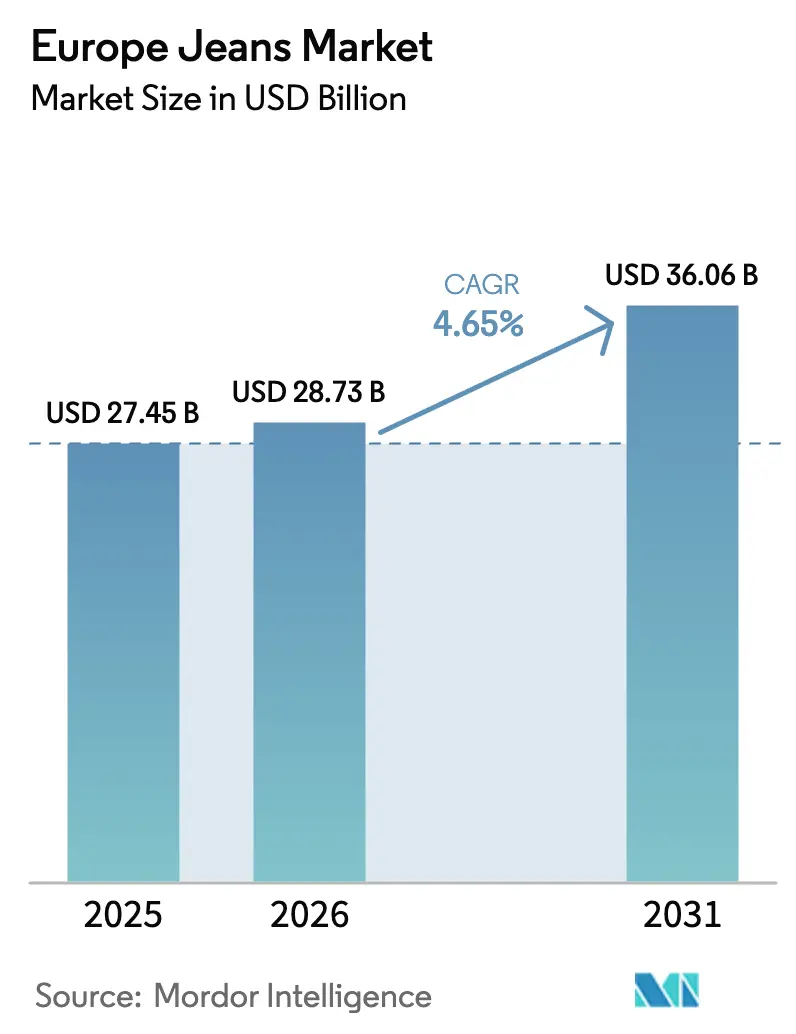
Europe jeans market size in 2026 is estimated at USD 28.73 billion, growing from 2025 value of USD 27.45 billion with 2031 projections showing USD 36.06 billion, growing at 4.65% CAGR over 2026-2031. The market benefits from the continued popularity of urban fashion trends and the enforcement of sustainability regulations across Europe, which help maintain steady demand. However, the jeans market faces strong competition from the growing athleisure segment. Key growth drivers include the increasing focus on premium products, the rise of online shopping, and adherence to regulatory standards. Companies are concentrating on innovative sourcing methods, water-efficient production technologies to stay competitive. While affordable, mass-market jeans still account for the majority of sales, premium and niche brands are gaining traction by combining high-quality European craftsmanship with environmentally friendly production practices. Brands that prioritize product innovation and align with circular economy goals are securing more retail opportunities, particularly in Western Europe. Rising demand from Eastern European countries is contributing to the market's growth. The Europe jeans market remains highly fragmented, with numerous players such as Levi Strauss & Co., H&M Group competing for market share.
Key Report Takeaways
- By type/fit, regular fit held 24.45% of the Europe jeans market share in 2025, whereas slim fit is advancing at a 6.58% CAGR through 2031.
- By price range, mass-market lines captured 47.85% of the Europe jeans market size in 2025, yet premium denim is expanding at a 6.42% CAGR to 2031.
- By end user, men’s styles commanded 53.10% of 2025 revenue, while women’s jeans are expected to post a 6.25% CAGR over the same horizon.
- By distribution channel, supermarkets/hypermarkets accounted for 42.40% of 2025 sales, and online retail is growing the fastest at a 7.05% CAGR.
- By country, Germany led with 26.40% revenue share in 2025; the Netherlands holds the highest projected growth at a 6.05% CAGR through 2031.
Note: Market size and forecast figures in this report are generated using Mordor Intelligence’s proprietary estimation framework, updated with the latest available data and insights as of 2026.
Market Trends and Insights
Drivers Impact Analysis of Europe Jeans Market*
| DRIVER | (~) % IMPACT ON CAGR FORECAST | GEOGRAPHIC RELEVANCE | IMPACT TIMELINE |
|---|---|---|---|
| Consumer preferences and fashion trends | +1.2% | Stronger influence in Germany, France, Italy | Medium term (2-4 years) |
| Growing demand for high-quality and branded denim | +0.9% | Western Europe core, expanding to Eastern Europe | Long term (≥ 4 years) |
| Advancements in fabric technology and finishing techniques | +0.8% | Europe manufacturing hubs, Turkey supply chain | Medium term (2-4 years) |
| Advancements in sustainable and eco-friendly practices | +1.1% | Netherlands, Germany, France leading adoption | Long term (≥ 4 years) |
| Tailored solutions and individualized experiences | +0.5% | Major urban centers across Europe | Short term (≤ 2 years) |
| Partnerships with celebrities and influencers | +0.4% | United Kingdom, Germany, France fashion capitals | Short term (≤ 2 years) |
| Source: Mordor Intelligence | |||
Consumer preferences and fashion trends
European consumers increasingly consider denim jeans a staple in their wardrobes, as they offer a balance between casual and semi-formal styles. This trend has grown stronger with more people prioritizing comfort in their clothing choices. Features like stretchable fabrics and moisture-wicking materials, which provide better flexibility and comfort, are becoming more popular as consumers look for versatile options. Fashion shows in cities like Milan and Paris continue to highlight stylish denim outfits, while advancements in sustainable materials and collaborations between designers from different cultures are adding more value to denim products. According to the European Commission, clothing remains the most purchased product category online in 2024, showing that denim is performing well in both physical stores and online platforms[1]. The focus on eco-friendly and high-quality denim, combined with consumers’ willingness to spend more on sustainable fashion, is driving steady growth in the denim market across Europe.
Advancements in fabric technology and finishing techniques
Technological advancements are transforming denim production in Europe by combining sustainability with improved efficiency. New technologies, such as laser finishing, robotics, and closed-loop chemical processes, are helping manufacturers significantly reduce water and chemical consumption. For instance, in 2023, Germany imported denim cotton fabrics worth USD 8.99 million for weights exceeding 200 grams per square meter. This placed Germany 31st globally in denim fabric imports, as per The Observatory of Economic Complexity (OEC), highlighting Europe’s dependence on high-quality raw materials to support its local manufacturing industry[2]. Sustainability initiatives like Jeanologia’s Mission Zero are playing a crucial role in this shift. By 2024, this program successfully prevented 20.9 million cubic meters of water pollution. These efforts provide European manufacturers with a practical and scalable approach to achieving environmental sustainability while remaining competitive in markets where production costs are higher.
Growing demand for high-quality and branded denim
European consumers, with a relatively high purchasing power of USD 21.18 thousand, as per the International Monetary Fund's purchasing power parity, are increasingly opting for premium and branded denim[3]. They are drawn to products that are durable, ethically produced, and offer superior comfort. To meet these demands, innovations like LYCRA FitSense® yarns are being used to provide targeted shaping and support without adding unnecessary bulk, making denim both functional and stylish. Levi’s® has experienced notable growth in Europe, achieving a 15% increase in sales during the second quarter of 2025. This growth is largely due to the company’s focus on adopting new business models which have helped strengthen its market presence in Europe and drive global expansion. These developments show that the success of premium denim in Europe depends on a combination of factors, including innovative product designs, sustainability initiatives, and tailored marketing strategies.
Advancements in sustainable and eco-friendly practices
The European jeans market is moving toward more sustainable and eco-friendly practices. Manufacturers are adopting techniques such as water-saving technologies, low-impact dyes, and circular production processes to minimize their environmental footprint. These efforts not only contribute to environmental protection but also enhance brand reputation and appeal to consumers who prioritize sustainability. A 2024 survey by IfD Allensbach revealed that 21.91% of Germans are willing to pay a premium for environmentally friendly products, reflecting the increasing demand for sustainable fashion. This trend is pushing denim brands in Europe to incorporate eco-conscious practices into their product designs and marketing strategies. By doing so, companies are aligning with consumer expectations while ensuring their competitiveness in the market. These sustainable initiatives are becoming a key factor for growth and differentiation in the evolving European jeans market.
Restraints Impact Analysis of Europe Jeans Market*
| RESTRAINT | (~) % IMPACT ON CAGR FORECAST | GEOGRAPHIC RELEVANCE | IMPACT TIMELINE |
|---|---|---|---|
| Strong competition from alternative apparel | -0.8% | Particularly affecting casual wear segments | Medium term (2-4 years) |
| Growth of counterfeit and low-quality products | -0.6% | Europe-wide, concentrated in online channels | Short term (≤ 2 years) |
| High production costs | -0.7% | Western Europe manufacturing hubs | Long term (≥ 4 years) |
| Uncertainties in tariff and trade policies | -0.5% | Europe-Turkey-Asia trade corridors | Medium term (2-4 years) |
| Source: Mordor Intelligence | |||
Strong competition from alternative apparel
The European denim market is increasingly facing competition from the growing athleisure and sportswear sectors, which are gaining popularity for their comfort, versatility, and practicality. Consumers now prefer clothing that can seamlessly transition between casual wear and active use. For instance, in 2023, Swiss sportswear brand On opened its first flagship store in Paris, highlighting innovative sportswear designs. Similarly, Adidas introduced its Fear of God Athletics collection in December 2023, combining functionality with luxury to meet modern consumer demands. These changes in preferences are challenging traditional denim brands to adapt. To remain competitive, denim manufacturers are focusing on creating innovative products, such as stretchable or hybrid designs, while also adopting fresh marketing strategies. This shift underscores the need for denim brands to evolve in response to the dynamic market landscape.
Uncertainties in tariff and trade policies
The European denim market is facing challenges due to changes in tariff and trade policies, which are affecting costs, supply chains, and market access. In 2024, the European Union introduced the Ecodesign for Sustainable Products Regulation (ESPR), requiring textiles sold in the market to contain recycled materials[4]. This regulation has created new compliance demands for manufacturers and importers, pushing them to adapt their production processes. The ESPR includes the Digital Product Passport (DPP), which mandates that detailed product information, such as material composition and environmental impact, must be accessible throughout the product's lifecycle. Moreover, the EU's Carbon Border Adjustment Mechanism (CBAM) requires importers to report and potentially pay for the carbon emissions associated with imported goods. This policy particularly impacts industries like textiles adding extra costs and administrative challenges for businesses operating in the denim market.
*Our forecasts treat driver/restraint impacts as directional, not additive. The impact forecasts reflect baseline growth, mix effects, and variable interactions.
Europe Jeans Market Segment Analysis
By Type/Fit:
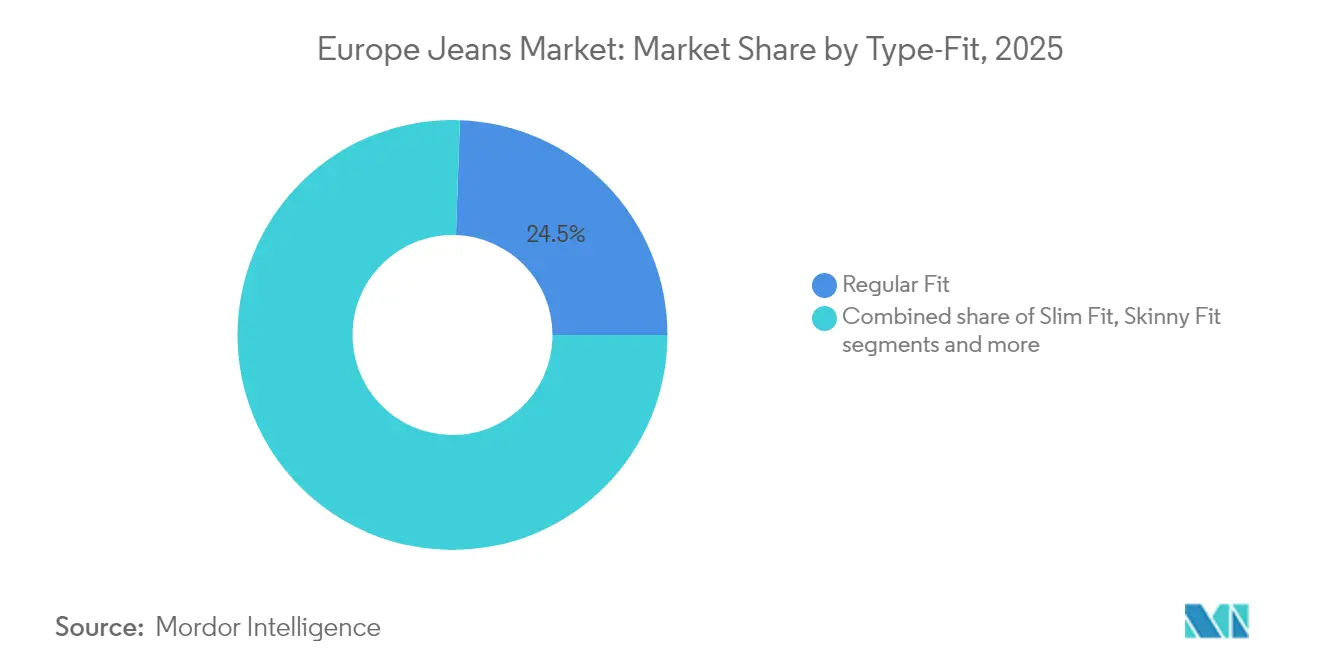
Slim Fit Gains GroundRegular Fit jeans remained the most popular choice in the European market in 2025, accounting for 24.45% of the total market share. This style continues to attract consumers due to its versatility, offering a comfortable and universally flattering fit suitable for various age groups and body types. Its classic and casual design makes it easy to pair with both everyday and semi-formal outfits, ensuring its place as a wardrobe staple. Retailers have ensured its widespread availability across both physical stores and online platforms, further driving its demand. The enduring appeal of Regular Fit jeans highlights how comfort and familiarity remain key factors influencing consumer preferences in the denim market.
Meanwhile, Slim Fit jeans are rapidly gaining traction as the fastest-growing style in Europe at 6.58% CAGR through 2031, driven by a growing preference for sleek, tailored looks. This segment is expected to grow significantly through 2031, reflecting a shift toward more modern and form-fitting designs. Slim Fit jeans are increasingly featured in fashion campaigns and on runways, boosting their popularity among style-conscious consumers. Brands are also innovating with fabrics that combine stretch, durability, and comfort, making these jeans more appealing. The rising demand for Slim Fit jeans not only diversifies the denim market but also complements the enduring popularity of Regular Fit, catering to evolving consumer tastes while maintaining a balance between classic and contemporary styles.

By Price Range:
Premium AcceleratesMass-market denim continued to dominate the European market in 2025, accounting for 47.85% of the total market share. Its popularity is primarily due to its affordability, making it a preferred choice for a wide range of consumers. These products are widely available through supermarkets, hypermarkets, and large retail chains, ensuring easy access for shoppers. Seasonal discounts and promotional campaigns further drive sales, attracting budget-conscious buyers. Mass-market denim caters to those looking for practical, everyday jeans that offer decent quality at a reasonable price. This segment’s strong performance highlights the importance of value-driven options in meeting the needs of the majority of European consumers.
Premium denim is rapidly gaining traction as the fastest-growing segment, with a projected growth rate of 6.42% CAGR from 2026 to 2031. Consumers are increasingly drawn to premium options due to their superior fabric quality, ethical production methods, and enhanced comfort features. Brands are focusing on innovations like stretchable materials and moisture-wicking technologies to improve functionality and appeal. Premium denim is marketed through exclusive channels such as specialty stores and online platforms, creating a sense of uniqueness. This segment’s growth reflects a shift in consumer preferences toward stylish, durable, and socially responsible products, as more shoppers are willing to invest in high-quality denim.
By End User:
Women’s Styles AccelerateIn 2025, men’s jeans continued to dominate the European market, holding a significant 53.10% share. This strong performance is driven by consistent demand across various age groups and occasions, as men prefer versatile styles that suit both casual and semi-formal settings. Brands focus on offering classic fits, durable materials, and practical features, which appeal to male consumers and ensure steady sales. The widespread availability of men’s jeans in both offline and online retail channels enhances their accessibility. This sustained preference underscores the importance of male consumers as the primary audience for denim manufacturers in Europe.
Women’s jeans, on the other hand, are emerging as the fastest-growing segment, with a projected CAGR of 6.25% through 2031. Female shoppers increasingly seek jeans that combine tailored fits, modern designs, and high-quality fabrics, offering both comfort and style. This growth is further fueled by targeted marketing campaigns, collaborations with influencers, and the growing presence of women’s denim on online platforms, which particularly attract younger audiences. As the demand for women’s jeans rises, the segment is expected to contribute significantly to the overall market expansion, presenting brands with opportunities to innovate and cater to premium and high-value consumer groups.

By Distribution Channel:
Online SurgesSupermarkets/hypermarkets continued to lead the European jeans market in 2025, contributing 42.40% of total sales. These outlets remain popular due to their convenience, affordability, and frequent promotional offers like discounts and combo deals. They cater to a broad customer base, particularly value-conscious shoppers looking for reliable and functional denim options. With their widespread presence in both urban and suburban areas, supermarkets and hypermarkets ensure easy access to jeans for a large segment of the population. This dominance highlights the ongoing importance of physical retail stores in driving high-volume sales in the region.
E-commerce is rapidly becoming the fastest-growing channel for jeans sales in Europe, with an expected growth rate of 7.05% CAGR through 2031. Online platforms attract consumers with their convenience, extensive product variety, and the ability to compare prices and reviews. Younger and tech-savvy shoppers are particularly drawn to features like virtual try-ons and personalized recommendations offered by many e-commerce sites. Brands are also focusing on improving the online shopping experience through targeted marketing and seamless delivery options. As e-commerce continues to grow, it is reshaping how European consumers shop for denim, offering brands new opportunities to reach a wider audience.
Geography Analysis
Western Europe Jeans Market
Western Europe continues to lead denim demand in the region, with Germany contributing 26.40% of total sales in 2025. Germany’s strong economy, widespread retail presence, and government policies promoting sustainable procurement by 2026 have made it a dominant player in the market. France, Italy, and Spain also play crucial roles in shaping the market. France has set an example with its early adoption of Extended Producer Responsibility fees, encouraging sustainable practices. Italy is known for its premium denim, supported by its integrated mills and renowned design expertise. Meanwhile, Spain’s fast-fashion industry drives high sales volumes by catering to a wide range of price points.
Netherlands Jeans Market
The Netherlands is becoming a leader in sustainable denim, with the fastest forecast growth at a 6.05% CAGR. The government’s initiatives, such as the Denim Deal, aim to promote circular fashion by targeting the production of 1 billion recycled-content denim units by 2030. In 2023, the Netherlands achieved a circular-material-use rate of over 20%, showcasing its commitment to sustainability. This has positioned the country as a testing ground for scalable green practices. The expansion of the Denim Deal into France highlights its growing influence across Europe, further driving the adoption of sustainable denim production.
Central and Eastern Europe Jeans Market
Central and Eastern Europe are emerging as key growth areas for denim, driven by the expanding urban middle-class population. For example, Poland’s denim imports grew by 12.3% annually between 2018 and 2023, reflecting steady demand in the region. However, price sensitivity remains a significant factor, with most consumers preferring affordable, mass-market brands. As European Union regulations increasingly push for sustainable practices, retailers in these regions will need to adapt by offering greener options. This shift is expected to improve supply chains and create new opportunities for growth in the denim market.
Regulatory Landscape
The European jeans market operates under tightening EU textile sustainability and transparency rules led by the European Commission. A key near-term compliance anchor is the Ecodesign for Sustainable Products Regulation (ESPR), including a ban on the destruction of unsold apparel, clothing accessories, and footwear that takes effect on 19 July 2026. This is expected to force brands and retailers to redesign end-of-season inventory handling and reverse-logistics processes.
Textiles and clothing are prioritized in the first ESPR Working Plan (2025-2030), and the delegated act defining product-specific ecodesign requirements and the Digital Product Passport (DPP) requirements is tracked for adoption around 2027, with an 18-month minimum transition period before enforcement. In parallel, the Waste Framework Directive revision introducing Extended Producer Responsibility (EPR) for textiles entered into force on 16 October 2025, with EU Member States moving through transposition and EPR organization setup. As these fee and reporting structures are put in place, durability and recyclability will be rewarded through eco-modulation.
Competitive Landscape
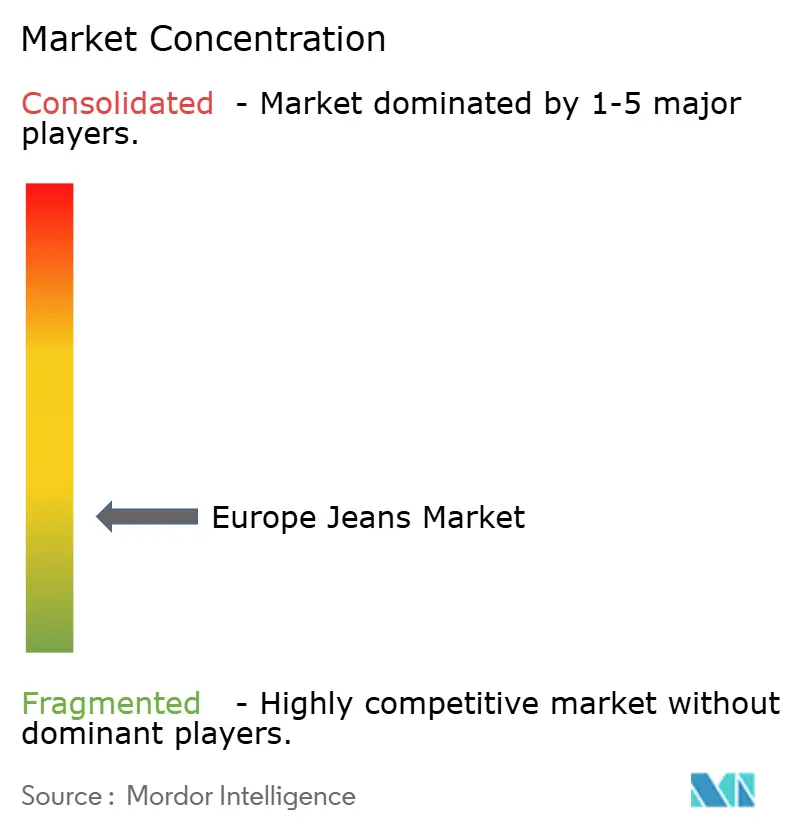
The European jeans market is highly fragmented, with major players like Levi Strauss and Inditex dominate the market, setting trends and influencing consumer expectations. Levi Strauss reported a 15% year-on-year growth in European sales in Q4 2024, driven by strong performance in direct-to-consumer channels. Inditex, a fast-fashion leader, achieved EUR 38.6 billion in sales in 2024, with 73% of its textiles now made from lower-impact fibers. These large companies are shaping the market by focusing on sustainability and speed, forcing smaller brands to find unique ways to stand out.
Investments in technology are becoming a key factor for success in the European jeans market. Companies that adopt innovations like laser finishing, robotics, and digital product passports are better equipped to handle new European Union compliance requirements. For example, Carbonfact’s software, used by several European brands, simplifies carbon-footprint reporting, helping businesses meet the 2027 disclosure deadlines efficiently. Mergers and acquisitions are on the rise, as seen with Chanel acquiring a 70% stake in Grey Mer to secure Italian manufacturing capacity and Maison Neyret integrating Martinetto Group to expand its access to trims and labels essential for premium jeans production.
The market is likely to see gradual consolidation as smaller, independent brands either partner with or sell to larger companies. These larger firms have the financial resources to invest in sustainability, digital transformation, and omnichannel marketing, which are becoming essential for staying competitive. As consumer demand for eco-friendly and innovative products grows, the ability to adapt quickly will determine which players thrive in this evolving market. This trend is expected to reshape the competitive landscape, creating opportunities for growth and collaboration.
Europe Jeans Industry Leaders
-
Gap Inc
-
H&M Group
-
Nudie Jeans Co.
-
Levi Strauss & Co
-
Inditex
- *Disclaimer: Major Players sorted in no particular order
Europe Jeans Market Companies Covered in this Report
- Levi Strauss & Co.
- H&M Group
- Inditex
- PVH Corp.
- Kontoor Brands
- Gap Inc.
- Marks and Spencer Group PLC
- OTB Group
- WHP Global
- All We Wear Group (AWWG)
- Bestseller AS
- Nudie Jeans Co.
- Edwin Co., Ltd.
- Edizione S.p.A.
- Fashion Box S.p.A.
- Next PLC
- SANVT GmbH
- MUD Jeans
- River Island Holdings Limited
- ASOS PLC
Market Opportunities and Future Outlook
The 19 July 2026 ESPR ban on destroying unsold apparel shifts commercial focus to inventory value recovery. For jeans specifically, this expands opportunities for structured resale, repair, take-back, and remanufacturing programs. Brands and retailers with direct-to-consumer and store networks can use these circular pathways to reduce write-offs while improving compliance readiness and meeting circular-economy expectations across Western Europe.
Digital traceability is also becoming an investment priority as textiles are a priority category under the ESPR Working Plan (2025-2030) and are tracked as part of the DPP wave around 2027. Building product-level data capabilities (materials, recycled content, and impact attributes) and connecting suppliers across Europe and adjacent sourcing corridors helps teams prepare for delegated acts. It also supports differentiated product claims in premium denim and can influence eco-modulated EPR fee outcomes where durability and recyclability lower compliance cost.
Recent Industry Developments in Europe Jeans Market
- July 2026: Gap Inc launched The Hailey Jean limited edition denim capsule collection featuring two fits, Extra Baggy and 90s Low Rise Loose, priced at 89, available July 16, 2026 online and in select international stores in the UK, France, China and Japan. The denim capsule targets European and global mass-market. The launch uses nostalgia-driven upsell with a premium positioning to support international denim growth.
- June 2026: H&M Group published its six month report for 2026, confirming store portfolio optimization with net plan of approximately 90 openings and about 170 closures for 2026, expanded digital presence, and active leasing negotiations for roughly one third of store leases. The company also outlined omnichannel expansion and store portfolio optimization in Europe. This supports a faster digital shift and tighter footprint management as the retail landscape evolves for European jeans.
- August 2025: Levi Strauss & Co introduced its Blue Tab collection in Europe, highlighting Japanese denim craftsmanship and innovative design tailored for the European market. Brand driven innovation in European denim segment. Reinforces Levis positioning in EU market amid sustainability and premiumization trends.
Europe Jeans Market Report Scope and Research Methodology
Market Definition and Coverage
This market covers the value of jeans sold across Europe, counted at the point of sale to end users through retail and online channels. It includes common jean styles and fits made primarily from denim and similar cotton blends, across men, women, and kids.
Scope exclusions: We exclude non-jeans denim apparel (such as jackets and skirts) and secondhand or rental transactions, unless they are booked as new product sales.
Segments Covered in This Report
- By Type/Fit
- Regular Fit
- Slim Fit
- Skinny Fit
- Bootcut
- Flared
- Others
- By Price Range
- Mass
- Premium
- By End User
- Men
- Women
- Children
- By Distribution Channel
- Supermarkets/Hypermarkets
- Specialty Stores
- Online Retail Stores
- Other Distribution Channels
- By Country
- United Kingdom
- Germany
- France
- Italy
- Spain
- Netherlands
- Sweden
- Poland
- Switzerland
- Rest of Europe
Data Sources, Market Sizing, and Validation
Desk Research
Desk research was used to set the guardrails for geography, channels, and macro demand signals before we built the model. We leaned on public sources such as Eurostat for household consumption and retail trade indicators, the European Commission for textile policy direction, UN Comtrade for trade flows linked to denim and cotton categories, and the International Cotton Advisory Committee for upstream fiber context.
We also reviewed company annual reports and investor presentations to understand how brands describe denim performance, price moves, and channel mix. We checked reputed business press and association websites for seasonality and promotion patterns. In parallel, we used paid subscriptions for company financials and intelligence, news and financials, and shipment-level import and export checks where it helped confirm direction and scale. These examples are not exhaustive, and many other sources were used for data collection, validation, and clarification during the work.
Primary Interviews and Surveys
Primary discussions helped us validate what is selling now and what is likely to change over the forecast window, with a focus on pricing, promotions, and channel shift. We spoke with participants across brand owners, apparel retailers, distributors, and sourcing or category experts. Coverage was spread across major European demand centers so regional differences did not get averaged away.
Distribution of primary research fieldwork respondents
| Company type | Respondent position |
|---|---|
| Top tier: 31% | CXOs: 19% |
| Mid tier: 47% | Functional/Unit leaders: 27% |
| Smaller Players: 22% | Managers: 54% |
Market-Sizing & Forecasting
Market sizing was built using a top-down and bottom-up flow, where a European apparel spend pool is reconstructed by country and then narrowed to jeans using apparel mix signals and channel splits. The totals are stress-tested with selective bottom-up checks, such as sampled price bands multiplied by estimated unit volumes from retailer channel checks, and then adjusted where gaps are explained by trade intensity or promotional depth.
Inputs that mattered most included apparel retail sales momentum, category mix shifts toward casual wear, average selling price movement by price range, online penetration for apparel, and seasonal promotion intensity (which affects realized prices). We also used import and export direction for relevant apparel codes as a reasonableness check, since sharp trade swings typically show up in availability and pricing pressure.
For forecasting, we leaned on scenario analysis that links demand to consumer spending and apparel retail indicators, then applies expert-validated assumptions on price progression and channel mix changes. Where bottom-up signals were thin for smaller countries, we filled gaps using proxy ratios from similar markets and then rechecked the implied per-capita jeans spend against interview feedback.
Data Validation & Update Cycle
Validation starts with basic variance checks so the country totals do not conflict with independent signals like apparel retail growth, trade direction, and category price moves. When an outlier appears, the assumption behind it is reviewed again, and experts are re-contacted if the variance cannot be explained through promotions, channel mix, or currency timing.
Before sign-off, the model and logic are reviewed in steps by another analyst so calculation errors and inconsistent assumptions are caught early. Reports are refreshed annually, and interim updates are made when material events occur, such as sharp inflation shifts, policy changes impacting textiles, or unusual retail disruption. Right before delivery, we do a fresh pass on the newest public indicators so the final numbers reflect the latest market conditions.
Mordor Intelligence's Europe Jeans Market Sizing Compared With Other Published Estimates
Published market sizes for Europe jeans can differ quite a lot because the scope lines are not drawn the same way, and because the price and volume assumptions are not always tested against real demand signals. Differences also show up when one estimate is updated more recently than another, especially in a category where promotions can move realized prices quickly.
Secondhand and resale jeans sit outside Mordor Intelligence's scope, which can push other published totals higher in years when circular fashion activity is reported together with new apparel sales. The spread can also come from whether VAT is included, how online cross-border purchases are assigned to countries, and whether average selling prices are held flat versus adjusted for discounting and mix shifts across price ranges.
Benchmark comparison
| Source | Market Size | Gaps in Research Methodology |
|---|---|---|
| Mordor Intelligence | USD 27.45 B (2025) | |
| Trade Journal A | USD 30.10 B (2025) | Often blends new jeans sales with resale activity and uses consumer spend snapshots that may include VAT, which inflates the sell-through value versus ex-VAT retail sales. |
| Regional Consultancy B | USD 24.90 B (2025) | Uses a conservative base case with slower price recovery and applies a narrower channel view that undercounts online and off-price contribution in several Western European markets. |
The table shows that scope and price realization are usually the two biggest drivers of the gap. By keeping the model tied to new-product sell-through, checking country totals against retail indicators and trade direction, and updating assumptions when promotion depth changes, the resulting figure stays traceable to clear steps that can be repeated year after year.
Key Questions Answered in the Report
How large is the Europe jeans market in 2026?
It is valued at USD 28.73 billion, with a 4.65% CAGR projected through 2031.
Which fit category is growing the fastest?
Slim Fit is set to expand at a 6.58% CAGR, outpacing Regular Fit.
Which distribution channel shows the strongest growth momentum?
Online retail is leading with a 7.05% CAGR, propelled by virtual fitting tools and QR-code product passports.
Why is premium denim gaining popularity among European consumers?
Shoppers increasingly associate higher prices with sustainability credentials, advanced comfort technologies, and European craftsmanship.