
Europe Jam Market Size and Share
Market Overview
| Study Period | 2021 - 2031 |
|---|---|
| Forecast Data Period | 2026 - 2031 |
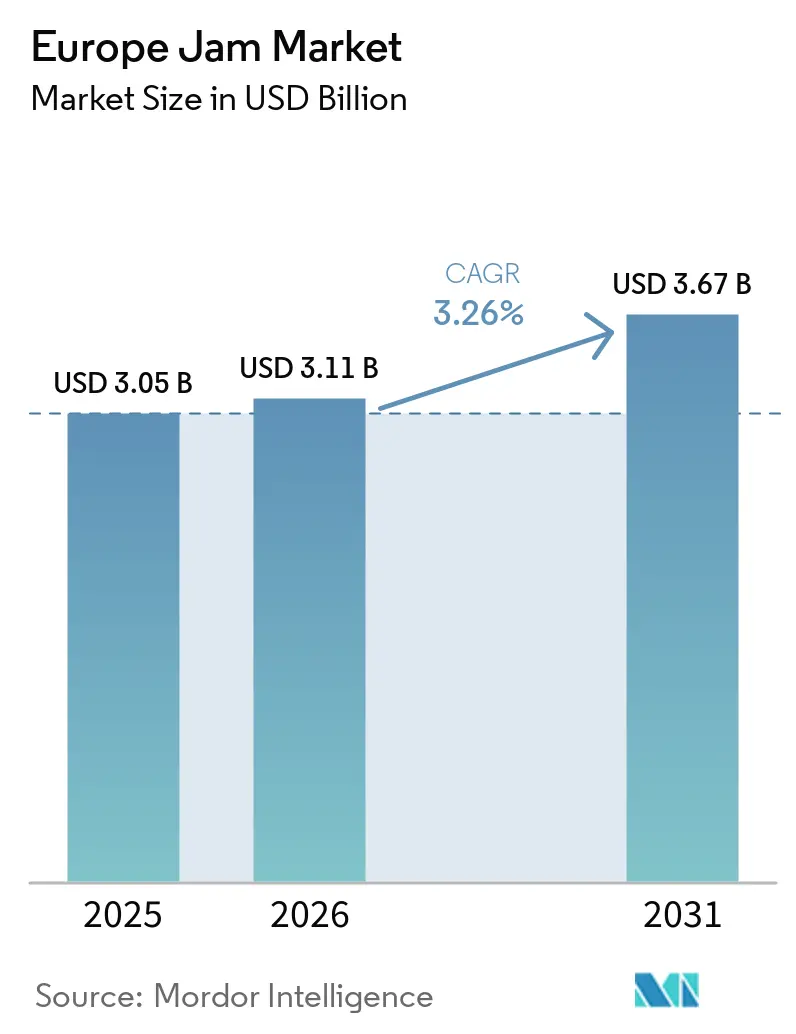
| Base Year Market Size (2025) | USD 3.05 Billion |
| Market Size (2026) | USD 3.11 Billion |
| Market Size (2031) | USD 3.67 Billion |
| Growth Rate (2026 - 2031) | 3.26 % |
| Market Concentration | Medium |
Major Players *Disclaimer: Major Players sorted in no particular order Image © Mordor Intelligence. Reuse requires attribution under CC BY 4.0. | |
Europe Jam Market Analysis by Mordor Intelligence
The Europe jam market size is projected to expand from USD 3.05 billion in 2025 and USD 3.11 billion in 2026 to USD 3.67 billion by 2031, registering a CAGR of 3.26% between 2026 and 2031. The Europe jam market is moving toward higher-value jars as buyers favor visible fruit content, clearer ingredient lists, and products with a stronger quality position. Directive (EU) 2024/1438 applies from June 14, 2026, and raises minimum fruit-content requirements for standard and extra jams, making reformulation and dependable fruit sourcing more important for suppliers[1]. This change favors producers that can manage higher fruit inputs and maintain consistent product quality across retail channels. Organic, reduced-sugar, and portion-controlled products create opportunities when they are supported by credible sourcing and practical packaging. Competition remains active because established brands, private labels, and smaller specialty producers all serve different price and quality needs in the Europe jam market.
Key Report Takeaways
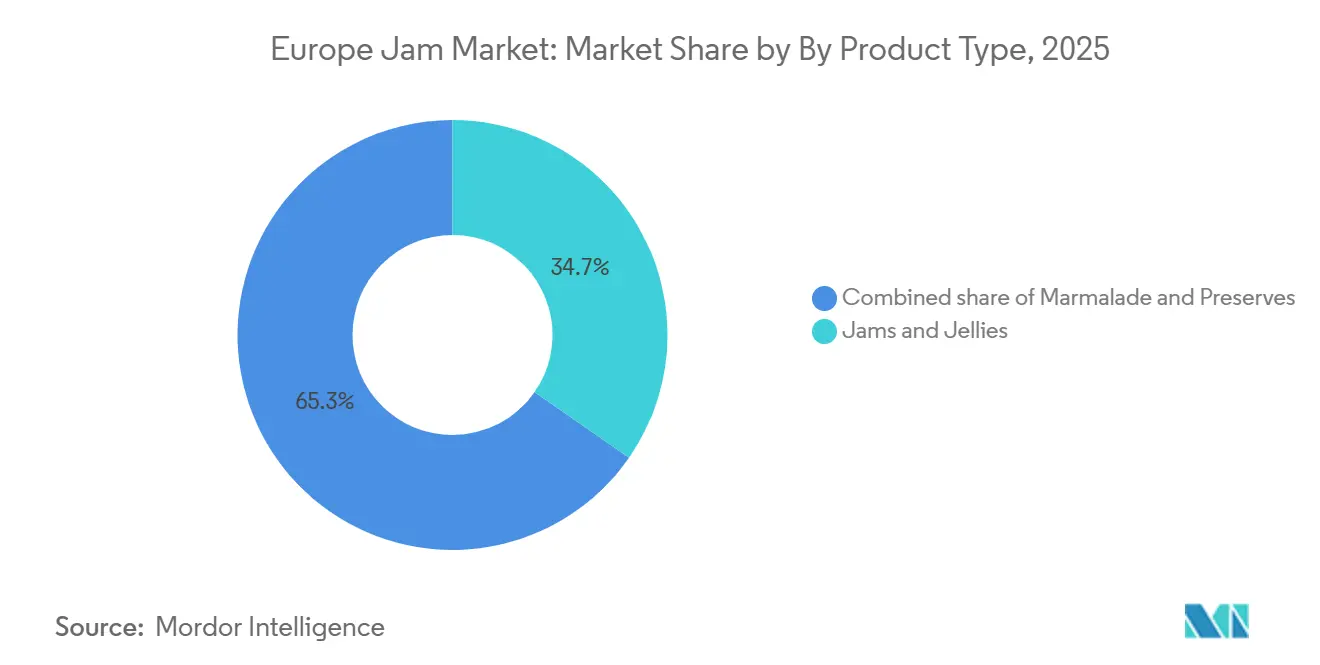
- By product type, jams and jellies held a 34.67% revenue share in 2025, while preserves are forecast to expand at a 4.20% CAGR through 2031.
- By category, conventional products held 86.43% revenue share in 2025, while organic variants are forecast to expand at a 5.65% CAGR through 2031.
- By packaging type, glass jars held 38.96% revenue share in 2025, while single-serve portion packs are forecast to expand at a 4.80% CAGR through 2031.
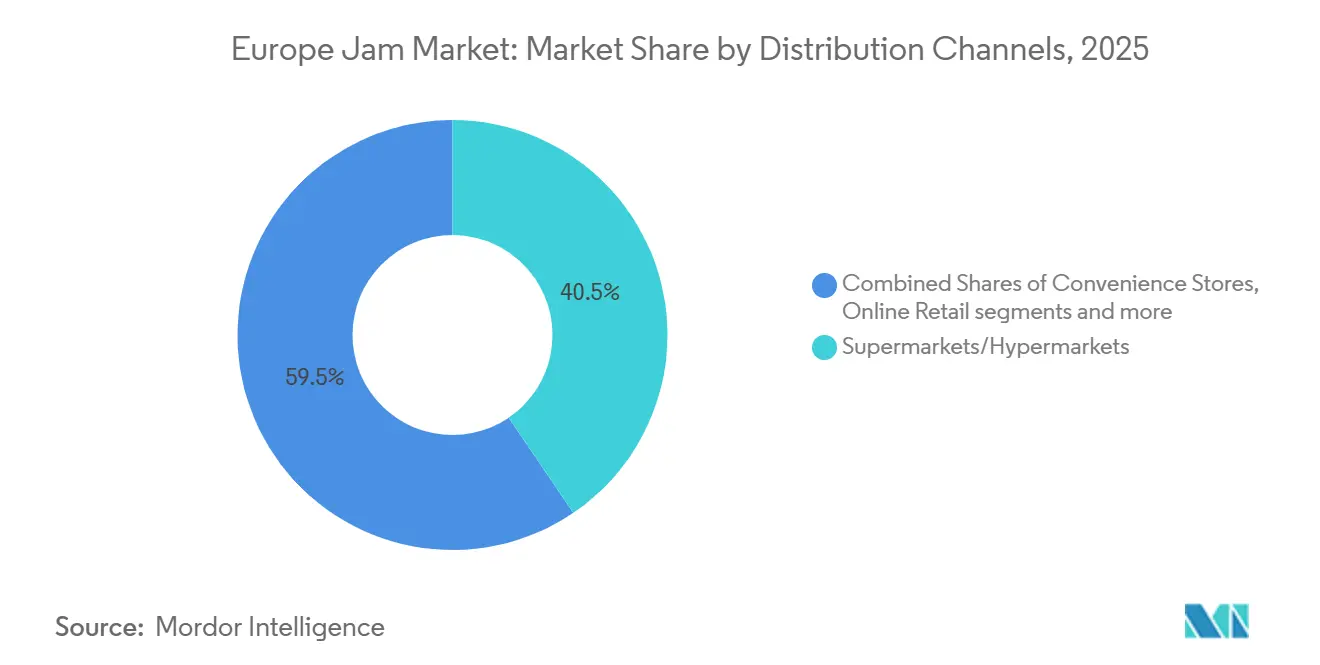
- By distribution channel, supermarkets and hypermarkets held 40.50% revenue share in 2025, while online retail stores are forecast to expand at a 5.10% CAGR through 2031.
- By geography, the United Kingdom held a 36.32% revenue share in 2025, while Germany is forecast to expand at a 4.80% CAGR through 2031.
Note: Market size and forecast figures in this report are generated using Mordor Intelligence’s proprietary estimation framework, updated with the latest available data and insights as of January 2026.
Market Trends and Insights
Drivers Impact Analysis of Europe Jam Market*
| Driver | (~) % Impact on CAGR Forecast | Geographic Relevance | Impact Timeline |
|---|---|---|---|
| Rising demand for premium fruit jams | +0.8% | Western Europe, including the United Kingdom, France, Germany, and Italy | Medium term (2-4 years) |
| Clean-label reformulation across retail private label | +0.7% | Pan-European, strongest in Germany, the Netherlands, and Scandinavia | Short term (≤ 2 years) |
| Growth in breakfast, snacking, and on-the-go consumption | +0.6% | Pan-European, led by the United Kingdom, Germany, and France | Medium term (2-4 years) |
| Expansion of e-commerce and DCC specialty brands | +0.5% | Western Europe, particularly the United Kingdom, Germany, and the Netherlands | Medium term (2-4 years) |
| Sugar reduction and fruit-forward innovation | +0.4% | Pan-European, with compliance factors linked to Directive (EU) 2024/1438 | Short term (≤ 2 years) |
| Export-led brand expansion from heritage European producers | +0.3% | Global export corridors, including the Gulf, Asia-Pacific, and North America | Long term (≥ 4 years) |
| Source: Mordor Intelligence | |||
Rising Demand for Premium Fruit Jams
Premium products are reshaping the Europe jam market because consumers in the United Kingdom, France, and Germany are selecting jars with stronger fruit, origin, and craft credentials. This purchasing pattern places greater value on visible fruit content and trusted ingredient claims, particularly where a jar is bought as a small premium rather than a basic pantry item. Directive (EU) 2024/1438 requires more fruit in standard and extra jams, and it gives greater weight to products that can demonstrate their fruit composition on pack. The rule applies from June 14, 2026, so producers must already manage its formulation and labeling effects across existing lines and future launches. Heritage brands can use established sourcing relationships to support this positioning while newer brands need a similarly credible fruit story. The Europe jam market therefore rewards a clear quality proposition more than price-led messaging alone.
Clean-Label Reformulation Across Retail Private Label
Retailers are using short ingredient lists, reduced sugar, and organic fruit claims to strengthen private-label offers. This creates direct pressure on branded suppliers because similar product benefits are becoming available at lower price points. The Europe jam market benefits when reformulation gives shoppers a reason to remain in the fruit-spread category rather than choose alternatives. The EU organic agricultural area reached 17.4 million hectares in 2023, and the supplied USDA report expected a 14% increase by 2025 compared with 2022, expanding the potential certified raw-material base[2]. Larger certified supply can help manufacturers develop compliant lines without relying on a narrow group of fruit suppliers or making ingredient claims that are difficult to sustain. Private-label growth also requires established brands to show why their fruit, taste, and format justify a premium for regular household purchases.
Growth in Breakfast, Snacking, and On-the-Go Consumption
More eating occasions support demand for convenient fruit jams in homes and hospitality settings. Hotels, airline lounges, and corporate canteens use single-serve packs because they are practical for individual service and make handling easier for staff. This supports the Europe jam market, where suppliers can meet foodservice requirements alongside retail demand without reducing the quality of the fruit proposition. Hero Group reported CHF 1,187 million in net sales in 2025, with 2.2% organic growth, and reported EBIT of CHF 71.3 million as it developed its Better Snacking platform. Its results show why convenient formats matter to companies serving changing snacking routines across several food occasions. Brands with suitable portion packs can reinforce visibility in venues where consumers later make retail choices.
Expansion of E-Commerce and DTC Specialty Brands
Digital channels allow small-batch producers to sell seasonal flavors and specialty products without waiting for broad supermarket listings. Subscription models can help these producers build direct relationships with buyers who value differentiated products and want to repeat a preferred purchase. The Europe jam market becomes more competitive when digital channels shorten the route from product trial to repeat purchase. Online storefronts also give brands room to present more flavors, gift options, and product detail than a physical shelf can hold. This can make it easier to test niche combinations before committing to wider distribution and larger production runs. Larger suppliers must maintain credible digital offers while protecting the efficiency of their supermarket business.
Restraints Impact Analysis of Europe Jam Market*
| Restraint | (~) % Impact on CAGR Forecast | Geographic Relevance | Impact Timeline |
|---|---|---|---|
| Pressure from sugar and calorie reduction trends | -0.4% | Pan-European, with regulatory influence from Nutri-Score labeling in France and Germany | Short term (≤ 2 years) |
| Competition from substitutes such as nut butters and savory spreads | -0.3% | Western Europe, led by the United Kingdom, Germany, and the Netherlands | Medium term (2-4 years) |
| Private-label pricing pressure in mass retail | -0.3% | Pan-European, sharpest in high-discounter markets including Germany and Poland | Medium term (2-4 years) |
| Seasonal fruit supply volatility and input cost sensitivity | -0.2% | Mediterranean sourcing regions and Eastern European soft-fruit belts | Short term (≤ 2 years) |
| Source: Mordor Intelligence | |||
Competition From Substitutes Such as Nut Butters and Savory Spreads
Nut butters and savory spreads compete for the same breakfast and snacking occasions. These alternatives appeal to consumers seeking protein-forward and filling products, particularly when they are choosing a spread for a routine weekday meal. The Europe jam market faces the strongest pressure among younger consumers who are open to varied spread formats. Fruit-spread producers can respond through authentic fruit provenance and products with higher fruit-to-sugar ratios that retain the category’s familiar taste. Competing directly on protein claims would be less credible than emphasizing the distinct taste and fruit content of preserves and jams.
Seasonal Fruit Supply Volatility and Input Cost Sensitivity
Soft-fruit sourcing remains exposed to weather conditions in Southern and Eastern Europe. Late frosts, uneven rainfall, and summer heat can reduce strawberry, apricot, and cherry yields by as much as 50% in adverse seasons. These changes raise input costs for manufacturers and make cost planning more difficult, especially when production commitments were set before a difficult harvest. The Europe jam market is especially challenging for smaller suppliers without multi-country sourcing or long-term contracted supply. Higher fruit-content requirements can add further pressure when raw fruit availability is limited. Companies with diversified procurement and reliable grower relationships are better positioned to protect continuity, manage price changes, and maintain consistent specifications for retail customers.
*Our forecasts treat driver/restraint impacts as directional, not additive. The impact forecasts reflect baseline growth, mix effects, and variable interactions.
Europe Jam Market Segment Analysis
By Product Type:
Preserves Lead the Gourmet OpportunityJams and jellies held a 34.67% revenue share in 2025, supported by their broad availability in everyday retail. Their role in breakfast routines in the United Kingdom, France, and Germany sustains regular demand. The segment covers a wide price range that includes private-label products and artisanal offerings. This range gives suppliers flexibility even when some consumers reduce purchase frequency. Marmalade remains important in the United Kingdom and Spain, where citrus flavors and established serving occasions support a premium position. Preserves are forecast to grow at a 4.20% CAGR through 2031, making them the fastest-growing product type in the Europe jam market.
Preserves benefit from buyers seeking visible fruit, limited processing, and a more crafted product experience. These attributes fit the stricter minimum fruit-content rules under Directive (EU) 2024/1438. The category allows premium offers to stand apart from conventional jam products and alternative spreads. Suppliers can use differentiated flavor combinations to encourage trade-up without abandoning familiar fruit formats. Jams and jellies still matter because their scale supports efficient production and broad household access. Product planning can therefore balance cash-generating mainstream lines with preserves that offer stronger growth potential.

By Category:
Organic Variants Advance From a Smaller BaseConventional products held 86.43% of the Europe jam market size in 2025, reflecting their established retail presence and distribution scale. Their reach makes them essential for manufacturers that need broad shelf access and steady volumes. Organic variants are forecast to grow at a 5.65% CAGR through 2031. This rate exceeds the overall category pace and reflects interest in certified ingredients and clear product positioning. Germany’s organic food market reached EUR 18.23 billion, equivalent to USD 19.78 billion, in 2025 and grew 6.7% from 2024. Its scale makes Germany an important setting for organic fruit-jam launches.
France’s organic consumption market grew 3.6% in 2025 to EUR 12.6 billion, equivalent to USD 13.67 billion[3]. The recovery in grocery demand gives suppliers a supportive setting for certified fruit jams. More organic farmland can improve access to compliant ingredients over time. Organic products still need trusted quality and a clear consumer benefit because certification alone does not secure repeat purchases. Reduced sugar and organic claims can work together when formulation remains familiar, and taste remains central. Conventional products retain their importance because price-sensitive households continue to anchor category volumes.
By Packaging Type:
Single-Serve Packs Gain From Hospitality DemandGlass jars held 38.96% revenue share in 2025, supported by their familiar shelf appearance and premium presentation. The format suits artisanal and higher-value products because it helps buyers see the product and recognize the brand. Glass also aligns with consumer interest in recyclable packaging. Squeezable plastic remains useful for convenient household use and families with children. Single-serve portion packs are forecast to grow at a 4.80% CAGR through 2031. Their demand is linked to hotels and other foodservice settings where individual portions are a hygiene and service requirement.
Portion packs give brands a way to remain visible in hospitality settings without relying on bulk dispensers. They also allow buyers to sample products before choosing them in retail stores. This gives brands with foodservice distribution an advantage when competing for breakfast venues. Packaging decisions now need to meet operational needs as well as sustainability expectations. A format must protect quality, communicate fruit content, and work efficiently in the intended channel. Producers that can manage these requirements are better able to serve both premium retail and institutional buyers.
By Distribution Channel:
Online Retail Broadens Specialty ReachSupermarkets and hypermarkets held 40.50% of the Europe jam market size in 2025, reflecting the category’s role as a routine grocery purchase. These retailers shape price competition and influence the visibility of private-label products. Convenience and grocery stores serve top-up and impulse needs in dense urban areas. Specialty food stores, farm shops, gift retailers, and direct foodservice supply support premium and artisanal offers. Online retail stores are forecast to grow at a 5.10% CAGR through 2031. Their growth reflects recurring grocery orders, wider digital discovery, and space for extended flavor assortments.
Online channels can reach consumers who may not encounter smaller brands in mainstream stores. They can support subscription models and direct communication around ingredients, flavor, and seasonality. This gives smaller producers a more practical path to validate demand. The Europe jam industry must manage this alongside supermarket operations that still provide scale and routine reach. A dual-channel approach can support volume products in physical retail and premium products through direct channels. Digital activity should complement supermarket execution rather than weaken the core retail business.
Geography Analysis
Western Europe Jam Market
The United Kingdom held 36.32% of the European fruit spreads market share in 2025, which made it the largest national market in the region. That lead reflects strong breakfast habits, established use occasions such as toast and afternoon tea, and a mature branded preserves culture. Heritage labels remain important in the United Kingdom because they support a premium reference point for both retail and foodservice. France also remains an important consumption market, while Italy and Spain matter as both consuming countries and producing bases for fruit-based products. Together, these Western European markets keep a large part of the European fruit spreads market centered on tradition, retail depth, and product familiarity.
Germany and Northern Europe Jam Market
Germany is forecast to grow at a 4.80% CAGR through 2031, making it the fastest-growing geography in the European fruit spreads market. Demand there is supported by strong interest in organic certification, clear ingredient sourcing, and packaging that fits sustainability expectations. Hero Group identified Germany as a key growth market for natural spreads, with premium seasonal flavor activity supporting volume and visibility. The Netherlands, Belgium, and Sweden are smaller in absolute terms, but they show similar preferences for clean-label and premium propositions. These markets offer a logical next step for producers that want to extend premium positioning beyond the largest Western European countries.
Central and Eastern Europe Jam Market
Poland and the wider Central and Eastern European group bring a different mix of cost, supply, and demand factors to the Europe fruit spreads market. Poland is important not only as a consumer market but also as a fruit processing hub that supports broader regional supply chains. That gives producers a route to manage raw material costs while serving Western European demand. Russia has faced a more complicated path because earlier geopolitical disruption and import limits changed the trade environment. Orkla Food Ingredients’ acquisition of Eurohansa Toruń reflects the strategic value of Central and Eastern European processing assets for companies that want a more efficient regional manufacturing base
Competitive Landscape
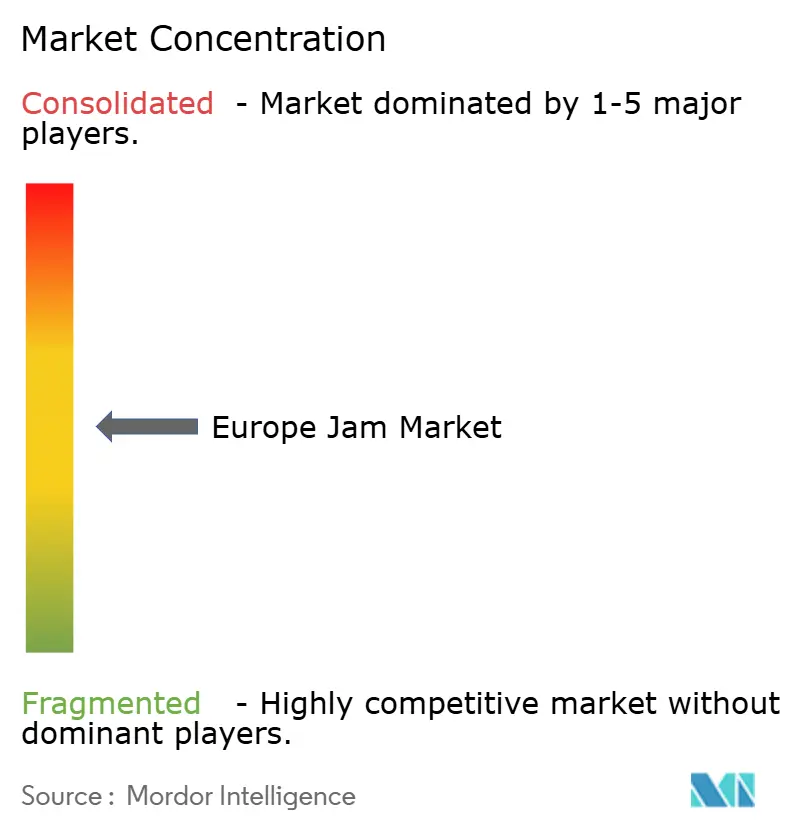
The Europe jam market has a moderately competitive structure because larger groups operate alongside strong regional specialists. Andros Group and Hero Group have broad brand and distribution capabilities, while regional suppliers compete through fruit quality, heritage, organic credentials, and specialty formats. Hero Group reported CHF 1,187 million in 2025 net sales and CHF 71.3 million in EBIT, supported by 2.2% organic growth. Its Hero 2035 strategy centers on Better Snacking and indicates a long-term shift toward products suited to changing food habits HERO GROUP. Such moves show that leading companies are combining portfolio direction with operating discipline. The Europe jam market rewards suppliers that can translate this strategy into dependable retail execution.
Directive (EU) 2024/1438 increases the importance of formulation capability and secure fruit supply because it raises fruit-content requirements for products sold as standard and extra jam. This places a higher burden on manufacturers that depend on lower-cost concentrate-heavy recipes. Larger and more integrated suppliers can use sourcing depth and reformulation resources to protect listings. Organic, no-added-sugar, and hospitality-ready formats are important areas because few producers combine all 3 at meaningful scale.
Digital-first brands add pressure by building an audience before seeking large supermarket listings. They can use direct selling to test flavors and learn which offers generate repeat purchases. Established brands can respond by improving their own digital routes and keeping product development close to consumer preferences. Private labels remain influential because they provide familiar products at accessible prices. A Europe jam market concentration score of 5 out of 10 reflects the presence of meaningful leading groups and durable regional competitors, without evidence that a small group controls the category at the threshold required for a higher score.
Europe Jam Industry Leaders
-
Valeo Foods
-
Zentis GmbH & Co. KG
-
Andros Group
-
Hero Group
-
Darbo AG
- *Disclaimer: Major Players sorted in no particular order
Europe Jam Market Companies Covered in this Report
- Andros Group (Bonne Maman)
- Hero Group
- Zentis GmbH and Co. KG
- Schwartau Werke GmbH and Co. KG
- Valeo Foods Group
- Orkla ASA
- Darbo AG
- Agrana Beteiligungs-AG
- Wilkin and Sons Ltd (Tiptree)
- Menz and Gasser S.p.A.
- Rigoni di Asiago S.r.l.
- F. Duerr and Sons Ltd
- St Dalfour
- Helios Food
- Baxter Food Group
- Andechser Molkerei Scheitz GmbH
- Casa Giulia
- La Vieja Fábrica (GBfoods)
- Confitera Aragon
- Kühne + Heitz KG
Recent Industry Developments in Europe Jam Market
- May 2026: Fearne & Rosie, a United Kingdom-based jam brand, has expanded its reduced-sugar strawberry preserve range through wider distribution in Tesco stores. This development highlights increasing consumer and retailer demand for lower-sugar spreads and has contributed to the brand's rapid sales growth in the United Kingdom jam market.
- April 2025: Hero Group acquired full control of MadreNatura, its Italian joint venture for baby food, previously 50%-held with Angelini Holding, consolidating its Italian market presence as part of the Baby and Toddler Food and Natural Spreads growth strategy.
- May 2025: Hero Group rolled out redesigned, lighter-weight 340 g glass jam jars across multiple European markets, using Artificial Intelligence digital twin modeling to reduce glass weight by 13% and projecting 700 tonnes of CO2e savings in the first year, with plans to extend to additional formats and markets
Europe Jam Market Report Scope
Jam is a sweet food product made by cooking fruit with sugar until it reaches a thick, spreadable consistency.
The scope of the report covers the Europe jam market, segmented by product type, category, packaging type, distribution channel, and geography. By product type, the market includes jams and jellies, marmalade, and preserves. By category, the market is divided into conventional and organic products. Based on packaging type, the market is segmented into glass jars, squeezable plastic, and single-serve portion packs. By distribution channel, the market includes supermarkets/hypermarkets, convenience/grocery stores, online retail stores, and other distribution channels. Geographically, the report covers Germany, the United Kingdom, Italy, France, Spain, Russia, the Netherlands, Poland, Belgium, Sweden, and the rest of Europe. The market sizing has been done in value terms in USD for all the above-mentioned segments.
Segmentation Overview
| Jams and Jellies |
| Marmalade |
| Preserves |
| Conventional |
| Organic |
| Glass Jars |
| Squeezable Plastic |
| Single-serve Portion Packs |
| Supermarkets/Hypermarkets |
| Convenience/Grocery Stores |
| Online Retail Stores |
| Other Distribution Channels |
| Germany |
| United Kingdom |
| Italy |
| France |
| Spain |
| Russia |
| Netherlands |
| Poland |
| Belgium |
| Sweden |
| Rest of Europe |
| By Product Type | Jams and Jellies |
| Marmalade | |
| Preserves | |
| By Category | Conventional |
| Organic | |
| By Packaging Type | Glass Jars |
| Squeezable Plastic | |
| Single-serve Portion Packs | |
| By Distribution Channel | Supermarkets/Hypermarkets |
| Convenience/Grocery Stores | |
| Online Retail Stores | |
| Other Distribution Channels | |
| By Geography | Germany |
| United Kingdom | |
| Italy | |
| France | |
| Spain | |
| Russia | |
| Netherlands | |
| Poland | |
| Belgium | |
| Sweden | |
| Rest of Europe |
Key Questions Answered in the Report
What is the projected value of the Europe jam market by 2031?
The Europe jam market is projected to reach USD 3.67 billion by 2031, from USD 3.11 billion in 2026, at a 3.26% CAGR.
Which product type is growing fastest in Europe?
Preserves are forecast to grow at a 4.20% CAGR through 2031, supported by demand for visible fruit and more premium products.
Which channel has the strongest growth outlook for jam sales?
Online retail stores are forecast to grow at a 5.10% CAGR through 2031, supported by subscriptions, digital discovery, and broader flavor assortments.
Which European country leads jam consumption?
The United Kingdom held 36.32% revenue share in 2025, reflecting its established breakfast and teatime traditions.