
Market Overview
| Study Period | 2020 - 2031 |
|---|---|
| Forecast Data Period | 2026 - 2031 |
| Base Year Market Size (2025) | USD 7.21 Billion |
| Market Size (2026) | USD 8.14 Billion |
| Market Size (2031) | USD 14.89 Billion |
| Growth Rate (2026 - 2031) | 12.86 % |
| Market Concentration | Low |
Major Players *Disclaimer: Major Players sorted in no particular order Image © Mordor Intelligence. Reuse requires attribution under CC BY 4.0. | |
Europe IT Asset Disposition Market Analysis by Mordor Intelligence
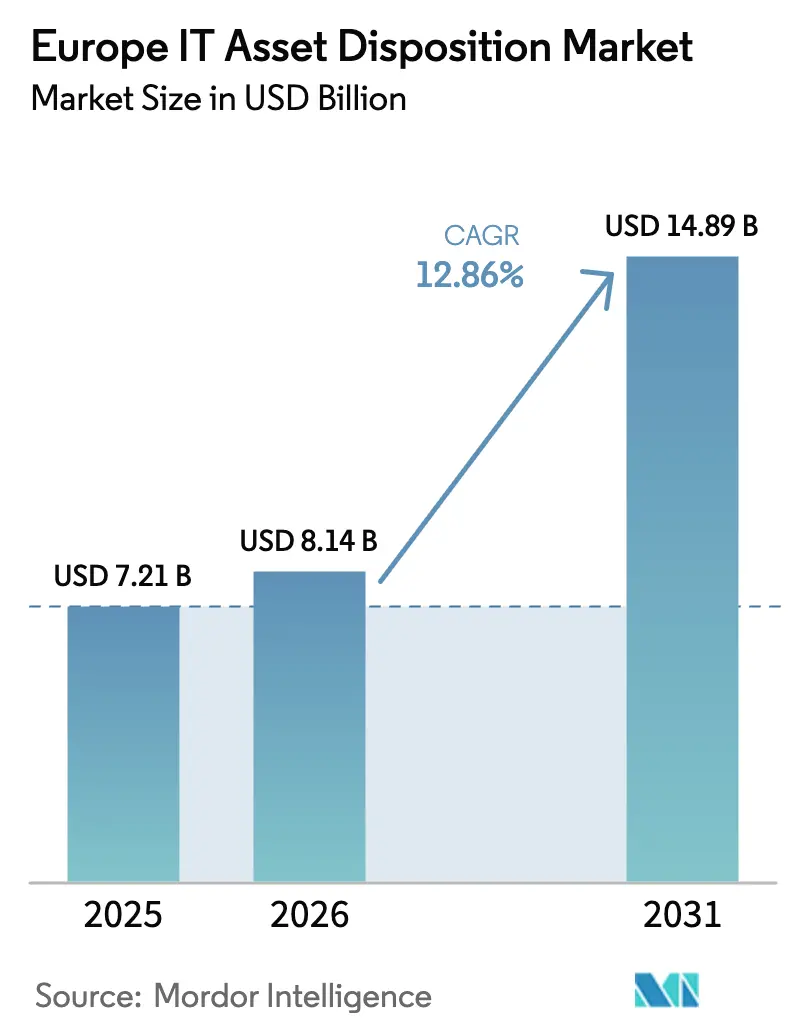
The Europe IT Asset Disposition market size was valued at USD 7.21 billion in 2025 and estimated to grow from USD 8.14 billion in 2026 to reach USD 14.89 billion by 2031, at a CAGR of 12.86% during the forecast period (2026-2031). Mandatory energy-efficiency labels for PCs coming into force in 2026, the Corporate Sustainability Reporting Directive (CSRD) now in effect, and multiyear cloud-migration programs are all combining to lift asset-retirement volumes and reshape provider revenue models. Corporate customers are moving rapidly to refresh entire hardware fleets ahead of the energy-label ban, while Device-as-a-Service agreements bundle disposition into predictable, subscription-style contracts. Take-back incentives from original equipment manufacturers (OEMs) are further supporting remarketing margins, and private-equity roll-ups are knitting together regional refurbishers into cross-border hubs that deliver scale advantages on testing, grading, and logistics.
Key Report Takeaways
- By service type, Remarketing and Value Recovery led with 37.12% of the Europe IT Asset Disposition market share in 2025, whereas Reverse Logistics and De-installation is projected to surge at 13.48% CAGR through 2031.
- By asset type, Computers and Laptops accounted for 34.92% share of the Europe IT Asset Disposition market size in 2025, while Mobile Devices are forecast to expand at a 14.35% CAGR to 2031.
- By enterprise size, Large Enterprises captured 66.55% spending in 2025; Small and Medium Enterprises are advancing at a 14.92% CAGR through 2031.
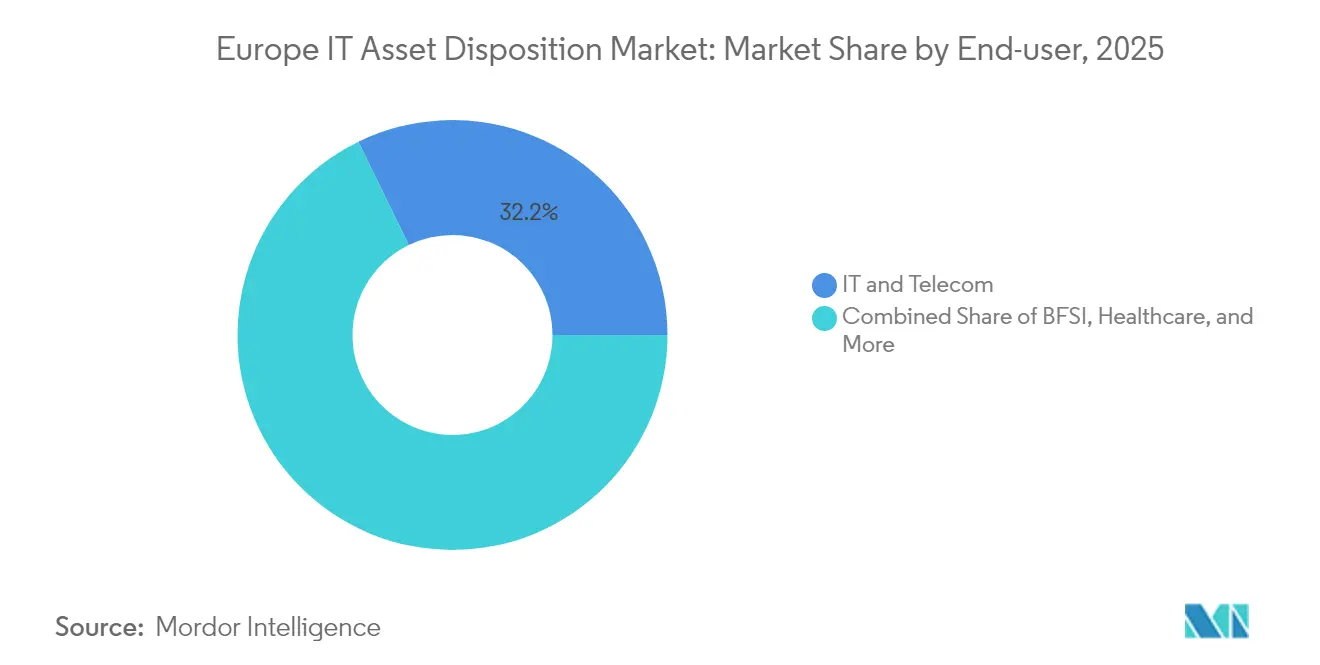
- By end-user vertical, IT and Telecom held 32.21% revenue share in 2025, whereas Healthcare is expected to grow fastest at 13.92% CAGR between 2026-2031.
- By country, the United Kingdom maintained 21.53% of the Europe IT Asset Disposition market share in 2025; Poland shows the highest projected growth at 12.88% CAGR to 2031.
Note: Market size and forecast figures in this report are generated using Mordor Intelligence’s proprietary estimation framework, updated with the latest available data and insights as of 2026.
Market Trends and Insights
Drivers Impact Analysis of Europe IT Asset Disposition Market*
| Driver | (~) % Impact on CAGR Forecast | Geographic Relevance | Impact Timeline |
|---|---|---|---|
| Accelerated PC refresh from EU 2026 energy-label ban | +2.1% | EU-27, strongest in Germany, France, Netherlands | Short term (≤ 2 years) |
| Corporate-wide CSRD reporting pushes audited ITAD | +1.8% | EU-27 large enterprises, spillover to United Kingdom and Switzerland | Medium term (2-4 years) |
| OEM take-back schemes subsidise remarketing margins | +1.4% | Global, early adoption in Nordic countries and Germany | Medium term (2-4 years) |
| Shift to Device-as-a-Service contracts bundles ITAD | +1.6% | Western Europe core, expanding to Eastern Europe | Long term (≥ 4 years) |
| Cloud exit from ageing on-premise data-centre hardware | +1.9% | Global, concentrated in business centres | Short term (≤ 2 years) |
| Private-equity roll-ups create pan-EU hubs | +1.3% | Western Europe first, later Central and Eastern Europe | Long term (≥ 4 years) |
| Source: Mordor Intelligence | |||
Accelerated PC Refresh from EU 2026 Energy-Label Ban
The upcoming EU energy-efficiency label effectively removes low-performing computers from sale and pushes enterprises to replace legacy PCs before the 2026 deadline. Many procurement teams are front-loading refresh budgets to avoid non-compliant inventory, which is set to lift Europe's IT Asset Disposition market volumes significantly. Providers able to capture these units early profit from higher residual values before secondary-market saturation sets in, and the regulation dovetails with the broader Ecodesign for Sustainable Products framework that introduces Digital Product Passports starting in 2027.[1]As a result, certified recyclers and refurbishers see a window to lock in supply contracts with large corporates and speed up capacity investments.
Corporate-wide CSRD Reporting Pushes Audited ITAD
From January 2024, the CSRD obliges around 50,000 European companies to disclose Scope 3 emissions, making verifiable end-of-life tracking for devices a board-level issue. Large multinationals are now awarding disposition contracts based on audit readiness, chain-of-custody transparency, and carbon-impact reporting rather than unit fees alone. ITAD providers with integrated data-destruction, recycling, and remarketing workflows, each accompanied by tamper-proof documentation, rise to preferred-supplier status in requests for proposals. Healthcare chains, for instance, increasingly select vendors that can prove Health Insurance Portability and Accountability Act (HITECH) compliance alongside greenhouse-gas savings, moving the Europe IT Asset Disposition market toward service-quality differentiation.
OEM Take-Back Schemes Subsidise Remarketing Margins
OEMs from consumer to industrial electronics now embed trade-in credits that guarantee minimum values for devices returned through authorized ITAD pipelines. Apple’s pledge to use 100% recycled cobalt in all batteries and 99% recycled rare-earth magnets by 2025 sets a benchmark for circularity that pushes enterprises to partner with brand-approved recyclers. Siemens offers pan-EEA return options for packaging and batteries, allowing customers to meet WEEE obligations without sourcing additional vendors.[2] These take-back incentives de-risk inventory for ITAD partners, let providers bid more aggressively, and keep high-quality assets in compliant channels.
Shift to Device-as-a-Service Contracts Bundles ITAD
Under Device-as-a-Service, hardware is delivered, supported, and eventually taken back under one multi-year subscription. SHI International, Foxway, and other providers now include certified disposition in the monthly fee, converting lump-sum disposal to recurring cash flow.[3]Customers gain predictable costs and skip multiple tenders, while providers lock in asset supply and can plan long-term investments in refurbishment lines or shredding equipment. The model aligns with finance teams’ push to classify devices as operating expenditure and meets CSRD data-tracking requirements out of the box.
Restraints Impact Analysis of Europe IT Asset Disposition Market*
| Restraint | (~) % Impact on CAGR Forecast | Geographic Relevance | Impact Timeline |
|---|---|---|---|
| Fragmented WEEE enforcement across EU-27 | -1.2% | Southern and Eastern Europe most affected | Medium term (2-4 years) |
| Inflation-linked logistics costs squeeze margins | -0.9% | High-cost Northern Europe | Short term (≤ 2 years) |
| Grey-market exports erode certified volume | -0.7% | Eastern EU borders | Long term (≥ 4 years) |
| Refurb device stigma among enterprise buyers | -0.5% | Mainly Western Europe | Medium term (2-4 years) |
| Source: Mordor Intelligence | |||
Fragmented WEEE Enforcement Across EU-27
Regulators interpret WEEE rules differently, so cross-border asset flows must comply with several record-keeping procedures, each adding cost. Germany’s 12.5 kg per-capita e-waste generation contrasts with less-stringent enforcement in Poland, forcing providers to maintain multiple licences and audits, complicating route planning and undermining potential economies of scale. Until harmonisation improves, operators incur duplicated compliance overheads and slower customs clearance on trans-EU lanes.
Inflation-Linked Logistics Costs Squeeze Margins
Fuel, driver wages, and specialised vehicle insurance have all risen, pushing transport to 25% of total disposal cost for low-value devices. Secure vans cannot simply join commodity haulage networks, and pick-ups from dispersed branch offices rarely fill a truck. These economics disadvantage smaller collection runs and erode margin, particularly for assets below USD 50 residual value. Providers respond by clustering pick-up days, investing in telematics for route optimisation, or rolling out on-site shredding to eliminate returns where feasible.
*Our forecasts treat driver/restraint impacts as directional, not additive. The impact forecasts reflect baseline growth, mix effects, and variable interactions.
Europe IT Asset Disposition Market Segment Analysis
By Service Type:
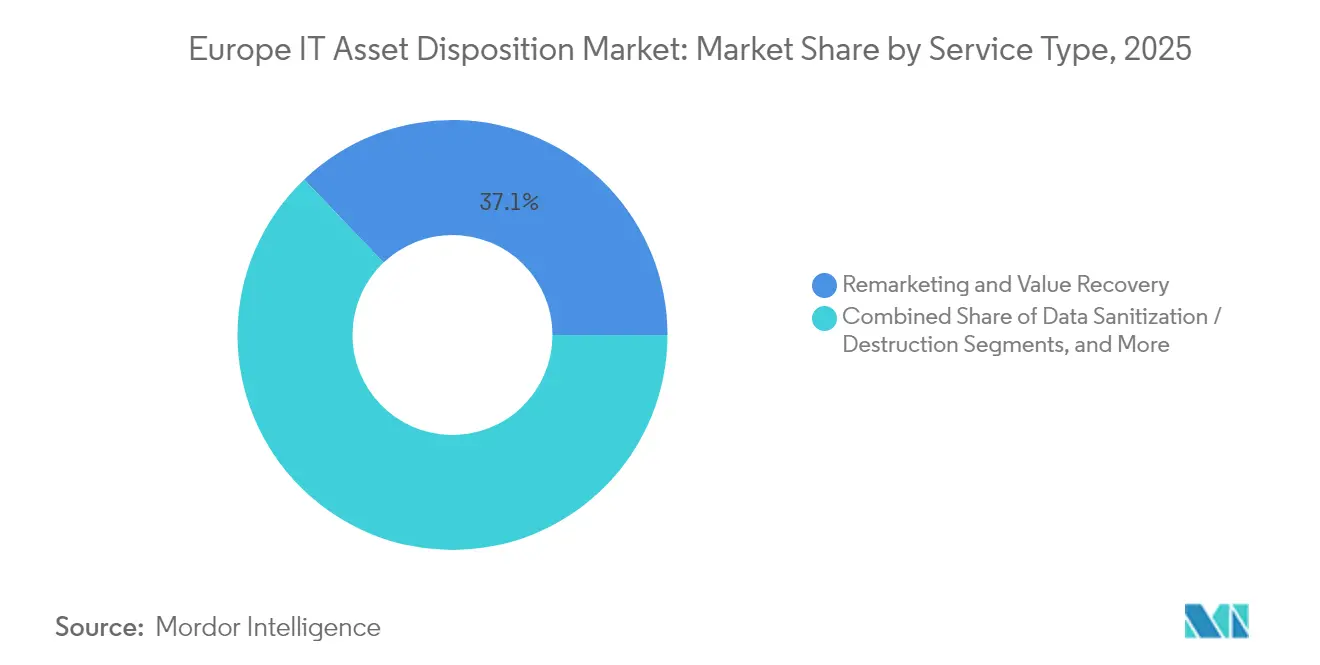
Remarketing Remains the High-Value CoreRemarketing and Value Recovery held 37.12% of 2025 revenue, underlining the appetite for refurbished gear that meets budget and sustainability goals. Certified grading and robust warranty programs assure buyers, while OEM take-back schemes buttress minimum buy-back prices, letting providers capture extra margin on resale. Reverse Logistics and De-installation, the fastest-growing line at 13.48% CAGR, reflects multi-site enterprises scheduling simultaneous refreshes ahead of the energy-label deadline. Secure chain-of-custody removal services command price premiums, ensuring data and brand protection throughout transit. Lease Return and End-of-Life Management enjoys a tailwind from finance houses keen to present circular-economy credentials. Data Sanitisation gains steady demand as customers align with ISO 27001 and NIST SP 800-88 protocols.
Integrated contract structures dominate client procurement. Single-vendor frameworks covering collection, erasure, resale, and reporting remove coordination overhead. AI-enabled optical inspection and Internet-of-Things (IoT) trackers improve yield forecasting and increase labour productivity on the testing line. Battery-recovery and urban-mining offerings sit in the “Other” bucket and win share in markets where raw-material scarcity raises the value of critical minerals. Providers that master both component harvesting and full-device resale achieve higher return per kilogram and widen the moat around their platforms. The Europe IT Asset Disposition market thus continues to prize remarketing skills while rewarding logistical precision.

By Asset Type:
Smartphones Surge AheadComputers and Laptops accounted for 34.92% of 2025 turnover, underpinned by a corporate fleet swap that accelerates through 2026. Yet Mobile Devices, from smartphones to rugged tablets, are the fastest-rising pool at 14.35% CAGR. Shorter two-to-three-year refresh intervals and the bring-your-own-device trend feed unit volumes, while strong secondary demand in Africa and South-East Asia lifts average selling prices. Servers and Storage arrays, although fewer in number, deliver high value density due to gold-plated connectors and aluminium casings. Their disposal schedules align with cloud migration milestones, and strict data-wiping needs make them premium margin for secure ITAD vendors.
Edge computing produces a new wave of micro-servers and gateways scattered across retail or industrial sites, adding collection complexity. Meanwhile, Advania’s Swedish refurbishment centre highlights the scale investments needed to process 1 million devices annually, reinforcing how capacity build-outs set the competitive pace. Emerging streams such as electric-vehicle chargers and renewables control boards sit within “Other Assets” and signal the broader electronic-waste spectrum the Europe IT Asset Disposition market will tackle over the next decade. For each category, providers must balance secure data handling against efficient material harvesting to maximise residual values.
By Enterprise Size:
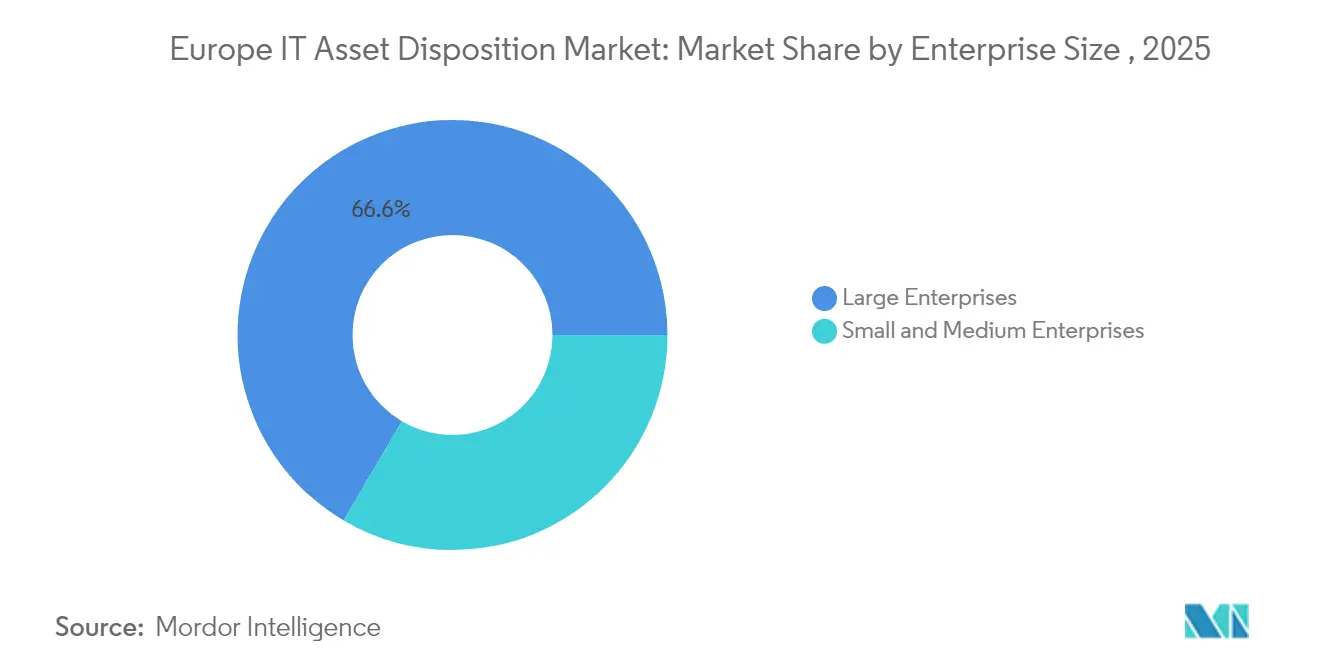
SMEs Become the Next WaveLarge Enterprises controlled 66.55% of spending in 2025, driven by multi-year global refresh plans and complex compliance files that only full-service providers can satisfy. These customers demand integration with asset-management platforms, real-time dashboards for carbon savings, and certificates of destruction within 24 hours of pick-up. Small and Medium Enterprises, however, offer the steepest trajectory at 14.92% CAGR. Greater cloud adoption reduces server counts but speeds up laptop renewal cycles. Rising cyber-risk awareness and CSRD spill-over provisions push SMEs to abandon informal disposal in favour of professional ITAD.
Triangle Ecycling’s focus on biotech firms in North Carolina, although US-based, illustrates how niche specialists package education, social-impact and security messages to resonate with mid-market buyers. European providers replicate this with subscription-style bundles, mobile collection days, and shared-drop programmes at coworking hubs. Digital quoting portals cut transaction cost per asset, unlocking scale even when pick-up volumes stay modest. As regulatory tightens, the Europe IT Asset Disposition market size for SMEs will amplify, encouraging regional providers to standardise offerings and thus narrow the service-quality gap with large enterprise contracts.
By End-User Vertical:
Healthcare Outpaces AllIT and Telecom retained 32.21% of revenue in 2025, a logical result of chronic hardware churn, data-security standards, and high unit counts across fixed and mobile assets. Vertical-specific contracts include rigorous chain-of-custody and on-site shredding for failed drives. Healthcare, with a 13.92% CAGR outlook, rises on the back of connected diagnostic equipment, electronic health-record mandates, and bio-pharma digitalisation. Disposal must align with both HITECH and GDPR, lifting the barrier to entry and sustaining price premiums.
BFSI institutions require traceable serial-number reconciliation and multi-factor sign-off: Iron Mountain’s specialised financial-services program is emblematic ironmountain. Manufacturing injects industrial IoT nodes into the waste stream, demanding disassembly of sensors and controllers in line with hazardous-substances rules. Government plugs in as a steady, policy-driven buyer, while newer segments such as renewable-energy operators begin issuing tenders for inverter and battery disposal. Each sector adds its nuances, but all enlarge the addressable Europe IT Asset Disposition market size and raise expectations around carbon-impact accounting.
Geography Analysis
United Kingdom IT Asset Disposition Market
The United Kingdom contributed 21.53% of 2025 revenue, giving it the largest slice of the Europe IT Asset Disposition market. Long-established Waste Electrical and Electronic Equipment (WEEE) frameworks, mature sustainability reporting cultures, and dense clusters of multinational headquarters all converge to create high-value disposal contracts. London’s financial hub demands certified, same-day data destruction, and the nation’s early adoption of circular-economy targets underpins robust take-back volumes. Although Brexit triggered separate filing processes, functional alignment with EU environmental norms ensured cross-border equipment flows continued without material friction.
Broader European Markets
Germany follows as the second-largest contributor, driven by strict environmental legislation and one of the continent’s highest per-capita technology footprints. With strong manufacturing and automotive bases, the country produces both office-IT and industrial-control waste streams that require specialist treatment. Econocom’s investment in bb-net demonstrates how strategic consolidation seeks to secure refurbishment talent and local customer relationships inside Europe’s biggest economy econocom. France ranks closely behind, buoyed by vigorous enforcement of circular-economy regulations, targeted public funding for recycling infrastructure, and an enterprise culture already steeped in CSR audits. Poland stands out for pace, predicted to clock a 12.88% CAGR to 2031. Fast industrial expansion, rising household incomes, and EU-level co-financing widened the flow of used devices and encouraged foreign players to install processing lines locally. Nordic markets Sweden, Denmark, Finland show high per-capita electronics consumption and regulatory clarity, supporting premium pricing for carbon-scored disposal. The Netherlands, frequently a European logistics gateway, hosts specialised data-centre de-commissioning firms attracted by Amsterdam’s cloud density. Southern European markets such as Italy and Spain trail the North on enforcement consistency but display improving awareness as CSRD reporting obligations ripple down supply chains. Eastern European states, except Poland, continue building formal collection networks, creating white-space for operators willing to partner with municipal agencies.
Regulatory Landscape
Europe IT asset disposition (ITAD) activity is shaped by the EU Waste Electrical and Electronic Equipment (WEEE) Directive 2012/19/EU and its 2024 amendment, Directive (EU) 2024/884. Under Directive (EU) 2024/884, Member States must bring into force national provisions by 9 October 2025, and the European Commission is mandated to assess whether a full revision of the WEEE Directive is needed by 31 December 2026. This creates a visible compliance timeline that increases demand for documented collection, treatment, and reporting.
Circular-economy and disclosure rules further tighten requirements around traceability and end-of-life outcomes. The Ecodesign for Sustainable Products Regulation (ESPR) entered into force in July 2024 as an enabling framework for more circular product rules and future data transparency tools, while the Corporate Sustainability Reporting Directive (CSRD) has already pushed audited, verifiable ITAD reporting into enterprise procurement. Packaging-related obligations also matter for logistics-intensive ITAD operations, as the new Regulation on Packaging Waste (PPWR) entered into force in February 2025, increasing attention to packaging minimization and reporting across reverse-logistics flows.
Competitive Landscape
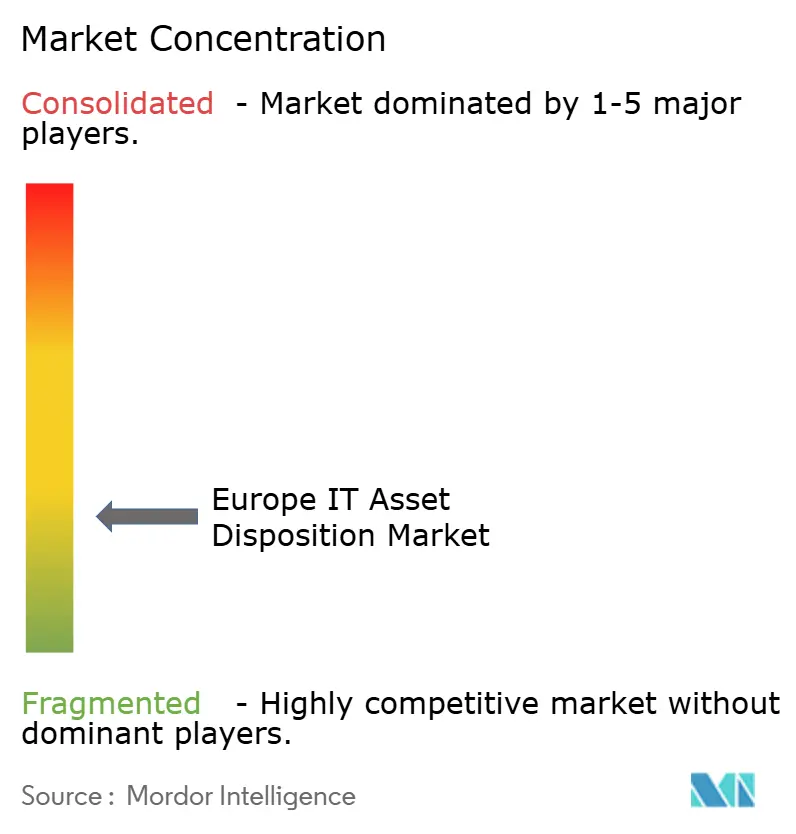
The Europe IT Asset Disposition market remains moderately fragmented. Global multinationals such as Iron Mountain capitalise on integrated shredding, warehousing, and global compliance frameworks to win multi-country contracts. Regional specialists like TES lean on niche strengths in data-centre de-installation, whereas Foxway differentiates through Device-as-a-Service and consumer-grade web storefronts for refurbished stock.
Consolidation accelerates as private equity hunts scalable circular-economy plays. The 2024-2025 window saw Econocom fold bb-net into its portfolio to gain refurbishment know-how and German coverage. Similar deals are expected in Spain and Italy, where family-owned recyclers seek capital for automation. Technology investments provide another competitive lever: AI vision systems score cosmetic grade in seconds, IoT tags give real-time chain-of-custody, and blockchain pilots test immutable destruction logs. Providers are able to finance equipment upgrades, therefore raising operational efficiency and preserving margin in the face of rising logistics costs.
Strategically, firms strive for vertical integration. OEM take-back partnerships guarantee inbound volume while resale channels capture consumer margins, locking in profitability. Some players explore component harvesting for critical minerals, expanding downstream into smelter partnerships. Competition intensifies in healthcare and BFSI niches where compliance-driven premium pricing attracts newcomers with sector-specific certifications. Despite this, barriers arise from the capital cost of shredders, licences and insurance, keeping entry thresholds significant and sustaining disciplined pricing across the Europe IT Asset Disposition market.
Europe IT Asset Disposition Industry Leaders
-
Flex IT
-
Liquid Technology
-
TecDis
-
Iron Mountain
-
Foxway
- *Disclaimer: Major Players sorted in no particular order
Europe IT Asset Disposition Market Companies Covered in this Report
- Iron Mountain
- Foxway
- Sims Lifecycle Services
- Econocom Group
- TES (SK ecoplant)
- Dell Technologies Asset Recovery
- HPE Asset Upcycling
- IBM Global Asset Recovery Services
- Flex IT
- Wisetek
- BNP Paribas 3 Step IT
- Liquid Technology
- CentricsIT
- CNE Direct
- TecDis Network
- Sims Recycling Solutions
- Ingram Micro ITAD
- Arrow Electronics
- Dynamic Lifecycle Innovations
- Sipi Asset Recovery
Market Opportunities and Future Outlook
Enterprise procurement is shifting from ad hoc device disposal toward auditable, circular-economy-aligned programs. This opens whitespace for ITAD providers that can bundle chain-of-custody, data sanitization, and reporting into a single workflow. CSRD obligations (in effect from 2024) are pushing larger companies to demand proof-grade documentation for end-of-life outcomes and Scope 3 reporting, which tends to favor operators that can industrialize serial-level tracking, standardize certificates, and deliver services across multiple countries rather than relying on country-by-country subcontracting.
A second opportunity is developing around cross-border hubs and secondary-market optimization tied to EU circular-economy policy direction. European policy work on a Circular Economy Act (tracked at EU level in 2026) and the Commission mandate to assess the need for a full WEEE revision by 31 December 2026 support investment cases in higher-yield refurbishment, parts harvesting, and secondary raw materials recovery. Activity also concentrates around logistics and cloud-density corridors (notably the Netherlands, Germany, and Belgium), strengthening demand for specialized data-center decommissioning and secure reverse logistics where proximity helps control transport cost and supports tighter documentation and handling expectations from regulated buyers.
Recent Industry Developments in Europe IT Asset Disposition Market
- April 2026: Flex IT announced Sales Leader status in the HP Amplify Impact Program with a 90% sustainability score. The announcement reinforces alignment with the HP ITAD ecosystem and strengthens enterprise-hardware remarketing potential in Europe ITAD.
- January 2026: Liquid Technology launched a new corporate website to mark its 25th anniversary. The launch expands branding and digital presence in Europe ITAD, and the initiative improves visibility and perceived scale in regional refurbishing and remarketing services.
- February 2025: Econocom Group finalised 80% acquisition of bb-net, adding EUR 17 million in annual refurbishment revenue. The consolidation expands cross-border refurbishing footprint and scale, influencing regional competitive dynamics.
Europe IT Asset Disposition Market Report Scope and Research Methodology
Market Definition and Coverage
For this report, the market includes revenues earned in Europe from organized IT asset disposition services, covering the collection, secure handling, data sanitization, refurbishment, resale, and compliant recycling of retired enterprise IT equipment.
Scope exclusions: This sizing excludes informal peer-to-peer resale and the standalone value of recovered raw materials when sold outside an ITAD service contract.
Segments Covered in This Report
- By Service Type
- Data Sanitization / Destruction
- Remarketing and Value Recovery
- Reverse Logistics and De-installation
- Lease-Return / End-of-Life Mgmt.
- Others
- By Asset Type
- Computers and Laptops
- Mobile Devices
- Servers and Storage
- Others
- By Enterprise Size
- Large Enterprises
- Small and Medium Enterprises
- By End-User Vertical
- BFSI
- IT and Telecom
- Healthcare
- Government and Public Institutions
- Manufacturing
- Others
- By Country
- United Kingdom
- Germany
- France
- Italy
- Spain
- Netherlands
- Nordics (Sweden, Denmark, Finland)
- Poland
- Russia
- Rest of Europe
Data Sources, Market Sizing, and Validation
Desk Research
Desk work starts by building the addressable flow of end-of-life IT equipment and the policy context that pushes compliant disposition. Public sources, such as Eurostat waste and ICT statistics, the European Environment Agency publications, and European Commission pages for WEEE and related circular economy rules, help anchor device retirement pressure and compliance requirements.
We also use supporting information from sources such as national statistical offices and customs or trade releases for electronics movement where relevant, plus technical and standards bodies that shape data destruction and reporting expectations. Company filings, investor presentations, and reputable press are reviewed to understand service mix shifts (for example, reuse versus recycling) and pricing direction. Selected paid subscriptions for company financials, patents, and shipment-level trade checks are used to fill gaps where public data is not detailed enough. These desk sources are illustrative only, and many additional references are used during data collection, validation, and clarification.
Primary Interviews and Surveys
Primary work is used to test the real service boundary and the revenue drivers that are not fully visible in public data, including typical contract bundles, average recovery values, and how often enterprises refresh endpoints and servers. We speak with service providers, reverse logistics partners, recyclers, large enterprise users, and channel participants across major European markets so assumptions reflect on-the-ground practices rather than only policy intent.
Distribution of primary research fieldwork respondents
| Company type | Respondent position |
|---|---|
| Top tier: 27% | CXOs: 15% |
| Mid tier: 57% | Functional/Unit leaders: 29% |
| Smaller Players: 16% | Managers: 56% |
Market-Sizing & Forecasting
Sizing starts with a top-down demand pool build where enterprise installed base, refresh cycles, and retirement volumes are translated into serviceable ITAD throughput, and then converted to revenue using blended pricing by service bundle. To keep it grounded, we apply country-level differences in outsourcing penetration and compliance intensity before totals are rolled up to the European level.
The model is stress-tested with selective bottom-up checks, such as sampling provider revenue disclosures, using channel checks on typical fees for data sanitization and logistics, and validating reuse versus recycle splits through interviews. Key inputs that most influence the totals include device mix (endpoints versus servers and storage), average residual value capture, share of assets routed to certified processing, turnaround time effects on remarketing price, and the pace of enterprise refresh tied to security and energy efficiency needs.
For forecasting, we mainly use scenario analysis supported by a lighter multivariate regression on drivers like enterprise IT spending direction, device replacement rates, and regulatory reporting pull-through. Where bottom-up visibility is limited in smaller countries, we apply proxy penetration rates from comparable markets and then re-check the implied per-device revenue with primary feedback.
Data Validation & Update Cycle
Validation is done through triangulation across model outputs, interview feedback, and independent signals such as reported e-waste collection trends, enterprise hardware refresh commentary, and disclosed revenue direction from service providers. If any country result looks unusual, assumptions are revisited, the calculation trail is rechecked, and follow-up calls are triggered to confirm whether the shift is real or caused by a modeling mismatch.
Before sign-off, outputs go through multi-step analyst reviews that focus on variance checks by country and by service bundle, followed by consistency checks on implied pricing and throughput. Reports are refreshed annually, and interim updates are made when a material event changes the demand pool or pricing. A final pre-delivery pass is completed so clients receive the latest view.
Mordor Intelligence's Europe IT Asset Disposition Market Size Compared Against Other Published Estimates
Published estimates for Europe can vary a lot because the service boundary is not always applied the same way, and because reuse value, recycling-only revenue, and logistics are sometimes bundled differently. Differences also show up when one study uses a single Europe-wide average price, while another uses country mixes that change the blended revenue level.
By tracking service-bundle attachment rates and refreshing country mix assumptions annually, Mordor Intelligence keeps the Europe ITAD total tied to retirements that move through formal disposition workflows, rather than counting adjacent electronics recycling activity that does not include IT asset lifecycle services. The spread is also affected by whether server and data center equipment is fully included, how residual value is netted versus grossed, and the exchange rate timing used for multi-country rollups.
Benchmark comparison
| Source | Market Size | Gaps in Research Methodology |
|---|---|---|
| Mordor Intelligence | USD 7.21 B (2025) | |
| Regional Consultancy A | USD 4.50 B (2025) | Often treated as recycling-led e-waste processing for IT equipment, with limited inclusion of remarketing value and lower assumed outsourcing penetration in several countries. |
| Global Advisory B | USD 3.80 B (2026) | Uses a later start year with conservative pricing per device and may exclude server and storage disposition revenues, which pulls down the blended European total. |
The comparison points to three practical drivers behind the differences, which are boundary choice, how resale value is handled, and whether country-level mixes are modeled or averaged. Our approach stays repeatable because each step is linked back to device flows, service attachment, and pricing checks that can be reviewed and updated as conditions change.
Key Questions Answered in the Report
What is driving the rapid growth of the Europe IT Asset Disposition market through 2031?
Mandatory EU energy-efficiency labels for PCs, CSRD-driven audit requirements, cloud data-centre de-commissioning, and bundled Device-as-a-Service contracts are combining to lift asset-retirement volumes and accelerate market expansion at a 12.86% CAGR.
Which service line currently generates the most revenue?
Remarketing and Value Recovery leads with 37.12% of 2025 revenue, reflecting enterprise focus on residual-value capture and compliance-aligned resale channels.
Why are Mobile Devices forecast to outpace other asset types?
Smartphone refresh cycles are shortening, enterprise mobile fleets are expanding, and high secondary-market demand drives a 14.35% CAGR for Mobile Devices through 2031.
How important are Small and Medium Enterprises to future market growth?
SMEs show the fastest spending increase at 14.92% CAGR because rising cyber-security awareness and CSRD spill-over rules are pushing smaller firms toward professional ITAD services.
Which European country is expected to grow quickest?
Poland is projected to advance at 12.88% CAGR due to rapid economic development, technology-manufacturing clusters, and EU-funded recycling infrastructure build-out.
What competitive factors matter most when selecting an ITAD provider?
Enterprises typically weigh proof of secure data destruction, carbon-impact reporting, geographic coverage, and the provider’s ability to remarket devices to maximise residual value.