
Europe IP Telephony And Unified Communications As-a-service Market Size and Share
Market Overview
| Study Period | 2020 - 2031 |
|---|---|
| Forecast Data Period | 2026 - 2031 |
| Base Year Market Size (2025) | USD 26.01 Billion |
| Market Size (2026) | USD 28.18 Billion |
| Market Size (2031) | USD 42.08 Billion |
| Growth Rate (2026 - 2031) | 8.35 % |
| Market Concentration | Medium |
Major Players *Disclaimer: Major Players sorted in no particular order Image © Mordor Intelligence. Reuse requires attribution under CC BY 4.0. | |
Europe IP Telephony And Unified Communications As-a-service Market Analysis by Mordor Intelligence
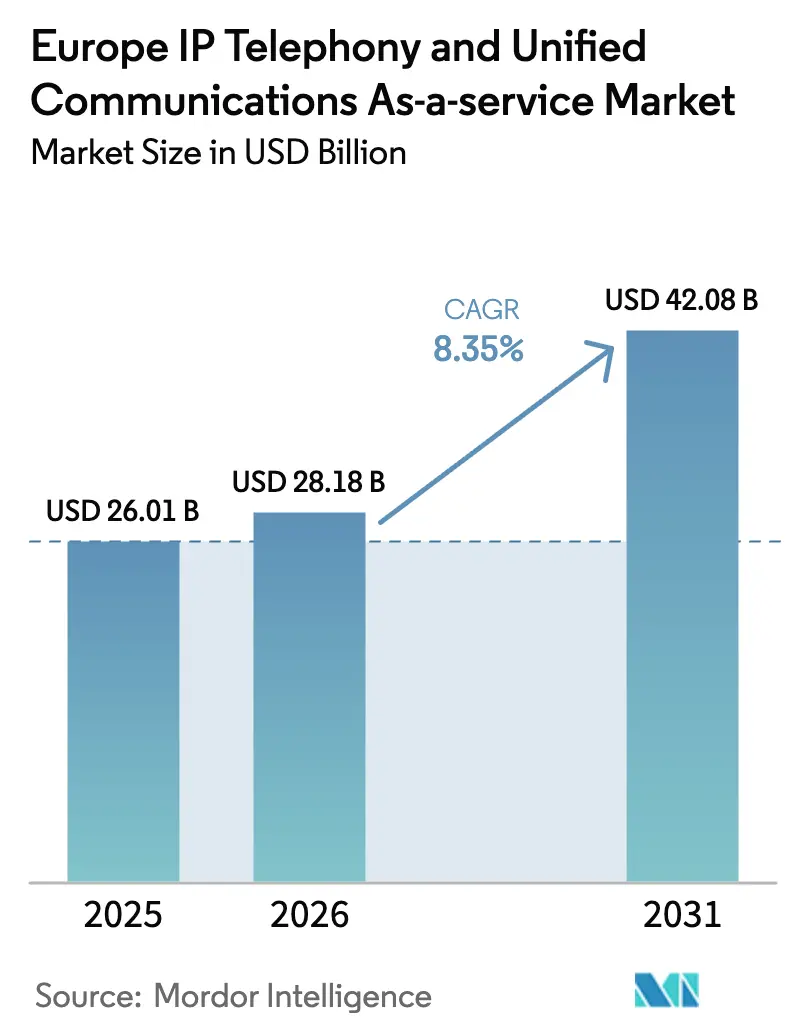
The Europe IP Telephony and Unified Communications As-A-Service market size in 2026 is estimated at USD 28.18 billion, growing from 2025 value of USD 26.01 billion with 2031 projections showing USD 42.08 billion, growing at 8.35% CAGR over 2026-2031. The growth reflects accelerated digital transformation across enterprises, stronger regulatory alignment under the European Electronic Communications Code, and mandatory shifts from ISDN to all-IP networks. Rapid 5G deployments by major operators are enabling sub-10 millisecond latency for UCaaS workloads, while the EU Data Act encourages multi-vendor portability that weakens supplier lock-in. Hybrid work policies have become permanent for many organizations, driving the need for cloud-native communication suites that unify voice, video, and messaging. Public subsidies that offset subscription costs for SMEs and sector-specific integration requirements in healthcare and manufacturing further widen the addressable base for service providers. Competition remains moderate as global hyperscale vendors face region-specific specialists with deep regulatory expertise, fueling both innovation and pricing pressure.
Key Report Takeaways
- By solution, software captured 61.45% of revenue in 2025, while hardware trailed due to the shift toward API-driven platforms.
- By type, hosted IP PBX held a 41.92% share in 2025, whereas CPaaS is projected to expand at an 8.58% CAGR through 2031.
- By organization size, large enterprises contributed 53.05% of 2025 revenue, but SMEs are advancing at a 10.05% CAGR.
- By end user, the IT and telecom segment led with a 30.94% share in 2025; the healthcare segment is forecast to grow at an 8.42% CAGR to 2031.
- By geography, the United Kingdom commanded a 22.05% share in 2025, while Spain is set to record an 8.46% CAGR during the outlook period.
Note: Market size and forecast figures in this report are generated using Mordor Intelligence’s proprietary estimation framework, updated with the latest available data and insights as of 2026.
Market Trends and Insights
Drivers Impact Analysis of Europe IP Telephony And Unified Communications As-a-service Market*
| Driver | (~) % Impact on CAGR Forecast | Geographic Relevance | Impact Timeline |
|---|---|---|---|
| Accelerated 5G rollouts enabling low latency UCaaS | +1.8% | EU-wide, strongest in Germany, UK, Netherlands | Medium term (2-4 years) |
| Shift toward hybrid work policies across Europe | +2.1% | Pan-European, highest in Nordic and Benelux | Short term (≤ 2 years) |
| Rapid migration from ISDN to all-IP networks | +1.5% | Germany, UK, France, spillover to Eastern Europe | Medium term (2-4 years) |
| Growing SMB demand for OpEx friendly subscriptions | +1.2% | Southern and Eastern Europe | Long term (≥ 4 years) |
| Integration with vertical specific SaaS workflows | +0.9% | Western Europe core | Long term (≥ 4 years) |
| Edge computing adoption for real time voice | +0.9% | Major metropolitan clusters | Long term (≥ 4 years) |
| Source: Mordor Intelligence | |||
Accelerated 5G Rollouts Enabling Low-Latency UCaaS
Standalone 5G coverage now blankets most metropolitan areas in Germany and the UK, giving enterprises consistent sub-10 millisecond latency that rivals circuit-switched voice.[1] Operators have placed voice processing functions at the network edge through Network Function Virtualization (NFV), which reduces dependence on centralized data centers and improves call quality in contact center scenarios. These architecture gains support real-time capabilities such as language translation and AI call analytics. The shift differentiates European providers from global hyperscalers in terms of latency-sensitive workloads and accelerates the migration from legacy PBX systems.
Shift Toward Hybrid Work Policies Across Europe
Post-pandemic labor regulations in France and the Netherlands now codify flexible work rights, cementing long-term demand for mobile-first collaboration suites.[2] Nordic employers report high employee satisfaction when cloud tools replace traditional hardware PBX systems, leading to broader rollouts of presence, messaging, and video functions. A policy emphasis on work-life balance drives the uptake of AI-powered meeting summaries that limit after-hours interactions. Public-sector agencies follow the European Commission’s own digital workplace guidelines, ensuring steady demand from government accounts.
Rapid Migration From ISDN to All-IP Networks
Germany completed its nationwide ISDN shutdown in December 2024, forcing businesses to adopt IP voice or risk service loss.[3] All-IP mandates remove technical excuses for retaining on-premises PBX and expand bandwidth for 4K video conferencing. Regulatory obligations for IP-based emergency calling under the Electronic Communications Code further encourage organizations to adopt cloud suites with built-in E911 compliance. SMEs benefit most because they avoid capital outlays associated with ISDN hardware maintenance.
Growing SMB Demand For OpEx-Friendly Subscription Models
SMEs value predictable monthly costs and reduced IT overhead, a preference reflected in a 73% subscription bias captured by the European Investment Bank survey. Spain’s Kit Digital scheme reimburses up to EUR 12,000 (USD 13,560) in UCaaS expenses, lifting penetration among previously price-sensitive firms. Similar incentive programs in Poland and the Czech Republic extend the model to Eastern Europe. Subscription models simplify upgrades and enable SMEs to scale licenses in response to seasonal workload changes, thereby strengthening vendor lock-in while also stabilizing cash flows.
Restraints Impact Analysis of Europe IP Telephony And Unified Communications As-a-service Market*
| Restraint | (~) % Impact on CAGR Forecast | Geographic Relevance | Impact Timeline |
|---|---|---|---|
| Fragmented cross-border data sovereignty regulations | -1.4% | EU-wide, strong effect on multinational deployments | Medium term (2-4 years) |
| Heightened cyber attack surface in cloud telephony | -0.8% | Northern Europe and financial clusters | Short term (≤ 2 years) |
| Vendor lock-in concerns hindering contracts | -0.6% | Western Europe enterprise segment | Medium term (2-4 years) |
| Skills gap in SIP and VoIP network management | -0.7% | Eastern Europe rural regions | Long term (≥ 4 years) |
| Source: Mordor Intelligence | |||
Fragmented Cross-Border Data-Sovereignty Regulations
Despite the GDPR, France, Italy, and Germany maintain parallel localization frameworks that require UCaaS vendors to duplicate infrastructure, thereby increasing compliance costs and complicating pan-European rollouts. Multinational firms must map traffic flows to each jurisdiction and maintain separate disaster recovery zones, limiting economies of scale. The proposed Data Governance Act aims for harmonization, yet enforcement is not expected to be implemented until 2027, leaving uncertainty over future platform architecture.
Heightened Cyber-Attack Surface in Cloud Telephony
ENISA recorded telecommunications as a top ransomware target between July 2023 and June 2024, noting the 3CX supply-chain compromise that infiltrated thousands of European endpoints. The incident revealed systemic risk inherent in concentrated UCaaS software stacks. Swiss cybersecurity authorities logged a surge in voice-based fraud, prompting enterprises to bolster endpoint security. Security fears slow adoption among risk-averse sectors such as finance, despite clear cost benefits.
*Our forecasts treat driver/restraint impacts as directional, not additive. The impact forecasts reflect baseline growth, mix effects, and variable interactions.
Europe IP Telephony And Unified Communications As-a-service Market Segment Analysis
By Solution:
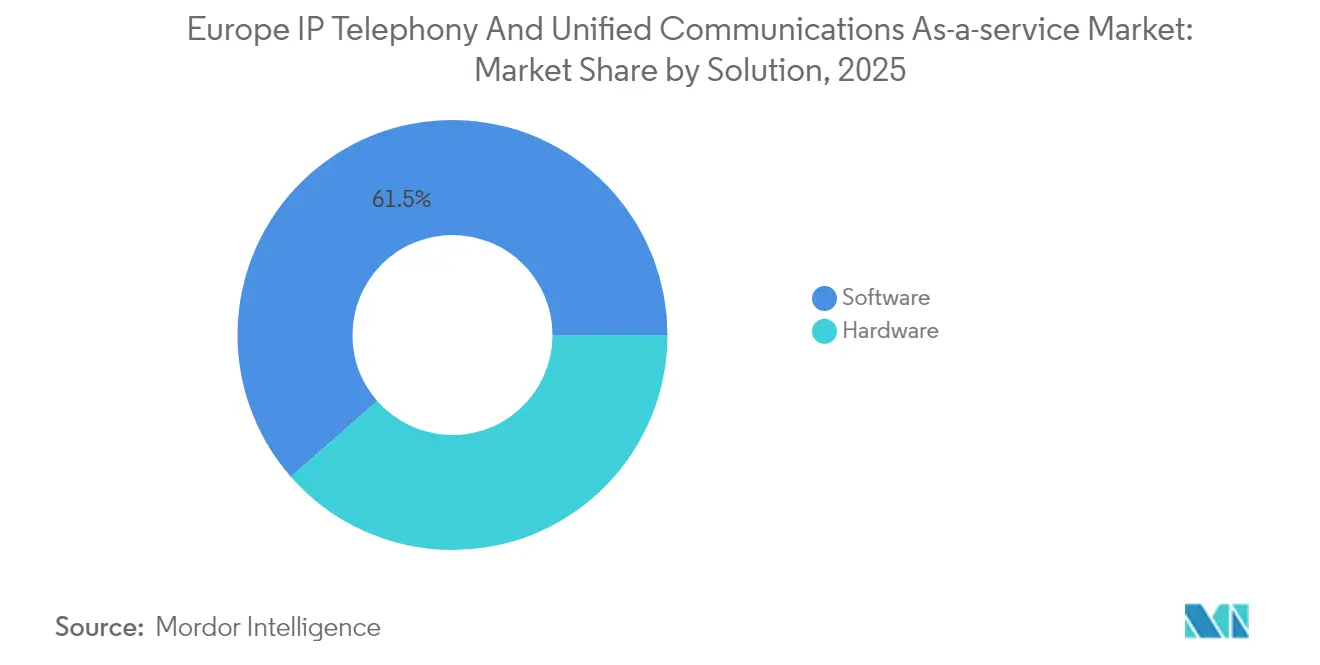
Software Dominance Accelerates IntegrationSoftware solutions held 61.45% of the Europe IP Telephony and Unified Communications As-A-Service market share in 2025 due to demand for scalable cloud-native platforms that embed into existing workflows. The category is projected to post a 10.03% CAGR to 2031 as enterprises favor API orchestration over hardware refresh cycles. Call control and PBX software benefit directly from IP emergency service mandates, while unified messaging and team collaboration tools ride the wave of established hybrid work practices. Vendors integrate AI-based transcription and sentiment analytics, boosting value without additional hardware.
Hardware remains essential for sectors that need physical endpoints with certified security, including defense and utilities. IP desk phones continue to serve trading floors that require tactile interfaces and a fixed quality of service. VoIP gateways ease transitional scenarios during the ISDN phase-out, although their relevance declines as fiber reaches regional hubs. Video endpoints are pivoting toward software-defined meeting rooms, but continue to prioritize where guaranteed optics matter. Overall, hardware growth lags behind software, yet it acts as a compliance safeguard.

By Type:
Hosted IP PBX Leads While CPaaS EmergesHosted IP PBX contributed 41.92% of 2025 revenue, reflecting its role as a direct cloud replacement for on-premises legacy systems. The model delivers familiar PBX features with cloud scalability, easing compliance with emergency calling standards. Integrated SIP trunking remains a backbone service but loses market share to comprehensive UCaaS suites that include video and messaging.
Communication Platform as a Service (CPaaS), although smaller, is the fastest-growing type, with an 8.58% CAGR through 2031. Developers utilize CPaaS APIs to integrate voice and video capabilities into customer applications, thereby eliminating the need for standalone interfaces and promoting vertical innovation. Managed IP PBX appeals to enterprises that want operational outsourcing but still retain on-site control for sensitive workflows. Cloud call control offers a middle path by decoupling signaling from hardware, allowing firms to preserve their sunk investments. Together, these types illustrate a migration continuum toward programmable communications that underpin digital transformation.
By Organization Size:
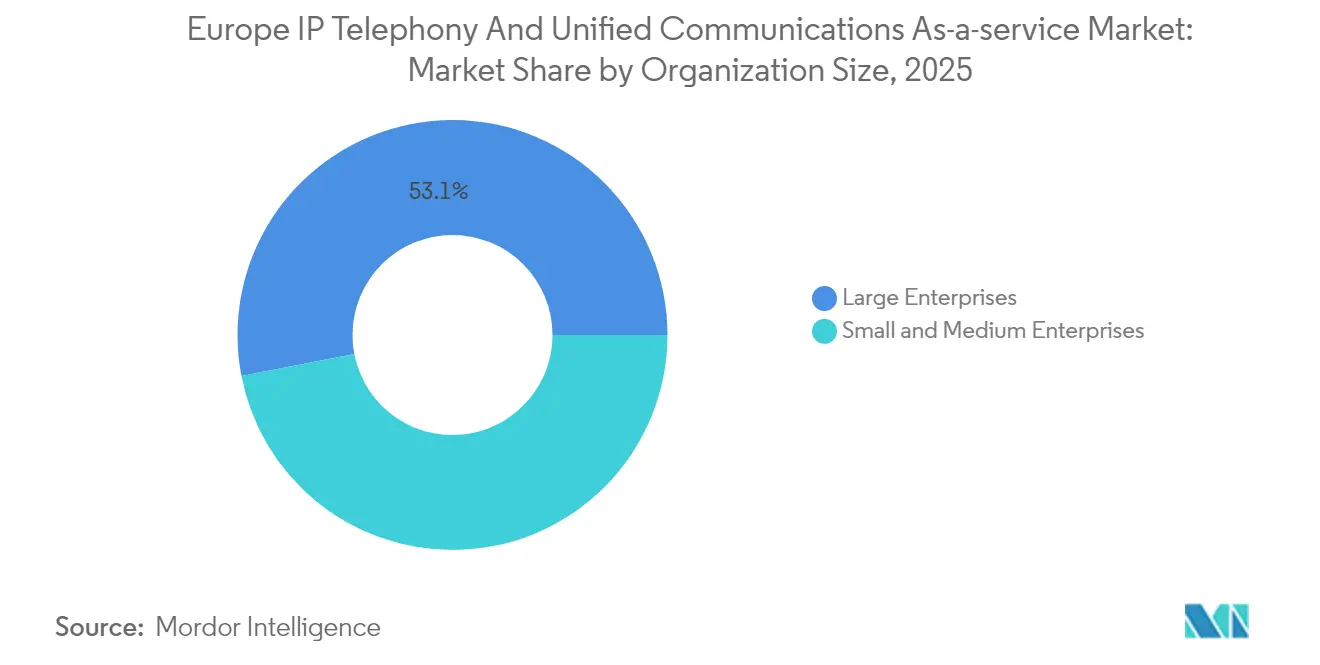
SME Momentum Outpaces Enterprise AdoptionLarge enterprises owned 53.05% of spend in 2025 through multi-site deployments that integrate contact centers, analytics, and compliance modules. They prioritize advanced encryption, granular role-based access, and direct peering relationships with carriers. Yet SME growth, at a 10.05% CAGR, is overtaking as smaller firms exploit subsidy programs such as Spain’s Kit Digital to offset adoption costs.
SMEs value ease of use, mobile accessibility, and predictable operating expenses. Providers respond with packaged offers that bundle broadband, security, and UCaaS under one invoice. The Europe IP Telephony and Unified Communications as-a-Service market size for SMEs is slated to rise sharply as high fiber coverage lowers latency and supports video-heavy workflows. Incentives in Poland and the Czech Republic replicate Spain’s success, suggesting sustained demand over the forecast window.
By End User:
Healthcare Drives Fastest GrowthIT and telecom firms led the adoption at a 30.94% share in 2025, as they require collaboration suites for distributed software teams. Banking and insurance organizations follow closely due to the need for stringent audit trails and the requirement for omnichannel customer engagement.
Healthcare is the fastest-growing vertical, with an 8.42% CAGR to 2031, spurred by the EU Digital Health Strategy mandates that facilitate cross-border teleconsultations. Hospitals integrate UCaaS with electronic health records and IoT medical devices, while compliant cloud architectures address patient data privacy. Manufacturing adopts UCaaS to link shop floor sensors with enterprise resource planning data, supporting Industry 4.0 goals. Retail leverages programmable APIs for click-to-call in mobile apps, creating frictionless omnichannel experiences that raise customer satisfaction scores.
Geography Analysis
United Kingdom IP Telephony and Unified Communications As-a-service Market
The United Kingdom held a 22.05% share in 2025, leveraging early fiber rollouts and mature cloud usage patterns. BT Group completed national IP migration, and Vodafone extended 5G to half the population, enabling edge analytics and AI-driven voice services. Growth expectations remain steady, although Brexit-related compliance divergence adds costs for providers serving EU clients.
Europe IP Telephony and Unified Communications As-a-service Market
Germany is the second-largest market, thanks to the completion of ISDN shutdowns and strong industrial demand. Enterprises favor hybrid topologies that combine on-site gateways with cloud call control to meet data residency requirements. France is growing steadily due to support for its sovereign cloud policy, although stringent localization requirements raise entry barriers for foreign platforms. Spain delivers the fastest CAGR at 8.46% due to the España Digital 2026 roadmap and generous SME subsidies that stimulate cloud adoption. Italy accelerates recovery fund allocations targeting public service digitalization. The Netherlands leverages dense data center clusters for low-latency UCaaS, while Nordic countries exhibit the highest per-capita usage and serve as test beds for AI features. Eastern European states benefit from EU infrastructure funds, moving quickly from low baseline penetration to modern cloud communication suites.
Regulatory Landscape
The Europe IP Telephony and Unified Communications as-a-service market operates under the EU electronic communications framework, led by the European Electronic Communications Code (EECC) and supervised through national regulatory authorities with coordination from BEREC. A key forward-looking regulatory milestone is the European Commission proposal for a Digital Networks Act (published 21 January 2026), intended to consolidate multiple instruments into a single directly applicable regulation and reduce cross-border fragmentation for providers delivering IP voice, UCaaS, and related connectivity-enabled services.
Regulatory scrutiny also extends to platform conduct and bundling practices that shape UCaaS competition. The European Commission published a review report on the Digital Markets Act on 28 April 2026, reinforcing continuing attention to gatekeeper behavior in digital markets that can affect packaging, interoperability, and switching dynamics for enterprise communications and collaboration suites.
Value Chain Analysis
The value chain starts with core connectivity and numbering (fixed and mobile operators), then moves through SIP trunking and interconnect, UCaaS and hosted IP PBX platforms, CPaaS API layers, and endpoint ecosystems (soft clients and certified devices). Distribution is channel-led in Europe, with telecom operators, systems integrators, and managed service providers packaging UCaaS with broadband, mobile, and security into a single contract, while hyperscalers and large software suites pull demand through established productivity tenants.
Recent moves show operators and UCaaS specialists tightening platform and compliance linkages within the chain. Gamma Communications launched International Operator Connect in February 2026 so channel partners can deliver Microsoft Teams Phone services across 25 markets, with Gamma taking on regulatory and compliance responsibilities. NFON also reported exceeding 100,000 active users for its Digital Phone solution among O2 Telefónica Deutschland customers (as of end-2025, disclosed March 2026). On the hosting and trust layer, Orange Business launched Live Collaboration in March 2026 on its Cloud Avenue SecNum environment in France, highlighting the role of sovereign-cloud infrastructure for regulated customers and public-sector procurement.
Competitive Landscape
The Europe IP Telephony and Unified Communications as-a-Service market exhibits moderate fragmentation, as global suites compete with local specialists. Microsoft Teams dominates through existing Office 365 tenants, yet faces antitrust scrutiny that could lead to unbundling pricing in the future. Cisco Webex leverages extensive channel partners, while RingCentral builds its European footprint via operator alliances, such as Vodafone’s multi-country launch. Zoom partners with Mitel to offer hybrid packages targeting organizations with significant PBX investments.
Regional players such as NFON, Wildix, and Gamma Communications harness regulatory insight and language localization to win mid-market accounts. Gamma’s 2024 purchase of Placetel extends its reach in Germany and adds Cisco Webex capabilities. Telecom operators bundle UCaaS with connectivity, fostering integrated offers that simplify procurement. CPaaS vendors, such as Twilio and Vonage, enter through developer channels, encouraging custom workflows that bypass traditional monolithic suites. Mergers and strategic alliances are expected to continue as vendors seek to scale, achieve broader geographic reach, and drive AI innovation.
Europe IP Telephony And Unified Communications As-a-service Industry Leaders
-
Microsoft Corporation
-
Cisco Systems Inc.
-
RingCentral Inc.
-
8x8 Inc.
-
Vonage Holdings Corp.
- *Disclaimer: Major Players sorted in no particular order

Europe IP Telephony And Unified Communications As-a-service Market Companies Covered in this Report
- Microsoft Corporation
- Cisco Systems Inc.
- RingCentral Inc.
- 8x8 Inc.
- Vonage Holdings Corp.
- Zoom Video Communications Inc.
- Avaya Holdings Corp.
- Mitel Networks Corporation
- Alcatel-Lucent Enterprise International SAS
- Unify Software and Solutions GmbH and Co. KG
- Wildix Srl
- NFON AG
- Vodafone Group Plc
- BT Group plc
- Orange Business Services SA
- Telefonica SA
- Intermedia Cloud Communications Inc.
- Freshworks Inc.
- Dialpad Inc.
- Ooma Inc.
- Grandstream Networks Inc.
- Ascom Holding AG
- NEC Corporation
- Panasonic Corporation
- Ziff Davis Inc.
Read Analysis of Europe IP Telephony And Unified Communications As-a-service Companies
Market Opportunities and Future Outlook
Regulated and high-volume service environments create whitespace for UCaaS providers that combine compliance-grade hosting with contact center and workflow integration. In January 2026, AOK Bayern deployed NiCE CXone on the EU Sovereign Cloud to modernize contact center operations serving 4.5 million members, showing active demand for cloud customer engagement platforms aligned with European data residency and security requirements. This supports opportunities for vendors that package UCaaS with CCaaS, analytics, and vertical integrations in healthcare and other compliance-intensive sectors.
Large-site legacy migration and infrastructure modernization programs also create room for cloud IP telephony platforms that can handle complex routing and multi-site transitions. Hub One migrated 7,000 analog lines at Paris Charles de Gaulle and Paris Orly airports to the Enreach UP cloud-based IP architecture in June 2026, and selected Ribbon Communications PSX as its core voice traffic routing platform in July 2026, reflecting enterprise-scale appetite for policy-based routing and modernization beyond standard hosted PBX. Alongside these programs, EU digital infrastructure targets and reported 2024 coverage levels (5G household coverage at about 94% and FTTP at 69.2%) expand the addressable base for video- and API-heavy UCaaS deployments where access quality and latency constraints previously limited adoption.
Recent Industry Developments in Europe IP Telephony And Unified Communications As-a-service Market
- June 2026: Momentum expanded its Microsoft Teams Operator Connect service to 27 countries across Europe. The update strengthens carrier-grade PSTN connectivity options for Teams-centric customers and increases competitive pressure on incumbent UCaaS voice bundles by making multi-country rollouts simpler through an operator-led model.
- June 2025: 8x8 doubled its Operator Connect global offerings, extending native integration with Microsoft Teams across 50 countries, including the Czech Republic. The broader footprint supports multinational procurement of Teams calling connectivity and raises the bar for regional providers competing on geographic coverage and deployment speed.
- July 2024: Vodafone Business expanded its global communications offer to include RingCentral RingCX as a native contact center solution. Adding CCaaS to the operator-led UC portfolio pushes bundled communications and customer experience packages deeper into enterprise accounts, reinforcing the convergence of UCaaS and contact center buying cycles.
Europe IP Telephony And Unified Communications As-a-service Market Report Scope and Research Methodology
Market Definition and Coverage
This market covers revenue generated in Europe from cloud-delivered business communications that replace or augment legacy phone systems, including hosted IP voice and unified communications suites sold on a subscription basis.
Scope exclusions: We exclude consumer calling apps, pure on-premises PBX and licensing, and network connectivity charges that sit outside the UCaaS or hosted voice service contract.
Segments Covered in This Report
- By Solution
- Hardware
- IP Desk Phones
- VoIP Gateways
- Video Conferencing Endpoints
- Other Hardwares
- Software
- Call Control and PBX Software
- Unified Messaging
- Team Collaboration Platforms
- Contact Center Applications
- Other Softwares
- Hardware
- By Type
- Integrated Access - SIP Trunking
- Managed IP PBX
- Hosted IP PBX
- Cloud Call Control
- Communication Platform as a Service (CPaaS)
- By Organization Size
- Large Enterprises
- Small and Medium Enterprises
- By End User
- Banking, Financial Services and Insurance
- Healthcare
- Retail and E-Commerce
- Information Technology and Telecom
- Government and Public Sector
- Manufacturing and Industrial
- Education
- Hospitality
- Other End Users
- By Geography
- United Kingdom
- Germany
- France
- Italy
- Spain
- Netherlands
- Rest of Europe
Data Sources, Market Sizing, and Validation
Desk Research
Desk research helped us frame the addressable revenue pool and make sure the model matched how Europe buys and consumes cloud communications. We referred to public sources such as Eurostat for enterprise structure and ICT usage, the International Telecommunication Union (ITU) for telecom indicators, and national regulators such as Ofcom and BNetzA for voice and broadband context.
To anchor adoption and workplace patterns, we also used sources such as OECD digital economy datasets, the European Commission Digital Economy and Society indicators, and standards or industry material from ETSI where it clarified technology definitions. General secondary inputs such as company annual reports, earnings notes, product price sheets, and reputable press were used to cross-check subscription logic and packaging changes. Where needed, we supplemented with paid database access for company financials and news screening, and for patent databases to sanity-check feature direction. The desk sources mentioned above are illustrative, and many additional sources were also used for data collection, validation, and clarification.
Primary Interviews and Surveys
Primary work focused on validating what is actually being paid for UCaaS seats and hosted voice in Europe, and how bundles are being structured across enterprise sizes. We spoke with a mix of service providers, channel partners, enterprise IT decision-makers, and telecom experts across major European countries, and then we used those inputs to close gaps in adoption, churn, and pricing assumptions.
Distribution of primary research fieldwork respondents
| Company type | Respondent position |
|---|---|
| Top tier: 26% | CXOs: 13% |
| Mid tier: 59% | Functional/Unit leaders: 34% |
| Smaller Players: 15% | Managers: 53% |
Market-Sizing & Forecasting
Sizing was built using a top-down and bottom-up combination, where enterprise demand was first reconstructed from the addressable employee base and UCaaS or hosted voice penetration, and then checked against revenue patterns implied by supplier disclosures and channel feedback. For Europe, we translated the demand pool into value using typical seat counts per company, mix of hosted voice versus broader UCaaS bundles, and country-level differences in cloud adoption.
Key inputs that guided the model included UCaaS seat penetration by company size, average revenue per user per month by bundle type, migration pace from legacy PBX to hosted voice, the share of users on softphone versus desk phone use cases, and contract term and discounting behavior that influences realized pricing. When some sub-country splits were not directly available, we applied structured proxies based on enterprise counts, broadband readiness, and interview-backed adoption ranges, and then the totals were rebalanced to stay consistent with observed revenue direction.
Forecasts were produced using scenario analysis, where pricing progression, migration speed, and macro IT spending sentiment were adjusted within ranges that were repeatedly confirmed in interviews. The final outlook was only signed off after the forecast path matched practical signals such as reported customer growth direction, packaging changes, and the timing of public-sector and regulated-industry adoption cycles.
Data Validation & Update Cycle
Outputs were validated through several steps so odd spikes and unrealistic country mixes could be caught early. We compared modeled revenues against independent signals such as enterprise cloud adoption indicators, telecom service trends, and supplier commentary, and then we rechecked any large variance before sign-off.
A second analyst review was used to test assumptions like ARPU ranges, penetration ceilings, and the split between hosted voice and full UCaaS bundles, which helps reduce single-source bias. The report is refreshed annually, and interim updates are made when material events occur such as major pricing moves, regulation shifts, or large M&A. Before delivery, we do a final pass to confirm the latest public information is reflected in the numbers and narrative.
Mordor Intelligence's Europe Ip Telephony and Unified Communications As A Service Market Estimate Compared With Other Published Estimates
Published estimates for Europe can look far apart because the same terms get used to describe different revenue baskets, and because pricing is often blended in ways that hide what is truly paid for subscriptions. Differences also show up when some publishers treat collaboration software and contact center revenue as part of the same market, even when it is sold and renewed as a separate contract.
The main gap comes from whether adjacent cloud communication products are added on top of hosted voice and UCaaS, where Mordor Intelligence counts only recurring UCaaS and hosted IP telephony revenue in Europe and avoids folding in stand-alone CCaaS, CPaaS, or connectivity charges. Other gaps usually come from how ARPU is projected (flat versus step-down discounting at renewal), how multi-country currency timing is handled, and how quickly legacy PBX migrations are assumed to complete during tighter IT spending cycles.
Benchmark comparison
| Source | Market Size | Gaps in Research Methodology |
|---|---|---|
| Mordor Intelligence | USD 26.01 B (2025) | |
| Industry Association A | USD 21.40 B (2025) | Uses a narrower definition that focuses on hosted voice and excludes broader unified communications bundles such as meetings and team messaging when sold as a suite, which reduces the counted subscription value. |
| Global Consultancy B | USD 33.60 B (2025) | Expands scope to include adjacent cloud communications revenue such as CCaaS or CPaaS in the same total, and applies more aggressive ARPU progression that does not fully reflect discounting at scale. |
The spread across the table is largely explained by what gets counted inside the service contract and how recurring pricing is normalized across countries and customer sizes. By tying the total to seat-based demand, bundle mix, and interview-checked ARPU ranges, the final number stays traceable to inputs that can be reviewed and repeated.
Key Questions Answered in the Report
How large is the Europe IP Telephony and Unified Communications As-A-Service market in 2026?
It is valued at USD 28.18 billion in 2026 with a projected CAGR of 8.35% to 2031.
Which deployment type holds the largest revenue share?
Hosted IP PBX leads with 41.92% of 2025 revenue.
What segment is expanding the fastest by type?
Communication Platform as a Service is forecast to grow at an 8.58% CAGR through 2031.
Why are SMEs adopting UCaaS more quickly now?
Government subsidies and subscription models lower upfront costs, pushing SME CAGR to 10.05%.
Which country records the highest growth rate to 2031?
Spain shows the fastest expansion at an 8.46% CAGR due to its España Digital 2026 incentives.
What is the key restraint for multinational deployments?
Fragmented data-sovereignty rules require separate hosting footprints, raising complexity and cost.