Market Overview
| Study Period | 2020 - 2031 |
|---|---|
| Forecast Data Period | 2025 - 2031 |
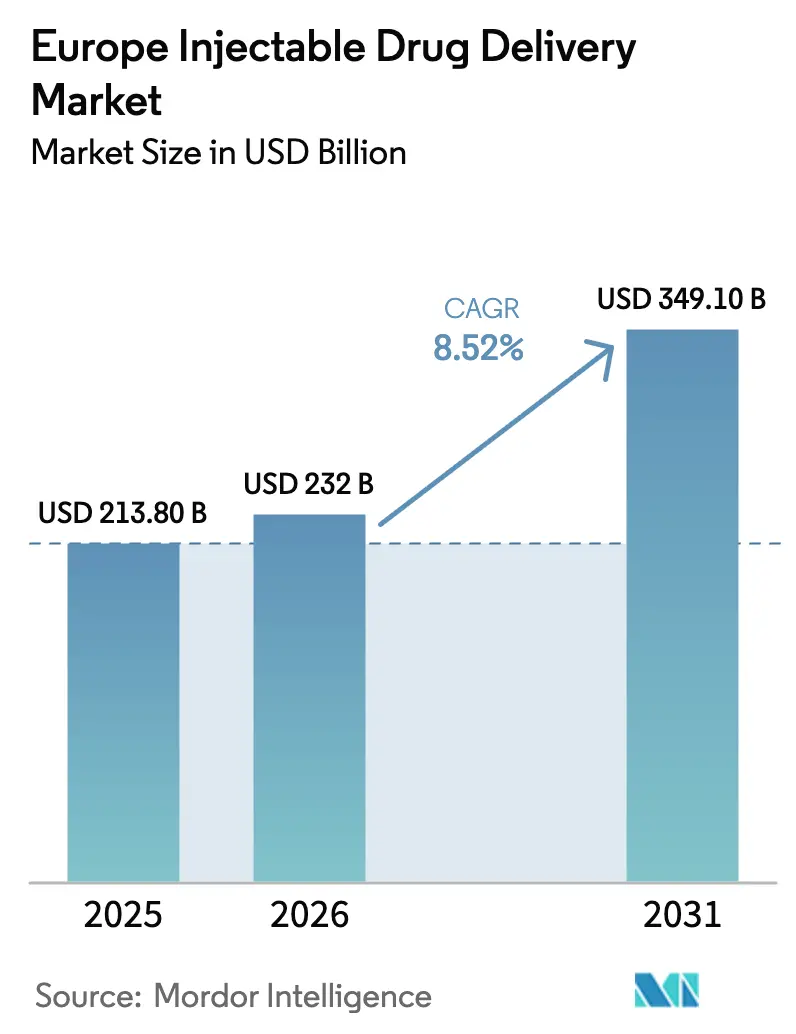
| Base Year Market Size (2025) | USD 213.80 Billion |
| Market Size (2026) | USD 232 Billion |
| Market Size (2031) | USD 349.10 Billion |
| Growth Rate (2025 - 2030) | 8.52% CAGR |
| Market Concentration | Medium |
Major Players *Disclaimer: Major Players sorted in no particular order Image © Mordor Intelligence. Reuse requires attribution under CC BY 4.0. | |
Europe Injectable Drug Delivery Market Analysis by Mordor Intelligence
The Europe Injectable Drug Delivery Market size was valued at USD 213.80 billion in 2025 and is estimated to grow from USD 232 billion in 2026 to reach USD 349.10 billion by 2031, at a CAGR of 8.52% during the forecast period (2026-2031).
Rising chronic-disease prevalence, a wave of biosimilar approvals, and mounting workforce shortages are moving parenteral care from hospitals into homes, accelerating the adoption of self-injectable formats and connected devices. Demographic aging amplifies demand for long-term biologic therapies, while European Union size-based recycling mandates spur material innovation in polymer syringes. Large-volume wearable injectors are replacing multihour infusions, saving infusion-suite chair time and boosting patient convenience. At the same time, non-invasive technologies such as oral GLP-1 analogs and microneedle patches signal competitive pressure on traditional needles, demanding continuous product differentiation by device makers.
Key Report Takeaways
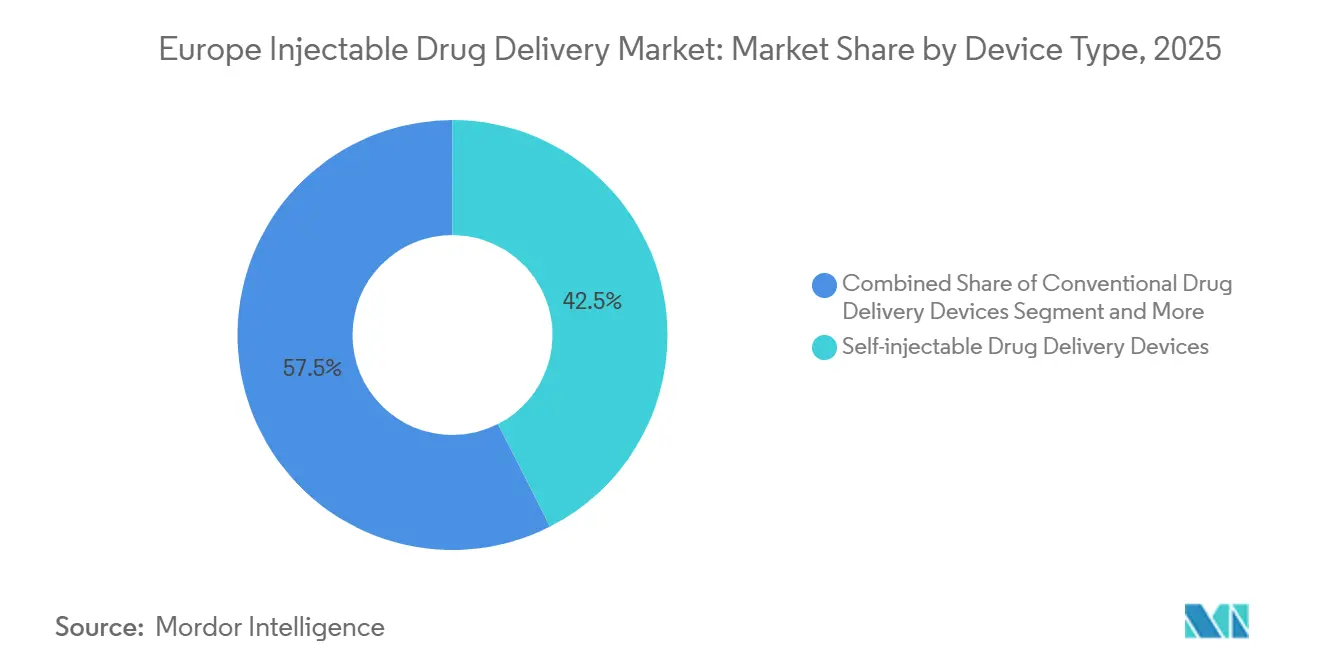
- Self-injectable devices led with 42.55% of the Europe Injectable Drug Delivery market share in 2025, while the same segment is forecast to expand at an 11.85% CAGR through 2031.
- Oncology applications are advancing at a 9.75% CAGR between 2026–2031, outpacing diabetes, which retained 38.53% of 2025 revenue.
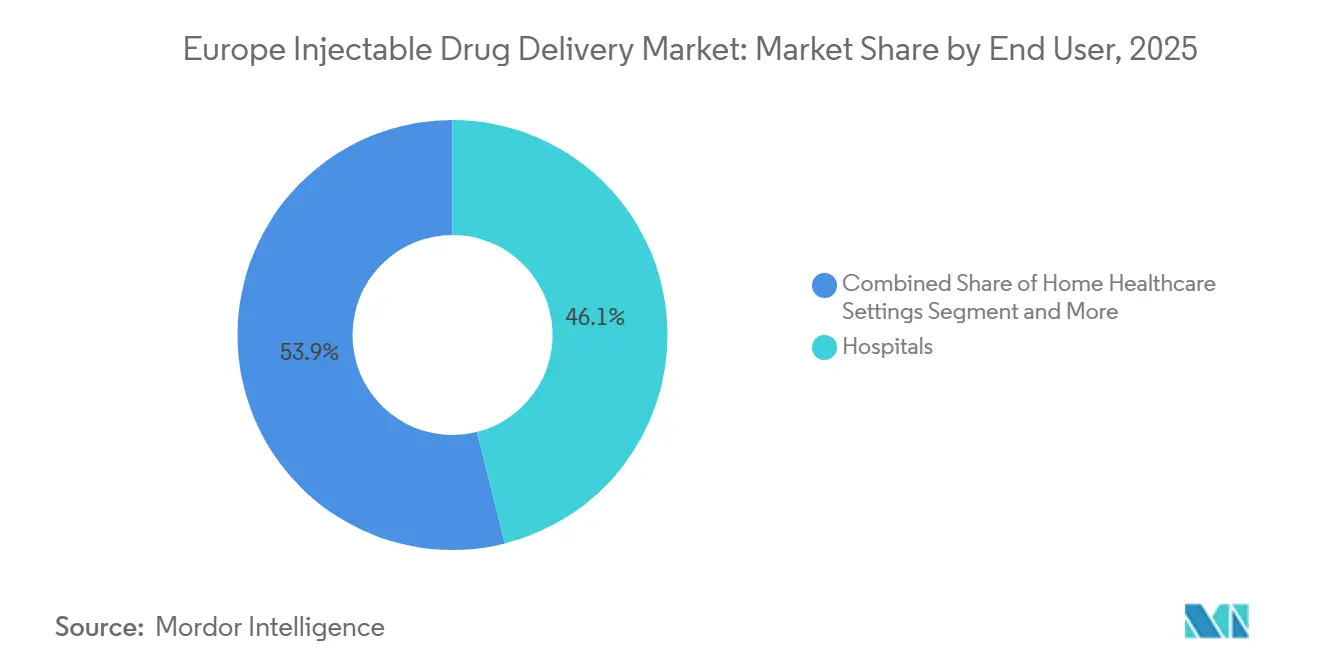
- Hospitals accounted for 46.15% of end-user revenue in 2025, but home healthcare settings represent the fastest trajectory at 11.82% CAGR.
- Borosilicate glass contributed 63.32% of raw-material revenue in 2025, whereas sustainable polymers will grow at a 9.29% CAGR to 2031.
- Germany dominated with 24.52% of regional revenue in 2025, yet Italy is projected to post the quickest geographic growth at a 9.32% CAGR.
Note: Market size and forecast figures in this report are generated using Mordor Intelligence’s proprietary estimation framework, updated with the latest available data and insights as of January 2026.
Europe Injectable Drug Delivery Market Trends and Insights
Drivers Impact Analysis*
| Driver | (~) % Impact on CAGR Forecast | Geographic Relevance | Impact Timeline |
|---|---|---|---|
| Rising prevalence of chronic diseases | +2.1% | Pan-European, acute in Germany, France, Italy | Long term (≥ 4 years) |
| Preference for self-injectable devices | +3.2% | Northern Europe (Nordics, Benelux), expanding to Southern EU | Medium term (2–4 years) |
| Growth of biologics & biosimilars | +2.8% | Germany, France, UK, Spain | Long term (≥ 4 years) |
| Regulatory push for safety syringes | +0.9% | EU-wide (MDR/IVDR compliance zones) | Short term (≤ 2 years) |
| EU eco-design rules spurring polymer syringes | +0.7% | Germany, Netherlands, France (circular-economy leaders) | Medium term (2–4 years) |
| Integration of smart injectors with eHealth | +1.5% | Nordics, Germany, Estonia (digital-health frontrunners) | Medium term (2–4 years) |
| Source: Mordor Intelligence | |||
Rising Prevalence of Chronic Diseases
Cardiovascular disease, diabetes, and cancer together account for 60% of European mortality, creating persistent demand for injectable biologics that cannot survive gastrointestinal degradation[1]International Diabetes Federation, “IDF Diabetes Atlas,” diabetesatlas.org. Type 2 diabetes prevalence reached 9.2% among European adults in 2025, with incidence rising fastest in Eastern Europe, where preventive infrastructure lags. Oncology incidence climbed to 2.7 million new cases in 2025; subcutaneous trastuzumab and pembrolizumab now cut chair time by 75%, easing ambulatory-unit bottlenecks. Autoimmune disease burden is also climbing: biologic penetration in rheumatology surpassed 40% by 2025, buoyed by tumor-necrosis-factor and interleukin blockers in prefilled syringes. The European Commission’s 2024 Pharmaceutical Strategy harmonizes cross-border reimbursement, widening patient access to high-cost injectables.
Preference for Self-Injectable Devices
A 2024 survey of 3,200 European biologic users reported that 68% preferred self-injection over clinic visits, citing schedule flexibility and lower infection risk. Statutory insurers in Germany and the Netherlands reimburse home infusions at rates up to 40% below hospital tariffs, financially incentivizing adoption of auto-injectors and portable pumps. Ypsomed’s YpsoMate 2.5 autoinjector integrates Bluetooth sensors that transmit dose and time stamps, supporting value-based contracts that penalize non-adherence. UCB’s rozanolixizumab enables patient-controlled subcutaneous delivery for generalized myasthenia gravis, eliminating routine hospital infusions[2]European Medicines Agency, “Biosimilar Medicines: Overview,” ema.europa.eu. Compliance with ISO 11608 standards facilitates drug-device interoperability, further lowering switching costs for biosimilar substitution.
Growth of Biologics & Biosimilars
Biologics consumed 38% of European pharmaceutical spending in 2025. The EMA cleared 28 biosimilars in 2024, unlocking an estimated EUR 1.8 billion in health-system savings. Germany’s AMNOG rule caps biosimilar launch price at 85% of the reference product, yet adalimumab biosimilars reached 70% volume share within 18 months. Prefilled syringes dominate biosimilar packaging; Stevanato Group’s EZ-fill polymer platform now supplies 40% of European biosimilar fill-finish demand. High-concentration formulations above 100 mg/mL require ultra-low dead-volume syringes and viscosity-reduction excipients, intensifying collaboration between formulation scientists and device engineers. EFPIA forecasts a 6% annual rise in biologic approvals through 2030, cementing long-run demand for injectable systems.
Integration of Smart Injectors with eHealth
Connected injectors transform delivery devices into data-generating endpoints. Biocorp’s Mallya smart cap retrofits insulin pens with Bluetooth, synchronizing dosing data to diabetes-management platforms such as MySugr and Glooko. Denmark’s national eHealth portal mandates interoperability between medical devices and electronic records, allowing clinicians to monitor adherence in real time. SHL Medical’s Molly 2.5 wearable injector embeds near-field communication tags so oncology nurses can scan devices directly into electronic logs, minimizing transcription errors. Under the EU Medical Device Regulation, Unique Device Identification codes became compulsory in May 2025, aiding post-market surveillance and outcome-based reimbursement. Cybersecurity remains a concern; ENISA flagged multiple vulnerabilities in connected pumps in 2024, prompting ISO 81001 compliance audits.
Restraints Impact Analysis*
| Restraint | (~) % Impact on CAGR Forecast | Geographic Relevance | Impact Timeline |
|---|---|---|---|
| Shift to non-invasive delivery routes | -1.8% | Germany, UK, Nordics (oral GLP-1 uptake) | Medium term (2–4 years) |
| EMA combination-product hurdles & cost | -1.3% | EU-wide (MDR/pharmaceutical dual compliance) | Short term (≤ 2 years) |
| EU 'pharma-in-water' producer liability | -0.6% | Rhine basin countries (Germany, Netherlands, France) | Long term (≥ 4 years) |
| Shortages of borosilicate glass/resins | -0.9% | Pan-European supply chain | Short term (≤ 2 years) |
| Source: Mordor Intelligence | |||
Shift to Non-Invasive Delivery Routes
Oral, transdermal, and inhaled formulations are eating into injectable volumes in segments where adequate bioavailability has been achieved. Novo Nordisk’s oral semaglutide captured 15% of German GLP-1 prescriptions by late 2025, despite lower bioavailability, reflecting strong needle aversion among patients. Transdermal microneedle patches from 3M entered Phase III insulin trials in 2025 and deliver 85% bioequivalence relative to subcutaneous injection, while eliminating sharps waste. Inhaled insulin (Afrezza) regained EU authorization in 2024 and targets the 12% of type 1 diabetics unwilling to inject. Transmucosal opioid films are now preferred in palliative care, further curbing demand for injectable opioids. The restraint is most pronounced in pediatric and geriatric cohorts, where injection anxiety and manual-dexterity issues are common.
EMA Combination-Product Hurdles & Cost
Devices that deliver medicinal products must satisfy both Medical Device Regulation and pharmaceutical dossiers, stretching approval cycles and inflating regulatory fees. Industry surveys placed average EU combination-product review time at 22 months, eight months longer than pure devices, with direct submission costs topping EUR 500,000. Small manufacturers struggle to fund parallel notified-body and EMA reviews, reinforcing the advantage of vertically integrated incumbents. Post-market obligations also intensify; MDR Article 83 requires periodic safety reports linking device performance to drug stability in real time. The European Commission’s 2025 “single-portal” proposal seeks to streamline dual submissions but will not materialize before 2028.
*Our forecasts treat driver/restraint impacts as directional, not additive. The impact forecasts reflect baseline growth, mix effects, and variable interactions.
Segment Analysis
By Device Type: Self-Injectables Command Innovation Pipeline
Self-injectable devices generated 42.55% of 2025 revenue and are on track to expand at an 11.85% CAGR through 2031, outpacing all other formats within the Europe Injectable Drug Delivery market[3]Stevanato Group, “Investor Presentation 2025,” stevanatogroup.com. Prefilled syringe demand is anchored by Stevanato Group’s EZ-fill polymer barrels that curb protein aggregation, supporting high-concentration biologics above 150 mg/mL. Auto-injectors such as YpsoMate 2.5 embed Bluetooth sensors for dose confirmation, opening the door to adherence-linked reimbursement models. Wearable injectors are disrupting infusion paradigms; BD’s Libertas can deliver 5 mL subcutaneously in 30 minutes, displacing multihour intravenous infusions for immunoglobulins. Needle-free jet injectors remain niche due to patient discomfort, yet PharmaJet’s Tropis system gained EMA clearance for intradermal vaccines, a sign of gradual acceptance.
Smart connected injectors are the fastest-moving subsegment of the Europe Injectable Drug Delivery market. Biocorp’s Mallya adapts legacy insulin pens for real-time data capture, an affordable retrofit sought by cost-conscious payers in Eastern Europe. Conventional glass syringes, vials, and ampoules still meet hospital demands where multi-dose vials lower per-unit antibiotic costs. Implantable pumps, such as Medtronic’s SynchroMed II, maintain niche roles in refractory pain management. Subcutaneous home-infusion pumps like Baxter’s Homepump Eclipse reduce cystic-fibrosis readmissions by 40% in UK pilots. Microneedle patches, currently in late-stage insulin trials, hold future promise for needle-phobic populations.


By Therapeutic Application: Oncology Overtakes Diabetes in Growth Velocity
Oncology applications are poised to advance at a 9.75% CAGR between 2026–2031, the fastest of any indication tracked within the Europe Injectable Drug Delivery industry. Subcutaneous pembrolizumab, approved in 2024, administers 600 mg in only five minutes, cutting infusion-suite utilization and freeing thousands of chair-hours annually. Trastuzumab biosimilars now command 62% share of HER2-positive breast-cancer starts in Germany, illustrating payer appetite for cost-saving injectables. Diabetes held 38.53% of 2025 revenue; however, oral semaglutide’s rise limits incremental injection growth. Autoimmune disorders such as rheumatoid arthritis and Crohn’s disease are robust, supported by quarterly wearable-injector formulations that simplify dosing schedules.
Cardiovascular injectables, led by Amgen’s evolocumab prefilled pen, hold steady as guideline updates broaden PCSK9 inhibitor usage for high-risk LDL profiles. Hepatitis injectables are waning as direct-acting antivirals migrate to oral formats. Pain-management injections face tighter opioid controls, while vaccine volumes normalize post-COVID-19. Fertility hormones and growth factors sustain stable demand as subcutaneous methotrexate transitions to autoinjectors in Nordic markets.
By End User: Home Healthcare Disrupts Hospital Dominance
Hospitals delivered 46.15% of 2025 sales, preserving critical roles in acute oncology, surgical anesthesia, and emergency cardiology. Yet the Europe Injectable Drug Delivery market size tied to home healthcare is projected to expand at an 11.82% CAGR through 2031, propelled by a forecast 1.2 million clinician shortfall by 2030. Germany’s statutory insurers raised home-biologic tariffs by 18% in 2025, equalizing profitability with hospital day-case reimbursements. Baxter’s Homepump Eclipse enables antibiotic therapy at home, trimming UK readmissions by 40% and validating outpatient infusion models. Specialty clinics remain important channels for rheumatology and dermatology, while ambulatory-surgery centers gain share as France pushes 70% outpatient eligibility by 2027.
Online pharmacies currently hold marginal injectable volumes due to cold-chain and prescription rules, yet Amazon Pharmacy’s 2024 entry into Germany hints at future e-commerce expansion. Home-based care sees the fastest equipment turnover, favoring connected auto-injectors that provide pharmacists with adherence data. The Europe Injectable Drug Delivery market share held by ambulatory settings is expected to grow as payer contracts reward providers for keeping patients out of inpatient settings.
By Raw Material: Sustainable Polymers Challenge Glass Hegemony
Borosilicate glass represented 63.32% of 2025 raw-material revenue, underpinned by Type I glass’s chemical inertness and legacy regulatory validation. Nevertheless, sustainable polymers—chiefly cyclic olefin copolymers—are forecast to rise at a 9.29% CAGR through 2031, buoyed by EU recycling quotas of 70% by 2030. Stevanato’s EZ-fill polymer syringes already account for 40% of European biosimilar fill-finish output. West Pharmaceutical’s NovaPure fluoropolymer-coated plungers curtail tungsten and silicone contamination, commanding premiums in high-concentration biologics. Biodegradable polymers remain experimental because degradation-rate variability clouds MDR biocompatibility compliance.
SCHOTT and Nipro have redirected capacity toward high-margin pharmaceutical tubing, creating sporadic glass shortages. The new Ecodesign for Sustainable Products Regulation mandates digital product passports disclosing material composition, raising compliance costs for multi-material injectors by roughly EUR 0.12 per unit. Stainless-steel components endure in reusable autoinjector shells, where 316L alloy’s corrosion resistance delivers long service life.
Geography Analysis
Germany generated 24.52% of regional revenue in 2025 as AMNOG pricing and pharmacist-substitution mandates accelerated biosimilar uptake. Gerresheimer’s Bünde facility boosted ready-to-fill syringe capacity by 30% in 2024, accommodating escalating fill-finish demand. The United Kingdom faces National Health Service budget strain, yet a 2025 home-infusion pilot for immunoglobulins cut admissions by 35%, foreshadowing a policy pivot toward outpatient delivery. France’s ambulatory-surgery plan, aimed at 70% outpatient eligibility, lifts demand for single-dose prefilled analgesics.
Italy is expected to log the fastest growth, at a 9.32% CAGR from 2026–2031, as AIFA imposes regional biosimilar quotas that close utilization gaps between southern and northern regions. Spain supports wearable injectors for hemophilia factor concentrates, halving infusion-center visits during Catalonia’s pilot. The remaining Europe Injectable Drug Delivery market territory—Nordics, Benelux, Poland, and Eastern Europe—benefits from EU Cohesion Fund allocations that underwrite diabetes-supply chains in underserved areas.
Nordic countries pioneer digital integration. Denmark’s sundhed.dk requires injector data interoperability with electronic records, and Estonia’s e-Prescription platform captures 99% of outpatient prescriptions, seamlessly populating national datasets. Belgium lifted home-biologic tariffs by 22% in 2025 to match hospital economics. The Netherlands ties wearable-injector reimbursement to patient-reported outcomes via value-based contracts, motivating device makers to embed sensors for real-time adherence tracking.
Regulatory Landscape
Injectable drug delivery systems marketed as integral drug-device combinations in Europe operate under a dual regime: medicinal product legislation (including Directive 2001/83/EC and EMA oversight for quality, safety, and efficacy) alongside the EU Medical Device Regulation (Regulation (EU) 2017/745, MDR) for the device constituent. MDR requirements, including Article 117 consultation and demonstration of conformity with the General Safety and Performance Requirements (Annex I), continue to influence development timelines and the depth of technical documentation for prefilled syringes, autoinjectors, and on-body delivery systems.
Regulatory coordination is increasingly used to reduce combination-product cycle time. The European Commission and Member States COMBINE Programme (launched June 2023) targets friction points at the MDR, IVDR, and Clinical Trials Regulation interface. The second phase of COMBINE Project 1 was officially launched in June 2026 to enable a coordinated, all-in-one assessment procedure for combined study applications across Member States, with the first procedures for this phase starting in September 2026. In parallel, Unique Device Identification requirements, in force since May 2025 for MDR, reinforce traceability and post-market surveillance expectations for connected injectors and wearable systems used in hospital and home-care settings.
Competitive Landscape
The Europe Injectable Drug Delivery market remains moderately consolidated: the top suppliers—Gerresheimer, Eli Lilly and Company, Teva Pharmaceutical Industries Ltd, and others—control a sizable slice of device revenue via vertical integration. Becton Dickinson’s Libertas wearable platform leverages its syringe base to cut partner time-to-market by up to 18 months. Novo Holdings’ USD 16.5 billion acquisition of Catalent in 2024 gives Novo Nordisk internal fill-finish capacity while expanding third-party CDMO services. Ypsomed filed 14 European patents in 2024 for connectivity modules, revealing a focus on value-based reimbursement opportunities.
Large-volume subcutaneous delivery is the key white-space battleground. Enable Injections’ enFuse and SHL Medical’s Molly 2.5 vie to displace intravenous immunoglobulin infusions in hospitals facing chair shortages. Biocorp’s Mallya smart cap retails at one-tenth the price of integrated smart injectors, appealing to payers in cost-sensitive Eastern Europe. Competitive differentiation is shifting from mechanical precision to extractables and leachables performance; West Pharmaceutical’s NovaPure components eliminate tungsten residues, commanding 25% price premiums in high-protein formulations. Regulatory streamlining under the proposed single-portal submission could lower entry barriers for mid-sized innovators, yet full implementation remains years away.
Europe Injectable Drug Delivery Industry Leaders
Baxter
Gerresheimer AG
Teva Pharmaceutical Industries Ltd
Eli Lilly and Company
Pfizer Inc.
- *Disclaimer: Major Players sorted in no particular order


Market Opportunities and Future Outlook
Platform-based development and more standardized conformity assessment workflows are creating whitespace for faster scale-up of self-injectables and connected delivery systems across Europe, especially where developers can reuse device architectures across multiple biologics. EMA work on the Molecule-Independent Device Bridging Approach (MIDBA) in October 2025 indicates a route for autoinjector platforms to apply existing PK knowledge from reference monoclonal antibodies, which can support broader device-platform adoption for biosimilars and high-concentration formulations while keeping MDR evidence expectations for the device constituent.
Conformity assessment is also shifting toward more uniform expectations. Regulation (EU) 2026/977 (published May 2026) sets more consistent quality management and procedural requirements for notified bodies, directly addressing variability in assessment practices that has acted as a bottleneck for drug-device combinations. At the same time, capacity localization in Europe is opening near-term opportunities for primary packaging, assembly, and fill-finish ecosystems tailored to home administration and large-volume subcutaneous delivery. West Pharmaceutical Services expanded its Dublin facility by 165,000 square feet in March 2026 to support high-volume injectable therapies including GLP-1 treatments, and Vetter began construction in May 2026 on a 50,000 sqm commercial production site in Saarlouis, Germany, supported by an initial EUR 480 million investment. Sharp also announced a EUR 20 million expansion in July 2026 for autoinjector and prefilled syringe assembly and packaging capacity in Hamont-Achel (Belgium) and Heerenveen (the Netherlands). These additions support shorter lead times for ready-to-fill formats, device assembly, and secondary packaging services used in biosimilars, oncology subcutaneous regimens, and expanding home-care channels, while continuing to pull through demand for components that meet extractables and leachables control and sustainability requirements.
Recent Industry Developments
- July 2026: Sharp announced a EUR 20 million expansion of injectable packaging capacity in Hamont-Achel, Belgium, and Heerenveen, the Netherlands, targeting autoinjector and prefilled syringe assembly and secondary packaging. The added regional capacity strengthens supply assurance for self-injectables used in home care and helps sponsors shorten logistics cycles versus reliance on non-European finishing hubs.
- October 2025: Gerresheimer began construction of a new 4,000 m2 production facility for ready-to-fill vials at its Wertheim, Germany site, with completion targeted for mid-2027. The project increases local availability of high-quality primary packaging needed for biologics and supports European fill-finish networks that are scaling injectable portfolios and biosimilar launches.
- December 2024: Gerresheimer started building a 7,600 m2 production hall for glass syringes at its Skopje, North Macedonia site, with total investment exceeding EUR 100 million. The expansion adds capacity for glass syringe supply into Europe, supporting demand for prefilled formats while diversifying manufacturing footprints amid periodic glass and resin availability constraints.


Research Methodology Framework and Report Scope
Market Definition and Coverage
For this methodology, the Europe injectables drug delivery market covers the value of injectable delivery products and systems used to administer drugs through injections across European countries, including hospital, clinic, and at home use where applicable.
Scope exclusions: We exclude non-injectable delivery routes, and we do not count oral, topical, or inhalation-only drug delivery products even if they share similar patient groups.
Segmentation Overview
- By Device Type
- Conventional Drug Delivery Devices
- Self-injectable Drug Delivery Devices
- Prefilled Syringes
- Injection Pens
- Auto-injectors
- Needle-free Injectors
- Wearable Injectors
- Smart Connected Injectors
- Implantable Drug Delivery Devices
- Infusion Pumps (Sub-Q)
- Microneedle Systems
- By Therapeutic Application
- Cardiovascular Disease
- Diabetes
- Oncology
- Autoimmune Disorders
- Hepatitis
- Pain Management
- Infectious Diseases & Vaccines
- Others
- By End User
- Hospitals
- Specialty Clinics
- Home Healthcare Settings
- Ambulatory Surgery Centers
- Online Pharmacies
- By Raw Material
- Borosilicate Glass
- Plastics (COP/COC, PP, PC)
- Sustainable/Biodegradable Polymers
- Country
- Germany
- United Kingdom
- France
- Italy
- Spain
- Rest of Europe
Data Sources, Market Sizing, and Validation
Desk Research
We start with desk research to set the boundaries, build the country map, and collect basic demand and supply signals that influence injectables use in Europe. Public and official sources that are typically checked include Eurostat health and trade tables, European Medicines Agency product and safety updates, OECD health statistics, World Health Organization Europe health indicators, and national health ministries and reimbursement bodies.
We then add supporting documents such as annual reports, investor presentations, and reputable press coverage to track product launches, capacity expansion announcements, and changes in therapy use. Where consistency is needed across markets, paid subscriptions for company financials, news and financials, and patent databases are used to cross-check timelines and the direction of technology adoption. The desk sources listed above are illustrative, and other references are also used for data collection, validation, and clarifying gaps.
Primary Interviews and Surveys
Primary work is used to validate what the desk data cannot fully explain, especially around device mix, channel patterns, and price evolution across major European markets. We interview and survey stakeholders across manufacturers, distributors, and care delivery settings, and we cross-check inputs across Western and Southern Europe to reduce reliance on a single country view.
Distribution of primary research fieldwork respondents
| Company type | Respondent position | Region |
|---|---|---|
| Top tier: 36% | CXOs: 19% | |
| Mid tier: 42% | Functional/Unit leaders: 35% | |
| Smaller Players: 22% | Managers: 46% |
Market-Sizing & Forecasting
The sizing model uses a top-down and bottom-up structure in a practical order. On the top-down side, healthcare spending signals, injectable therapy uptake, and country-level demand pools are reconstructed into a value view for injectables drug delivery across Europe, and then the totals are allocated using observed device and setting mix.
To keep the output realistic, we corroborate totals with selected bottom-up checks such as sampled average selling price (ASP) ranges by key device formats, volume proxies from treatment settings, and supplier and channel checks shared during interviews. Inputs we commonly test include chronic disease treatment intensity, biologics penetration where injections are the standard, share of self-administration, hospital versus ambulatory split, and expected ASP progression driven by mix and procurement cycles. Forecasts are built using scenario analysis, where base assumptions are aligned to expert expectations on adoption speed and pricing, and then stress-tested for policy or reimbursement shifts. If a country or product line has limited public visibility, we handle gaps by using proxied mix shares from similar markets and then revalidate through follow-up calls.
Data Validation & Update Cycle
Model outputs are validated through multiple checks so the final number does not depend on one source type. We compare results against independent signals such as regulatory activity, country demand markers, and financial disclosures, and we review anomalies before sign-off.
If variances are large at the country or sub-scope level, assumptions are revisited and relevant experts are re-contacted to confirm what changed and why. Reports are refreshed annually, and interim updates are done when major events materially shift volumes, pricing, or access. Before delivery, a fresh analyst pass is completed so the output reflects the latest available information.
Mordor Intelligence's Europe Injectables Drug Delivery Market Market Size Compared Against Other Published Estimates
Published market sizes for Europe injectables drug delivery often look different because scope boundaries are not drawn the same way across publishers, and because pricing inputs and country coverage choices vary. Differences also show up when base years do not match, or when currency conversion timing and inflation handling are not stated clearly.
Hospital purchasing signals and country-level therapy utilization patterns are used to keep the Mordor Intelligence estimate anchored to an injectable demand pool that is consistent across the main European markets, rather than being driven by a narrow device-only view. Some sources report a subset of delivery devices only, while others apply a more conservative mix and ASP path, which can pull the total down for the same year.
Benchmark comparison
| Source | Market Size | Gaps in Research Methodology |
|---|---|---|
| Mordor Intelligence | USD 213.80 B (2025) | |
| Industry Analytics A | USD 166.90 B (2025) | Often reflects a tighter counted scope and more conservative device and therapy mix assumptions in the base year, which reduces the value captured versus a broader injectable delivery view across care settings. |
| Research Desk B | USD 140.08 B (2023) | Uses an earlier base year and reports in USD million, with coverage that appears more device-led, and the year mismatch plus different ASP timing makes direct comparisons look lower versus a 2025 value. |
The table shows that the spread is mainly explained by scope boundaries, base-year alignment, and how ASP and mix are carried through the model. By keeping steps traceable to country demand indicators and then confirming mix and pricing through interviews, the final number stays practical to use and easier to refresh over time.


Key Questions Answered in the Report
What is the current value of the Europe Injectable Drug Delivery market?
The Europe Injectable Drug Delivery market size reached USD 232.0 billion in 2026 and is set to climb toward USD 349.1 billion by 2031.
How fast is the market growing?
From 2026 to 2031 the market is projected to grow at an 8.52% CAGR, powered by self-injectables, biosimilar uptake, and home-care models.
Which device category is expanding the quickest?
Self-injectable platforms, including wearable on-body pumps, are advancing at an 11.85% CAGR as patients and payers prefer home administration.
Which therapeutic area shows the highest growth momentum?
Oncology leads with a 9.75% CAGR, thanks to subcutaneous checkpoint inhibitors and antibody-drug conjugates.
Which country will register the fastest revenue growth?
Italy is expected to deliver a 9.32% CAGR through 2031 as regional biosimilar quotas broaden biologic access in the south.
What material trends are shaping future device design?
Sustainable cyclic olefin polymers are the fastest-growing raw material, driven by EU recycling mandates and superior protein-stability profiles.
Page last updated on: