Market Overview
| Study Period | 2020 - 2031 |
|---|---|
| Forecast Data Period | 2026 - 2031 |
| Base Year Market Size (2025) | USD 15.64 Billion |
| Market Size (2026) | USD 16.82 Billion |
| Market Size (2031) | USD 23.63 Billion |
| Growth Rate (2026 - 2031) | 7.04% CAGR |
| Market Concentration | Low |
Major Players *Disclaimer: Major Players sorted in no particular order Image © Mordor Intelligence. Reuse requires attribution under CC BY 4.0. | |
Europe HVAC Services Market Analysis by Mordor Intelligence
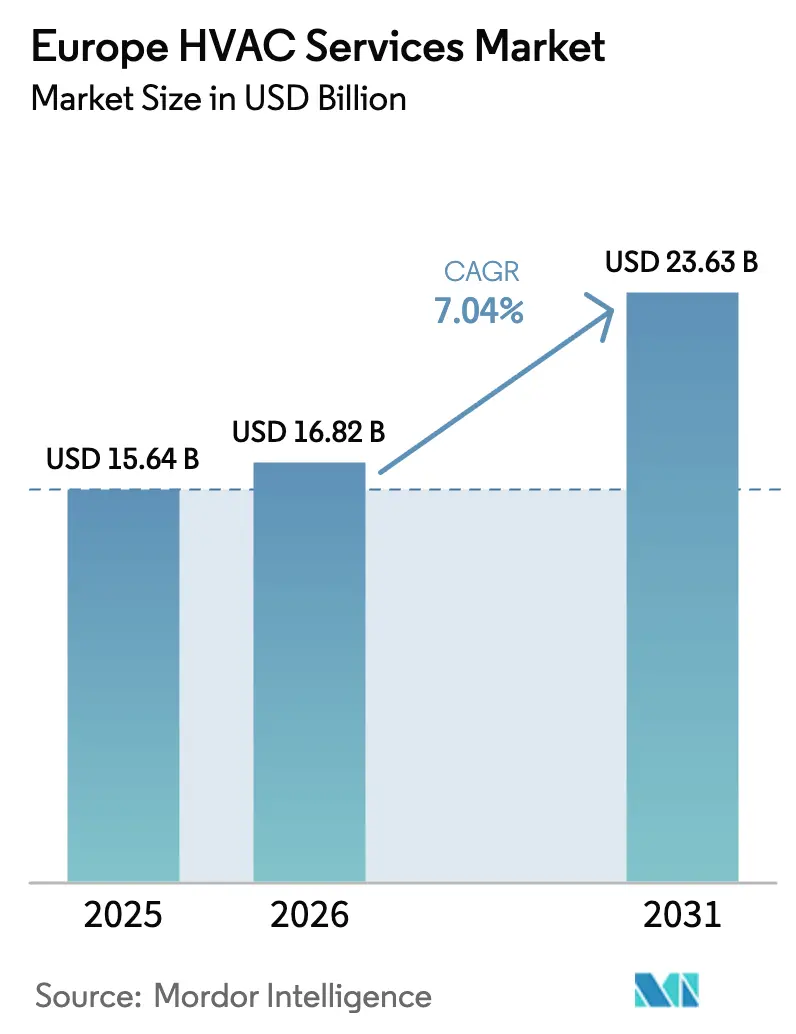
The Europe HVAC services market size is projected to be USD 15.64 billion in 2025, USD 16.82 billion in 2026, and reach USD 23.63 billion by 2031, growing at a CAGR of 7.04% from 2026 to 2031. Ambitious retrofit mandates, a heat-pump replacement boom, outcome-based contracting, and the expanding data-center footprint are redefining cash-flow visibility for the Europe HVAC services market. Service providers able to bundle installation, predictive maintenance, and energy-performance guarantees are defending margins as raw-material costs and wages rise. Electric-to-gas price spreads continue to favour electrification, while subsidy frameworks in Germany, France, and Poland shield homeowners from steep upfront outlays. At the same time, installer scarcity is inflating labour rates, prompting a pivot toward smart-connected operations that curb truck rolls by as much as 30%.
Key Report Takeaways
- By implementation type, retrofit buildings held 58.59% of the Europe HVAC services market share in 2025 and are advancing at a 7.84% CAGR through 2031.
- By type of service, maintenance and repair led with 46.74% revenue share in 2025, whereas smart-connected operations and maintenance is expanding at a 7.39% CAGR to 2031.
- By end-user industry, commercial facilities within the non-residential segment captured 7.63% CAGR growth, outpacing the residential segment’s 6.9% rate over 2026-2031.
- By service delivery model, heat-as-a-service contracting, although below 10% penetration in 2025, is projected to compound at 7.59% annually to 2031.
- By geography, Germany commanded 24.25% revenue in 2025, while Poland is forecast to post the fastest 7.88% CAGR through 2031.
Note: Market size and forecast figures in this report are generated using Mordor Intelligence’s proprietary estimation framework, updated with the latest available data and insights as of 2026.
Europe HVAC Services Market Trends and Insights
Drivers Impact Analysis*
| Driver | (~) % Impact on CAGR Forecast | Geographic Relevance | Impact Timeline |
|---|---|---|---|
| EU Renovation Wave Mandates | +1.80% | Pan-European, with concentration in Germany, France, Netherlands | Medium term (2-4 years) |
| Heat-Pump Replacement Boom | +2.10% | Germany, France, Poland, Nordic region | Short term (≤ 2 years) |
| Growing Demand for Energy-Efficient Retrofits | +1.50% | Pan-European, led by Western Europe | Medium term (2-4 years) |
| Data-Center Cooling Demand Surge | +0.90% | Frankfurt, Amsterdam, Dublin, Paris, Stockholm | Short term (≤ 2 years) |
| Expansion of Heat-as-a-Service Contracting | +0.60% | Germany, UK, Netherlands, France | Long term (≥ 4 years) |
| Seasonal Thermal-Storage-Enabled Operations and Maintenance Revenue Streams | +0.40% | Nordic countries, Germany, Austria | Long term (≥ 4 years) |
| Source: Mordor Intelligence | |||
EU Renovation Wave Mandates
The European Commission intends to renovate 35 million buildings by 2030, forcing upgrades that normally bundle envelope insulation, heat pumps, and smart controls.[1]European Commission, “Renovation Wave,” energy.ec.europa.eu Germany allocated USD 14.45 billion in 2024 to subsidize up to 70% of qualifying retrofit costs, and both France and the Netherlands run parallel grant schemes that link incentive payouts to five-year service contracts. Because roughly three-quarters of Europe’s stock predates 1990 efficiency codes, compliance guarantees a decade-long pipeline for the Europe heating, ventilation, and air conditioning services market. Eligibility rules favour certified installers, locking in recurring maintenance revenue. As subsidy budgets roll forward, service providers capable of delivering turnkey retrofits are positioned to capture premium margins.
Heat-Pump Replacement Boom
More than 356,000 units were installed in Germany during 2024, and millions of aging boilers across the bloc are entering end-of-life cycles.[2]McKinsey, “Heat Pumps: A Key Technology for Europe’s Energy Transition,” mckinsey.com Service intensity runs 40%–60% higher than gas-boiler swaps, lifting average ticket sizes for the Europe heating, ventilation, and air conditioning services market. Poland’s “My Heat” scheme alone directs USD 3.21 billion toward residential heat-pump adoption by 2026. Total cost-of-ownership models consistently favour electric systems whenever electricity-to-gas price ratios hold below four-to-one. Yet technician scarcity has pushed wait times to 16 weeks in Germany, nudging providers to invest in training and acquisition of smaller installers.
Growing Demand for Energy-Efficient Retrofits
Carbon-price exposure under the expanded EU Emissions Trading System will add USD 321–535 in annual heating costs for poorly insulated homes starting 2027.[3]European Commission, “EU Legislation to Control F-gases,” climate.ec.europa.eu Corporate landlords confront disclosure duties under the Corporate Sustainability Reporting Directive, accelerating HVAC-retrofit budgets across western capitals. Turnkey offerings that blend smart thermostats, insulation, and heat pumps command 25%–30% price premiums over equipment-only quotes, a pattern buoying profitability for the Europe heating, ventilation, and air conditioning services market. Buildings upgraded to high-efficiency classes capture 5%–8% rent premiums and double-digit sale premiums, ensuring durable retrofit demand.
Data-Center Cooling Demand Surge
European data-center capacity is on track to double by 2030, with each megawatt of IT load demanding up to 0.6 megawatts of cooling capacity. Liquid-cooling retrofits cost USD 500–1,200 per kilowatt but cut energy use by up to 40%, a value proposition that attracts hyperscalers willing to sign seven-year service contracts north of USD 200,000 per megawatt. Providers offering uptime guarantees of 99.99% plus waste-heat recovery integration are differentiating themselves within the Europe heating, ventilation, and air conditioning services market. Stockholm’s corridor showcases sub-1.15 power-usage-effectiveness ratios that hinge on sophisticated operations and maintenance programs.
Restraints Impact Analysis*
| Restraint | (~) % Impact on CAGR Forecast | Geographic Relevance | Impact Timeline |
|---|---|---|---|
| Shortage of F-Gas-Certified Technicians | -1.20% | Pan-European, acute in Germany, France, UK | Short term (≤ 2 years) |
| High IoT Retrofit Costs for Legacy Systems | -0.70% | Southern and Eastern Europe | Medium term (2-4 years) |
| Compressor Supply-Chain Vulnerability Amid Heat-Pump Spike | -0.50% | Pan-European | Short term (≤ 2 years) |
| Data-Privacy Compliance Burdens on Remote Maintenance | -0.30% | Pan-European, especially Germany, France | Medium term (2-4 years) |
| Source: Mordor Intelligence | |||
Shortage of F-Gas-Certified Technicians
Europe maintains roughly 367,000 certified technicians, yet needs an additional 70,000–500,000 by 2030 to meet policy targets. Certification courses require up to 80 hours and cost USD 1,605–3,210 per trainee. Resulting labour scarcity inflates service-call fees to USD 192.60 in Germany, eroding margins for price-sensitive residential projects. The bottleneck particularly hampers retrofit timelines where complex integrations demand seasoned installers.
High IoT Retrofit Costs for Legacy Systems
Smart thermostat and sensor retrofits run USD 53.50–160.50 per square meter when legacy HVAC units lack modern communication protocols. Building owners in Southern and Eastern Europe, where energy prices remain lower, hesitate to commit capital unless payback periods fall under five years. GDPR compliance further elevates platform costs by up to 40% and exposes providers to heavy fines. Consequently, IoT uptake lags in nations such as Italy and Spain, tempering addressable volume for the Europe HVAC services market.
*Our forecasts treat driver/restraint impacts as directional, not additive. The impact forecasts reflect baseline growth, mix effects, and variable interactions.
Segment Analysis
By Type of Service: Smart Platforms Redefine Maintenance Economics
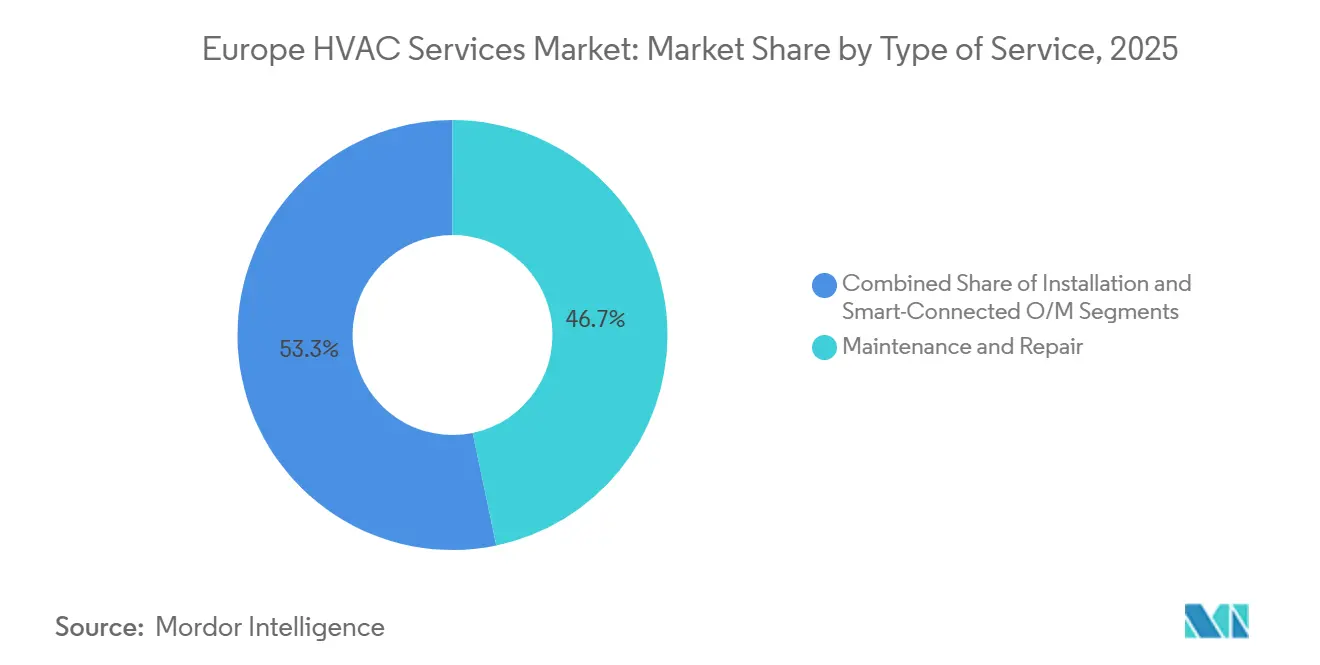
Maintenance and repair represented 46.74% of revenue in 2025, anchored by an installed base exceeding 180 million HVAC units across the continent. Smart-connected operations and maintenance, however, is expanding at 7.39% to 2031 as machine-learning platforms forecast faults days in advance, cutting downtime by up to 35%. The segment’s shift toward predictive analytics elevates contract values from USD 85.60 to beyond USD 428 per unit annually. Installation services are still vital, growing at 7.2% thanks to heat-pump swaps and liquid-cooling overhauls. In Germany, the average truck-roll cost of USD 128.40 incentivizes remote diagnostics, bolstering margins. Online marketplaces are compressing installer prices by as much as 15% in residential channels, compelling providers to bundle ten-year warranties to protect revenue streams. Consequently, the Europe HVAC services market is tilting toward digitally enabled service models that monetize data rather than headcount.
Smart platforms also enable granular energy reporting, a requirement under multiple EU directives. Carrier’s Abound suite monitors 2 million connected units, scheduling maintenance during off-peak hours and reducing labour hours by 18%. Providers investing 4%–6% of revenue in digital twin’s report service-margin lifts of 200–300 basis points. Meanwhile, traditional maintenance businesses risk erosion unless they integrate IoT competencies. As subscription remote monitoring reaches critical mass, the Europe HVAC services market size for smart-connected contracts is poised to surpass conventional maintenance by the late 2020s.


By Implementation Type: Retrofit Dominance Driven by Mandate Intensity
Retrofit projects accounted for 58.59% of implementation revenue in 2025, and their 7.84% CAGR through 2031 outpaces new construction by 110 basis points. Deep-energy packages yield internal rates of return up to 9% when energy savings and avoided carbon taxes are considered. Each retrofit square meter generates 40%–60% more service revenue than new builds owing to surveys, asbestos mitigation, and legacy system integration. New construction, growing at 6.74%, benefits from heat pumps becoming the default heat source across Nordic markets, yet aggressive developer negotiations compress margins. Rising interest rates trimmed German housing starts by 18% in 2024, whereas retrofit permits climbed 27%. As a result, the retrofit share within the Europe HVAC services market will continue expanding throughout the forecast horizon.
Policy asymmetry reinforces this trend. The revised Energy Performance of Buildings Directive targets the worst 15% of stock, compelling landlords to act or risk asset devaluation. Subsidies tilt further toward retrofit depth, with German grants covering up to 70% of qualifying costs. Labor scarcity remains a wild card but also encourages digital oversight tools that reduce onsite time. Ultimately, the Europe HVAC services market size tied to retrofit activity is likely to dominate long term, particularly as carbon prices tighten.
By End-User Industry: Commercial Segment Leads on Precision Cooling
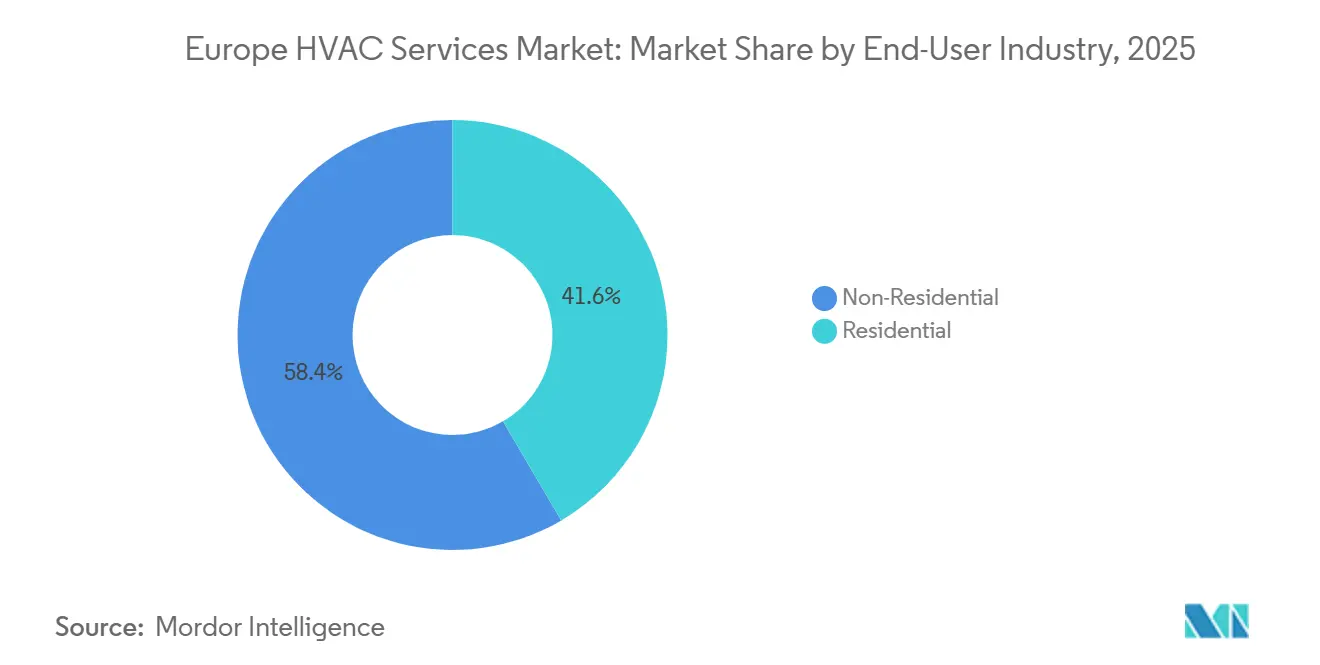
Residential customers delivered 41.57% of revenue in 2025, but commercial facilities are on a faster 7.63% growth trajectory as datacenter and office-to-lab conversions require sub-1 °C stability. Commercial contract values of USD 53,500–214,000 dwarf residential tickets and include service attachment rates above 90%. Industrial clients are adopting megawatt-scale heat pumps to offset carbon-border tariffs, while public institutions rely on performance contracts guaranteed to cut energy use by at least 20%. Nordic residential markets are nearing heat-pump saturation, capping household growth but opening replacement cycles rich in smart-services revenue. Given these dynamics, the commercial slice of the Europe HVAC services market will increasingly influence pricing discipline and technology roadmaps.
Incremental opportunity also lies in industrial process heating, where carbon compliance drives high-temperature heat-pump retrofits. Retail chains upgrading cold-chain logistics add another demand vector. Conversely, residential affordability constraints in Southern Europe temper volume, even after subsidies. Still, remote monitoring subscriptions are gaining traction, with British Gas bundling annual servicing for USD 15.36 per month and reaching 380,000 subscribers by mid-2025. As household budgets tighten, subscription models grant the Europe HVAC services industry a sticky revenue avenue.
By Service Delivery Model: Heat-as-a-Service Gains Traction
Conventional time-and-material agreements held 52.85% of service-delivery revenue in 2025, yet heat-as-a-service is staging the fastest rise at 7.59% through 2031. Utilities such as Vattenfall and Engie now charge USD 85.60–160.50 per month in contracts spanning up to 15 years, absorbing equipment risk while locking in customers. Performance-based energy contracts, prevalent in the commercial sector, post 7.3% CAGR growth by ensuring 15%–25% energy-savings guarantees. Subscription remote monitoring, at 7.1% growth, monetizes data from connected thermostats. Combined, these emerging models are shifting capital intensity away from building owners and embedding service providers deeper into client operations. That evolution multiplies the recurring-revenue share of the Europe HVAC services market.
Providers with balance-sheet strength are best placed to underwrite performance risks, further concentrating market power among top manufacturers and utilities. Smaller contractors mitigate exposure through partnerships or platform participation. As predictive analytics prove their worth in reducing emergency repairs, subscription adoption is likely to accelerate across the residential base. Over time, equipment commoditization will make service innovation, not hardware differentiation, the decisive factor in Europe HVAC services market share gains.
Geography Analysis
Germany generated 24.25% of regional revenue in 2025 on the strength of the Gebäudeenergiegesetz’s 65% renewable-heat mandate and USD 14.45 billion in subsidies. Installer shortages inflated lead times to 16 weeks, an issue expected to persist into 2027. Poland, supported by USD 3.21 billion in “My Heat” funding, is forecast to post the region’s quickest 7.88% CAGR, moving household heating away from coal. France led unit sales with more than 500,000 heat pumps installed in 2024 under MaPrimeRénov’, while the United Kingdom’s grants of USD 9,600 spurred 25,000 projects the same year. Italy’s scaled-back Superbonus slowed approvals by 35%, whereas Spain channels USD 7.28 billion from EU recovery funds into social-housing retrofits, favouring commercial and institutional contracts.
Rest-of-Europe markets, including the Nordics, Benelux, and Eastern Europe, delivered 27.75% of revenue. Norway and Sweden display heat-pump penetration above 60%, thereby pivoting demand toward replacement services and commercial retrofits. Irish and Dutch data-center clusters fuel precision-cooling contracts, complementing Frankfurt’s hyperscale corridor. Across geographies, retrofit depth and policy clarity remain the main differentiators shaping the trajectory of the Europe HVAC services market.
Differential subsidy generosity prompts cross-border installer migration, especially from Eastern to Western Europe, marginally alleviating labour tightness in Germany and France. However, language and certification barriers limit mobility. Meanwhile, energy-price volatility keeps payback economics favourable for electrification through 2031. Country-specific carbon taxes further compress fossil-fuel competitiveness. Collectively, these factors underpin a robust outlook for the Europe HVAC services market across the bloc.
Regulatory Landscape
The European HVAC services market is operating under a tightening EU policy framework that increases inspection, documentation, and refrigerant-handling workloads for service providers. The recast Energy Performance of Buildings Directive, Directive (EU) 2024/1275, requires Member States to transpose measures by 29 May 2026, while reinforcing regular inspection requirements for heating, ventilation, and air-conditioning systems in non-residential buildings. This is translating into more recurring compliance-driven service visits and reporting.
On refrigerants, Regulation (EU) 2024/573 (F-gases) accelerates the shift away from high-GWP gases in service operations. From 1 January 2026, fluorinated greenhouse gases with GWP 2500 or higher are prohibited for the maintenance or servicing of air-conditioning equipment and heat pumps, which expands the need for certified technicians, leak prevention, and refrigerant conversion work. In parallel, EU ecodesign and energy-label rules for air heating and cooling products continue to influence replacement decisions and push service providers to maintain competency across newer high-efficiency and low-GWP system designs.
Competitive Landscape
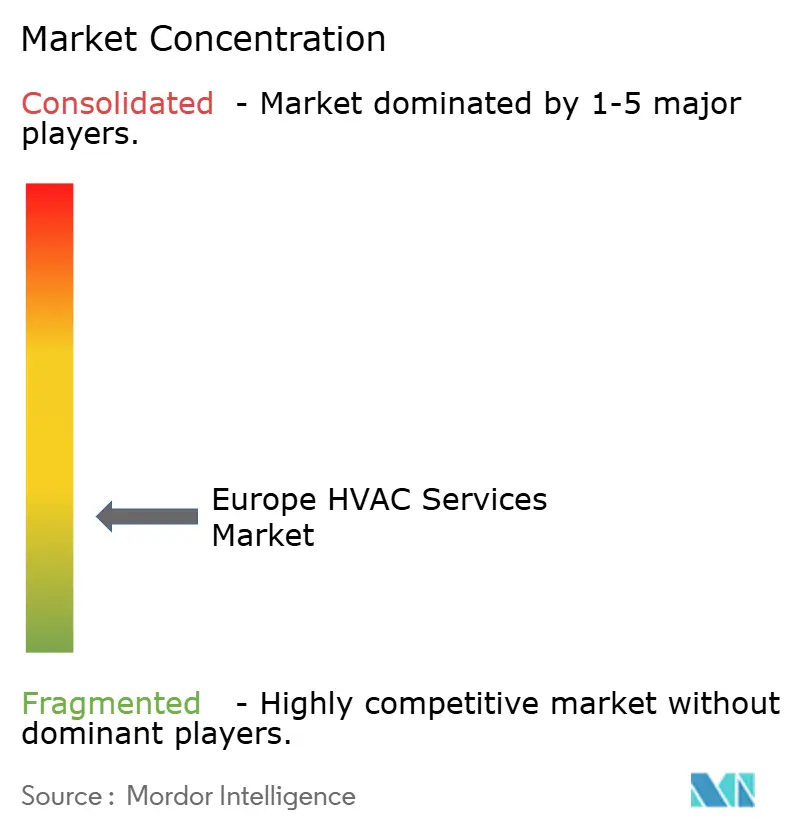
The top five players Johnson Controls, Carrier, Daikin, Trane Technologies, and Siemens collectively hold an estimated 35%–40% market share. Equipment manufacturers are vertically integrating, as shown by Carrier’s USD 12.84 billion Viessmann acquisition that added 13,000 technicians and 120 service centers. Utilities such as Vattenfall and Engie wield balance sheets to finance heat-as-a-service rollouts, capturing customers reluctant to fund USD 16,050–26,750 heat-pump installations. Technology investments are the leading differentiator: firms devote up to 6% of revenue to IoT platforms and digital twins, trimming service costs by up to 30% and lifting uptime.
Johnson Controls’ Silent-Aire acquisition bolstered data-center expertise, while Siemens linked building-management data with Microsoft Azure, delivering 22% energy savings in a Frankfurt pilot. Smaller specialists focus on compliance-intensive niches; Airedale International’s clean-room and data-center orientation earns 25%–35% price premiums. Online marketplaces such as Thermondo and Heatio compress residential pricing by unifying fragmented installer networks. Consequently, incumbents must match transparency and speed or cede share, especially in northern markets where digital readiness is high.
Strategic moves increasingly revolve around manufacturing footprints. Johnson Controls’ USD 128.4 million expansion in Poland targets 200,000 annual heat-pump units by 2027, positioning the firm near growth hot spots. Vaillant’s USD 74.9 million Remscheid plant doubled its European capacity, incorporating automated refrigerant charging that cuts defects 40%. Trane’s EUR 85 million ten-year Frankfurt data-center contract demonstrates the value of uptime guarantees that only deep-pocketed vendors can underwrite. Collectively, these moves reflect a race to secure recurring revenue in the Europe HVAC services market ahead of anticipated consolidation.
Europe HVAC Services Industry Leaders
Johnson Controls International plc
Carrier Corporation
Daikin Industries, Ltd.
Trane Technologies plc
Siemens AG
- *Disclaimer: Major Players sorted in no particular order

Market Opportunities and Future Outlook
Policy-driven retrofit activity and refrigerant rules are creating clear whitespace for providers that can package compliance, installation, and multi-year operations. The EPBD recast (Directive (EU) 2024/1275) and its 29 May 2026 transposition deadline increase demand for inspection workflows and building-performance documentation, which benefits contractors running digital processes for audits, reporting, and ongoing maintenance. The F-gas regime (Regulation (EU) 2024/573), together with the 1 January 2026 servicing restriction for GWP 2500+ refrigerants, expands the scope for leak management, refrigerant retrofits, and system replacement support, particularly for customers looking for a single accountable service partner.
Commercial and mission-critical cooling services also remain an identifiable growth lane, supported by testing and product capability investments inside Europe. Carrier inaugurated a EUR 12 million HVAC and data center testing facility in Montluel, France (April 2026), and launched the AiroVision 39CV computer room air handler for medium-to-large data centers (March 2026), reinforcing a vendor emphasis on validated performance and serviceability for critical environments. Financing and contracting innovation is expanding service attach as well: Carrier and BNP Paribas Leasing Solutions announced a multi-country HVAC financing partnership across major European markets (April 2026), reinforcing bundled offerings that combine equipment deployment with ongoing service and monitoring. Technician scarcity remains a constraint, but it also opens demand for providers that can build training capacity and standardize processes, given the documented shortfall of F-gas-certified technicians versus policy targets.
Recent Industry Developments
- June 2026: Daikin Industries Ltd launched the VKM-JM decentralised ventilation unit for commercial applications. The launch expands Daikin's commercial ventilation footprint in Europe and strengthens product diversification.
- May 2026: Johnson Controls International plc opened a new production facility and customer test centre in Aarhus, Denmark. Local production and test capabilities improve supply-chain resilience and service delivery in Europe.
- April 2026: Carrier Corporation inaugurated a 12 million euro testing laboratory in Montluel, France. Enhances validation capabilities for data-center and commercial HVAC solutions in Europe.


Research Methodology Framework and Report Scope
Market Definition and Coverage
For this study, the Europe HVAC services market is defined as the revenue earned from providing HVAC-related services, including installing, maintaining, repairing, and upgrading heating, ventilation, and air conditioning systems across Europe.
Scope exclusions: We exclude HVAC equipment manufacturing sales and pure parts-only trading revenue when it is not bundled into a service job.
Segmentation Overview
- By Type of Service
- Maintenance and Repair
- Installation
- Smart-Connected O&M
- By Implementation Type
- New Construction
- Retrofit Buildings
- By End-User Industry
- Residential
- Non-Residential
- Commercial
- Industrial
- Public and Institutional
- By Service Delivery Model
- Conventional Time-and-Material Contracts
- Performance-Based Energy Contracts
- Heat-as-a-Service Contracting
- Subscription Remote Monitoring
- By Country
- Germany
- United Kingdom
- France
- Italy
- Spain
- Rest of Europe
Data Sources, Market Sizing, and Validation
Desk Research
Desk research is used to set the boundaries of the service market and to anchor demand drivers that are visible in public data. We review EU and national energy efficiency rules, the flow of construction and renovation activity, and macro indicators that influence service call-outs.
Public sources we commonly refer to include the European Commission and Eurostat for building and energy context, the European Environment Agency for decarbonization signals, and standards or guidance bodies such as CEN and REHVA for HVAC-related requirements. We also use customs and trade series where they help interpret replacement cycles. In addition, company annual reports and investor presentations, reputable trade press, and association publications are used to cross-check service mix and pricing direction. Paid subscriptions are used selectively for company financial intelligence, shipment and trade datasets, and patent and news tracking that helps validate technology shifts. The examples above are illustrative, since many other sources were also used for data collection, validation, and clarification during the work.
Primary Interviews and Surveys
Primary work is used to pressure-test how service revenue is created in practice, which is then translated into a repeatable model. We speak with service providers, distributors and contractors, building operators, and industry experts across major European markets so assumptions on labor rates, contract types, and retrofit intensity do not rely on a single viewpoint.
Distribution of primary research fieldwork respondents
| Company type | Respondent position | Region |
|---|---|---|
| Top tier: 25% | CXOs: 15% | |
| Mid tier: 55% | Functional/Unit leaders: 39% | |
| Smaller Players: 20% | Managers: 46% |
Market-Sizing & Forecasting
Sizing starts with a top-down build that uses Europe-level service demand signals, and then ties them to how often systems are installed, maintained, repaired, and replaced in real buildings. When the demand pool is formed this way, the main clause is a market value that is traceable to observable activity rather than only to provider claims.
We then corroborate totals with selective bottom-up checks, such as sampling provider revenue disclosures, using channel conversations to validate service mix, and applying typical price-per-job ranges to a realistic volume of service events. Key inputs include renovation and retrofit momentum, new construction starts, heat pump and boiler replacement direction, labor availability and wage inflation for technicians, and the share of jobs moving to planned contracts versus ad hoc call-outs. Where gaps exist, they are handled through conservative ranges that are narrowed after expert feedback, and then documented so changes can be revisited.
For forecasting, scenario analysis is used because policy support, energy prices, and installer capacity can shift the pace of retrofits quickly. The forward view is built by projecting the above drivers and then applying service intensity and pricing assumptions that were validated in interviews.
Data Validation & Update Cycle
Validation is done through triangulation across independent signals, and then through a set of variance checks at country and service-type level. We look for breakpoints in pricing, unusual growth spikes, and mismatches between retrofit activity and implied service volumes before the numbers are finalized.
A multi-step internal review is used so that assumptions, calculations, and outputs are checked by more than one analyst. If large differences show up versus known building activity or provider commentary, respondents are re-contacted and inputs are adjusted with written rationale. Reports are refreshed annually, with interim updates when material events occur, and a final pre-delivery check is completed so clients receive the most current view.
Mordor Intelligence's Europe Hvac Services Market Size Compared Against Other Published Estimates
Published market sizes for Europe HVAC services can vary more than buyers expect, even when the topic sounds similar. The main reasons are usually what is counted as a service (for example, consulting or replacement jobs), which countries are grouped into Europe, and how pricing is translated from job-level rates into annual revenue.
Permitting and renovation indicators, heat pump replacement signals, and service contract penetration checks are the evidence used to keep Mordor Intelligence tied to an identifiable service demand pool for Europe. This reduces the risk of counting adjacent construction trades as HVAC services by default.
Benchmark comparison
| Source | Market Size | Gaps in Research Methodology |
|---|---|---|
| Mordor Intelligence | USD 15.64 B (2025) | |
| Trade Journal A | USD 17.76 B (2023) | Uses an earlier base year and may reflect a broader service mix captured during a different pricing cycle, which can lift the starting point when technician wage inflation is high. |
| Industry Publisher B | USD 25.04 B (2029) | Reports a later-year value for a maintenance and services framing that can include replacement and consulting revenue more fully, which typically increases the counted addressable spend versus narrower service-only treatments. |
The comparison shows that year selection and scope boundaries explain most of the spread, not just growth assumptions. By keeping the model tied to visible retrofit and replacement activity and then re-checking pricing and contract mix through interviews, we arrive at a market size that is easier to reproduce and update with clear inputs.


Key Questions Answered in the Report
What is the forecast value of the Europe HVAC services market by 2031?
The Europe HVAC services market is projected to reach USD 23.63 billion by 2031.
Which implementation type is expanding fastest across Europe?
Retrofit buildings are growing the quickest, advancing at a 7.84% CAGR through 2031.
Why are data centers significant for service providers in Europe?
Hyperscale and colocation facilities demand liquid-cooling retrofits and multi-year uptime guarantees, driving high-value operations and maintenance contracts.
How is heat-as-a-service changing contracting models?
Heat-as-a-service shifts upfront equipment costs and performance risk to providers, generating predictable monthly fees over 1015 years.
What limits heat-pump deployment despite strong policy support?
A shortage of F-gas-certified technicians extends installation lead times and raises labor costs, constraining near-term growth.
Which country is expected to record the highest growth rate through 2031?
Poland is set to expand at a 7.88% CAGR, aided by substantial national subsidies for residential heat-pump adoption.
Page last updated on: