
Market Overview
| Study Period | 2020 - 2031 |
|---|---|
| Forecast Data Period | 2026 - 2031 |
| Base Year Market Size (2025) | USD 2.07 Billion |
| Market Size (2026) | USD 2.19 Billion |
| Market Size (2031) | USD 2.87 Billion |
| Growth Rate (2026 - 2031) | 5.62 % |
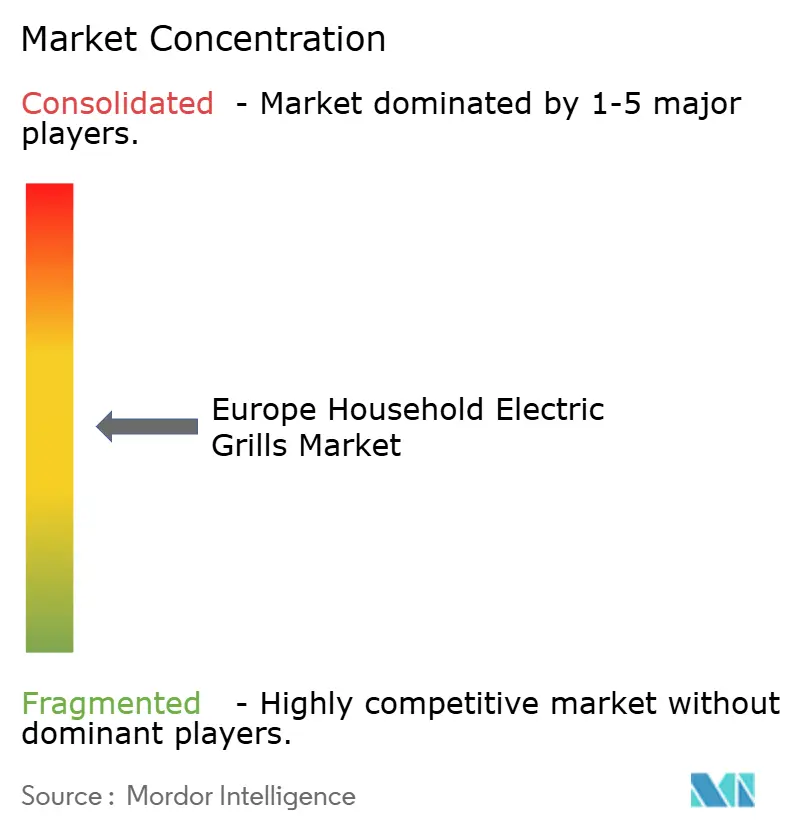
| Market Concentration | Medium |
Major Players *Disclaimer: Major Players sorted in no particular order Image © Mordor Intelligence. Reuse requires attribution under CC BY 4.0. | |
Europe Household Electric Grills Market Analysis by Mordor Intelligence
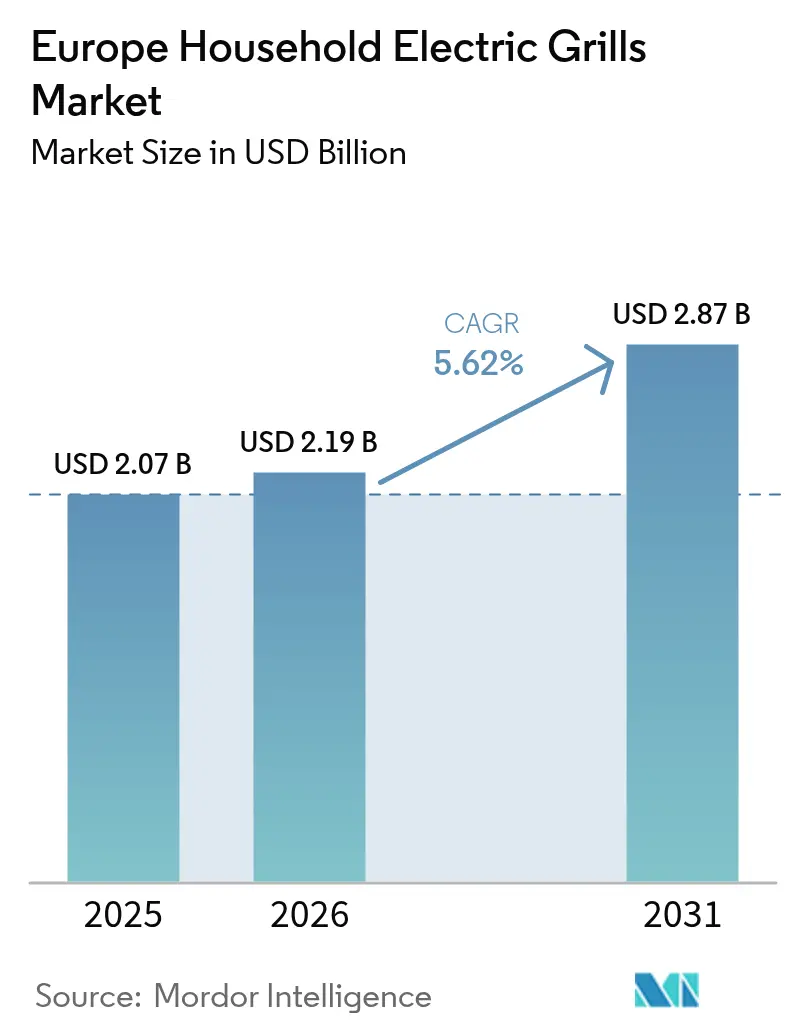
The Europe household electric grills market size was valued at USD 2.07 billion in 2025 and estimated to grow from USD 2.19 billion in 2026 to reach USD 2.87 billion by 2031, at a CAGR of 5.62% during the forecast period (2026-2031). Urbanization, tighter fire safety codes, and the European Union’s push for low-emission home appliances have accelerated adoption. Manufacturers are focusing on compact, high-performance models that fit small balconies while achieving searing temperatures comparable with gas grills. Smart-home integration and connected cooking apps are justifying premium prices, and e-commerce is widening access across the region’s fragmented retail landscape. Regulatory initiatives under the Eco-design for Sustainable Products Regulation (ESPR) have further raised the bar on energy efficiency, creating a competitive arena where sustainable design is a prerequisite rather than a differentiator.
Key Report Takeaways
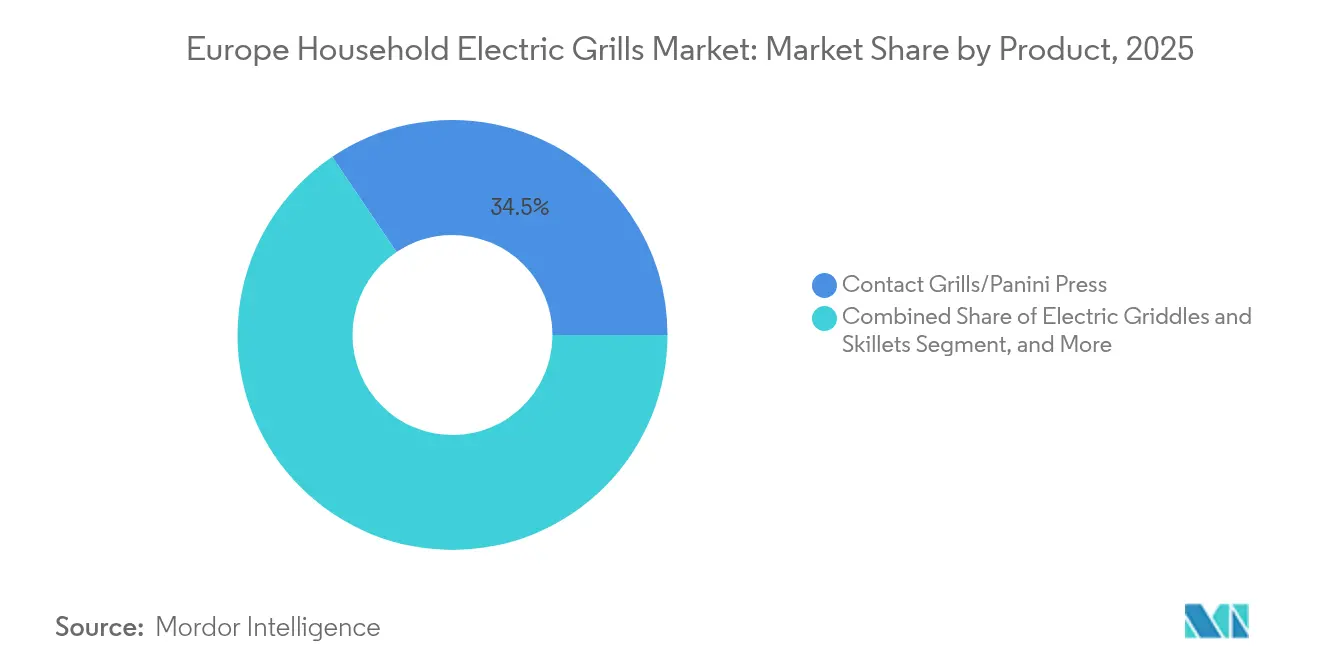
- By product category, contact grills led with 34.45% revenue share in 2025, while electric smokers are projected to expand at a 5.72% CAGR to 2031.
- By functionality, indoor models held 69.60% of the European household electric grills market share in 2025; outdoor units record the fastest CAGR at 5.95% through 2031.
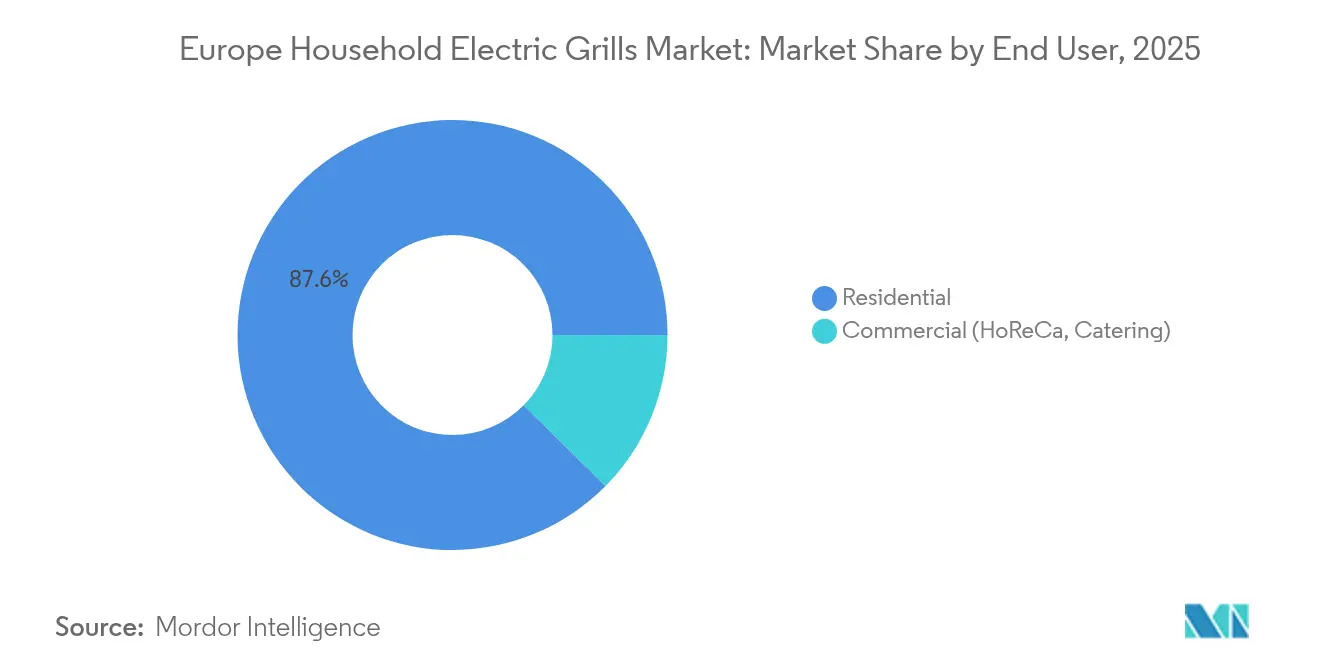
- By end-user, the residential segment accounted for 87.60% share of the Europe household electric grills market size in 2025, while commercial applications are advancing at a 5.55% CAGR.
- By distribution channel, offline retail commanded 59.70% of 2025 revenue, whereas online retail is forecast to grow at 6.85% CAGR.
- By geography, Germany led with a 20.05% share in 2025, and the Nordic region is poised for the quickest expansion at a 6.18% CAGR to 2031.
Note: Market size and forecast figures in this report are generated using Mordor Intelligence’s proprietary estimation framework, updated with the latest available data and insights as of 2026.
Market Trends and Insights
Drivers Impact Analysis of Europe Household Electric Grills Market*
| Driver | (~) % Impact on CAGR Forecast | Geographic Relevance | Impact Timeline |
|---|---|---|---|
| Urban apartment fire-code limits | +1.4% | Germany, UK, France, urban centers | Short term (≤ 2 years) |
| EU Green-Deal electrification policies | +1.7% | EU-wide; strongest in Nordics, Germany | Medium term (2-4 years) |
| Social-media-driven home-gourmet trend | +1.1% | Pan-European; highest in UK, France | Short term (≤ 2 years) |
| Smart-IoT integration | +0.9% | Germany, Nordics, UK | Medium term (2-4 years) |
| Compact balcony/patio models | +1.0% | Southern Europe urban areas | Medium term (2-4 years) |
| E-commerce direct-to-consumer brands | +0.7% | UK, Germany, Pan-European | Short term (≤ 2 years) |
| Source: Mordor Intelligence | |||
Urban Apartment Fire-Code Limits Boosting Electric Grill Adoption
European city councils have tightened fire-code restrictions, prohibiting open-flame cooking on many balconies. In markets where 72% of residents already live in urban settings, this policy shift has channeled demand toward electric solutions that meet safety regulations. The European household electric grills market is, therefore, benefiting from compact units that still reach 600°F, satisfying consumers who feared inadequate heat for searing.[1] German and French retailers reported double-digit sales growth in 2024 for models explicitly labeled “balcony-safe.” Manufacturers continue to miniaturize heating elements and incorporate ceramic coatings that boost thermal efficiency without increasing footprint.
EU Green-Deal Electrification Policies Favoring Emission-Free Cooking
The European Green Deal has embedded efficiency labels into appliance buying decisions, with 93% of consumers consulting the rating before purchase. As energy-saving measures delivered household savings up to EUR 266 (USD 313.28) in 2020, the policy narrative strengthened the total-cost-of-ownership case for electric grills. Competitive pressure within the Europe household electric grills market now centers on meeting or exceeding the A-class benchmark under the ESPR framework. Brands that earn the top tier can advertise quantifiable running-cost benefits, capturing share in price-sensitive regions and driving premium model upgrades in high-income markets.
Social-Media-Driven Home-Gourmet Grilling Trend
Lockdowns created a cohort of amateur chefs who publicize cooking results on Instagram and TikTok. Precision temperature control and smoke-free indoor operation allow visually appealing plates, positioning electric grills as tools for social affirmation. Younger urban consumers - especially in France and the UK - have broadened category participation beyond traditional barbecue audiences. The European household electric grills market is responding with colorful chassis designs, LED interfaces, and quick-share recipe libraries that transform a utilitarian appliance into a lifestyle accessory.
Smart-IoT Integration Enhancing Premium Grill Appeal
Connected grills equipped with Wi-Fi monitoring fetch price points 70% above basic models. Sensors and predictive algorithms maintain stable heat zones from 200°F to 700°F, enabling restaurant-quality results at home. Early adopters in the Nordics and Germany - regions with high smart-home penetration - are embracing remote control functions that let users adjust settings from a smartphone. As firmware updates deliver new cooking modes, owners perceive the product as an evolving platform rather than a static appliance, extending upgrade cycles and boosting repeat sales across the Europe household electric grills market.
Restraints Impact Analysis of Europe Household Electric Grills Market*
| Restraint | (~) % Impact on CAGR Forecast | Geographic Relevance | Impact Timeline |
|---|---|---|---|
| High average price vs charcoal/gas | -0.9% | Southern & Eastern Europe | Medium term (2-4 years) |
| Energy-cost inflation | -1.1% | Germany, Italy, Pan-European | Short term (≤ 2 years) |
| Perceived flavor inferiority | -0.6% | Southern Europe, Germany | Long term (≥ 4 years) |
| EU eco-design compliance costs | -0.5% | EU-wide | Medium term (2-4 years) |
| Source: Mordor Intelligence | |||
High Average Price vs Charcoal/Gas Alternatives
Electric grills still command list prices 40-60% above entry-level charcoal units, testing consumer budgets in price-sensitive regions. The economic slowdown has accelerated a “trading down” trend, with households delaying discretionary appliance purchases. Manufacturers have added lower-wattage models to mitigate sticker shock, yet engineering standards needed for fast heat-up times prevent the deep cost cuts seen in other small-appliance categories. This price gap tempers headline growth in the Europe household electric grills market, especially in Southern and Eastern Europe, where traditional wood-fired grilling remains culturally entrenched.
Energy-Cost Inflation Across Europe
Electricity tariffs rose by 12.3% in Germany and 14.7% in Italy during 2024, narrowing the operating-cost advantage once touted by electric-grill advocates. Consumers are acutely aware that a 2,000-watt grill draws similar power to a kettle or space heater. In response, vendors incorporate reflective liners, zoned heating, and idle-mode algorithms that cut power draw when the lid is closed. Although these features reduce real-world consumption, bill-shock fears continue to affect purchase intent, producing a short-term drag on the Europe household electric grills market.
*Our forecasts treat driver/restraint impacts as directional, not additive. The impact forecasts reflect baseline growth, mix effects, and variable interactions.
Europe Household Electric Grills Market Segment Analysis
By Product:
Electric Smokers Disrupting Traditional SegmentElectric smokers registered a 5.72% CAGR outlook for 2026-2031, challenging the dominance of contact grills that accounted for a 34.45% Europe household electric grills market share in 2025. Innovations such as automated smoke generators and closed-loop thermostats let novices achieve authentic barbecue flavors without constant supervision. This technology convergence has expanded the segment’s addressable audience from outdoor enthusiasts to weekday users seeking slow-cooked meals with minimal prep time.
Contact grills continue to anchor category revenue because they excel in day-to-day tasks like sandwiches and steak searing. Meanwhile, raclette tables and tabletop party grills have carved a social-dining niche, and convertible indoor-outdoor platforms cater to small-space owners wanting flexible setups for different seasons. The product spectrum illustrates a maturing European household electric grills market where consumers own multiple specialized devices rather than a single all-purpose grill.

By Functionality:
Outdoor Segment Gaining MomentumOutdoor-rated units are forecast to grow at 5.95% CAGR, eroding the indoor segment’s 69.60% market hold. Weather-sealed heating elements now reach 650°F, overcoming the historical performance gap with gas grills and enabling authentic sear marks outdoors. Balcony-sized frames comply with local bylaws, further stimulating adoption in apartment-dense cities.
The indoor category remains the workhorse of the Europe household electric grills market size due to its all-season practicality. Convertible models target households that entertain on patios during summer yet rely on countertop cooking in colder months. Vendors are layering smart-weather alerts, lid-open sensors, and recipe-driven automation across both formats, blurring the distinction and driving an upsell path toward premium SKUs.
By End-User:
Commercial Applications Expanding RapidlyThe commercial channel is projected to advance at 5.55% CAGR, even though residential buyers generated 87.60% of 2025 revenue. Hotels, cafés, and quick-service restaurants favor electric grills for smoke control in open-kitchen environments. Energy-efficiency scores heavily influence procurement teams because small percentage gains translate into measurable utility-bill savings over long service lives in the Europe household electric grills industry.
Household demand keeps pace through urbanization and the ongoing replacement of aging gas grills. Premium residential models now feature dual-zone thermostats and sous-vide integration, technologies once reserved for professional kitchens. This crossover fuels brand awareness and reinforces the perception that an electric grill can deliver professional-grade results without special ventilation infrastructure
By Distribution Channel:
Online Retail Reshaping Market AccessOnline sales are expected to climb 6.85% annually, leveraging detailed product videos and algorithmic recommendations that simplify complex specification comparisons. Direct-to-consumer entrants exploit this channel to collect first-party data and iterate designs rapidly, shortening time-to-market for new features. In Norway, for example, barbecues sold online already represent 49.3% of the garden e-commerce segment, signaling how digital-first behavior can spill into higher-ticket appliances.
Physical showrooms retain a 59.70% revenue lead because consumers still value tactile assessment before committing to premium purchases. Retailers are therefore blending QR-code-enabled demo stations and augmented-reality apps to merge the immediacy of in-store trials with the breadth of online catalogues, reinforcing omnichannel loyalty across the Europe household electric grills market.
Geography Analysis
Germany Household Electric Grills Market
Germany retained a 20.05% share of the Europe household electric grills market in 2025, underpinned by stringent urban fire codes and a culture that prizes outdoor cooking. Retail assortments emphasize balcony-safe grills capable of 600°F sear zones, features that resonate with consumers seeking authentic steakhouse results on limited outdoor space. Specialty outdoor-living chains work alongside electronics stores to showcase live demonstrations that convert sceptics.
Nordics Household Electric Grills Market
Nordic countries are forecast to grow at a 6.18% CAGR. High disposable income, environmental stewardship, and robust smart-home adoption make consumers comfortable paying premiums for connected energy-efficient models. Indoor and convertible units dominate sales due to long winters; nevertheless, summer festivals spur seasonal spikes for portable outdoor grills, highlighting cross-merchandising opportunities between appliance and leisure retailers.
Broader European Markets
The United Kingdom, France, and Italy each contribute significant volume but display distinct buyer personas. British shoppers gravitate to weather-resilient grills that promise year-round patio use. French households - often in compact apartments - prioritize slim, stylish chassis that complement modern kitchens. Italians remain wary of flavor trade-offs, so vendors promote hybrid designs capable of adding wood chips for smoke infusion. Spain, Benelux, Switzerland, and Austria round out the landscape with steady demand anchored in urban centers. These regional nuances compel brands to tailor feature sets, marketing messages, and distribution partners to local habits, ensuring the Europe household electric grills market achieves granular rather than blanket growth.
Regulatory Landscape
Household electric grills sold in the EU fall under a layered compliance stack covering product safety and electrical safety. From May 2026, the General Product Safety Regulation (EU) 2023/988 applies to consumer products, while electrical safety for appliances continues to be governed by the Low Voltage Directive (2014/35/EU), together with EMC and substance restrictions such as RoHS, which shape component selection and documentation.
Energy-use and eco-design obligations are tightening in ways that affect control boards, power management, and connected features. Commission Regulation (EU) 2023/826 introduced specific caps and test conditions for off mode, standby, and networked standby power from May 2025, and Commission Regulation (EU) 2025/2262 (dated 11 November 2025) amended elements of that framework, increasing the need for precise measurement conditions and firmware-controlled power states. The Eco-design for Sustainable Products Regulation (EU) 2024/1781 sets the broader EU direction on sustainability, repairability, and circularity, pushing manufacturers toward modular designs and longer-life components rather than relying on one-time compliance updates.
Value Chain Analysis
The value chain begins with upstream materials and components such as heating elements, thermostats and sensors, control boards, housings, and coatings. It then moves through product design and certification testing, notably against EN 60335-2-9 for portable cooking appliances, with manufacturing spread across extra-regional and European nodes. Mass-market finished goods and many electronic subassemblies are sourced from Asia, particularly China, while European footprints in countries such as Poland and Romania support final assembly, compliance testing, packaging, and localization (plugs, labeling, and software), which helps brands manage lead times and EU conformity requirements.
Midstream, brands and private-label entrants use a mix of in-house production and OEM/ODM partners to scale output, then sell through omnichannel distribution across electronics chains, specialty retailers, hypermarkets, and online marketplaces and direct-to-consumer storefronts. Physical European assets support responsiveness and cost control: Weber Barbecues operates a 50,000 square meter manufacturing and distribution center in Zabrze, Poland, while THUROS GmbH manufactures stainless steel grills in Georgenthal, Germany, and Furlan Grills uses a factory-direct model from Slovenia with centralized European shipping. Downstream value is increasingly tied to software updates, app ecosystems, and aftersales services (spares, repair, and warranties), which also aligns with EU sustainability and safety expectations.
Competitive Landscape
The market remains moderately fragmented: global appliance powerhouses, niche grill specialists, and agile direct-to-consumer labels all stake claims. Groupe SEB, through Tefal and Moulinex, reported EUR 8.3 billion (USD 9.78 billion) in sales in 2024 and controls about one-third of Europe’s small electrical cooking-appliance segment, underscoring the benefits of established channel relationships and deep R&D pipelines.[3]Electrolux secured a EUR 200 million European Investment Bank loan in April 2025 to accelerate energy-efficient product development, highlighting sustainability as a capital-attractive theme.
Smart-first challengers such as Current Backyard differentiate with app ecosystems and firmware-upgradable hardware, positioning themselves as tech platforms rather than appliance vendors. At the entry-level, Asian contract manufacturers are white-labeling basic grills for online marketplaces, compressing margins in the value tier. Mid-market players therefore face a squeeze between premium connectivity and budget commoditization, prompting joint ventures and component-sharing agreements to manage costs while adding features.
Strategic moves over the past 18 months include Weber’s January 2025 electric-focused product line, designed to compete directly with high-end gas grills, and Groupe SEB’s December 2024 acquisition of Sofilac to deepen professional-grade know-how transferable to upscale residential models. These actions illustrate how scale and specialized expertise both serve as levers to secure competitive advantage in the evolving Europe household electric grills market.
Europe Household Electric Grills Industry Leaders
-
Philips Domestic Appliances
-
Groupe SEB (Tefal, Krups)
-
Spectrum Brands (Hamilton Beach/George Foreman)
-
Weber-Stephen Products LLC
-
Kenyon
- *Disclaimer: Major Players sorted in no particular order
Europe Household Electric Grills Market Companies Covered in this Report
- Philips Domestic Appliances
- Groupe SEB (Tefal, Krups)
- Spectrum Brands (Hamilton Beach/George Foreman)
- Weber-Stephen Products LLC
- Kenyon
- Breville Group (Sage Appliances Europe)
- Severin Elektrogeräte
- WMF GmbH
- Princess Household Appliances
- Tristar Europe
- G3 Ferrari (Trevi Group)
- Klarstein (Chal-Tec GmbH)
- Ninja Kitchen (SharkNinja)
- Electrolux AB
- Landmann Grill GmbH
- Outdoorchef AG
- Traeger Grills
- Masterbuilt Manufacturing
- Bull Europe Ltd
- Alpina Appliances
Market Opportunities and Future Outlook
A clear whitespace is emerging around compliance-driven redesign and premium differentiation as EU policy tightens requirements on standby and networked standby power (Regulation (EU) 2023/826 effective from May 2025, amended in November 2025). For household electric grills, this points to opportunities in smarter power management, including idle modes, lid-closed logic, zoned heating, and reduced always-on connectivity draw. It also favors brands that can show performance at high searing temperatures while meeting stricter measurement conditions. Under the ESPR framework (EU) 2024/1781, offerings built around durability, repairability, and modular subassemblies can strengthen manufacturers that are able to support robust spare-parts and service ecosystems across Europe.
Connected grills form a second opportunity cluster as connectivity requirements shift from feature marketing toward compliance readiness. With the Cyber Resilience Act taking effect from September 2026 for connected products, brands selling Wi-Fi-enabled grills in Europe face a more formalized cybersecurity and lifecycle-update burden, raising barriers for low-cost, lightly supported connected imports and strengthening vendors that can maintain firmware, manage vulnerabilities, and support secure onboarding. On the demand side, urban space constraints still favor multi-functional, compact appliances that replace several single-purpose devices. At the same time, regional manufacturing and OEM capacity in Eastern Europe, including Poland-based manufacturing and distribution footprints and OEM partners, creates room for private-label and challenger brands to enter with localized compliance, faster replenishment, and differentiated feature bundles targeted at Germany, the Nordics, and other high smart-home penetration markets.
Recent Industry Developments in Europe Household Electric Grills Market
- May 2026: Spectrum Brands entered into a strategic partnership with Oaktree Capital Management for its Home and Personal Care business, which includes the George Foreman brand. The move supports investment and structural flexibility in a core small-appliance portfolio that competes in electric grilling, with implications for product funding, channel support, and regional go-to-market focus in Europe.
- February 2026: Groupe SEB announced its Rebound plan, including a targeted EUR 200 million savings program aimed at improving industrial efficiency. For household electric grills and adjacent cooking appliances, the initiative signals increased emphasis on cost-down engineering, supply-chain simplification, and faster compliance-oriented redesign under evolving EU requirements.
- December 2024: Groupe SEB finalized the acquisition of Sofilac to strengthen professional cooking technology capabilities that can be transferred into premium residential appliances. This adds know-how that can support higher-performance electric grilling platforms and feature upgrades positioned for European consumers trading up within connected and specialty cooking categories.
Europe Household Electric Grills Market Report Scope and Research Methodology
Market Definition and Coverage
This market covers the value of electric grill appliances bought for household use across Europe, counted at the point where the product is sold into retail and e-commerce channels and used in a home setting.
Scope exclusions: We exclude fuel-based grills, purely commercial kitchen grilling equipment, and replacement parts and accessories sold separately.
Segments Covered in This Report
- By Product
- Contact Grills/Panini Press
- Electric Griddles and Skillets
- Electric Smokers
- Raclette and Table-top Party Grills
- Convertible Indoor-Outdoor Grills
- By Functionality
- Indoor
- Outdoor
- Convertible
- By End-User
- Residential
- Commercial (HoReCa, Catering)
- By Distribution Channel
- Offline Retail - Specialty Stores
- Offline Retail - Hyper/Supermarkets
- Department Stores
- Online Retail
- By Geography
- Germany
- United Kingdom
- France
- Italy
- Spain
- Nordics (Sweden, Norway, Denmark, Finland)
- Benelux (Netherlands, Belgium, Luxembourg)
- Switzerland and Austria
- Rest of Europe
Data Sources, Market Sizing, and Validation
Desk Research
Desk research was used to build the base structure of the model and to keep country coverage consistent across Europe. We reviewed public statistics and policy signals that shape appliance demand and pricing, such as Eurostat consumption and retail trade indicators, and European Commission updates tied to eco-design and energy-efficiency requirements.
To ground the product and channel story, we also referred to sources such as national statistics offices, customs and trade publications for import and export directionality, and relevant standards and regulatory material that affects product specs. Company annual reports, investor decks, and reputable press were used to cross-check distribution shifts between online and offline, and any major product launches that can move average selling prices. Where needed, we supplemented this with paid subscriptions for company financials and news, patent search, and shipment-level import and export tracking to clarify supplier footprints. These examples are illustrative only, since many other sources were also used for data collection, validation, and clarification during research.
Primary Interviews and Surveys
Primary work focused on converting the desk assumptions into usable sizing inputs, particularly around how households choose between contact grills, griddles, raclette units, smokers, and convertible formats. We spoke with a spread of brands, distributors, retailers, and category managers across major markets and smaller European countries so that channel mix, price bands, and promotional intensity could be validated and then applied consistently.
Distribution of primary research fieldwork respondents
| Company type | Respondent position |
|---|---|
| Top tier: 25% | CXOs: 12% |
| Mid tier: 60% | Functional/Unit leaders: 34% |
| Smaller Players: 15% | Managers: 54% |
Market-Sizing & Forecasting
Sizing starts with a top-down build where household appliance demand signals and country-level consumption patterns are used to reconstruct the addressable pool for electric grills, and then we split this by product style and channel. To keep the totals realistic, we corroborate the outcome using selective bottom-up checks, such as sampled retail price tracking, country-level channel checks, and a limited roll-up of supplier revenues where disclosures were clear.
We treated a few market fingerprints as core inputs since they can be checked repeatedly across countries. These include the residential versus HoReCa demand split, the online versus offline share shift, and the typical price ladder between contact grills, griddles, raclette grills, and convertible models. We also used observed promotion seasonality around key retail events, and the effect of energy-efficiency and eco-design discussions on product refresh cycles, which tends to influence replacement buying and average prices.
For forecasting, we used scenario analysis so near-term swings in discretionary spending and pricing are handled without forcing one straight-line trend. Assumptions on price progression and channel mix were stress-tested through primary feedback, and where bottom-up checks were incomplete, we applied country-level proxies (for example, using similar income levels and retail structure markets) before finalizing the totals.
Data Validation & Update Cycle
Validation is done through multiple passes so outliers are identified early and corrected with supporting evidence. We compared model outputs against independent signals, such as major retail category performance, import and export directionality, and the implied average selling price movement by product type, and then we revisited any large variance at the country and channel level.
Before sign-off, the model and assumptions go through an analyst review so math checks, currency timing, and cross-country consistency are confirmed. Reports are refreshed once a year, and interim updates are made when a material event occurs (for example, a major regulatory change or a clear demand shock). Right before delivery, we run a final check to ensure clients receive the latest updated view rather than an older snapshot.
Mordor Intelligence's Europe Household Electric Grills Market Size Versus Other Published Estimates
Published market sizes for household electric grills in Europe can differ even when they sound similar, because the included products, the counted end-users, and the pricing logic are not always aligned. Variance also comes from whether the number represents retail value, manufacturer value, or a mix of both, which can change the total quickly.
The benchmark table shows a spread, and in the Mordor Intelligence model the value is counted for Europe household electric grills with a clear separation of residential demand from smaller HoReCa usage, while also keeping fuel-based grills and standalone accessories out of the total. Some other estimates blend in broader small kitchen appliances, or they treat online marketplace pricing and promotions in a simplified way, which can lift or suppress the implied average selling price depending on the year chosen.
Benchmark comparison
| Source | Market Size | Gaps in Research Methodology |
|---|---|---|
| Mordor Intelligence | USD 2.07 B (2025) | |
| Trade Journal A | USD 1.86 B (2025) | Uses a narrower product list that largely emphasizes contact grills and excludes raclette and convertible formats in several countries, which reduces the modeled volume base. |
| Regional Consultancy B | USD 2.42 B (2025) | Appears to use a broader kitchen appliance scope and a retail-price assumption that does not fully net out promotion intensity and channel mix, which increases the implied ASP. |
Across the three figures, the main drivers of variance come down to what is counted as an electric grill, how residential versus HoReCa demand is treated, and how pricing is normalized across online and offline channels. By tying the total back to repeatable inputs such as country coverage, product mix, and channel-level pricing checks, the estimate is designed to be practical to recreate and easier to audit year over year.
Key Questions Answered in the Report
What is the current value of the Europe household electric grills market?
The market stood at USD 2.19 billion in 2026 and is projected to reach USD 2.87 billion by 2031.
Which product segment is growing fastest?
Electric smokers are forecast to grow at 5.72% CAGR, outpacing other categories due to innovations that replicate traditional smoking with minimal effort.
Why are outdoor electric grills gaining traction?
Improved heating elements now achieve authentic sear temperatures, while balcony-friendly footprints and compliance with fire regulations make them attractive for urban residents.
How are EU regulations influencing product design?
The Eco-design for Sustainable Products Regulation requires higher energy efficiency and repairability, pushing manufacturers toward modular components and A-class energy labels.
What role does smart-home technology play in market growth?
Wi-Fi connectivity and predictive cooking algorithms command price premiums and appeal to tech-savvy consumers, especially in the Nordics and Germany.