
Market Overview
| Study Period | 2020 - 2031 |
|---|---|
| Forecast Data Period | 2026 - 2031 |
| Base Year Market Size (2025) | USD 4.17 Billion |
| Market Size (2026) | USD 4.41 Billion |
| Market Size (2031) | USD 5.86 Billion |
| Growth Rate (2026 - 2031) | 5.84 % |
| Market Concentration | High |
Major Players *Disclaimer: Major Players sorted in no particular order Image © Mordor Intelligence. Reuse requires attribution under CC BY 4.0. | |
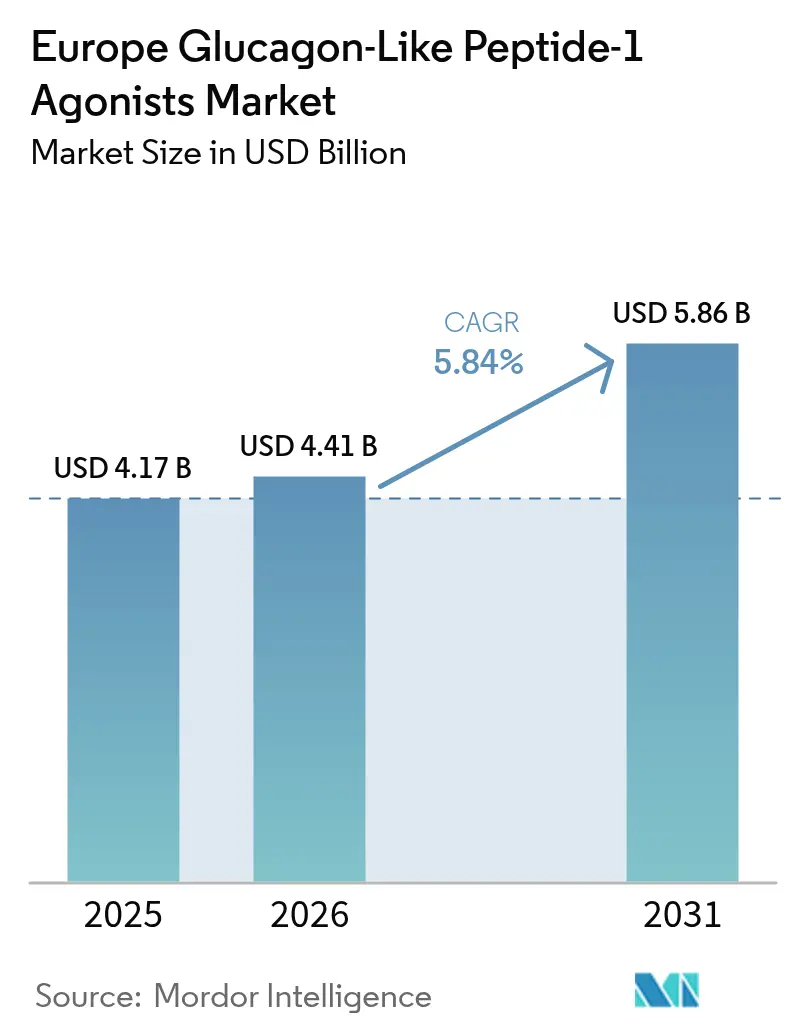
Europe Glucagon-Like Peptide-1 Agonists Market Analysis by Mordor Intelligence
The Europe Glucagon-Like Peptide-1 Agonists Market size market is expected to grow from USD 4.17 billion in 2025 to USD 4.41 billion in 2026 and is forecast to reach USD 5.86 billion by 2031 at 5.84% CAGR over 2026-2031.
The market is growing primarily due to new drug launches. Europe has approximately 57 million adults living with diabetes, and this number is expected to reach 75 million by 2026, which would represent around 10% of the total population of Europe. Europe's expenditure on diabetes is 9% of its total healthcare expenditure. Spending on diabetes largely varies among countries in Europe. It ranges from EUR 312 per capita in the Republic of Macedonia, to EUR 6,896 per capita in Norway. Similarly, the prevalence is also highly varied across Europe, ranging from 2.8% in Albania to 9.8% in Portugal. In high-income countries, diabetes is one of the leading causes of cardiovascular disease, blindness, kidney failure, and lower limb amputation.
Note: Market size and forecast figures in this report are generated using Mordor Intelligence’s proprietary estimation framework, updated with the latest available data and insights as of 2026.
Europe Glucagon-Like Peptide-1 Agonists Market Trends and Insights
The dulaglutide segment occupies the highest market share in the Europe Glucagon-Like Peptide-1 Agonists Market in the current year
The dulaglutide segment holds the highest share in the Europe Glucagon-Like Peptide-1 Agonists Market in the current year and is expected to register a CAGR of about 8.3% over the forecast period.
According to the IDF, the overall diabetes expenditure in Europe among the population aged 20-79 years was USD 156 billion, and it is expected to increase to USD 174 billion by 2040. These figures indicate that approximately 9% of the total healthcare expenditure is spent on diabetes in Europe. The rapidly increasing incidence and prevalence of diabetic patients and healthcare expenditure are indications of the increasing usage of diabetic drugs.
GLP1RAs have been available internationally and are recommended when treatment escalation for type 2 diabetes is required after metformin and lifestyle management. They can be safely used with all other glucose-lowering therapies except vildagliptin. Dulaglutide (Trulicity) is a weekly subcutaneous GLP1RA that reduces HbA1c with additional weight loss and cardiorenal protection benefits. Therapy with dulaglutide allows many patients to reach and maintain target HbA1c without insulin and sulfonylureas, eliminating the associated hypoglycemia risk. GLP1RAs elicit greater weight reduction and are recommended over SLGT2 inhibitors when cerebrovascular disease other than heart failure or renal disease predominates.
The government and the companies are working towards better diabetes management. For instance, the National Service Framework (NSF) program is improving services by setting national standards to drive up service quality and tackle variations in care. The Association of British HealthTech Industries (ABHI) launched a diabetes section, enabling diabetes technology companies to work together in the first forum of its kind. Such advantages have helped the rise in the market growth.
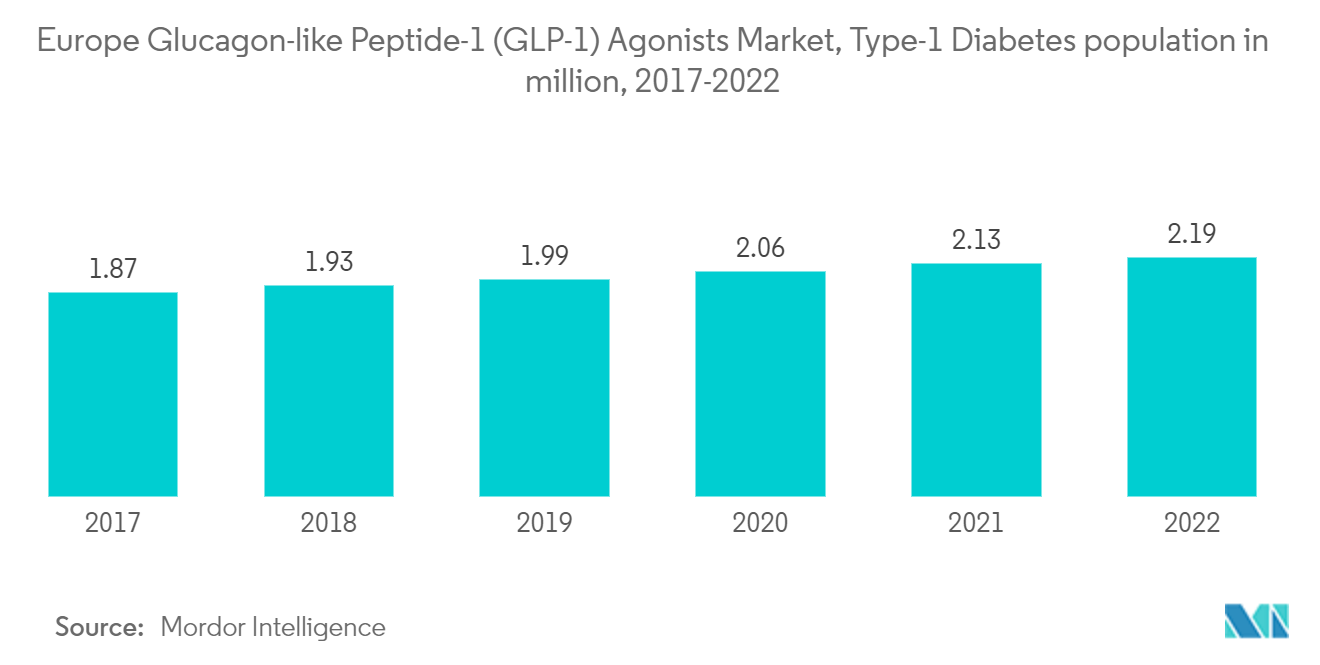
Germany is expected to register the highest CAGR in the Europe Glucagon-Like Peptide-1 Agonists Market over the forecast period
Germany is expected to register the highest CAGR of about 7.8% in the Europe Glucagon-Like Peptide-1 Agonists Market over the forecast period.
According to the German Diabetes Centre (DDZ), about 8.5 million people in Germany are affected by diabetes. The number of people with type 2 diabetes in Germany will continue to increase over the next twenty years. Diabetes is a significant health problem and one of the astounding challenges for healthcare systems all over Germany. The prevalence of known type 1 & 2 diabetes in the German adult population is very high, along with many patients not yet diagnosed with the disease. Due to an aging population and unhealthy lifestyle, the prevalence of type 2 diabetes is expected to increase steadily over the next few years. High-quality care, including adequate monitoring, control of risk factors, and active self-management, are the key factors for preventing complications in German patients with type 2 diabetes.
The disease's growing incidence, prevalence, and progressive nature have encouraged the development of new drugs to provide additional treatment options for dietic patients. Non-insulin treatments, used as first-line therapies for patients who have diabetes, currently capture more than half the sales in the anti-diabetics market. German law requires public plans to cap out-of-pocket health care costs and to cover all medically necessary treatment, including insulin. Germany is one of the developed countries with advanced healthcare facilities. Moreover, reimbursement and pricing policies are highly regulated, which drives the market.
The roll-out of many new products, increasing international research collaborations in technology advancement, and increasing awareness about diabetes among people are some market opportunities for the players in the German diabetes drugs market.
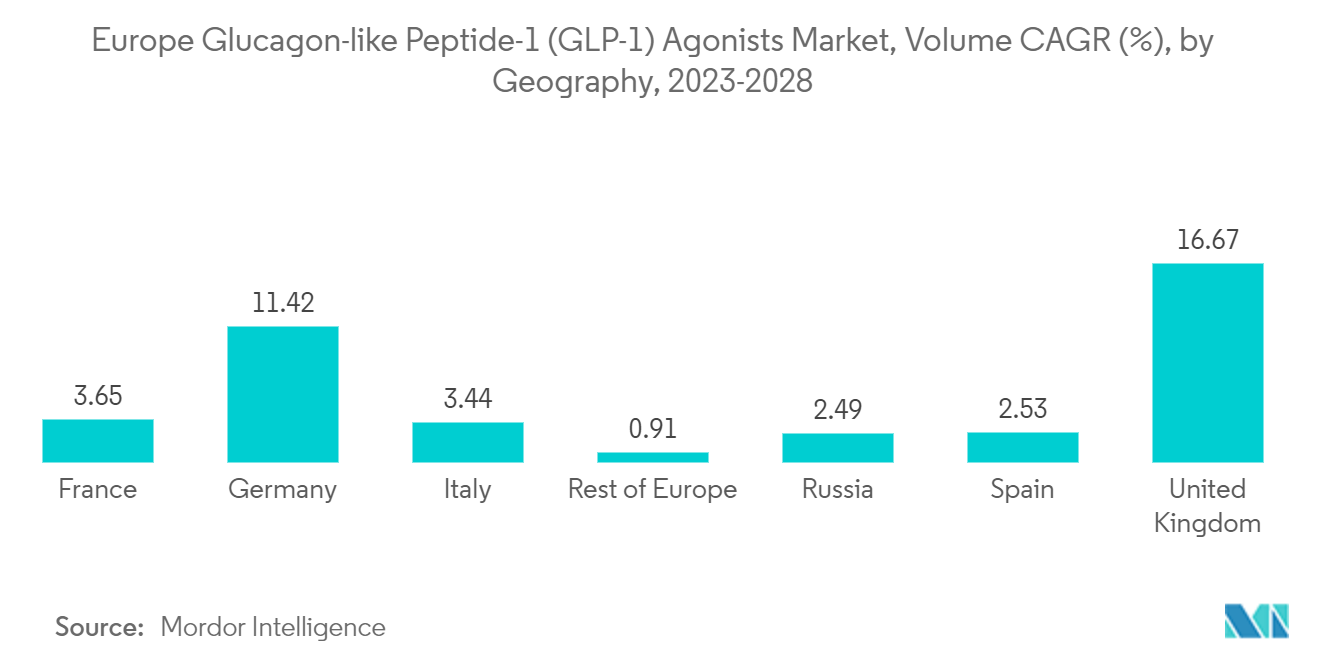
Competitive Landscape
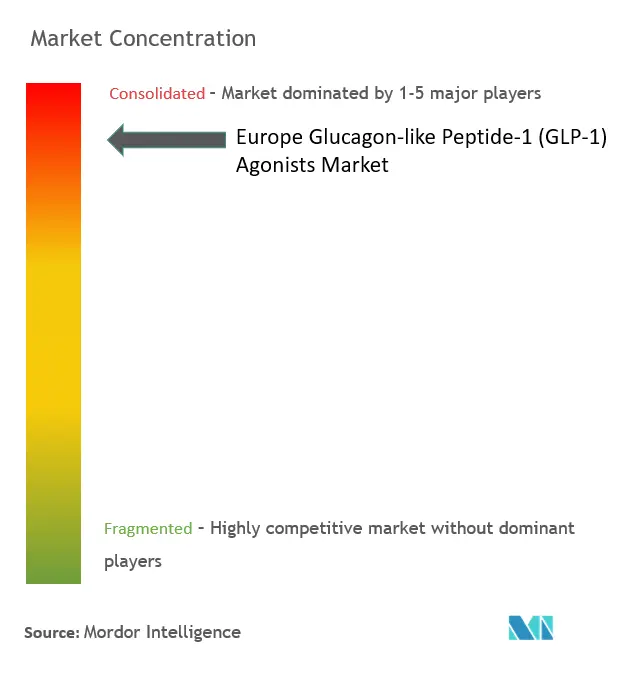
The Europe Glucagon-Like Peptide-1 Agonists Market is consolidated, with major manufacturers, namely Eli Lilly, Sanofi, Novo Nordisk, AstraZeneca, etc., holding a presence in the region.
Europe Glucagon-Like Peptide-1 Agonists Industry Leaders
-
Novo Nordisk
-
AstraZeneca
-
Eli lilly and Company
-
Sanofi
-
Pfizer
- *Disclaimer: Major Players sorted in no particular order
Market Opportunities and Future Outlook
Ongoing GLP-1 receptor agonist shortages across EU Member States, addressed through the EMA-led Medicine Shortages Steering Group recommendations, have created room for supply-chain localization and additional capacity within Europe. That opportunity is now supported by manufacturing commitments, including Novo Nordisk's March 2026 announcement of a EUR 432 million expansion in Athlone, Ireland, to increase capacity for oral GLP-1 therapies, alongside Eli Lilly's November 2025 plan to build a USD 3 billion manufacturing facility in Katwijk, the Netherlands, aimed at oral medicines including the GLP-1 receptor agonist orforglipron.
Access models are also expanding beyond injectable-only regimens toward oral options, which changes how persistence and prescribing evolve across diabetes and weight management. In May 2026, the EMA's CHMP adopted a positive opinion recommending approval for Wegovy oral tablets for weight management, adding lifecycle-management opportunities across semaglutide, dulaglutide, and other GLP-1RA classes. As companies expand European oral solid-dose capabilities, including tabletting, automation, and analytical controls, and regulators coordinate shortage mitigation actions, procurement discussions and portfolio strategies increasingly emphasize securing European supply for high-demand GLP-1 therapies.
Recent Industry Developments
- June 2026: Novo Nordisk confirmed its Jevany, Czech Republic, production facility started operations, following an investment of more than CZK 8 billion to make components used in diabetes and obesity medicines. The start-up adds regional industrial capacity and strengthens supply resilience for high-demand GLP-1-linked product portfolios across Europe.
- November 2025: Eli Lilly announced plans to build a new USD 3 billion manufacturing facility in Katwijk, the Netherlands (Leiden Bio Science Park) to produce oral medicines, including the oral GLP-1 receptor agonist orforglipron. The project shows a shift toward scaling oral formulation capacity in Europe and broadening beyond injectable supply chains.
- December 2024: Novo Nordisk announced an investment of DKK 8.5 billion to build a new production facility in Odense, Denmark, with completion planned for 2027. The expansion highlights continued capital deployment to increase manufacturing throughput for diabetes and obesity medicines amid elevated demand.
Research Methodology Framework and Report Scope
Market Definition and Coverage
This market is defined as the revenue generated from prescription GLP-1 receptor agonist medicines sold and used across Europe, measured at the therapy level and captured in USD value for the study period.
Scope exclusions: We exclude non-GLP-1 diabetes drugs, devices for injection or monitoring, and non-prescription weight management products.
Segmentation Overview
- Drug
- Exenatide
- Byetta
- Bydureon
- Liraglutide
- Victoza
- Lixisenatide
- Lyxumia
- Dulaglutide
- Trulicity
- Semaglutide
- Ozempic
- Exenatide
- Geography
- Germany
- Spain
- Italy
- France
- United Kingdom
- Russia
- Rest of Europe
Data Sources, Market Sizing, and Validation
Desk Research
Desk work starts by mapping the treated patient pool and the therapy environment in Europe, before numbers are modeled. We refer to public health and statistics sources such as the World Health Organization, OECD Health Statistics, Eurostat, and the European Medicines Agency, which help us anchor prevalence, diagnosis, and treatment practice signals by country.
The desk phase is then extended using sources such as national health ministry publications, national reimbursement and HTA bodies, clinical guideline groups, and peer reviewed journals that summarize dosing and switching patterns for GLP-1 therapies. We also review annual reports, investor presentations, and press releases to understand product availability, label updates, and any major supply constraints, and we selectively use paid company financials and patent databases for cross checks on revenue direction and pipeline timing. This list is not exhaustive, and many other public sources were consulted to collect data, validate assumptions, and clarify open questions.
Primary Interviews and Surveys
Primary work was used to pressure test the desk assumptions and to fill gaps that are hard to read from public documents, especially around real world uptake, reimbursement friction, and brand level volume mix. We spoke with stakeholders across the value chain, including clinicians, hospital and retail pharmacy contacts, payers, and distribution side experts, with coverage balanced across major European markets and the rest of the region.
Distribution of primary research fieldwork respondents
| Company type | Respondent position |
|---|---|
| Top tier: 31% | CXOs: 18% |
| Mid tier: 51% | Functional/Unit leaders: 36% |
| Smaller Players: 18% | Managers: 46% |
Market-Sizing & Forecasting
Sizing is built using a top-down patient based demand pool, where diagnosed type 2 diabetes prevalence and treatment intensity are converted into GLP-1 therapy volumes and then priced into revenue. Before the final totals are locked, selective bottom-up approximations are used, such as sampled country brand volume checks and ASP times unit logic, which are then adjusted when the direction does not match the demand signals.
The model uses practical inputs that can be explained and tracked, including diabetes prevalence and growth, treated patient share on injectables, average dose and persistence by therapy, country level reimbursement breadth, and typical list to net price behavior where relevant. Because Europe is not one uniform market, assumptions are set at country level and then aggregated, and missing data points are handled through peer country proxies and rechecks with interview feedback.
For forecasting, scenario analysis is used, since uptake is shaped by reimbursement decisions, label expansions, and supply continuity, which can change faster than a smooth time series would suggest. The base case uses expected launch timing and adoption curves validated by primary insights, and then the sensitivity ranges are tested against plausible shifts in access and pricing.
Data Validation & Update Cycle
Model outputs are validated through multiple checks, so the final number does not rely on one data stream. We compare implied revenue per treated patient, country to country uptake patterns, and year over year growth against independent signals, and any sharp variance is reviewed back to the underlying assumptions before sign off.
A second analyst review is done to confirm math, unit conversions, and country aggregation logic, and follow up outreach is triggered when interview feedback conflicts with the desk story. Reports are refreshed annually, with interim updates when material events occur such as major reimbursement shifts, supply disruptions, or label changes, and a final pre delivery pass is completed so the view reflects the latest available information.
Mordor Intelligence's Europe Glucagon Like Peptide 1 Agonists Market Size Compared Against Other Published Estimates
Published market sizes for Europe GLP-1 agonists can look far apart, even when the topic sounds the same at first glance. The differences usually come from what is counted as part of the market, the year selected for the base, and how pricing and adoption are assumed to move over time.
The key gap drivers in this market are whether obesity focused use is included alongside diabetes, whether newer dual acting therapies are counted within the same bucket, and whether totals reflect list prices or net realized pricing after rebates. Currency conversion timing and how quickly access changes are reflected in the model also matter, because a single reimbursement update in a large country can swing the regional total.
Benchmark comparison
| Source | Market Size | Gaps in Research Methodology |
|---|---|---|
| Mordor Intelligence | USD 4.41 B (2026) | |
| Trade Publication A | USD 7.09 B (2024) | This figure is presented with obesity treatment included alongside type 2 diabetes, and it also lists newer molecules that may be grouped outside a strict GLP-1 only scope, which can lift the total versus a narrower therapy definition. |
| Regional Research Outlet B | USD 8.70 B (2026) | The estimate appears to extend the scope to broader cardiometabolic indications and a wider product pool, and the faster growth profile suggests more aggressive uptake and pricing progression assumptions across Europe. |
The table shows a clear spread, and in Mordor Intelligence's model the count is limited to GLP-1 receptor agonists used for type 2 diabetes across the covered European countries, which keeps obesity led revenues and adjacent cardiometabolic indications outside the total. When scope, pricing basis, and update timing are aligned, the remaining differences become easier to trace to adoption speed and access assumptions rather than simple arithmetic.
Key Questions Answered in the Report
How big is the Europe Glucagon-Like Peptide-1 Agonists Market?
The Europe Glucagon-Like Peptide-1 Agonists Market size is expected to reach USD 4.41 billion in 2026 and grow at a CAGR of 5.84% to reach USD 5.86 billion by 2031.
What is the current Europe Glucagon-Like Peptide-1 Agonists Market size?
In 2026, the Europe Glucagon-Like Peptide-1 Agonists Market size is expected to reach USD 4.41 billion.
Who are the key players in Europe Glucagon-Like Peptide-1 Agonists Market?
Novo Nordisk, AstraZeneca, Eli lilly and Company, Sanofi and Pfizer are the major companies operating in the Europe Glucagon-Like Peptide-1 Agonists Market.
What years does this Europe Glucagon-Like Peptide-1 Agonists Market cover, and what was the market size in 2025?
In 2025, the Europe Glucagon-Like Peptide-1 Agonists Market size was estimated at USD 4.41 billion. The report covers the Europe Glucagon-Like Peptide-1 (GLP-1) Agonists Market historical market size for years: 2019, 2020, 2021, 2022, 2023 and 2024. The report also forecasts the EEurope Glucagon-Like Peptide-1 Agonists Market size for years: 2026, 2027, 2028, 2029, 2030 and 2031.