
Market Overview
| Study Period | 2020 - 2031 |
|---|---|
| Forecast Data Period | 2026 - 2031 |
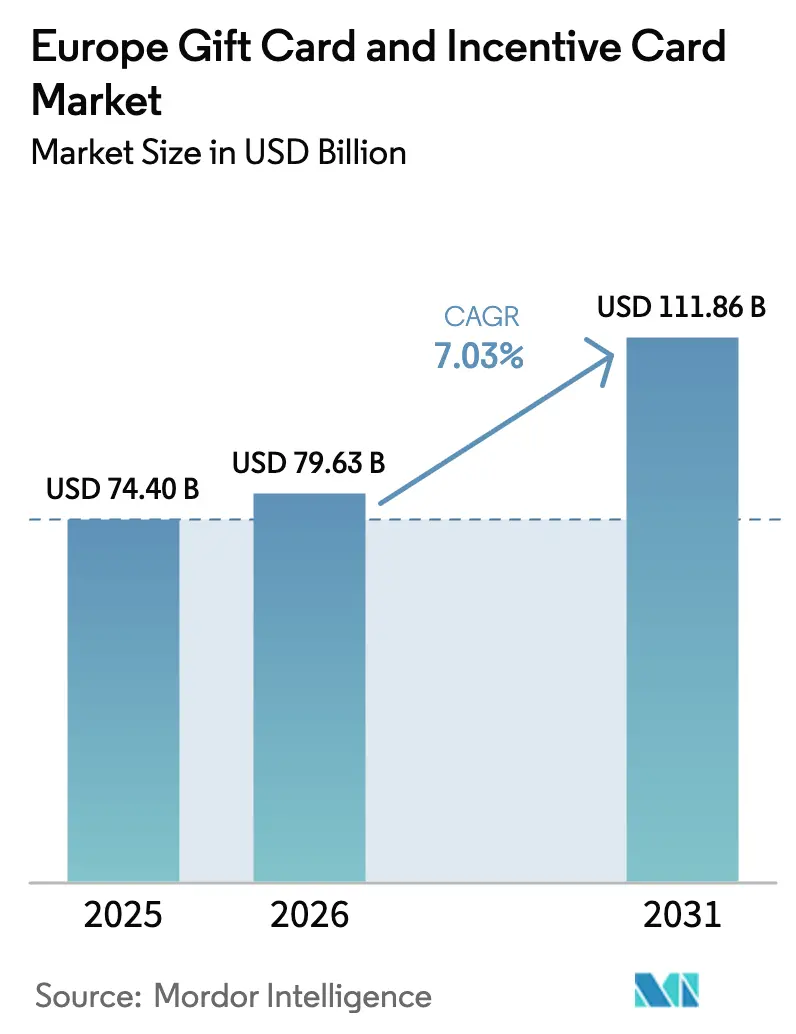
| Base Year Market Size (2025) | USD 74.40 Billion |
| Market Size (2026) | USD 79.63 Billion |
| Market Size (2031) | USD 111.86 Billion |
| Growth Rate (2026 - 2031) | 7.03 % |
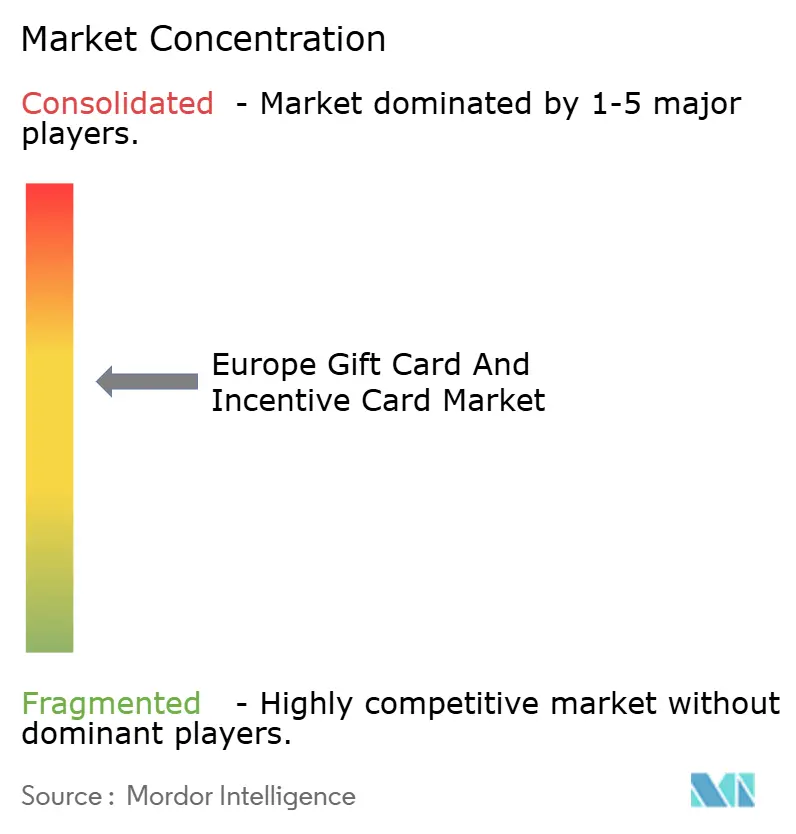
| Market Concentration | Medium |
Major Players *Disclaimer: Major Players sorted in no particular order Image © Mordor Intelligence. Reuse requires attribution under CC BY 4.0. | |
Europe Gift Card And Incentive Card Market Analysis by Mordor Intelligence
The European gift card and incentive card market size was valued at USD 74.40 billion in 2025 and estimated to grow from USD 79.63 billion in 2026 to reach USD 111.86 billion by 2031, at a CAGR of 7.03% during the forecast period (2026-2031). An expanding digital-payment ecosystem, widespread mobile-wallet acceptance, and instant-payment rails anchor this growth path. Corporate incentive budgets remain the largest revenue engine, yet Gen-Z self-use and budgeting habits add a steady, non-seasonal layer of demand. PSD3 and the EU Digital Identity Wallet streamline KYC and enable instant top-ups, partially offsetting new EUR 150 value caps for anonymous prepaid loads. Municipal multi-merchant schemes and pan-European payment initiatives further expand addressable volumes by reducing cross-border frictions inside the European gift card and incentive card market. Competitive intensity is moderate: scale incumbents exploit pan-regional settlement infrastructure, while API-first fintechs target niche use cases and geography gaps to win share.
Key Report Takeaways
- By card type, closed-loop products held 58.15% of the Europe gift card and incentive card market share in 2025, while open-loop formats in the Europe gift card and incentive card market are projected to expand at a 8.78% CAGR to 2031.
- By format, digital cards captured 57.80% of the Europe gift card and incentive card market size in 2025, and digital issuance across the Europe gift card and incentive card market is expected to advance at a 10.12% CAGR over the forecast period.
- By consumer type, the corporate B2B segment commanded 66.10% of the Europe gift card and incentive card market in 2025, whereas individual B2C demand within the Europe gift card and incentive card market is growing fastest at an 8.42% CAGR through 2031.
- By distribution channel, online sales accounted for 61.90% of the Europe gift card and incentive card market size in 2025, and online penetration in the Europe gift card and incentive card market is rising at a 11.75% CAGR.
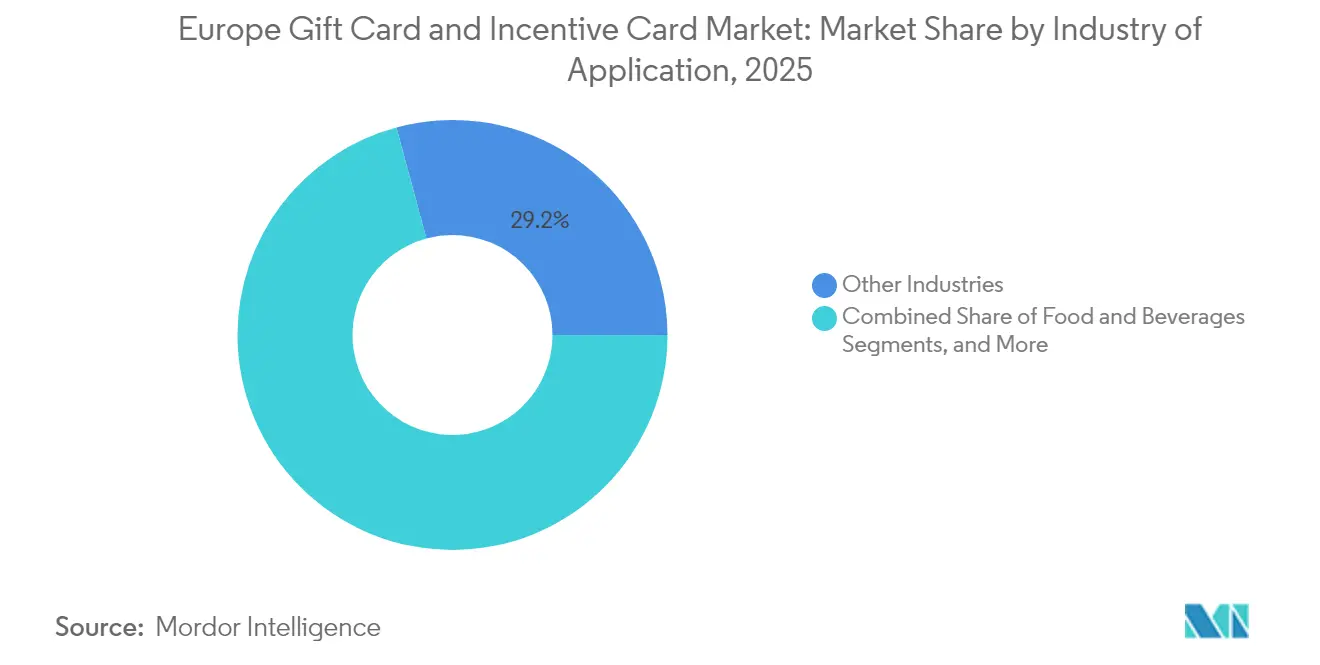
- By industry application, the other industries segment held a 29.20% of the Europe gift card and incentive card market size in 2025, whereas consumer electronics leads growth in the Europe gift card and incentive card market, registering a 10.05% CAGR to 2031 and outpacing traditional categories such as food & beverages.
- By country, the United Kingdom dominated with 23.30% revenue share of the Europe gift card and incentive card market in 2025, while Spain is the fastest-growing national segment of the Europe gift card and incentive card market at a 9.10% CAGR.
Note: Market size and forecast figures in this report are generated using Mordor Intelligence’s proprietary estimation framework, updated with the latest available data and insights as of 2026.
Market Trends and Insights
Drivers Impact Analysis of Europe Gift Card And Incentive Card Market*
| Driver | (~) % Impact on CAGR Forecast | Geographic Relevance | Impact Timeline |
|---|---|---|---|
| E-commerce & mobile-wallet proliferation | +1.8% | Global, Nordic leadership | Medium term (2–4 years) |
| Corporate incentive program scaling | +2.1% | DACH, Benelux, Nordics | Long term (≥ 4 years) |
| Gen-Z self-use & budgeting adoption | +1.2% | Urban EU markets | Medium term (2–4 years) |
| Municipal “local town” multi-merchant cards | +0.7% | Belgium, Netherlands first-movers | Long term (≥ 4 years) |
| PSD3 & EU Digital ID instant top-ups | +1.4% | EU-wide | Short term (≤ 2 years) |
| Source: Mordor Intelligence | |||
E-commerce & Mobile-Wallet Proliferation
Mobile commerce now drives a growing share of online checkouts, and contactless payments dominate point-of-sale volumes across the Nordics[1]. As wallets gain ubiquity, consumers increasingly perceive stored-value gift cards as a frictionless extension of everyday payment habits. Tokenized redemption removes checkout barriers and encourages spontaneous gifting, especially on cross-border sites where traditional cards incur higher FX fees. Retailers benefit from lower chargeback rates and richer data streams, bolstering loyalty integrations and reinforcing sustained momentum within the Europe gift card and incentive card market.
Corporate Incentive Program Scaling
European employers facing tight labor markets allocate larger non-cash reward budgets. Digital gift cards deliver measurable engagement, tax efficiency, and instant distribution at scale. Integration with HRIS and ERP platforms allows automated loading, real-time spend tracking, and multi-country compliance. Edenred’s pan-regional acquisitions exemplify a land-and-expand strategy designed to deepen wallet share across client portfolios[2]. Strong average order values and recurring cycles stabilize revenue flows and extend the corporate segment’s dominance in the Europe gift card and incentive card market.
Municipal “Local Town” Multi-Merchant Cards
Belgian and Dutch municipalities issue prepaid cards restricted to local post codes, funneling consumer euros into neighborhood SMEs and tracking economic impact through anonymized redemption data. Merchants welcome guaranteed footfall, and city councils leverage ESG narratives to secure EU cohesion fund grants. Fintech operators gain subsidized marketing and an early seat at future stimulus rounds, positioning the Europe gift card and incentive card market for deeper public-sector integration over the long term.
PSD3 & EU Digital ID Wallet-Enabled Instant Top-Ups
PSD3 elevates instant credit transfers, harmonizes data-access rules, and lowers authentication frictions, while the EU Digital Identity Wallet pilots bundle biometric IDs with payment credentials. Gift card issuers can embed “top-up now” buttons that pull verified IBANs directly, eliminating card-scheme costs and reducing fraud exposure. Visa’s participation in the 80-member pilot signals mainstream backing for the initiative. The convergence of regulatory and technology upgrades widens cross-border acceptance and further scales the Europe gift card and incentive card market.
Restraints Impact Analysis of Europe Gift Card And Incentive Card Market*
| Restraint | (~) % Impact on CAGR Forecast | Geographic Relevance | Impact Timeline |
|---|---|---|---|
| Digital gift-card fraud & chargebacks | -0.8% | High-volume markets | Short term (≤ 2 years) |
| KYC/AML value-cap constraints | -0.6% | EU-wide | Medium term (2–4 years) |
| Impending Digital Euro & Wero scheme substitution risk | -1.1% | Eurozone core | Long term (≥ 4 years) |
| Source: Mordor Intelligence | |||
Digital Gift-Card Fraud & Chargebacks
Fraud rings exploit rapid code delivery and anonymous loads, causing direct issuer losses and regulatory scrutiny. Mastercard’s ScamClassifier categorizes emerging attack vectors and highlights the speed at which criminals pivot toward new channels. While advanced analytics mitigate risks, smaller providers face resource constraints, and heightened fraud chatter can temper consumer appetite in the Europe gift card and incentive card market.
Impending Digital Euro & Wero Scheme Substitution Risk
The ECB’s planned Digital Euro, capped at EUR 1,500–2,500 per wallet, aims to facilitate small-ticket retail payments[3]. In parallel, the Wero consortium’s instant SCT-Inst network challenges international scheme dominance. Both could displace basic stored-value use cases, yet branded promotions and analytics-rich loyalty functions offer defensible niches for gift card providers inside the Europe gift card and incentive card market.
*Our forecasts treat driver/restraint impacts as directional, not additive. The impact forecasts reflect baseline growth, mix effects, and variable interactions.
Europe Gift Card And Incentive Card Market Segment Analysis
By Card Type:
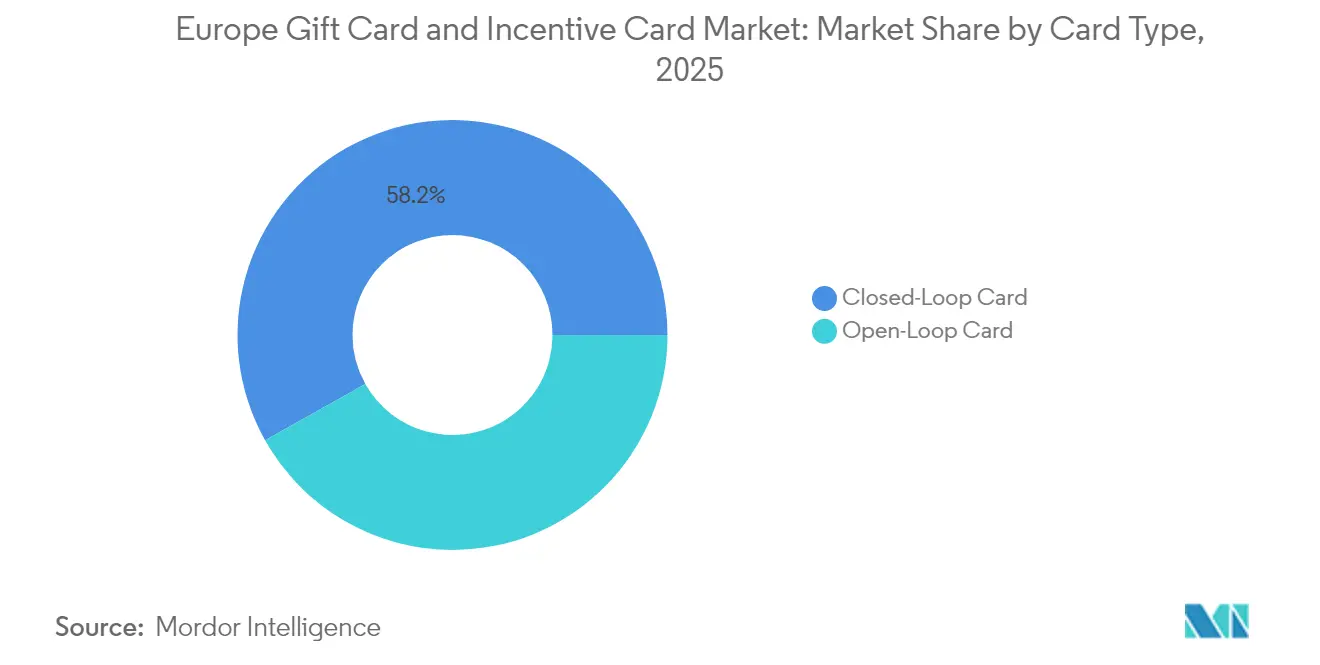
Closed-Loop Dominance Faces Open-Loop InnovationClosed-loop cards generated 58.15% of the Europe gift card and incentive card market size in 2025, capitalizing on retailer loyalty integrations and predictable redemption flows. However, open-loop formats are expected to post a 8.78% CAGR over the forecast period as cross-border shoppers and remote workers value universal acceptance. Mastercard tokenization upgrades narrow perceived fraud gaps and boost merchant acceptance, reinforcing open-loop momentum across the Europe gift card and incentive card market.
Retailers counter with enhanced closed-loop perks—tiered cashback, bonus credit events, and app-native gamification—that elevate lifetime value. Fintech aggregators now embed both card types in unified catalogs, letting corporate clients toggle based on workforce dispersion, tax treatment, and redemption analytics. As EU Digital ID wallets go live, cross-border acceptance gaps shrink, further redefining share dynamics.

By Format Type:
Digital Cards Achieve Critical MassDigital issuance surpassed physical cards in 2025, capturing 57.80% of the Europe gift card and incentive card market size and is projected to expand at 10.12% CAGR. Environmental targets, instant delivery expectations, and mobile-wallet storage drive this inflection. QR codes, NFC passes, and printable e-wrappers combine convenience with sharable aesthetics. Physical variants still resonate where tactile gifting matters, yet rising parcel fees and plastic-waste regulations keep the pendulum firmly in digital’s favor.
Gamified balance-boost campaigns and AI-derived purchase prompts further lift redemption velocity. Providers redeploy savings from reduced printing into richer customer-service chatbots and localized language support, sharpening their competitive edge within the Europe gift card and incentive card market.
By Consumer Type:
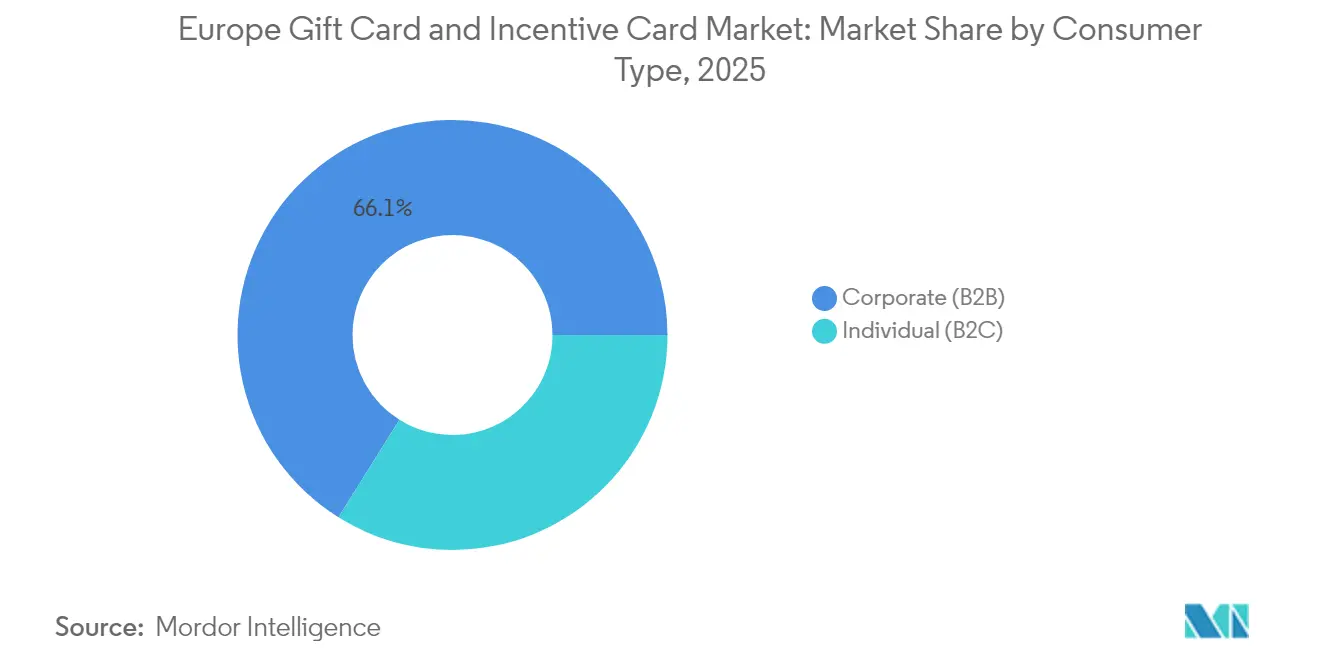
Corporate Segment Drives Value CreationCorporate buyers accounted for 66.10% of the Europe gift card and incentive card market size; bulk procurement cycles linked to onboarding kits and seasonal spot bonuses underpin resilient demand. Real-time API issuance reduces HR workload across multi-country entities and provides audit-ready spend reports. Individual B2C usage, fueled by Gen-Z self-budgeting, grows at 8.42% CAGR, lengthening average redemption cycles and flattening the once-pronounced holiday spike inside the Europe gift card and incentive card market.
By Distribution Channel:
Online Channels Capture Digital TransformationOnline portals held 61.90% of the Europe gift card and incentive card market size in 2025 and are climbing at 11.75% CAGR. Direct API distribution to BNPL apps, neobanks, and e-commerce checkouts extends reach with negligible marginal cost. Offline supermarket racks and petrol stations still attract impulse purchasers, but footfall momentum migrates toward click-and-collect models that pair e-purchases with in-store pick-up, sustaining a hybrid path for future growth.
By Industry Application:
Consumer Electronics Emerge as Growth LeaderThe other industries segment held 29.20% of the Europe gift card and incentive card market size in 2025. Consumer electronics outpace all verticals with a 10.05% CAGR, reflecting high average selling prices and tech-savvy employee rewards. Retailers preload gift cards ahead of flagship product releases, locking in demand and smoothing supply planning cycles. Travel, entertainment, and professional-services segments maintain solid single-digit trajectories through loyalty tie-ins and promotional bundles, reinforcing the Europe gift card and incentive card market’s sector diversity.
By Country:
UK Leadership Meets Spanish AccelerationThe United Kingdom retained 23.30% of the Europe gift card and incentive card market size in 2025, benefiting from established corporate-benefit cultures and mature open-banking rails. Spain leads growth at 9.10% CAGR as smartphone penetration converts cash-heavy shoppers into wallet users. Germany, France, and Italy deliver scale with steady regulation-aligned growth, while Benelux and Nordic regions pioneer instant-payment integrations that influence broader market standards across the Europe gift card and incentive card market.
Geography Analysis
Western Europe Gift Card and Incentive Card Market
The United Kingdom’s digital infrastructure, high contactless usage, and HR perk adoption anchor its leadership. Post-Brexit rules oblige issuers to maintain dual compliance tracks, yet FCA consumer-duty requirements bolster customer confidence and maintain spend volumes. Spain’s e-commerce boom coincides with favorable tax treatment on meal and mobility vouchers, bolstering digital card penetration. French corporates expand voucher-to-cash-out options, while German surveys highlight consumer readiness for CBDC-adjacent products, hinting at potential cannibalization but also smoother adoption of innovative stored-value features.
Benelux and Nordics Gift Card and Incentive Card Market
Benelux markets leverage instant-payment orchestration: Belgium’s SCT Inst usage demonstrates settlement speed that helps issuers offer real-time top-ups. Nordic nations, though smaller in absolute value, lead Europe in per-capita card loads, creating a living lab for biometric wallet redemption and subscription-linked auto-reloads. Collectively, regional variances require layered go-to-market strategies, reinforcing the complexity and opportunity within the European gift card and incentive card market.
Regulatory Landscape
Gift cards and incentive cards in Europe sit at the intersection of payment services, electronic money, and AML/CFT rules. Open-loop products typically qualify as electronic money under the second Electronic Money Directive (Directive 2009/110/EC), while closed-loop programs can fall under the limited network exclusion depending on how narrowly the acceptance network is defined and assessed by national competent authorities.
Policy is moving toward a more consolidated EU rulebook via PSD3 and the Payment Services Regulation (PSR). In May 2026, the European Parliament ECON committee approved the text agreed at early second-reading negotiations for PSD3/PSR, which updates treatment of payment institutions and e-money institutions and aims to reduce regulatory arbitrage. On financial crime compliance, the launch of the EU Anti-Money Laundering Authority (AMLA) from 1 January 2026 adds a more centralized supervisory layer. Existing e-money threshold-based customer due diligence requirements (for example, around EUR 150 for stored value and EUR 50 for certain online uses) continue to shape product design, onboarding flows, and anonymous load limits.
Value Chain Analysis
The value chain spans issuers (banks and electronic money institutions), program managers and reward platforms (catalog management, client onboarding, settlement and reconciliation), and technical enablers (tokenization, wallet provisioning, fraud analytics, and KYC/AML tooling). Acceptance and redemption are delivered through merchant networks and scheme rails for open-loop cards, and through closed-loop merchant POS and e-commerce stacks for retailer-specific programs. Distribution runs through two main lanes: digital channels (issuer and aggregator portals, HR and rewards platforms, and API integrations into apps) and offline channels (retailers and other physical outlets used for activation and top-ups), with broad retail availability across the EU supporting reach.
Regulatory classification is a key friction point, particularly for distributors and agents. PSD3/PSR negotiations and industry positions highlighted by EuroCommerce focused on clarifying that distribution of e-money products such as gift cards does not automatically constitute a regulated payment service, which would otherwise impose heavier compliance obligations on merchants and intermediaries. Interoperability and security requirements in the SEPA area are supported by the SEPA Cards Standardisation Volume maintained by the European Payments Stakeholders Group, shaping card acceptance consistency, authentication, and risk controls across cross-border redemption journeys.
Competitive Landscape
The Europe gift card and incentive card market displays moderate concentration: Edenred, Sodexo, Blackhawk Network, WeGift, and InComm together control a considerable share of the market. Edenred’s acquisitions in Denmark and Brazil expand catalog depth and cross-sell potential. Sodexo pilots multispend “choice cards” that let workers toggle meal, mobility, and wellness allowances, tightening user engagement loops. Blackhawk Network embeds instant-issue codes into online grocery checkouts to raise basket sizes. API-first insurgents such as Tango Card and WeGift build white-label issuance rails for neobanks, leveraging rapid integration to undercut legacy pricing. The 16-bank Wero consortium’s planned fee-light instant-payment framework aims to disintermediate international card schemes, promising cost relief for high-volume gift card issuers.
Crypto-forward providers like Bitrefill convert digital assets into merchant balances, attracting speculative-asset holders and gaming communities. Hospitality-focused MyBeezBox packages experiences for hotels seeking ancillary revenue streams. Incumbents respond with machine-learning fraud controls that smaller rivals struggle to fund, preserving a scale-based moat even as API commoditization intensifies competition across the Europe gift card and incentive card market.
Europe Gift Card And Incentive Card Industry Leaders
-
Edenred
-
Sodexo
-
Blackhawk Network
-
InComm Payments
-
WeGift
- *Disclaimer: Major Players sorted in no particular order
Europe Gift Card And Incentive Card Market Companies Covered in this Report
- WeGift
- OptioPay GmbH
- Swile
- Amazon
- Tango Card
- HUBUC
- MyBeezBox
- Bitrefill
- Buybox
- Retailo
- Blackhawk Network
- Edenred
- Sodexo
- Gyft
- Givex
- InComm Payments
- Voucher Express
- Giftcloud
- Ryft
- Miconex
Read Analysis of Europe Gift Card And Incentive Card Companies
Market Opportunities and Future Outlook
Whitespace is forming around lower-friction digital issuance and redemption, especially when corporate reward programs need multi-country compliance and rapid fulfillment. The May 2026 advancement of PSD3/PSR work at the European Parliament ECON committee level reinforces the direction toward clearer delineation between payment services and e-money activities. EuroCommerce policy engagement during 2025 highlights the commercial stakes of keeping low-value e-money distribution workable for large retail footprints. Providers that operationalize EU-wide controls (KYC/AML, fraud, and reconciliation) while preserving simple checkout flows have a direct path to expand catalogs and participation among corporate buyers that require auditability.
A second opportunity track is linking gift cards to programmable or conditional payments and loyalty tooling being explored across the broader European payments ecosystem. The European Central Bank has been running a digital euro innovation platform that examined conditional payments for loyalty-style use cases such as automated vouchers, discounts, and cashback triggers, creating a technology reference point for incentive mechanics beyond one-time stored value. Separately, VAT treatment of vouchers remains complex across member states, reinforced by the European Commission report pursuant to Article 410b of the VAT Directive and subsequent country-level VAT changes in 2026. This favors platforms that can encode voucher classification and tax logic by country and redemption category to reduce errors for pan-European programs.
Recent Industry Developments in Europe Gift Card And Incentive Card Market
- July 2026: Edenred Payment Solutions launched Web Push Provisioning to deliver virtual cards directly into digital wallets via web, SMS, or email without requiring an app download. This reduces activation friction for digital issuance at scale and supports faster deployment of virtual incentive and gift card programs across multiple channels.
- May 2026: InComm Payments partnered with Zip to enable installment payments for gift card purchases inside the Zip app. The partnership broadens affordability-driven use cases for digital gift cards and adds a BNPL-funded purchase path to an otherwise upfront-pay product category.
- September 2024: Sixteen European banks formed the Wero initiative and acquired iDeal and Payconiq to build an SCT Inst-based payment alternative. A bank-led instant-payment framework raises competitive pressure on international card-scheme rails and increases the urgency for gift card issuers to optimize cost and acceptance strategies across the Eurozone.
Europe Gift Card And Incentive Card Market Report Scope and Research Methodology
Market Definition and Coverage
For this study, we define the Europe gift card and incentive card market as the total value of stored-value cards issued for consumer gifting, employee rewards, and promotional incentives, offered in physical or digital form, and redeemable at a merchant or a payment network.
Scope exclusions: prepaid payroll cards, remittance-linked prepaid instruments, and multi-currency travel cards are not counted in this market.
Segments Covered in This Report
- By Card Type
- Open-Loop Card
- Closed-Loop Card
- By Format Type
- Digital Card
- Physical Card
- By Consumer Type
- Individual (B2C)
- Corporate (B2B)
- By Distribution Channel
- Online
- Offline
- By Industry of Application
- Food and Beverages
- Health, Wellness, and Beauty
- Apparel, Footwear, and Accessories
- Consumer Electronics
- Other Industries
- By Country
- United Kingdom
- Germany
- France
- Spain
- Italy
- Benelux (Belgium, Netherlands, and Luxembourg)
- Nordics (Sweden, Norway, Denmark, Finland, and Iceland)
- Rest of Europe
Data Sources, Market Sizing, and Validation
Desk Research
Desk research helped us map the demand drivers behind gift card and incentive card issuance and redemption in Europe, and it also helped us align definitions around stored-value products. We relied on public sources such as the European Central Bank payment statistics, Eurostat consumption and retail trade indicators, and European Commission publications that shape payments and digital identity rules.
We also used industry disclosures such as annual reports, issuer and distributor investor presentations, and retailer updates that describe gift card sales behavior, breakage policies, and digital mix shifts. When we needed consistent company-level financial and news context across countries, a paid company financials and intelligence subscription was used to speed up validation, and we referenced a paid import-export shipment-level database in a limited way for cards and packaging-related trade signals. These sources are illustrative, and we also reviewed other public and company materials for data collection, validation, and clarification.
Primary Interviews and Surveys
Primary work was used to confirm what is being counted as a gift or incentive product across countries, and to pressure-test assumptions such as digital share, typical load values, and redemption timing. We spoke with issuers, program managers, distributors, large retailers, and corporate reward buyers across major European economies so gaps from desk research could be closed, and the final sizing could be cross-checked.
Distribution of primary research fieldwork respondents
| Company type | Respondent position |
|---|---|
| Top tier: 28% | CXOs: 17% |
| Mid tier: 53% | Functional/Unit leaders: 30% |
| Smaller Players: 19% | Managers: 53% |
Market-Sizing & Forecasting
Sizing started from a top-down build that reconstructs market value using Europe-level payment activity signals and retail spending context, then narrows the demand pool to gift and incentive use cases by applying adoption and usage patterns learned from interviews. After that, selective bottom-up approximations were used to corroborate totals, such as sampled issuer and retailer disclosures, channel checks on distribution mix, and an ASP-times-volume style sense check using typical load values.
Key model inputs included the share of digital versus physical cards, corporate incentive penetration (employee reward and sales incentive usage), redemption and breakage behavior, and the split between open-loop and closed-loop programs where it affects value capture. We also tracked seasonality around major retail events and how e-commerce share changes the delivery format, which helped reduce overstatement in peak quarters. Forecasts were built using scenario analysis, where base, conservative, and faster-adoption cases were tied to interview consensus on digital issuance growth, retailer participation, and corporate budget trends, and then reconciled back to the historical trajectory.
Where bottom-up inputs were incomplete for smaller countries or private players, we filled gaps using peer country ratios and known channel structures, followed by a final adjustment so the implied per-capita usage stays reasonable for each market.
Data Validation & Update Cycle
Validation was handled through triangulation across multiple signals, followed by variance checks at country and regional roll-up levels so any abnormal jumps could be explained. We compared outputs against independent indicators like retail spend direction, payment instrument usage, and the reported pace of digital gifting adoption, and then reviewed outliers before sign-off.
If interview feedback or newly released public statistics created a material mismatch with the model, we re-contacted sources to confirm whether the change was real or driven by definition issues, timing, or currency conversion. Reports are refreshed annually, and interim updates are made when major regulatory or market events shift assumptions. Before delivery, we do a final pass to ensure the most recent data points are reflected in the narrative and numbers.
Mordor Intelligence's Europe Gift Card and Incentive Card Market Size Compared With Other Published Estimates
Published market sizes for gift card and incentive card activity in Europe often vary because the product boundary is not consistent across sources, and because the same value chain can be counted at different points. Timing also matters since reporting years, currency conversion dates, and refresh cycles do not always match.
The main gap comes from whether adjacent prepaid instruments are mixed into the total or treated separately, and from how breakage and reloadable value are recognized in the market number. Some sources lean more on headline gift card spend or retailer-facing figures, while others build up from issuer-side activity and then adjust for redemption patterns, which can move totals by several billion dollars. Excluding prepaid payroll and travel-related prepaid, and keeping the scope to gifting and incentive use cases (as modeled by Mordor Intelligence), also changes how fast the market is shown to grow when digital issuance rises.
Benchmark comparison
| Source | Market Size | Gaps in Research Methodology |
|---|---|---|
| Mordor Intelligence | USD 74.40 B (2025) | |
| Payments Data Publisher A | USD 78.90 B (2025) | This figure is presented as gift card value growth and does not clearly separate incentive programs or exclude adjacent prepaid categories, and it can read closer to reported spend rather than issuer-side market value after breakage adjustments. |
| Industry Databook B | USD 71.40 B (2024) | The estimate is anchored to a different base year and often emphasizes closed-loop retailer programs and channel splits, which can understate open-loop incentive activity and shift totals based on how digital issuance is treated. |
Taken together, the spread is mainly explained by what gets included alongside gift and incentive cards, and by whether the number reflects loaded value, spend, or a redemption-adjusted view. By keeping inputs traceable to adoption, load values, digital mix, and redemption behavior, the sizing steps remain repeatable and easier to validate when the market changes.
Key Questions Answered in the Report
How large is the Europe gift card and incentive card market in 2026?
The Europe gift card and incentive card market generated USD 79.63 billion in 2026, reflecting sustained digital-payment momentum.
What is the growth outlook for the Europe gift card and incentive card market through 2031?
Forecasts indicate a 7.03% CAGR, lifting market value to USD 111.86 billion by 2031.
Which product format is growing fastest in the Europe gift card and incentive card market?
Digital cards are expanding at a 10.12% CAGR due to mobile-wallet integration, instant delivery, and ESG considerations.
Why does the corporate B2B segment dominate the Europe gift card and incentive card market?
Employers integrate gift cards into scalable benefit programs, giving the B2B lane 66.10% of the 2025 market size and providing recurring, high-ticket purchases.
What regulatory change will most impact the Europe gift card and incentive card market over the next two years?
PSD3 plus the EU Digital Identity Wallet will enable instant top-ups, harmonize authentication, and unlock seamless cross-border usage.
What role will the Digital Euro play in the Europe gift card and incentive card market?
A 2027 launch could substitute basic low-value transactions, but branded promotions, loyalty analytics, and corporate-reward functions keep gift cards competitively differentiated.