
Market Overview
| Study Period | 2020 - 2031 |
|---|---|
| Forecast Data Period | 2026 - 2031 |
| Base Year Market Size (2025) | USD 4.99 Billion |
| Market Size (2026) | USD 5.32 Billion |
| Market Size (2031) | USD 7.37 Billion |
| Growth Rate (2026 - 2031) | 6.71 % |
| Market Concentration | Medium |
Major Players *Disclaimer: Major Players sorted in no particular order Image © Mordor Intelligence. Reuse requires attribution under CC BY 4.0. | |
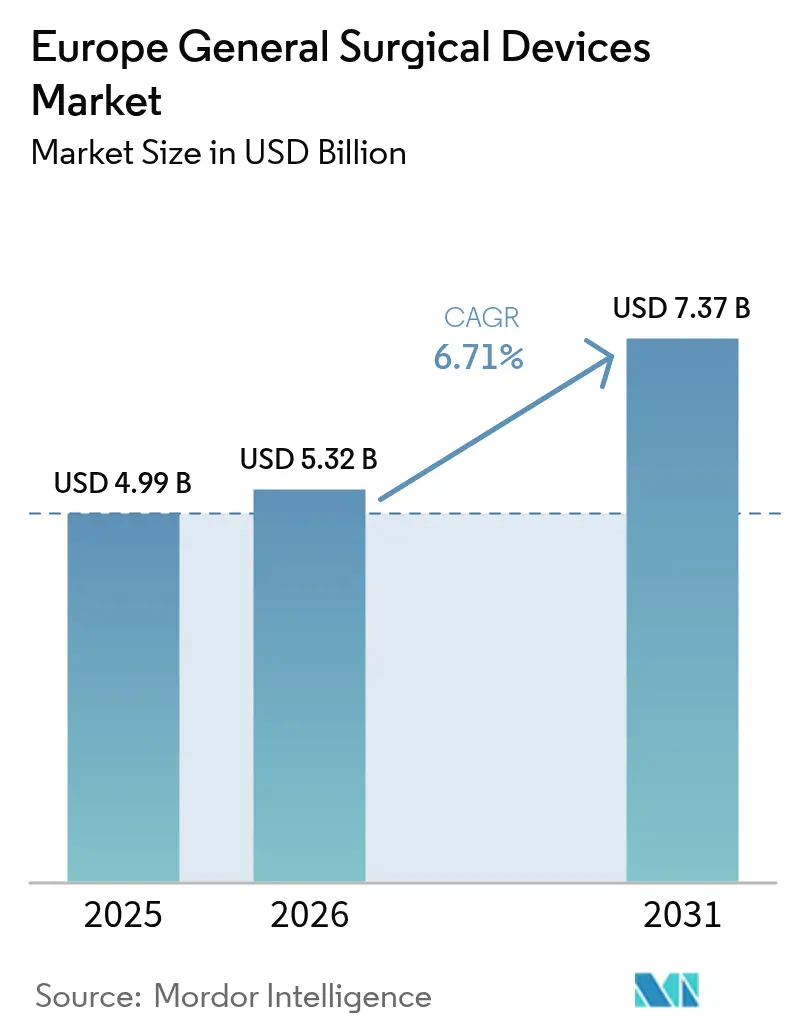
Europe General Surgical Devices Market Analysis by Mordor Intelligence
The Europe General Surgical Devices Market size was valued at USD 4.99 billion in 2025 and estimated to grow from USD 5.32 billion in 2026 to reach USD 7.37 billion by 2031, at a CAGR of 6.71% during the forecast period (2026-2031). Robust procedure growth in minimally invasive and robotic platforms, coupled with a rapidly aging population and widening clinical indications, underpins this expansion. EU-MDR compliance costs have simultaneously driven strategic consolidation, positioning well-capitalized multinationals to absorb regulatory overheads while smaller firms either exit or seek partnerships. Hospital purchasers intensify price negotiations, yet procedure volumes keep climbing as health systems shift toward day-case models to relieve capacity constraints. Supply-chain resilience has become a board-level priority, with manufacturers now directing 3–5% of annual revenue to logistics diversification.
Key Report Takeaways
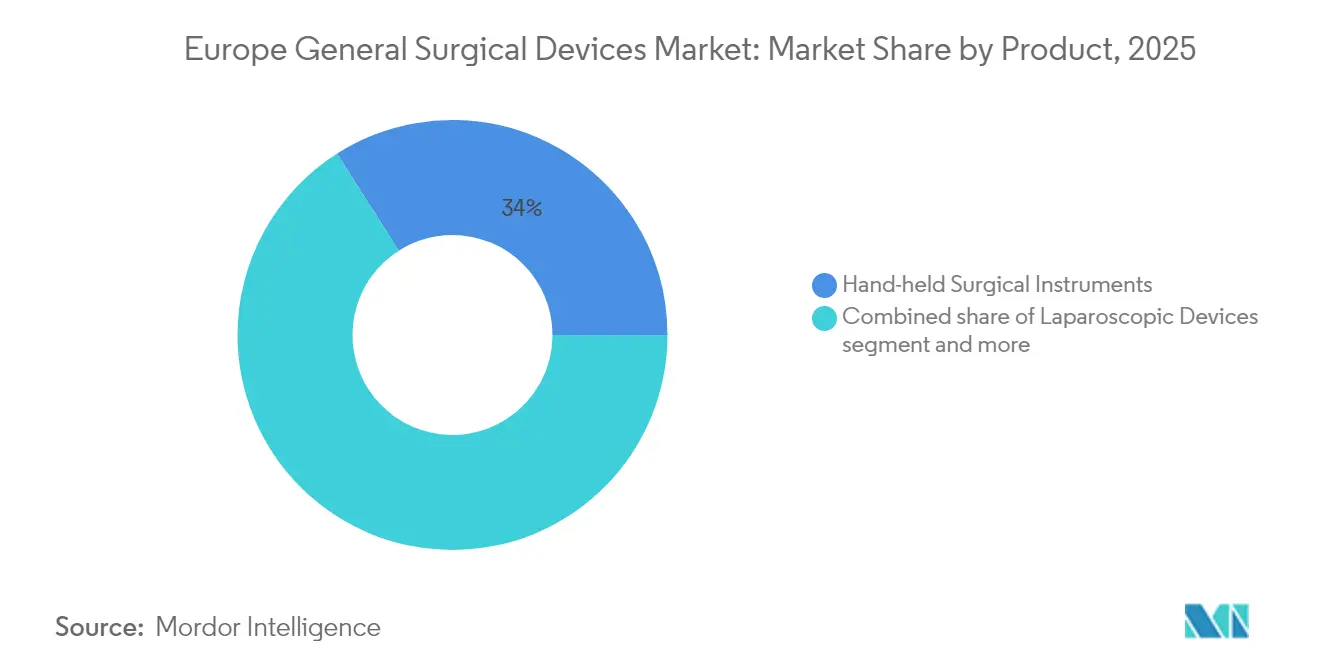
- By product type, hand-held surgical instruments led with 34.02% of the Europe general surgical devices market share in 2025, while robotic and computer-assisted systems are projected to expand at a 8.96% CAGR through 2031.
- By procedure approach, minimally invasive surgery accounted for 71.62% of the Europe general surgical devices market size in 2025 and is growing at an 8.08% CAGR to 2031.
- By application, orthopedic procedures held 26.72% of the Europe general surgical devices market size in 2025; general and bariatric surgery is the fastest-growing segment at an 8.71% CAGR.
- By end user, hospitals commanded 68.55% share of the Europe general surgical devices market in 2025, whereas ambulatory surgery centers are advancing at a 8.83% CAGR through 2031.
- By Country, Germany held a dominant share of 22.05% in 2025 of the Europe general surgical devices market; France is anticipated to grow with the fastest CAGR of 8.59% from 2026 to 2031.
Note: Market size and forecast figures in this report are generated using Mordor Intelligence’s proprietary estimation framework, updated with the latest available data and insights as of 2026.
Europe General Surgical Devices Market Trends and Insights
Drivers Impact Analysis*
| Driver | (~) % Impact on CAGR Forecast | Geographic Relevance | Impact Timeline |
|---|---|---|---|
| Rising demand for minimally-invasive procedures | +1.8% | Global, with strongest adoption in Germany, UK, France | Medium term (2-4 years) |
| Aging population & procedure volume growth | +1.5% | EU-wide, particularly acute in Germany, Italy, Spain | Long term (≥ 4 years) |
| Rapid innovations in laparoscopic & robotic systems | +1.2% | Core markets: Germany, UK, France, with spillover to Nordic countries | Medium term (2-4 years) |
| Shift toward day-case surgeries & disposable kits | +0.9% | UK leading, followed by Netherlands, Germany | Short term (≤ 2 years) |
| Favourable, procedure-linked reimbursement structures | +0.7% | Variable by country: strong in Germany, Netherlands; challenged in France, Italy | Medium term (2-4 years) |
| Expansion of private hospital groups and ambulatory surgery centres | +0.6% | Germany, UK, Spain leading; emerging in Eastern Europe | Long term (≥ 4 years) |
| Source: Mordor Intelligence | |||
Rising demand for minimally invasive procedures
Healthcare providers across Europe continue to transition from open to minimally invasive techniques, aiming to cut recovery times and free inpatient capacity. NHS England projects 500,000 robotic-assisted operations annually by 2035, signaling a steep adoption curve that will accelerate capital equipment refresh cycles.[1] Nordic centers mirror this trend, installing more than 120 robotic platforms to support hernia repairs and other soft-tissue interventions. Energy-based devices such as Olympus ESG-410, which combine hybrid, bipolar, and ultrasonic modalities, are benefiting from the broader shift as surgeons seek multifunctional tools. Hospitals deploying Boston Scientific workflow-advisory solutions report 40% higher transcatheter volumes, illustrating how digital integration multiplies throughput.
Aging population & procedure volume growth
Citizens aged ≥ 65 represent a fast-growing cohort, particularly in Germany, Italy, and Spain, and this demographic shift fuels an uptick in joint replacements, cardiovascular interventions, and complex oncology resections. France still ranks 8th among OECD nations for hip replacement rates despite reimbursement cuts, underscoring latent demand.[2] Ambulatory surgery centers (ASCs) have flagged cardiology as their highest-growth specialty, aided by favorable Medicare-aligned payments and private equity investment. Intensivist shortages prompt a tighter integration of surgery and critical-care services, with anesthesiologists now managing 70% of ICU beds across Europe.
Rapid innovations in laparoscopic & robotic systems
Technology suppliers increasingly address ergonomic and cost barriers linked to earlier robotic generations. The Hugo robotic system has reduced median console times for inguinal hernia repair to 37 minutes for unilateral cases in European studies. Single-port solutions expand indications in colorectal and urologic surgery. Johnson & Johnson’s Polyphonic digital ecosystem pilots a fully connected OR, leveraging AI-driven analytics to improve decision-making and asset utilization. EU-funded HoloSurge integrates holographic visualization for liver and pancreatic cases, promising safer resections through real-time 3D anatomy guidance.
Shift toward day-case surgeries & disposable kits
With 69.27% of procedures still performed inside hospitals, European payers encourage migration to outpatient settings to ease budget stress. The United Kingdom leads in promoting day-case pathways, spurring demand for disposable instrument kits that bypass sterilization backlogs. Private-equity-backed operators are rolling out ASC networks focused on spine, orthopedics, and gastroenterology, mirroring U.S. models. Manufacturers like Lexington Medical have secured fresh capital to expand single-use stapling portfolios across 35+ countries. Advances in low-thermal-injury sealing technologies enable faster discharge protocols, further boosting outpatient share.
Restraints Impact Analysis*
| Restraint | (~) % Impact on CAGR Forecast | Geographic Relevance | Impact Timeline |
|---|---|---|---|
| EU-MDR compliance costs & approval delays | -1.4% | EU-wide, particularly affecting SMEs and innovative device categories | Medium term (2-4 years) |
| Purchasing-group price pressure on OEM margins | -0.8% | Germany, France, UK leading; spreading to other major markets | Short term (≤ 2 years) |
| OR staff shortages constraining throughput | -0.6% | EU-wide, with acute shortages in France, Germany, UK | Medium term (2-4 years) |
| Persistent supply-chain vulnerabilities | -0.4% | EU-wide, with particular exposure in Eastern Europe and supply-dependent markets | Medium term (2-4 years) |
| Source: Mordor Intelligence | |||
EU-MDR compliance costs & approval delays
Conformity assurance can cost from EUR 5,000 for basic analyses to EUR 500,000 for Class III trials, squeezing SME cash flows and prompting portfolio rationalization.[3] Only 43 notified bodies remain to review an estimated 500,000 devices, leading to extended approval cycles and deferred launches. Industry surveys show half of device makers plan to withdraw or limit EU portfolios due to regulatory burdens.
Purchasing-group price pressure on OEM margins
France has mandated a 25% reimbursement cut for orthopedic implants starting 2025, and the Economic Committee for Health Products seeks 11% additional price reductions by 2027. Group-purchasing organizations across Germany and the UK are adopting similar tactics, compelling vendors to offer deeper discounts or bundled service agreements. Device Benefit Management firms now mediate negotiations to enhance pricing transparency. Advanced prostheses risk withdrawal if reimbursement fails to cover cost-to-serve.
*Our forecasts treat driver/restraint impacts as directional, not additive. The impact forecasts reflect baseline growth, mix effects, and variable interactions.
Segment Analysis
By Product Type: Robotics Drive Innovation Despite Hand-Held Dominance
Hand-held instruments retained a 34.02% Europe general surgical devices market share in 2025, reflecting their ubiquity in routine interventions. Robotic and computer-assisted systems, however, are set to outpace all categories at a 8.96% CAGR to 2031, powered by broader clinical acceptance and falling per-procedure costs. Olympus THUNDERBEAT and VISERA 4K platforms illustrate how imaging and energy technologies converge to enhance tissue handling and visualization. Medtronic’s PlasmaBlade operates at significantly lower temperatures than legacy electrocautery, reducing collateral damage. Hybrid devices that integrate sensors and wireless connectivity are poised to stretch the competitive gap between premium and value tiers.
Second-generation robotics address prior cost and footprint limitations, opening adoption among mid-sized centers. Europe general surgical devices market vendors increasingly bundle capital equipment with digital workflow software to create stickier customer relationships. Virtual-Ports’ CE-marked laparoscopic accessories and Johnson & Johnson’s Ottava-compatible generator exemplify targeted product updates that fit new robotic ecosystems. Wound-closure systems and trocar lines benefit from the day-case push, with single-use options mitigating sterilization bottlenecks and infection risk.

By Procedure Approach: Minimally Invasive Surgery Reshapes Operating Theaters
Minimally invasive techniques accounted for 71.62% of the Europe general surgical devices market size in 2025 and are advancing at an 8.08% CAGR, consolidating their position as the preferred standard of care. Improved optics, energy delivery, and haptic feedback allow surgeons to tackle complex pathologies with smaller incisions. Open surgery maintains a vital role for trauma and large tumor resections but is ceding volume steadily.
Fast docking times reported for the Hugo platform illustrate cumulative efficiency gains that reduce anesthesia duration and improve turnover. HoloSurge’s 3D holography enters pilot phases, supporting safer resection planes in hepatobiliary cases. Europe general surgical devices market participants invest heavily in training centers to help surgeons climb new learning curves quickly, a prerequisite for payer support and technology credentialing.
By Application: Bariatric Surgery Outpaces Traditional Orthopedic Leadership
Orthopedic interventions captured 26.72% of the Europe general surgical devices market size in 2025, driven by aging demographics and active-lifestyle expectations. Reimbursement cuts in France signal cost headwinds, but elective volumes remain resilient. By contrast, bariatric and general surgery is surging with an 8.71% CAGR as obesity prevalence rises and metabolic surgery guidelines broaden eligibility.
Ambulatory centers target sleeve gastrectomy and gastric bypass as anchor procedures, rationalizing investments in energy devices and stapling platforms tailored for thicker tissue profiles. Europe general surgical devices market vendors see cross-selling potential into revision surgeries, which often require advanced access tools and powered staplers. Oncology, neurology, and gynecology continue steady growth, each influenced by screening uptake and site-of-care shifts.

By End User: ASCs Challenge Hospital Dominance Through Efficiency Gains
Hospitals still generated 68.55% of Europe general surgical devices market revenue in 2025 due to their comprehensive acute-care infrastructure. Yet ASCs are expanding at a 8.83% CAGR and progressively moving up the acuity ladder. Site-neutral payment proposals and surgeon ownership models make the setting attractive for high-volume procedures such as joint arthroplasty and cardiovascular interventions.
Efficiency programs have become a strategic lever; Italian facilities deploying Boston Scientific analytics lowered warehouse time by 87% and expanded throughput by 40%. Specialty clinics occupy a niche for dermatologic, ophthalmologic, and fertility procedures, offering tailored care pathways. Europe general surgical devices market suppliers tailor commercial models—leasing, pay-per-use, or service bundles—to match disparate cash-flow profiles across settings.
Geography Analysis
Germany anchors the Europe general surgical devices market with its deep manufacturing base and supportive reimbursement frameworks. Germany held a share of 22.05% in 2025 of the Europe market; France is anticipated to grow with the fastest CAGR of 8.59% from 2026 to 2031. Karl Storz’s EUR 2.17 billion turnover in 2023 reinforces the domestic innovation ecosystem and accelerates technology diffusion into university hospitals. Procedure volumes remain buoyant despite budget restraint measures, as demographic trends amplify demand.
France retains significant weight even after a 25% cut to orthopedic implant tariffs in 2025, forcing providers to weigh cost versus clinical benefit rigorously. Hip replacement incidence still ranks among OECD front-runners, indicating structural demand. The United Kingdom leads robotic adoption; a ten-fold growth to 500,000 robotic cases per year by 2035 will require sustained investment in surgeon credentialing and maintenance contracts.
Italy and Spain represent high-growth territories as public-private hospital partnerships modernize infrastructure. Italian centers adopting efficiency software cut non-clinical workload, freeing capacity for additional surgical lists. Spanish private operators such as Fresenius Helios recorded 8% revenue growth in 2024 driven by procedure mix optimization. Nordic countries, though smaller, exhibit outsized appetite for advanced robotics, piloting single-port and endoluminal platforms early in the life cycle.
Regulatory Landscape
The Europe general surgical devices market operates under the EU Medical Device Regulation (EU-MDR 2017/745), where conformity assessment capacity and legacy-device transition requirements continue to shape portfolios. Regulation (EU) 2023/607 set staggered transition deadlines for legacy devices through 31 December 2027 for certain higher-risk categories (including Class III and Class IIb implantables) and through 31 December 2028 for other device classes, contingent on meeting specified conditions. As a result, manufacturers have been sequencing technical documentation updates and notified-body bookings earlier.
In 2026, the regulatory system further shifted toward centralized, digital market-access controls and updated standards. Mandatory use of EUDAMED modules for Actor Registration and UDI/Device Registration took effect on 28 May 2026 for new MDR and IVDR devices, increasing the importance of data readiness and UDI processes for continued EU commercialization. Implementing Decision (EU) 2026/1231 (11 June 2026) also adopted new harmonised standards developed by CEN, reinforcing harmonised standards as a compliance pathway for general surgical device categories such as instruments, energy devices, and wound-closure systems.
Competitive Landscape
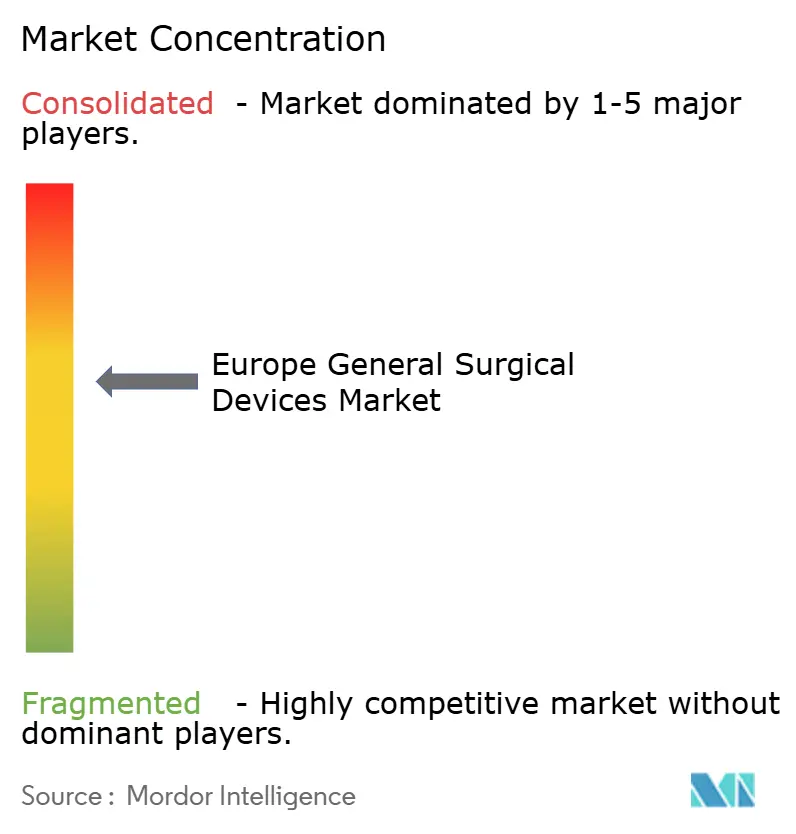
Competitive intensity in the Europe general surgical devices market is moderate with a tilt toward consolidation. Johnson & Johnson, Medtronic, and Stryker leverage expansive portfolios to negotiate multi-year framework agreements, but niche innovators chip away at specialized segments. Teleflex’s EUR 760 million buyout of BIOTRONIK’s vascular unit strengthens its coronary and peripheral line-up, illustrating portfolio realignment toward high-growth endovascular therapy.
Digital enablement differentiates offerings beyond hardware. Boston Scientific packages analytics that lifted European procedure volumes by 40%, signaling a shift to service-led value propositions. Brainlab’s planned EUR 200 million IPO underlines investor appetite for software-first surgical guidance platforms, a field expected to grow alongside AI adoption.
Regulatory hurdles favor large incumbents able to absorb EU-MDR costs, yet startups secure capital by focusing on unmet needs such as colorectal anastomosis protection (SafeHeal) or compact robotic arms (Moon Surgical). Procurement bans on Chinese suppliers alter sourcing calculus, potentially opening share for European mid-tier manufacturers with cost-competitive lines.
Europe General Surgical Devices Industry Leaders
-
Boston Scientific Corporation
-
Johnson & Johnson (Ethicon / DePuy Synthes)
-
B. Braun SE
-
Medtronic plc
-
Stryker Corporation
- *Disclaimer: Major Players sorted in no particular order
Market Opportunities and Future Outlook
Compliance digitization and standard updates are creating opportunities for services and product features that reduce MDR execution friction for both hospitals and manufacturers. The May 2026 EUDAMED go-live step for Actor Registration and UDI/Device Registration is raising demand for UDI-enabled labeling, traceability workflows, and connected inventory management that align perioperative supply with device registration requirements. The June 2026 publication of new or updated harmonised standards, including references such as EN ISO 10993-1:2025 for biocompatibility risk management, supports differentiation for suppliers that can document materials, coatings, and adhesive systems more efficiently across instrument and disposable-kit portfolios.
Procedure migration toward minimally invasive and robotic-assisted surgery is also expanding opportunities for interoperable instrument ecosystems, stapling and energy-device platforms, and training-led commercialization in countries with accelerating adoption. UK general surgery data indicate robotic-assisted surgical systems usage rising from 0.4% (2015) to 7.0% (2024), and France reported 31,221 robotic-assisted soft-tissue procedures in 2022 (+15.6% YoY), which supports demand for compatible staplers, vessel sealers, access devices, and workflow software that can operate across both laparoscopic and robotic setups. With hospitals remaining the largest end user base in the region, day-case pathways and purchasing-group scrutiny are further increasing the value of standardized single-use kits and digitally supported throughput programs that help providers reduce sterilization bottlenecks while maintaining consistent clinical performance.
Recent Industry Developments
- April 2026: Johnson & Johnson received EU CE Mark approval for the ETHICON 4000 Stapler for open and laparoscopic surgery. The clearance strengthens J&J stapling coverage in Europe and supports its strategy of aligning core mechanical categories with evolving robotic and digital surgery ecosystems.
- November 2025: Medtronic announced a limited launch of the Signia Circular Stapler with Tri-Staple technology after securing regulatory market authorization in Western Europe. The launch broadens its advanced stapling portfolio in a region where purchasers evaluate outcomes consistency alongside price, and it sets up the platform for wider rollout as hospitals refresh minimally invasive toolsets.
- June 2024: Medtronic secured a CE Mark for LigaSure vessel-sealing technology on the Hugo robotic-assisted surgery system for gynecologic, general, and urologic procedures in Europe. By enabling a widely used energy modality on Hugo, Medtronic improves procedural standardization across robotic and conventional cases and increases switching costs through tighter instrument-system integration.
Research Methodology Framework and Report Scope
Market Definition and Coverage
For this study, the Europe general surgical devices market is defined as revenue generated from instruments and device systems used during general surgery procedures, across hospital and outpatient settings, within Europe.
Scope exclusions: Implantable devices, imaging systems, patient monitoring equipment, and tools dedicated mainly to non-general specialties are not counted in this market value.
Segmentation Overview
- By Product Type
- Hand-held Surgical Instruments
- Laparoscopic Devices
- Electrosurgical Devices
- Wound-Closure Devices
- Trocars and Access Systems
- Robotic and Computer-Assisted Systems
- Other Products
- By Procedure Approach
- Open Surgery
- Minimally Invasive Surgery
- By Application
- Gynecology and Urology
- Cardiology
- Orthopedic
- Neurology
- General and Bariatric Surgery
- Oncology
- Other Applications
- By End User
- Hospitals
- Ambulatory Surgical Centers
- Specialty Clinics
- By Country
- Germany
- United Kingdom
- France
- Italy
- Spain
- Rest of Europe
Data Sources, Market Sizing, and Validation
Desk Research
Desk work starts with mapping procedure activity and device adoption across Europe, before any number is modeled. We used public sources such as Eurostat for health and trade context, OECD health statistics for care delivery indicators, and WHO Europe datasets for population and disease signals that influence surgery demand.
Alongside that, we reviewed national health ministry publications, EU-MDR updates and related guidance from official EU bodies, and procurement or tender notices where they helped explain pricing and availability patterns. We also used company annual reports, investor presentations, and reputable medical-device press to understand product positioning and recent launches. In some cases, we used paid subscriptions for company financials and patent intelligence to support cross-checks on revenue scale and innovation intensity. These examples are not exhaustive, and many other public sources were reviewed to collect, validate, and clarify data points.
Primary Interviews and Surveys
Primary discussions were run with people involved in buying, using, and distributing general surgical devices across key European countries, so assumptions from desk research could be confirmed or corrected. We spoke with a mix of hospital procurement viewpoints, clinician and theater staff input on utilization, and channel participants who see pricing and stocking behavior, which helped us tighten adoption rates and replacement cycles before finalizing the model.
Distribution of primary research fieldwork respondents
| Company type | Respondent position |
|---|---|
| Top tier: 32% | CXOs: 17% |
| Mid tier: 50% | Functional/Unit leaders: 36% |
| Smaller Players: 18% | Managers: 47% |
Market-Sizing & Forecasting
Sizing starts with a top-down build where procedure volumes and care-setting splits are translated into device demand pools, then adjusted using utilization intensity by approach (open versus minimally invasive). Totals are cross-checked through selective bottom-up approximations, such as sampled price-per-unit ranges multiplied by estimated unit flows for high-usage categories, and also through supplier and distributor sense checks, so the final number does not rely on one view.
Key inputs used in the model include elective and inpatient versus outpatient surgery mix, penetration of minimally invasive procedures, average use rates for staples and sutures in wound closure, adoption of electrosurgical tools by facility type, and replacement cycles for reusable hand instruments. Where country reporting gaps exist, we fill them using proxy indicators such as population age mix, hospital bed density, and procedure intensity patterns, and then test the output with local expert feedback.
Forecasting is built using scenario analysis. The base case is anchored on expected procedure growth and gradual shifts toward minimally invasive surgery. We then stress test for pricing pressure, regulatory-driven product transition timing, and changes in capital spending appetite for system-type devices. Assumptions are kept simple and traceable so the outputs can be recreated and discussed clearly on a client call.
Data Validation & Update Cycle
Validation is done by comparing model outputs against multiple independent signals, including procedure trends, broad import and production directionality, and the implied spend per procedure for the covered device groups. When outliers show up at country or product level, we recheck inputs, and we trigger follow-up calls to confirm whether the variance is real or caused by a timing or classification mismatch.
Before sign-off, the work is reviewed in steps, starting from input integrity checks, then assumption logic, and finally the aggregated totals. Reports are refreshed annually, with interim updates when material events occur, such as major regulatory changes or sharp shifts in hospital purchasing behavior. Right before delivery, a final pass is done so the latest available information is reflected in the published view.
Mordor Intelligence's Europe General Surgical Devices Market Sizing Compared With Other Published Estimates
Published market values for Europe general surgical devices often do not match because the scope boundary can shift across studies, and the pricing and volume assumptions are not always built from the same demand signals. The base year chosen, how capital equipment is treated, and how countries are grouped inside Europe also tend to create visible gaps.
The benchmark table shows a tighter market value when the count is limited to instruments and procedure-used device categories (including laparoscopy, electrosurgery, and wound closure), and in Mordor Intelligence's model this also means implantable devices and adjacent monitoring or imaging equipment are not included, even if they appear in broader surgical equipment discussions.
Benchmark comparison
| Source | Market Size | Gaps in Research Methodology |
|---|---|---|
| Mordor Intelligence | USD 4.99 B (2025) | |
| Industry Publisher A | USD 6.12 B (2024) | Uses an earlier base year and appears to apply a wider umbrella that can fold in more disposable surgical supplies and adjacent surgical items, which increases the total when compared across time. |
| Industry Publisher B | USD 5.33 B (2025) | Covers a broader surgical equipment set and places more weight on capital equipment categories, which can lift the number when system-type devices are counted more fully. |
Taken together, the spread mainly comes from what is included under the surgical equipment umbrella and how pricing and replacement timing are applied to reusable versus single-use items. By keeping the scope tied to clear device groups used directly in general surgery, and then checking the implied spend against procedure activity signals, the resulting estimate stays easier to trace and repeat year over year.
Key Questions Answered in the Report
What operational challenge do EU surgical device manufacturers rank as the most disruptive in 2025?
Rising EU-MDR compliance costs and lengthy notified-body queues top the list because they delay product launches and force portfolio cuts.
How are hospitals mitigating staff shortages in operating rooms across major European markets?
Facilities are adopting workflow-automation software and robotic platforms that shorten case times and reduce reliance on hard-to-recruit scrub nurses and anesthetists.
Why are ambulatory surgery centers expanding faster than traditional hospitals in Europe?
Payers favor day-case models that lower inpatient stays, and surgeons value the streamlined scheduling and ownership stakes ASCs can provide.
Which technology feature is most sought after when European buyers evaluate next-generation laparoscopic systems?
Surgeons increasingly prioritize integrated energy devices that deliver ultrasonic and bipolar modalities through a single handpiece, enhancing speed and vessel-sealing reliability.
How are group-purchasing organizations influencing device design choices in France and Germany?
By mandating price ceilings, they push vendors to develop cost-efficient, single-use instruments that fit bundled-payment thresholds without compromising clinical performance.