
Market Overview
| Study Period | 2021 - 2031 |
|---|---|
| Forecast Data Period | 2026 - 2031 |
| Historical Data Period | 2021 - 2024 |
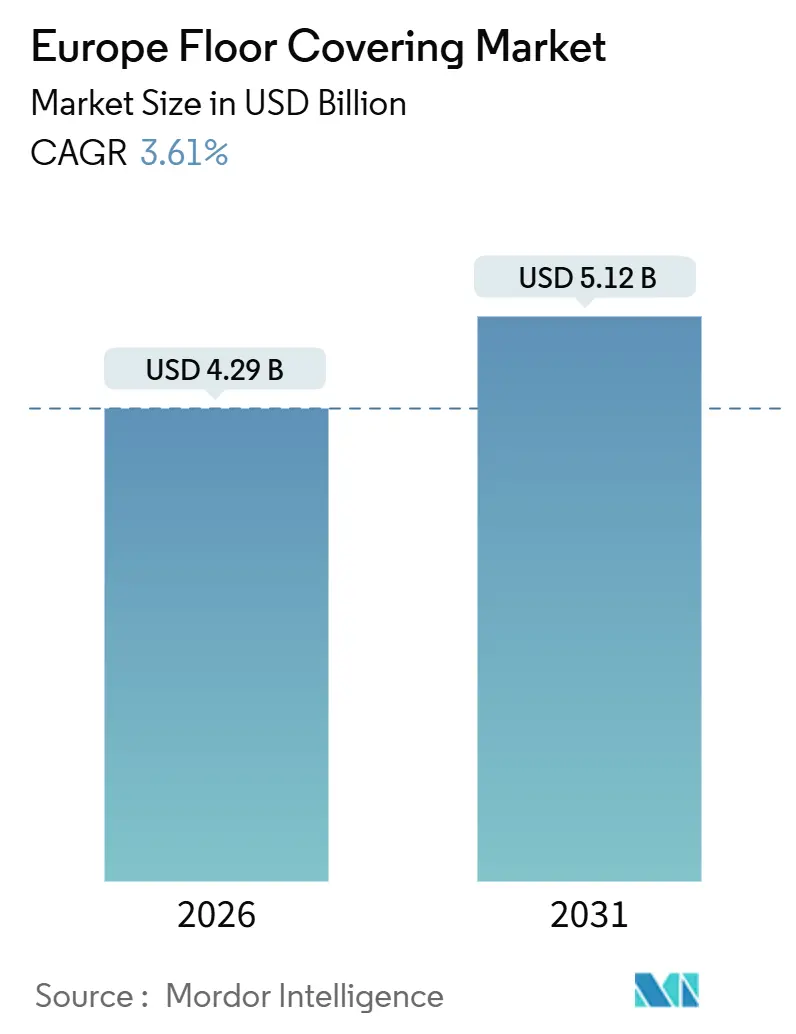
| Market Size (2026) | USD 4.29 Billion |
| Market Size (2031) | USD 5.12 Billion |
| Growth Rate (2026 - 2031) | 3.61 % |
| Market Concentration | Medium |
Major Players *Disclaimer: Major Players sorted in no particular order Image © Mordor Intelligence. Reuse requires attribution under CC BY 4.0. | |
Europe Floor Covering Market Analysis by Mordor Intelligence
The Europe floor covering market size is estimated at USD 4.29 billion in 2026, and is expected to reach USD 5.12 billion by 2031, at a CAGR of 3.61% during the forecast period (2026-2031). Growth is supported by the EU Renovation Wave and the Energy Performance of Buildings Directive, which channel retrofit activity toward performance-driven materials and verified environmental data through 2030[1]Efficient Buildings Europe, “Energy Performance of Buildings Directive Implementation Guide 2024,” Efficient Buildings Europe, efficientbuildings.eu. Circular procurement in the Nordics and Benelux, including tender weighting for recycled content and documented end-of-life pathways, pushes manufacturers to scale take-back and recycled-content programs. Energy costs, though off crisis highs, continue to influence kiln-fired categories while resilient formats gain from faster installation and installer scarcity across several member states. Suppliers emphasize vertical integration, closed-loop collection, low-emission certifications, and transparent life cycle data to meet public-sector requirements and ESG-minded private demand across the European floor covering market.
Key Report Takeaways
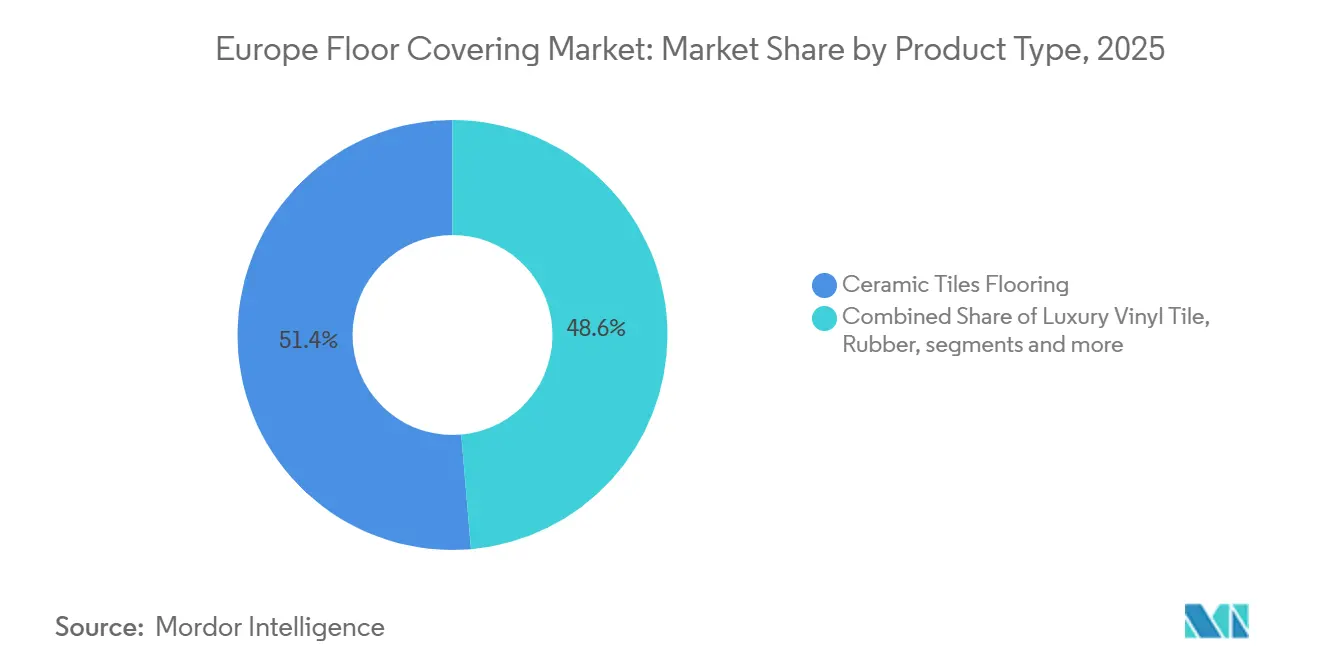
- By product type, ceramic tiles led with 51.38% of the European floor covering market size in 2025. Vinyl flooring is projected to expand at a 7.65% CAGR through 2031.
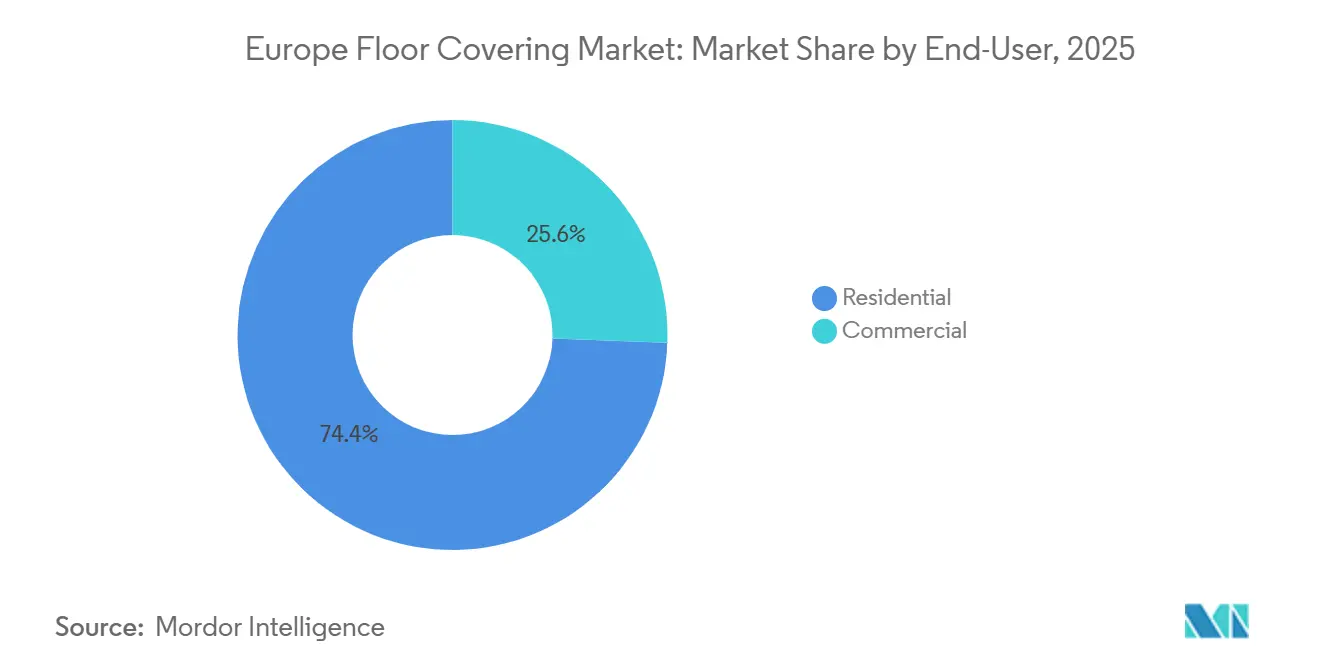
- By end-user, the residential segment held 74.43% of the European floor covering market size in 2025. The commercial segment is forecast to record the highest CAGR at 8.36% through 2031.
- By distribution channel, B2C retail accounted for 71.37% share of the European floor covering market size in 2025. B2B contractors and builders are projected to grow at a 9.65% CAGR through 2031.
- By construction type, remodelling or retrofit commanded a 64.44% market share of the European floor covering market in 2025. New construction is projected to grow at a 9.63% CAGR through 2031.
- By geography, Germany accounted for a 31.76% share of the European floor covering market size in 2025. France is projected to expand at a 9.37% CAGR through 2031.
Note: Market size and forecast figures in this report are generated using Mordor Intelligence’s proprietary estimation framework, updated with the latest available data and insights as of January 2026.
Europe Floor Covering Market Trends and Insights
Drivers Impact Analysis*
| Drivers | (~) % Impact on CAGR Forecast | Geographic Relevance | Impact Timeline |
|---|---|---|---|
| EU Renovation Wave boosting retrofit in Germany, France, Italy | +1.2% | Germany, France, Italy | Medium term (2-4 years) |
| Circular materials under the EU Green Deal favour recyclable flooring | +0.8% | Global, strongest in Nordics and Benelux | Long term (≥ 4 years) |
| DIY-led penetration of LVT and SPC in Western Europe | +1.5% | Western Europe, including the United Kingdom, Germany, France, Benelux | Short term (≤ 2 years) |
| Hybrid work model driving office redesign in Nordics and Benelux | +0.6% | Nordic countries, Benelux | Medium term (2-4 years) |
| Healthcare infrastructure expansion in CEE is lifting resilient flooring | +0.9% | Central and Eastern Europe | Medium term (2-4 years) |
| Premium upgrades in the United Kingdom homes are raising engineered wood adoption | +0.7% | United Kingdom | Short term (≤ 2 years) |
| Source: Mordor Intelligence | |||
EU "Renovation Wave" Stimulating Retro-Fit Demand in Germany, France, and Italy
The Energy Performance of Buildings Directive aligns the region toward deep renovation outcomes and requires minimum performance standards to lift the worst energy classes, which converts flooring components into compliance-critical elements in retrofit scopes. Buildings account for a large share of energy use and emissions in the region; therefore, measures such as floor insulation and acoustic underlayment move from optional to expected where thermal gains are measured at the building level. Germany’s multi-year renovation ambition catalyzes demand for moisture-resistant subfloors and rigid, resilient products that can meet acoustic targets without complex assemblies. France’s subsidy framework that supports compliant low-emission installations redirects purchases toward engineered formats with verified emission claims. This environment shifts procurement toward multi-attribute specifications, where performance, embodied carbon, and verifiable declarations are evaluated together in public and commercial tenders.
Shift to Circular Materials under EU Green Deal Raising Demand for Recyclable Flooring
Public-sector tenders in the Nordics and Benelux incorporate recycled-content weighting and documented pathways for material recovery, which strengthens demand for flooring that can be disassembled and retrieved at the end of life. The Ecodesign for Sustainable Products Regulation and the revised Construction Products Regulation extend product-level requirements and environmental declarations, making EPDs and material passports central to market access and bid eligibility. Sector initiatives prove the viability of recycling methods for PVC and elevate post-consumer content in backings without performance loss, which supports circular procurement[2]Plastics Europe, “The Circular Economy for Plastics, A European Analysis,” Plastics Europe, plasticseurope.org. Manufacturers respond with bio-based and climate-positive ranges, including linoleum lines with agricultural byproducts and high biogenic carbon storage documented across the life cycle. These policies and practices weave circularity into product design and procurement decisions and lift the appeal of closed-loop programs in the European floor covering market.
Rapid Penetration of LVT and SPC in Western Europe Driven by DIY Retail Chains
Click-lock resilient formats reduce labour dependencies and align with DIY retail strategies in large Western European markets that face installer scarcity and schedule constraints. The category’s premium growth is supported by embossing-in-register visuals, antimicrobial wear layers, and dimensional stability that suits underfloor heating and frequent cleaning cycles. VOC restrictions on adhesives and floor coverings in Belgium, and related emission testing requirements, further advantage low-odor resilient systems in occupied renovations. These traits reinforce the shift toward resilient within the European floor covering market as renovation activity remains the primary driver of installed volumes through the forecast period.
Growth of Hybrid Work Models Triggering Office Re-Design Cycles in the Nordics and Benelux
Hybrid work strategies prompt office reconfigurations that segment collaboration and focus zones, raising demand for acoustic performance and modularity in floor systems. Modular carpet tiles and loose-lay resilient products allow reconfiguration without disruptive adhesive removal, which fits shorter leases and frequent refresh cycles in these markets[3]Interface, “2024 Interface Impact Report Highlights Continued Climate Progress,” Interface, investors.interface.com. Corporate buyers prioritize verified carbon and recycled-content attributes alongside functional performance, including slip, fire, and indoor-air criteria that align with well-being objectives. Smart readiness assessments in non-residential buildings encourage adaptable systems that integrate with sensor-ready subfloors and building automation, increasing the value of modular flooring designs. This pattern supports premium commercial specifications and influences higher-end residential preferences within the European floor covering market as people carry office design cues into the home.
Restraints Impact Analysis*
| Restraints | (~) % Impact on CAGR Forecast | Geographic Relevance | Impact Timeline |
|---|---|---|---|
| Elevated European gas and power costs are raising ceramic and kiln costs | -0.7% | EU-wide, strongest in Italy, Spain, Portugal | Short term (≤ 2 years) |
| Tight VOC norms are increasing carpet compliance costs | -0.4% | Germany, Nordics, Benelux | Medium term (2-4 years) |
| Installer shortages are delaying large fit-outs | -0.9% | EU-wide, construction-heavy economies | Long term (≥ 4 years) |
| Volatile timber supply from Russia and Belarus is disrupting wood chains | -0.5% | EU-wide, importers of birch plywood | Medium term (2-4 years) |
| Source: Mordor Intelligence | |||
Soaring European Gas and Electricity Prices Inflating Ceramic and Kiln-Fired Tile Costs
Industrial energy prices eased in 2025 versus crisis peaks but remain above pre-pandemic baselines, which challenges energy-intensive kiln-fired categories[4]Eurostat, “Electricity price statistics,” Eurostat, ec.europa.eu. Gas and electricity costs vary by country, with several markets facing higher-than-average rates for non-household users, which affects margins and pricing decisions. These dynamics explain why ceramic’s large installed base grows more slowly than resilient in renovation-focused geographies. Geopolitical supply rebalancing and sanction regimes add uncertainty around future contracts and risk premiums that manufacturers must manage in planning horizons. As a result, specifiers lean toward materials with lower production energy intensity in projects with tight budgets and schedules across the European floor covering market.
Skilled Installer Shortages in the EU Labor Market Delaying Large-Scale Fit-outs
Persistent labour shortages across many trades complicate scheduling and raise the appeal of flooring systems that require fewer installation steps. Upskilling initiatives progress, yet reported participation rates are not sufficient to close gaps at the scale required for renovation targets in the near term. These constraints influence specifiers to choose click-lock, loose-lay, and acclimation-light products that shorten on-site times and reduce dependencies on scarce trades. Coordinating trades for smart-ready non-residential buildings increases complexity and amplifies the need for modular flooring that can integrate with sensor-ready subfloors. These dynamics tilt decisions toward resilient and engineered options in the European floor covering market, where installer availability is uncertain.
*Our forecasts treat driver/restraint impacts as directional, not additive. The impact forecasts reflect baseline growth, mix effects, and variable interactions.
Segment Analysis
By Product Type: Vinyl Leads Fastest Growth as Rigid-Core Technologies Displace Ceramics
Ceramic tiles held 51.38% of the European floor covering market share in 2025, leading in Southern Europe. Growth has slowed in renovation-driven markets favoring faster installation and lower embodied energy. Vinyl flooring is expected to grow at a 7.65% CAGR through 2031, supported by rigid-core formats meeting acoustic, hygiene, and underfloor heating needs without extensive subfloor work. Resilient flooring with enhanced embossing and antimicrobial layers has expanded into healthcare, education, and food service sectors, where cleaning protocols and indoor air standards are critical. Low-emission adhesives and restricted-VOC lists further drive adoption of loose-lay and click-fit systems in residential remodels, addressing installer shortages and project delays. These trends position resilient flooring as a key growth segment, aligning with renovation budgets and compliance requirements.
Waterproof laminate and engineered wood remain competitive for residential upgrades, valued for acoustic underlayment and indoor air quality claims. Innovations in recycled content, take-back programs, and verified EPDs enhance public-sector eligibility. Rubber and linoleum flooring, backed by life cycle data, attract education and healthcare buyers seeking durable, low-maintenance, and environmentally friendly options. Investments in European resilient flooring capacity and digital printing technology improve availability, lead times, and regional aesthetic alignment, supporting compliance with emission and circularity standards.


By Construction Type: Remodelling Surges Ahead of New Construction Amid Regulatory Push
Remodeling and retrofit held a 64.44% market share in 2025, driven by policies and financing frameworks targeting upgrades to existing buildings. These efforts emphasize minimum performance standards and energy labeling. New construction is expected to grow at a 9.63% CAGR through 2031, addressing housing shortages in urban areas. Retrofits focus on flooring products with low emissions, acoustic performance, and underfloor heating compatibility to enhance comfort and energy efficiency. Low-profile resilient options are ideal for heritage buildings, minimizing floor elevation changes and avoiding door or threshold modifications. These preferences support faster installation and compliance with European floor covering market requirements.
Underfloor heating and efficient building services in new housing influence demand for dimensionally stable surfaces and thermally rated adhesives. Rigid-core resilient flooring and engineered wood with verified emission performance are preferred for balancing comfort and maintenance. Expanding environmental reporting obligations, such as life cycle declarations, affects product selection to ensure market access and faster permitting. Procurement teams prioritize recovery options to improve circularity ratios, aligning with updated construction product guidelines. These factors shape finishing choices and direct supply toward compliant systems in the European floor covering market.
By End-User: Commercial Segment Outpaces Residential Growth on Office Redesigns and Healthcare Mandates
Residential applications dominated 74.43% of the European floor covering market size in 2025, driven by large housing stocks and retrofit programs integrating flooring into thermal and acoustic upgrades. The commercial segment is expected to grow at a CAGR of 8.36% through 2031, with offices, healthcare, and education projects adopting modular and resilient systems for reconfiguration and maintenance efficiency. Corporate interiors focus on acoustic comfort, underfoot resilience, and low-emission credentials supporting well-being and ESG targets. Healthcare procurement prioritizes seamless, antimicrobial surfaces resistant to frequent disinfection, increasing demand for homogeneous sheet products and advanced rubber. Verified low-emission and circular-ready products meet these needs, with public tenders enforcing strict documentation standards.
Hospitality, retail, and education sectors balance durability and design, favoring long-format visuals with reduced pattern repetition and resilient performance under heavy traffic. Loose-lay systems and high-recycled-content carpet tiles enable quick installations with low-odor materials. Universities and schools prioritize acoustic performance and low fire and slip classifications, often specifying linoleum and rubber for corridors and classrooms to optimize lifecycle costs. Commercial buyers also consider material passports and take-back programs to meet circularity goals and regulatory standards. These functional, regulatory, and sustainability priorities shape adoption trends in the European floor covering industry during commercial remodeling cycles.
By Distribution Channel: B2B Contractors Surge as Renovation Wave Fuels Project-Based Sales
The B2C retail segment held a 71.37% share of the European floor covering market in 2025, supported by home centers, specialty stores, and online platforms offering DIY-friendly inventory and quick purchasing. The B2B segment, growing at a 9.65% CAGR through 2031, benefits from renovation aggregators and accredited installers managing subsidy-linked retrofits requiring documentation and multi-trade coordination. Bundling projects like HVAC, insulation, fenestration, and flooring enables scale pricing and streamlined procurement under qualified contractors. Online tools for visualization and sample logistics enhance omnichannel retail, while physical samples remain preferred for high-value purchases. Channels combining technical guidance, compliance support, and product availability drive market growth.
Specialty dealers excel in advisory services and regulatory compliance, addressing EPD registration, VOC testing, and chain-of-custody requirements. Manufacturer-builder partnerships integrate flooring into standard packages for new housing and multifamily retrofits, ensuring schedule adherence. Industry associations train installers on adhesives, substrates, and sensor-ready assemblies to meet automation and smart-readiness demands. Digital displays and curated showroom assortments help consumers balance performance and sustainability considerations without delays. These practices boost confidence and efficiency, supporting the European floor covering market amid strong renovation activity.
Geography Analysis
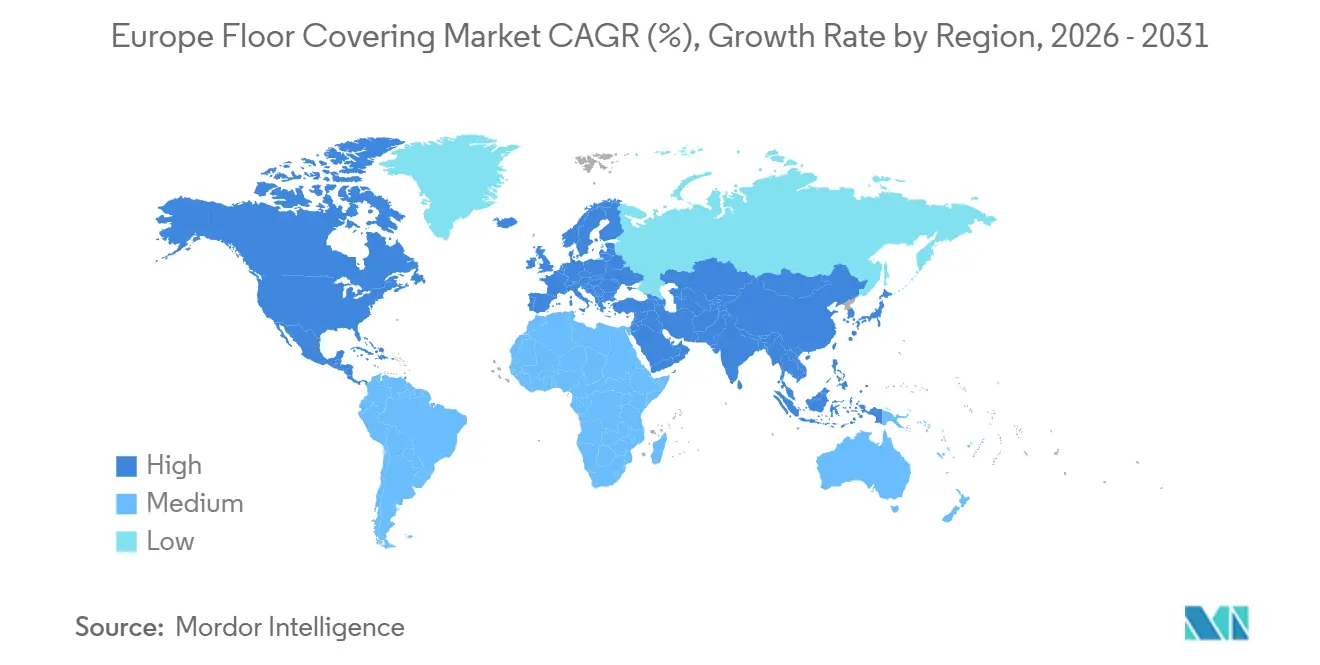
Germany held 31.76% of the European floor covering market size in 2025, supported by renovation goals and financing that stabilized retrofit volumes in housing and public buildings. France is expected to grow at a 9.37% CAGR through 2031, driven by incentives for low-emission installations and embodied-carbon thresholds guiding material choices. Southern European producers face elevated energy costs, influencing ceramic tile pricing and production capacity. Renovation regulations and public procurement criteria, emphasizing environmental declarations and circularity, shape bidding processes and product strategies across the market.
The United Kingdom focuses on premium renovations, favoring engineered wood and resilient flooring compatible with underfloor heating and low-emission standards. Benelux markets prioritize circular procurement, using material passports and recycled-content weighting to favor suppliers with take-back programs. The Nordics emphasize heating-compatible, resilient, and engineered wood flooring that withstands temperature fluctuations. Central and Eastern Europe allocate funds to healthcare and institutional projects requiring antimicrobial and washable surfaces under strict procurement standards. These trends drive diverse product mixes and compliance expectations across the market.
Steady growth continues in accession-related markets and regions with expanding housing supply, where residential space per capita lags Western norms. Value-oriented ceramic and laminate materials remain popular in budget-constrained areas, while public frameworks focus on recovery and recycling targets. Variations in VOC enforcement and emissions documentation require localized formulations and labeling to meet national regulations. Suppliers adjust operations and distribution to serve tender-heavy segments and address reporting needs, shaping go-to-market strategies across Europe’s diverse regulatory landscapes.

Regulatory Landscape
The European regulatory environment for floor coverings is tightening around product transparency, sustainability information, and chemicals compliance in construction. The Construction Products Regulation (EU) 2024/3110 applies from 8 January 2026 and strengthens harmonized marketing rules for construction products. It also embeds sustainability-related information and the pathway for digital product passports (DPPs), which reinforces demand for standardized environmental data in public and commercial procurement.
At the same time, the Ecodesign for Sustainable Products Regulation (EU) 2024/1781 establishes a framework for durability, reparability, recyclability, and recycled-content information requirements, with the ability to extend coverage to additional product groups through delegated acts. This raises the bar for product design and data readiness beyond traditional energy-related scopes. Standards work is also converging with these rules, adding category-specific compliance anchors for manufacturers active in Europe. 2026 publications such as SIST EN 18135:2026 (product passport framework for floor coverings) and EN 688:2026 (specification for corklinoleum in roll form) increase the need for accurate product identification, performance classification, and structured information handover across supply chains. Chemical compliance under REACH remains a baseline requirement, including Article 33 obligations to communicate Candidate List SVHC presence above 0.1% (w/w) in articles, which shapes formulations, supplier declarations, and documentation workflows for flooring sold into regulated tenders.
Competitive Landscape
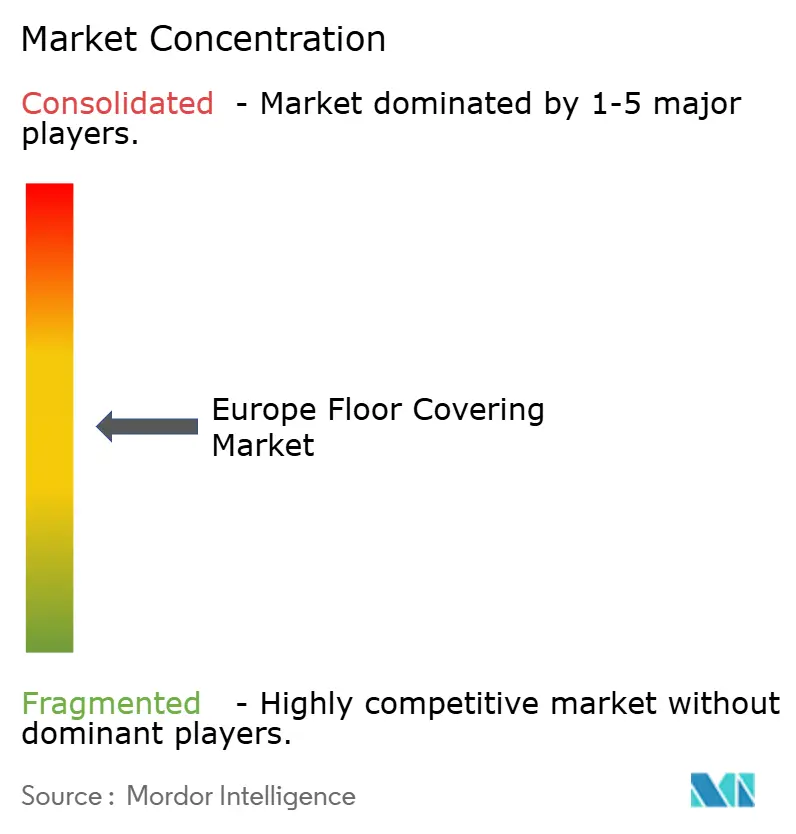
Supply in the European floor covering market remains fragmented, with national and global players competing in procurement, R&D, and compliance to meet rising standards in tenders. Companies focus on low-emission adhesives, bio-based backings, and PVC-free alternatives to comply with indoor air quality requirements. Circular collection and recycling programs are increasingly prioritized, driving investments in logistics and processing to recover post-installation and post-use materials. Investor communications emphasize energy management, emissions reduction, and recycled content, influencing capital access and corporate positioning. These strategies are essential for competitive differentiation where performance and compliance intersect.
Manufacturers are enhancing European resilient capacity and high-definition printing to localize aesthetics and reduce design cycle times. Product launches target lower cradle-to-gate carbon footprints and antimicrobial properties, addressing hygiene and sustainability goals in education and healthcare projects. Verified carpet tiles, rubber solutions, and modular vinyl products are positioned for reconfigurable commercial spaces and premium residential markets. Partnerships with builders integrate flooring specifications into housing packages, simplifying choices for buyers and developers. These efforts align production and market strategies with evolving demand and regulatory requirements, strengthening the market.
Corporate disclosures show progress in renewable energy use, carbon reduction, and recycled-content adoption, helping suppliers meet qualification criteria and improve procurement scores. Companies with take-back programs and Environmental Product Declarations (EPDs) are prepared for stricter regulations and circularity goals. Capital allocation and restructuring focus on cost reduction and asset efficiency while maintaining European production footprints for resilient categories. This positions market leaders to serve public and private projects as the market evolves under stricter specification and reporting standards.
Europe Floor Covering Industry Leaders
Mohawk Industries
Tarkett Group
Forbo Holding AG
Gerflor Group
Interface Inc.
- *Disclaimer: Major Players sorted in no particular order

Market Opportunities and Future Outlook
Regulation-led digitization and circularity requirements are creating demand for flooring suppliers that can operationalize traceability, verified sustainability attributes, and end-of-life pathways across Europe. With CPR (EU) 2024/3110 applying from January 2026 and linking construction product access to more structured sustainability information, opportunities center on digital product passport-ready portfolios, scalable EPD and material-data pipelines, and contractor-facing documentation bundles for tendered retrofit work. Standardization momentum, including guidance on circular design for resilient, textile, and laminate flooring (CEN/TS 18075:2024), supports product redesign around disassembly and recyclability, and gives specifiers clearer reference points to compare modular systems, backing chemistries, and recycled-content claims.
Circular collection and recycling infrastructure is increasingly a practical differentiator rather than a niche attribute. This expands the scope for partnerships and investment in take-back logistics, sorting, and reprocessing. The CISUFLO project concluded in March 2025 with circularity guidelines and the ePRODIS product information system, providing a concrete blueprint for data exchange and end-of-life decision-making across carpets, resilient flooring, and laminates. Commercial execution is also visible: Unilin started industrial operations for its Osiris laminate recycling technology in September 2025 to convert end-of-life laminate into reclaimed wood fibers, and Forbo maintained a 2026 environmental transparency passport for its Sphera Elite b+ line highlighting bio-based content and manufacturing resource metrics. Together, these examples underline where suppliers can attach credible, auditable data and collection schemes to circular-ready product design in tender-heavy markets such as the Nordics and Benelux.
Recent Industry Developments
- April 2026: Mohawk Group announced the addition of Hero Flooring to its resilient portfolio, broadening its offering in high-performance commercial flooring. The update points to faster portfolio building through brand integration and adds a recycled-content narrative via products using Nike Grind rubber, aligning with circular procurement requirements in parts of Europe.
- April 2026: Tarkett launched the iQ Motion homogeneous vinyl flooring collection, positioning it around circular design and long service life. The introduction expands Tarkett's resilient specification set for commercial interiors where restoration, modular replacement strategies, and documented sustainability attributes influence tender outcomes.
- February 2026: Interface launched noravant, a PVC-free resilient rubber flooring line with woodgrain aesthetics, made available in the Americas and select EMEA markets. The launch strengthens Interface's ability to support projects prioritizing low-emission material choices and provides an alternative resilient option for healthcare and other performance-critical environments.


Research Methodology Framework and Report Scope
Market Definition and Coverage
This market covers the sales value of finished floor-covering materials installed over subfloors in Europe across residential and commercial buildings. It includes common formats like carpet and rugs, resilient flooring, and hard surfaces that are bought for new build and renovation needs.
Scope exclusions: Loose mats, small area rugs, subfloor panels, adhesives, and installation labor are not counted in this sizing.
Segmentation Overview
- By Product Type
- Carpet and Area Rugs
- Wood Flooring
- Ceramic Tiles Flooring
- Laminate Flooring
- Vinyl Flooring
- Stone Flooring
- Other Products
- By Construction Type
- New Construction
- Remodelling/Retrofit
- By End-User
- Residential
- Commercial
- Hospitality & Leisure
- Retail & Shopping Centers
- Healthcare Facilities
- Education
- Corporate Offices
- Public & Government Buildings
- Other Commercial Users
- By Distribution Channel
- B2C Retail
- Home Centres
- Specialty Flooring Stores
- Online
- Other Distribution Channels
- B2B / Contractors / Builders
- B2C Retail
- By Geography (Europe)
- United Kingdom
- Germany
- France
- Spain
- Italy
- BENELUX (Belgium, Netherlands, Luxembourg)
- NORDICS (Denmark, Finland, Iceland, Norway, Sweden)
- Rest of Europe
Data Sources, Market Sizing, and Validation
Desk Research
Desk work was used to set the demand boundary and to anchor the model to measurable construction and renovation activity across Europe. We referenced public sources such as Eurostat construction output and housing statistics, national statistics offices for building permits and renovation indicators, European Commission energy efficiency and building policy publications, customs trade data for relevant flooring material categories, and standards and sustainability bodies that publish product and certification guidance.
In parallel, we reviewed company annual reports, investor presentations, product catalogs, and reputable trade press to understand pricing movement, format adoption, and channel shifts. Paid subscriptions supporting company financials and competitive intelligence, patent databases, and shipment-level import and export data were used selectively to validate key assumptions. The sources listed here are illustrative, and many other public and credible references were also used for collection, validation, and clarification.
Primary Interviews and Surveys
Primary work focused on validating what is actually sold into Europe each year, and how the mix changes by country, end use, and flooring format. We spoke with participants across manufacturing, distribution, installer ecosystem viewpoints, and large buyers, which then helped us tighten volume proxies, realistic price bands, and the timing of replacement cycles across key European countries.
Distribution of primary research fieldwork respondents
| Company type | Respondent position |
|---|---|
| Top tier: 29% | CXOs: 16% |
| Mid tier: 53% | Functional/Unit leaders: 38% |
| Smaller Players: 18% | Managers: 46% |
Market-Sizing & Forecasting
The sizing started from a top-down build where construction and renovation activity was translated into a flooring demand pool, and then allocated into material types using observed mix patterns. To keep it practical, we leaned on measurable indicators such as residential completions and permits, renovation and replacement intensity, commercial fit-out activity, flooring area trends per dwelling, import and export signals for key materials, and average selling price bands by format.
Once the top-down totals were formed, selective bottom-up checks were run to keep totals realistic, including supplier and distributor roll-ups for a sample of countries, channel checks on price points, and volume times ASP approximations where data was available. Where bottom-up visibility was thinner for smaller countries, gaps were handled by using regional per-capita or per-square-meter intensity benchmarks, then adjusted using interview feedback and trade flow direction.
For forecasting, scenario analysis was used around construction cycles and renovation momentum, and the year-by-year path was tuned using expert consensus on variables like housing starts, remodeling budgets, energy retrofit programs, and format shifts toward resilient and easier-to-install products. Assumptions were kept transparent so the model can be reproduced and stress-tested with the same public indicators.
Data Validation & Update Cycle
Validation was done by triangulating results across independent signals, so the final value aligns with construction reality and product movement on the ground. We checked for country-level outliers, unusual price jumps, and mix shifts that did not match trade data, policy changes, or respondent feedback, and then corrected the model before sign-off.
Before release, totals are reviewed in multiple analyst steps, and follow-up outreach is triggered when variances remain unexplained, or when a major driver moves abruptly. The report is refreshed annually, and interim updates are made when material events occur, such as sharp changes in construction spending, regulatory shifts affecting materials, or sustained pricing inflation. Right before delivery, a fresh pass is completed so clients receive an updated view.
Mordor Intelligence's Europe Floor Covering Market Sizing Compared With Other Published Estimates
Published market sizes for Europe floor covering do not always match because the market is not defined the same way across studies, and because pricing and timing assumptions are handled differently. Differences typically show up around whether the number reflects only finished floor-covering product sales or whether it also bundles a broader flooring materials basket and related spend.
By checking format-level price bands and country-level replacement cycles, Mordor Intelligence keeps the value tied to finished coverings permanently installed in buildings, and then reconciles it with construction output and trade signals before finalizing totals. Some estimates appear to blend wider material categories and upstream items, and a few also apply different base years or exchange-rate timing, which shifts the reported USD value even if the headline title looks similar.
Benchmark comparison
| Source | Market Size | Gaps in Research Methodology |
|---|---|---|
| Mordor Intelligence | USD 4.29 B (2026) | |
| Global Consultancy A | USD 42.00 B (2024) | Uses a wider definition that reads closer to overall flooring materials spend, and it likely blends broader channels and adjacent product categories beyond installed finished floor coverings, which increases the total versus a tighter surface-material scope. |
| Industry Publisher B | USD 4.46 B (2026) | Shows a similar year but appears to include industrial application and a broader channel perimeter, and the assumptions behind mix splits and ASP progression are less transparent, which can move the total even when the headline scope sounds close. |
The spread is mainly explained by what is counted inside the market and how prices are carried forward across the base year. When totals are anchored to clear drivers like construction output, renovation intensity, and format mix, they remain easier to trace and re-check as conditions change.


Key Questions Answered in the Report
What is the current size and expected growth of the European floor covering market?
The European floor covering market size reached USD 4.29 billion in 2026 and is projected to reach USD 5.12 billion by 2031 at a 3.61% CAGR.
Which product category is growing fastest in the European floor covering market?
Vinyl is the fastest-growing category, projected at a 7.65% CAGR through 2031, supported by rigid-core formats and antimicrobial finishes.
Which end-user segment leads demand within the European floor covering market?
Residential led with 74.43% of value in 2025, while commercial is set to grow fastest at 8.36% CAGR through 2031 due to office redesigns and healthcare projects.
How do regulations influence the European floor covering market today?
Energy performance rules, VOC restrictions, EPD mandates, and circular-procurement criteria drive demand for low-emission, recyclable, and take-back-enabled flooring systems across public and private projects.
Which country holds the largest share of the European floor covering market?
Germany led with 31.76% in 2025 due to renovation programs and financing that sustain high retrofit volumes.
Which sales channel is expected to grow fastest for floor coverings in Europe?
B2B or contractor channels are projected to grow at a 9.65% CAGR through 2031 as subsidy-tied retrofits and project bundling favour accredited installers and project-based procurement.
Page last updated on:


 Your data is secure and never sold or shared.


