
Market Overview
| Study Period | 2021 - 2031 |
|---|---|
| Forecast Data Period | 2026 - 2031 |
| Base Year Market Size (2025) | USD 3.60 Billion |
| Market Size (2026) | USD 3.79 Billion |
| Market Size (2031) | USD 4.89 Billion |
| Growth Rate (2026 - 2031) | 5.23 % |
| Market Concentration | Medium |
Major Players *Disclaimer: Major Players sorted in no particular order Image © Mordor Intelligence. Reuse requires attribution under CC BY 4.0. | |
Europe Flavored Milk Market Analysis by Mordor Intelligence
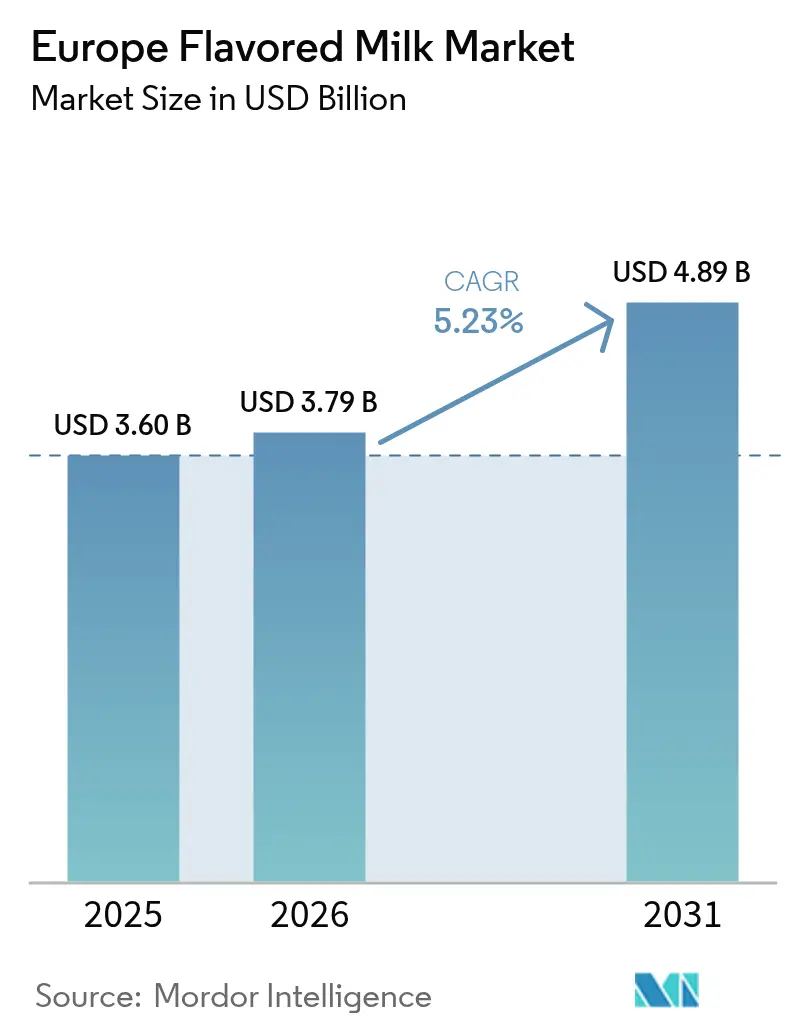
The Europe flavored milk market size was valued at USD 3.60 billion in 2025 and estimated to grow from USD 3.79 billion in 2026 to reach USD 4.89 billion by 2031, at a CAGR of 5.23% during the forecast period (2026-2031). The market is growing due to the increasing demand for convenient, ready-to-drink beverages that save consumers time. Flavored milk is also gaining popularity as a source of protein, appealing to health-conscious individuals who seek a convenient and nutritious option. The introduction of hybrid products that combine dairy and plant-based ingredients is attracting a wider range of consumers, including those seeking alternative options. Sustainability regulations are encouraging manufacturers to use recyclable packaging, which aligns with the growing focus on environmental responsibility. To manage the volatility of raw milk prices, companies are adopting vertical integration, which enables them to control costs and maintain a stable supply. The market remains moderately fragmented, with competition among both global and regional players.
Key Report Takeaways
- By product type, dairy-based variants led the European flavored milk market with 85.02% of the market share in 2025; plant-based alternatives are forecasted to expand at a 5.31% CAGR through 2031.
- By flavor profile, chocolate held 51.40% revenue share in 2025, while strawberry is advancing at a 6.29% CAGR through 2031.
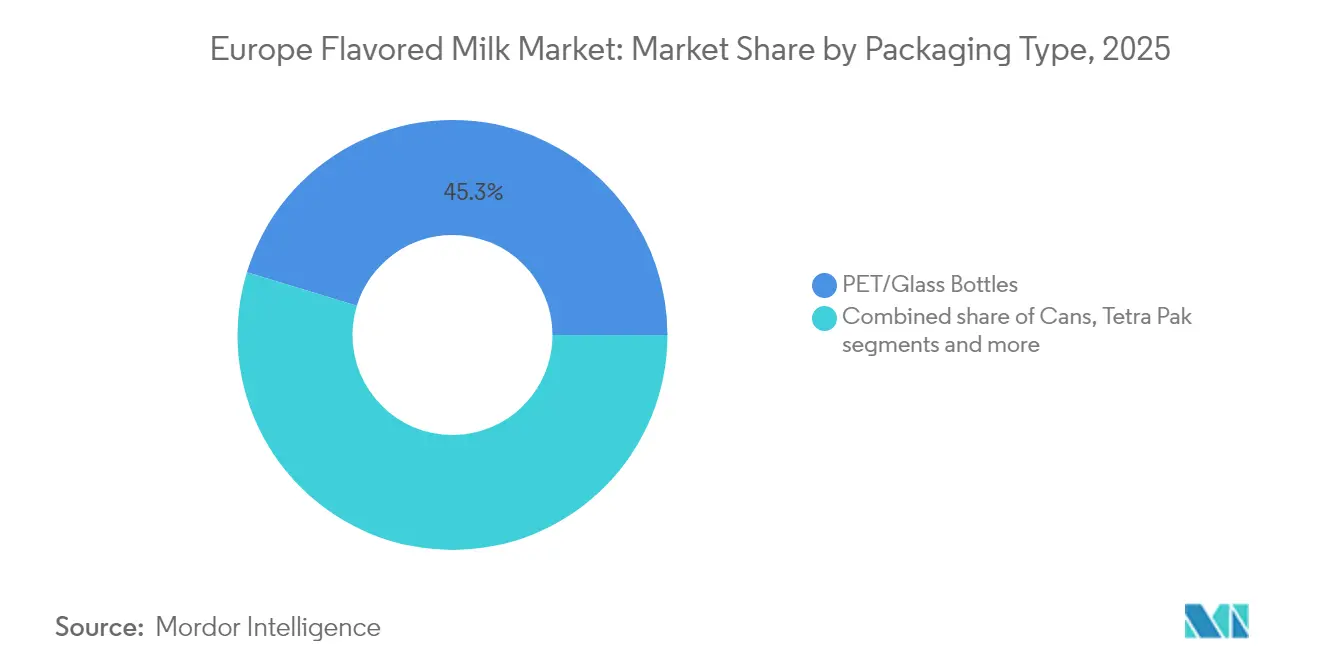
- By packaging type, PET/glass bottles dominated with a 45.29% contribution in 2025; aluminum cans are projected to grow at a 6.38% CAGR between 2026 and 2031.
- By distribution channel, the off-trade accounted for 45.55% of sales in 2025, whereas the on-trade is poised for a 7.05% CAGR over the forecast period.
- By country, the United Kingdom commanded a 24.05% share in 2025, and Spain is expected to post the fastest growth rate of 6.68% up to 2031.
Note: Market size and forecast figures in this report are generated using Mordor Intelligence’s proprietary estimation framework, updated with the latest available data and insights as of 2026.
Europe Flavored Milk Market Trends and Insights
Drivers Impact Analysis*
| Driver | (~) % Impact on CAGR Forecast | Geographic Relevance | Impact Timeline |
|---|---|---|---|
| Increasing demand for convenient and ready-to-drink beverages | +0.9% | Strongest uptake in United Kingdom, Germany, Netherlands | Short term (≤ 2 years) |
| Preference for beverages that are protein-rich and packed with nutrients | +0.8% | United Kingdom, Germany, France, Nordics (Sweden, Denmark via Arla) | Medium term (2-4 years) |
| Growth in the availability of plant-based flavored milk options | +1.1% | United Kingdom, Germany, Netherlands, France; spill-over to Spain, Italy | Medium term (2-4 years) |
| Growing café culture and rising demand for coffee-flavored milk variants | +0.7% | United Kingdom, Germany, France, urban centers across Europe | Short term (≤ 2 years) |
| Rising demand for clean label flavored milk featuring natural ingredients and minimal additives | +0.6% | France, Germany, Netherlands, United Kingdom, Sweden | Long term (≥ 4 years) |
| Exclusive flavored milk launches through celebrity collaborations | +0.4% | United Kingdom, Germany, Poland (Arla-Mondelēz Milka) | Short term (≤ 2 years) |
| Source: Mordor Intelligence | |||
Preference for beverages that are protein-rich and packed with nutrients
Consumers in Europe are increasingly focusing on meeting their daily protein requirements, which is driving the demand for fortified flavored milk. According to ScienceDirect in October 2025, the average protein intake across 20 European countries ranges between 0.8 g/kg/day and 1.25 g/kg/day[1]. This growing awareness is encouraging people to choose convenient and nutrient-rich beverages that help fill their dietary protein gaps. To cater to this demand, major European dairy companies, such as Arla, Emmi, and Müller, are expanding their range of high-protein flavored milk products. These products are made using ultra-filtered milk and enriched with whey and casein proteins. Manufacturers are also utilizing advanced filtration and enrichment technologies to enhance the protein content and improve the texture of these beverages. As a result, fortified flavored milk is becoming a practical and accessible option for consumers seeking high-quality protein in their daily diets.
Growth in the availability of plant-based flavored milk options
The increasing availability of plant-based and hybrid dairy–plant milk options is driving growth in the European flavored milk market. This trend is supported by a growing number of plant-focused consumers, including the 964,800 vegans recorded in Italy in 2024, as reported by World Population Review[2]. The demand for plant-based dairy alternatives is steadily rising, with retail sales of plant-based dairy products reaching EUR 3.6 billion in 2023 and continuing to grow at a faster rate than traditional dairy products. In May 2025, Farm Dairy in the Netherlands and PlanetDairy in Denmark introduced a new range of sustainable dairy–plant milk blends across Europe, reflecting the industry's shift toward environmentally friendly and flexitarian-friendly products. Leading brands like Alpro, Oatly are also expanding their production capacities to cater to the increasing demand for flavored milks made from oats, almonds, and soy.
Increasing demand for convenient and ready-to-drink beverages
The demand for convenient and ready-to-drink beverages is increasing across Europe, leading to a rise in the popularity of flavored milk. Consumers with busy lifestyles are opting for single-serve and portable options instead of traditional café beverages. Packaging innovations, such as lightweight bottles, cans, and ambient cartons, are making flavored milk more accessible in convenience stores and for on-the-go consumption. Additionally, the longer shelf life and availability of these products in ambient formats make them a practical choice for consumers who prioritize convenience. The success of similar portable packaging in other categories, like yogurt pouches, is also influencing consumer preferences and encouraging the adoption of flavored milk. These factors are collectively positioning flavored milk as a convenient and appealing everyday beverage for people with active and mobile lifestyles.
Growing café culture and rising demand for coffee-flavored milk variants
The growing café culture across Europe is driving demand for coffee-flavored milk products, as consumers increasingly seek the taste of café-style beverages in convenient, ready-to-drink options. Europe’s strong coffee consumption habits support this trend. For instance, in the United Kingdom, people consume approximately 98 million cups of coffee daily, according to the British Coffee Association[3]. This widespread love for coffee, combined with the rapid growth of Europe’s ready-to-drink (RTD) coffee market, is encouraging consumers to explore affordable, dairy-based coffee alternatives. Countries like Germany are witnessing significant adoption of these products as more people develop a preference for premium coffee flavors. Partnerships between cafés and manufacturers, along with the increasing availability of these products in convenience stores, are making coffee-flavored milk more accessible.
Restraints Impact Analysis*
| Restraint | (~) % Impact on CAGR Forecast | Geographic Relevance | Impact Timeline |
|---|---|---|---|
| Rising concerns regarding the high sugar content in flavored milk | -0.5% | United Kingdom, France, Germany, Netherlands, Sweden | Short term (≤ 2 years) |
| Increasing demand for clear and transparent ingredient labeling | -0.3% | France, Germany, Netherlands, United Kingdom | Medium term (2-4 years) |
| Fluctuating milk prices are driving up production costs | -0.7% | Europe-wide, with acute impact in Spain, Italy, Poland | Short term (≤ 2 years) |
| Concerns regarding the use of artificial flavors, colors, and stabilizers | -0.4% | France, Germany, Netherlands, United Kingdom, Nordics | Medium term (2-4 years) |
| Source: Mordor Intelligence | |||
Rising concerns regarding the high sugar content in flavored milk
Concerns about the high sugar content in flavored milk are increasingly limiting its market growth in Europe. Consumers are becoming more health-conscious, and policymakers are introducing stricter measures to reduce sugar consumption in beverages. For example, in Italy, the implementation of a sugar tax has proven highly effective. According to ScienceDirect, as of July 2024, this tax has resulted in an 18% reduction in purchases of sugar-sweetened beverages and a 24% decrease in sugar intake[4]. Such results are encouraging other European countries to consider similar policies, which are adding cost pressures for manufacturers of high-sugar flavored milk products. Labeling systems, such as Nutri-Score, are influencing consumer choices. Many popular flavored milk variants, such as chocolate and strawberry, receive low ratings (D or E), which impacts their visibility and shelf placement in retail stores.
Concerns regarding the use of artificial flavors, colors, and stabilizers
Concerns about artificial flavors, colors, and stabilizers are slowing the growth of the European flavored milk market. Consumers are becoming increasingly cautious about these ingredients, often linked to the “E-number stigma,” which refers to skepticism around additives labeled with E-numbers. Ingredients such as carrageenan, artificial vanilla, and certain stabilizers are facing increased scrutiny, even when they comply with EU safety standards. This has led consumers to pay closer attention to product labels and avoid heavily processed options. Stricter regulations on cocoa contaminants, such as limits on ochratoxin levels, are forcing manufacturers to improve supplier oversight and reformulate their products to meet these standards. In countries such as France and Germany, there is a growing demand for flavored milk made with natural ingredients or free from artificial additives.
*Our forecasts treat driver/restraint impacts as directional, not additive. The impact forecasts reflect baseline growth, mix effects, and variable interactions.
Segment Analysis
By Product Type: Plant-Based Momentum Within Dairy Dominance
Dairy-based flavored milk held a significant 85.02% share of the European market in 2025, primarily due to its strong consumer preference and well-established cold-chain logistics. These products are naturally high in protein, offering 8–9 grams per serving, which makes them a popular choice for those seeking nutritious and satisfying beverages. Their widespread availability in supermarkets, cafés, and schools ensures they remain a convenient option for daily consumption. The introduction of new flavors and premium product lines continues to strengthen the position of dairy-based flavored milk in terms of both market volume and value across Europe.
Plant-based flavored milk is projected to grow at a CAGR of 5.31% through 2031, driven by the increasing demand for vegan, lactose-free, and flexitarian diets. Popular options, such as oat, soy, and almond milk, are gaining traction as consumers seek sustainable and ethical alternatives to traditional dairy products. Enhanced production capabilities and broader retail availability are making these products more accessible to a wider audience. Clean labels and allergen-free claims are appealing to health-conscious consumers. Although plant-based flavored milk currently holds a smaller market share, its growing variety of flavors and rising consumer interest are helping it establish a stronger presence as a complementary segment in the flavored milk market.


By Flavor Profile: Chocolate Reigns, Strawberry Rises
In 2025, chocolate made up 51.40% of the Europe flavored milk market, maintaining its position as the most preferred flavor. Its popularity stems from its universal appeal, making it a staple choice for both children and adults. Partnerships between dairy producers and well-known chocolate brands have helped chocolate-flavored milk gain prominent shelf space in stores, boosting its visibility. Seasonal limited-edition offerings and indulgent variations further drive consumer interest, ensuring steady demand. As a result, chocolate remains the leading flavor, contributing significantly to the market's overall growth in terms of both sales and value.
Strawberry-flavored milk is projected to grow at a CAGR of 6.29% through 2031, as more consumers opt for lighter, fruit-based flavors in their beverages. Its refreshing and versatile taste appeals to a wide range of age groups, and its adaptability to both dairy and plant-based formulations has led to its inclusion in various new product launches. Retailers are also increasing shelf space for strawberry-flavored milk to meet the rising demand for healthier and less sugary options. Additionally, advancements in natural coloring and cleaner, fruit-based ingredients are enhancing its appeal. These factors make strawberry the fastest-growing flavor segment in the European flavored milk market.
By Packaging Type: Aluminum Cans Accelerate Under Recycling Targets
PET/glass bottles made up 45.29% of the European flavored milk market in 2025. This dominance is due to their strong consumer acceptance and the transparency of the packaging, which allows customers to see the product inside, offering reassurance about its quality. These packaging types are commonly used in both retail stores and foodservice outlets because they are portable, durable, and easy to recycle within well-established collection systems. Additionally, their suitability for both single-serve and family-size options provides manufacturers with flexibility. The clear visibility of the product and branding through labels further attracts consumers, making PET and glass bottles the most preferred packaging options in the region.
Aluminum cans are projected to grow at a compound annual growth rate (CAGR) of 6.38% from 2026 to 2031. This growth is driven by increasing consumer demand for convenient and portable beverage packaging. Aluminum cans are lightweight, cool quickly, and are highly recyclable, which appeals to environmentally conscious buyers. They also help extend the shelf life of products and are ideal for placement in vending machines, convenience stores, and travel retail outlets. Furthermore, the growing popularity of ready-to-drink (RTD) coffee and energy drinks has encouraged the use of aluminum cans for flavored milk products. These combined benefits are driving the rapid adoption of aluminum cans, making them one of the fastest-growing packaging options in the European flavored milk market.
By Distribution Channel: On-Trade Gains Through Café Alliances
Off-trade channels, including supermarkets, hypermarkets, and discounters, accounted for 45.55% of the Europe flavored milk market in 2025. These channels dominate due to their affordable private-label options and prominent in-store promotions, which encourage impulse buying. Supermarkets and hypermarkets offer a wide variety of flavors and packaging sizes, making them a convenient choice for regular household shopping. Additionally, their well-established cold storage systems ensure the availability of fresh products, while frequent discounts and multi-pack deals attract cost-conscious consumers. Discounters, in particular, are gaining traction by offering budget-friendly flavored milk options, thereby further strengthening their market position.
On-trade channels, such as cafés, quick-service restaurants, and vending machines, are expected to grow at a 7.05% CAGR from 2026 to 2031. The increasing popularity of café culture and coffee-flavored milk products is driving demand in these settings. Consumers are also turning to on-the-go options, with vending machines in travel hubs, workplaces, and other high-traffic areas playing a significant role in expanding accessibility. Premium offerings in cafés, such as specialty flavored milk beverages, are encouraging consumers to try higher-priced products. These factors are collectively contributing to the rapid growth of on-trade channels, making them an important and expanding segment in the flavored milk market.
Geography Analysis
The United Kingdom was the largest flavored milk market in Europe in 2025, holding a 24.05% share. This strong position is supported by a well-developed grocery retail system and a popular café culture that encourages regular consumption of flavored milk and milk-based beverages. Major investments, such as Arla’s GBP 300 million upgrades, have increased the availability of high-protein and health-focused flavored milk options to meet the growing demand for wellness products. Additionally, the expected expansion of sugar levies is pushing manufacturers to create reduced-sugar alternatives. Frequent collaborations between brands and the introduction of trendy flavors further solidify the United Kingdom’s role as a leading market for testing new product ideas.
Spain is expected to be the fastest-growing flavored milk market in Europe, with a projected CAGR of 6.68% through 2031. Increasing imports drive this growth, a rising preference for premium and indulgent flavored milk options, and shifting consumer tastes, even as domestic production slows. The country’s strong tourism industry and diverse retail formats are exposing consumers to a wider variety of innovative products. These factors, combined with changing purchasing habits, are making Spain a key market for expansion in Europe. The focus on offering high-quality and indulgent products is helping brands attract a broader audience and gain a competitive edge.
Germany played a significant role in the growth of the European flavored milk market in 2024, supported by the expansion of discount retail chains and increasing interest in ready-to-drink coffee-inspired flavored milk products. Sustainability trends are also shaping the market, with a growing shift toward eco-friendly packaging solutions like aluminum-free cartons. Other countries, such as the Netherlands, the Nordics, Italy, Poland, and Switzerland, also contribute to the market with their unique consumer preferences, pricing strategies, and retail environments. While regulatory harmonization across Europe simplifies product launches, cultural and linguistic differences require brands to adopt localized strategies. This creates a wide range of opportunities for growth across the region.
Regulatory Landscape
Flavored milk in Europe operates under EU horizontal food safety rules and dairy hygiene requirements, including the General Food Law (Regulation (EC) No 178/2002) and the hygiene package applicable to milk and dairy processing (including Regulation (EC) No 853/2004). HACCP-based controls are implemented at plant level and enforced by Member State authorities. Product communication is governed by the food information rules under Regulation (EU) No 1169/2011, which requires clear ingredient and allergen declarations for dairy and plant-based variants sold across the region.
Formulation and fortification are also influenced by EU authorization pathways for additives, flavorings, and novel ingredients, supported by EFSA risk assessments under the EU additives framework (including Regulation (EC) No 1333/2008). In June 2024, Commission Regulation (EU) 2024/1821 amended annexes to the fortification framework (Regulation (EC) No 1925/2006) by including iron milk caseinate as an approved substance, expanding compliant options for functional positioning. In 2026, EFSA continued updating scientific assessment outputs and guidance related to the data packages required for authorizations, which affects the timing and cost of innovation for reduced-sugar, clean-label, and enriched flavored milk products.
Competitive Landscape
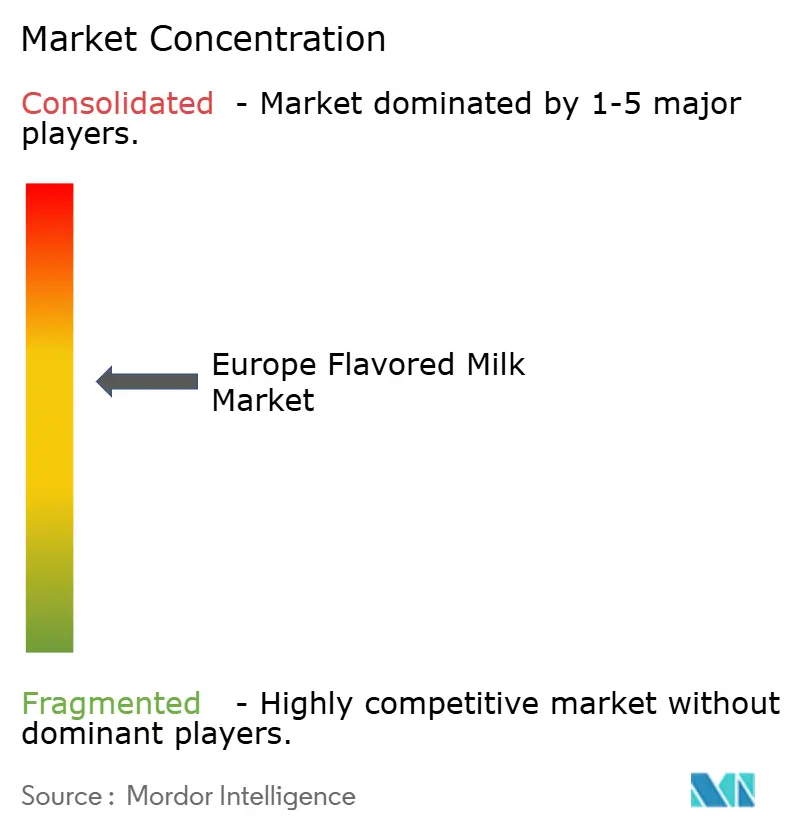
The European flavored milk market is moderately fragmented. FrieslandCampina’s merger with Milcobel in December 2024 has significantly enhanced its procurement capabilities and aseptic production capacity, enabling the company to execute more effective marketing and promotional strategies. Similarly, Arla’s acquisition of Volac in February 2025 has strengthened its position in the premium functional product segment by gaining access to advanced whey technology. Danone, through its Milk Academy initiative, is focusing on sustainable practices like regenerative sourcing and reducing methane emissions, which align with growing consumer and retailer demand for environmentally responsible products.
Plant-based brands such as Oatly and Alpro are expanding their presence by forming partnerships with cafés and offering direct-to-consumer bundles. These strategies cater to the increasing demand for sustainable and lactose-free options, which are gaining popularity among health-conscious consumers. Additionally, Refresco, a contract manufacturer, has acquired Frías Nutrición, allowing retailers to quickly enter the private-label market for oat and almond-based drinks. Smaller brands are leveraging social media campaigns and celebrity endorsements to gain visibility. However, stricter compliance regulations and new packaging requirements are expected to drive market consolidation, making it more challenging for new entrants to establish themselves in the European flavored milk market.
Technological advancements are playing a crucial role in helping companies differentiate themselves in the competitive market. Innovations such as enzyme-enabled hybrid proteins and mono-material packaging are enabling businesses to meet sustainability goals while maintaining profitability. The growing share of private-label products, which is projected to reach 40%, is pushing established brands to accelerate their innovation efforts. To stay competitive, these brands are focusing on creating compelling narratives around product origin, nutritional benefits, and sustainability, ensuring they retain their position on retail shelves in the European flavored milk market.
Europe Flavored Milk Industry Leaders
-
Nestlé S.A.
-
Danone S.A.
-
Royal FrieslandCampina N.V.
-
Müller Group
-
Arla Foods amba
- *Disclaimer: Major Players sorted in no particular order
Market Opportunities and Future Outlook
A near-term whitespace for flavored milk manufacturers and co-packers is emerging from capacity modernization and higher-throughput liquid dairy lines that can support ready-to-drink formats, including coffee-flavored and high-protein flavored milk. In July 2025, Muller UK & Ireland announced a GBP 45 million investment at its Skelmersdale site to increase liquid milk processing capacity and expand milk drying capabilities, with completion scheduled by end-2026. This improves supply-side flexibility for new flavored and functional SKUs sold through the United Kingdoms dominant off-trade channel. At the same time, factory upgrades and storage expansion backed by the European Investment Bank, including the Lactinovs program supported by a EUR 50 million grant for specialized nutrition dairy lines over 2026-2029, point to a shift toward more sophisticated, higher-margin dairy beverage and nutrition adjacencies that flavored milk portfolios can leverage.
Institutional demand programs also provide a structured route to volume and brand familiarity in core dairy consumption settings. In April 2026, the European Commission fixed the definitive allocation of Union aid for the EU school milk scheme for 1 August 2026 to 31 July 2027 under the CMO framework (Regulation (EU) No 1308/2013), anchoring procurement planning for approved dairy products in educational establishments. For brand owners, this supports opportunities around compliant nutrition profiles, including sugar reduction and clean-label reformulation aligned with consumer and policy pressure, as well as packaging shifts toward recyclable formats such as aluminum cans that fit sustainability-driven retail requirements and on-the-go consumption occasions.
Recent Industry Developments
- January 2026: Muensterland announced a collaboration with Ball Corporation to launch limited-edition SpongeBob SquarePants flavored milk drinks in aluminum cans in Germany. The initiative pairs a packaging format shift with licensed IP to increase visibility in impulse and convenience channels where cans and single-serve packs perform well.
- July 2025: Arla Foods expanded its Arla Protein portfolio with a ready-to-drink protein milkshake range in 200 ml cups, offered in Vanilla Fudge and Chocolate Brownie flavors. The launch reinforces the markets functional positioning trend, using protein-led claims to defend flavored milk relevance amid sugar and additive scrutiny.
- July 2024: Delamere Dairy introduced flavored milk variants (Strawberry and Chocolate) in recyclable paper CartoCan packaging in the United Kingdom. This packaging-led differentiation supports retailer sustainability goals and provides a route to premium shelf placement for smaller brands competing against multinational dairy players.
Research Methodology Framework and Report Scope
Market Definition and Coverage
For this methodology, the Europe flavored milk market covers ready-to-drink milk beverages sold in Europe that are flavored (for example, chocolate, strawberry, vanilla, or similar), and are bought mainly for direct consumption through retail and foodservice.
Scope exclusions: plain/unflavored drinking milk, infant formula, and yogurt-based spoonable products are not counted as flavored milk in our sizing.
Segmentation Overview
- By Product Type
- Dairy-Based
- Cow
- Goat
- Others
- Plant-Based
- Soy
- Almond
- Oat
- Others
- Dairy-Based
- By Flavor Profile
- Chocolate
- Strawberry
- Vanilla
- Others
- By Packaging Type
- PET/Glass Bottles
- Cans
- Tetra Pak
- Others
- By Distribution Channel
- On-trade
- Off-trade
- Supermarkets/Hypermarkets
- Specialist Retailers
- Convenience Stores
- Online Retail
- Others
- By Country
- United Kingdom
- Germany
- France
- Italy
- Spain
- Netherlands
- Sweden
- Poland
- Switzerland
- Rest of Europe
Data Sources, Market Sizing, and Validation
Desk Research
Desk research was used to build the base market structure and to align definitions across countries before any modeling was finalized. We relied on public statistics and references such as Eurostat, FAOSTAT, national agriculture and food ministries, customs and tariff databases for dairy trade, and food safety and labeling guidance from EFSA and the European Commission. These sources were used to map milk supply conditions, category trends, and the way flavored milk is labeled and sold across Europe.
Along with official sources, we also reviewed company annual reports, investor presentations, retailer category notes, and reputable press coverage to understand pricing direction and packaging shifts. Where needed, we used paid database subscriptions for company financials and intelligence, and patent databases to track product renovation activity. This list is illustrative, and many other public sources were also used for data collection, validation, and clarification during the work.
Primary Interviews and Surveys
We interview and survey CXOs, functional/unit leaders, and managers involved in dairy processing, brand planning, distribution, and retail across Europe. Their input helps separate flavor demand from broader milk demand and clarifies channel mix, pack sizes, pricing, and plant-based substitution at the country level. We use these discussions to check secondary evidence and address country gaps, then review conflicting responses before final analysis.
Distribution of primary research fieldwork respondents
| Company type | Respondent position |
|---|---|
| Top tier: 30% | CXOs: 15% |
| Mid tier: 50% | Functional/Unit leaders: 30% |
| Smaller Players: 20% | Managers: 55% |
Market-Sizing & Forecasting
The sizing starts with a top-down build where dairy consumption patterns, flavored milk penetration by country, and channel splits are used to reconstruct the demand pool, and then value is derived using observed price bands. To keep totals realistic, we corroborated the outcome with selective bottom-up checks such as sampled brand and private label price points, distributor feedback on shipped volumes, and cross-checks against a small set of supplier roll-ups where data was available.
Key inputs that shaped the model included flavored milk share within drinking milk, retail versus foodservice contribution, packaging mix shifts (cartons versus bottles and cans), sugar-reduction and protein fortification trends that affect price ladders, and inflation-driven price resets by country. Forecasts were produced using scenario analysis, where the core case was guided by expected milk input cost direction, consumer demand resilience, and likely promotional intensity, and the upper and lower cases were stress-tested in expert calls. When a country-level data point was thin, we filled the gap using peer-country proxies based on similar dairy consumption and retail structure, then adjusted it after primary checks.
Data Validation & Update Cycle
Outputs were validated through triangulation across independent signals, including country demand indicators, pricing direction, and the implied per capita consumption of flavored milk. Variance checks were run to flag countries where growth or price movement looked inconsistent with the wider dairy context, and those cases were reviewed again before sign-off.
Reports are refreshed annually, and interim updates are completed when material events occur such as regulation changes, large pricing shocks, or major capacity moves. Before delivery, a final pass is done so clients receive the latest view, and any meaningful new data triggers a quick model re-run and selective re-contact with respondents.
Mordor Intelligence's Europe Flavored Milk Market Size Measured Against Other Published Estimates
Published market sizes for Europe flavored milk can look far apart, even when the topic sounds the same, because different studies set different category boundaries and they do not always treat geography, channels, and product types consistently.
The benchmark table shows a wide spread that is mainly explained by what gets counted as flavored milk and when price and currency assumptions are locked. In Mordor Intelligence's model, the value is built for ready-to-drink flavored milk beverages sold in Europe, with country-level channel mix and packaging effects reflected, while some other sources appear to fold in adjacent dairy beverages or broader flavored drink baskets that inflate the total.
Benchmark comparison
| Source | Market Size | Gaps in Research Methodology |
|---|---|---|
| Mordor Intelligence | USD 3.60 B (2025) | |
| Global Consultancy A | USD 17.27 B (2024) | Uses a much broader category scope for Europe flavored milk, which likely includes a wider flavored dairy beverage basket and different channel coverage, making it less comparable to a strict ready-to-drink flavored milk definition. |
| Industry Data Publisher B | USD 8.86 B (2025) | Reports a larger 2025 total, which can come from including additional sub-categories (such as extended dairy beverages and wider plant-based flavored drinks) and applying different price ladders or currency timing across European countries. |
Taken together, the differences are not just about forecasting optimism, they come from definition choices, channel treatment, and how prices are applied across countries. Our approach keeps the total traceable to clear demand drivers like penetration, channel mix, and price bands, so decision-makers can repeat the logic and pressure-test assumptions.
Key Questions Answered in the Report
How large is the Europe flavored milk market in 2026?
The Europe flavored milk market size is USD 3.79 billion in 2026 with a forecast 5.23% CAGR to 2031.
Which product type is growing the fastest?
Plant-based flavored milk is projected to post a 5.31% CAGR through 2031, outpacing dairy-based alternatives.
What flavor is most popular among European consumers?
Chocolate leads with 51.40% share, although strawberry is the fastest-growing at 6.29% CAGR.
Which country offers the highest growth opportunity?
Spain is expected to grow at 6.68% CAGR thanks to rising imports and premiumization trends amid stagnant local milk supply.