
Market Overview
| Study Period | 2021 - 2031 |
|---|---|
| Forecast Data Period | 2026 - 2031 |
| Base Year Market Size (2025) | USD 11.09 Billion |
| Market Size (2026) | USD 11.58 Billion |
| Market Size (2031) | USD 14.40 Billion |
| Growth Rate (2026 - 2031) | 4.46 % |
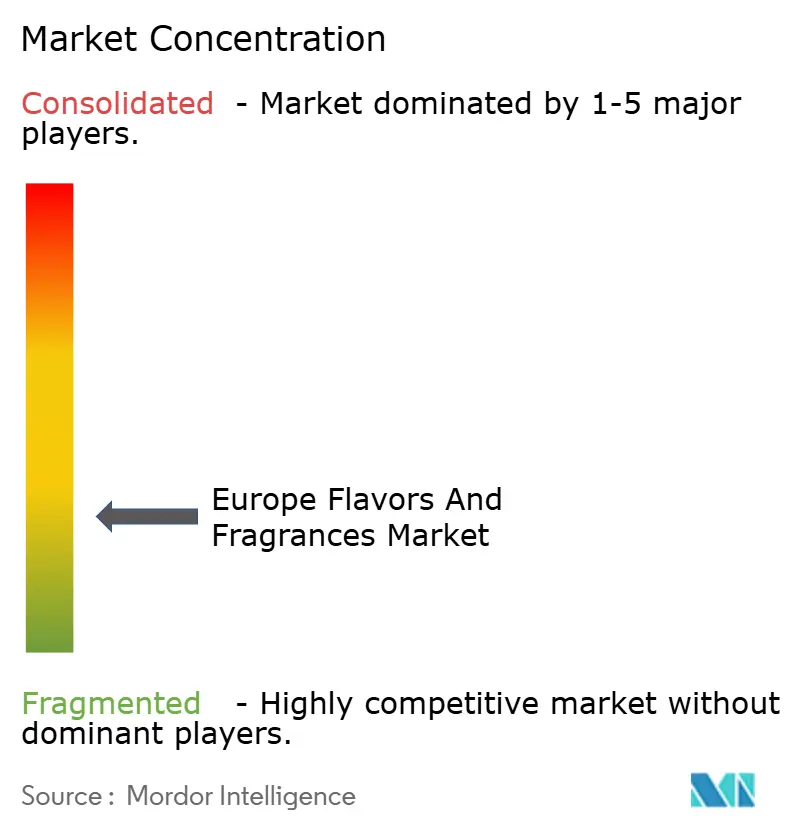
| Market Concentration | Low |
Major Players *Disclaimer: Major Players sorted in no particular order Image © Mordor Intelligence. Reuse requires attribution under CC BY 4.0. | |
Europe Flavors and Fragrances Market Analysis by Mordor Intelligence
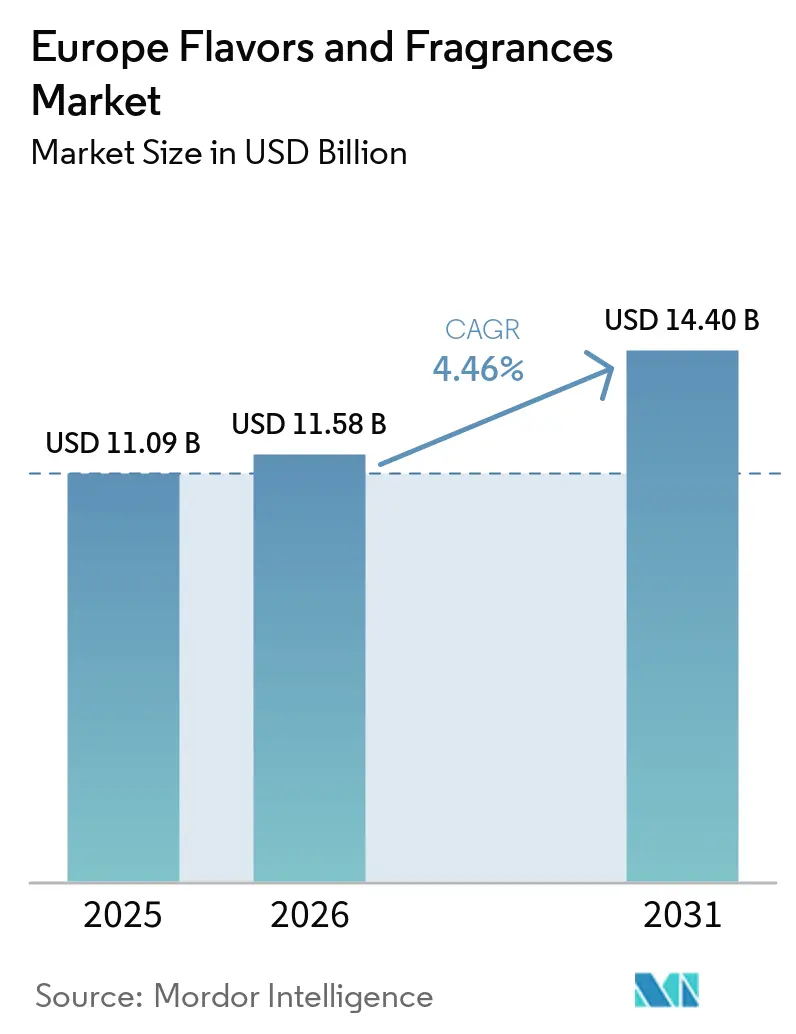
The Europe flavors and fragrances market size is expected to grow from USD 11.09 billion in 2025 to USD 11.58 billion in 2026, and is forecast to reach USD 14.40 billion by 2031, at a 4.46% CAGR over 2026-2031. This steady climb reflects demand for premium, sustainable and health-aligned ingredients across food, beverage, personal care and household categories. Growth pivots on three structural forces: progressive regulation that encourages clean-label reformulation, rapid technology adoption in biotechnology and digital product design, and a consumer shift toward wellness, personalization and ethical sourcing. Germany anchors scale and innovation while Spain supplies outsized momentum, mirroring its competitive energy costs and expanding food-processing base.
Key Report Takeaways
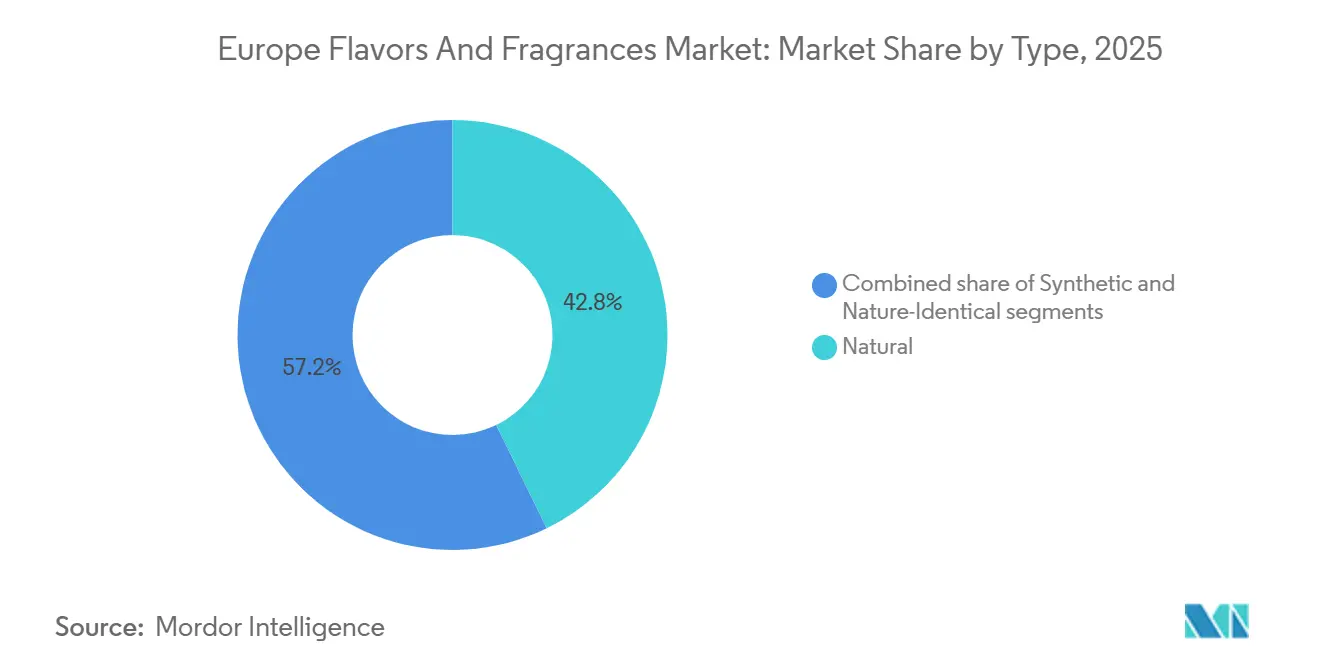
- By type, natural ingredients captured 42.78% of Europe's flavors and fragrances market share in 2025 and are advancing at a 5.88% CAGR through 2031.
- By form, liquid products led with a 33.65% share of the European flavors and fragrances market size in 2025; powder formats are projected to expand at a 5.31% CAGR between 2026-2031.
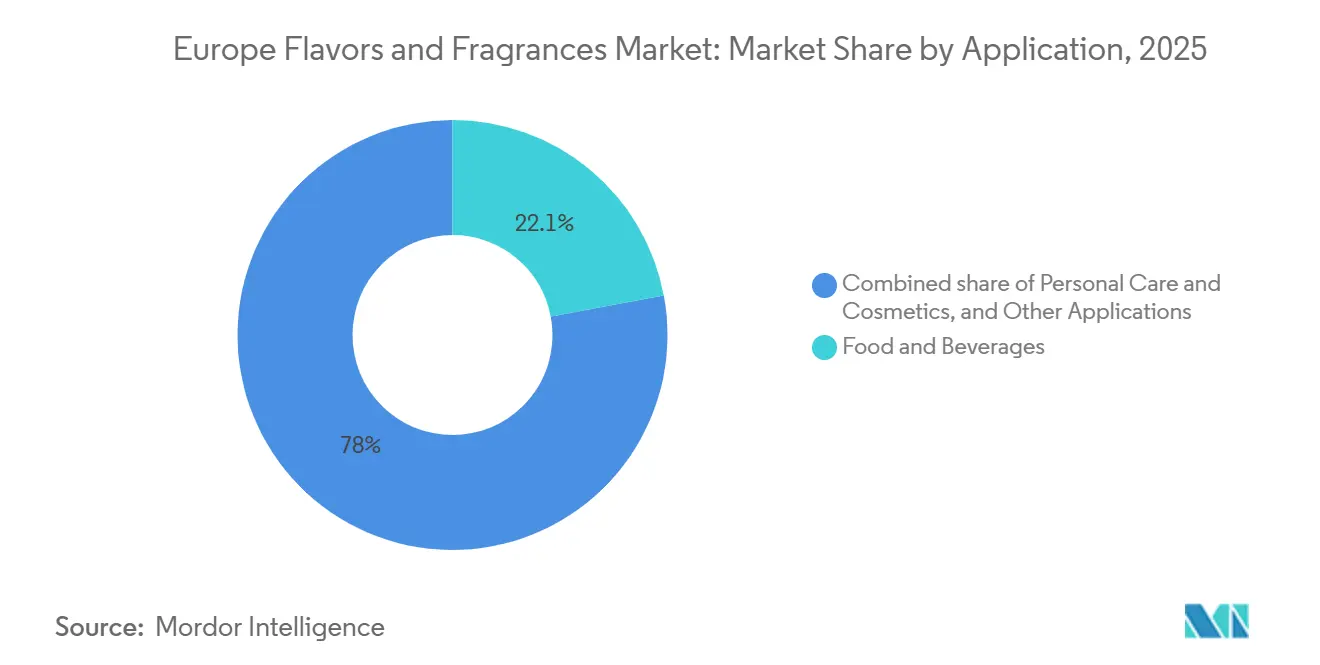
- By application, food and beverages held 22.05% revenue share in 2025, while personal care and cosmetics recorded the highest projected CAGR at 6.29% through 2031.
- By geography, Germany commanded 25.30% of the European flavors and fragrances market in 2025, whereas Spain is forecast to post the fastest 6.12% CAGR to 2031.
Note: Market size and forecast figures in this report are generated using Mordor Intelligence’s proprietary estimation framework, updated with the latest available data and insights as of 2026.
Europe Flavors and Fragrances Market Trends and Insights
Drivers Impact Analysis*
| Drivers | (~) % Impact on CAGR Forecast | Geographic Relevance | Impact Timeline |
|---|---|---|---|
| Rising demand for natural and clean-label ingredients | +1.2% | Regional, strongest in Germany, France, Netherlands | Medium term (2-4 years) |
| Growth of functional foods, beverages, and wellness products | +0.9% | Western Europe core, expanding to Eastern Europe | Long term (≥ 4 years) |
| Increasing popularity of personalized and customized flavor/fragrance solutions | +0.7% | Germany, France, United Kingdom leading adoption | Medium term (2-4 years) |
| Expansion of processed food & beverage industry | +0.8% | Spain, Italy showing strongest growth | Short term (≤ 2 years) |
| Increasing use of fragrances in various cosmetics and personal care products | +1.1% | France, Germany, Italy premium segments | Long term (≥ 4 years) |
| Growing interest in vegan and cruelty-free ingredients | +0.6% | Northern Europe, spreading to Mediterranean | Medium term (2-4 years) |
| Source: Mordor Intelligence | |||
Rising Demand for Natural and Clean-Label Ingredients
In Germany, 69% of organic food sales now occur through conventional retail outlets, highlighting a significant consumer shift toward transparency and naturalness and signaling the mainstream adoption of natural products. This trend extends beyond the food market. For example, the Mindera® platform of Symrise AG features 100% plant-based product protection technology designed for cosmetic formulations. Regulatory developments further support this transition. The EFSA recently approved naringenin as a food flavoring, citing no genotoxicity concerns, in stark contrast to its ban on artificial smoke flavorings. Companies investing in biotechnology-derived natural ingredients are aligning with evolving regulatory standards that increasingly favor naturally-sourced alternatives while positioning themselves to capture premium pricing.
Growth of Functional Foods, Beverages, and Wellness Products
European beverage manufacturers are heeding the Union of European Beverage Associations' pledge to cut added sugars by 10% between 2019 and 2025. This commitment has spurred a demand for advanced flavor systems that not only preserve taste but also align with health-centric branding. A notable advancement in this realm is the rise of protein-based sweeteners. For instance, the X3 sweetener from the Fraunhofer Institute boasts a sweetness level 10,000 times that of table sugar, all while delivering flavor profiles reminiscent of honey. This blend of heightened health awareness and cutting-edge technology paves the way for flavor houses to craft multifunctional ingredients, ensuring both taste satisfaction and wellness advantages. Furthermore, the growing inclination towards botanicals and herbal extracts in functional applications underscores a consumer preference for naturally health-associated ingredients over synthetic ones.
Increasing Popularity of Personalized and Customized Flavor/Fragrance Solutions
Artificial intelligence and digital technologies are reshaping the landscape of flavor creation. Companies like Estée Lauder are harnessing AI for tailored fragrance suggestions, simultaneously inaugurating innovation hubs such as the Fragrance Atelier in Paris. Givaudan's Digital Factory, also in Paris, stands as a testament to this evolution, boasting state-of-the-art collaborative spaces and tools like the Mini Scent Piano, elevating sensory experiences. The push for customization isn't confined to premium segments. AI Palette's 2025 trends report underscores hyper-personalization as a pivotal trend, spotlighting features like allergen detection and tailored nutrition. Gen Z, with their penchant for unique and whimsical flavors, is at the forefront of this demand, further fueled by the rapid-fire nature of social media. This blend of technology not only facilitates smaller batch productions but also accelerates the market entry of these bespoke solutions, making once-exclusive personalized products accessible to a broader audience.
Expansion of Processed Food and Beverage Industry
The import of agricultural products for the Spain's food processing sector indicates a strong demand for flavoring ingredients, as noted by the USDA Foreign Agricultural Service[1]. Spanish manufacturers in the processed food industry enjoy a competitive edge in energy-intensive flavoring processes, thanks to lower energy costs compared to global rivals, as highlighted by research done by CaixaBank. Kerry Group's innovative salt and sugar reduction technologies are boosting their margins, with EBITDA margins hitting 16.1% in H1 2025. This surge comes as retailers impose stricter standards on added sugars and salt content. As the processed food sector expands, there's a rising demand for advanced flavoring systems. These systems not only mask off-notes from reformulated products but also ensure they remain appealing to consumers. Companies specializing in natural masking agents and flavor enhancement technologies stand to gain the most, as they enable healthier product formulations without sacrificing taste.
Restraints Impact Analysis*
| Restraints | (~) % Impact on CAGR Forecast | Geographic Relevance | Impact Timeline |
|---|---|---|---|
| Stringent European regulations on the use of additives | -0.8% | European Union-wide, particularly affecting Germany, France | Short term (≤ 2 years) |
| Volatility in raw material prices | -0.6% | European Union-wide | Short term (≤ 2 years) |
| Challenges in scaling up new sustainable or biotechnology-derived ingredients | -0.4% | Northern Europe biotech hubs | Medium term (2-4 years) |
| Rising health concerns over the use of artificial flavoring | -0.5% | European Union-wide consumer sentiment shift | Long term (≥ 4 years) |
| Source: Mordor Intelligence | |||
Stringent European Regulations on the Use of Additives
The European Union's ban on artificial smoke flavorings impacts approximately USD 34.91 billion in sales. Manufacturers have only two years to reformulate products containing these additives, while traditional smoking replacements are allowed a five-year phase-out period. European Food Safety Authority's (EFSA) identification of genotoxicity in eight primary smoke flavoring products underscores the European Union's increasingly stringent safety assessments, creating uncertainty for companies developing new synthetic ingredients, as highlighted by the European Commission[2]. The new European Union Regulation 2023/1545 expands fragrance allergen labeling requirements to 56 ingredients, with compliance deadlines set for July 2026 for existing products and July 2028 for new formulations. These regulatory pressures provide a competitive edge to companies with strong natural ingredient portfolios while imposing significant reformulation costs on those dependent on synthetic alternatives. The regulatory environment's shift toward precautionary principles indicates a continued tightening of approval processes, favoring established natural ingredients over novel synthetic compounds.
Volatility in Raw Material Prices
Between January and July 2024, Madagascar exported 4,300 metric tons of vanilla, exceeding global demand by nearly 50%. This oversupply has resulted in historically low prices for industrial-grade vanilla. In the cocoa market, supply is expected to fall short by 11% in 2024, with prices rising approximately 300% over the past year due to the swollen shoot virus and illegal gold mining in key production regions. Climate events are disrupting orange juice markets, affecting both the availability and pricing of citrus-based flavoring ingredients. This volatility is driving flavor houses to explore alternative sourcing strategies and invest in synthetic or biotechnology-derived substitutes, leading to higher R&D costs and increased supply chain complexity. Companies with diversified ingredient portfolios and flexible formulation capabilities are better positioned to withstand raw material price shocks. Conversely, those dependent on single-source natural ingredients are facing margin pressures and potential supply chain disruptions.
*Our forecasts treat driver/restraint impacts as directional, not additive. The impact forecasts reflect baseline growth, mix effects, and variable interactions.
Segment Analysis
By Type: Natural Ingredients Drive Premium Positioning
In 2025, natural ingredients held a 42.78% market share and are expected to grow at a 5.88% CAGR through 2031. This growth reflects consumers' willingness to pay a premium for clean-label products, supported by regulatory encouragement for sustainable options. Advances in biotechnology further drive this segment. For example, Newcastle University has developed highly efficient biocatalysts for solvent-free flavor ester production, showcasing the potential for sustainable manufacturing. On the other hand, synthetic ingredients face stricter regulatory oversight. The European Food Safety Authority (EFSA), as noted by Food Compliance International, has removed several flavoring substances from the Union list, including 2-Phenylpent-2-enal and certain thiazoline compounds. Nature-identical ingredients offer a middle ground, delivering cost advantages over natural alternatives while avoiding the regulatory challenges linked to synthetic compounds.
Biotechnology-derived ingredients face uncertainty due to the EU's evolving definition of natural flavors. The Standing Committee on Plants, Animals, Food, and Feed is evaluating whether flavors produced by genetically modified microorganisms should qualify as 'natural.' This regulatory ambiguity influences investment decisions and market strategies, particularly for companies focusing on fermentation-based natural alternatives. The shift toward natural ingredients is accelerating, as demonstrated by major players like Symrise, which has achieved 95% sustainable sourcing of raw materials, proving the scalability and commercial viability of natural ingredient strategies.

By Form: Liquid Dominance Challenged by Powder Innovation
In 2025, liquid formulations hold a 33.65% market share, attributed to their easy incorporation into beverages and superior sensory performance in personal care products. Meanwhile, powder formulations are experiencing growth at a 5.31% CAGR through 2031, driven by their stability and cost benefits in industrial applications. The expansion of the powder segment is supported by innovations in microencapsulation technology, which enable controlled release and improved shelf-life stability for sensitive flavor compounds. Sensient Technologies' launch of the BioSymphony platform highlights advancements in natural flavor solutions, addressing challenges related to ingredient masking and taste balancing across various applications.
Micro-encapsulated formulations are the fastest-growing sub-segment within powder applications, offering protection for volatile compounds and enabling time-release functionality in functional foods and nutraceuticals. The adoption of this technology is accelerating as manufacturers strive to differentiate products by enhancing sensory experiences and functional benefits. Liquid formulations continue to dominate premium fragrance applications, where their immediate sensory impact and complex scent profiles justify higher costs and handling challenges. The choice of form factor increasingly depends on specific application requirements: powders are gaining traction in cost-sensitive industrial applications, while liquids maintain their dominance in premium consumer markets.
By Application: Personal Care Surges Ahead of Traditional Food Applications
Personal care and cosmetics is projected to expand at a 6.29% CAGR through 2031, supported by increasing demand for fragranced skincare, haircare, body care, and cosmetic products across Europe. The application segment benefits from growing consumer preference for premium and sensorial products, where fragrances are increasingly used to enhance product differentiation and consumer experience. Rising demand for natural, botanical, and long-lasting fragrance profiles is also encouraging manufacturers to develop more specialized fragrance solutions for personal care formulations. Furthermore, the growing appeal of unisex fragrances and smaller multipack options supports scent experimentation, particularly among Gen Z consumers seeking tailored experiences.
Food and beverages held 22.05% revenue share in 2025 and are under margin pressure due to health-focused reformulations. For instance, the Union of European Beverage Associations' 10% sugar reduction target has created a need for advanced masking and enhancement technologies. While dairy and bakery sectors benefit from the clean-label trend, meat products face challenges, particularly regulatory issues related to smoke flavoring bans. Although the beverages segment maintains a significant market share, its growth rates lag behind personal care due to commoditization pressures and regulatory constraints. Meanwhile, emerging opportunities in sectors like home care and fine fragrances are gaining traction as manufacturers expand fragrance applications to deliver multisensory brand experiences beyond traditional categories.
Geography Analysis
In 2025, Germany held a 25.30% market share, highlighting its advanced chemical and pharmaceutical infrastructure, strong regulatory compliance, and consumer preference for high-quality natural ingredients. While Germany benefits from robust industrial demand and proximity to major flavor houses' research and development centers, its growth is constrained by market maturity and economic challenges affecting consumer spending. Spain, however, is the fastest-growing market, with a 6.12% CAGR projected through 2031. This growth is driven by Spain's expanding food processing industry and competitive energy costs, which provide a manufacturing advantage over other European regions.
France continues to lead as a global hub for fragrance innovation. Key players like Estée Lauder and Givaudan are making significant investments in Paris, establishing facilities such as the Fragrance Atelier and the Digital Factory to leverage France's expertise in perfumery and its luxury brand ecosystem. Italy's fragrance market is thriving in the artistic perfumery segment, which now accounts for over 2% of the beauty market. Companies like Lumson are entering the fragrance packaging space to capitalize on the segment's 10.2% global growth rate. Meanwhile, the United Kingdom, Netherlands, and Belgium markets remain stable despite Brexit-related trade challenges. The Netherlands benefits from its role as a European distribution hub, while Belgium leverages its expertise in the chemical industry.
Russia's market remains restricted by geopolitical tensions and sanctions, creating opportunities for other Eastern European markets to capture redirected demand. The Rest of Europe shows varied performance: Nordic countries lead in sustainability initiatives, while Eastern European markets exhibit strong growth potential as consumer preferences increasingly align with Western European trends. Additionally, regional regulatory harmonization under European Union frameworks provides a competitive advantage for companies with pan-European operations. However, success in culturally distinct segments, such as traditional foods and regional fragrance preferences, requires a deep understanding of local market dynamics.
Competitive Landscape
The European flavors and fragrances market showcases low fragmentation, paving the way for both consolidation and niche specialization. The recent merger of DSM and Firmenich, resulting in a USD 14.32 billion entity operating in over 60 countries, underscores the scale advantages essential for navigating intricate regulatory landscapes and championing biotechnology innovations. Major players are increasingly leaning towards vertical integration; for instance, Givaudan's acquisition of b.kolormakeup & skincare not only bolstered its sales by USD 95.69 million but also enhanced its beauty formulation and production capabilities.
In the race for a competitive edge, technology adoption stands out. Companies are channeling investments into digital tools for flavor development and harnessing AI for personalized offerings. Symrise's push towards digital transformation and its strategic investments in specialized biotech firms highlight the paramount importance of tech prowess in staying relevant. There's a burgeoning demand for biotechnology-derived natural ingredients, tailored formulation services, and eco-friendly packaging solutions.
Mane, for instance, is carving a niche by emphasizing its family-centric culture and ethical standards, setting itself apart from its larger counterparts. The market increasingly favors players with robust regulatory compliance, sustainable sourcing, and innovations in natural ingredient technologies. In contrast, those specializing in traditional synthetic ingredients grapple with shrinking margins and dwindling market shares.
Europe Flavors and Fragrances Industry Leaders
-
International Flavors & Fragrances
-
Symrise AG
-
Sensient Technologies Corporation
-
DSM-Firmenich
-
Givaudan SA
- *Disclaimer: Major Players sorted in no particular order
Recent Industry Developments
- June 2026: Givaudan announced an agreement to acquire a majority stake in Barcelona-based fragrance house Eurofragance. The move expands Givaudan’s position in fine fragrances and strengthens access to a fast-moving customer base in Spain and other export markets. It also reflects continued consolidation among global leaders to broaden creative capabilities and customer reach in Europe.
- May 2026: Symrise held a groundbreaking ceremony for the second phase of construction of its logistics center in Holzminden, Germany, supported by a EUR 25 million investment. The expansion increases logistics capacity and enhances supply reliability for both food and fragrance ingredients serving European customers. It also supports shorter lead times and tighter inventory control as customers push for higher service levels and documentation readiness.
- March 2024: dsm-firmenich inaugurated two production plants in Castets, France, for perfumery ingredients, including a dedicated unit for the biodegradable musk Habanolide. The added capacity reinforces regional manufacturing depth for specialty fragrance ingredients and supports sustainability-oriented product portfolios. Locating production in France also strengthens proximity to key perfumery ecosystems and major brand owners.
Research Methodology Framework and Report Scope
Market Definition and Coverage
This market covers the value of flavors and fragrances sold and used across Europe for making consumer and industrial finished goods, where demand comes from food and beverages, personal care, cosmetics, home care, and fine fragrance use.
Scope exclusions: We exclude the retail sales value of finished foods, beverages, perfumes, and toiletries, and we also exclude packaging and contract manufacturing services unless they are priced as part of the flavor or fragrance supply.
Segmentation Overview
- Type
- Synthetic
- Natural
- Nature-Identical
- Form
- Powder
- Liquid
- Micro-Encapsulated
- Application
- Food and Beverages
- Dairy Products
- Bakery and Confectionery
- Snacks and Savory Products
- Meat Products
- Beverages
- Other Types
- Personal Care and Cosmetics
- Other Applications
- Food and Beverages
- Geography
- United Kingdom
- Germany
- France
- Spain
- Italy
- Netherlands
- Belgium
- Russia
- Rest of Europe
Data Sources, Market Sizing, and Validation
Desk Research
Desk work was used to set the fact base for Europe-level demand signals and keep the model consistent across countries. We pulled public statistics and documentation such as Eurostat manufacturing and trade series, European Commission chemicals and food information portals, UN Comtrade trade tables, and OECD industry indicators, then aligned these with the product definitions used in relevant industry standards.
To connect supply and demand logic, we reviewed company annual reports, investor presentations, and public sustainability updates, followed by association websites and reputable press coverage of capacity changes and regulation. When needed, we used paid subscriptions for company financials and intelligence, patent databases, and shipment-level import and export data to validate directional movements and sanity-check pricing and sourcing changes. These examples are not exhaustive, and many other public sources were also used to collect, verify, and clarify the data points in the build.
Primary Interviews and Surveys
Primary inputs came from interviews and short surveys with raw material suppliers, flavor and fragrance blenders, distributors, and procurement or product leaders at end-use manufacturers across Europe. We used these discussions to test application mixes, typical pricing movements (including natural versus synthetic spreads), and substitution behavior, and then to confirm whether country-level shifts were structural or temporary.
Distribution of primary research fieldwork respondents
| Company type | Respondent position |
|---|---|
| Top tier: 34% | CXOs: 12% |
| Mid tier: 48% | Functional/Unit leaders: 41% |
| Smaller Players: 18% | Managers: 47% |
Market-Sizing & Forecasting
The core sizing logic uses a top-down build where Europe demand is reconstructed from end-use output indicators and trade context, then allocated across flavors and fragrances based on application intensity. After that structure was in place, we checked it with selective bottom-up approximations, such as sampled supplier revenue splits, channel discussions, and simple volume times average selling price calculations for common forms. We then adjusted totals where the two views did not line up.
Inputs used in the model included food and beverage manufacturing output trends, personal care and home care production signals, import and export flows for relevant preparations, the natural versus synthetic mix shift, and observed average selling price progression by form (liquid, powder, and micro-encapsulated) and by application. Where gaps appeared for smaller countries, ratios were inferred from similar markets using known manufacturing structure and validated through local trade and distributor feedback.
For forecasting, scenario analysis was used because pricing and reformulation cycles can move quickly in this space. The scenarios were anchored on agreed primary-view ranges for raw material inflation pass-through, adoption of natural and nature-identical solutions, and expected demand from packaged food, cosmetics, and household product volumes over the forecast period.
Data Validation & Update Cycle
Outputs were cross-checked against independent signals such as country mixes, application shares, and plausible price bands, then reviewed for step changes that did not match known events. If a variance was too large, we reopened the assumption, rechecked the data trail, and completed targeted re-contacts with industry respondents before sign-off.
Each report is refreshed annually, and interim updates are triggered when there are material events such as major regulation updates, large capacity additions, or sharp currency and input cost swings. Before publication, the latest pass is completed so clients receive the most current view that still matches the defined scope and model logic.
Mordor Intelligence's Europe Flavor and Fragrance Market Size Compared With Other Published Estimates
Published market sizes for Europe flavors and fragrances can differ even when the topic name looks identical, mainly because each study chooses its own year cut, currency timing, and inclusion boundary around aroma chemicals, nature-identical inputs, and downstream value.
In this study, the spread is usually explained by how quickly average selling prices are refreshed and revalidated against current contract discussions and import and export price signals, then translated into USD using consistent timing choices. That refresh-led discipline is a key reason the Mordor Intelligence number lands above some older or slower-updated estimates.
Benchmark comparison
| Source | Market Size | Gaps in Research Methodology |
|---|---|---|
| Mordor Intelligence | USD 11.58 B (2026) | |
| Industry Publisher A | USD 9.26 B (2025) | Uses a different base year and a longer forecast window, and the pricing build is less transparent by application, which can understate Europe totals when natural-premium mixes and form-level ASP steps change quickly. |
| Global Publisher B | USD 6.70 B (2024) | Reports an earlier base year and a narrower product framing that emphasizes natural flavors and fragrances plus aroma chemicals, which can leave out parts of the broader application demand pool used in other Europe-wide totals. |
Taken together, the benchmark table shows that the biggest differences come from year alignment and what is counted inside the market boundary, followed by how price progression is handled across applications. By keeping assumptions tied to observable demand indicators and repeating the same conversion and validation steps each update, we keep the final value traceable and easier to reconcile with real industry movement.
Key Questions Answered in the Report
How big is the Europe flavors and fragrances market in 2026?
It is valued at USD 11.58 billion in 2026 and is forecast to reach USD 14.4 billion by 2031 at a 4.46% CAGR.
Which segment grows fastest through 2031?
Personal care and cosmetics applications lead with a 6.29% CAGR, outpacing food and beverage uses.
Why are natural ingredients gaining share?
Regulatory bans on certain synthetics and consumer trust in clean-label products drive naturals to 42.78% share and a 5.88% CAGR.
Which country shows the highest growth?
Spain is projected to expand at a 6.12% CAGR due to competitive energy costs and food-processing investments.