
Market Overview
| Study Period | 2020 - 2031 |
|---|---|
| Forecast Data Period | 2026 - 2031 |
| Base Year Market Size (2025) | USD 85.52 Billion |
| Market Size (2026) | USD 98.14 Billion |
| Market Size (2031) | USD 195.35 Billion |
| Growth Rate (2026 - 2031) | 14.76% CAGR |
| Market Concentration | Medium |
Major Players *Disclaimer: Major Players sorted in no particular order Image © Mordor Intelligence. Reuse requires attribution under CC BY 4.0. | |
Europe Fintech Market Analysis by Mordor Intelligence
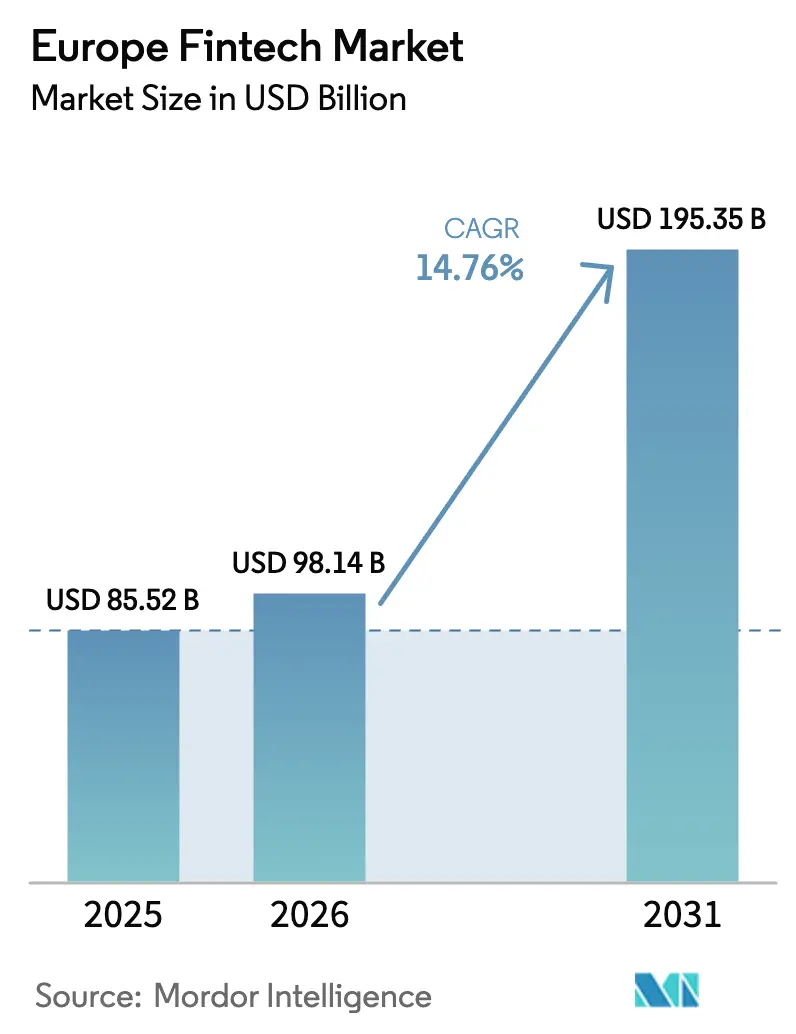
The Europe Fintech Market size is projected to expand from USD 85.52 billion in 2025 and USD 98.14 billion in 2026 to USD 195.35 billion by 2031, registering a CAGR of 14.76% between 2026 to 2031.
The European fintech market is growing rapidly due to a combination of regulatory reform, infrastructure modernization, and rising digital adoption across financial services. One of the primary drivers is the European Instant Payments Regulation, which promotes always-on account-to-account transactions and mandates verification of the payee, significantly improving payment speed, security, and consumer trust. This shift is reducing settlement times and enhancing liquidity management for businesses and consumers alike.
The market is further supported by strong momentum in embedded payments, as digital platforms increasingly integrate payment capabilities directly into their ecosystems. Payment infrastructure providers are benefiting from higher transaction volumes as merchants adopt omnichannel payment orchestration and real-time settlement solutions. Mobile-first consumer behavior continues to fuel fintech adoption, with biometrics, digital wallets, and card-on-file features reducing checkout friction and improving user experience. The rollout of the European Digital Identity Wallet is strengthening secure authentication across both public and private services, enabling safer digital financial interactions. Open banking initiatives are also expanding access to payment initiation and customer data, allowing fintech firms to develop more personalized and data-driven financial products.
Key Report Takeaways
- By service proposition, digital payments led with 52.67% of the European fintech market share in 2025, while insurtech is forecasted to expand at a 16.58% CAGR through 2031.
- By end-user, the retail segment accounted for 67.82% of the European fintech market share in 2025, while businesses are projected to grow at a 15.77% CAGR through 2031.
- By user interface, mobile applications commanded 59.73% of the European fintech market share in 2025 and are expected to post a 17.92% CAGR through 2031.
- By geography, the United Kingdom held 21.56% of the European fintech market share in 2025, while the Nordics are forecasted to grow at a 16.17% CAGR.
Note: Market size and forecast figures in this report are generated using Mordor Intelligence’s proprietary estimation framework, updated with the latest available data and insights as of January 2026.
Europe Fintech Market Trends and Insights
Drivers Impact Analysis*
| Drivers | (~) % Impact on CAGR Forecast | Geographic Relevance | Impact Timeline |
|---|---|---|---|
| Expansion of Account-to-Account Instant Payments Enabled by PSD2 and SEPA Infrastructure | +3.2% | Global (SEPA zone: 40 countries, including EU27, EFTA, United Kingdom, accession states) | Short term (≤2 years) |
| Acceleration of Embedded Payments Adoption Among European SMEs and Mid-Market Enterprises | +2.8% | Global, with early gains in the United Kingdom, the Netherlands, Germany, Nordics | Medium term (2-4 years) |
| Maturation of Open-Banking API Ecosystems Unlocking Data-Driven Revenue Streams | +2.5% | Global, strongest in the United Kingdom (13.3M users), France (537 TPPs), Germany (90+ PIs) | Medium term (2-4 years) |
| Rapid Uptake of Buy-Now-Pay-Later Solutions Across Regional E-commerce Channels | +2.1% | Europe-wide, concentrated in the Netherlands, the United Kingdom, Germany, Nordics | Short term (≤2 years) |
| European Central Bank Digital-Euro Pilots Catalysing Wallet and Digital Identity Investments | +1.8% | Eurozone core (19 countries), spillover to non-euro EEA by 2027-2029 | Long term (≥4 years) |
| Growth in Climate-Aligned Fintech Innovation Driven by EU Sustainable Finance Regulations | +1.4% | EU27 with extension to EEA; Germany, Netherlands, and France are early adopters | Long term (≥4 years) |
| Source: Mordor Intelligence | |||
Expansion of Account-to-Account Instant Payments Enabled by PSD2 and SEPA Infrastructure
The Instant Payments Regulation (IPR) adopted by the EU in 2024 is rapidly accelerating the deployment and uptake of instant account-to-account credit transfers in euros across Europe by mandating that providers of traditional euro credit transfers must also offer instant versions of those services. Under the regulation, instant payments must be available 24/7/365 and settled within seconds, narrowing the gap between payment initiation and final funds availability and fostering real-time transaction capabilities across banks and fintechs. PSPs (payment service providers) are required to ensure that instant payments are offered at no greater cost than standard credit transfers, helping to remove pricing barriers that previously discouraged adoption. The regulation also introduces a verification-of-payee (VoP) requirement, which alerts payers to mismatches between account identifiers and beneficiary names before execution, reducing fraud risk and strengthening trust in real-time account-to-account transfers. In addition, the regulation supports broader market participation by granting non-bank payment and e-money institutions access to core payment systems, widening the ecosystem of providers that can deliver instant payment services. By harmonizing access, pricing, and security standards across the Single Euro Payments Area (SEPA), the IPR significantly enhances the reliability, reach, and appeal of instant account-to-account payments, making real-time transactions an essential, scalable foundation for Europe’s evolving fintech landscape.[1]European Central Bank, “Instant Payments Regulation,” European Central Bank, ecb.europa.eu.
Acceleration of Embedded Payments Adoption Among European SMEs and Mid-Market Enterprises
The acceleration of embedded payments adoption among European SMEs and mid-market enterprises is a major driver of growth in the European fintech market, as reflected in Adyen’s H1 2025 performance. The company reported strong double-digit revenue growth, supported by increasing transaction volumes from platform businesses and mid-sized merchants that are embedding payments directly into their software and commerce ecosystems. Growth in Adyen’s platforms and issuing segments indicates rising demand for integrated payment acceptance, payouts, and card issuing capabilities that are delivered through a single, scalable infrastructure. European SMEs and mid-market enterprises are increasingly prioritizing embedded payments to reduce operational complexity, eliminate multiple vendor relationships, and improve speed to market. By integrating payments natively into enterprise resource planning systems, marketplaces, and SaaS platforms, these businesses can offer seamless checkout, faster settlement, and unified reporting across channels. Embedded payment models also support omnichannel strategies, allowing merchants to manage in-store, online, and mobile transactions through a single backend. As transaction volumes scale, payment infrastructure providers benefit from operating leverage, reinforcing investment in advanced fintech capabilities. This shift is particularly relevant in Europe, where fragmented markets and cross-border activity create demand for unified payment orchestration.[2]Adyen Investor Relations, “Shareholder Letter H1 2025,” Adyen, investors.adyen.com.
Maturation of Open-Banking API Ecosystems Unlocking Data-Driven Revenue Streams
The maturation of open-banking API ecosystems is a key driver of growth in the European fintech market, as banks move beyond regulatory compliance toward revenue-generating digital platforms. Under PSD2 and emerging open finance frameworks, banks are increasingly exposing standardized APIs for account data access, payment initiation, and financial services integration. These APIs enable fintechs and third-party developers to build data-driven applications that deliver personalized financial products and automated customer journeys. As ecosystems mature, banks are adopting API monetization models such as usage-based pricing, subscription tiers, and revenue-sharing arrangements. This shift is creating recurring, non-interest income streams from data access, analytics, and value-added services. Mature APIs also facilitate deeper partnerships between banks, fintechs, and digital platforms, expanding distribution channels and embedded finance use cases. Enhanced data availability supports advanced analytics, improving credit scoring, fraud detection, and customer insights.[3]Open Banking Limited, “Show Me the Money: Open Banking API Monetisation Models for Banks,” Open Banking Limited, openbanking.org.uk.
Rapid Uptake of Buy-Now-Pay-Later Solutions Across Regional E-Commerce Channels
The rapid uptake of buy-now-pay-later (BNPL) solutions across European e-commerce channels is a significant growth driver for the fintech market, supported by rising digital commerce activity and evolving regulatory clarity. Across the EU, BNPL adoption is expanding as consumers seek flexible, short-term financing options that integrate seamlessly into online and point-of-sale checkout experiences. Regulatory authorities are tightening conduct and creditworthiness standards, which is strengthening consumer protection while allowing the segment to scale within a formalized framework. The upcoming implementation of updated consumer credit rules is reinforcing affordability assessments and transparency, moving BNPL from unregulated growth toward sustainable, compliant expansion. Leading BNPL providers are leveraging AI-driven underwriting and risk analytics to improve approval accuracy, enhance on-time repayment rates, and reduce delinquencies. At the same time, providers are broadening merchant networks and diversifying product offerings to reach a wider consumer base. Partnerships with payment service providers are helping BNPL platforms optimize checkout flows and conversion rates without compromising risk controls.
Restraints Impact Analysis*
| Restraints | (~) % Impact on CAGR Forecast | Geographic Relevance | Impact Timeline |
|---|---|---|---|
| Prolonged venture capital slowdown is creating funding gaps for scale-ups | -2.8% | Europe-wide, with uneven recovery across major hubs | Short term (≤2 years) |
| Fragmented national licensing regimes are hindering cross-border expansion | -2.1% | EU27, United Kingdom, EEA with persistent localization and IBAN discrimination frictions | Medium term (2-4 years) |
| Rising compliance and operational costs from expanding EU financial regulations | -1.9% | EU27 and EEA, with a higher burden on SMEs and early-stage fintechs | Medium term (2-4 years) |
| Increasing competition from incumbent banks and Big Tech platforms is compressing fintech margins | -1.6% | Europe-wide, strongest in mature markets (Germany, France, Nordics, United Kingdom) | Medium to long term (3-5 years) |
| Source: Mordor Intelligence | |||
Prolonged Venture Capital Slowdown Creating Funding Gaps for Scale-Ups
Prolonged weakness in venture capital funding remains a key restraint for the European fintech market, particularly for scale-ups and early-stage firms. In 2025, investor appetite became increasingly selective, with capital concentrated on proven, later-stage business models and stronger revenue visibility. This shift has extended fundraising timelines and raised expectations around profitability, unit economics, and operating discipline. Recovery in fintech investment is uneven across Europe, as major hubs continue to attract funding while smaller or emerging markets face reduced deal activity. Elevated interest rates and global policy uncertainty have further reinforced investor preference for lower burn rates and sustainable growth strategies. As a result, fintechs without diversified revenue streams or clear paths to cash generation face constrained access to expansion capital.
Fragmented National Licensing Regimes Hindering Cross-Border Expansion
Fragmented national licensing regimes continue to restrain cross-border expansion for European fintechs. Fintechs face inconsistent authorization pathways, differing AML and compliance requirements, and technical divergences such as PSD2 API performance, which increase compliance costs and extend time-to-market for firms scaling internationally. Persistent IBAN discrimination, despite SEPA regulations, creates additional friction for consumers and complicates cross-border payments. Maintaining local licenses and branches often requires significant ongoing expenditure on risk management, AML, and data governance, diverting resources from innovation and customer acquisition. Divergent PSD2 API performance and support practices across countries further exacerbate operational challenges, as uptime, error handling, and incident resolution vary widely. The EDFA’s Bridging Borders report highlights these issues and emphasizes that greater harmonization, clearer guidance, and stronger regulatory cooperation are needed to make cross-border growth more predictable and efficient. While policymakers are pursuing market integration and supervisory convergence, progress remains gradual, leaving fintechs to carefully navigate national interpretations of common rules.[4]European Digital Finance Association, “Bridging Borders: Towards a More Coherent European Financial Market,” EDFA, europeandigitalfinance.eu.
*Our forecasts treat driver/restraint impacts as directional, not additive. The impact forecasts reflect baseline growth, mix effects, and variable interactions.
Segment Analysis
By Service Proposition: Neobanks Scale While Insurtech Draws AI Investment
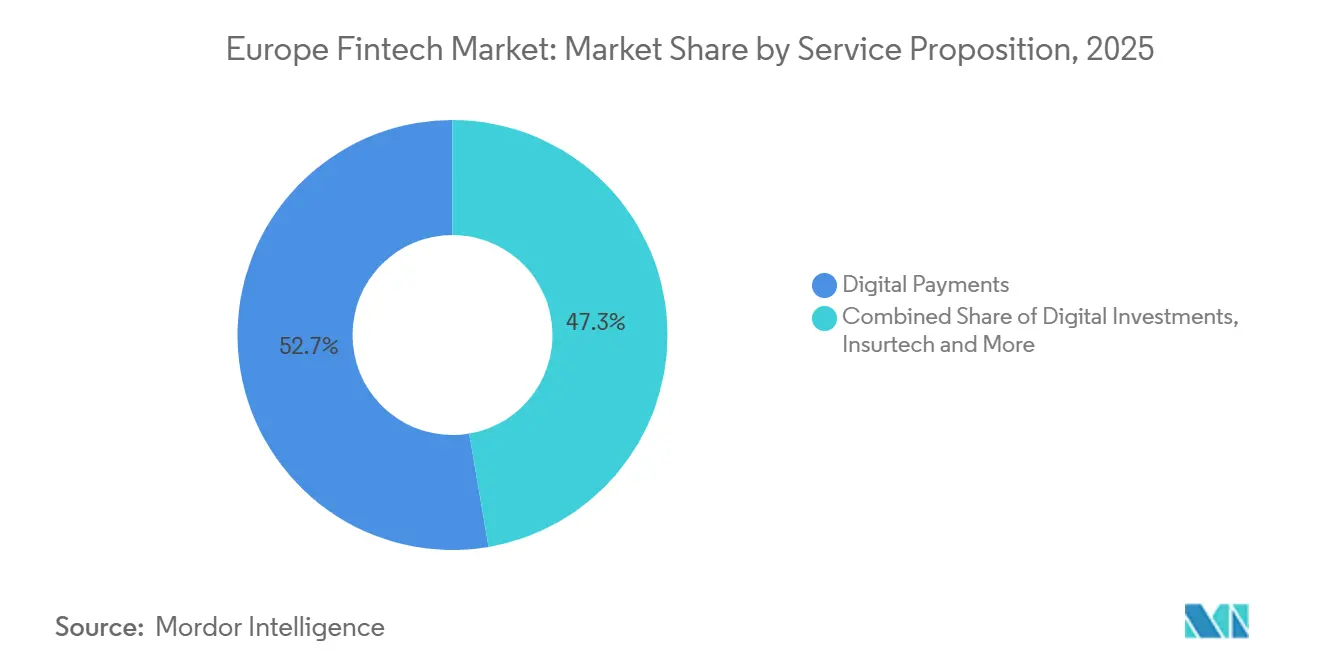
Digital payments accounted for 52.67% of the European fintech market in 2025. Growth is driven by instant payment mandates, verification-of-payee requirements, and increasing merchant adoption of account-to-account and card-based flows. Infrastructure providers, such as Adyen, report strong revenue and transaction volume, reflecting the shift toward omnichannel, real-time payment acceptance. Regulatory measures like mandatory verification-of-payee enhance transaction security and build trust, encouraging broader adoption in both e-commerce and point-of-sale environments. Together, real-time rails, offline acceptance safeguards, and unified risk controls are making payments faster, safer, and more reliable for consumers and merchants across Europe.
Insurtech is the fastest-growing segment in Europe, projected to expand at a 16.58% CAGR through 2031, supported by data-driven underwriting, embedded distribution, and compliance-ready product design. Neobanking is evolving, with profitable leaders expanding product lines, improving operating leverage, and leveraging AI-enabled service flows, while smaller providers focus on cost efficiency. The growth of real-time payment rails and open APIs provides new channels for data, distribution, and personalization, enabling insurers and banks to embed coverage and financial services seamlessly into digital journeys. European rulemaking and participation in scheme governance are integrating fintechs more directly into the industry, strengthening settlement and standardization. Overall, these innovations allow multiple fintech segments to scale concurrently, with digital payments advancing on real-time infrastructure and Insurtech expanding via AI and partner-led distribution.


By End-User: Businesses Outpace Retail on Embedded Finance Uptake
Retail users accounted for nearly 67.82% of the European fintech market in 2025, continuing to drive transaction volume across payments and financial services. Mobile wallets and buy-now-pay-later solutions are maturing under stricter conduct rules, supporting safer, more reliable consumer experiences. Adoption is further reinforced by European digital identity initiatives, which streamline authentication, consent, and verification processes. These improvements reduce friction at checkout and increase engagement across online and in-store channels. As a result, retail users remain a key source of transaction volume while enabling fintechs to scale digital payment solutions efficiently.
The business segment is projected to grow at a 15.77% CAGR through 2031, driven by SMEs embedding payments, issuing, and lending tools within accounting, payroll, and commerce platforms. Digital integration enables faster onboarding, automated reconciliation, and real-time risk assessment, supporting working capital and credit solutions. Strong ecosystems in countries like Germany and the United Kingdom provide infrastructure and data access that facilitate embedded finance adoption. Platform providers offering unified commerce and capital solutions are accelerating cross-sell opportunities and reducing friction for both B2B and B2C transactions. Overall, the shift from standalone banking interfaces to native financial tools in vertical software is driving sustained growth in the Europe fintech market’s business segment.
By User Interface: Mobile Applications Lead as Web Channels Consolidate
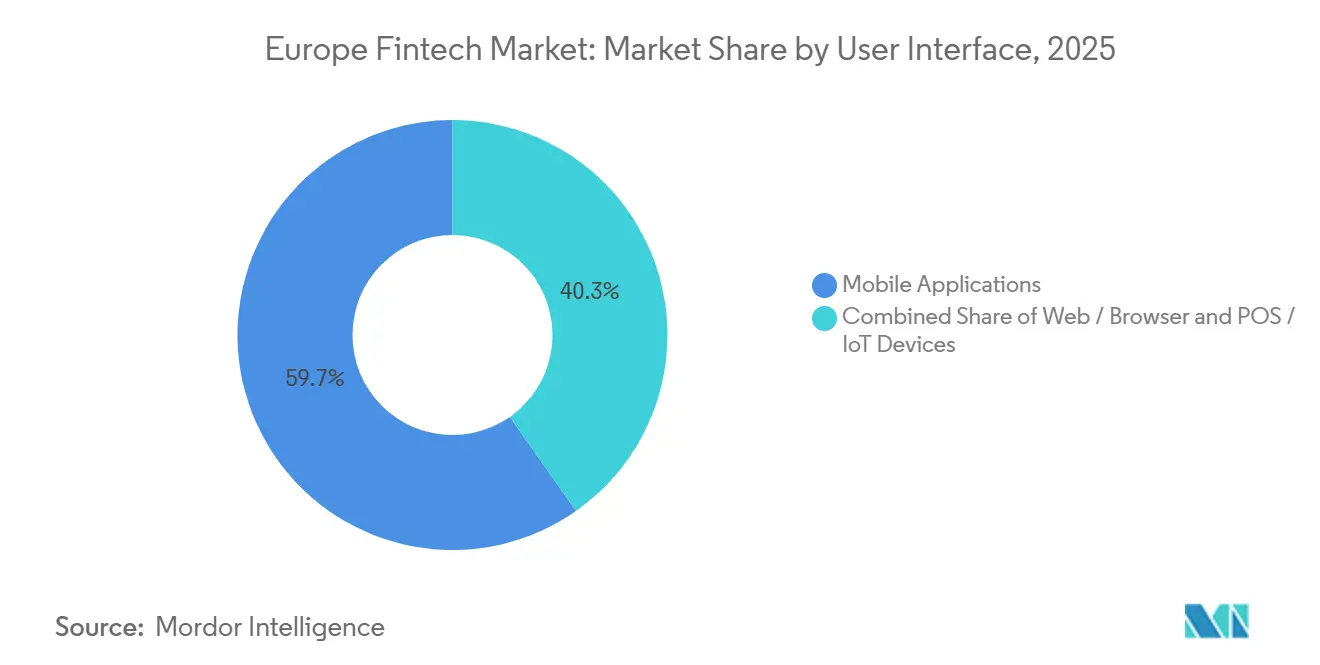
Mobile applications held nearly 59.73% of the European fintech market in 2025 and are projected to grow at a 17.92% CAGR through 2031, reflecting strong consumer and business preferences for in-app checkout, card-on-file, and biometric authentication. Regulatory programs and institutional initiatives are enhancing the speed, security, and cost-efficiency of digital payments, reinforcing mobile-first adoption. Real-time payment rails, consent mechanisms, and tokenization improvements make mobile apps ideal for seamless repeat use in e-commerce and subscription services. While web channels continue to support discovery and onboarding, deep engagement is increasingly shifting to mobile apps where users can authenticate, pay, and manage money efficiently. Over the forecast period, mobile experience design is expected to remain a key driver for conversion, fraud mitigation, and user retention across both retail and business segments.
POS terminals and IoT-enabled devices represent a smaller channel but are essential for maintaining continuity during network outages and supporting offline capabilities for critical merchants. Germany’s near-universal instant payment adoption is enabling faster in-store refunds and more customer-friendly service flows, while merchant upgrades continue gradually across terminal fleets. Providers offering unified commerce solutions integrate APIs for online, mobile, and in-store transactions, simplifying orchestration, reporting, and reconciliation for retailers. European standards bodies are finalizing QR code specifications to enhance cross-border acceptance and interoperability between mobile and in-person interfaces. Together, these developments anchor a cohesive omnichannel experience, ensuring resilience, seamless payment flows, and improved user experience across all touchpoints.
Geography Analysis
The United Kingdom accounted for 21.56% of the European fintech market in 2025 and remains a leader in open banking. The country has seen strong growth in digital and contactless payments, while fraud prevention measures such as confirmation of payee are increasingly covering most payment flows. Fintech leaders with robust unit economics are investing in compliance and AI-enabled services to protect margins and scale operations efficiently. United Kingdom merchants and platforms are exploring account-to-account payment options, adapting to regulatory developments in fraud reimbursement and incident reporting. Over the forecast period, the United Kingdom’s mature open API base and real-time capabilities are expected to support ongoing product innovation while requiring careful risk management and customer protection.
Germany remains Europe’s second-largest fintech market by revenue, supported by a diverse ecosystem across payments, banking, and investments, bolstered by strong commerce and manufacturing sectors. BaFin’s supervisory focus on digital operational resilience, outsourcing risk, and cyber incident reporting under the DORA framework has raised standards for ICT governance across financial entities. Germany’s advanced instant payment infrastructure allows retailers to provide instant refunds and enables banks and PSPs to migrate more flows onto real-time rails. France complements this growth with a vibrant fintech community that added new unicorns by 2025, even as investors apply stricter standards on revenue quality and compliance readiness. Policy emphasis on domestic payment stacks, resilience, and innovation continues to guide European financial services over the medium term.
The Nordics are projected to achieve the highest regional CAGR at 16.17%, driven by high digital adoption, widespread instant transfers, and integrated mobile payments. Sweden’s Swish platform connects millions of individuals and businesses, while authorities ensure offline acceptance and redundancy to maintain transaction continuity. Southern Europe also shows growing fintech activity, supported by EIB financing for high-growth payment providers and strengthening merchant acceptance programs. Pan-European initiatives, including the Digital Identity Wallet and instant payment mandates, create a common innovation layer that reduces experience gaps across regions. Together, these developments enhance cross-border portability, shared payment rails, and regional expansion, even as local compliance and oversight require targeted adaptations.
Regulatory Landscape
Europe’s fintech regulatory landscape is increasingly shaped by EU-level harmonization across payments, resilience, and digital finance. The EU Instant Payments Regulation (IPR), in force since January 2025, tightens requirements around 24/7 euro instant transfers, pricing parity versus standard credit transfers, and verification of payee, shaping product design for PSPs and accelerating account-to-account use under SEPA infrastructure.
Operational and market conduct compliance requirements are also widening for fintechs that rely on cloud, outsourcing, and multi-partner distribution. DORA has applied since 17 January 2025, establishing harmonized ICT risk management and an EU oversight regime for critical ICT third-party providers, and EU institutions progressed work in 2026 on the Payment Services Package (PSD3 and PSR) to update authorization, supervision, and fraud-liability rules for payment and e-money institutions. The European Commission also maintains the EU Digital Finance Platform, which supports cross-border scaling and innovation collaboration.
Value Chain Analysis
The Europe fintech value chain covers regulated financial entities (banks, payment and e-money institutions, and fintechs) that originate digital payment, lending, investment, insurtech, and neobanking products. It also includes technology enablers (core banking and payment processors, open-banking API aggregators, KYC/AML and fraud providers, and identity and authentication), plus scheme and infrastructure layers (SEPA schemes and instant payment rails). Distribution runs through merchants, marketplaces, vertical SaaS platforms, and mobile app ecosystems.
Scale in payments and embedded finance is increasingly driven by platform orchestration, where providers combine acceptance, payouts, issuing, and risk controls into unified APIs used by SMEs, mid-market firms, and enterprise merchants. Regulation is now a direct value-chain constraint and design input, especially for operational resilience and third-party dependencies. DORA became applicable on 17 January 2025 and introduced EU-wide requirements for ICT risk management and oversight of critical ICT third-party providers, raising expectations around due diligence, exit planning, and concentration-risk management across fintech stacks. In parallel, bank-fintech partnerships and adjacent working-capital ecosystems keep deepening integration between platform technology and balance-sheet liquidity, including BBVA’s alliance with Olea (July 2025) for supply chain finance digitization and Finastra’s integration of CredAble into its Trade Innovation solution (July 2024).
Competitive Landscape
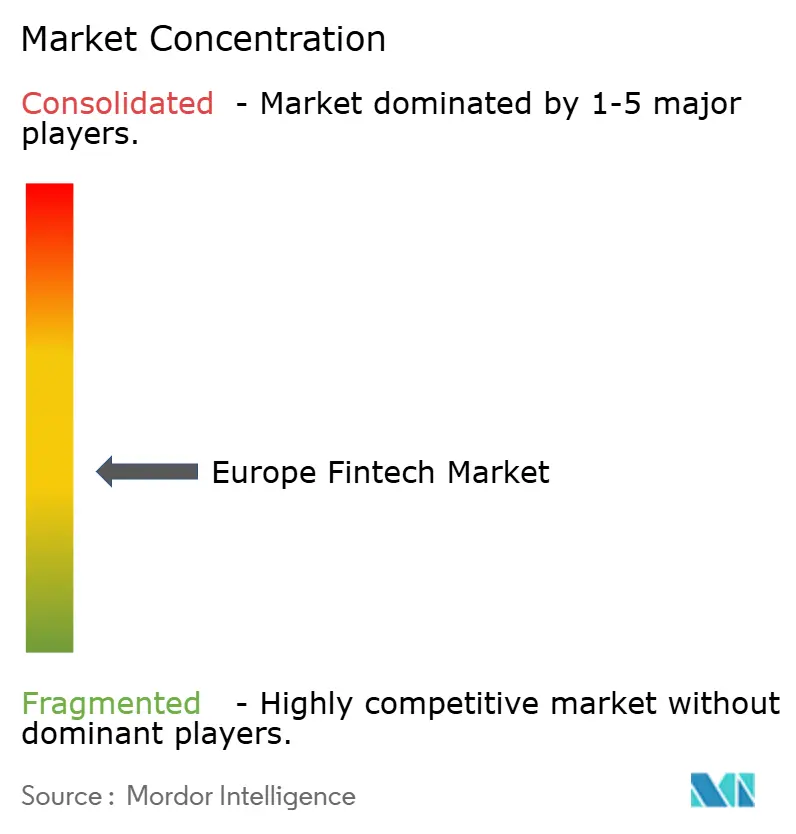
The European fintech market is moderately consolidated in payments infrastructure but remains fragmented in adjacent segments, with leading providers scaling omnichannel acceptance, instant payments, and expanding into issuing and working capital solutions. Major players are achieving strong financial and operational performance as merchants adopt more terminals and unified APIs for online and in-store acceptance. Open banking monetization and account-to-account capabilities are increasing competitive pressure on traditional card flows, while scheme governance evolves to include more fintech participants in standard-setting and SEPA programs. Companies with robust compliance programs, strong merchant relationships, and AI-driven execution are positioned to capture incremental market share. Overall, consolidation favors firms that can combine scale, technology, and operational excellence to serve complex merchant and enterprise needs.
Technology differentiation is becoming a key competitive advantage, with leading fintechs deploying AI across customer operations, risk management, checkout optimization, and collections. AI-driven tools help improve conversion, reduce fraud, and optimize operational costs, while investments in underwriting models enhance payment performance for BNPL and fixed-term financing. The adoption of richer messaging standards and early integration with modern infrastructure provides strategic advantages for players able to support data-rich payment flows. Participation in scheme governance and standards workstreams allows fintechs to influence interoperability improvements, lowering onboarding, testing, and support costs. This environment rewards scaled PSPs and banks that leverage shared rails and extend their product portfolios efficiently.
Regulatory programs like the Digital Operational Resilience Act strengthen incident reporting, third-party risk oversight, and ICT resilience, driving demand for compliance automation and operational testing across institutions. The digital euro initiative is advancing toward implementation, encouraging wallet readiness and identity integration for banks and PSPs. The European Digital Identity Wallet mandate standardizes authentication across public and private services, laying the groundwork for unified digital credential acceptance and future digital euro adoption. As instant rails, identity wallets, and rich messaging converge, cross-border offerings can expand with higher security and lower operational friction. Firms that build on these foundations while maintaining operational discipline and capital efficiency are expected to outperform in the coming years.
Europe Fintech Industry Leaders
Adyen N.V.
Klarna Bank AB
Revolut Ltd
Checkout.com Group
Wise plc
- *Disclaimer: Major Players sorted in no particular order

Market Opportunities and Future Outlook
Regulatory and infrastructure milestones are creating near-term whitespace for providers that can operationalize instant payments, stronger authentication, and more standardized payment-institution frameworks at scale. The PSD3 and PSR legislative track moved forward in May 2026, when the European Parliament ECON committee approved the final compromise text following a provisional interinstitutional agreement reached in November 2025. This supports opportunities for compliance-ready PSPs to simplify cross-border product rollouts and differentiate around fraud controls, verification flows, and dispute handling as the rules become more prescriptive.
A second opportunity layer is also taking shape around wallet readiness, terminal compatibility, and scheme-level standardization tied to the Eurosystem digital euro work program. In July 2026, the ECB published digital euro scheme rulebook version 0.91, incorporating feedback from the June to October 2025 market consultation. It also selected 36 payment service providers to participate in a digital euro pilot after a March 2026 expression-of-interest call, which creates concrete implementation work for PSPs, merchant acquirers, and infrastructure vendors covering certification and approval, ATM and terminal specifications, and identity-linked payment experiences alongside existing mobile and instant-rail propositions.
Recent Industry Developments
- July 2026: Adyen completed the acquisitions of Talon.One and Orb, expanding its capabilities beyond core payments into loyalty/incentives and enterprise billing. The combined stack strengthens Adyen’s unified commerce positioning for large merchants that want to consolidate checkout, recurring billing, and retention mechanics under a single platform.
- May 2026: Checkout.com became a direct scheme member and partner of BLIK, enabling merchants to connect to Poland’s local mobile payment method through a direct integration. This supports higher local conversion and reduces reliance on indirect routing for one of Europe’s most used domestic payment options.
- December 2024: Taulia and REWE Group extended their collaboration to implement a supply chain finance program that links early payment incentives to ESG ratings from EcoVadis. The initiative highlights how fintech-enabled working capital solutions are being bundled with sustainability metrics, shaping supplier onboarding and program differentiation for large European buyers.


Research Methodology Framework and Report Scope
Market Definition and Coverage
For this report, we size Europe fintech as the revenue generated in Europe from technology-enabled financial services, where the service is delivered digitally and monetized through fees, commissions, subscription income, or net interest income.
Scope exclusions: Pure-play decentralized crypto exchanges that do not support fiat settlement are excluded from this market sizing.
Segmentation Overview
- By Service Proposition
- Digital Payments
- Digital Lending and Financing
- Digital Investments
- Insurtech
- Neobanking
- By End-User
- Retail
- Businesses
- By User Interface
- Mobile Applications
- Web/Browser
- POS/IoT Devices
- By Country
- United Kingdom
- Germany
- France
- Spain
- Italy
- Benelux (Belgium, Netherlands, and Luxembourg)
- Nordics (Sweden, Norway, Denmark, Finland, and Iceland)
- Rest of Europe
Data Sources, Market Sizing, and Validation
Desk Research
Desk research started with trusted public references that describe the rulebook and the adoption signals for digital finance in Europe. Sources such as the European Central Bank payments statistics, European Banking Authority publications, Eurostat indicators, and the Bank for International Settlements datasets helped us frame the demand pool and track directionally consistent trends.
We then cross-checked the sizing inputs against company annual reports, financial statements, investor presentations, and reputable press coverage so the revenue logic aligns with how firms report their digital financial activities. When a data point was fragmented by country, an import-export shipment-level database was selectively used to sanity-check cross-border activity proxies that influence transaction-heavy fintech lines. The desk sources listed here are illustrative only, and many other public documents were also used for data collection, validation, and clarification.
Primary Interviews and Surveys
Primary interviews and surveys were used to convert the desk signals into practical model inputs, especially where public datasets do not cleanly separate fintech revenue from broader financial services. We spoke with executives, functional leaders, and managers from fintech operators, enabling technology providers, and adjacent financial institutions across key European markets, and we used these discussions to confirm monetization patterns, pricing movement, and adoption pacing by use case.
Distribution of primary research fieldwork respondents
| Company type | Respondent position | Region |
|---|---|---|
| Top tier: 25% | CXOs: 18% | |
| Mid tier: 56% | Functional/Unit leaders: 22% | |
| Smaller Players: 19% | Managers: 60% |
Market-Sizing & Forecasting
The market was first built using a top-down approach where payments and digital banking adoption signals, online transaction intensity, and digitally originated credit activity were used to reconstruct the addressable revenue pool for Europe. This was then corroborated with selective bottom-up approximations, such as sampled revenue run-rates from public financials, channel checks on fee schedules, and volume times average take-rate logic, which are then used to adjust totals when gaps appear.
A few practical inputs were treated as key drivers in the model, including digital payment usage and instant payment rollout signals, open banking penetration and monetization indicators, consumer and SME digital account adoption, credit origination trends for online lending, and average fee or net interest margin movement in digital-first offerings. Where a sub-area had limited disclosure, we used ranges agreed in interviews and applied conservative allocation rules so the totals stayed consistent with observable demand and reported revenue patterns.
For forecasting, we used scenario analysis supported by country-level adoption outlooks and rate assumptions gathered through primary discussions. The forward view was stress-tested by changing take-rates and growth speeds in high-sensitivity lines like payments and lending so the final trajectory remains explainable and repeatable.
Data Validation & Update Cycle
Before finalizing the numbers, we triangulated the model outputs against independent signals such as payment statistics, digital banking adoption markers, and reported revenue direction from representative companies. Outliers were reviewed country by country, and when a variance could not be explained through a clear driver, the assumptions were revisited and follow-up conversations were triggered.
Each draft goes through multi-step analyst checks so calculations, currency handling, and year-to-year movements are consistent with the stated scope. The report is refreshed annually, and interim updates are made when material regulatory or macro events shift the demand outlook. Right before publication, we do a fresh validation pass so clients receive the latest view available at the time of delivery.
Mordor Intelligence's Europe Fintech Market Size Versus Other Published Estimates
Published values for Europe fintech do not always match because the term fintech gets used as a mix of revenue measures, transaction value measures, and sometimes even funding activity measures. Differences also come from how each source treats cross-border activity, currency conversion timing, and what gets counted as fintech versus adjacent financial technology services.
Pure-play decentralized crypto exchanges without fiat settlement sit outside Mordor Intelligence's scope, and that exclusion alone can shift totals upward or downward depending on how another source bundles crypto trading revenue into fintech. Another common gap driver is whether the estimate is built from transaction value multiplied by assumed take-rates, or from reported fee and net interest income, since the first route can inflate results when take-rates are not validated by providers.
Benchmark comparison
| Source | Market Size | Gaps in Research Methodology |
|---|---|---|
| Mordor Intelligence | USD 85.52 B (2025) | |
| Industry Report Publisher A | USD 96.50 B (2024) | Uses an earlier base year and often blends broader digital finance categories into fintech, which can pull in crypto and platform revenue that is not consistently tied to regulated, fee or interest income in Europe. |
| Fintech Network Publication B | USD 3600.00 B (2024) | Reports transaction value rather than provider revenue, so the figure is structurally larger and cannot be compared directly without applying validated take-rates and removing pass-through flows. |
The table shows that the widest spread comes from mixing different measurement units, where transaction value and market revenue are treated as if they are the same. By keeping the model tied to Europe-earned fee and interest income and then checking it against adoption and pricing signals, we aim to provide a number that is easier to replicate and explain in planning discussions.


Key Questions Answered in the Report
What is the projected size and growth of the Europe fintech market to 2031?
The Europe fintech market size is USD 98.14 billion in 2026 and is projected to reach USD 195.35 billion by 2031 at a 14.76% CAGR, supported by instant payment mandates and open banking monetization.
Which service areas lead growth and scale in the Europe fintech market?
Digital Payments leads with 52.67% share in 2025, while Insurtech posts the highest projected growth at a 16.58% CAGR, reflecting a combination of real-time rails and AI-enabled underwriting.
How are EU regulations shaping payment speed and security for European fintechs?
The Instant Payments Regulation mandates instant euro transfers and verification of payee, which increases speed and trust across account-to-account flows and catalyzes merchant adoption.
Why are mobile applications central to user engagement in European financial services?
Mobile holds 59.73% interface share in 2025 and is set to grow at 17.92% CAGR as biometrics, card-on-file, and real-time rails make in-app payments seamless and secure.
Which regions show the strongest near-term momentum in European fintech?
The United Kingdom leads in open banking usage with 21.56% in 2025, while the Nordics are forecast to record the fastest regional CAGR at 16.17% as instant rails and digital comfort broaden use cases.
Page last updated on:


