
Market Overview
| Study Period | 2021 - 2031 |
|---|---|
| Forecast Data Period | 2026 - 2031 |
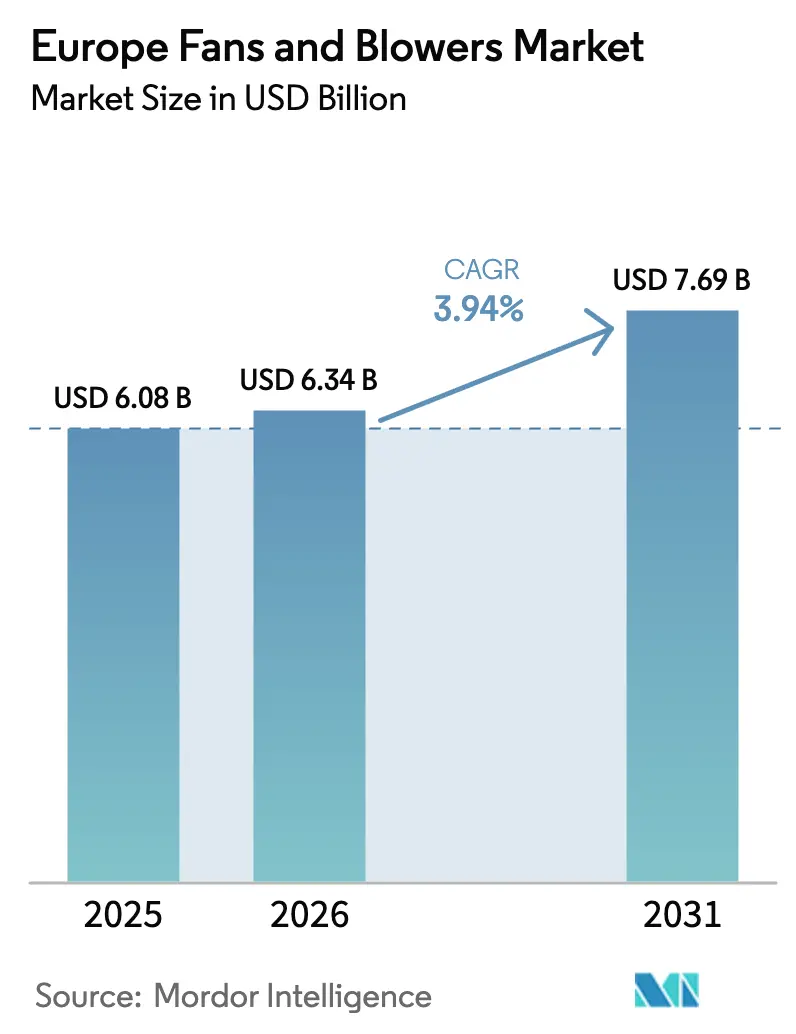
| Base Year Market Size (2025) | USD 6.08 Billion |
| Market Size (2026) | USD 6.34 Billion |
| Market Size (2031) | USD 7.69 Billion |
| Growth Rate (2026 - 2031) | 3.94 % |
| Market Concentration | Medium |
Major Players *Disclaimer: Major Players sorted in no particular order Image © Mordor Intelligence. Reuse requires attribution under CC BY 4.0. | |
Europe Fans And Blowers Market Analysis by Mordor Intelligence
The Europe Fans And Blowers Market size is estimated at USD 6.34 billion in 2026, and is expected to reach USD 7.69 billion by 2031, at a CAGR of 3.94% during the forecast period (2026-2031).
Stricter Ecodesign efficiency rules support demand, the ongoing data-center build-out, and a fast-moving wave of commercial-building retrofits that favor electronically commutated (EC) motors. Centrifugal technology still dominates heavy-industry orders, yet axial designs are winning share in low-pressure ventilation because they couple variable-speed control with quieter operation. End-user spending is tilting toward lifecycle-cost optimization, a trend reinforced by IoT-ready sensors that cut unplanned downtime and document energy savings. Competitive intensity is rising as Asian producers undercut prices by 20-30%, prompting European brands to differentiate with predictive-maintenance analytics and additive-manufactured impellers. Strategic-buyer and private-equity interest remains high after Samsung Electronics and Chart Industries acquired FläktGroup and Howden, respectively, signaling that conglomerates see ventilation hardware as an anchor for connected-building and hydrogen infrastructure platforms.
Key Report Takeaways
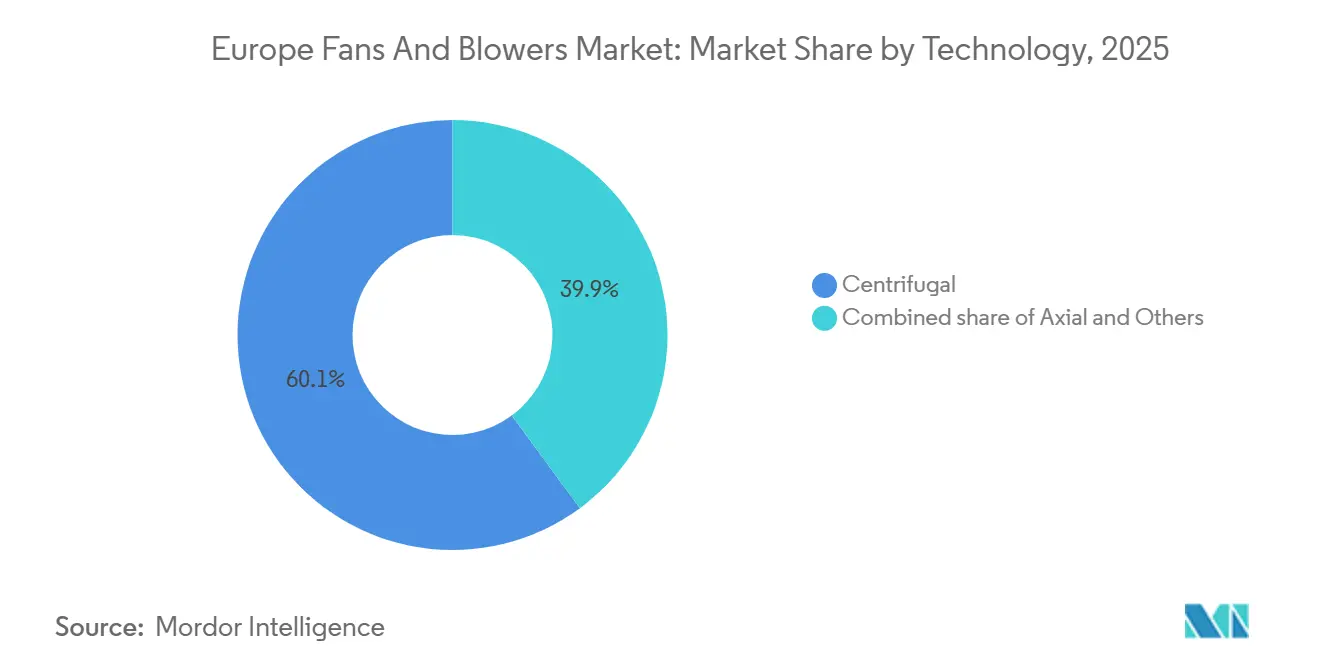
- By technology, centrifugal fans led with 60.1% of the Europe fans and blowers market share in 2025, while axial fans are projected to advance at a 4.9% CAGR through 2031.
- By pressure range, low-pressure units below 15 kPa captured 55.5% revenue share in 2025 and are expanding at 5.4% CAGR to 2031.
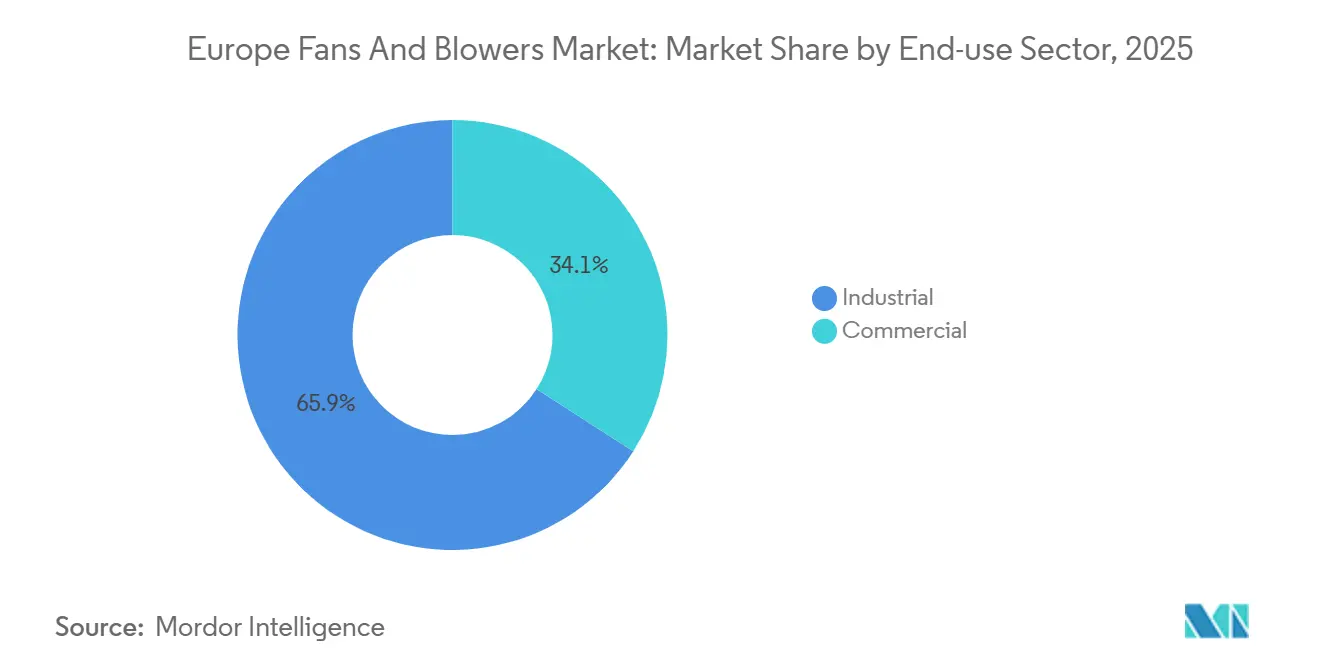
- By end-use sector, industrial facilities accounted for 65.9% of 2025 sales, while commercial buildings are growing fastest at 5.0% CAGR through 2031.
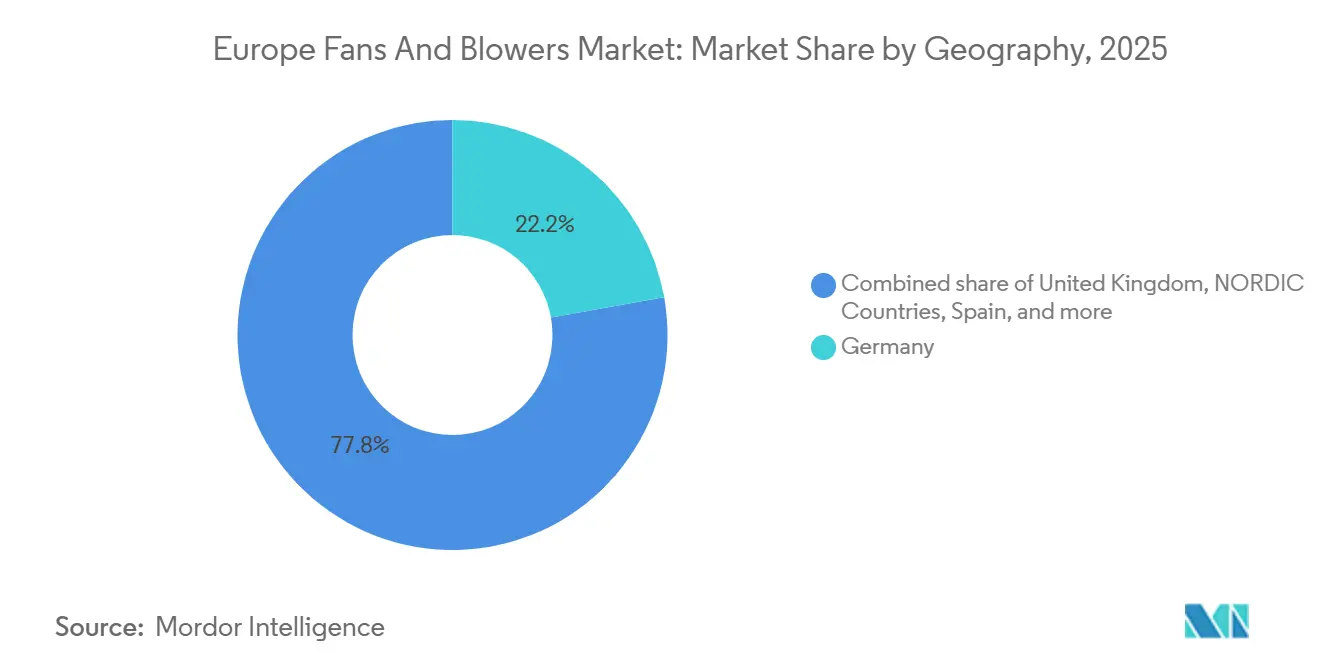
- By geography, Germany contributed 22.2% of 2025 revenue, whereas the Nordics are poised for the quickest climb at 4.8% CAGR to 2031.
Note: Market size and forecast figures in this report are generated using Mordor Intelligence’s proprietary estimation framework, updated with the latest available data and insights as of January 2026.
Europe Fans And Blowers Market Trends and Insights
Drivers Impact Analysis*
| Driver | (~) % Impact on CAGR Forecast | Geographic Relevance | Impact Timeline |
|---|---|---|---|
| EU Ecodesign energy-efficiency mandates for fan systems | 1.2% | EU-wide, strongest enforcement in Germany, France, Netherlands | Medium term (2-4 years) |
| Rapid capacity build-out of European data centers | 0.9% | Germany, Netherlands, Nordics, Spain | Short term (≤ 2 years) |
| HVAC green-building retrofits in commercial real estate | 0.8% | Western Europe core (UK, Germany, France), expanding to Southern Europe | Medium term (2-4 years) |
| Expansion of hygienic air-handling demand in F&B and pharma | 0.6% | Denmark, Ireland, Belgium, Germany, Switzerland (pharma hubs); France, Netherlands (F&B clusters) | Medium term (2-4 years) |
| Integration of IoT sensors enabling predictive maintenance | 0.5% | Germany, Nordics, UK (early adopters), gradual spread to CEE | Long term (≥ 4 years) |
| Additive-manufactured impeller designs boosting replacement cycle | 0.3% | Germany, UK, France (aerospace and automotive clusters with AM capabilities) | Long term (≥ 4 years) |
| Source: Mordor Intelligence | |||
EU Ecodesign Energy-Efficiency Mandates for Fan Systems
Commission Regulation 2024/1834 replaces voluntary schemes with binding minimum energy-efficiency indexes from July 2026. The rule covers fans between 125 W and 500 kW, instantly outlawing single-speed AC induction motors in most commercial HVAC and light-industrial settings.[1] Germany’s economic ministry projects an 8 TWh cut in EU electricity use by 2030, roughly equal to the output of a mid-sized coal plant. Manufacturers gain a staggered path, Tier 1 in 2026 and Tier 2 in 2029, which softens tooling-cost shocks but shortens the replacement cycle for installed units. Contractors have begun stockpiling compliant inventory, as evidenced by Systemair’s 11.1% organic sales jump in Western Europe during Q2 2025/26. The regulation, therefore, pulls forward retrofit budgets and lifts demand for EC-motor axial fans that comfortably meet the new index thresholds.
Rapid Capacity Build-Out of European Data Centers
Hyperscale and colocation operators commissioned 742 MW in 2024 and have 1.7 GW under construction, with a further 2.5 GW in planning.[2] Spain has emerged as a hot spot after Amazon Web Services committed EUR 15.7 billion for its Aragon campus. Frankfurt and London jointly exceed 1.7 GW of live capacity, and both markets carry pipelines above 500 MW. Rack densities are climbing from 8 kW in 2020 to 15 kW and higher for AI workloads, forcing operators to specify low-pressure axial arrays that modulate airflow in real time and meet stringent acoustic rules. Germany’s Section 71a of the Building Energy Act requires digital monitoring for HVAC systems above 290 kW, further steering buyers toward IoT-ready fan platforms.
HVAC Green-Building Retrofits in Commercial Real Estate
The EU renovation wave targets 35 million structures by 2030, mandating Energy Performance Certificate class D or better for all buildings undergoing major works. Part L changes in the United Kingdom set a 27% carbon-cut baseline for new non-domestic buildings, and policymakers are now consulting on retrofit equivalence. Landlords, therefore, replace pre-2010 air-handling units with EC-motor fans that achieve specific fan power below 1.5 W/L·s. Trane Technologies deepened its retrofit toolkit by taking a majority stake in Danish district-energy specialist Vartech in September 2024.
Integration of IoT Sensors Enabling Predictive Maintenance
Section 71a in Germany sets a legal floor for digital monitoring, and early adopters show tangible gains. Samotics’ SAM4 Health detects fan bearing faults 4-8 weeks ahead of failure, yielding 30-40% downtime cuts in pilot industrial sites. Research in 2024 proved that hybrid LoRa-5G sensor networks can hit 95% fault-detection accuracy with sub-200 ms latency, suitable for real-time control.[3] ebm-papst now embeds Bluetooth Low Energy modules in its RadiCal and AxiBlade lines, letting facility teams pull performance data from a phone without hard-wiring into the building-management system. Adoption remains concentrated in Germany, the Nordics, and the UK because integration depends on planned outages.
Restraints Impact Analysis*
| Restraint | (~) % Impact on CAGR Forecast | Geographic Relevance | Impact Timeline |
|---|---|---|---|
| Volatile steel & aluminum prices inflating BOM costs | -0.6% | EU-wide, acute in Germany, Italy, Spain (manufacturing hubs) | Short term (≤ 2 years) |
| Price pressure from low-cost Asian imports | -0.4% | Western Europe (Germany, France, UK), limited in Nordics | Medium term (2-4 years) |
| Supply risks for rare-earth magnets in high-efficiency motors | -0.4% | EU-wide, particularly affecting Germany, France, Italy (motor manufacturing centers) | Medium term (2-4 years) |
| Urban noise-emission limits curbing large-fan installations | -0.3% | Dense urban centers: London, Paris, Berlin, Amsterdam, Milan, Barcelona | Long term (≥ 4 years) |
| Source: Mordor Intelligence | |||
Volatile Steel & Aluminum Prices Inflating BOM Costs
North-west European hot-rolled coil traded between EUR 550 and EUR 720 per t in 2024, with 15% quarter-on-quarter swings driven by energy costs and anti-dumping measures.[4] Aluminum billet fluctuated between USD 2,400 and USD 2,800 per t as smelters curtailed output amid high electricity prices. Fan housings, impellers, and motor frames account for up to 45% of centrifugal unit cost, leaving suppliers exposed when fixed-price contracts collide with raw-material spikes. EBM-Papst’s revenue fell 13.1% in fiscal 2024/25 as legacy quotes failed to absorb input-cost inflation. Steel demand is likely to stabilize alongside a mild construction rebound in 2026, yet aluminum volatility will linger until the Carbon Border Adjustment Mechanism reaches full force.
Price Pressure from Low-Cost Asian Imports
Chinese vendors now provide CE-marked axial fans at 20-30% lower prices, and regional distributors face fewer procurement hurdles as e-commerce simplifies cross-border sourcing. European suppliers counter with extended warranties, local service, and IoT analytics, propositions that resonate with pharmaceutical and data-center customers but less so with price-sensitive commercial buyers. The EU’s Carbon Border Adjustment Mechanism may narrow the gap for steel-intensive centrifugal models, yet aluminum-rich axial units see limited tariff exposure. Systemair acknowledged that specification-grade projects underpin growth while commodity segments lose share to imports.
*Our forecasts treat driver/restraint impacts as directional, not additive. The impact forecasts reflect baseline growth, mix effects, and variable interactions.
Segment Analysis
By Technology: EC Motors Propel Axial Gains
Centrifugal fans held 60.1% of 2025 revenue, underpinned by process industries that need high static pressures beyond 70 kPa for material handling and thermal control. Axial designs, however, are advancing at 4.9% CAGR because EC motors cut energy use by as much as 70% compared with single-speed induction units and meet Ecodesign thresholds coming into force in 2026. The Europe fans and blowers market size attached to axial products is expanding fastest within data-center cooling and commercial-HVAC retrofits, where footprint, noise, and variable-speed capability outweigh peak-pressure requirements.
Centrifugal technology will keep its foothold in medium- and high-pressure slots because backward-curved and radial wheels handle particulate-laden flows and corrosive gases. Yet low-pressure ventilation, currently 55.5% of total demand, now gravitates toward axial arrays controlled through building-management software, chipping away at centrifugal share below 15 kPa. The trend parallels a broader shift toward distributed air paths in data halls and office retrofits, replacing legacy high-static central plants with modular fan walls that scale rack by rack.

By Pressure Range: Low-Pressure Segment Leads on Dual Fronts
Low-pressure units below 15 kPa secured 55.5% of 2025 revenue and show the highest 5.4% CAGR as building-code revisions tighten specific fan-power ceilings and noise thresholds. The Europe fans and blowers market share that low-pressure products command stems from ventilation retrofits across office, retail, and public buildings, plus the surge in hyperscale data centers, where low static pressure and high volumetric flow best match hot-aisle containment.
Medium-pressure equipment covering 15-70 kPa maintains roughly 30% of the European fans and blowers market size, tracking the overall 3.94% CAGR because industrial capital spending remains cautious. High-pressure models above 70 kPa, used in forced-draft boilers and mining shafts, hover near 15% share and face sub-3% growth due to coal-plant retirements and steel output cuts. The resulting portfolio mix underscores a structural pivot: regulatory and acoustic constraints favor many small, quiet, energy-sipping fans rather than one large, high-static machine.
By End-Use Sector: Commercial Acceleration Amid Industrial Stagnation
Industrial users generated 65.9% of 2025 sales, dominated by power, chemicals, metals, and heavy manufacturing that rely on rugged centrifugal blowers. Pharmaceutical and food plants buck the industrial sluggishness as Novo Nordisk, Eli Lilly, and Pfizer equip new cleanrooms with stainless-steel, HEPA-ready systems that command premium prices.
Commercial buildings, conversely, log the swiftest 5.0% CAGR. Owners retrofit air-handling units to hit Energy Performance Certificate targets without lengthy shutdowns, favoring modular EC-motor axial fans that slot into existing shafts. Trane Technologies’ investment in Vartech exemplifies how OEMs bundle ventilation with heat pumps and district-energy links to capture turnkey retrofit contracts. Shorter 15-year replacement cycles and clear payback calculations ensure that commercial demand grows faster than heavy industry.
Geography Analysis
Germany contributed 22.2% of 2025 revenue thanks to its dense network of automotive, chemical, and machinery plants that specify high-pressure centrifugal blowers for paint booths, fume extraction, and pneumatic conveying. Factory orders dipped 5.4% year-on-year in 2024, tempering near-term expansion, yet the installed base guarantees a steady retrofit stream tied to Ecodesign compliance. The United Kingdom, France, Italy, and Spain collectively form about 40% of the European fans and blowers market size. UK Part L updates and France’s RE2020 standard lift commercial-building retrofits, while Spain’s hyperscale boom, anchored by AWS and Meta, drives low-pressure axial uptake.
The Nordics, though smaller in absolute terms, post the fastest 4.8% CAGR. Denmark’s climate-neutrality goal for 2045 and Sweden’s target of net-zero by 2045 give teeth to efficiency incentives, and district-heating upgrades bundle high-efficiency fans with heat pumps. Novo Nordisk’s EUR 2.3 billion Kalundborg expansion and Microsoft’s Stockholm data-center cluster illustrate how pharmaceutical and hyperscaler investment pushes specification criteria toward lifecycle performance and sensor readiness.
The Netherlands remains Europe’s densest data-center hub, with Digital Realty’s 27 MW AMS11 site relying on variable-speed axial arrays. Central and Eastern Europe contributes roughly 15% of revenue and records near-average growth, held back by looser code enforcement and limited hyperscale presence. Cohesion-fund grants for public-building efficiency are, however, seeding early replacement projects in Poland and the Czech Republic.
Regulatory Landscape
EU ecodesign policy is the key regulatory lever for industrial fans sold in Europe. Commission Regulation (EU) 2024/1834 updates ecodesign requirements for fans with motor input power between 125 W and 500 kW, tightening minimum efficiency thresholds and adding obligations on repairability and reporting fan performance across different loads and speeds. It also transitions the market away from the legacy framework under Regulation (EU) No 327/2011.
Implementation details were further clarified by Commission Regulation (EU) 2025/2481 (adopted 2 December 2025), which amends definitions, verification tolerances, and test-result corrections, including fan-speed related provisions. The old Regulation (EU) No 327/2011 is repealed effective 24 July 2026, with transitional provisions that can extend certain legacy requirements for specified spare parts through 2037. Industry bodies such as AMCA, Eurovent, and EVIA issued an FAQ update in May 2026 to support practical compliance and testing alignment across the supply chain.
Competitive Landscape
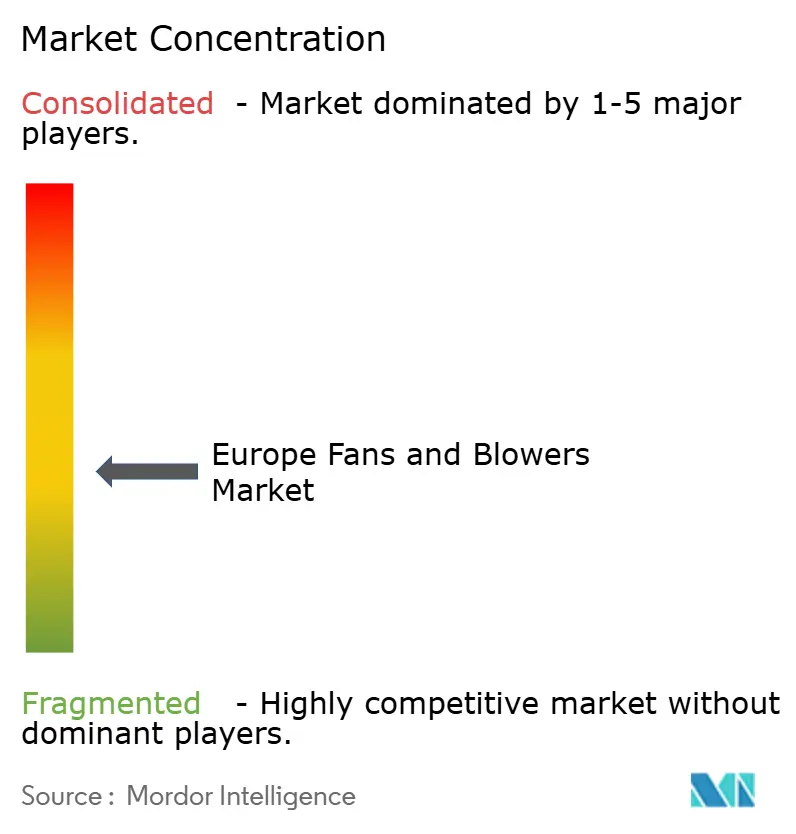
The Europe fans and blowers market features moderate fragmentation; the top five suppliers, ebm-papst, Howden, FläktGroup, Systemair, and Greenheck, control an estimated 35-40% combined share. Conglomerates are entering through acquisitions: Samsung Electronics closed a EUR 1.5 billion buyout of FläktGroup in November 2025 to embed ventilation into smart-building ecosystems. Chart Industries finalized its USD 4.5 billion takeover of Howden in May 2024, bundling cryogenic and hydrogen gear with industrial fans. Schneider Electric paid USD 850 million for UK-based Motivair in October 2024 to deepen thermal-management services for hyperscale data centers.
Strategic playbooks now diverge. Premium brands such as ebm-papst and Systemair embed IoT sensors and cloud dashboards, justifying 15-25% price premiums in uptime-critical niches like pharma and AI data halls. Mid-tier suppliers focus on quick customization and 48-hour delivery for commercial HVAC contractors. Emerging white-space lies in rare-earth-free motor designs; start-ups such as Niron Magnetics develop iron-nitride magnets to sidestep neodymium supply risks highlighted by the EU Critical Raw Materials Act.
Margin pressure from Chinese entrants remains acute for commodity axial models. European brands counter through local service footprints, extended warranties, and additive-manufactured impellers that shave weight and raise aerodynamic efficiency, though these gains resonate mainly with operators who monetize uptime and energy savings.
Europe Fans And Blowers Industry Leaders
-
ebm-papst Group
-
Howden Group Ltd
-
FläktGroup Holding GmbH
-
Systemair AB
-
Greenheck Fan Corp.
- *Disclaimer: Major Players sorted in no particular order
Market Opportunities and Future Outlook
The July 2026 start of the new ecodesign thresholds under Commission Regulation (EU) 2024/1834 establishes a clearer replacement and redesign cycle for fan platforms in the 125 W to 500 kW range. This supports demand for EC-motor, variable-speed, and measurement-ready products that can document performance across operating points. Near-term whitespace is concentrated in compliant retrofit packages for commercial HVAC and light industrial ventilation, where installed single-speed configurations are being replaced, and in system-level offerings (fans plus controls and monitoring) that reduce verification effort for owners and contractors.
Recent capacity and capability investments also point to where suppliers are placing resources within the region. In June 2026, ebm-papst inaugurated a new production and R&D building in Oradea, Romania, backed by a EUR 30 million investment and tied to a multi-year hiring plan, supporting localized manufacturing and engineering for HVAC and ventilation applications. In the same month, Ziehl-Abegg committed an additional EUR 90 million for machinery, tooling, and production capacity expansion across multiple regions, explicitly linked to AI data centers, building ventilation, heat pumps, and refrigeration. The linkage reinforces pull from higher-efficiency ventilation and cooling applications where lifecycle energy performance and acoustic constraints influence specification-grade procurement.
Recent Industry Developments
- June 2026: ebm-papst inaugurated a new production and R&D building in Oradea, Romania, backed by a EUR 30 million investment. The site strengthens in-region manufacturing and engineering capacity for high-efficiency fan platforms used in building ventilation and other HVAC applications. It also supports shorter lead times and localization strategies as EU ecodesign requirements tighten for industrial fans.
- November 2025: Samsung Electronics completed its acquisition of FlaktGroup and integrated it as an independent subsidiary. The transaction brings a major electronics and connected-building player deeper into European HVAC hardware, increasing competitive intensity around digitally enabled air-handling and ventilation solutions. It also signals continued consolidation among premium ventilation brands serving specification-driven commercial and industrial projects.
- May 2024: Chart Industries finalized its USD 4.5 billion takeover of Howden. The combined group links industrial fans and blowers with complementary equipment used across energy transition and process-industry applications. The move broadens Howden's platform for large-project bidding and bundled offerings where rotating equipment and system integration affect vendor selection.
Research Methodology Framework and Report Scope
Market Definition and Coverage
For this study, we define the Europe fans and blowers market as the revenue generated from equipment that moves air for ventilation, cooling, dust control, and process airflow, across industrial and commercial uses in Europe.
Scope exclusions: We exclude aftermarket service labor, standalone installation contracts, and unrelated air-treatment equipment that does not primarily create airflow.
Segmentation Overview
- By Technology
- Centrifugal
- Axial
- Others
- By Pressure Range
- Low (Below 15 kPa)
- Medium (15 to 70 kPa)
- High (Above 70 kPa)
- By End-use Sector
- Industrial
- Power Generation
- Oil and Gas
- Iron and Steel
- Chemical and Petrochemical
- Mining and Metals
- Construction and Cement
- HVAC and Cleanrooms
- Others
- Commercial
- Industrial
- By Geography
- Germany
- United Kingdom
- France
- Italy
- Spain
- NORDIC Countries
- Netherlands
- Rest of Europe
Data Sources, Market Sizing, and Validation
Desk Research
Desk research starts with public signals that explain demand for air movement equipment in Europe, and it helps us set realistic boundaries before modeling. We review official industrial production and macro series, and then map them to the most relevant end-use activity that pulls fans and blowers into projects and maintenance cycles.
The desk inputs rely on reputable, non-paywalled sources such as Eurostat industrial production and energy statistics, UN Comtrade trade flows for relevant machinery categories, the European Environment Agency for emissions and air-quality policy direction, and the International Energy Agency for energy efficiency and electrification trends. We also use sources such as company annual reports, investor presentations, and credible industry association publications to understand pricing direction, product mix changes, and replacement cycles. Where needed, a paid subscription database for company financials and a shipment-level import or export database are used selectively to fill gaps for smaller private entities and cross-check trade-linked volumes. These sources are illustrative and not exhaustive, and additional public references were used to validate assumptions and clarify open questions.
Primary Interviews and Surveys
Primary work is used to stress-test the model and tighten assumptions that are usually not fully visible in public data, such as typical pricing by pressure class, buyer mix, and how often customers replace units. We speak with a spread of manufacturers, distributors, system integrators, and large end users across Europe so that country-level construction activity and industrial cycles are reflected in the final totals.
Distribution of primary research fieldwork respondents
| Company type | Respondent position |
|---|---|
| Top tier: 29% | CXOs: 15% |
| Mid tier: 56% | Functional/Unit leaders: 39% |
| Smaller Players: 15% | Managers: 46% |
Market-Sizing & Forecasting
Sizing starts with a top-down build that reconstructs the addressable demand pool from Europe industrial output, construction activity, and ventilation investment, which is then filtered by where fans and blowers are a required component. We corroborate the totals with selective bottom-up approximations, using sampled supplier revenue splits, channel checks, and price times volume logic by pressure range to keep the outcome realistic.
Key model inputs include (as examples) industrial production trends in heavy industries that use process airflow, commercial building activity tied to HVAC upgrades, energy-efficiency regulation and retrofit intensity, import and export movement for relevant equipment groups, and observed price progression for low, medium, and high-pressure products. When company disclosures are limited, missing pieces are handled through peer-group ratios (similar product mix and geography) and then adjusted after interview feedback.
For forecasting, we use scenario analysis supported by simple time-series smoothing on the most stable drivers, and the scenarios are anchored to expert views on replacement demand versus new capacity additions. The final forecast is accepted only after the demand drivers, implied unit movement, and price assumptions align with what interviewees see in current quoting and project pipelines.
Data Validation & Update Cycle
Validation is done through several checks so the outputs do not depend on a single data stream. We compare modeled revenue against independent signals such as trade movement, industrial activity, and typical price bands, and then investigate large variances at the country and end-use level before sign-off.
An internal review step is added where assumptions, formulas, and boundary choices are re-checked by another analyst, and follow-up calls are triggered if a key input changes or if an expert flags a structural shift (for example, a major efficiency rule change or a sudden demand slowdown). Reports are refreshed annually, with interim updates when material events occur, and a final pre-delivery pass is completed so clients receive the latest view.
Mordor Intelligence's Europe Fans and Blowers Market Size Compared Against Other Published Estimates
Published market values for Europe fans and blowers can vary because each publisher draws the market boundary differently, chooses a different base year, and applies its own price and volume assumptions. Differences also show up when some studies blend adjacent ventilation equipment categories, or when they use broad industrial multipliers without checking how demand splits across pressure ranges.
Trade movement patterns and industrial production signals are the checks that keep Mordor Intelligence's estimate tied to equipment revenue that is actually moving through European supply chains, instead of being inflated by add-on system spend. Gaps also come from currency conversion timing, how replacement cycles are treated in mature end uses, and how aggressively pricing is assumed to rise during the forecast window.
Benchmark comparison
| Source | Market Size | Gaps in Research Methodology |
|---|---|---|
| Mordor Intelligence | USD 6.08 B (2025) | |
| Regional Consultancy A | USD 7.20 B (2025) | Uses a wider boundary that appears to roll in broader ventilation equipment spend beyond standalone fans and blowers, and it does not clearly separate pressure classes when applying average prices. |
| Industry Portal B | USD 5.45 B (2025) | Leans heavily on a limited set of manufacturing revenue disclosures and applies conservative pricing, which can undercount cross-border sales routed through distributors and integrators. |
The comparison shows that the spread is mainly explained by what gets counted as in-scope equipment and how prices are applied across different duty levels. By keeping the inputs traceable to clear demand signals and then verifying sensitive assumptions through interviews, we get a number that is easier to reproduce and update as conditions change.
Key Questions Answered in the Report
What is the current value of the Europe fans and blowers market?
The market stood at USD 6.34 billion in 2026 and is projected to reach USD 7.69 billion by 2031.
How fast is the market expected to grow through 2031?
Revenue is forecast to advance at a 3.94% CAGR between 2026 and 2031.
Which technology category is expanding quickest?
Axial fans powered by electronically commutated motors are growing at 4.9% CAGR on the back of data-center and commercial-HVAC demand.
Why are low-pressure fans gaining share?
Tight building-code limits on specific fan power and a shift toward distributed ventilation make low-pressure, variable-speed units the most energy-efficient option.
Which region is expected to record the fastest growth?
The Nordic countries are forecast to log a 4.8% CAGR, driven by aggressive decarbonization goals and data-center investment.
How are European suppliers responding to low-cost Asian imports?
They focus on lifecycle-cost value, IoT-enabled predictive maintenance, local service networks, and advanced impeller designs to justify premium pricing.