
Market Overview
| Study Period | 2019 - 2031 |
|---|---|
| Forecast Data Period | 2026 - 2031 |
| Base Year Market Size (2025) | USD 7.76 Billion |
| Market Size (2026) | USD 8.16 Billion |
| Market Size (2031) | USD 10.74 Billion |
| Growth Rate (2026 - 2031) | 5.65 % |
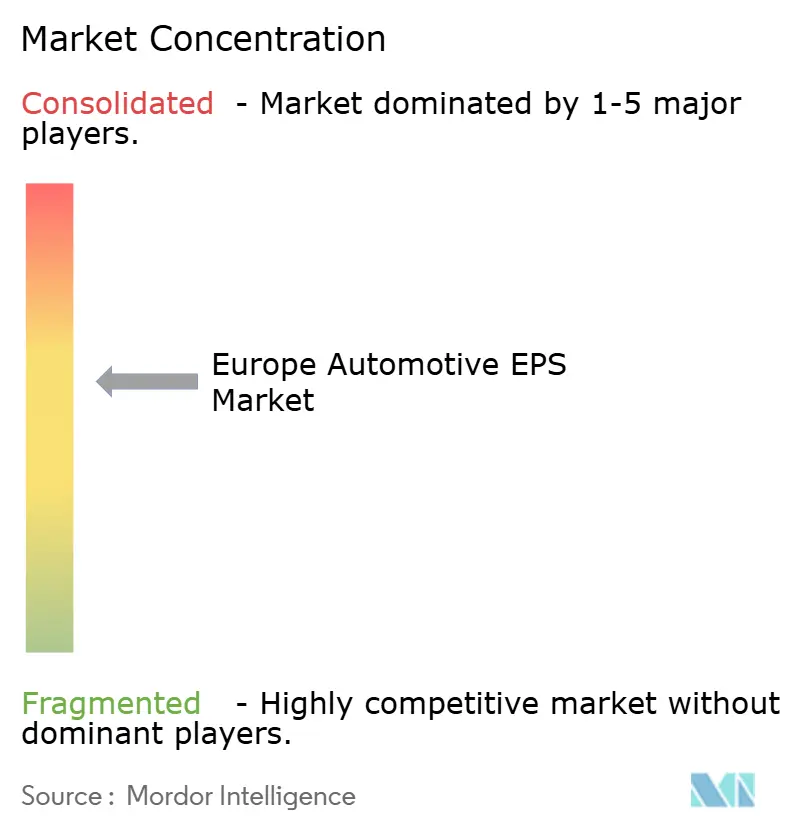
| Market Concentration | Medium |
Major Players *Disclaimer: Major Players sorted in no particular order Image © Mordor Intelligence. Reuse requires attribution under CC BY 4.0. | |
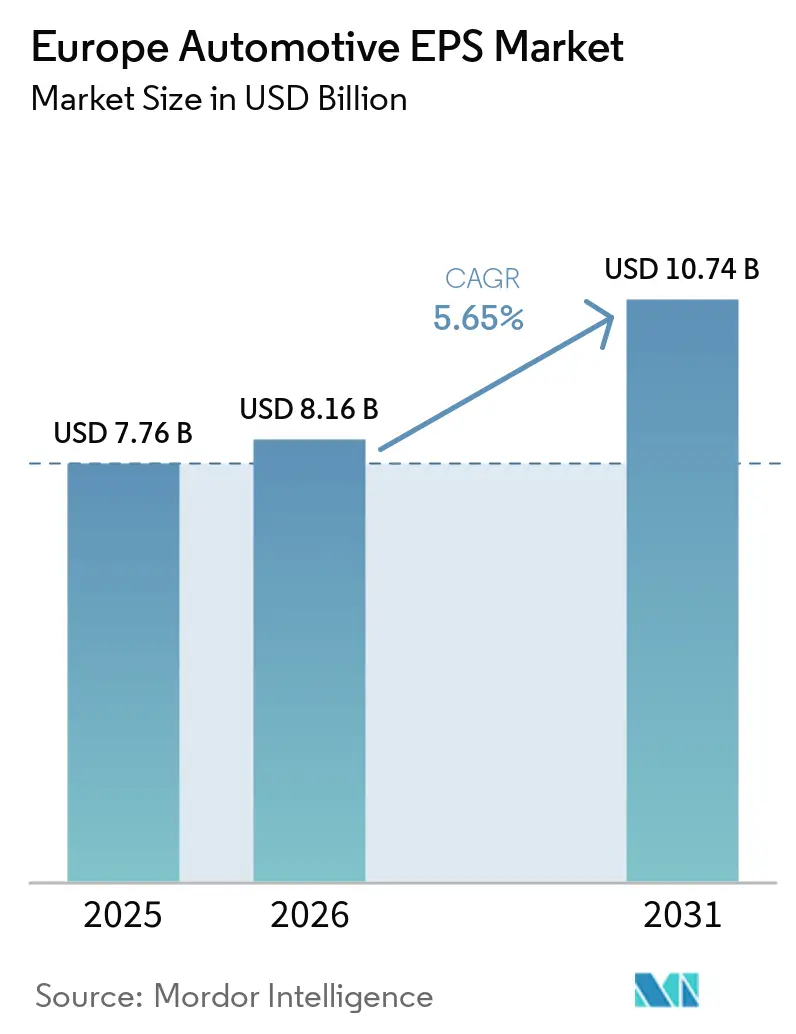
Europe Automotive EPS Market Analysis by Mordor Intelligence
The European electric power steering market size was valued at USD 7.76 billion in 2025 and is estimated to grow from USD 8.16 billion in 2026 to reach USD 10.74 billion by 2031, at a CAGR of 5.65% during the forecast period (2026-2031). Electric vehicle adoption supports the European electric power steering market because battery electric vehicles cannot use engine-driven hydraulic pumps, making electric power steering the relevant steering format for those vehicles. Europe recorded 4.2 million battery-electric vehicle sales in 2025, accounting for 28% of new-car sales, and the total rose by more than 30% from the previous year [1]. Safety rules and vehicle-rating protocols also encourage manufacturers to use steering systems that can support driver-assistance functions. The European electric power steering market is also moving toward software-enabled and redundant designs as automated steering functions become more important. This change creates opportunities for suppliers to combine steering hardware, sensing, software, and safety validation while keeping cost and component supply exposure as important constraints.
Key Report Takeaways
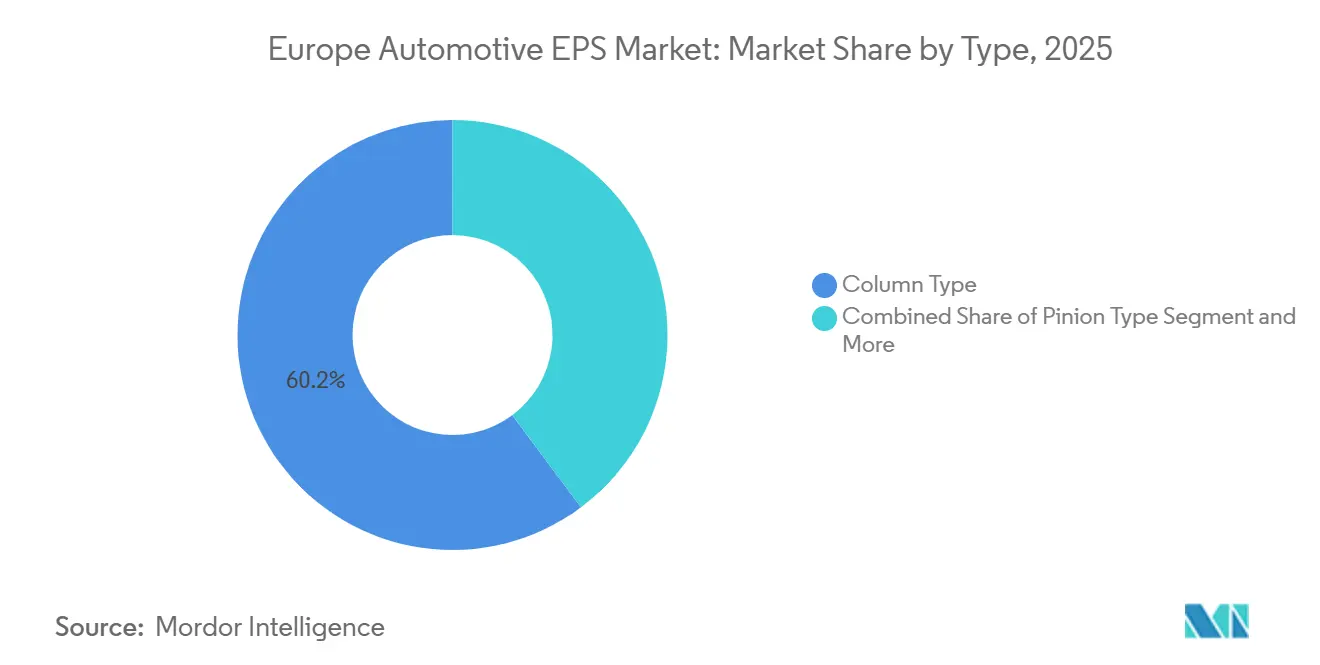
- By type, Column Type held 60.15% of the European electric power steering market share in 2025, while Dual-Pinion Type is forecast to grow at a 9.48% CAGR through 2031.
- By component type, Steering Rack/Column accounted for 40.33% of the European electric power steering market share in 2025, while Sensors are forecast to grow at an 8.12% CAGR through 2031.
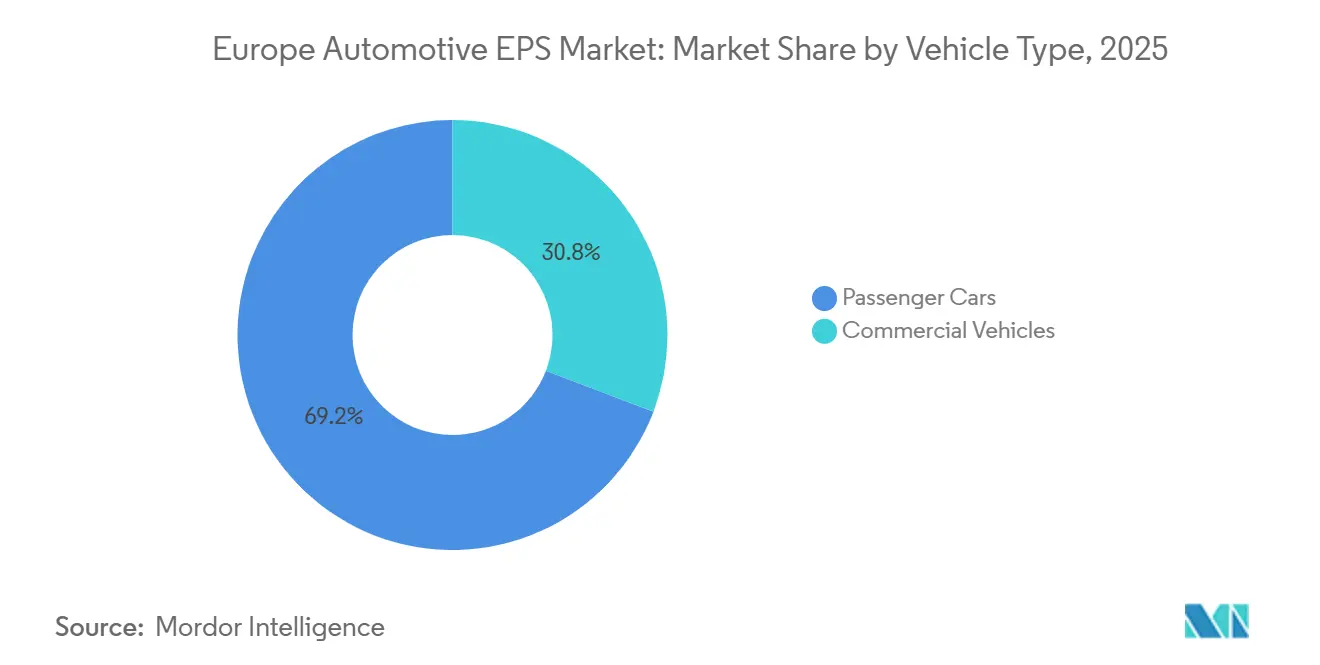
- By vehicle type, Passenger Cars accounted for 69.15% of the European electric power steering market size in 2025, while Commercial Vehicles are forecast to grow at a 7.75% CAGR through 2031.
- By propulsion type, ICE Vehicles accounted for 59.24% of the European electric power steering market size in 2025, while Battery Electric Vehicles are forecast to grow at a 13.55% CAGR through 2031.
- By country, Germany held 40.11% of the European electric power steering market share in 2025 and is forecast to grow at a 6.41% CAGR through 2031.
Note: Market size and forecast figures in this report are generated using Mordor Intelligence’s proprietary estimation framework, updated with the latest available data and insights as of January 2026.
Market Trends and Insights
Drivers Impact Analysis of Europe Automotive EPS Market*
| Driver | (~) % Impact on CAGR Forecast | Geographic Relevance | Impact Timeline |
|---|---|---|---|
| Advanced Driver-Assistance System Adoption | +1.8% | Global, with the highest concentration in Germany, France, and Nordic markets | Medium term (2-4 years) |
| Increasing Electrification of Vehicles | +1.5% | EU-wide, with early gains in Germany, France, the United Kingdom, and Scandinavia | Short term (≤ 2 years) |
| Vehicle Safety and Emissions Requirements | +0.9% | EU-wide, with compliance deadlines under Regulation (EU) 2019/2144 and Euro NCAP 2026 | Short term (≤ 2 years) |
| Demand for Software-Defined Steering | +0.7% | Germany and the United Kingdom, extending to France and Italy | Medium term (2-4 years) |
| Steering With Motion-Control Architectures | +0.5% | Core OEM hubs in Germany, Sweden, and the United Kingdom | Medium term (2-4 years) |
| Steer-by-Wire-Ready Architectures | +0.4% | Germany, France, and major European OEM programs | Long term (≥ 4 years) |
| Source: Mordor Intelligence | |||
Rising Adoption of Advanced Driver-Assistance Systems
Advanced driver-assistance systems are a major source of demand for automotive electric power steering in Europe. Lane-keeping assist, pedestrian avoidance, and traffic-jam assist require precise steering corrections and electronic feedback. Hydraulic steering does not provide the same closed-loop control capability. Regulation (EU) 2019/2144 requires specified safety systems for new vehicle types, which supports steering architectures compatible with these functions. Euro NCAP's 2026 protocol places vehicle assessment around Safe Driving, Crash Avoidance, Crash Protection, and Post-Crash Safety, with greater attention to automated interventions [2]. Manufacturers are therefore extending ADAS-ready steering to more mid-volume platforms, which favors systems capable of managing closed-loop steering control.
Increasing Electrification of Passenger and Commercial Vehicles
The move to electric powertrains provides a firm demand base for the European electric power steering market. In the first half of 2026, battery electric vehicle registrations grew 35% year over year and accounted for 22% of new vehicle registrations across Europe [3]. Electric trucks and buses require higher-torque steering systems than passenger vehicles. Their adoption of electric power steering is still in its early stages because hydraulic steering remains common in those applications. This leaves commercial vehicles positioned to contribute more strongly during the later years of the forecast period.
Stricter European Vehicle Safety and Emissions Requirements
European safety and emissions requirements reinforce the role of electric power steering across vehicle categories. The General Safety Regulation II supports lane-keeping and pedestrian-avoidance systems that need electronically controlled steering. Euro NCAP's revised 2026 protocol places greater emphasis on active interventions in crash-avoidance scenarios. This can place vehicles without ADAS-capable steering at a disadvantage in safety assessments used by buyers and fleet operators. Electric power steering also removes the continuous mechanical load of a hydraulic pump. Knorr-Bremse stated that its electric bus power steering can reduce carbon dioxide emissions by 1,000 kg per bus per year under standard driving cycles.
Growing Demand for Software-Defined Steering Functions
The European electric power steering market is increasingly shaped by steering systems that operate as software-addressable vehicle functions. Software can use steering, sensor, and vehicle-motion data to support features such as road-surface detection and hands-off detection. Nexteer introduced its MotionIQ software suite in 2025, featuring Steer-by-Brake, Quiet Wheel Steering, and Road Surface Detection. Manufacturers using centralized electrical and electronic architectures are also changing how steering suppliers participate in vehicle programs. Suppliers with software that manufacturers can extend are better placed than suppliers that offer only hardware. This divides demand between higher-content steering for ADAS and electric platforms and lower-cost column systems for high-volume ICE vehicles.
Restraints Impact Analysis of Europe Automotive EPS Market*
| Restraint | (~) % Impact on CAGR Forecast | Geographic Relevance | Impact Timeline |
|---|---|---|---|
| High Cost Compared With Alternatives | -0.7% | EU-wide, especially Southern and Eastern Europe | Medium term (2-4 years) |
| Component Supply Exposure | -0.6% | Global, with greatest exposure in German and Czech manufacturing clusters | Short term (≤ 2 years) |
| Safety and Cybersecurity Validation Complexity | -0.4% | Germany and the United Kingdom, extending to France and Italy | Medium term (2-4 years) |
| Limited Repairability and High Replacement Costs | -0.3% | EU-wide, particularly Italy and Eastern Europe | Long term (≥ 4 years) |
| Source: Mordor Intelligence | |||
High System Cost Compared With Hydraulic and Electrohydraulic Alternatives
Electric power steering has higher bill-of-materials costs than hydraulic steering at comparable torque levels. The difference can put pressure on margins for value-segment vehicles and delay conversion in some commercial vehicle lines. Smaller and price-sensitive platforms are particularly relevant in Southern and Eastern Europe. Some manufacturers retain electrohydraulic systems where a lower upfront cost outweighs the operating benefit of a fully electric system. Electrohydraulic steering also remains present in heavy commercial vehicles, where electric steering torque capacity was historically limited. ZF's production of 100 million electric power steering systems illustrates the role of volume in reducing unit costs. However, redundant sensors and dual-channel actuators preserve a cost premium for ADAS-grade systems.
Semiconductor, Sensor, and Rare-Earth Component Supply Exposure
The rare-earth disruption in 2025 exposed the geographic concentration risk in European electric power steering production. China's April 2025 export controls on rare earths led some European automotive suppliers to suspend operations as inventories fell. The European Central Bank reported that euro-area rare-earth imports from China were below typical seasonal levels in June 2025. Electric power steering also relies on automotive-grade microcontrollers produced by a narrow group of semiconductor manufacturers. The earlier semiconductor shortage showed how disruptions can delay whole vehicle programs. The EU Critical Raw Materials Act signals intent to diversify, but the evidence provided does not indicate that refined rare-earth capacity outside China will be materially diversified during 2026-2031.
*Our forecasts treat driver/restraint impacts as directional, not additive. The impact forecasts reflect baseline growth, mix effects, and variable interactions.
Europe Automotive EPS Market Segment Analysis
By Type:
Column Architecture Holds Volume Leadership While Dual-Pinion Systems Grow FasterColumn-type electric power steering held 60.15% in 2025. Its position reflects its fit with front-wheel-drive vehicle packaging and its lower cost and simpler integration for high-volume models. These factors remain relevant for European passenger vehicles where steering fitment is already widespread. Pinion-type systems serve mid-torque uses where column packaging is less suitable. They are used in larger passenger vehicles and light commercial applications. The European electric power steering market continues to support this architecture where vehicle layout and torque requirements call for it, particularly when manufacturers prioritize familiar packaging, simpler assembly, and cost control on high-volume vehicle programs.
The dual-pinion type is forecast to grow at a 9.48% CAGR from 2026 to 2031. It can provide primary and redundant steering torque, which supports ASIL-D-rated systems and higher levels of vehicle automation. Manufacturers with active automation programs are allocating future platform work to redundant steering designs. UNECE R79 requirements for higher automation levels make fail-operational steering more important. ZF's series-production steer-by-wire system for Mercedes-Benz shows the direction of premium steering investment in Europe. Thyssenkrupp Presta is also developing electromechanical steering actuators and column assemblies for next-generation redundant systems.

By Component Type:
Sensors Add Growth Above the Mechanical Steering AssemblySteering Rack/Column components held 40.33% in 2025. Their share reflects the cost weight of the mechanical actuator assembly in each electric power steering unit. Steering motors are becoming more differentiated as brushless permanent-magnet designs replace earlier brushed designs. These motors offer lower noise and greater torque density. They also increase exposure to the rare-earth magnet supply. Electronic control units and wiring harnesses make up the remaining component categories.
Sensors are forecast to grow at an 8.12% CAGR from 2026 to 2031 within the European electric power steering market. Torque, angle, and road-surface sensing are moving from single measurements to multi-axis data sets that support both steering control and ADAS functions. Nexteer's MotionIQ platform uses sensor information for Road Surface Detection and Hands-Off Detection. This makes the sensor-software combination more valuable in safety-rated applications. Suppliers with sensor-fusion software certified to ISO 26262 can be less exposed to hardware commoditization. The number of sensors per unit can rise as redundancy requirements increase, even if individual sensor prices decline with volume.
By Vehicle Type:
Passenger Cars Lead While Commercial Vehicles Gain MomentumPassenger Cars represented 69.15% in 2025. Their leading position is supported by the widespread adoption of electric power steering in Europe's passenger fleet. Safety requirements that encourage ADAS functions further support the use of compatible steering systems in this vehicle class. Growth is becoming more dependent on system content than fitment expansion. Redundant sensors, software-controlled torque support, and steer-by-wire readiness increase the value of each system. The European electric power steering market, therefore, retains a strong passenger-car base even as the replacement cycle matures.
Commercial Vehicles are forecast to grow at a 7.75% CAGR from 2026 to 2031. Electrification is driving demand for trucks and buses, where hydraulic steering had previously held an advantage. The replacement cycle in this group is beginning later than it did in passenger cars. Knorr-Bremse presented its commercial-vehicle electric power steering system at IAA Transportation 2026 and stated that the system is intended for market launch in 2027. The company also stated that the system can reduce steering energy consumption by up to 90% compared with conventional systems. Its planned high-volume commercial steering capacity in Germany aligns with the expected demand for fleet electrification.
By Propulsion Type:
ICE Retains the Largest Share While Battery Electric Vehicles AccelerateICE Vehicles held 59.24% in 2025. This position reflects the installed importance of combustion-powered vehicles in Europe during that year. The share did not indicate a stable long-term pattern. ICE vehicles fell from 38% of new European registrations in the first half of 2025 to 30% in the first half of 2026. Hybrid vehicles continue to support demand for electric power steering across mild-hybrid and plug-in-hybrid vehicles. They also allow manufacturers to manage fleet carbon dioxide requirements during the transition.
Battery Electric Vehicles are forecast to grow at a 13.55% CAGR from 2026 to 2031. More than 1.2 million battery electric vehicles were registered in Europe during the first half of 2026, an increase of 33.7% from the first half of 2025. Battery electric vehicles represented 25.6% of new-car registrations across 17 key European markets in June 2026. Transport and Environment projects a 23% share of new European car registrations for battery-electric vehicles for the full year 2026 [4]. Because battery electric vehicles cannot use engine-driven hydraulic steering, their steering fitment supports direct demand for electric systems. The European electric power steering market gains from this relationship without a hydraulic substitution option.
Geography Analysis
Germany Automotive EPS Market
Germany accounted for 40.11% in 2025 and is forecast to grow at a 6.41% CAGR from 2026 to 2031. Volkswagen Group, BMW Group, and Mercedes-Benz Group give the country a dense concentration of original equipment manufacturers. ZF, Thyssenkrupp Presta, and Bosch also have major steering operations connected to this manufacturing base. Mercedes-Benz selected ZF's steer-by-wire technology for a European series-production program in 2026.
United Kingdom and France Automotive EPS Market
The United Kingdom and France form a second major group of demand within the European electric power steering market, where electric vehicle growth, safety assessment requirements, and supplier engineering capabilities support wider use of electronically controlled steering systems. The United Kingdom benefits from its ADAS engineering base, including ZF's work on steer-by-wire technology. Its continued alignment with Euro NCAP standards supports investment in vehicle compliance despite Brexit. France recorded nearly two-thirds growth in battery electric vehicle registrations in the first half of 2026 and a 28% share. These conditions encourage Renault and Stellantis to use higher-content steering systems on electric platforms.
Broader European Markets
Russia's contribution has declined following disruptions in automotive production and reduced access to semiconductor and controller components. Spain, the Czech Republic, Hungary, the Nordic countries, and Eastern Europe are becoming both manufacturing locations and electric-vehicle growth markets. Hyundai Mobis began full operations at its plant in Hungary in March 2026 to supply chassis modules for Mercedes-Benz electric and hybrid vehicles. Norway reached a 98% share of new registrations from battery-electric vehicles in the first half of 2026, while Denmark reached 80%. These countries show the future full-electric steering demand pattern that other European countries will approach over time.
Competitive Landscape
The European electric power steering market is moderately consolidated in high-volume vehicle programs because established suppliers retain long-running manufacturer relationships, validated production processes, and the scale required for large vehicle-platform awards. JTEKT, ZF, Nexteer, Bosch, and NSK retain leading positions in established steering programs. Hyundai Mobis, Mando, Denso, Hitachi Astemo, and Mitsubishi Electric compete for adjacent opportunities. ZF has produced 100 million electric power steering systems globally, showing the manufacturing scale available to leading suppliers. Large-scale production can lower costs and make mid-program supplier changes difficult for vehicle manufacturers. Competition is becoming more intense, with software and safety validation determining access to advanced programs.
Nexteer's steer-by-wire system achieved ASIL-D functional-safety approval from a German accreditation body in late 2025 and entered series production in April 2026. This gives the company a compliance qualification for next-generation vehicle programs. ZF's steer-by-wire series production for Mercedes-Benz is another strategic move toward redundant steering architectures in Europe. Knorr-Bremse presented electric power steering for commercial vehicles in July 2026, with a market launch confirmed for 2027. These moves show that the strongest competition is shifting toward safety-certified, software-capable, and commercial-vehicle steering systems.
Commercial vehicle steering remains an important opening in the European electric power steering market, as hydraulic steering is still widely used in trucks and buses, leaving suppliers room to address an application segment that has not converted at the same pace as passenger cars. Knorr-Bremse's planned capacity expansion at Aldersbach supports its move into this segment. Software updates and motion-control licensing may also create revenue beyond the initial hardware sale. JTEKT's announced divestiture of its European automotive steering business to an independent European Tier-1 entity changes the supplier structure in the region. The transaction may create a supplier that is more locally focused in the mid-market tier.
Europe Automotive EPS Industry Leaders
-
JTEKT Corporation
-
Robert Bosch GmbH
-
Nexteer Automotive
-
ZF Friedrichshafen AG
-
NSK Ltd.
- *Disclaimer: Major Players sorted in no particular order
Europe Automotive EPS Market Companies Covered in this Report
- JTEKT Corporation
- Robert Bosch GmbH
- Nexteer Automotive
- ZF Friedrichshafen AG
- Denso Corporation
- NSK Ltd.
- Hyundai Mobis Co. Ltd.
- Thyssenkrupp Presta AG
- Continental AG
- Knorr-Bremse AG
- HL Mando Corporation
- Mitsubishi Electric Corporation
- Astemo Ltd.
Recent Industry Developments in Europe Automotive EPS Market
- July 2026: Knorr-Bremse presented its Electric Power Steering system for commercial vehicles at IAA Transportation 2026 in Hanover, alongside a redundant EPS variant (rEPS) targeting highly automated driving applications; market launch is confirmed for 2027. The system claims up to 90% lower steering energy consumption compared with conventional alternatives.
- June 2026: Knorr-Bremse secured a new EPS series production order from an Asia-Pacific commercial vehicle manufacturer, with start of production targeted for 2028. The order consolidates the company's position as one of the few European suppliers with EPS production contracts across both Europe and Asia-Pacific for trucks and buses.
Europe Automotive EPS Market Report Scope
The scope includes segmentation by type (column type, pinion type, and dual pinion type), component type (steering rack/column, sensor, steering motor, and other component types), vehicle type (passenger cars and commercial vehicles), and propulsion type (internal combustion engine vehicles, hybrid vehicles, and battery electric vehicles). The analysis also covers country-level segmentation including Germany, the United Kingdom, France, Italy, Russia, and the rest of Europe. Market size and growth forecasts are presented by value in USD and by volume in units.
By Type
| Column Type |
| Pinion Type |
| Dual Pinion Type |
By Component Type
| Steering Rack/Column |
| Sensor |
| Steering Motor |
| Other Component Types |
By Vehicle Type
| Passenger Cars |
| Commercial Vehicles |
By Propulsion Type
| Internal Combustion Engine Vehicles |
| Hybrid Vehicles |
| Battery Electric Vehicles |
By Country
| Germany |
| United Kingdom |
| France |
| Italy |
| Russia |
| Rest of Europe |
| By Type | Column Type |
| Pinion Type | |
| Dual Pinion Type | |
| By Component Type | Steering Rack/Column |
| Sensor | |
| Steering Motor | |
| Other Component Types | |
| By Vehicle Type | Passenger Cars |
| Commercial Vehicles | |
| By Propulsion Type | Internal Combustion Engine Vehicles |
| Hybrid Vehicles | |
| Battery Electric Vehicles | |
| By Country | Germany |
| United Kingdom | |
| France | |
| Italy | |
| Russia | |
| Rest of Europe |
Key Questions Answered in the Report
What is the forecast growth rate for electric power steering in Europe?
The European electric power steering market is forecast to grow at a 5.65% CAGR from 2026 to 2031, rising from USD 8.16 billion to USD 10.74 billion.
What is driving demand for electric power steering systems in Europe?
Electric vehicle adoption, ADAS requirements, and safety rules are supporting demand for electronically controlled steering systems.
Which vehicle category is growing fastest for electric power steering?
Commercial Vehicles are forecast to grow at a 7.75% CAGR through 2031 as truck and bus electrification expands.
Which propulsion category has the highest growth rate?
Battery Electric Vehicles are forecast to grow at a 13.55% CAGR through 2031 because they cannot use engine-driven hydraulic steering.