
Market Overview
| Study Period | 2020 - 2031 |
|---|---|
| Forecast Data Period | 2026 - 2031 |
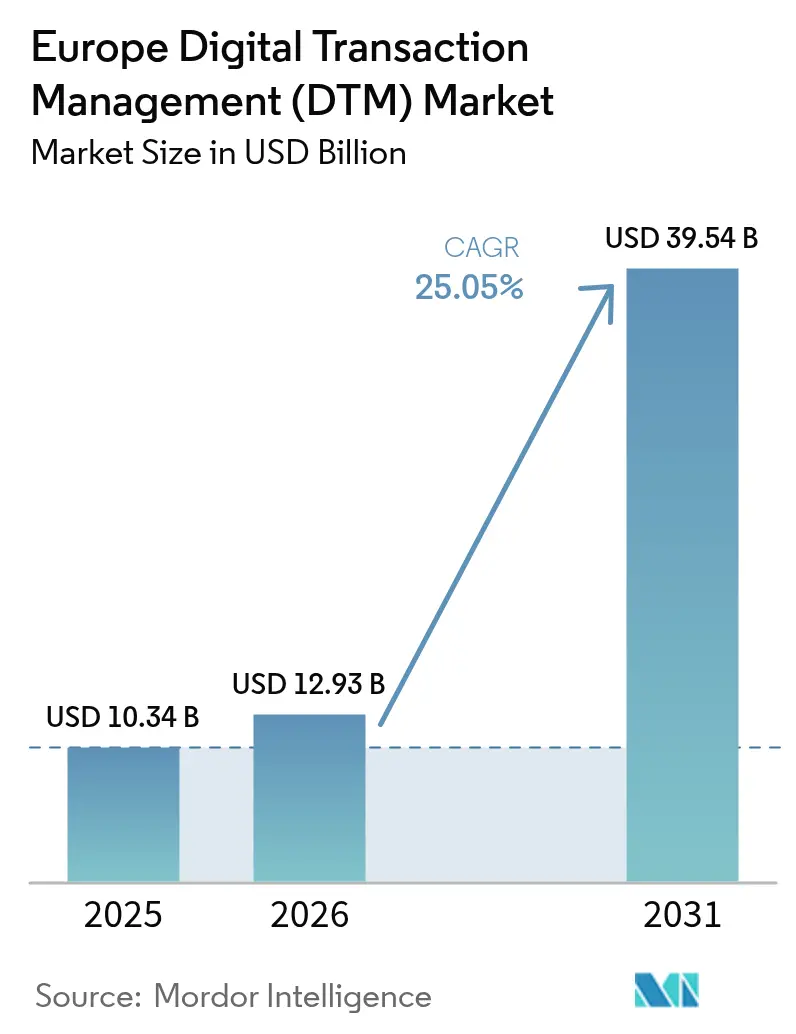
| Base Year Market Size (2025) | USD 10.34 Billion |
| Market Size (2026) | USD 12.93 Billion |
| Market Size (2031) | USD 39.54 Billion |
| Growth Rate (2026 - 2031) | 25.05 % |
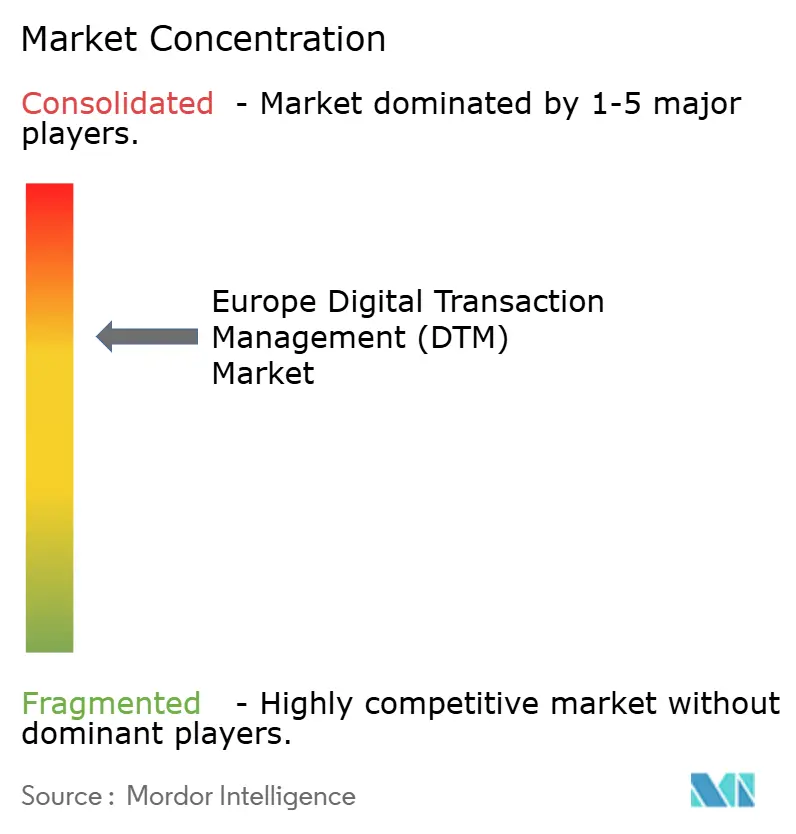
| Market Concentration | Medium |
Major Players *Disclaimer: Major Players sorted in no particular order Image © Mordor Intelligence. Reuse requires attribution under CC BY 4.0. | |
Europe Digital Transaction Management (DTM) Market Analysis by Mordor Intelligence
Europe Digital Transaction Management market size in 2026 is estimated at USD 12.93 billion, growing from 2025 value of USD 10.34 billion with 2031 projections showing USD 39.54 billion, growing at 25.05% CAGR over 2026-2031. This growth reflects the synchrony of stringent EU-level mandates and a work culture that now defaults to remote, paper-free interactions. Continuous regulatory pushes such as eIDAS 2.0, the January 2025 instant-payment rule, and phased B2B e-invoicing deadlines are steering every corporate workflow toward fully digital rails. Enterprises view compliance readiness, real-time processing speed, and pan-European identity interoperability as strategic, not optional, thereby sustaining double-digit spending momentum on platform modernisation. Competitive intensity is rising as European specialists inject local trust-service expertise into a landscape long dominated by a few global providers, while private equity interest signals confidence in decades-long secular adoption. Cyber-risk, funding gaps among smaller firms, and fragmented national eID schemes could temper the upward trajectory, yet they are unlikely to derail it because most new legislation embeds non-negotiable digital requirements into daily trade.
Key Report Takeaways
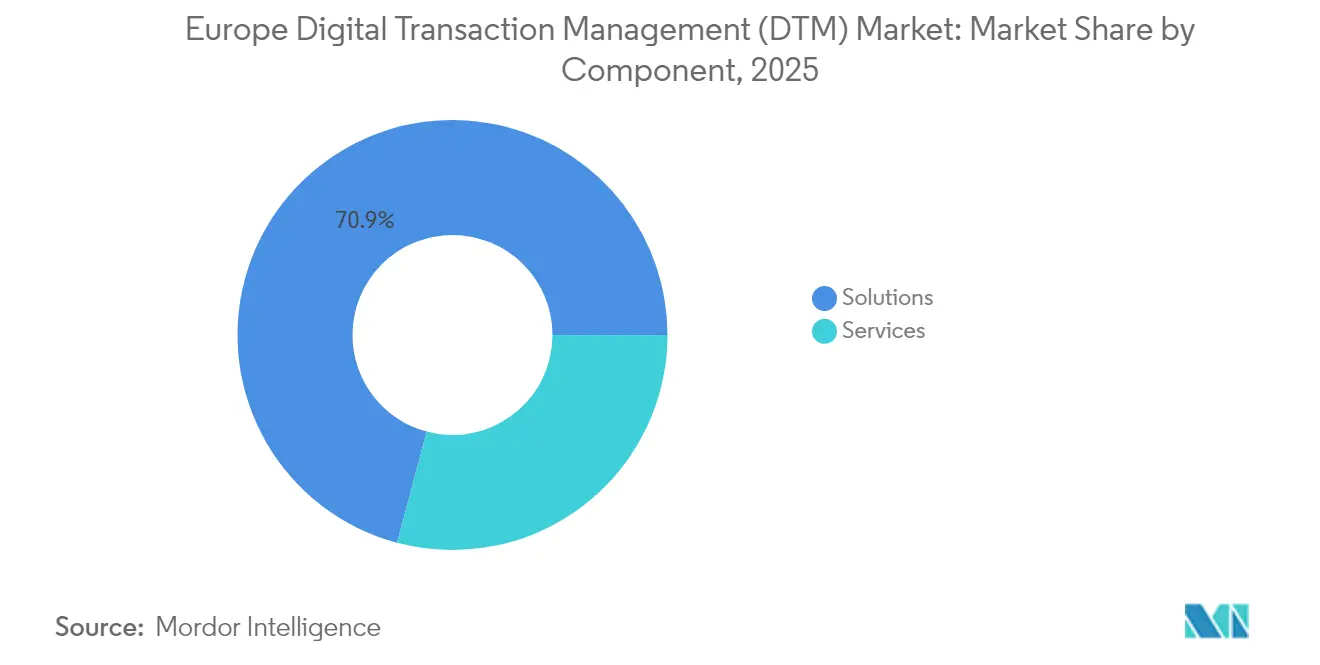
- By component, solutions captured 70.85% of the Europe Digital Transaction Management market share in 2025; services are projected to grow at 23.15% CAGR through 2031.
- By deployment mode, cloud maintained 78.15% share of the Europe Digital Transaction Management market size in 2025 and is advancing at a 27.95% CAGR to 2031.
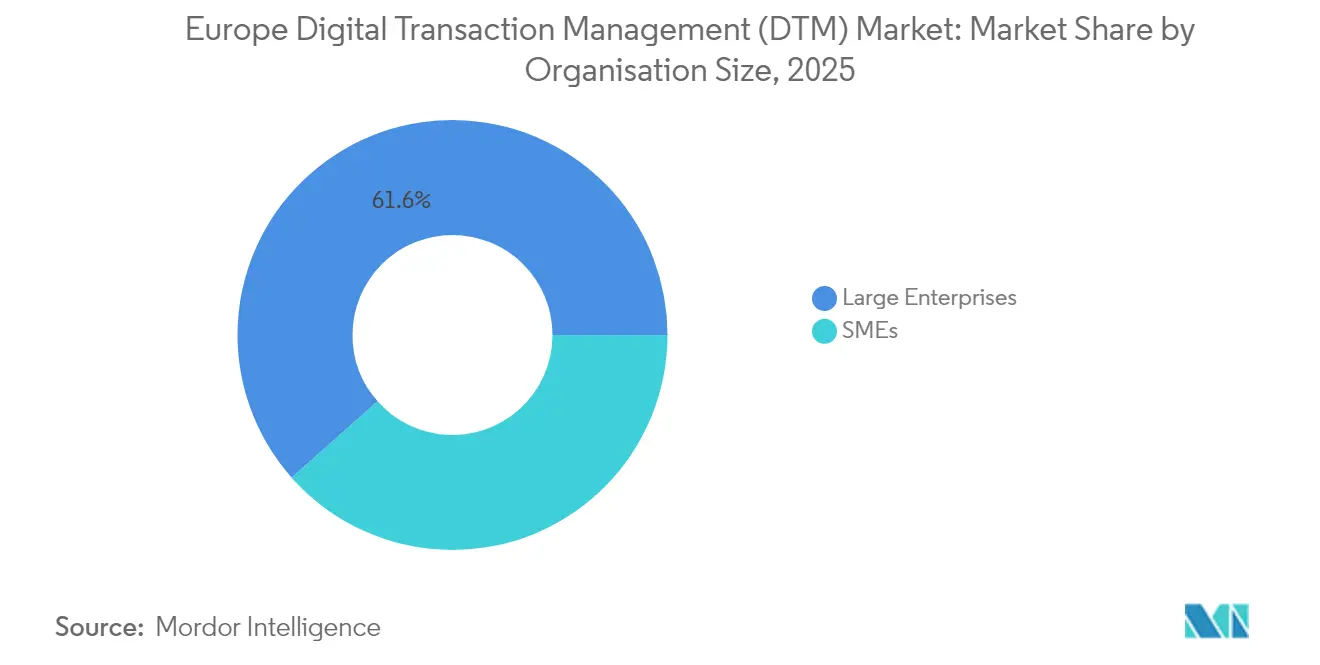
- By organisation size, large enterprises held 61.55% revenue share in 2025, while SMEs are forecast to expand at 25.95% CAGR between 2026-2031.
- By end-user industry, BFSI led with 28.35% share of the Europe Digital Transaction Management market size in 2025; automotive and mobility exhibit the quickest pace at 27.65% CAGR to 2031.
Note: Market size and forecast figures in this report are generated using Mordor Intelligence’s proprietary estimation framework, updated with the latest available data and insights as of 2026.
Europe Digital Transaction Management (DTM) Market Trends and Insights
Drivers Impact Analysis*
| Driver | (~) % Impact on CAGR Forecast | Geographic Relevance | Impact Timeline |
|---|---|---|---|
| Rise in e-signatures and cloud adoption | +6.2% | Global, with Nordic leadership | Short term (≤ 2 years) |
| SME push for end-to-end workflow automation | +5.8% | EU core, spill-over to UK | Medium term (2-4 years) |
| EU eIDAS 2.0 and PSD3 accelerating trust services | +4.9% | EU member states, EEA countries | Long term (≥ 4 years) |
| Post-COVID permanent shift to digital workflows | +3.7% | Global, with Western Europe focus | Short term (≤ 2 years) |
| Mandatory B2B e-invoicing roll-outs across EU | +3.1% | EU member states | Medium term (2-4 years) |
| Instant-payment rails driving real-time DTM demand | +2.4% | Eurozone, expanding to non-Euro EU | Short term (≤ 2 years) |
| Source: Mordor Intelligence | |||
Rise in e-signatures and cloud adoption
European legislators project stable 25% yearly revenue gains for e-signature services, propelling cloud models that already hold 77.70% of transactions and register the fastest CAGR through 2030. Nordic governments showcase near-paperless public services, with Denmark eliminating hard-copy options for most citizen interactions and Sweden nearing a cash-free economy. eIDAS 2.0 removes cross-border friction by recognising remote signatures issued under any qualified EU trust service. BFSI stakeholders also depend on cloud scalability to authenticate instant payments within the mandated 10 seconds, cementing cloud architecture as the de facto backbone of pan-European trust services[1].
SME push for end-to-end workflow automation
SMEs account for over 99% of European businesses yet carry a EUR 53 billion digital-compliance burden. Targeted EU Digital Europe funds partially offset those costs and are catalysing 26.50% CAGR uptake among smaller firms. Consolidators such as Visma have responded by acquiring niche platforms that package KYC, invoicing and signing features into turnkey bundles. As 72% of SMEs now rely on data-driven decision tools, the demand for subscription-based, no-code automation has evolved from a convenience to a survival requirement [2].
EU eIDAS 2.0 and PSD3 accelerating trust services
The May 2024 adoption of eIDAS 2.0 obliges every member state to issue a European Digital Identity wallet by December 2026, covering 360 million citizens. Parallel PSD3 verification rules mandate real-time “confirmation of payee” checks from October 2025, driving banks to integrate certified trust-service providers capable of sub-second identity resolution. European firms such as InfoCert are leveraging acquisitions to scale these regulated services and reduce reliance on non-EU technology while maintaining sovereignty over personal data.
Post-COVID permanent shift to digital workflows
Remote operations introduced during lockdowns have outlasted the pandemic. Cloud collaboration suites now embed native signing options that eliminate the document “print-scan-send” loop, opening recurring revenue streams for providers. Healthcare transformation through the European Health Data Space further embeds digital authentication into patient record systems, and connected-car commerce requires continuous transaction checks. These permanent behavioural shifts sustain double-digit demand even as macroeconomic conditions fluctuate.
Restraints Impact Analysis*
| Restraint | (~) % Impact on CAGR Forecast | Geographic Relevance | Impact Timeline |
|---|---|---|---|
| Persistent data-privacy and cyber-risk concerns | -3.8% | Global, with GDPR compliance focus | Long term (≥ 4 years) |
| High integration and change-management costs | -4.2% | EU SME segment, Eastern Europe | Medium term (2-4 years) |
| Fragmented national eID schemes hinder interoperability | -2.1% | EU member states, varying adoption | Long term (≥ 4 years) |
| Tight SME financing slows tech refresh cycles | -1.9% | Southern and Eastern Europe | Short term (≤ 2 years) |
| Source: Mordor Intelligence | |||
Persistent data-privacy and cyber-risk concerns
Real-time payments demand 10-second clearing and yet must honour GDPR data-minimisation rules that often require data residency within national borders. The NIS2 directive widens breach-notification duties and raises fines, leading many banks to deploy AI-based anomaly detection that can handle rising fraud attempts without infringing privacy constraints. Smaller firms particularly struggle to finance specialist security skills, underscoring the need for vendor-provided compliance capabilities baked into platforms.
High integration and change-management costs
For SMEs, linking older ERP stacks to modern DTM platforms may take up to 12 months and absorb scarce developer budgets. Simultaneous compliance with eIDAS 2.0, PSD3, mandatory e-invoicing, and GDPR forces parallel project tracks, inflating consulting costs. The burden is heaviest in cash-constrained Southern and Eastern member states despite EU grants, slowing conversion from paper to digital in those regions[3].
*Our forecasts treat driver/restraint impacts as directional, not additive. The impact forecasts reflect baseline growth, mix effects, and variable interactions.
Segment Analysis
By Component: Solutions Maintain Scale Advantage
Solutions accounted for 70.85% of the Europe Digital Transaction Management market share in 2025 on the back of platforms that bundle signing, identity, workflow and audit functions under one licence. The services slice is smaller but rising at 23.15% CAGR as organisations outsource complexity to managed providers, especially for eIDAS wallet integration and instant-payment obligations. Vendors embed AI to auto-classify documents, verify identities and trigger alerts, reducing staff overheads and ensuring that solutions revenue continues to dominate absolute spend even while services expand faster.
Demand for consulting peaks during regulation roll-outs, after which recurring platform fees drive sustained revenue. Healthcare projects funded under the European Health Data Space allocate budget specifically to qualified trust-service integration, thereby locking in multi-year platform contracts. European software majors are consequently acquiring niche service firms to secure implementation talent and defend platform primacy.

By Deployment Mode: Cloud Supremacy Deepens
Cloud solutions held 78.15% of the Europe Digital Transaction Management market size in 2025 and are growing at 27.95% CAGR, reinforcing the architectural pivot away from on-premise. Providers offer real-time compliance updates, geo-fenced data centres and latency guarantees that on-premise installs find costly to replicate. Regulatory requirements for 24/7 instant-payment uptime further tilt adoption toward elastic cloud resources that can auto-scale during volume spikes.
Hybrid remains a transition path for financial institutions that wish to retain core-ledger data locally while routing customer-facing activity to the cloud. Nevertheless, even in these cases audit trails and signature verification often reside in managed environments. Nordic government portals, built completely in the cloud, supply proof points that nationwide digital services can run at scale with strong privacy safeguards, causing lagging countries to follow suit.
By Organisation Size: SME Momentum Rises
Large enterprises still represent 61.55% of revenue, yet SME uptake is expanding at 25.95% CAGR, changing the revenue pyramid. Subsidies under Digital Europe and local tax incentives soften upfront costs, and low-code interfaces reduce technical hurdles. SMEs are also compelled by fiscal authorities to adopt e-invoicing, and failure to comply risks invoice rejection or late-payment penalties.
Subscription pricing lowers entry barriers so that smaller firms bypass multi-year licence commitments. Regional software houses integrate DTM microservices into accounting suites, giving SMEs a single pane of glass for payroll, invoicing and compliance. As these firms scale cross-border, wallet-based identity schemes will reduce onboarding friction, further accelerating SME penetration.
By End-user Industry: BFSI Holds Lead, Automotive Surges
BFSI carried 28.35% share in 2025, justified by the sector’s stringent KYC, AML and instant-payment duties. PSD3 and real-time clearing reinforce the need for tokenised signatures tied to verified identities. At the same time, the automotive and mobility vertical is growing at 27.65% CAGR, buoyed by in-vehicle commerce ranging from charging payments to usage-based insurance. Each driver action can trigger micro-transactions that must be signed and audited automatically.
Healthcare adoption benefits from the European Health Data Space and electronic prescription mandates, whereas retail leverages DTM to curb chargeback risk in cross-border e-commerce. Government portals supply an additional catalyst, as tender bids, grant applications and payroll attestations increasingly require qualified electronic signatures rather than physical stamps.
Geography Analysis
The United Kingdom remains pivotal despite no longer being an EU member. Banks such as Lloyds and Santander invest heavily in open-banking APIs that require end-to-end digital identity proofing, ensuring that cross-border flows with the Single Market remain seamless. London’s fintech cluster continues to attract venture funding for real-time verification services that plug directly into EU eIDAS frameworks.
Germany is the region’s largest single market. January 2025 B2B e-invoicing obligations compel the Mittelstand to embed structured invoice and signature modules into legacy ERP systems, fuelling licence sales into manufacturing supply chains. Germany’s automotive OEMs then extend DTM capabilities into connected-car platforms, creating adjacent revenue streams for provider ecosystems.
Italy offers a mature reference case after mandating B2B e-invoicing in 2019. Its Sistema di Interscambio platform processes millions of invoices daily, and public procurement now requires qualified electronic signatures as standard. Spain and France follow on staggered timetables but mirror Italy’s legislation. Nordic countries demonstrate what fully digital public services deliver in efficiency gains: Denmark’s “digital by default” model and Sweden’s cash-less trajectory display usage benchmarks that other member states are keen to replicate.
Regulatory Landscape
The Europe DTM market operates under the EU electronic identification and trust-services framework (eIDAS), updated by Regulation (EU) 2024/1183, which entered into force in May 2024 and requires each Member State to make at least one European Digital Identity (EUDI) Wallet available by 31 December 2026. Alongside this, a set of implementing acts has shifted the market from high-level legal requirements to concrete technical conformance obligations for signatures, seals, certificates, and validation services, shaping both product roadmaps and compliance budgets for qualified trust service providers (QTSPs) and enterprise relying parties.
Several implementing rules adopted in 2025-2026 tighten interoperability and validation requirements. Commission Implementing Regulation (EU) 2025/1945 (29 September 2025) specifies technical standards for validation of qualified electronic signatures and seals. Implementing Regulations (EU) 2025/1943 and 2025/1942 (29 September 2025) define reference standards for qualified certificates and qualified validation services. Commission Implementing Regulation (EU) 2026/248 (adopted 2 February 2026) introduces standard formats for advanced electronic signatures and seals, supporting cross-border acceptance. The European Commission also maintains supporting building blocks such as the Digital Signature Service (DSS) used to implement and validate signature workflows.
Value Chain Analysis
The Europe DTM value chain begins with identity and trust infrastructure and then moves through software orchestration and integration into business processes. Upstream enablers include national eID schemes and the EUDI Wallet framework under Regulation (EU) 2024/1183, along with standards bodies and reference frameworks that define how wallets, signatures, seals, and attribute attestations interoperate. QTSPs sit at the center of the ecosystem by providing regulated identity proofing (KYC/KYB), qualified electronic signatures (QES) and seals, certificate issuance, validation, and long-term preservation services, which DTM platforms consume via APIs to support compliant end-to-end transactions.
Midstream, DTM platform vendors package workflow, signing, audit trails, and archiving, then depend on system integrators, managed service providers, and ERP/accounting ecosystems to embed these capabilities into invoicing, onboarding, procurement, and banking or payment flows. Downstream, relying parties (including BFSI, telecom, transport, energy, healthcare, and large online platforms) connect to wallet and trust services for user authentication and transaction authorization. This can also involve registration as wallet-relying parties in national registers and declaration of data request scopes. A recurring bottleneck is certification and re-certification capacity, as conformity assessment requirements evolve under eIDAS 2.0 implementing acts, which introduces lead-time and cost pressure that influences vendor selection and deployment schedules.
Competitive Landscape
DocuSign remains the global brand leader and enjoys unrivalled name recognition among enterprise buyers, yet European specialists such as Visma, Signicat and InfoCert are eroding share by emphasising deep compliance alignment with eIDAS and national eID schemes. The top five suppliers collectively control roughly 68% of regional revenue, signalling a moderately concentrated field where challenger gains can still impact incumbent positioning.
M&A has intensified. InfoCert’s acquisition of Ascertia broadens qualified trust footprints into the UK, while Visma’s spree of four purchases in 18 months bundles KYC, expense and signing functions for two million SME subscribers. Large cloud vendors integrate leading signature engines into productivity suites, locking platforms into daily workflows and raising switching costs.
Private-equity suitors evaluating DocuSign at USD 12 billion highlight conviction that secular digital-workflow adoption has room to run. Smaller entrants target sector-specific gaps, such as electronic notarisation or real-estate escrow, leveraging API-first designs to embed quickly into niche applications. Strategic partnerships between global hyperscalers and local trust-service providers are emerging as the mechanism to reconcile pan-European coverage with country-specific rule nuances.
Europe Digital Transaction Management (DTM) Industry Leaders
-
DocuSign Inc.
-
Adobe Inc.
-
ZorroSign Inc.
-
Nintex Group Pty Ltd
-
Namirial SpA
- *Disclaimer: Major Players sorted in no particular order
Market Opportunities and Future Outlook
EUDI Wallet readiness is creating a defined opportunity for wallet-relying party onboarding, orchestration, and compliance tooling across sectors that must accept the wallet for authentication, including banking, telecoms, energy, transport, healthcare, and very large online platforms. Regulation (EU) 2024/1183 sets the milestone for Member State wallet availability by 31 December 2026, and the market is shifting toward products that industrialize relying-party registration, consent and attribute-request management, and high-assurance identity proofing aligned to updated standards, including ETSI TS 119 461 v2 (February 2025). This is pulling DTM platforms further into regulated trust services, where qualified signatures, seals, and validation are purchased as embedded infrastructure rather than standalone e-sign tools.
ViDA (VAT in the Digital Age), adopted in March 2025, expands the opportunity for DTM vendors to integrate structured e-invoicing, qualified electronic seals, and compliant archiving into finance and ERP workflows, particularly for cross-border trade where standardized evidence and audit trails help. The direction also reflects observed digitization baselines in the EU: as of 2025, 72% of EU businesses reached at least a basic level of digital intensity and 53% purchased cloud services. That uptake supports scale-up of cloud-delivered DTM modules that can be deployed via APIs into existing applications. With wallet-centric authentication and e-invoicing-driven document integrity in focus, demand is building for interoperable validation, attribute attestation, and preservation services that can operate across multiple Member State schemes while remaining aligned to the 2025-2026 implementing acts.
Recent Industry Developments
- February 2026: The European Commission adopted Commission Implementing Regulation (EU) 2026/248 introducing standard formats for advanced electronic signatures and seals to improve cross-border interoperability. This implementation-level clarification reduces ambiguity for DTM vendors building signature and sealing workflows that must validate consistently across Member States and trust-service stacks.
- September 2025: The EU adopted Commission Implementing Regulation (EU) 2025/1945, alongside Implementing Regulations (EU) 2025/1943 and 2025/1942, setting technical standards for validation of qualified electronic signatures and seals and defining reference standards for qualified certificates and qualified validation services. The package increases the compliance premium on validation engines, certificate lifecycle management, and audit-ready verification services embedded within DTM platforms.
- April 2024: Microsoft added native Adobe and DocuSign signing capabilities to SharePoint, embedding signature execution into common Microsoft 365 document workflows. The integration strengthened distribution through collaboration suites and pushed DTM adoption toward API-driven, in-workflow signing rather than separate point solutions.
Research Methodology Framework and Report Scope
Market Definition and Coverage
For this study, we define digital transaction management in Europe as the software and related services used to prepare, authenticate, sign, route, store, and track business documents digitally, so agreements and approvals can be completed end to end without paper.
Scope exclusions: We exclude non-enterprise, consumer-only signature tools and general IT hardware, and we also do not count unrelated payment processing revenues.
Segmentation Overview
- By Component
- Solutions
- Services
- By Deployment Mode
- Cloud
- On-premise
- Hybrid
- By Organisation Size
- Small and Medium Enterprises
- Large Enterprises
- By End-user Industry
- BFSI
- Healthcare and Life Sciences
- Retail and E-commerce
- IT and Telecommunication
- Government and Public Sector
- Real-Estate and Construction
- Automotive and Mobility
- By Country
- United Kingdom
- Germany
- France
- Spain
- Italy
- Rest of Europe
Data Sources, Market Sizing, and Validation
Desk Research
Desk research helped us set the market boundary and build the starting data layer for Europe. We reviewed public policy and legal references tied to digital identity and signatures, including European Commission updates on eIDAS and related guidance, because these requirements affect adoption timing by country.
We also used public datasets and publications that act as demand signals, such as Eurostat enterprise digitalization indicators, European Central Bank payment and digital finance publications, national statistics offices for business counts, and OECD digital economy statistics. To connect these signals to revenue pools, we cross-checked company annual reports, investor decks, and credible press coverage for product focus and geographic exposure, then we supplemented with paid databases for company financials and news when disclosures were limited. The sources listed here are illustrative only, and we relied on additional public references to support validation and clarify boundary decisions during the work.
Primary Interviews and Surveys
Primary interviews and surveys were used to test adoption assumptions and pricing logic across Europe, especially where public data is not detailed enough by workflow type. We spoke with a mix of solution providers, channel partners, and enterprise users across regulated and non-regulated industries to confirm what is actually being bought in practice, how contracts are priced (subscription, usage, or enterprise license), and how usage expands after the first rollout.
Distribution of primary research fieldwork respondents
| Company type | Respondent position |
|---|---|
| Top tier: 25% | CXOs: 15% |
| Mid tier: 58% | Functional/Unit leaders: 34% |
| Smaller Players: 17% | Managers: 51% |
Market-Sizing & Forecasting
Sizing was built using top-down and bottom-up logic, with Europe totals reconstructed from a demand pool and then checked against supplier-side reality. On the top-down side, we mapped the addressable pool using enterprise counts by country, the share of processes that can move to digital execution, and adoption levels shaped by compliance requirements and remote-work maturity. We then converted these volumes into spend using price bands observed in the market.
To keep the model grounded, we used a small set of repeatable inputs, such as (illustratively) enterprise digitization rates, the mix of regulated document workflows (like onboarding and contract signing), cloud versus on-premises preference, average contract values by organization size, and renewal and expansion behavior after year one. Bottom-up checks were then used selectively, including revenue roll-ups for Europe-exposed providers, sampled price-per-user or price-per-envelope assumptions, and channel checks on typical deal sizes. Where we saw gaps, we handled them through conservative interpolation across similar countries and industry mixes.
For forecasting, we relied on scenario analysis supported by a simple multivariate regression for the key demand drivers that change year to year, mainly digital adoption indicators, compliance-led program rollouts, and IT spend sentiment. When expert inputs differed by country, the forecast path was adjusted, then rechecked against implied penetration and spend per adopting enterprise to avoid unrealistic step changes.
Data Validation & Update Cycle
Validation was done through triangulation across three layers: demand signals, pricing and contract structure, and supplier exposure to Europe. We ran variance checks at country and industry level to flag outliers, and we re-opened assumptions when the implied spend per enterprise or implied penetration did not match what interviewees described in live deployments.
Before sign-off, the model goes through a multi-step analyst review where key variables, unit economics, and growth drivers are challenged, and any large swings are reconciled back to a clear reason such as regulation timing, buying cycles, or pricing shifts. The report is refreshed annually, with interim updates when material events occur, and a final pre-delivery review is done so the numbers reflect the latest available information.
Mordor Intelligence's Europe Digital Transaction Management Market Size Versus Other Published Estimates
Published market sizes for Europe digital transaction management can look far apart because the market boundary is not always drawn the same way, and because pricing and deployment assumptions are handled differently. The year used for the base, the treatment of services revenue, and even which countries are included in Europe can all change the final number.
Evidence such as country-level enterprise adoption indicators, eIDAS-led rollout timelines, and cross-checks on vendor Europe revenue exposure helps keep Mordor Intelligence tied to a realistic spend pool, instead of letting the model drift into adjacent categories like broader workflow software or identity-only tools. Differences usually come from whether services are counted as ongoing managed revenue versus one-time implementation, whether SME pricing is extrapolated from large-enterprise deals, and whether currency timing uses an average rate or an end-year conversion.
Benchmark comparison
| Source | Market Size | Gaps in Research Methodology |
|---|---|---|
| Mordor Intelligence | USD 10.34 B (2025) | |
| Trade Magazine A | USD 3.06 B (2021) | Uses an older base year and a narrower monetized scope that appears to undercount subscriptions and expansion revenue, and the Europe country coverage is not clearly reconciled to current enterprise adoption levels. |
| Press Release B | USD 27.07 B (2030) | Publishes only a forward target year with limited transparency on assumed pricing ramps and services attach rates, which can inflate totals when adoption and ASP growth are applied aggressively across all countries at once. |
Looking at the three numbers together, the spread is mainly explained by different base years and how services and price growth are treated in the model. Our estimate stays traceable because the total is built from adoption, workflow suitability, and price bands that can be checked back to real buying patterns and supplier exposure.
Key Questions Answered in the Report
What is the 2026 value of the Europe Digital Transaction Management market?
The Europe Digital Transaction Management market is valued at USD 12.93 billion in 2026.
How fast will the market grow through 2031?
It is forecast to expand at a 25.05% CAGR, reaching USD 39.54 billion by 2031.
Which deployment model leads adoption across Europe?
Cloud deployment accounts for 78.15% of usage and posts the fastest 27.95% CAGR.
Why are SMEs accelerating their uptake of digital transaction tools?
Driver % Impact on CAGR Forecast Geographic Relevance Impact Timeline Rise in e-signatures and cloud adoption +6.2% Global, with Nordic leadership Short term (≤ 2 years) SME push for end-to-end workflow automation +5.8% EU core, spill-over to UK Medium term (2-4 years) EU eIDAS 2.0 and PSD3 accelerating trust services +4.9% EU member states, EEA countries Long term (≥ 4 years) Post-COVID permanent shift to digital workflows +3.7% Global, with Western Europe focus Short term (≤ 2 years) Mandatory B2B e-invoicing roll-outs across EU +3.1% EU member states Medium term (2-4 years) Instant-payment rails driving real-time DTM demand +2.4% Eurozone, expanding to non-Euro EU Short term (≤ 2 years)