
Market Overview
| Study Period | 2021 - 2031 |
|---|---|
| Forecast Data Period | 2026 - 2031 |
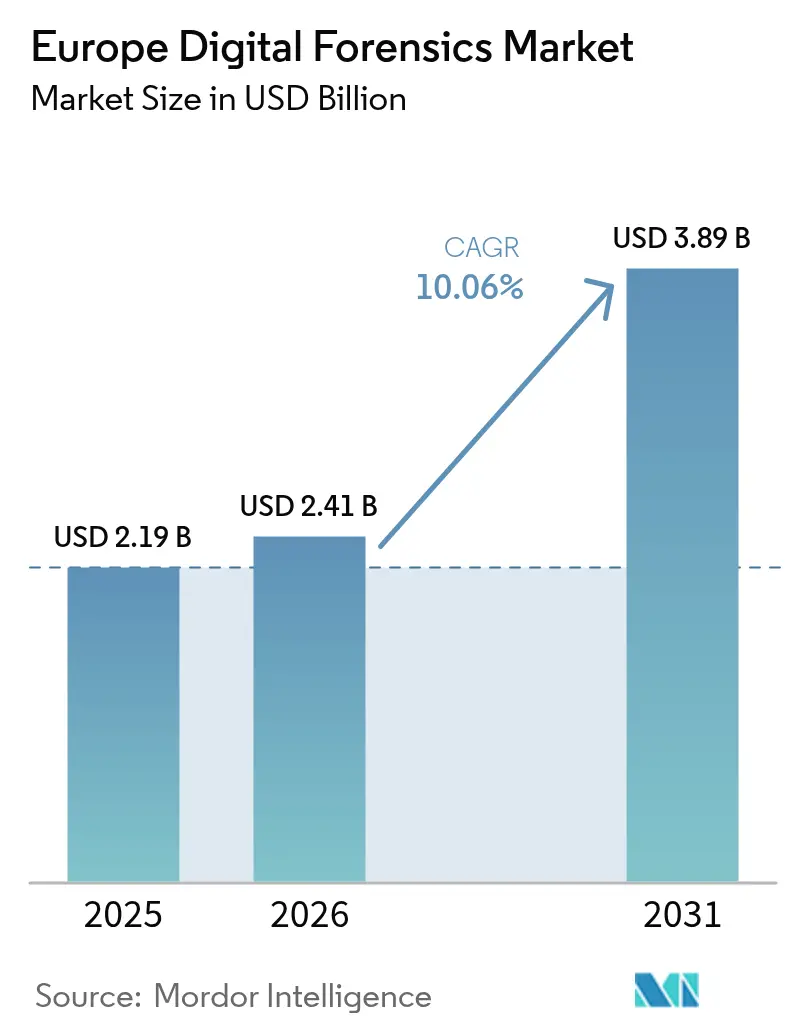
| Base Year Market Size (2025) | USD 2.19 Billion |
| Market Size (2026) | USD 2.41 Billion |
| Market Size (2031) | USD 3.89 Billion |
| Growth Rate (2026 - 2031) | 10.06 % |
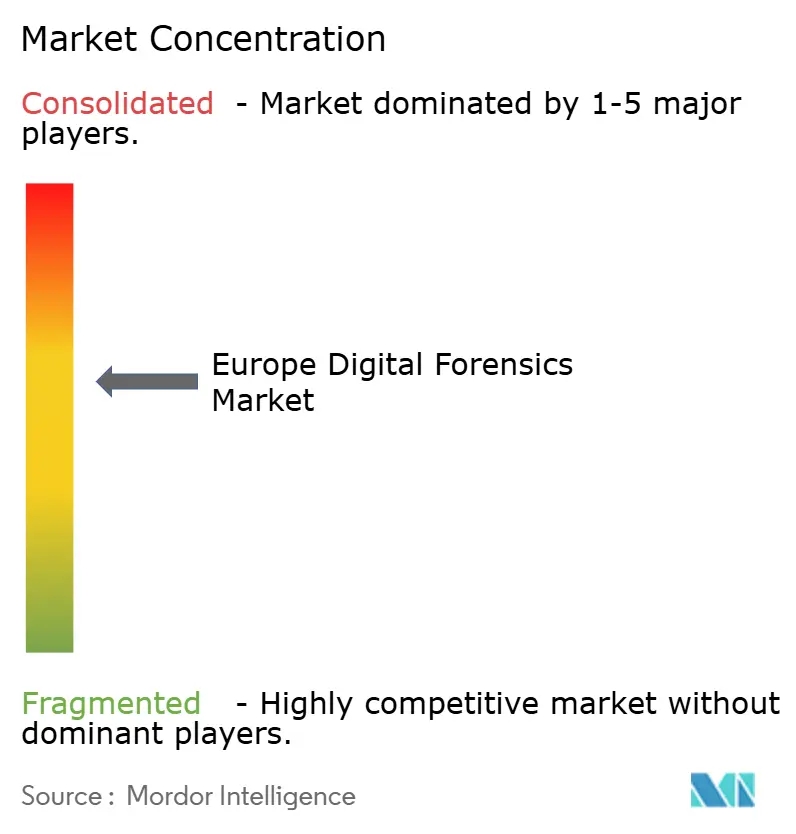
| Market Concentration | Medium |
Major Players *Disclaimer: Major Players sorted in no particular order Image © Mordor Intelligence. Reuse requires attribution under CC BY 4.0. | |
Europe Digital Forensics Market Analysis by Mordor Intelligence
The Europe digital forensics market size was valued at USD 2.19 billion in 2025 and estimated to grow from USD 2.41 billion in 2026 to reach USD 3.89 billion by 2031, at a CAGR of 10.06% during the forecast period (2026-2031). Consistent public-sector funding, tighter resilience rules such as the Digital Operational Resilience Act, and rising cross-border cybercrime keep spending on investigation platforms high.[1] Technology refresh cycles are shortening as AI analytics, cloud evidence capture, and automated case management replace legacy point tools, prompting vendors to pursue subscription models and managed offerings. Heightened ransomware activity across DACH, Benelux, and Nordic banking clusters forces enterprises to embed forensic readiness in incident-response playbooks. Venture funding for smart-vehicle and 5G security startups accelerates demand for new data-capture probes focused on in-vehicle systems and high-traffic edge nodes.
Key Report Takeaways
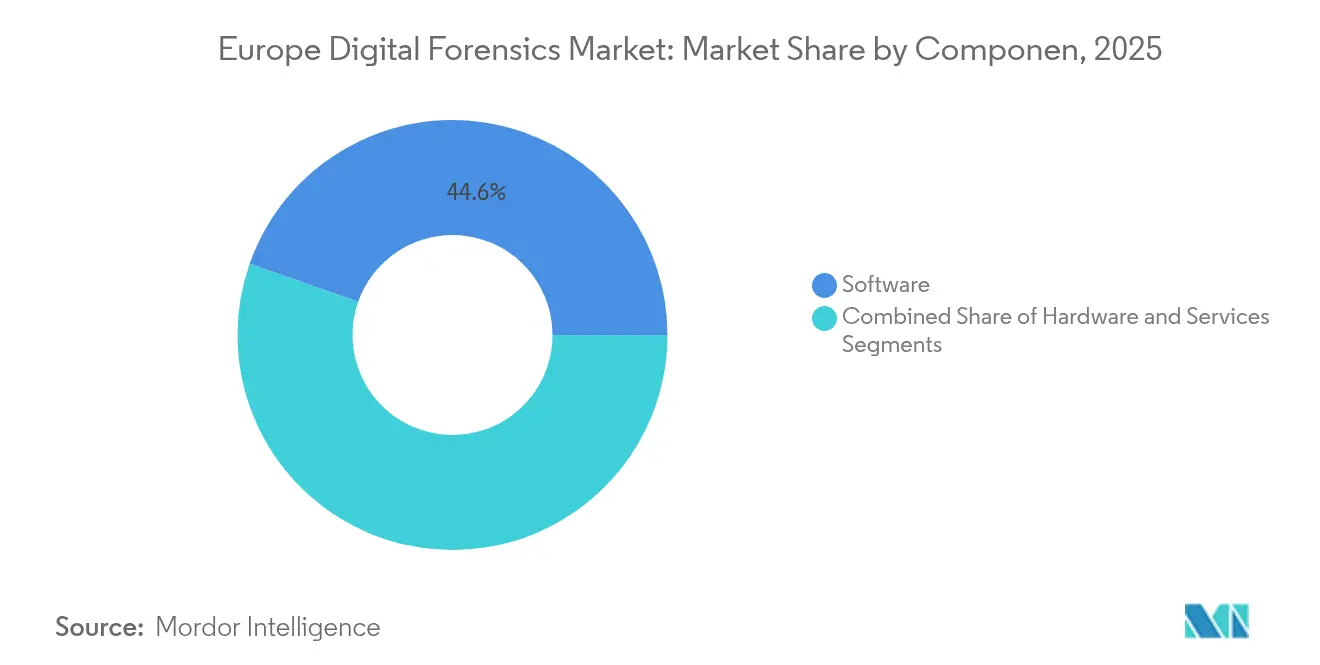
- By component, software retained 44.62% of the Europe digital forensics market share in 2025, while services are tracking the highest CAGR at 11.01% through 2031.
- By type, mobile device forensics led with 34.58% revenue share in 2025; cloud forensics is projected to expand at an 11.23% CAGR to 2031.
- By tool, data acquisition and preservation represented 31.47% of the Europe digital forensics market size in 2025, whereas forensic data analytics posts a 10.78% CAGR through 2031.
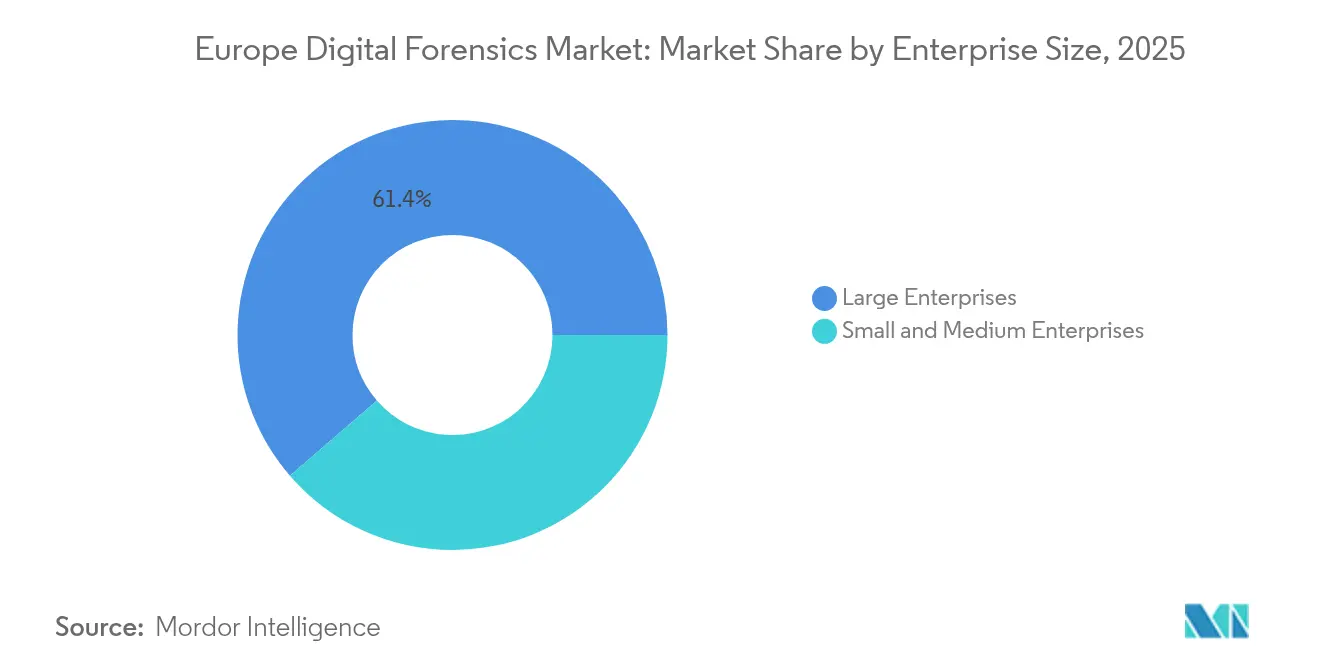
- By enterprise size, large enterprises commanded 61.35% share in 2025, but the SME segment is growing fastest at 10.55% CAGR to 2031.
- By end-user, government and law enforcement held 57.42% share in 2025; the BFSI sector records the strongest 11.33% CAGR on the back of DORA compliance.
- By geography, the United Kingdom captured 21.76% of the Europe digital forensics market in 2025, while Poland shows the quickest 10.74% CAGR through 2031.
Note: Market size and forecast figures in this report are generated using Mordor Intelligence’s proprietary estimation framework, updated with the latest available data and insights as of 2026.
Market Trends and Insights
Drivers Impact Analysis of Europe Digital Forensics Market*
| Driver | (~) % Impact on CAGR Forecast | Geographic Relevance | Impact Timeline |
|---|---|---|---|
| EU DORA & NIS2 Compliance Accelerating Forensic Readiness | +2.8% | EU-wide, strongest in financial hubs | Medium term (2-4 years) |
| Proliferation of Encrypted Messaging Apps Boosting Mobile Forensics Demand | +2.1% | Global, concentrated in Western Europe | Short term (≤ 2 years) |
| Spike in Ransomware Incidents Across DACH & Benelux Elevating Incident-Response Forensics | +1.9% | DACH & Benelux, spillover to Nordic | Short term (≤ 2 years) |
| Connected-Vehicle Growth Creating New Vehicle/IoT Forensics Workloads | +1.6% | EU-wide, early adoption in Germany & Nordic | Long term (≥ 4 years) |
| 5G Roll-out Driving AI-based Network Forensics Investments | +1.4% | Advanced markets: UK, Germany, Nordic | Medium term (2-4 years) |
| Source: Mordor Intelligence | |||
EU DORA & NIS2 Compliance Accelerating Forensic Readiness
Since 17 January 2025, financial entities across the bloc must prove continuous monitoring, incident logging, and third-party oversight, turning forensic readiness from an optional add-on into a regulatory baseline. Supervisors now audit registers of ICT providers, so banks procure enterprise-wide evidence repositories that plug directly into SIEM stacks and automate breach notification. Harmonisation with NIS2 extends similar obligations to energy utilities and digital service providers, widening the European digital forensics market beyond core finance. Budget reallocations favour multi-tenant cloud platforms offering chain-of-custody validation, which lifts recurring revenue for software vendors.
Proliferation of Encrypted Messaging Apps Boosting Mobile Forensics Demand
End-to-end encryption in iOS 18 and disappearing-message defaults push investigators toward advanced bypass techniques that combine logical extraction, backup parsing, and AI pattern matching. Research shows 83.33% of deleted WhatsApp messages remain recoverable through notification artefacts when sophisticated tooling is used.[2]Greater technical complexity makes professional services indispensable, fuelling the services segment’s double-digit growth trajectory.
Spike in Ransomware Incidents Across DACH & Benelux Elevating Incident-Response Forensics
Germany logged 330,000 cybercrime cases in 2024 with EUR 178.6 billion (USD 190.8 billion) in losses, pushing insurers and regulators to request full post-event forensics within hours. [3] Municipal breaches such as Anhalt-Bitterfeld’s 2021 shutdown continue to influence the procurement of automated triage tools that shrink containment times. DDoS-for-hire services lower entry barriers, so organisations invest in cloud capture appliances capable of petabit traffic inspection to reconstruct attack timelines.
Connected-Vehicle Growth Creating New Vehicle/IoT Forensics Workloads
EU Regulation 155, mandatory for all new cars from July 2024, forces OEMs to keep tamper-resistant logs, giving rise to purpose-built probes that interface with CAN, LIN, and Automotive Ethernet buses. Academic frameworks such as CFPEA secure evidence hand-off between roadside units and cloud vaults, reducing chain-of-custody risk. Insurers and fleet operators now outsource periodic vehicle forensics audits, opening white-space for niche service boutiques.
Restraints Impact Analysis of Europe Digital Forensics Market*
| Restraint | (~) % Impact on CAGR Forecast | Geographic Relevance | Impact Timeline |
|---|---|---|---|
| GDPR Privacy Limits on Evidence Acquisition | -1.8% | EU-wide, strictest in Germany & Nordic | Long term (≥ 4 years) |
| End-to-End Encryption Increasing Investigation Time & Cost | -1.4% | Global, concentrated in privacy-conscious markets | Medium term (2-4 years) |
| Fragmented Police Procurement Budgets Slowing Adoption | -1.2% | National level, varying by country budget cycles | Medium term (2-4 years) |
| Shortage of ISO/IEC 17025-Accredited Labs in Europe | -0.9% | EU-wide, acute in smaller jurisdictions | Long term (≥ 4 years) |
| Source: Mordor Intelligence | |||
GDPR Privacy Limits on Evidence Acquisition
Privacy Impact Assessments now accompany most large-scale forensic cases, lengthening engagement cycles and pushing smaller labs to defer complex cross-border work. National differences in supervisory interpretation mean evidence gathered legally in one state may face challenge in another, adding legal-review overhead. Investment is shifting toward selective-collection software that can hash and flag personally identifiable data instead of extracting entire disk images, aligning practice with data-minimisation rules.
End-to-End Encryption Increasing Investigation Time & Cost
Policy debates over lawful access remain unresolved; meanwhile, forensic teams spend more budget on FPGA-based accelerated cracking rigs and specialist SaaS decryption platforms. Smaller providers struggle to amortise these capital costs, raising barriers to entry and reinforcing vendor consolidation dynamics. Regulators such as the UK are examining technical backdoor proposals, but uncertainty keeps procurement focused on advanced brute-force and metadata-correlation tools.
*Our forecasts treat driver/restraint impacts as directional, not additive. The impact forecasts reflect baseline growth, mix effects, and variable interactions.
Europe Digital Forensics Market Segment Analysis
By Component:
Services Drive Market TransformationSoftware retains the dominant 44.62% slice of the European digital forensics market in 2025, thanks to scaled subscription pricing and continuous feature updates covering mobile, cloud, and SaaS artefact parsing. Hardware spend slows as acquisition tasks shift into virtual machines, yet proprietary dongles for chip-off extraction and high-speed write-blockers stay necessary for severe criminal investigations. Overall, a service-centric operating model positions providers to capture expansion budgets while protecting customers from skills shortages.
Services recorded the quickest 11.01% CAGR between 2026-2031 as corporates outsource complex evidence collection to specialised teams that operate remote labs and on-demand analytics. Large financial institutions sign multi-year managed forensics contracts that embed consultants during resilience-testing cycles mandated by DORA.Vendors differentiate through court-ready documentation workflows and API integrations with e-discovery suites, reducing hand-off friction for legal counsel

By Type:
Mobile Device Forensics Leads Market EvolutionMobile platforms captured 34.58% of the Europe digital forensics market size in 2025, reflecting smartphone ubiquity across personal and enterprise workflows. Investigators focus on encrypted chat artefacts, sensor fusion data, and artefact timeline stitching to recreate user journeys. Companion wearables add another evidence layer, further cementing handset analysis as a foundational discipline.
Cloud forensics grows at 11.23% CAGR as multi-tenant SaaS moves key evidence off-premise. Providers now supply snapshot tooling that freezes virtual instances and automates jurisdiction mapping to maintain legal validity. Computer forensics share declines, though endpoint artefacts still anchor insider-threat and fraud probes. Emergent vehicle and IoT evidence types spur integrated platforms able to stitch log data from ECUs, smart sensors, and central clouds in a single case file.
By Tool:
Data Analytics Transforms Investigation CapabilitiesData acquisition and preservation solutions held 31.47% of the Europe digital forensics market share in 2025 because chain-of-custody integrity starts at the point of capture. Imaging products now trigger automatic SHA-512 hashing and evidence-locker synchronisation to support courtroom validation standards.
Forensic data analytics posts a 10.78% CAGR as machine-learning engines correlate chat, location, and financial artefacts within minutes, collapsing manual review cycles. Review-and-reporting tools evolve to enable multi-jurisdiction case teams to annotate artefacts simultaneously, embedding audit trails. Decryption tool spending rises, but growth remains niche given ongoing regulatory debate around lawful-access mandates.
By Enterprise Size:
SMEs Accelerate Digital Forensics AdoptionLarge enterprises still account for the bulk of spend, yet SMEs add the most new customers with a 10.55% CAGR through 2031. EU legislation assigns identical incident-reporting duties to smaller firms, compelling them to adopt affordable SaaS forensic suites that bundle automated playbooks and regulatory templates. National grant programs offset compliance costs, boosting vendor pipeline activity in manufacturing, retail, and professional services verticals.
The Europe digital forensics market sees community colleges and regional chambers launch micro-credential courses to close skill gaps exposed by SME adoption. Managed-security providers partner with boutique forensic labs to deliver tier-2 support, ensuring investigators can escalate complex artefact analysis without full-time staff. Over time, SME uptake expands addressable revenue while diversifying incident datasets used to train AI engines.
By End-user Industry:
BFSI Sector Drives Rapid GrowthGovernment and law-enforcement agencies commanded 57.42% of 2025 revenue, yet the BFSI domain grows fastest at 11.33% CAGR as supervisors tie operational-resilience scoring to forensic maturity. Banks deploy centralised evidence lakes feeding automated risk dashboards that translate technical artefacts into monetary impact visuals for boards.
Telecom operators upgrade lawful-intercept gateways to ingest 5G slice logs, while healthcare systems invest in immutable audit chains to safeguard patient confidentiality. Energy utilities pilot forensic collectors on SCADA networks to satisfy NIS2, and e-commerce portals integrate payment-fraud evidence capture to accelerate charge-back disputes. Diversified sectoral adoption embeds the Europe digital forensics market deeply across the real economy.
Geography Analysis
United Kingdom Digital Forensics Market
The United Kingdom retained its 21.76% leadership position in 2025, supported by a cybersecurity sector that generated GBP 13.2 billion (USD 16.7 billion) in revenue and exported GBP 7.2 billion (USD 9.1 billion) in services. Active policy work on a Cyber Security and Resilience Bill and a public stance against synthetic-media abuses spur further investment in forensic deepfake-analysis tools. Capital continues to flow into safety-tech vendors, reinforcing the nation’s innovation cluster.
Germany and France Digital Forensics Market
Germany stands as the largest single continental market after reporting EUR 178.6 billion (USD 190.8 billion) in cybercrime damages during 2024. Federal initiatives to expand ISO/IEC 17025-accredited labs and Fraunhofer training programs strengthen the professional talent pipeline. France benefits from its EUR 1 billion (USD 1.1 billion) cybersecurity fund under France 2030, with EUR 39 million (USD 41.7 million) allocated to 17 targeted projects that include next-generation forensics.
Poland and Nordics Digital Forensics Market
Poland records the fastest 10.74% CAGR on the back of USD 2.5 billion in governmental cyber programs and the EU’s highest 32% incident rate among firms. Nordic collaboration tightens after large-scale DDoS attacks, with Norway forecasting a USD 20.65 million market by 2029 at 10.07% growth. Denmark’s Digital Growth Strategy and Norway’s Data Economy study underscore shared recognition that digital-evidence management is critical to economic sovereignty
Regulatory Landscape
Europe's digital forensics regulatory environment is being shaped by EU-wide cross-border evidence access rules alongside sectoral resilience requirements. Regulation (EU) 2023/1543 and Directive (EU) 2023/1544 (the EU e-Evidence package) introduce European Production and Preservation Orders, and require in-scope service providers to designate an EU establishment or appoint a legal representative. The regulation becomes applicable on 18 August 2026, and Member States are required to transpose the directive by 18 February 2026. Alongside this, the Digital Operational Resilience Act (DORA) has already pushed forensic readiness into mainstream compliance for financial entities from January 2025 via tighter obligations for logging, testing, and third-party oversight.
Rules governing the tools and methods used in investigations are also tightening around AI and connected-device security. The EU AI Act (Regulation (EU) 2024/1689) adds governance expectations for high-risk AI systems used in law enforcement contexts, reinforcing the need for traceable, auditable analytics within forensic workflows. The Cyber Resilience Act (Regulation (EU) 2024/2847) raises baseline cybersecurity requirements for products with digital elements, which affects how evidence is generated and preserved from IoT and embedded devices. Standards-based handling remains central for evidential integrity, with European practice referencing guidance such as ISO/IEC 27037 for identification, collection, and preservation of digital evidence.
Value Chain Analysis
The Europe digital forensics value chain begins with evidence sources across endpoints, mobile devices, cloud/SaaS workloads, network telemetry, and emerging IoT and connected-vehicle logs. It then progresses through acquisition and preservation (imaging, write-blocking, hashing, secure upload), processing and analytics (parsing, correlation, decryption support), and review and reporting for courts, regulators, and internal governance. Vendors supply software platforms and specialized hardware, while service providers deliver incident-response forensics, lab operations, expert testimony support, and managed forensic readiness. Buyers include government and law enforcement agencies as well as regulated industries such as BFSI, where DORA-linked auditability and reporting increase demand for integrated case management and evidence repositories.
Cross-border evidence exchange requirements and EU capability-building efforts are reshaping integration points across the chain. The e-Evidence framework pushes service providers to operationalize preservation and production workflows through designated establishments or legal representatives by 18 August 2026, which raises emphasis on standardized interfaces, jurisdiction mapping, and provable chain-of-custody across borders. EU-sponsored programs are also feeding the solution pipeline, including the SALUS Horizon-funded project developing IoT forensic solutions, digital twins, and AI-driven toolkits with testing in nuclear and hospital facility environments, showing how R&D work translates into new acquisition and analysis capabilities. A High-Level Group on access to data for law enforcement has also pointed to interoperability gaps and concerns around opaque, "black box" tools, reinforcing value-chain pressure for evaluation, certification, and tool-sharing mechanisms that support more verifiable outcomes.
Competitive Landscape
The Europe digital forensics market remains moderately concentrated; the top five vendors collectively control about 48% of revenue, leaving room for specialised entrants. Cellebrite grew annual recurring revenue by 26% to USD 346 million in 2024, driven by AI modules that compress case review from months to weeks. The firm’s push for FedRAMP authorisation signals strategic alignment with sovereign-cloud mandates in defence and public-safety segments.
Emerging academic spinouts such as the University of Winchester’s “Spidernet” illustrate how research labs commercialise cloud-scale mapping algorithms that track digital “DNA” across smart-device ecosystems. Niche startups focus on IoV log harvesters and quantum-resistant evidence lockers, exploiting product gaps in incumbent suites. Established integrators partner with telco operators to insert lawful-intercept probes at the 5G edge, expanding managed-service addressable revenue.
M&A activity revolves around talent acquisition and cross-border expansion. Vendors buy boutique labs in Poland and the Baltic to secure low-cost analyst benches and local language expertise. Strategic alliances with legal-technology providers help convert forensic artefacts directly into e-discovery deliverables, positioning suppliers as end-to-end litigation-support partners. Overall, innovation velocity and regulatory complexity dictate that competitive advantage hinges on continuous R&D and compliance alignment.
Europe Digital Forensics Industry Leaders
-
MSAB AB
-
LogRhythm Inc.
-
IBM Corporation
-
PricewaterhouseCoopers LLP
-
Nuix Ltd.
- *Disclaimer: Major Players sorted in no particular order
Europe Digital Forensics Market Companies Covered in this Report
- MSAB AB
- LogRhythm Inc.
- IBM Corporation
- PricewaterhouseCoopers LLP
- Nuix Ltd.
- Cellebrite DI Ltd.
- Magnet Forensics Inc.
- OpenText Corp. (Guidance Software)
- FireEye Inc. (Trellix)
- Envista Forensics
- Cellebrite (Digital Intelligence)
- ADF Solutions LLC
- AccessData (Exterro)
- Oxygen Forensics Inc.
- Paraben Corp.
- BAE Systems Applied Intelligence
- Atos SE (Evidian)
- Sytech Digital Forensics
- CCL Solutions Group Ltd.
- Evidence Talks Ltd.
Market Opportunities and Future Outlook
A near-term commercialization window is emerging around operationalizing the EU e-Evidence package across investigations involving cloud providers, platforms, and cross-border data holdings. Regulation (EU) 2023/1543 applies from 18 August 2026 and enables cross-border electronic evidence access through European Production and Preservation Orders, while accelerated timelines are referenced for emergencies. Directive (EU) 2023/1544 also requires national implementation by 18 February 2026, which creates concrete procurement and integration needs for evidence-preservation workflows, provider response tooling, and audit-ready chain-of-custody at scale. Vendors that bundle legal-representative support, standardized request handling, and secure evidence transfer into their platforms can differentiate as service providers and investigators align processes across member states.
Opportunities also center on convergence between CSIRTs, SOCs, and law-enforcement workflows, particularly in regulated sectors where forensic readiness is moving into day-to-day operations. ENISA publications on electronic evidence, together with ENISA Threat Landscape coverage through mid-2025, support continued prioritization of tools that combine endpoint, cloud, and network artifacts into a single case record. This is pulling demand toward SIEM-integrated evidence repositories, cloud-native capture and snapshot tooling, and selective-collection capabilities that help teams operate within GDPR data-minimization constraints. A further whitespace area involves verifiable AI in forensics, since the EU AI Act raises governance requirements around accuracy and transparency for certain law-enforcement uses, encouraging procurement of explainable analytics, reproducible processing pipelines, and defensible reporting that can be used across jurisdictions.
Recent Industry Developments in Europe Digital Forensics Market
- July 2026: LogRhythm released a SIEM platform update focused on accelerating investigations and expanding visibility across monitored environments. The release supports faster triage and deeper log correlation, which feeds directly into forensic timelines and case reconstruction for enterprise and public-sector SOCs.
- October 2025: MSAB secured a contract worth SEK 11.2 million with a UK law enforcement agency covering software license renewals (XRY, XAMN, XEC) and support. The renewal highlights continued public-safety investment in mobile extraction and analysis workflows and reinforces recurring revenue models in the region.
- July 2024: IBM won a five-year contract with USD 26 million in initial funding from USAID to support the Cybersecurity Protection and Response program in Europe and Eurasia. The program investment expands incident response capacity and increases demand for investigation tooling and services that can operate across multiple countries and stakeholders.
Europe Digital Forensics Market Report Scope and Research Methodology
Market Definition and Coverage
For this methodology, the Europe digital forensics market covers tools and services used to acquire, preserve, analyze, and report electronic evidence from endpoints, mobiles, networks, and cloud sources for investigations and response work across Europe.
Scope exclusions: This sizing excludes broader cybersecurity software that is not primarily used for forensic evidence handling, and it also excludes general IT consulting that does not deliver a forensics outcome.
Segments Covered in This Report
- By Component
- Hardware
- Software
- Services
- By Type
- Computer Forensics
- Mobile Device Forensics
- Network Forensics
- Cloud Forensics
- Database Forensics
- IoT and Embedded Device Forensics
- By Tool
- Data Acquisition and Preservation
- Data Recovery and Reconstruction
- Forensic Data Analysis
- Review and Reporting
- Forensic Decryption and Password Cracking
- By Enterprise Size
- Large Enterprises
- Small and Medium Enterprises
- By End-user Industry
- Government and Law Enforcement Agencies
- BFSI
- IT and Telecom
- Healthcare
- Retail and E-commerce
- Energy and Utilities
- Manufacturing
- Transportation and Logistics
- Defense and Aerospace
- Education
- By Country
- United Kingdom
- Germany
- France
- Italy
- Spain
- Nordics
- Rest of Europe
Data Sources, Market Sizing, and Validation
Desk Research
Desk research was first used to set a practical Europe-level demand picture and keep definitions consistent across countries. We reviewed public crime and cybercrime statistics, including Eurostat and relevant national statistics offices, and we checked incident and threat reporting from official cybersecurity agencies (for example, ENISA and country-level CERT publications).
To link demand signals to spending, we scanned public procurement portals and award notices, plus regulatory and policy documents that shape evidence handling and reporting in the region. Company annual reports, investor presentations, and reputable press were used to understand product positioning and the portion of forensics within larger security portfolios. In a few cases, paid subscriptions for company financials, patent intelligence, and contract and tender tracking were used to cross-check timelines and revenue exposure. These desk sources are illustrative only, and many other public and internal reference points were also used for data collection, clarification, and validation.
Primary Interviews and Surveys
We interview European law enforcement, forensic laboratories, cybersecurity teams, service providers, and technology buyers. Expert discussions and surveys test secondary findings, clarify software and service pricing, identify workload gaps, and validate assumptions across large, mid-sized, and smaller organizations.
Distribution of primary research fieldwork respondents
| Company type | Respondent position |
|---|---|
| Top tier: 30% | CXOs: 15% |
| Mid tier: 50% | Functional/Unit leaders: 30% |
| Smaller Players: 20% | Managers: 55% |
Market-Sizing & Forecasting
Sizing starts with a top-down build where cybercrime activity, reportable incident levels, and investigation workload signals are translated into an addressable spending pool for forensic evidence acquisition and analysis across Europe. That demand pool is then adjusted using country-level cues that move budgets up or down, such as public-sector modernization programs, enforcement intensity, and cloud adoption that changes the mix of evidence sources.
To keep the totals realistic, the model is corroborated with selective bottom-up checks, including sampled price-per-case or license-and-seat assumptions, channel checks on typical package structures, and a light roll-up of supplier exposure where disclosures allow it. When a bottom-up input is missing for a country or buyer group, we use proxy ranges anchored to similar markets and then re-check those ranges in follow-up calls.
Forecasts are built using scenario analysis supported by a multivariate view of leading indicators that practitioners agreed matter most, such as digital device penetration, enterprise cloud workload migration, incident response retainer uptake, and expected changes in chain-of-custody and evidence retention requirements. Assumptions are kept transparent so they can be re-run quickly when a regulation, funding cycle, or major breach changes the near-term path.
Data Validation & Update Cycle
Validation is done in layers so the final number is not dependent on a single source type. Analysts compare outputs against independent signals, such as procurement momentum, public cyber incident reporting, and observed pricing movement, and then investigate any large variance by country or buyer group before sign-off.
If an anomaly persists, respondents are re-contacted to confirm whether it is a real shift (for example, a policy-driven funding change) or a modeling artifact. The report is refreshed annually, and interim updates are triggered when material events occur, such as major regulatory changes or large public funding announcements. Before delivery, a final analyst pass is completed so clients receive the most current view available at that time.
Mordor Intelligence's Europe Digital Forensics Market Size Measured Against Other Published Estimates
Published values for Europe digital forensics often differ because the counted spend can shift depending on what is treated as forensics versus adjacent security work, and because base-year choices and currency timing vary across studies. Differences also show up when some estimates lean on broad supplier revenues, even when forensics is only one part of a larger portfolio.
Some published figures fold incident response, e-discovery, or general cybersecurity operations into the same bucket, which pushes totals up quickly. In the Mordor Intelligence approach, only spending tied to forensic evidence acquisition, preservation, analysis, and reporting is counted, and mixed contracts are split so non-forensics work is not double-counted.
Benchmark comparison
| Source | Market Size | Gaps in Research Methodology |
|---|---|---|
| Mordor Intelligence | USD 2.41 B (2026) | |
| Industry Publisher A | USD 2.23 B (2025) | Uses an earlier base year and may apply different currency conversion timing, and it can also treat broader evidence-management and related services as part of the same spend pool. |
| Global Consultancy B | USD 3.10 B (2026) | Appears to include a wider bundle that can capture incident response and e-discovery style services, and it may rely more on broad supplier scope rather than buyer-side demand signals and contract-level splits. |
Across the three figures, the spread is mainly explained by scope packaging and how mixed service bundles are handled, followed by base-year and currency timing choices. Our model stays traceable to casework demand signals and procurement reality, which makes it easier to reproduce and to update when country policies or buying cycles change.
Key Questions Answered in the Report
What is the current size of the Europe digital forensics market?
The market is valued at USD 2.41 billion in 2026 and is projected to hit USD 3.89 billion by 2031 at a 10.06% CAGR.
Which component is growing fastest?
Services grow at 11.01% CAGR as organisations outsource complex evidence collection and analysis tasks.
Why is the BFSI sector investing heavily in digital forensics?
The Digital Operational Resilience Act mandates continuous incident logging and resilience testing, driving 11.33% CAGR spending within banks and insurers.
How does GDPR affect forensic investigations?
GDPR imposes strict data-minimisation rules and mandatory privacy assessments, adding cost and time to evidence acquisition.
Which geography shows the fastest growth?
Poland leads with a 10.74% CAGR due to high incident rates and USD 2.5 billion in government cyber investments.
What emerging technology will reshape forensic tools?
AI-driven analytics that correlate multi-source artefacts in real time are reducing investigation timelines and enabling proactive threat-hunting across 5G and cloud environments.