
Market Overview
| Study Period | 2020 - 2031 |
|---|---|
| Forecast Data Period | 2026 - 2031 |
| Base Year Market Size (2025) | USD 28.80 Billion |
| Market Size (2026) | USD 30.37 Billion |
| Market Size (2031) | USD 39.61 Billion |
| Growth Rate (2026 - 2031) | 5.45 % |
| Market Concentration | Low |
Major Players *Disclaimer: Major Players sorted in no particular order Image © Mordor Intelligence. Reuse requires attribution under CC BY 4.0. | |
Europe Customs Brokerage Market Analysis by Mordor Intelligence
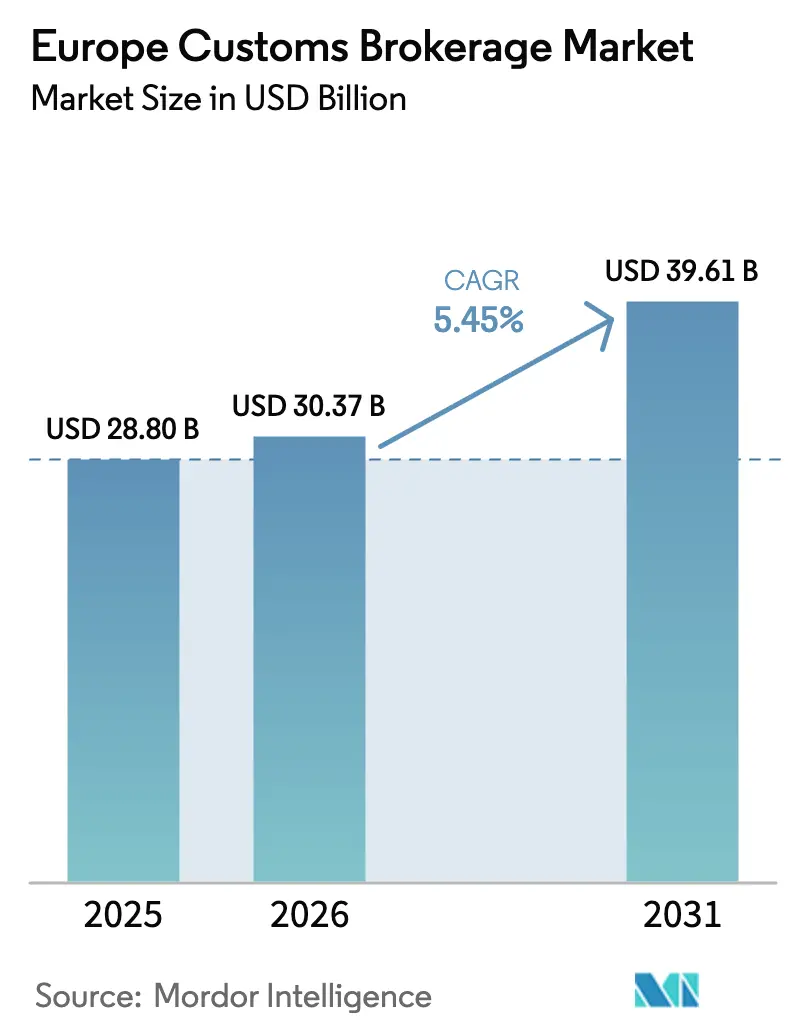
The Europe Customs Brokerage Market size was valued at USD 28.80 billion in 2025 and estimated to grow from USD 30.37 billion in 2026 to reach USD 39.61 billion by 2031, at a CAGR of 5.45% during the forecast period (2026-2031).
The expansion stems from the post-Brexit surge in customs declarations, e-commerce’s escalating low-value import volumes, and the European Union’s Customs Reform 2028 data-hub program, which is automating real-time risk analysis. Integrated freight forwarders are accelerating acquisitions to capture scale benefits, while traditional brokerages upgrade digital capabilities to defend share. The adaptive response of brokers to new Import One-Stop Shop (IOSS) rules, dual-use export-control audits, and AI-based HS-code tools is reshaping service portfolios. Geographically, Germany’s manufacturing core and Poland’s near-shoring momentum anchor short-term opportunities, whereas pan-EU API connectivity promises long-term efficiency gains. Across these dynamics, the Europe customs brokerage market continues to pivot from paper-centric clearance toward data-centric compliance.
Key Report Takeaways
- By mode of transport, ocean/sea led with 41.55% revenue share in 2025; cross-border land is projected to expand at a 4.62% CAGR through 2031.
- By broker type, freight forwarder/3PL-integrated brokers held 50.40% of the Europe customs brokerage market share in 2025, whereas traditional brokerages are advancing at a 5.12% CAGR to 2031.
- By importer size, large enterprises accounted for 38.45% share of the Europe customs brokerage market size in 2025, and mid-market is forecast to grow at 3.98% CAGR between 2026-2031.
- By end-use industry, retail and e-commerce captured 22.70% share in 2025 while automotive and EV segment is poised to register a 4.92% CAGR through 2031.
- By geography, Germany commanded 20.65% share of the Europe customs brokerage market size in 2025, with Poland anticipated to expand at 4.55% CAGR to 2031.
Note: Market size and forecast figures in this report are generated using Mordor Intelligence’s proprietary estimation framework, updated with the latest available data and insights as of 2026.
Market Trends and Insights
Drivers Impact Analysis of Europe Customs Brokerage Market*
| Driver | % Impact on CAGR Forecast | Geographic Relevance | Impact Timeline |
|---|---|---|---|
| Post-Brexit surge in customs declarations | +1.2% | UK, Ireland, Netherlands, Belgium | Short term (≤ 2 years) |
| E-commerce-driven rise in low-value import clearances | +0.8% | Global, with concentration in Germany, Netherlands, France | Medium term (2-4 years) |
| EU Customs Reform 2028 data-hub roll-out | +1.1% | EU27, with early adoption in Netherlands, Germany | Long term (≥ 4 years) |
| AI-based HS-code classification adoption | +0.9% | Global, led by Netherlands, Germany, UK | Medium term (2-4 years) |
| Near-shoring to Eastern Europe boosting cross-border volumes | +1.0% | Poland, Romania, Czech Republic, with spillover to Germany | Medium term (2-4 years) |
| Tightening dual-use export-control compliance | +0.7% | EU27, UK, with focus on technology hubs | Long term (≥ 4 years) |
| Source: Mordor Intelligence | |||
Post-Brexit Surge in Customs Declarations
The United Kingdom’s departure from the EU triggered a multi-fold rise in declaration volumes, driving sustained demand for brokerage expertise. New rules of origin checks, risk-based sanitary controls under the Border Target Operating Model, and Northern Ireland’s Windsor Framework two-lane system have multiplied document touchpoints per shipment[1]. Specialized brokers now package consulting, data validation, and automated audit trails to help traders avoid duty misclassification penalties. Integrated providers are embedding API links to HMRC’s Customs Declaration Service, cutting processing time and reducing manual errors. As UK-EU traffic normalizes, complexity rather than sheer volume will sustain brokerage revenue, ensuring the Europe customs brokerage market continues to rely on human expertise for high-risk commodities.
E-Commerce-Driven Rise in Low-Value Import Clearances
Elimination of the EUR 22 de minimis threshold and the mandatory IOSS regime shifted VAT collection to the point-of-sale, compelling platforms and sellers to integrate customs workflows[2]. Brokers with robust IT interfaces are onboarding marketplaces that ship thousands of daily parcels into Germany and the Netherlands. Parcel operators leverage network reach, yet niche brokers gain share by offering rule-based product classification, dynamic VAT calculation, and automated returns documentation. The Europe customs brokerage market is therefore witnessing intensified competition, with technology literacy overtaking scale as the main differentiator in B2C clearances.
EU Customs Reform 2028 Data-Hub Roll-Out
The EU’s single data-hub platform will consolidate declarations, duties, and risk profiles across member states via standardized APIs. Early pilots in the Netherlands demonstrated multi-country clearance within minutes, prompting brokers to fast-track API investment. Enhanced Authorized Economic Operator (AEO) benefits such as fewer inspections motivate brokers and their clients to adopt higher compliance tiers. Companies offering full-stack e-Customs solutions already position themselves as indispensable partners for traders navigating the pending “customs as a service” environment. Over the long term, platform readiness will determine competitive survival in the Europe customs brokerage market.
AI-Based HS-Code Classification Adoption
Machine-learning models embedded in brokerage platforms are slashing classification errors by double-digit margins, significantly reducing customs holds and post-entry amendments. Major ocean carriers and integrators have rolled out global AI customs tools that suggest optimal duty mitigation paths based on historic trade data. Early adopters integrate sensors and IoT feeds to forecast compliance risks before goods arrive at EU borders, enhancing customer visibility. Smaller independent brokers, while recognizing the productivity upside, face capital constraints that impede full AI deployment. Divergent adoption speeds are widening the capability gap, contributing to consolidation waves in the Europe customs brokerage market.
Restraints Impact Analysis of Europe Customs Brokerage Market*
| Restraint | % Impact on CAGR Forecast | Geographic Relevance | Impact Timeline |
|---|---|---|---|
| Geopolitical trade disruptions in EU border corridors | -0.6% | Eastern EU borders, Middle Corridor routes | Short term (≤ 2 years) |
| EU customs-talent shortages & ageing workforce | -0.5% | Germany, Netherlands, France, with spillover effects | Medium term (2-4 years) |
| Rising IT & automation fee burden on small brokers | -0.4% | Small independent brokers across EU | Medium term (2-4 years) |
| Parcel operators cannibalising low-value clearances | -0.3% | High e-commerce volume countries: Germany, France, UK | Long term (≥ 4 years) |
| Source: Mordor Intelligence | |||
Geopolitical Trade Disruptions in EU Border Corridors
Conflict-driven rerouting from the Northern route to the Middle Corridor has increased transit times and customs congestion at Turkish, Georgian, and Kazakh borders[3]. Brokers face volatile regulatory environments, currency swings, and emerging sanctions checks, which collectively raise processing costs. Automotive and electronics importers in Germany confront uncertainty incompatible with just-in-time norms, thereby dampening shipment volumes. The resulting unpredictability restrains the Europe customs brokerage market’s short-term growth.
EU Customs-Talent Shortages and Ageing Workforce
A sizable share of senior declarants in Germany and the Netherlands are nearing retirement, and training pipelines lag behind regulatory change. Wage inflation for specialized customs knowledge inflates operating costs, particularly for small and mid-sized firms. While automation alleviates repetitive tasks, complex advisory functions still depend on human expertise. This talent gap restrains service capacity in the Europe customs brokerage industry and could slow onboarding of new clients until workforce renewal stabilizes.
*Our forecasts treat driver/restraint impacts as directional, not additive. The impact forecasts reflect baseline growth, mix effects, and variable interactions.
Europe Customs Brokerage Market Segment Analysis
By Mode of Transport:
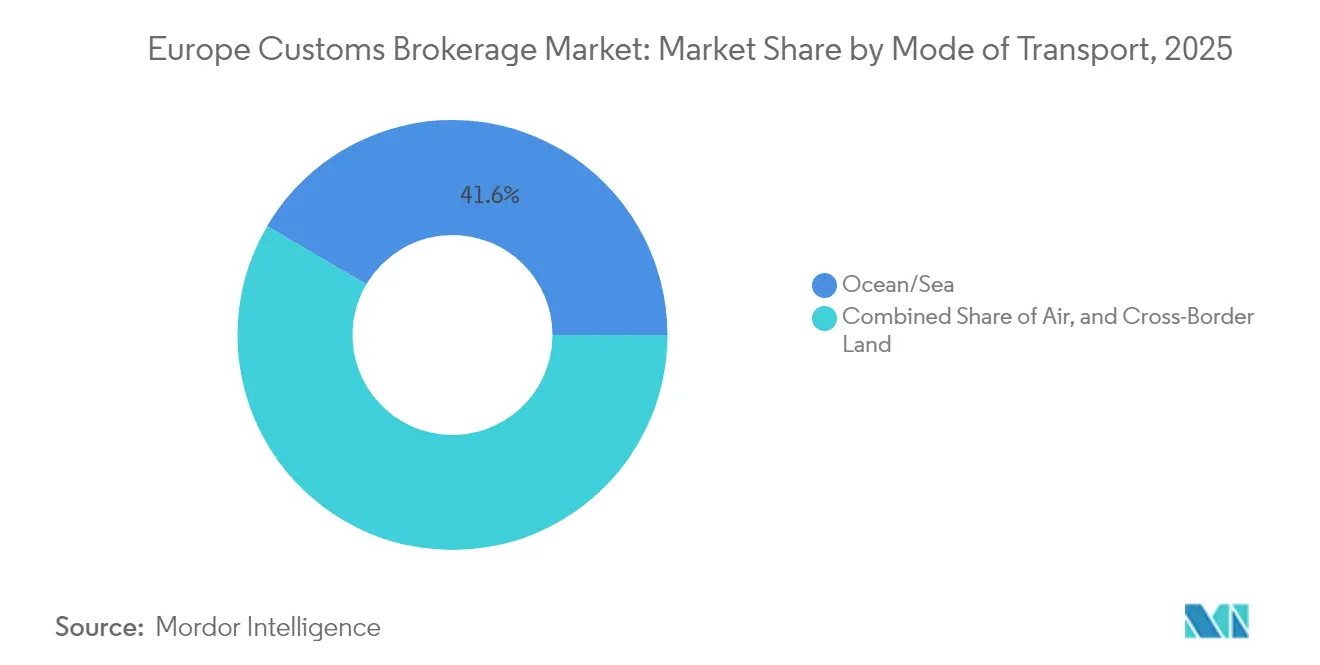
Ocean Commanding, Land AcceleratingOcean/sea services owned 41.55% of the Europe customs brokerage market in 2025, mirroring Europe’s heavy reliance on Asian imports through Rotterdam, Hamburg, and Antwerp. Port-centric brokers generate premium revenue by managing intricate documentation for automotive components, electronics, and industrial machinery. Cross-border land services are forecast to grow at a 4.62% CAGR, benefiting from factory relocations into Poland and Romania that shorten supply routes. Tightened truck security checks and the digitalization of road transit procedures encourage brokers to integrate e-TIR and NCTS-Phase 5 modules, reinforcing land-mode relevance. Over the forecast horizon, Europe customs brokerage market momentum will hinge on synchronized port-to-inland digital corridors that balance sea dominance with growing intra-European trucking flows.

By Broker Type:
Scale vs. SpecialismFreight forwarder/3PL-integrated brokers captured 50.40% of 2025 revenue as shippers gravitated toward single-provider logistics solutions. Their technology budgets, global network reach, and ability to bundle warehousing create formidable entry barriers. Traditional pure brokers defend share through niche expertise in pharmaceutical imports, dual-use goods, and AEO consultancy. The Europe customs brokerage market size for integrated brokers is set to compound at 4.26% CAGR, but pure specialists still attract clients needing tailored compliance. As mega-deals such as DSV’s USD 15.9 billion acquisition of DB Schenker close, competitive intensity will pivot on advisory depth rather than freight capacity.
By Importer Size:
Enterprise Volume, Mid-Market UpsideLarge enterprises drove 38.45% of brokerage revenue in 2025 thanks to complex multi-country supply chains, but mid-market firms are the fastest risers at 3.98% CAGR. ERP-API integrations, dashboard analytics, and duty-optimization audits make brokerage indispensable to mid-cap manufacturers expanding cross-border sourcing. SMEs favor simplified digital portals, yet remain price-sensitive. As EU data-hub standardization lowers procedural friction, mid-market adoption will deepen, broadening the Europe customs brokerage market’s addressable client base.
By Digital Adoption:
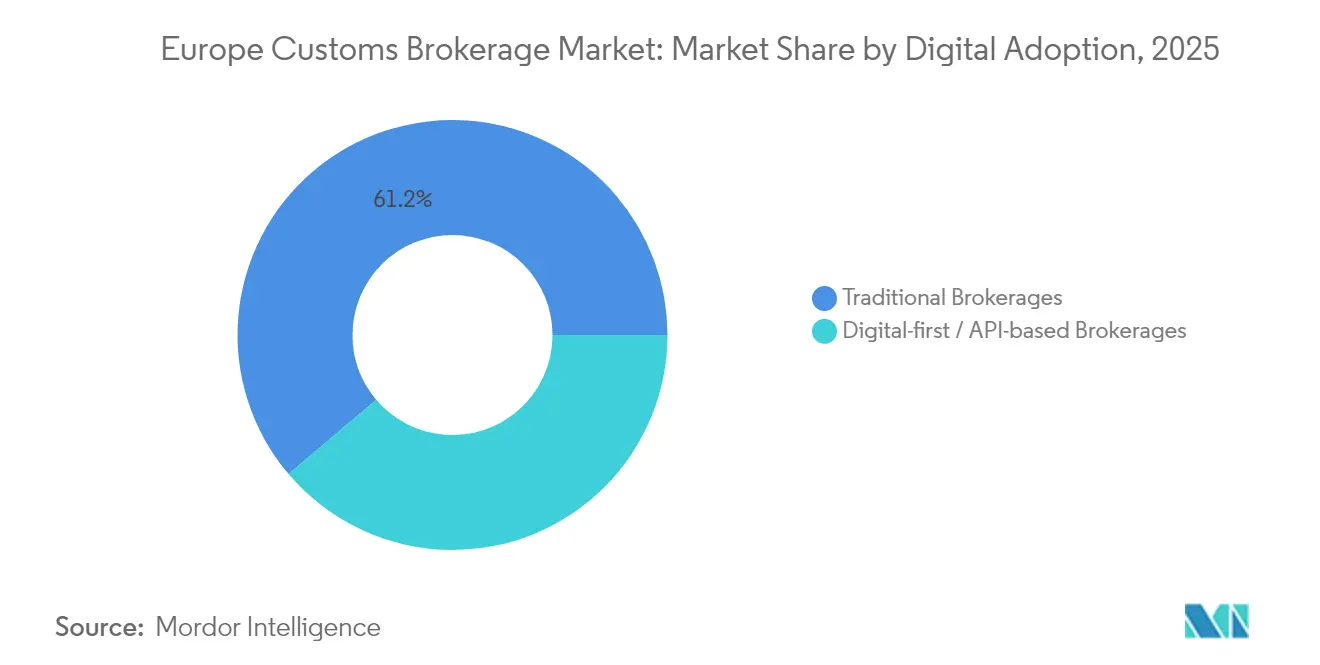
Hybrid Winning FormulaTraditional brokerages still command 61.20% share and post a surprising 5.12% CAGR, illustrating that digital upgrades reinforce not replace relationship-centric models. Investments in automated tariff classification, client-facing portals, and single-window submission tools enhance service speed while preserving human oversight. Digital-first/API-centric providers attract fast-growing e-commerce shippers but struggle with multi-jurisdictional exceptions. The Europe customs brokerage industry therefore prizes a hybrid value proposition that marries cloud automation with regulatory expertise.
By End-User Industry:
Retail Dominant, Automotive SurgingRetail and e-commerce led 2025 revenue at 22.70%, propelled by IOSS compliance, reverse-logistics filings, and rapid-cycle B2C clearances. Automotive and EV shipments are projected to grow 4.92% CAGR as battery rules, origin requirements, and anti-dumping duties on Chinese EVs complicate filing structures. Electronics and semiconductors, pharmaceuticals, and aerospace demand deep regulatory knowledge, ensuring multi-sector resilience for the Europe customs brokerage market.
Geography Analysis
Germany and United Kingdom Customs Brokerage Market
Germany maintained the largest regional footprint with 20.65% market share in 2025, supported by strong manufacturing exports and premier port infrastructure in Hamburg and Bremen. High-value industrial cargoes intensify demand for end-to-end clearance services, and the government’s drive to digitize customs transactions positions Germany as a reference market for technology pilots. The United Kingdom remains a pivotal node; ongoing CHIEF-to-CDS migration obliges brokers to manage dual systems, sustaining advisory revenues.
Broader European Markets
Poland is the fastest-growing geography with a 4.55% CAGR as manufacturers relocate assembly lines closer to Western Europe, boosting truck and rail traffic across Eastern borders. Investments in road-rail intermodal hubs and simplified transit procedures reinforce Poland’s ascent within the Europe customs brokerage market. France and the Netherlands benefit from gateway roles Calais and Rotterdam funnel Asian imports inland while Italy leverages Mediterranean routes for fashion and perishables. Spain capitalizes on Valencia’s port upgrades to serve North African trade lanes. Collectively, these shifts underscore a pan-European pivot toward shorter, digitally-orchestrated supply chains that expand brokerage opportunities beyond legacy hubs.
Regulatory Landscape
The regulatory environment for customs brokerage in Europe is being reshaped by the EU Customs Reform package led by the European Commission (DG TAXUD), with a March 2026 political agreement between the European Parliament and the Council to modernize the Union Customs Code and create a new EU Customs Authority alongside the EU Customs Data Hub. In parallel, the EU Single Window Environment for Customs advances integration of non-customs requirements (licenses and certificates) into electronic declaration flows, raising the compliance and data-orchestration burden on brokers operating across multiple member states.
In 2026, policy actions directly affecting parcel and low-value shipment workflows add near-term operational complexity. DG TAXUD issued guidance in June 2026 on a temporary flat-fee approach for low-value imports applying until 1 July 2028, and in July 2026 adopted amendments to the Union Customs Code Implementing Act to streamline application of non-preferential origin procedures, increasing the importance of consistent proof-of-origin handling and auditable data trails within broker systems.
Value Chain Analysis
The Europe customs brokerage value chain links shippers and importers (including e-commerce sellers and marketplaces) with carriers and freight forwarders, customs brokers (pure-play and 3PL-integrated), and national customs authorities, supported by enabling layers such as trade compliance data providers, software platforms, and bonded facilities at gateways like Rotterdam, Hamburg, and Antwerp. Inputs center on shipment and product master data (HS classification, origin, valuation, licenses/certificates), while service outputs include electronic declarations, duty and VAT calculation, risk-documentation, and post-clearance audit support.
EU Customs Reform adds a structural shift toward centralized data processing via the EU Customs Data Hub and a compliance-tier model (including a Trust and Check approach for highly compliant traders), moving more validation upstream and increasing demand for pre-departure data quality management. As e-commerce actors take on more direct accountability for customs obligations and low-value flows face a new fee framework from 1 July 2026 through 1 July 2028, brokers and integrated logistics providers are strengthening API connectivity, expanding cross-border coverage through acquisitions, and combining clearance with bonded warehousing and returns handling to control end-to-end exception management.
Competitive Landscape
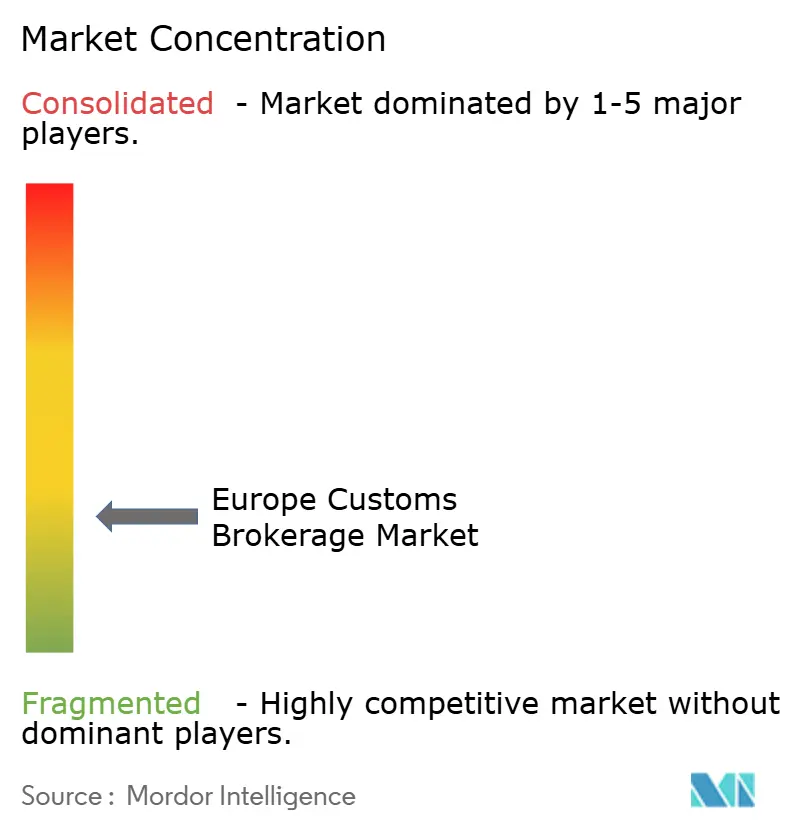
The market is moderately fragmented. The DSV-DB Schenker merger creates the world’s largest freight forwarder, amplifying integrated customs offerings across Europe. Customs Support Group has pursued a bolt-on strategy, adding targeted brokers in Italy, Norway, the UK, and Switzerland to build a pan-regional digital platform. Technology adoption differentiates leaders; firms deploy AI classification engines, IoT-linked risk analytics, and SaaS client dashboards to descend processing times from hours to minutes. Authorized Economic Operator certification further consolidates demand among compliant networks.
Mid-tier specialists focus on high-complexity verticals such as dual-use goods, life-science cold chains, or defense logistics, niches less sensitive to commoditized pricing. API-first challengers penetrate B2C segments by automating low-value clearances, yet struggle to scale human expertise for exception management. Overall, the Europe customs brokerage market gravitates toward hybrids that unify data-driven speed with regulatory mastery. Intensifying capital requirements and talent shortages are likely to accelerate M&A activity through 2030, gradually raising market concentration.
Europe Customs Brokerage Industry Leaders
-
Livingston International
-
DHL Group
-
Kuehne + Nagel
-
Rhenus Logistics
-
Gerlach Customs
- *Disclaimer: Major Players sorted in no particular order
Europe Customs Brokerage Market Companies Covered in this Report
- Livingston International
- DHL Group
- Kuehne + Nagel
- Rhenus Logistics
- Gerlach Customs
- APL Logistics
- DSV
- Gaston Schul Logistics
- C.H. Robinson
- Expeditors International
- Customs Support Group
- Dimerco Express
- UPS
- FedEx
- Geodis
- TIBA Group
- RHA Customs Brokerage
- Partida Logistics
- EFL Global
- ITG Air and Sea
Market Opportunities and Future Outlook
The transition from fragmented national customs IT toward the EU Customs Data Hub and the creation of an EU Customs Authority (agreed in March 2026) increases demand for brokers that can standardize multi-country data submission, product classification governance, and audit-ready traceability for importers operating across Europe. This creates whitespace for brokerages and 3PLs that can package EU Single Window integrations, origin and valuation controls, and AI-assisted HS code workflows into repeatable, cross-border offerings, especially for retail and e-commerce shipments where low-value processes and returns documentation drive high transaction counts.
Physical-network expansion in key corridors also supports differentiated brokerage propositions when paired with bonded capabilities. In June 2026, Geodis inaugurated a multi-service port hub in Le Havre with a 20,000 square meter bonded container yard, and Rohlig SUUS Logistics expanded its Poznan logistics hub by 14,000 square meters, illustrating how bonded sites near ports and near-shoring routes can be aligned with customs services. Consolidation remains an active pathway to broaden customs coverage and specialist talent pools, with deals such as Customs Support Group entering Austria via the acquisition of Trovino GmbH (June 2026) demonstrating continued investment in pan-European operating footprints.
Recent Industry Developments in Europe Customs Brokerage Market
- June 2026: Rhenus Logistics acquired Zollprofis AG (effective retroactively to January 1, 2026) to deepen customs and foreign-trade expertise in the Swiss border region, with locations including Rheinfelden, Thayngen, Basel, and Sisseln. The move strengthens Rhenus coverage for Switzerland-EU trade lanes and adds specialist capacity where documentation quality and border timing directly affect clearance performance.
- April 2025: DSV announced a USD 15.9 billion takeover of DB Schenker, expanding its scale in freight forwarding and integrated customs services across Europe. The combination increases the ability to bundle brokerage with transport and warehousing, intensifying competition for independent brokers and mid-sized forwarders serving multinational shippers.
- January 2025: WiseTech Global acquired Swedish customs-software firm CargoIT, expanding its customs and compliance software footprint in the Nordics. The deal supports wider digitization of customs workflows and enables brokers and forwarders to accelerate API-led filing, data validation, and exception handling in high-volume parcel and general cargo environments.
Europe Customs Brokerage Market Report Scope and Research Methodology
Market Definition and Coverage
For this study, the Europe customs brokerage market is defined as the fees earned for customs clearance support tied to cross-border trade, including declaration filing, documentation preparation, tariff classification, duty and tax calculation, and customs compliance assistance across European countries.
Scope exclusions: It excludes pure freight transportation charges, warehousing, and general freight forwarding fees unless they are billed specifically for customs brokerage work.
Segments Covered in This Report
- By Mode of Transport
- Ocean / Sea
- Air (Express and General Cargo)
- Cross-Border Land (Truck and Rail)
- By Broker Type
- Pure Customs Broker
- Freight Forwarder / 3PL-Integrated Brokers
- By Importer Size
- Large Enterprises
- Mid-Market
- SMEs / Micro-shippers
- By Digital Adoption
- Traditional Brokerages
- Digital-first / API-based Brokerages
- By End-Use Industry
- Retail and E-commerce
- Automotive and EV
- Electronics and Semiconductors
- Pharmaceuticals and Life Sciences
- Aerospace and Defense
- Chemicals and Industrial Goods
- Others
- By Country
- Germany
- United Kingdom
- France
- Netherlands
- Italy
- Spain
- Poland
- Rest of Europe
Data Sources, Market Sizing, and Validation
Desk Research
Desk research was used to set guardrails for volumes, routes, and regulatory frictions that drive brokerage workloads. We relied on public, non-paywalled sources such as Eurostat trade statistics, European Commission customs and trade publications, national customs authority guidance (for example HMRC and EU member customs portals), UN Comtrade datasets, and WTO trade indicators to understand directional import and export movements.
On top of that, we reviewed company annual reports, investor presentations, and trusted logistics press to map typical service bundles and the pricing logic by mode. A paid subscription for company financials and intelligence was used selectively to standardize revenue disclosures and business-line splits when they were not clearly stated. These sources were also used to cross-check country coverage, trade lane exposure, and major policy changes that can shift clearance complexity. The desk sources listed here are illustrative only, and other references were used for additional data collection, validation, and clarification during the work.
Primary Interviews and Surveys
Primary work focused on validating what share of cross-border shipments typically requires broker involvement, how pricing moves by mode (sea, air, and cross-border land), and how digital filing changes time spent per declaration. We spoke with brokerage providers, trade compliance specialists, and shipper-side logistics teams across core European markets. This helped close gaps where public data does not show service revenues directly.
Distribution of primary research fieldwork respondents
| Company type | Respondent position |
|---|---|
| Top tier: 32% | CXOs: 14% |
| Mid tier: 54% | Functional/Unit leaders: 32% |
| Smaller Players: 14% | Managers: 54% |
Market-Sizing & Forecasting
Market sizing was built using a top-down and bottom-up approach, where Europe trade flows by mode were used to reconstruct a demand pool for customs declarations and clearance tasks, and then translated into brokerage revenue using mode-specific fee ranges. To keep the model grounded, we used a practical chain of inputs such as import and export value trends, estimated declaration counts per shipment type, cross-border land shipment intensity, typical brokerage fee per declaration, and the share of shipments handled via in-house compliance versus outsourced brokers.
Selective bottom-up checks were then applied to keep totals realistic, including sampled revenue roll-ups from listed entities with visible service splits and channel checks on brokerage pricing in key countries. When financial disclosures did not cleanly separate customs brokerage from nearby services, the gaps were handled through conservative allocation rules that were validated in interviews and adjusted only when multiple sources aligned.
Forecasting relied on scenario analysis anchored to macro trade expectations and policy signals that affect processing load, followed by expert calibration on two drivers that move the most in practice, namely customs complexity (post-rule changes) and the pace of digital customs filing adoption. Growth was not assumed to be linear, so step-changes can be reflected when documentation rules or trade patterns shift.
Data Validation & Update Cycle
Validation was done by triangulating modeled revenues against independent signals such as Europe trade movements, customs processing indicators, and observed fee behavior by transport mode. Outliers at country level were reviewed for one-off effects, including regulatory transitions, abnormal import cycles, or a shift in routing between air and sea, and then checked again with follow-up expert calls when the variance stayed high.
Before sign-off, the full model is reviewed in steps by another analyst to confirm that the assumptions, unit conversions, and currency handling are consistent across countries. Reports are refreshed annually, and interim updates are made when material events occur, such as major customs rule changes or significant trade disruptions. Right before delivery, we run a final data pass so the numbers reflect the latest available public releases and the verified interview inputs.
Mordor Intelligence's Europe Customs Brokerage Market Size Compared With Other Published Estimates
Published market numbers for customs brokerage in Europe can look different because the service boundary is not uniform, and because trade volumes are only an indirect proxy for brokerage revenue. Differences also show up when a study mixes customs agency work into freight forwarding, applies one flat fee across modes, or uses older trade baselines that do not capture recent shifts in cross-border land and e-commerce clearance.
The benchmark table shows a spread that is mainly explained by what is counted as brokerage revenue and how mode-specific fees are applied. In Mordor Intelligence's model, the value is built from customs-clearance service fees tied to sea, air, and cross-border land movements rather than bundled freight forwarding turnover. Currency timing and refresh cadence also matter, since brokerage pricing can move faster than trade values when new compliance rules are introduced, and some estimates keep earlier fee assumptions without re-checking them through recent interviews.
Benchmark comparison
| Source | Market Size | Gaps in Research Methodology |
|---|---|---|
| Mordor Intelligence | USD 28.80 B (2025) | |
| Trade Journal A | USD 27.22 B (2024) | Uses an earlier base year and typically presents a shorter-horizon forecast, which can understate the step-up in clearance workload after newer compliance changes, and it is not fully clear how mode mix is reweighted year to year. |
| Regional Consultancy B | USD 31.89 B (2026) | Starts from a forward year and appears to assume a faster fee progression into the outlook, which can lift the near-term value if brokerage is priced as a broad bundle rather than applying separate fee ranges for sea, air, and cross-border land filings. |
Looking across the three figures, the gap is mostly driven by timing (2024 versus 2025 versus 2026) and by whether customs brokerage is kept as its own fee pool versus blended with adjacent logistics services. When the scope is kept tied to clearance activity and mode-level pricing, and the assumptions are rechecked against current trade and compliance conditions, the resulting market size is easier to trace and update year after year.
Key Questions Answered in the Report
What is the projected value of the Europe customs brokerage market by 2031?
The market is expected to reach USD 39.61 billion by 2031.
Which transport mode currently generates the most brokerage revenue across Europe?
Ocean and sea shipments lead with a 41.55% share of customs brokerage revenue.
How will EU Customs Reform 2028 affect brokers?
The reform’s centralized data-hub will standardize declarations across member states, rewarding brokers that integrate API connections for real-time processing.
Why is Poland viewed as the fastest-growing national market?
Near-shoring of manufacturing to Eastern Europe and upgraded border infrastructure push Poland’s brokerage market toward a 4.55% CAGR through 2031.
What differentiates traditional brokers from digital-first providers?
Traditional firms combine deep regulatory expertise with newly adopted automation tools, whereas digital-first providers emphasize API-driven speed but may lack complex advisory capacity.
Which end-use industry is expected to grow fastest through 2031?
Automotive and EV shipments are forecast to expand at a 4.92% CAGR due to battery regulations and origin-based duty calculations.